Arabic Classical / Jazz Rock / Krautrock / Métal / Moyen-Orient / Levant / Maghreb

Nuits d’Afrique | Sarab, East-West Conversation In Your Face

by Alain Brunet

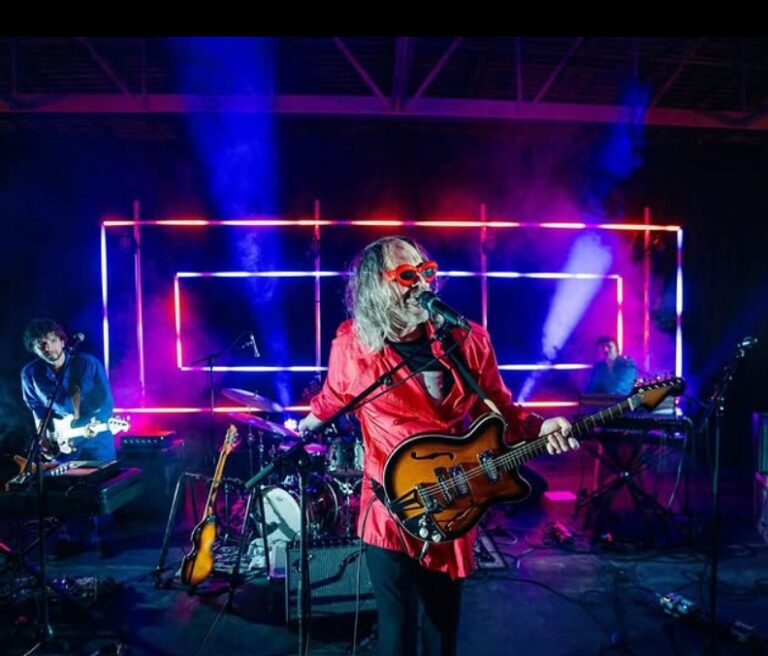
On a July evening in Montreal, Sarab arrived just a few weeks after Sanam. What these two bands have in common is a contemporary Arab sound and a rock attitude.

In the case of Sanam, from Beirut, we were into post-rock, drone, noize, ambient and Arab classical music. Sarab, invited to the Ministère on Tuesday as part of the Nuits d’Afrique festival, was an expressive blend of metal, krautrock, jazz-rock and Syrian-Lebanese classical and contemporary vocals.

Climène Zarkan’s vocal expression is strong, eloquent, hypnotic, engaged body and soul in the context of the profound disruptions that the wider Levant region has been undergoing for far too long.

We find ourselves at the heart of the dialogue between the singer, the daughter of immigrants from the Levant but very Parisian at the same time, and her guitarist colleague Baptiste Ferrandis, a highly gifted instrumentalist and musical director respectful of the East-West balance to be achieved in such a fusion exercise.

Sarab’s melodies are a blend of tarab (ecstatic chanting), Sufi incantations and the typical affects of great modern Arab pop (Abdel Wahab, Fairouz, Oum Kalthoum, etc.), not to mention the rock spirit that sets them apart and gives them their distinctive edge.

It’s both rough and complex, expressing the state of today’s Parisian souls who absorb the situation and turn it into art. And it’s done by seasoned artists, well-versed in advanced forms of amplified instrumental music. Clearly, the artists in this quintet are educated and advanced in their respective playing – excellent drummers, by the way.

Their intellectual curiosity has led them to bring together contemporary Arab song and poetry with music that is sometimes Middle Eastern, but above all Western in its expertise and execution.

In short, we’re not talking about quick-fix pop, but this kind of mix is slowly and surely taking hold, provided its practitioners persevere on this path of openness that excludes the easy way out.

We hope they do.

Photo : M. Belmellat

Publicité panam
Afro-Colombian / Afro-Electro / Digital Cumbia / Electronic / latino

Nuits d’Afrique | KillaBeatMaker, Colombian Consciousness and Dynamism

by Alain Brunet

As I left the Ministère on Wednesday, it was clear to me that KillaBeatMaker was making its contribution to Latin music in the digital age. In any case, the Nuits d’Afrique edifice has been enriched. On Wednesday evening, the Medellin resident more than lived up to the expectations of the festival-goers who turned out to meet him. Two heartfelt sets at the Ministère were delivered to the delight of some of his earliest Montreal fans.

The master of the game is at the center of a trio focused on electronic rhythms and patterns, rhythms emanating from acoustic percussion, vocals and a synthetic pan flute.

To her right, Guadalupe Giraldo on percussion, synthetic gaita with a sound reminiscent of panpipes, and vocals (a beautiful voice!). To her left, Julian Ramirez on percussion and backing vocals. KillaBeatMaker triggers machine sounds, and can add human beatbox, rap and vocals. An authentic frontman, he knows how to sing, rap, beatbox and motivate a dance floor.

The dynamism of this performance is contagious, its dramatic framework meticulously designed to heat up the crowd and bring it to the desired paroxysms.

The references highlighted are the result of a fine artistic direction, with a feel for local cultures, cumbia, champeta, Andean music, music from the Colombian Pacific and Caribbean coasts, and also current world music – afro-house, afrobeats, reggaeton and more.

And KillaBeatMaker proves to be more than just a party animal, adopting a critical and progressive stance through the themes of his tracks – the precariousness of Colombian biodiversity, economic injustice, unjust concentration of wealth, imperialism.

Just because it’s fun doesn’t mean it’s funny…

Publicité panam

Brazilian / Reggae

Nuits d’Afrique | Flavia Coelho, A Woman of Many Instruments

by Sandra Gasana

We already knew about her guitar talents, but what we didn’t know until last night was that Flavia Coelho also plays drums, keyboard and trombone. Yes, that’s right, as well as being an excellent dancer and storyteller.

It only took a few seconds for the Olympia to come to its feet when the Brazilian diva appeared on stage, dressed in a tight outfit, native-inspired boots and two ponytails, determined to set the hall alight. Indeed, seating made no sense when you know the boundless energy of Flavia Coelho, whom I like to call “the most French of Brazilians”.

Even her entrance to the stage was dramatic: lighting effects, a distant voice announcing her arrival, and off she went. 90 minutes during which the artist danced, sang and played several instruments, moving from one to another quite naturally. “I set myself the goal of learning a new instrument, and that’s what I’ve done,” she confides, before introducing a piece on which she plays the trombone.

Accompanied by her loyal producer and keyboardist, Victor Vagh, Al Chonville, her Martinique-born drummer who has been with her for several years, and a newcomer, Brazilian Caetano Malta, on guitar, she was well surrounded to deliver a show that festival-goers won’t soon forget.

She opens with “Sunshine”, from her 2009 album Bossa Muffin, on which she inserts her trademark ultra-fast rap. She interacts with her audience several times during the show, in both Portuguese and French, either telling them funny anecdotes or having them sing along to her choruses.

“I’ve just released my 5th album, Ginga, she proudly tells us before “Mama Santa”, the hit that pays tribute to all the women who have contributed to the artist’s upbringing, from childhood to adulthood. Probably one of the highlights of the evening.

She also shared some songs from the DNA album, released in 2019 like “Billy Django”, but also Mundo Meu, released in 2014 with “Por Cima”.

At times it felt like a Haitian evening, while at others it was like being transported to Kinshasa, much to the delight of the audience, who danced non-stop. She adapted her concert very well to the Nuits d’Afrique context, bringing back that Afro touch.

Of course, reggae remained present throughout the show, a genre she is particularly fond of. In fact, she gave way to her drummer for a few minutes of intense dub with reverb, while she replaced him on drums.

As is often the case at her concerts, Flavia invites an artist on stage, and it was none other than Griotte Djely Tapa who delighted us for a few minutes.

As an encore, we had my favorite song by artist “Temontou”, alluding to her admiration for author Dany Laferrière and his relationship with exile, before closing with the hit she created with producer and DJ Poirier, “Café com Leite”.

Niger’s Boubé opened the show in a trio format, also featuring in the program of the 39th edition of the Festival international Nuits d’Afrique with his desert blues. Naturally, Flavia mentioned Boubé during her concert, encouraging the next generation as only she knows how.

Photo Credit: Peter Graham

Publicité panam
Cumbia / latino

Nuits d’Afrique | La Chiva Gantiva Launches the Festival with a Bang

by Michel Labrecque

Fans of modernized Latin American cumbia are in for a real treat at the beginning of July: after performances by Frente Cumbiero and Empanadas Illegales at FIJM, the 39th edition of the Festival international Nuits d’Afrique kicked off with La Chiva Gantiva, a group of Colombians based in Brussels, who quickly set the Balattou alight. Like a match on very dry wood. The fire crackled. Instantly!

La Chiva Gantiva is made up of five versatile musicians who alternate between percussion, keyboards and other sequencers, guitars and basses, and flutes both normal and synthetic. Rafael Espinel takes the lead on vocals and all kinds of other instruments, especially the conga.

La Chiva Gantiva has nothing to envy of Colombia’s great electronic cumbia groups. The group has found an original blend of sounds, sometimes ethereal, sometimes percussive, with playful, intense improvisations. Many of the pieces were taken from their latest creation, Ego, released this year. As Rafael Espinel explained to us in an interview, this album, while playful and danceable, also contains reflective texts, notably on the inordinate place occupied by egocentricity in our societies. And on hunger and the future of indigenous peoples.

There was a surprise guest to accompany the band for a few songs. Noé Lira, the Mexico native, part-Quebecer, part-Mexican, fit in perfectly with the Belgo-Colombians’ groove. And the audience? A cross-cultural, cross-generational mix who got right into it. Most of them danced for most of the concert.

Photo Credit: M. Belmellat

Publicité panam
Baroque / Opera

Festival de Lanaudière | The Coronation of Poppea, the triumph of Octavia and the mastery of Alarcon

by Frédéric Cardin

On the strength of a masterful Orfeo in 2023, the Cappella Mediterranea conducted by Leonardo Garcia Alarcon made an eagerly awaited return to Lanaudière with Monteverdi’s “other” opera, The Coronation of Poppea. A different work, conceived at the very end of the composer’s life (whereas Orfeo was written some thirty years earlier) and subject to commercial dictates unheard of for opera at the time. On this subject, READ the interview I conducted with Mr. Alarcon in preparation for this concert.

Alarcon was surrounded by his faithful colleagues on instruments and vocals, many of whom were there in 2023. The same calibre, then, with the addition of Lanaudière’s Pascale Giguère, called in at the last minute to replace a sick violinist. Hats off to Ms. Giguère, and we’re justifiably proud of her, for the musician’s playing was fully up to the standard of the ensemble.

In a more sparing gauge than for Orfeo (see again the interview mentioned above), the Cappella demonstrated its perfect match with the score, as much in the suggestion of emotions as in the precision of the melodic and accompanying lines. And, once again, the splendour of the singers was on display. Countertenor Niccolo Balducci in the role of Nero was imperial, but without grandiloquence. Sophie Juncker, who was said to be indisposed by a virus, held her part very well, even if there were occasional lapses in the strength of her projection. Nothing to make us sulk, that said. The secondary roles were all of a very high standard: the solemn Edward Grint (Seneca), the amorous and even naive Lucia Martin Carton (Drusilla), the slightly pitiful and even loser Christopher Lowrey (Othon, splendidly ridiculous in his Hawaiian t-shirt) and the truculent Samuel Boden in a panoply of small roles (a nurse, Arnalta, Damigella, etc.), which he performed with humour and casualness, despite the use of a tablet on which he consulted his score. One can only imagine the increased impact his performance would have if he knew how to do without it!

But beyond all that, I was particularly charmed by soprano, Mariana Flores in the role of Octavia, a noble and somewhat haughty empress, humiliated by the rejection of her emperor husband and driven to plot like a villain to save her marriage and, above all, her title and reputation.

In an exquisite tight-fitting dress, she was as desirable as a queen should be in legend. But her Olympian presence gave her the appropriate emotional distance, betraying a character that Nero described as ‘frigid.’ An accusation often tinged with misogyny, but which here refers to the typical attitude of a matron from a prestigious and aristocratic lineage, whose scorned dignity can only be expressed by a certain contempt for the world. Yesterday, Mariana Flores had the most accomplished voice, the most qualitatively holistic, powerfully expressive in her anger, poignant despite her reserve in her ideal high-pitched murmurs. A voice without tonal flaw or timbral approximation. For your humble servant, the queen of the evening, despite her final downfall in the libretto.

On the whole, too, the acting is impressive, embodied and clearly the result of long and expert work. You believe it from start to finish. Leonardo Garcia Alarcon demonstrated the full depth of his mastery of Monteverdian language and style. Another triumph for the musical director. We wonder what miracle he will bring us next time, but we can only look forward to it.

That said, audiences will have to be worthy of receiving this artistic quality, by coming in greater numbers. Otherwise, at some point, people will tire of offering exceptional programmes to sparse audiences. 

Contemporary Jazz / Experimental / Contemporary / Jazz

FIJM | Sun Ra Arkestra Still in the Physical World But…

by Vitta Morales

It has now been thirty-two years since Sun Ra left this physical world to presumably return to Saturn. Since then, his Arkestra has been holding down the fort and carrying the torch for his brand of afrofuturist big band jazz; and although the Arkestra has become somewhat of a Ship of Theseus with the passage of time, the essence of Ra’s music is, in my estimation, still living on and reaching appreciative audiences through the band’s efforts.

During their sixty minute set, we heard bombastic fanfare, mean swing feel, some “free” moments, and lots of fun overall. Cartwheels from a sixty-eight year old Knoel Scott, swing dancing, marching around the stage as though playing in a parade were all seen; as were moments of controlled chaos juxtaposed by much more “straight ahead” sections. Indeed, the skill of all the horns, rhythm section, vocalists, percussionists, and dancers were on full display. The highlight for me was the band’s performance of “Enlightenment” which they played as a shuffle. It is probably one of my favourite melodies in the Sun Ra repertoire.

I can remember a while back a drummer once said to me, “For the last thirty years the Rolling Stones have been a Rolling Stones cover band.” This, of course, is the danger in continuing a good thing for too long. I would not say the Sun Ra Arkestra has fallen into this trap, however. The music itself is still being performed at too high a level for that. Although it’s true that the Arkestra can never be the same as it was, (the loss of Sun Ra himself, John Gilmore, and the retirement of Marshall Allen being simply too huge), the institution that is the Arkestra continues to engage skilled musicians that care about the rep. Likely that will be enough to sustain this good thing for a good while longer.

Photo Emmanuel Novak Bélanger

Publicité panam
Contemporary Jazz / Jazz Pop

FIJM | Esperanza Spalding Between Two Chairs on the Place des Festivals

by Alain Brunet

Esperanza Spalding has been a jazz star since 2006, when she released original compositions such as “I Know You Know,” which she performed on Saturday.

Slim, petite, yet so solid, the 40-year-old musician possesses all the attributes of a star without forcing herself. A virtuoso double bassist and bassist, a singer with a powerful voice and a very pretty face, she can easily move into the borderlands of pop, using song forms and enriching them with more complex compositions and improvisations.

These forms don’t exclude more sophisticated, sometimes even daring, conceptual detours. No, the beautiful Esperanza has little to do with the avant-garde, but neither does it frequent the pre-digested forms of jazz-flavoured pop.

On Saturday evening, it didn’t feel at all like a mass show, and yet… that’s exactly what the Place des Festivals was dedicated to on Saturday, for the most important of its closing free concerts. But for such a concert to work at full capacity and leave its mark on the imagination, it needs more than what we got.

Of course, Esperanza Spalding could count on the excellent Toronto guitarist and composer Matthew Stevens, a close collaborator on stage for several years—after having been a crucial musician with trumpeter Christian Scott aTunde Adjuah. This Fender Telecaster enthusiast should be the subject of a solo career, given the depth of his own musical universe. Finally, the compliments to his playing are absolutely welcome at Esperanza.

The frontwoman came in a small formation (bass, drums, guitar + electro), inviting two dancers who could transform themselves into backing singers when the occasion called for it. Not sure that the choreographic effect was decisive either. By the way, are two dancers and good lighting enough for a successful closing?

Presenting jazz in mainstream events at the FIJM is an idea to be defended tooth and nail, but more thought needs to be given to audiovisual immersion to bring such an adventure to a successful conclusion.

Bravo to the audience for listening, bravo to FIJM for taking the risk. The Place des Festivals was not deserted on this last evening, but we couldn’t conclude that it was a memorable, transcendent event of the calibre of The Roots or Hiatus Kaiyote. That said… we may have been between two chairs, but we were a long, long way from mediocrity.

Publicité panam

Publicité panam

période romantique

Festival de Lanaudière | Bruckner and Payare: Cathedral builders

by Frédéric Cardin

One man meticulously drew up all the plans for a majestic edifice, while the other was responsible for raising it from the ground, on solid foundations, decking it out in the finest finery and lifting it to the heavens. The undertaking succeeded admirably, and the result unveiled last night at the Amphithéâtre de Lanaudière was something of an Olympian.

I’m talking about Anton Bruckner’s Symphony No. 8 in C minor, which the explanatory clichés always compare to a great, magnificent cathedral. For once, let’s give clichés their share of symbolic truth. The Austrian composer’s penultimate symphony is indeed grandiose and monumental, and written in a spirit of vibrant devotion (Bruckner was very religious). This work, which lasts almost an hour and a half and requires a huge orchestra, has everything it takes to stimulate an architectural allegory as impressive as that of a cathedral. Notre-Dame? Reims? Strasbourg? Cologne? You get the idea.

Payare has skilfully constructed this Herculean edifice yesterday, with details and contrasting dynamics that reinforce the spiritual drama at work. Drama, yes. For even if we compare the Eighth to a cathedral, even if we say, quite rightly, that it is like an immense prayer by the composer, inviting us all to share his devotion with it, the power of the emotions concealed in this score tells a personal story of the search for transcendence.

Everything was perfect. Payare controlled the dynamic impulses, without really holding them back, just communicating, clearly, Bruckner’s will. Like a spiritual ferryman. Moments of extreme gentleness were so faintly audible that the nearby birds sounded louder. The composer would have been ecstatic! On the contrary, the moments of magnificence filled the natural basin of the site like the divine taking up all the space.

And what an orchestra! Payare and we are lucky. Ideal intonation of the solos, section ensembles and tutti, phrasing of the adagio without haste but with a palpable inherent energy.

This Adagio, moreover, and especially this quivering ascent of the strings accompanied by the three (!) harps, a celebrated moment (which recurs several times) that transports music-lovers very close to the gates of Paradise, had something purely celestial about it, and was perfectly successful. As for the finale of the Finale, a majestic construction, the final finishing touch to a sublime building that would house any supreme divinity of any cult (God, Allah, Brahma, Odin, Ra, Zeus, etc., etc.), this finale that grabs you by the guts and lifts you up in spite of yourself, was grandiose to a fault, but without any vulgarity. All real, all felt, with respect and elegance.

Oh, I could quibble about details. The trumpets in the Scherzo could have been much more incisive. I like them that way, you see. To mark the plebeian side of the movement, in contrast to the piety of the previous one. And the last bars of the first movement, which call for contemplation, could have been a little more “contemplative”.

Nevertheless, this level of musical quality is to the credit of our Montreal orchestra, which is undoubtedly one of the best in the world. Bravo to the soloists, impeccable, and in particular Catherine Turner on the French horn. What exceptional work, what accuracy of tone, sonority and colour. The lady was remarkable, mastering an instrument that is so capricious and so often tempted to betray its owner.

The only real downside was the audience: it was only partially full. A shame, given the quality of the performance on offer.

Choral Music / Classical / Modern Classical / période romantique

Festival de Lanaudière | Magistral Opening

by Alexandre Villemaire

The 47th edition of the Festival de Lanaudière opened with a bang, as sonorous as the first note of the masterpiece of this July 4 concert inaugurating a month of music in the Lanaudière region. Led by Rafael Payare, the Orchestre symphonique de Montréal and the OSM Chorus delivered a masterful performance of Carl Orff’s landmark secular cantata Carmina Burana. This was the first time in thirteen seasons that the work had been performed at the festival. An excellent opportunity for listeners and music lovers to discover or rediscover the work.

The first part featured two works with contrasting pictorial characters. The opening work was “Icarus” by composer Lena Auerbach. Eminently descriptive, the work of course refers to the figure from Greek mythology who, wanting to get too close to the sun, burnt his wings and ended up drowning. It’s an example of human nature’s desire to push back its limits through boasting and greed. The work oscillates between different moods, sometimes tense, sometimes lyrical. The first section establishes a dialogue between strings and woodwinds in this affect. A second section takes on more dramatic accents with the intervention of the brass, followed by a passage of great lyricism in the strings that flows into a harmonic anxiety that culminates in an evocation almost of a funeral march with the intervention of tubular bells. A third, calmer section is introduced by the harp in dialogue with the pizzicati of the violins, before a counter-melody interpreted by first violinist Andrew Wan progresses in an evanescent suraiguity that eventually melts into the ethereal sound of musical glasses. All in all, a well-cut composition with fine orchestration and imaginative orchestral effects.

After this ethereal piece, Rachmaninov’s “Rhapsody on a Theme” by Paganini moves into a wild register. Taking up the already virtuoso work of Italian violinist and composer Niccolo Paganini, Rachmaninov’s equally complex treatment was led by German pianist Kirill Gerstein. He demonstrated great pianistic agility in expressing the various passages, supported by a precise Rafael Payare. The only discomfort we felt was that the orchestra, even in its instrumental support role, was a little too sonically recessed.

Masterpiece. From the first stroke of the timpani and the first note of the chorus singing “O Fortuna”, we are taken on a solid musical journey. The words are clear, the pronunciation and articulation precise, and the various dynamics Payare brings to bear are roundly executed. The OSM conductor opted for a sequence of each of the twenty-five movements in attaca for his interpretation, keeping the attention and the audience and giving the work a clear narrative direction to its medieval poems tackling themes such as the constant nature of fortune and wealth, joy and the pleasures of alcohol and the flesh. Among the finest moments is the ninth movement, “Reie”, which features a superb, intimate passage between the voices. The entire In Taberna sequence, literally “at the tavern”, was aptly staged by countertenor Lawrence Zazzo and baritone Russell Braun. The unique tenor aria “Olim lacus colueram” (Once I dwelt on a lake), literally a swan’s lament describing the various stages leading to its being eaten, was both comic and disturbing, but unambiguously clear. Equally unambiguous was the duet between soprano Sarah Dufresne and Russell Braun “Tempus est iocundum”, (Time is joyous) where the inflections of the vocal line and the acceleration leave no doubt as to the nature of the text, which describes a scene of committed love. Both Dufresne and Braun delivered a heartfelt, vocally arresting interpretation of their respective arias.

With a masterful start to its fourth season, we can only wish the Festival de Lanaudière good luck for the rest of its programming.

Publicité panam
Modern Jazz

FIJM | For The Centenary of Oscar Peterson, Montreal’s Most Famous Jazzman

by Alain Brunet

Oscar Peterson (1925-2007) would have been 100 years old on August 15, and his daughter Celine has taken to the stage more than once at the Maison Symphonique to highlight the tribute program. On July 4, 2025, OP was still the most renowned Montreal musician in jazz history. Successor to the first supravirtuoso of modern jazz piano, the great Art Tatum, Oscar Peterson was in turn the supravirtuoso of his generation, the biggest jazz piano star of the ’50s and early ’60s.

For this centenary, various musical events commemorate this celebrated native of Little Burgundy. The most important is undoubtedly the one at the Maison Symphonique, where drummer Jim Doxas was in charge of the first part of the program, but let’s not forget that he honored OP’s music earlier this week at the FIJM, alongside his brother, saxophonist Chester (Chet), pianist Taurey Butler, trumpeter Lex French and other MTL colleagues.

On stage at the Maison symphonique, Jim Doxas was surrounded by the excellent Roma pianist Robi Botos, guitarist Jocelyn Gould and bassist Mike Downes. They played “Backyard Blues” and “When Summer Comes,” with Robi Botos’ piano playing a direct descendant. High-flying and voluptuous! Guests joined the basic quartet: Chet Doxas and Lex French took part in a medley of iconic OP pieces, including the magnificent ballad “The Night We Call It A Day,” a must-hear on an OP album entitled The Trio, on the Verve label.

And that’s not counting singer Paul Marinaro, a close friend of the Peterson clan, who came to perform “Taking A Chance on Love” and “Goodbye Old Friend” – whose lyrics were written after the sudden death in 2005 of the great double bassist Niels-Henning Ørsted Pedersen, long-time sideman of the century-old pianist.

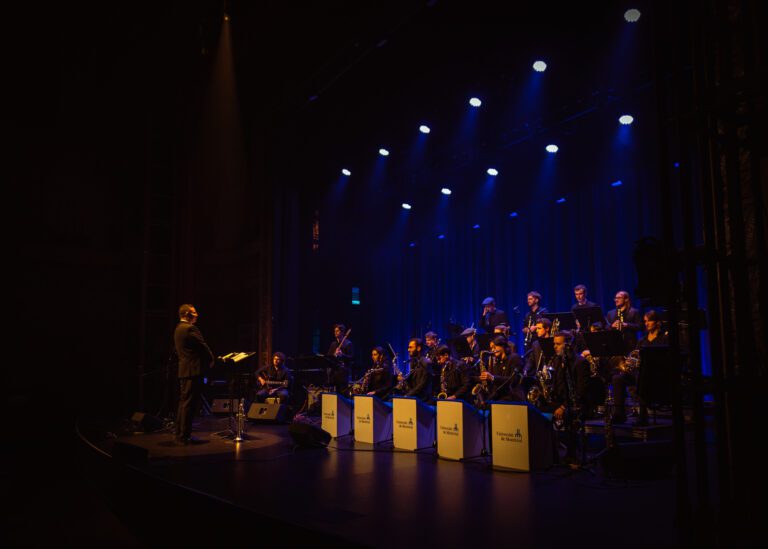
The second part of the program consisted of a performance of the eight parts of Oscar Peterson’s Canadiana Suite with the same ensemble, this time expanded to include 14 wind instruments, making for a very fine big band, under the direction of John Clayton. A wise, somewhat monochrome performance, nevertheless respectful of the late Oscar’s most ambitious work.

A surprise at the very end: our beloved Oliver Jones came to present the Oscar Peterson Award to its new recipient, none other than the evening’s musical director: Chet Doxas, who was Oliver’s sideman for a very long time. And the nonagenarian is still able to play!

Well, it’s no longer the time for grand sparages, but the big hands of the Montreal pianist, a worthy successor to OP for music lovers here, are still working and spreading beautiful keyboard chords throughout the cosmos. This would never have happened if Oscar Peterson and his sister Daisy, who was his piano teacher, had never existed.

Photo : Emmanuel Novak Bélanger

Publicité panam

FIJM | Marcus Strickland and The Black Fusion Following

by Alain Brunet

On Friday night at Studio TD, the impetuous tenorman Marcus Strickland (Bilal, Roy Haynes, Robert Gasper, Dave Douglas, etc.) brought us back to a very Brooklyn vibe with an all-black band: beefy drummer perfect in heavy funk and contemporary jazz, bassist perfect in this aesthetic and multi-keyboardist just as typical of this contemporary jazz fused with the groove jazz of the 70s and 80s.

Back in those increasingly distant days, we couldn’t have imagined a cover as groovy and electric as “Pinnochio,” composed by Wayne Shorter for the Miles Davis quintet—on the legendary Nefertiti album. We were delighted to hear it. Super version!

The forty-something saxophonist’s quartet is heavy, seasoned, sandpaper-like and rough despite the finesse and high virtuosity of these performances typical of black American and New York jazz. Because it’s not all about polyrhythmic grooves or heavy funk-jazz, there’s also plenty of room for swing, binary/ternary alternations, Great American Songbook ballads and soul/R&B. What’s more, Marcus Strickland is inspired by bird song, the planet Jupiter (thank you, Sun Ra), and the pentatonic chants of West African griots. But first and foremost, the saxophonist relies on the spirits of jazz.

Marcus Strickland’s brand of jazz may have run out of steam for a while, and we’ve lost interest … but we’re coming back to it, as we’re seeing more and more signs of a comeback. Ever since hip-hop sampled its predecessors, new practitioners have been emerging and driving the form forward from the very beginnings of their careers.

And who, it seems, are becoming cool again, winning over a young public fascinated by such musicianship, such compositions, such improvisations, such culture, such groove. A good deal!

Publicité panam
expérimental / contemporain / Jazz

FIJM | Fievel is Glauque For Dessert… Dessert loaded!

by Alain Brunet

Misc for starters and Fievel is Glauque for dessert on Thursday July 3, at Studio TD in Brussels.

Brussels singer Ma Clément likes the Cocteau Twins, Whitney Houston and Björk. Keyboardist Zach Phillips cites Maher Shalal Hash Baz, Royal Trux, Annette Peacock, MF Doom, Mal Waldron and Carla Bley. And all these names in no way sum up the audible, rich and exciting result.

Fievel is Glauque has a vast palette and a vast program. With its penchant for polyrhythms, modern harmonies, chamber music, pop and chanson, this is a chamber orchestra with hybrid instrumentation.

These are not “songs” in the proper sense of the word, as the lyrics (in French and English) are set in long pieces that in no way subscribe to the criteria of pop culture. It’s hard to play, and you have to be a fan of complex forms to really appreciate it.

Ma Clément’s relatively slim voice (but always accurate and impeccable phrasing) is reminiscent of Lætitia Sadier (Stereolab), but with more technical demands and even more charged compositions. Saxophonist and flautist André Sacalxot is the main soloist in this full orchestra, which will be the subject of a cult following if it isn’t already. Truly a discovery.

Photo: Emmanuel Novak Bélanger

Subscribe to our newsletter

Inscription
Infolettre

"*" indicates required fields

Type of Suscribers