CMIM 2026 | Japan Triumphs with Russian and Hungarian Music!
by Julie Thériault
At the competition finals this Thursday, June 4, at the Maison symphonique, it should come as no surprise that the results were a surprise! One thing is certain: our three finalists are all winners, and they treated us to a wonderful evening of music. The Grand Prize went to Koshiro Takeuchi of Japan, followed by his compatriot Sara Watanabe and Laurel Gagnon of the United States.
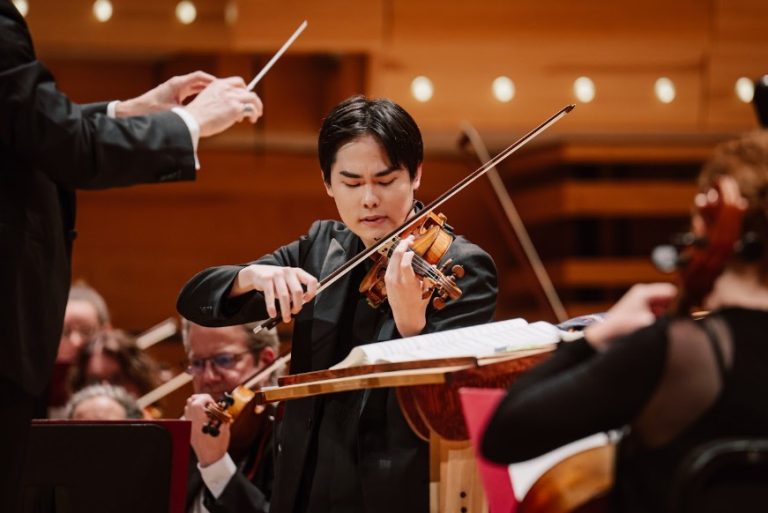
The grand finale began with Tchaikovsky’s concerto performed by the Japanese pianist Koshiro Takeuchi, who didn’t seem to be the same musician as the day before in the Mozart…
A virtuoso and spirited performance, to be sure, but as with the Mozart, the rhythmic anchor points—so crucial in these densely notated passages—weren’t always clear, which made the cohesion with the orchestra a bit less intelligible. Romantic music incorporates tempo fluctuations to express emotional content, but this rhythmic approach might have benefited from a little more breathing room—or “oxygen,” as Diane Dufresne would say. The slow movement deserved a stronger presence in its very timid opening alongside this large orchestra…The audience still thoroughly enjoyed the performance!
Crédit: Tam Photography
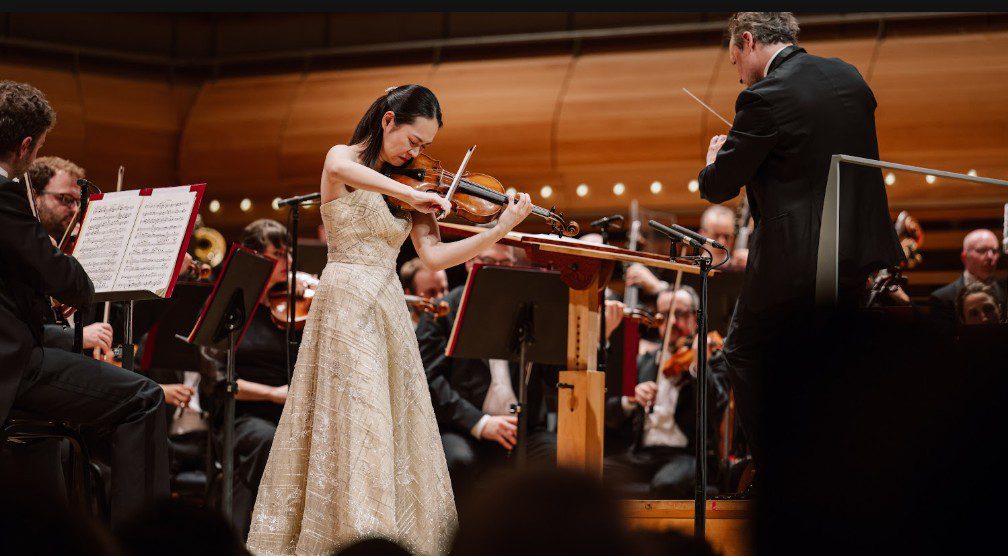
Sara Watanabe then treated us to a solid performance of Bartók’s Second Concerto, perhaps less crowd-pleasing than Tchaikovsky in this context… As in Bach’s Chaconne in the first half, she demonstrated a keen sense of structure and direction, to the benefit of the narrative arc. She masterfully embodies the demonic rhythmic episodes, as well as the mysterious and abstract atmospheres of the second movement. She perfectly occupies the space she needs to in relation to the orchestra, as if she herself were at the controls of the mix!
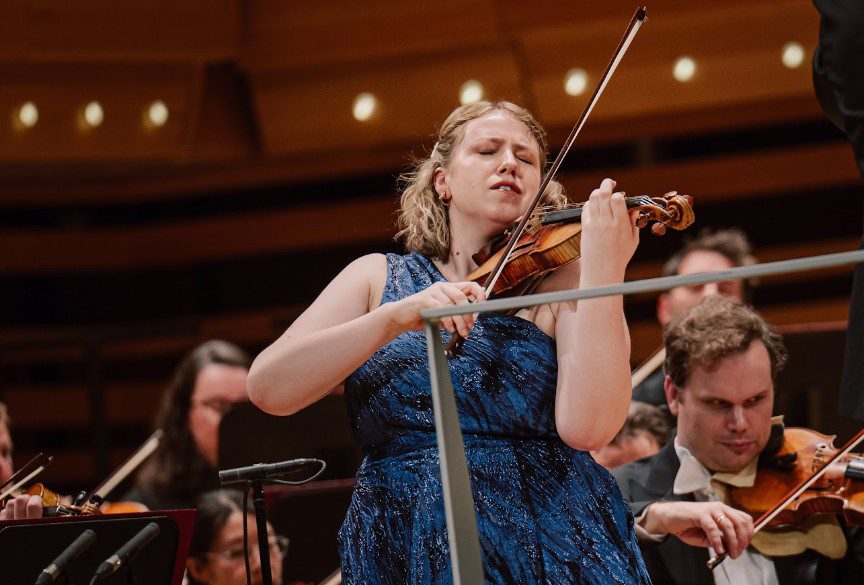
Unfortunately, the American Laurel Gagnon (some of whose ancestors are from Sherbrooke!) seemed to be affected by fatigue or nerves… and was unable to deliver the performance we had hoped for. Nevertheless, she moved us with her expressiveness, particularly in the highest registers!! If the Mozart competition is meant to demonstrate stylistic versatility, she should win the grand prize… Her Mozart from the previous evening, refined and playful, stood in stark contrast to her hyper-romantic and expressive Brahms. She offered a gift with every note!
Competitions stir up a lot of emotions in everyone who witnesses them—the contestants, the judges, and the audience. That may be the one thing everyone agrees on.
It will be interesting to follow the careers of these incredibly talented young people (and not just the three finalists) as they venture into the jungle!
With Yatou, Noubi Brings Together Voices From Around the World
by Sandra Gasana
Le Lion d’Or was packed to the brim on a Tuesday evening for the launch of Noubi’s Afro-folk album, Yatou, which means generosity, openness, and above all, hospitality in Wolof, one of the languages spoken in Senegal. With the Chœur d’Afrique et d’Ailleurs opening the show, we were in the perfect setting to enjoy the launch.
The Chœur d’Afrique et d’Ailleurs is a multilingual, multigenerational, and multicultural choir that supported Noubi throughout the two-year production of the album. Co-founded by Noubi and Charline Marion, an energetic and talented choir director, this group has taken us on a musical journey, singing in Wolof, Arabic, and other languages. Noubi on the cajón, Gabriel Evangelista on the piano, all brought together by Catherine Béliveau’s excellent direction and some choreography to round out the experience.
Let’s the launch begin
From backstage, you can hear the cajón. Then Caroline Planté appears on stage with her guitar, followed by Charline Marion at the piano, and finally Hector Alvarado with his bass and Dominique Soulard with his two guitars. All talented musicians hailing from France, Venezuela, Senegal, and Quebec (and a bit of Spain, since Caroline lived there for a few years). Each song is presented in a unique way. No two are alike. The Yatou Choir, much smaller than the first, accompanied them on some songs, while for others, only the musicians were on stage.
The environment, artificial intelligence, and the decolonization of the mind are among the themes explored by Noubi, who enjoys weaving short stories into his songs. A storyteller by trade, he works extensively with young children, particularly in the field of music composition.
In addition to the cajón, Noubi also plays guitar on a few tracks before returning to the cajón, his instrument of choice. Meanwhile, Charline leaves the piano to join the choir, before all the performers return to the stage for the grand finale. It was a real party, featuring a djembe segment performed by slam poet and percussionist JSM l’Officiel—who is also a member of the choir—much to the delight of the audience, who began dancing all over the place.
It was hard to leave after getting such a boost of energy in the middle of the week, but one thing is certain: everyone was smiling as they left.
Quatuor Molinari | The Shostakovich Complete Works: From Challenge to Pure Joy
by Michel Rondeau
During the last weekend of May—specifically on Thursday, Friday, and Sunday, the 28th, 29th, and 31st—the Molinari Quartet took over the concert hall at the Montreal Conservatory of Music to perform the complete cycle of fifteen string quartets by Russian composer Dmitri Shostakovich. Quite a challenge.
But how does one do justice to an event of such magnitude? Especially since this is not only one of the most significant chamber music works of the 20th century (and indeed of the entire history of music)—one of the richest and most expansive—but also one of the most demanding in terms of performance.
Imagine more than 6½ hours of highly challenging music presented in bursts over three nearly consecutive evenings—but above all, the perfect opportunity to hear these works performed in concert in chronological order (from 1936 to 1974) and in close succession, allowing the audience to clearly trace the composer’s evolution. When you consider that he originally planned to write 24 of them—one for each key, in both major and minor!
But the best part was undoubtedly having Olga Ranzenhofer, the ensemble’s director, as our guide on this journey. Olga has always had a genuine passion for these quartets and knows them inside and out—both their strengths and their pitfalls. The Molinari has frequently included them in its programs over the years and, about a decade ago, presented the first complete cycle, although the result apparently did not quite live up to Olga’s expectations. So this time, under her leadership, the Molinari succeeds in making the score shine with a thousand lights.
Speaking of incandescence and brilliance, this Shostakovich cycle also served as a sort of baptism by fire for the new violist, Cynthia Blanchon. Since joining the ensemble last summer, she had certainly had the opportunity to showcase her immense talent by participating in various programs, but this Shostakovich cycle represents, in a way, her true initiation. Since she rose to the challenge with flying colors, just like her colleagues Antoine Bareil on violin and Pierre-Alain Bouvrette on cello, she can already be considered a full-fledged member of Le Molinari.
The early quartets, numbered 1 through 6 and all in major keys, share a distinctly symphonic style. Although they are fairly classical in style, they are by no means conventional, as the composer constantly draws on a wealth of inventiveness that requires his performers to remain alert and to demonstrate as much flexibility and agility as they do energy.
One of them—the fourth, written in 1949—remained in the composer’s drawers and was not premiered until after Stalin’s death in 1953. Shostakovich feared that it would be banned, or at the very least censored, because he had incorporated Jewish and Eastern European folk music into it, whereas the party’s very strict line condemned anything that did not exalt the distinctly Russian character of the Soviet Union.
Since Shostakovich composed a great deal of large-scale music—operas, symphonies, festive music, and film scores—chamber music served as a kind of refuge for him, where he could give free rein to a more personal, more intimate style of composition. The 7th is thus dedicated to his first wife, Nina, who had died a few years earlier. It alternates between a mournful atmosphere, rage, and anger before giving way to a gentle dance.
For Shostakovich, the quartets of his middle period—specifically Nos. 7 through 10—also provided an opportunity to break free from formal constraints and express himself in an increasingly personal way. His anxieties and bitterness are evident in these works with considerable intensity, yet this did not prevent him from continuing to innovate and create.
The period during which he composed Quartets Nos. 11 through 15 (most of them in minor keys) coincided with his years of physical decline. These included heart problems, paralysis of the hand, and inflammation of the spinal cord, among other ailments, compounded by bouts of depression. But none of this could stop him from writing and continuing his work, so the music takes on very dark and painful introspective turns, and at times even jarring ones, as in the 13th, which ends with a viola solo in the highest register in a sort of heart-wrenching sigh.
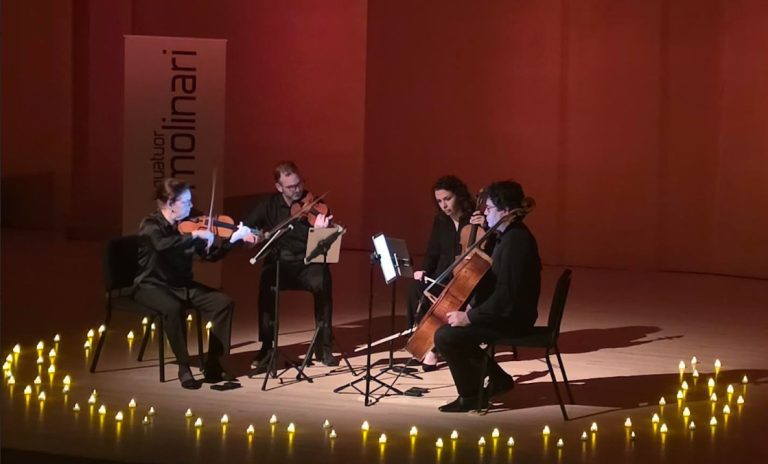
For the very last quartet, which is in a sense a long funeral oration, the musicians had swapped their white shirts and coats for black ones; they were surrounded by a circle of small lanterns, and the lights had been dimmed. Briefly unsettled by the flurry of sixteenth notes in the intermezzo, the six slow, desperate movements followed one another relentlessly. Here, Shostakovich engages in a sort of dialogue with death. It is heavy, powerful, and deeply poignant, yet at the same time imbued with a certain serenity in the face of the inevitable.
Once the final notes had faded away, we sat in silence for quite a while, still stunned by the heart-wrenching beauty of this existential distillation of humanity, before the applause snapped us back to our senses and brought us back to reality.
Thank you to Olga, Cynthia, Antoine, and Pierre-Alain for this wonderful journey. For all the music lovers who gathered on those three evenings, it was a time of pure joy.
A lively Vivaldi with the Orchestre classique de Montréal and the Petits chanteurs du Mont-Royal
by Frédéric Cardin
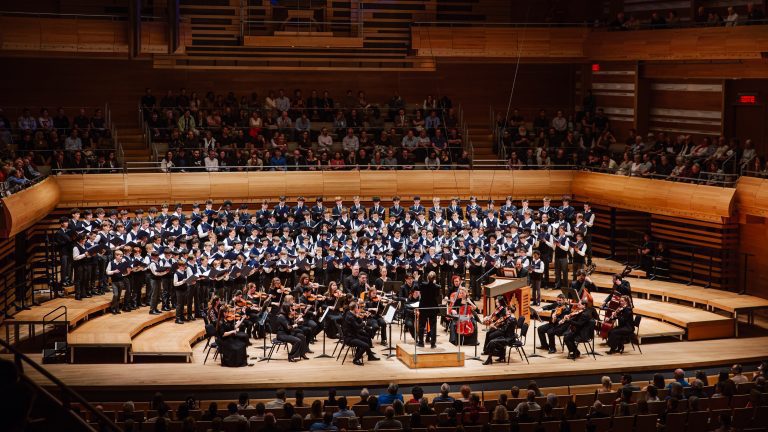
The Viva Vivaldi concert last Saturday, May 30, not only marked the end of the season for the Orchestre classique de Montréal (OCM) under the direction of Andrei Feher, but also the 70th anniversary of the Petits chanteurs du Mont-Royal. For the occasion, two great classics by Vivaldi were presented, a composer whose popularity is not in doubt: The Four Seasons, to highlight the qualities of the orchestra and especially its first violin, Mark Djokic. Then the Gloria RV 589, in a fully choral version, conducted rather briskly by the approximately 150 choristers present.
As an introduction to the concert, the Orchestra played a composition by Tom Lachance, as part of a partnership with the Schulich School of Music at McGill University, we are told. The work, which lasts about ten minutes, is called Concerto for Two Violins in G Major, and is a copy of the architecture of a baroque concerto of the type written by Vivaldi. Three movements marked fast-slow-fast, an exchange of dialogue between the soloists (Mark Djokic and Marianne di Tomaso) and the ensemble, and effects of marked contrasts. Here, the interplay is between tonal harmonies and modernist dissonances, in a back-and-forth that is not surprising, given that we have already heard this kind of process several times elsewhere. That said, Tom Lachance was able to exploit the principle skilfully enough, despite its predictability, to maintain interest.
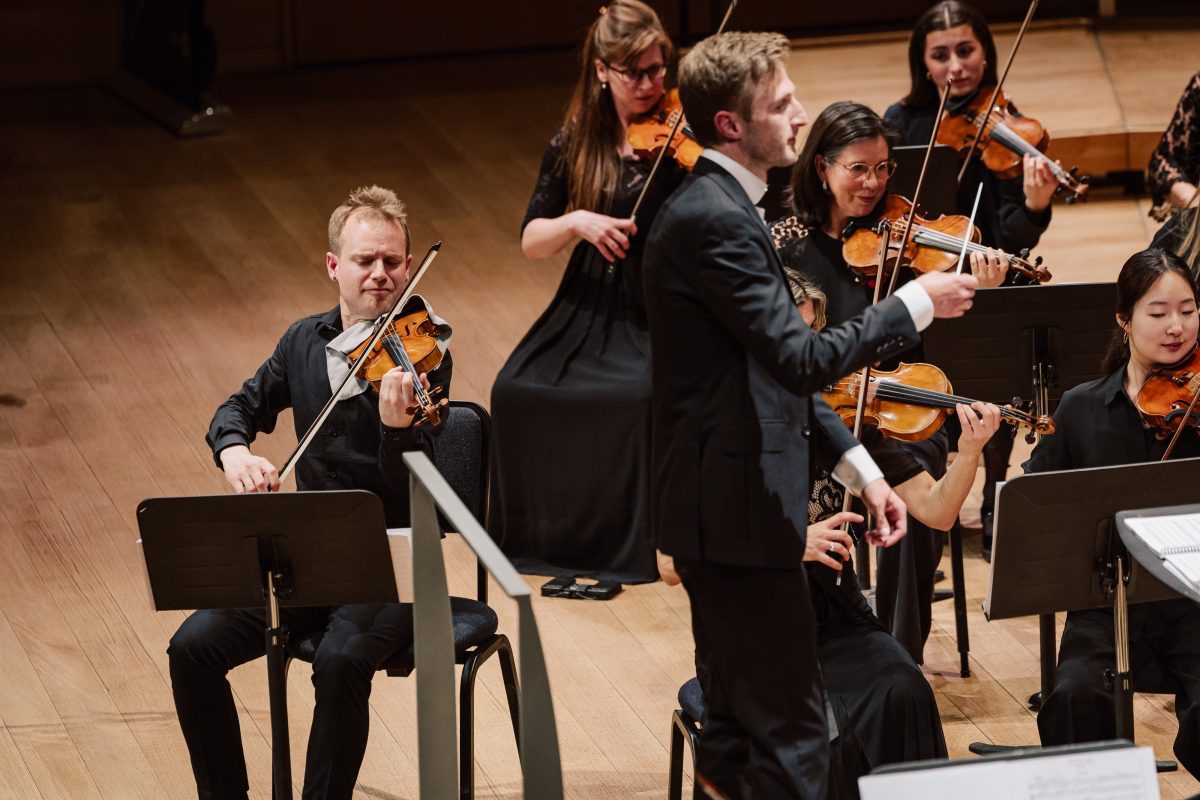
The Four Seasons followed, with Mark Djokic, first chair of the OCM, in very good form. The one who had injured his leg the day before moved slowly to his position, but once settled, he delivered a lively and articulate reading of the numerous virtuosic lines of the score. Without being devoid of a few hiccups, Mr. Djokic’s mastery is solid and confident. We will highlight the beautiful performance of the OCM under the baton of Andrei Feher, convincingly intense. He led his ensemble with incisive attacks and fairly short final note holds, informed by the aesthetics of historical performance, while allowing the modern instruments of the Orchestra to fully resonate. A roundness of sound, therefore, which beautifully married with the surgical practice of rhythms. The OCM offered a fusion of authenticist practice and a certain modern opulence that I found to work very well. Moreover, Mark Djokic also played this game by practicing the urgent style of historical baroque in the fast movements, but sometimes adding a more modern lyricism in certain melodic lines of the slow movements. A beautiful balance that satisfied the music lover’s pleasure of your devoted chronicler.
Concert Viva Vivaldi – 30 mai 2026 – Orchestre classique de Montréal – Mark Djokic, violon solo Andrei Feher, dir. – Photo : Tam Photography
The second part welcomed with great pomp the approximately 150 young choristers of the Petits chanteurs. The Maison symphonique was filled with a majority of the boys’ parents and friends, and it was noticeable. Maybe a little too much, especially because of the applause between each movement at the beginning of the Gloria! A bit annoying, even though at one point, conductor Andrew Grey (director of the Petits chanteurs), and not Andrei Feher, who had lent him his baton for the occasion, radically sped up the transitions between the movements, not giving the applause sprinters time to execute.
First, let’s remember that the Gloria RV 589 is interspersed with a few soprano solos, which had to be replaced here by the section of young boys in the choir. As for the tutti choruses, you will quickly understand that with 150 voices, the clarity and precision of the polyphonic lines, and especially the virtuosic counterpoints of several movements, were not easy to manage well. All in all, Andrew Grey managed to create some moments that left a strong impression. Apart from a few muddy passages (the Gratias agimus tibi, 4th movement among others), which were difficult to distinguish in such a mass, the different voices were clearly perceptible, and the required agility was quite satisfactory. So let’s tip our hats to the young singers and especially to their conductor.
I also wish to strongly highlight the excellence of the solos offered by the principal chairs of the OCM. The famous trumpet solo in the introductory movement was nothing short of exquisite. Also, superb melodic lines were offered by the oboe and cello throughout the piece.
As an encore, Andrei Feher delighted himself by taking up the baton again and conducting the mass of musicians in Vivaldi’s Laudate Dominum RV 606.
A successful evening for the OCM, which we hope will fill its subscription book, as well as for the sustainability of the Petits Chanteurs du Mont-Royal.
It’s easy to see why Vision Diversité chose to wrap up its Mozaïk series with Abdel Grooz and his talented band. Unlike the previous concerts, which were more intimate and introspective, this one was a completely different, vibrant show that left the audience in awe. It was intimate nonetheless, as Abdel shared snippets of his life stories and the context behind certain songs, inviting us into his world. The setting was perfect for the occasion, with just the right lighting, plants scattered across the stage, and a rug—making it feel as though we were in his living room.
But first and foremost, let’s talk about the top-notch musicians who accompanied Abdel for the occasion: his longtime collaborator Donald Auguste Dogbo on drums, who actually celebrated his birthday on stage, Zacharie Winter on guitar, Rémi Cormier on trumpet, Chacón on keyboards, and a surprise guest named Nazim Mohammedi, an Algerian guitarist visiting Montreal for the Montreal Raï Fest.
From the very first song, Abdel had the audience singing along, and they were immediately swept up in the moment. The show is full of surprises, shifting from diwane to West African sounds and Latin rhythms thanks to Chacón’s keyboard. Chacón, originally from Cuba, has added his own Latin jazz touch to Abdel’s rich repertoire. Sometimes, within the same song, Abdel manages to blend two or three different styles, which he brings together perfectly.
One of the highlights of the evening was Abdel’s bass solo during a song dedicated to his grandmother. It was a moment that seemed to stand still, and you could really feel the artist’s emotions as he took the song in a new direction.
The musicians had plenty of opportunity to shine, as they were given the space to do so. In each piece, Abdel introduces the musician before giving them the time they need to shine, thereby extending the experience. The audience particularly enjoyed Zacharie Winter’s solos, as well as Rémi Cormier’s trumpet flourishes. In fact, Cormier has just returned from a trip to Senegal, where he participated in the 5th edition of the Stéréo Africa Festival and the Saint-Louis Jazz Festival. Chacón also had the chance to introduce himself to the audience, who are not likely to forget his name anytime soon.
The rapport between Abdel and Donald was palpable, whether through the knowing smiles they exchanged or the way they communicated with their eyes regarding the musical direction.
“We have some good news to share with you: the show Diwane has been selected for the CAM tour!” Abdel tells us at the end of the concert.
In addition to the surprise with Nazim, we got to do a few dance moves thanks to two twin sisters who are members of the Kalabanté troupe. Abdel has toured with this Guinean circus troupe, and that experience has also left a lasting mark on his career. It was the perfect opportunity for the audience to stretch their legs and dance, much to Abdel’s delight.
And so the Mozaïk series, which began in January to mark the 20th anniversary of Vision Diversité, came to a close on a very festive note. I was thrilled that my children were able to attend the show and discover the best of Montreal’s multicultural music scene.
A bold transformation of Tchaikovsky’s Swan Lake envisioned by choreographer Ivan Cavallari, The Lake, in this truncated yet enhanced identification of new symbols, was premiered last night in the Wilfrid-Pelletier Hall at the Place des Arts in Montreal.
A Swan Lake stripped of its princes, princesses, talking animals, and wicked sorcerers to find itself in the world of luxury and olfactory fashion, namely a perfume brand promotion agency. I will not go over all the details regarding the vision of the artistic director of Les Grands Ballets Canadiens de Montréal; you can, on this subject, consult the report of a meeting held with Mr. Cavallari himself last week, right here:
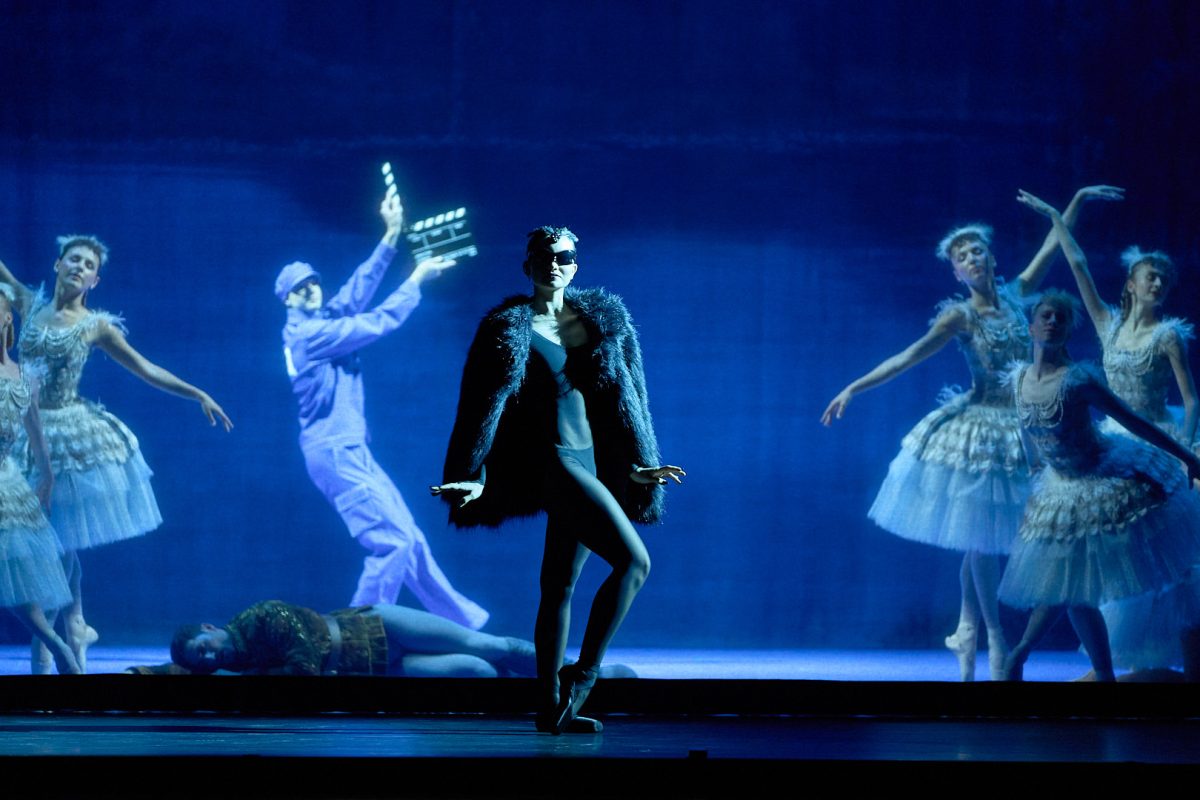
The curtain opens on a typical scene of choreographic enchantment. But the magic is interrupted in an effective transition to a film studio. The sets fade, the technical lighting structure descends from the ceiling, the cameras come into view, and the technicians bustle about. Odile, the muse of the Cygne Noir (Black Swan) perfume, takes center stage, the undisputed star of the brand. Siegfried is clearly her lover, but he is unceremoniously tossed around by the imposing personality of the frail yet temperamental star. A first pas de deux does not change the impression: it is Odile who leads the game. Here, Cavallari has completely stripped the stage bare to give the duo all the space. Deep blue curtains as the backdrop, and that’s it. The Lake, in a simple colour, stripped of its magical stereotype soul to make room for the personalities of the protagonists.
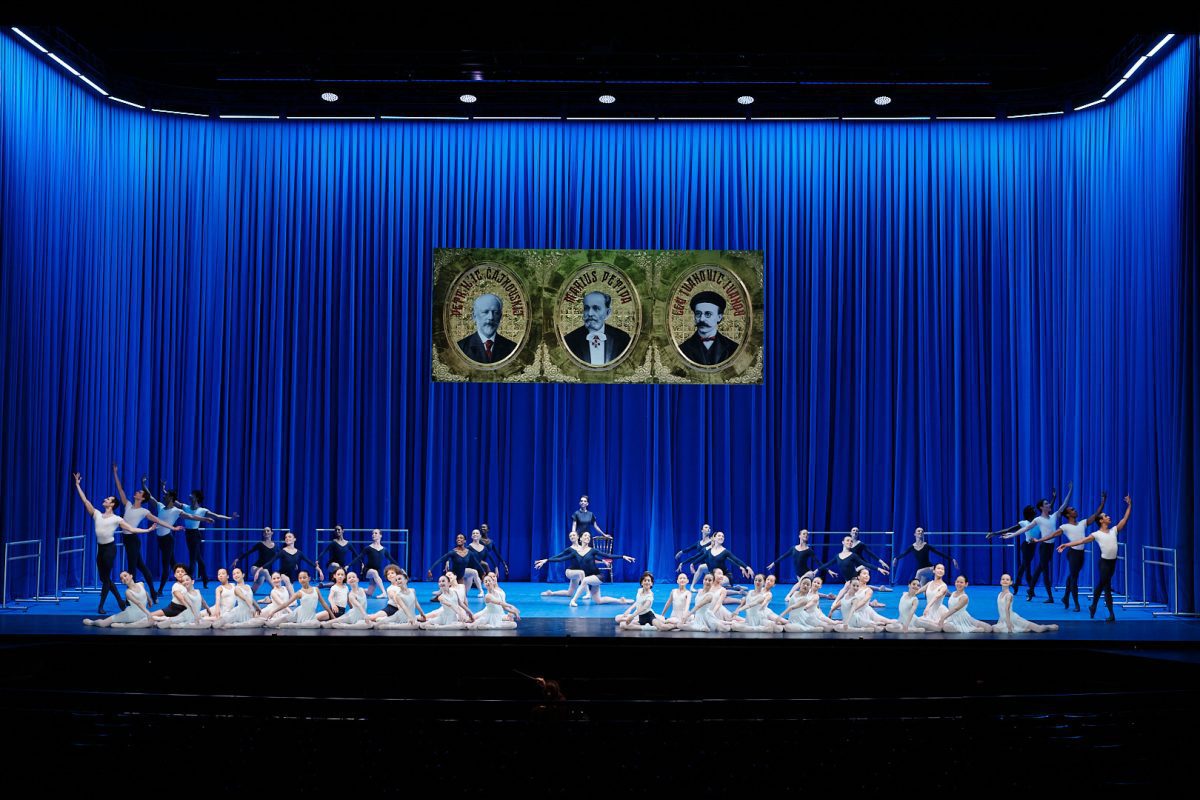
Transition to a dance school. Under the watchful eyes of the three original creators of the ballet, Tchaikovsky (music), Petipa, and Ivanov (choreography), the children perform before allowing Odette, the remarkably talented one from the school, to enter. She stands out from Odile with a clear naivety and a character without arrogance. You can see it quite well in the movements, the gestures, the costume, too. A simple, light dress, in contrast with Odile’s sporty, athletic, and high-performance clothes under a transparent veil.
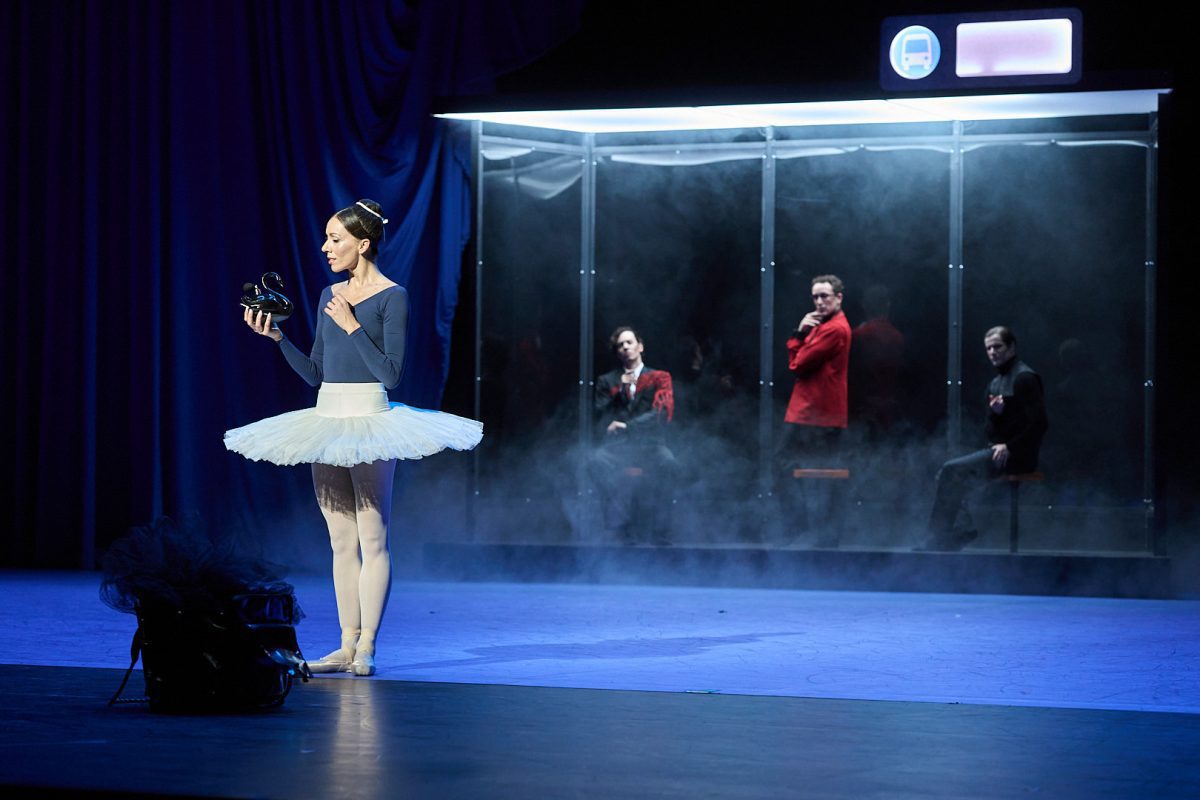
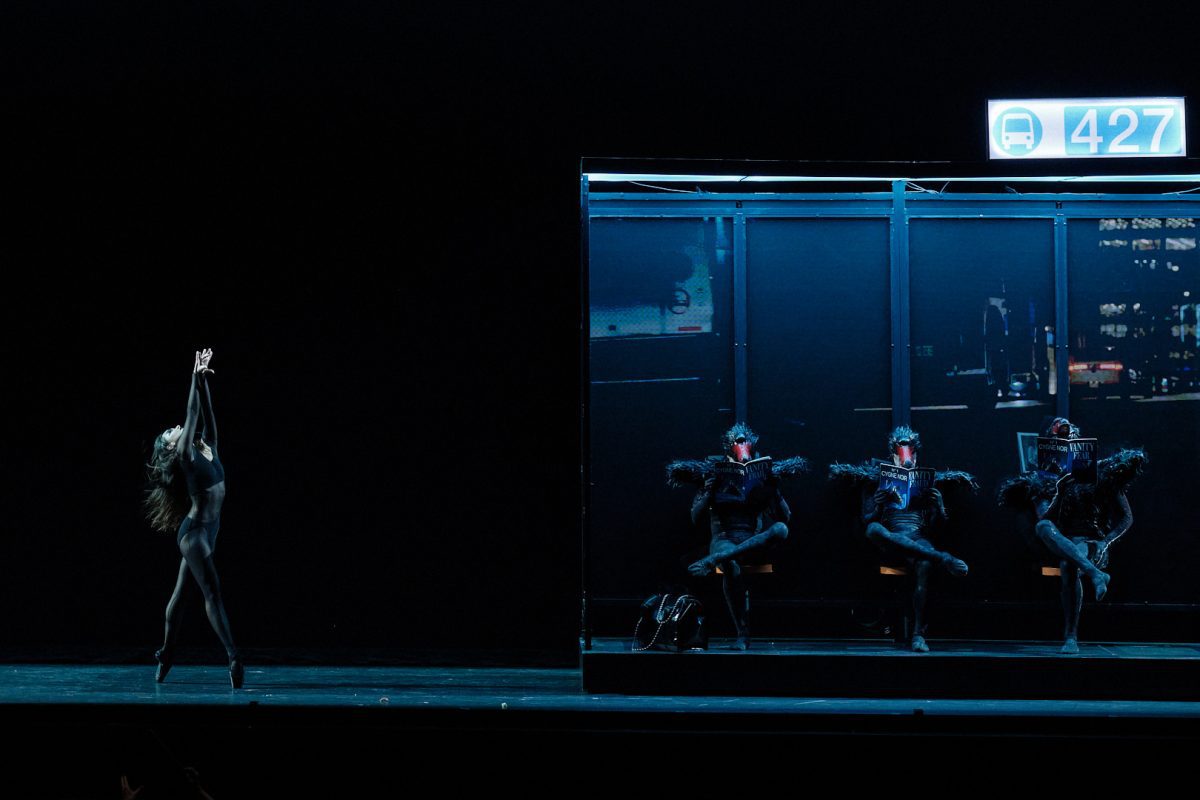
Odette leaves the school, Siegfried the stage. The scene of their meeting is ingenious and beautifully aesthetic. The two wait in a bus shelter that gradually moves from the left to the right. In the bus shelter, an ad for the famous perfume Cygne Noir. Odette is fascinated, Siegfried introduces himself, he is part of the ad too. Odette leaves with a card from Siegfried. She will go to participate in the auditions for the brand’s next product.
During these auditions, Odette fascinates everyone with her grace and talent, particularly the three creators, now materialised as capricious designers in red and black, and “realistic” avatars of the original villain Rothbart. It is during this episode that Siegfried, attracted to Odette, dances with her. Odile catches them and lets her anger explode. She leaves a bag with her perfume inside. Odette is enchanted by the scent and gets caught in the trap set by the three designers who offer her a contract on the spot. What am I saying, an arrangement is imposed on her.
There is something very significant in this scene where three men in positions of power take it upon themselves to instrumentalise a young woman as one would a particularly effective tool to achieve productivity goals. She finds herself dressed in a stylish bikini-like costume that Lady Gaga might wear in Ibiza. Odette is clearly dehumanised, and left a bit bewildered by the speed at which things have happened, even wondering what exactly she has just signed. A pact with the (three) devils, it seems. Or see it also as Tradition takes hold.
Music, between synthesis and radical cutting
This is where Cavallari introduces the excerpt from Tchaikovsky’s Pathetique Symphony, replacing the original folk dances, which are now rather unnecessary in this context. The transition to this music, from the original Swan Lake, is quite smooth. Obviously, it’s the same composer, and the same style. It remains that it could have clashed. But no, Cavallari’s choice is just as symbolic: the Symphony itself, but especially the 4th movement, which ends in silence and not in a grand finale. Odette, the authentic one, has just died.
Let’s take this opportunity to talk about the music. If you wanted to immerse yourself in Tchaikovsky’s complete and sumptuously enveloping soundtrack, you’ll have to pass. First of all, know that the original ballet lasts more than two and a half hours. Cavallari’s Lake makes it a good hour shorter. By replacing, moreover, part of the score with excerpts from the Symphony No. 6 “Pathétique” by the same composer, the music you already know is even more severely truncated.
Finally, famous landmarks, such as the Swan Theme, usually heard in the second act, are this time presented at the very beginning of the evening. As if the choreographer had wanted to get rid of this cumbersome melodic emblem as quickly as possible, probably because it was too powerfully associated with the “Once upon a time,” aspect of the work. In the logic of the Lake, the idea is valid. That said, due to habits, we still look for this sound reference later in the work, even though it doesn’t come.
On the performance side, the Orchestre des Grands Ballets played correctly, with some very beautiful ensemble passages, while others, like the first measures, were mechanical and lacked fluidity. I don’t usually take too much time to mention technical or intonation errors. This kind of thing happens. But I must highlight the serious intonation problem of the violin solo associated with the pas de deux of Siegfried and Odile, then Odette. A notoriously difficult score, it is true. But here, it was out of tune to the point of making teeth grind. And not just once. In a sustained and repeated manner. It’s a shame. If I had been with visitors, I would have been embarrassed.
Odette’s Revolt
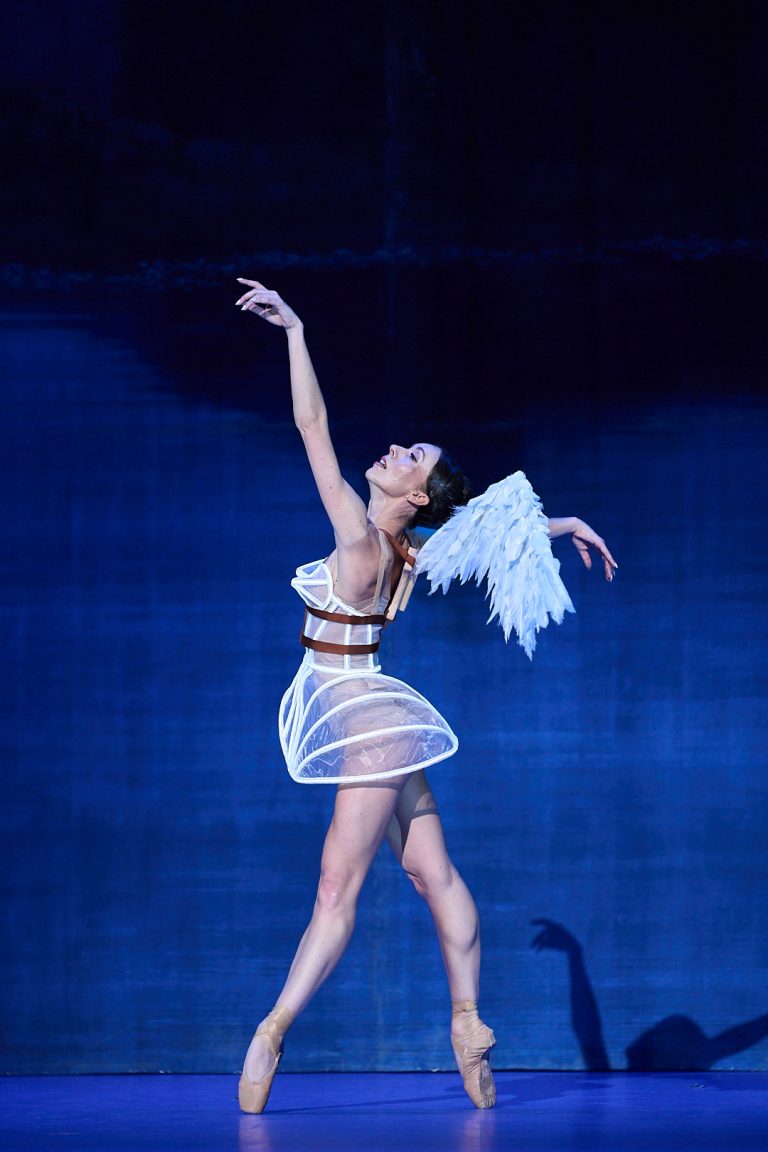
Let’s return to the action on stage. The frenzy of success becomes Odette’s daily life. But it is a success that does not belong to her. The next scene, the first after the intermission, is of great symbolic violence: the three designers manipulate Odette, and her body, as they please. On vertical screens at the back of the stage, we see a body (that of Odette), marked with numerous indications, all of which are alterations to be made. The three “villains” violently undress Odette, who was dancing in a very simple dress, the one she wore to school. The aggression here is entirely masculine, heavy with messages. They impose a futuristic tutu/corset (illuminated!) on her, adorned with a pointed bustier like the one Jean-Paul Gaultier made for Madonna.
Odette plays along, but eventually gets tired of it. She revolts, causing the appearance of four white swans, echoes of her identity submerged by a role that is not hers. The battle rages with the three designers, who refuse to lose their power over the young woman. Through all this, Siegfried looks quite pathetic. He tries to protect Odette, but is easily pushed aside. It is Odette, alone, who now leads the game, who tears her ties with this world that almost swallowed her.
Notable irony: after their failure, the three designers find themselves at the bus stop seen earlier and encounter Odile, who also seems to be questioning herself. A symbol seems to carry this reflection: her hair is down, left free to float and wave in the movements.
Correct intuition, because in the next scene, the last of the show, Odette has also let her hair down. It ends in a scene of calm, where Odette embraces Siegfried, with other couples behind, in the shadows. It’s not a fairy tale ending; the young woman does not find ultimate comfort in the lover’s arms. Here, I rather had the impression that it is Siegfried who is being comforted. Odette is doing him a favour by loving him, despite his insignificance.
A little bit of magic, nevertheless
Overall, Ivan Cavallari offers an interesting and effectively modernised reinterpretation of the classic tale. The message is certainly quite obvious, even somewhat unsubtle. But it still seems necessary to repeat it, considering the retrograde turmoil that is currently unfolding in the world.
When we go to see Swan Lake, and despite the outdated social discourse that accompanies it, we love to be amazed. We love to enter the tale and the fairyland. The big trap of this update was to turn it into a socio-political thing, a vehicle for an engaged message, with serious statements completely evacuating the sense of magic and enchantment.
Cavallari opted for a middle ground, hence the label of Magical Realism that he himself affixed to his creation. So that in the end, this modernised Swan Lake is not completely devoid of wonder. The magic still seeps through the symbols, through the allegories, through Odette’s waking dream. That said, some scenes stripped to the extreme, like the first pas de deux in front of a vast blue curtain, would still have benefited from a more evocative environment, whether classical or modern. There was a sense of emotional dryness.
On the choreography side, Cavallari’s choice to remain strictly faithful to the gestures, metrics, and codes of classicism could also have been reshaped, in addition to the music and the scenic concept, to signify even more strongly the dichotomy between dream and reality, between Realism and Magic, between authenticity and corporate oppression. The world of fashion could have been illustrated with modern, contemporary gestures.
I remain pleasantly struck by a few memorable scenes: the bus stop, the large display of the Cygne Noir, vulgar and almost Trump-like in its golden attire, the three designers who, fleetingly in a scene that passes very quickly (you have to observe carefully), take on the appearance of the three first creators, Tchaikovsky, Petipa, and Ivanov, the final scene of the embrace, etc. I think that this vision offered by Ivan Cavallari provides part of the answer to the modernisation of classics dusted off by the social dissonances they convey in this 21st century, where new generations need to connect differently to masterpieces. Some will say that it was done by succumbing to the attention deficit of a generation accustomed to rapid scrolling. Perhaps one could have extended the study of Odette and Odile’s characters, taken the time to delve deeper, and made their transitions more organic, more credible. It does indeed happen a bit too quickly.
But the portrayal of the character Odette as the truly central element of the work, leaving the “charming prince” Siegfried far behind in the shadows, now that feels good.
The presentation of The Lake continues until June 7th.
Kulusé Souriant, A Jazz Style Influenced by Caribbean Roots
by Sandra Gasana
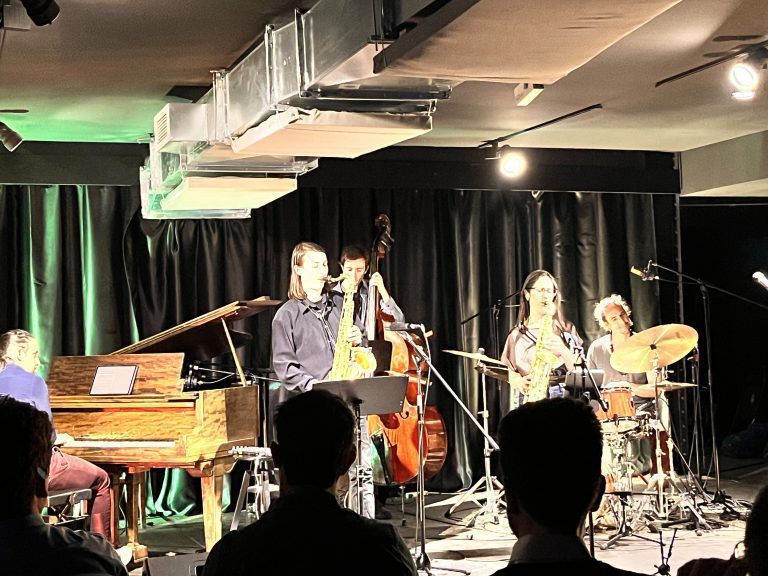
By a twist of fate, I found myself covering the launch of Kulusé Souriant’s album Douvan at L’Entracte on May 21st. For the occasion, his quintet consisted of Geneviève Gauthier on alto saxophone, Antonin Bourgault on tenor saxophone, the renowned Santiago Ferrer on piano, and Sean Burke on double bass, while Kulusé himself was on drums. Having lived in Montreal for four years, Kulusé, a drummer and composer of Guadeloupean origin, is increasingly making a name for himself on the Montreal jazz scene. He collaborates with several artists, notably Rachel Therrien, who is preparing a rather original project for the Jazz Festival in which he will be participating.
Released on May 15, 2026, this 9-track album includes several collaborations, notably with Malika Tirolien on the track “Horizon.” Tirolien was present at L’Entracte, having just returned from a trip to Senegal for the Stereo Africa Festival and the Saint-Louis Jazz Festival. Douvan is a call to reconnect with what is important: with oneself, with nature, and with others, in order to move forward.
From one piece to the next, the musicians are showcased. The saxophones alternate, sometimes even synchronizing. During some of Geneviève’s solos, Kulusé seemed to savor the moment, closing his eyes to better absorb it. We are immersed in different musical worlds throughout the concert, moving from gentle and introspective to more intense moments with breathtaking solos.
“I’m moved to present this music that we’ve been preparing for two years,” Kulusé tells us between songs. This artist, who is questioning his personal and musical identities, seems to have found some answers through this album.
Apart from “Heritage” and “Compassion” which last less than five minutes, most of the tracks are long enough to immerse us in Kulusé’s repertoire, which mixes jazz with other styles such as gwo ka, as is the case in “Anecdote”, on which he collaborates with Léo Tibao Leborgne.
Santiago Ferrer dazzled us, as always. His soaring piano solos delighted the audience, who seemed completely captivated. At times, it felt like we were in a legendary New York jazz bar. L’Entracte was the perfect venue for the evening, offering this intimate setting. Kulusé actually lived in New York for a few years in 2019, where he studied at the New School of Jazz before moving to Montreal a few years later.
“I’m lucky to play with such talented musicians,” he confesses. Depending on the drumsticks he uses, the atmosphere varies. On “Solitude,” one gets the impression of hearing rather mystical rhythms, which allows him to reinvent jazz by adding Guadeloupean sounds.
That said, the highlight of the evening was undoubtedly Malika Tirolien’s performance of “Horizon.” Kulusé’s immense respect and admiration for his fellow countrywoman was palpable. The song features a variety of rhythms, evoking a range of emotions. Malika’s improvisational section captivated the audience, who responded with enthusiastic applause.
Salomé Perli, singer and multi-instrumentalist, also features on the album but was unable to attend the launch. One thing is certain: this album will truly propel Kulusé Souriant onto the Montreal jazz scene, as he had primarily focused on his studies before this release. So remember this name; you’re likely to hear it again and again.
OSM | A Heroic Symphony That Doesn’t Beat the Boss
by Alexis Desrosiers-Michaud
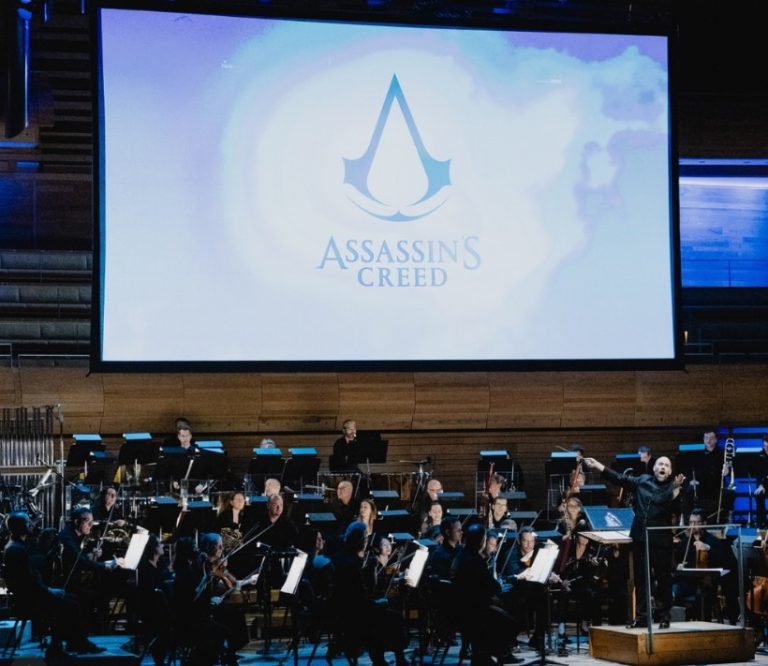
Big week for video game music in Montreal; after Final Fantasy: Distant World on Sunday by GFN Productions, the Montreal Symphony Orchestra (OSM) gave Heroes: Video Game Symphony on Wednesday evening, under the baton of the conductor of this touring production, Kevin Zakresky.
Everything was in place for an exceptional evening: a good selection of games and their soundtracks, a world-class orchestra that regularly performs music on screen, and a packed house. For a newcomer discovering the world of music, the evening was probably very enjoyable. But for those who know a little, or even a lot, about it, there were some major hiccups.
Presenting the concert as a “choose your own adventure” experience, interspersing each piece with chapters narrated by a voiceover summarizing each step a typical adventure game hero might take, wasn’t a bad idea on paper. The problem lies in the text itself, often meaningless, as if it were phrases pulled from a bowl of fortune cookies and strung together. A few such interludes during the concert would have sufficed, but not 14 or 15, especially when a technical glitch forces us to play the same chapter twice, or when they don’t quite mesh with the following cutscene.
The choir’s placement left much to be desired. Comprising 24 members and positioned stage left, they struggled to be heard from the back of the stalls. Even amplified, pitting such a small choir against a full orchestra makes no sense, especially for music where the choral part is an integral, even dominant, component of the instrumentation. It simply doesn’t make sense. This was particularly glaring in The Elder Scrolls: Skyrim Dragonborn Theme, a true hit with its guttural sound in video game music, where all one could hear were whispers.
Finally, Vancouver conductor Zakresky didn’t help the program’s cause. Working without a score, his eyes glued to his tablet, and offering only occasional cues, he conducted in a very similar fashion, resulting in everything sounding… pretty much the same, except when certain sections decided to go all out (trombones, solo violin), leaving the talented musicians to their own devices. He’s a good crowd-pleaser, speaking more than respectable French and appearing on stage wearing a Victoire de la Musique shirt for the second half, but this energy doesn’t translate when he turns to conduct. It’s a shame, because that’s the very essence of music on screen: supporting and being an integral part of the visual presentation, something the performers don’t see. For example, a transition between a calm moment and the instant when an enemy suddenly arrives must be accompanied by a real musical tension that goes beyond simply playing the notes, which was lacking too often yesterday and the only truly worthwhile moment was the encore, an excerpt from Final Fantasy VII, presented unfortunately without a projection.
Video game music has long since reached a point where it transcends mere background noise. The selection of tracks from the past was brimming with undisputed masterpieces: besides Skyrim, mentioned earlier, there were Bioshock, Assassin’s Creed, and Castlevenia, some pieces shining a spotlight on orchestral instruments less commonly known as soloists (piano, electric guitar, harp). This repertoire offers a wide array of colors that can be truly breathtaking, provided the necessary resources are invested.
ArtChoral Sings the Beatles: The Classic Pop We Needed
by Alexandre Villemaire
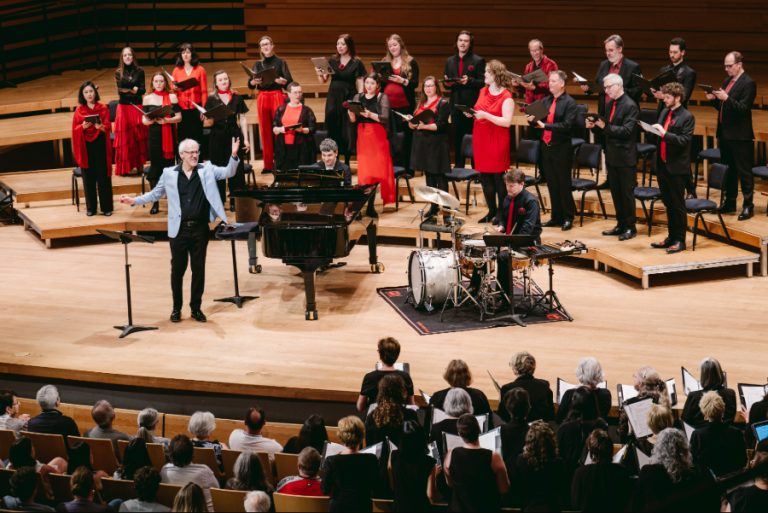
Beatlemania entered the Maison symphonique with the ArtChoral Ensemble on Sunday afternoon, May 17th. Fans of the Fab Four, regular ArtChoral concertgoers (or a mix of both) gathered in large numbers to hear, in a classical setting, the great hits of the iconic 1960s pop/rock group.
Led by Matthias Maute and accompanied only by a small percussion section (essentially a drum kit and cowbell) under the direction of Philip Hornsey, with Antoine Joubert on piano providing occasional harmonic support and rhythmic drive, the singers of ArtChoral performed a string of Beatles hits. From “Yellow Submarine,” which opened the concert, to “Can’t Buy Me Love,” including “Penny Lane,” “Eleanor Rigby,” “In My Life,” and “Yesterday,” to name just a few, the ArtChoral singers, with their pure and powerful voices, delivered “their” interpretation of Beatles classics. It would be a mistake to dismiss any concert featuring the Beatles’ repertoire simply because the music isn’t complex, repetitive, or classical enough to be handled by ensembles of ArtChoral’s caliber.
The performance of “Michelle” and “Because” is the best example of this. Performing with only voices allows one to fully appreciate the richness of the harmonies and the complexity of the chords and timbres that shape these pieces. The interpretation of “Michelle” was ethereal, and “Because” created a mystical aura in the hall with its luminous chords and chromatic passages that constantly altered the piece’s character. John Lennon said that he composed this piece after hearing Yoko Ono play Beethoven’s famous “Moonlight Sonata” and, struck by the melody, asked her to play the chord progression backwards. Just as in the writing of this famous Beethoven piece, the language is precise, refined, and captivating. This demonstrates once again that the boundary between classical and so-called popular music is not so permeable. Another example of this connection can be found in the piece Black Bird, which, like I Saw Her Standing There, received a piano solo treatment from Antoine Joubert. The simple melody of Black Bird, itself also inspired by a piece from the classical repertoire, namely Bach’s Bourrée in E minor, provided Joubert with superb material to work with, delivering a performance with varied musical contours and great virtuosity that showcased the interpretive possibilities of this piece.
An ArtChoral concert wouldn’t be complete without at least one contribution from the Grand Choir, this ad hoc choir made up of singers from diverse backgrounds. They joined the ArtChoral singers for heartfelt performances of Let It Be and All You Need Is Love. To conclude the concert, everyone sang Hey Jude, and the audience was invited to join the musicians as the Maison symphonique was bathed in a light show reminiscent of major rock concert performances.
Matthias Maute’s deliberate choices in this concert clearly demonstrate that the repertoire of Paul McCartney, John Lennon, Ringo Starr, and George Harrison transcends genre boundaries, and that these two worlds are ultimately not so far removed from one another. Was it a concert of extreme virtuosity? No. But it wasn’t a dull concert either, presenting “classic” Beatles for the sake of presenting soulless classic Beatles. Everyone, from the conductor to the singers and the choir, was filled with the joy of performing this repertoire, without pretension, and sharing it with an equally enthusiastic audience who reciprocated the musicians’ enthusiasm. In these times, the love of music and the passion for sharing it are truly among the few things we need.
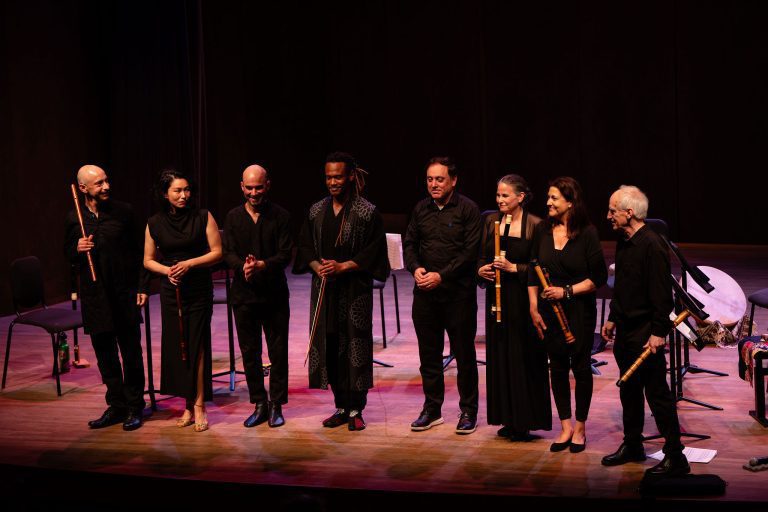
The Accès Asie Festival knows how to take risks. And we can congratulate it. On Tuesday, May 19, a concert was held at the Bourgie Hall featuring very disparate flutes (with a cello and percussion to add some texture): a Renaissance flute, a Baroque flute (Western classical icons, therefore), a ney (Persian flute), shakuhachi and ryuteki (traditional Japanese instruments), and a dizi (Chinese flute). The repertoire, although “tagged” world music, had everything to please the most curious and demanding ears, flirting with the harmonic complexity associated with modern classical music (there were indeed several works from the 20th and 21st centuries on the program).
Vivaldi’s Spring, in an arrangement for solo flute, unfolded throughout the concert, each movement being interpreted as a sort of bridge between various parts. Mika Putterman demonstrated the full extent of her mastery of the baroque flute. The percussionist Ziya Tabassian offered one of his compositions, an exploration based on the rhythmic structure of a Persian poem by Hâfez, while Ziad Chbat played a series of arabesques titled Nostalgia on his ney, a flute of West Asian tradition (up to Turkey) with an enchanting sound, akin to the Armenian duduk (which is not a flute, FYI, but a double-reed instrument, like an oboe).
Two harmonically “contemporary” pieces, that is to say, flirting with and even diving into atonality, were presented: an original composition by Jean Lérigé-Laplante, Évanescence. The piece is a sound wave that intertwines the different timbres of the flutes present, while still offering a welcome place to the cello of the Trinidadian-born Montrealer Kyran Assing, too discreet until then, I find (it’s not his fault, he had almost nothing to play).
The other chromatically dissonant piece was a composition by Bruno Deschênes, a “harmonic complexification” of an ancient Japanese melody, Shin Etenraku. The melody, taken as is but passed from one section to another with modifications and densified combinations, offers no reference point for our Western ears, which are not very familiar with the authentic Japanese repertoire. In the end, we had a modernist work, quite austere but frankly interesting.
A Chinese piece for solo dizi had a lively effect on the audience, with its naturalistic effects, like excited birds, and its spectacular virtuosic flights. Excellent performance by Shuni Tsou.
Moreover, it should be noted the excellence of all the instrumentalists present, all solid performers of their instrument.
The French Baroque composer Joseph Bodin de Boismortier saw his Concerto for Five Flutes, Op. 15 No. 1, transcribed for the present flutes, something he probably never dreamed of. The arranger, Bruno Deschênes, admitted to having taken a risk with this idea. We won’t say it was a great success, even though the artists clearly put all their conviction into it. It is difficult to combine Western and non-Western flutes accustomed to microtonality in a tempered language (with equal intervals) like that of European Baroque. One sometimes wonders if what one hears is off tune, or if it is the natural inflections of the Shakuhachi or the dizi that clash more violently than harmoniously with their baroque sisters. The idea, interesting at first glance, deserves to be refined.
That said, we recognise the interest of this unusual meeting, and we hope, despite a few hiccups, that this type of chamber ensemble will return to us with new ideas because the principle is promising and stimulating.
And hey, why not add a few other instruments (even non flutes) like the clarinet, the duduk, the bassoon, the mandingue flute, the Inca quena, the Indian bansuri, some recorders (the bass one!) and other cellos?
Wesli Turns Haitian History into Collective Celebration
by Juliana Cortes
The May long weekend usually announces the start of spring: flowers bloom, trees fill with vibrant green leaves, and the city begins to feel alive. This year, my weekend was marked by Makaya, the latest album from Montreal-based Haitian artist Wesli, as well as Haitian Flag Day on May 18, the day Haitians celebrate the creation of their flag during the Haitian Revolution in 1803.
With his iconic hat and glasses, Wesli blessed the audience with a performance that traveled through rhythms, blending African and Haitian traditions with more modern sounds. Through this musical voyage, he emphasized the ways our present remains deeply influenced by history, especially in Montreal, where culture — and music in particular — is deeply embedded in the city’s large Haitian community.
During the concert, Wesli explained the meaning of Makaya. In Kikongo, the word means “leaf.” In Haiti, it also refers to a mountain and to the gatherings where Maroons organized during the Haitian Revolution. Wesli said, “There had to be Makaya, for people to be spiritually healed and liberated.”
Anchored in history and memory, Wesli was joined onstage by Senegalese artist Ilham. With his soulful voice, they performed the Coupe Cloue song “Mon Konpé / Ti Bom.” I was deeply moved by this performance because one of my favorite artists, Joe Arroyo, created “A mi dios todo le debo,” a song highly influenced by Coupe Cloue’s music. This moment transported me directly to my childhood in Colombia.
At that moment, I stopped taking notes and stood up to dance, remembering family gatherings shaped by Joe Arroyo’s music. It is only in the last few years that I discovered how deeply this music had been influenced by Haiti. Learning about this connection felt like finding a missing piece of the puzzle, allowing me to better honor the music that had given me so much joy and connection throughout my life.
Wesli was also joined by Gaya, a wholesome singer and dancer who illuminated the stage with her energy and movement. The two have known each other for nearly 20 years, dating back to when they first began making music. Master percussionist Ronald Nazaire also took the stage, sharing ancestral knowledge through the drum. Nazaire needed no words to convey the depth and spirituality of his music.
Another highlight of the night was the band itself. Every musician shone individually, but what stood out most was the complicity between Wesli and his bandmates. Their playful and energetic interactions were contagious. Wesli generously gave space to each musician through solos and dance moments, allowing every performer to bring their own presence and energy to the stage. Everyone was shining.
So while Canada celebrated Queen Victoria, the Theatre Plaza became a space to celebrate Haitian history, memory, and musical inheritance.
As soon as they got on stage, ear made a shockwave by their mere presence. They seemed completely out of place and spoke with a nervous vulnerability which evoked questions about when the last time they left their room was. But that form of sincerity is precisely what made them a stand-out act.
The music began and everything fell into place. Unnerving, spontaneous, and bubbling with optimism, ear disarmed the festival-goer’s self-preservation reflex by generously sharing what might have been deemed unpolished. Most of their songs sounded like demos in the best way, often ending in a clumsy end of phrase, or by Jonah Paz simply skipping the track on his laptop. “Ok, this one’s called ‘Nerves,’ you can also dance to this if you want.”
They made it a point to coyly talk about every song before jumping into an uncontrolled thrashing that looked like Ian Curtis repeatedly getting punched in the stomach. For two rather awkward figures, they sure could entertain.
The now not-so-niche band came up quickly, but it wasn’t so much by self-promotion or luck as it was by their uncompromising sound and aesthetic. They could be compared in some ways to Crystal Castles or even MGMT, but their influences are more self-contained to the chemistry formed between the pair. Both come from respective musical backgrounds in folk and EDM, and there is a strong tension to draw from in their music. But more importantly, there is a feeling of all-seeing depth to their approach. A meta-dimension that is neither rooted in irony nor in self-proclamations of genius, one that is just there, looming in the corner of the dancefloor.
Even in the large crowd that had gathered, the intimacy that ear provoked made it feel like we were all suddenly together. This makes it easily my favourite discovery from this lineup, if not of the year. And if I knew ear before by scrolling through their album The Most Dear and The Future, the duo is now etched into my memory forever. ear summer?