The start of an OSM season is an opportunity to dazzle the eyes and ears. The choice of the central work in the program must be grandiose and often involves a choir and soloists in addition to the orchestra. This justifies the choice of La Damnation de Faust, a 136-minute dramatic legend, OP.24, composed and written by Hector Berlioz in the mid-19th century and premiered in 1846 under the baton of its composer.
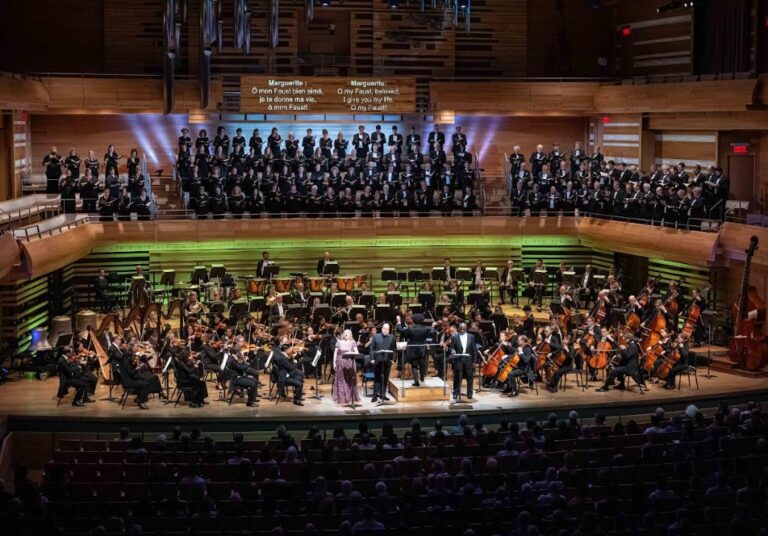
A huge choir behind the OSM (the OSM Choir and Petits Chanteurs de Laval, conducted by Andrew Megill and Philippe Ostiguy, respectively), four soloists, and conductor Rafael Payare. The effect was mammoth, as you can imagine. Performing such an oratorio for soloists, various choirs, and a symphony orchestra is a colossal undertaking, and a very costly one at that. Needless to say, the OSM pulled out all the stops for this performance.
So what to choose? The repertoire of works suitable for such a performance is relatively limited, and these works are not of equal value. The choice therefore fell on La Damnation de Faust, whose ancient legend was taken up by Goethe and then set to music by Schubert, Schumann, Spohr, Wagner, Boito, Gounod, Liszt, and Mahler. True to his era, Berlioz was no exception, as we saw powerfully demonstrated this Wednesday at the Maison symphonique.
Divided into 20 scenes grouped into four distinct parts, with an intermission in the middle, this work is ambitious in its instrumentation, its pomp, and its length. This ambition is understandable in an era when composers sought to create total spectacle. In 2025? It is generally accepted that this work is part of the great repertoire, but one can still take issue with the obsolescence of its libretto and the pompous and outdated nature of this French operatic writing, once admired. As for the dramatic plot, the story of the doctor Faust who sold his soul to the devil, a theme that dates back to the dawn of time, Berlioz’s version is more than ambitious.
The OSM’s performance here struck me as rigorous and fervent, always serving the singing of the choirs and soloists—tenor Andrew Staples plays the role of Faust, mezzo-soprano Karen Cargill transforms into Marguerite (his wife), and bass-baritone Willard White plays Mephistopheles (the devil), while bass-baritone plays Brander. Anyone familiar with the French language will have noticed the pronounced accents of the soloists, who would normally have been trained to master 19th-century French, as it is used in a significant part of the opera repertoire. Some may take issue with this… personally, I took more issue with the bombastic nature of the text, but hey, each to their own!
As for the vocal performances, it is clear that the lead soloist does not have the greatest power, and that such a piece requires the services of a tenor who is more experienced in the high frequencies in order to rise above the orchestra. The same can be said of the mezzo-soprano in the high notes of her register. And we applaud the exemplary preparation of the choirs, whose combined effect is more than striking.
And that’s probably the wow factor of this program, the first in the 2025-2026 lineup.
Photo Credits: Antoine Saito
Artists
Rafael Payare, conductor
Karen Cargill, mezzo-soprano (Marguerite)
Andrew Staples, tenor (Faust)
Sir Willard White, baritone (Méphistophélès)
Ashley Riches, bass-baritone (Brander)
OSM Choir
Andrew Megill, choir director
Petits Chanteurs de Laval, choir
Philippe Ostiguy, choir director
Work
Hector Berlioz, La damnation de Faust, op. 24 (136 min)
Intermission (20 min)