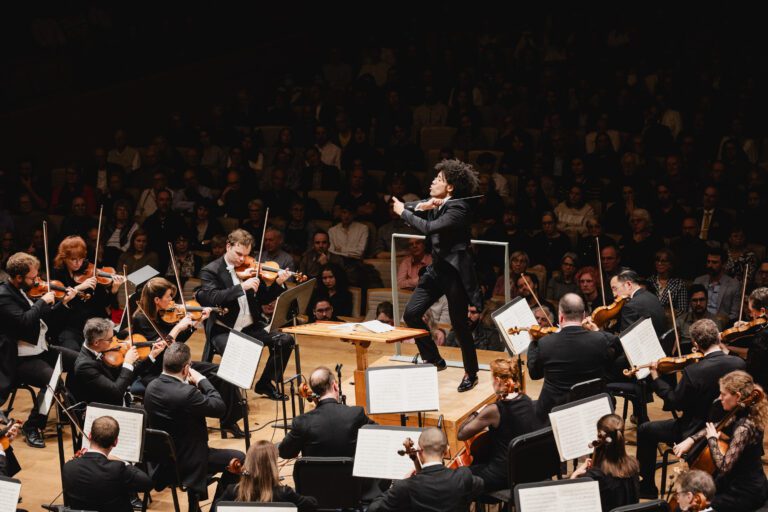
On Wednesday evening, Rafael Payare conducted the Montreal Symphony Orchestra in the continuation of the Mahler cycle, this time with the composer’s final completed symphony, the Ninth. A highly demanding work that reflects the consciousness of a man who knows his end is near and is bidding farewell to the world.
At the time of composing the work, Mahler knew he had been diagnosed with heart valve disease and was haunted by the recent death of his daughter. Fearing the bad luck associated with ninth symphonies (Beethoven, Schubert), Mahler had avoided numbering his previous symphonic work, but in vain: this Ninth would indeed be the last symphony he would complete.
Payare offers us a reading that is quite different from the classic interpretations marked by great dramatic tension that we associate with Mahler, right from the first movement.
In this first farewell to life, lasting around thirty minutes, it is difficult to find a clear guiding principle to hold on to. Payare’s direction evokes less the gravity of this imminent end than the vertigo of our existence in our modern era, where everything moves at high speed and everything is ephemeral. In fact, his proposal has something profoundly contemporary about it: that of a frantic, saturated world where futility takes hold.
The second movement, a Ländler, opens with a section of tightly knit bassoons and a section of rough strings. Here, Payare opts for rusticity and fully embraces the woody, earthy character. The intoxicating circularity of the rhythm, the warm cooing of the French horns, and the wavering pace of the waltz create a country atmosphere that is both joyful and melancholic. It is a farewell to the simple pleasures of life.
The Rondo-Burleske is delightfully sarcastic. It is a whirlwind of sound, a celebration that descends into frenzy. Each section of the orchestra shines with its density and energy, contributing to this brilliant and chaotic orchestral extravaganza. A gargantuan celebration, carried by a deliberately pompous ending, unapologetically ironic.
The final Adagio presents the acceptance of leaving this world. Payare’s subtlety serves this movement well. He deploys a more sober and internalized gesture, adapted to the delicacy of this last movement. Little by little, he allows the sounds to breathe, until the fear of death fades away. In this long farewell that closes this great symphony, silence becomes the last and most eloquent of notes.
A few seconds of silence were observed at the end of the symphony. This silence filled the space, imposing itself loudly. It was followed by a heartfelt ovation.
Photo Credit: Gabriel Fournier