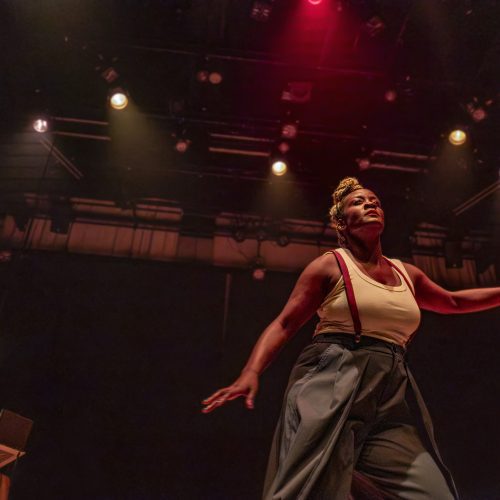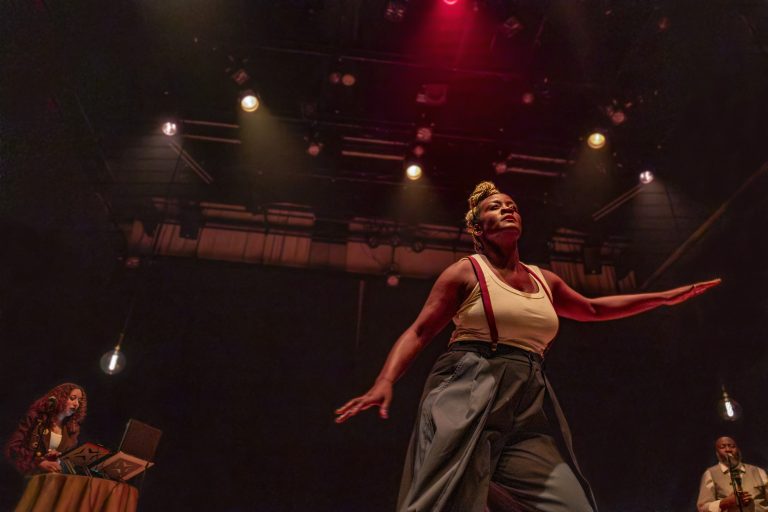
Triumphant, elegant, and poised, Myth sits on a divan, looking at the audience one by one as we enter the room with her piercing eyes. She appears comfortable, yet ready. The set-up feels mysterious, creating a sense of exclusivity that only a select few can access. The setting and her clothing clearly allude to the speakeasy era. In this underground basement party scene, people could drink, make music, and forget, or perhaps transmute, what was happening outside in the world. My first reaction was to enter the space carefully, to witness with full attention what was about to happen on stage. Myth slowly stands up, looks at the audience, and with her breath takes over the space. In silence, we see her move between total engagement and ease. The articulation of her movements immediately moved me; I could feel the strength required to remain fully connected to breath and body.
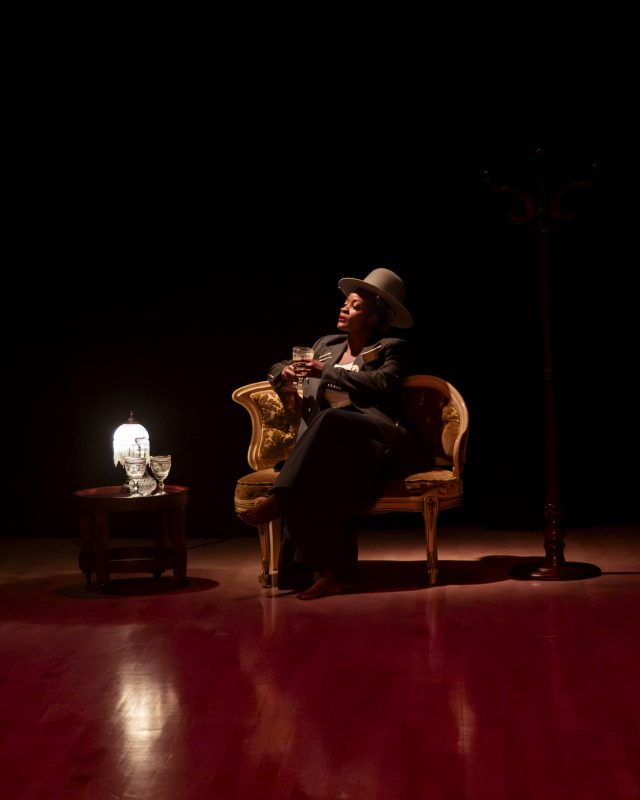
Myth honors Montreal’s dance and music scene, particularly the way jazz and house exist as both past and present, feeding each other. This is illustrated by the presence of Samantha “Sam I Am” Hinds with her singing and DJing, and Jason “Blackbird” Selman through poetry and trumpet. The three artists enter a conversation that moves between poetry, singing, movement, beats, and trumpet. Their exchange is seamless, with each artist having moments to shine. As a spectator, I felt drawn into the performance from my seat, instinctively bouncing my head to the rhythm. Myth’s body becomes a catalyst within the scene; her performance takes us into her inner world. We learn about her journey as a dancer who does not simply want to perform for entertainment, but to convey a message. It was difficult for me to hold back my tears as I understood that Myth was reminding us that when life is hard, dance can be the medicine that carries her—and many of us—through life’s ups and downs. I recognized the sacredness of dance and how, for me, it has become a way to know myself better, to make sense of my own roots, and to begin building a reality that encompasses all the pieces of who I am.
Speakeasy is also an homage to the Montreal dance scene: “a city she loves, but that does not always love her back,” a city that is far from easy to navigate or fully inclusive. The speakeasy theme made me think about how street and underground dance styles still do not have the place they deserve. Yet they continue to grow, evolve, and welcome people who are searching for a home. Sometimes these dances receive a spotlight that is difficult to share with everyone. However, dance is always happening—in church basements, community centres, schools, homes, family gatherings, and on the streets—as one of the poems suggests. As someone who is still searching for her place in this community, I found myself reflecting on the spaces where I have danced and the people who have made those spaces feel like home.
As a dancer, all I can say is thank you, Myth. Thank you for taking us into your inner world, for sharing your strength, and for being honest about the challenges that come with making art. The message felt clear: we no longer have to “speak easy.” We must be loud, take space, and create a reality where our histories and identities are fully welcomed.
Photo Credit: Renata Carmo