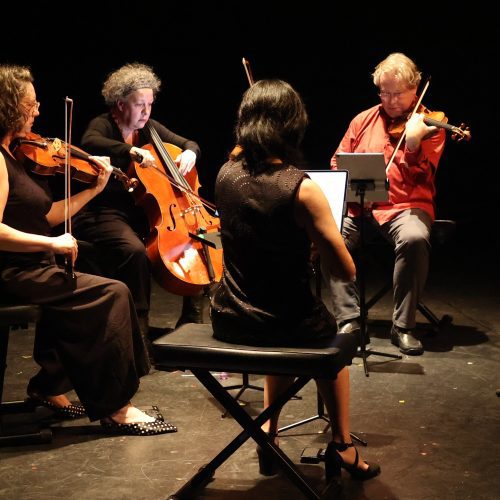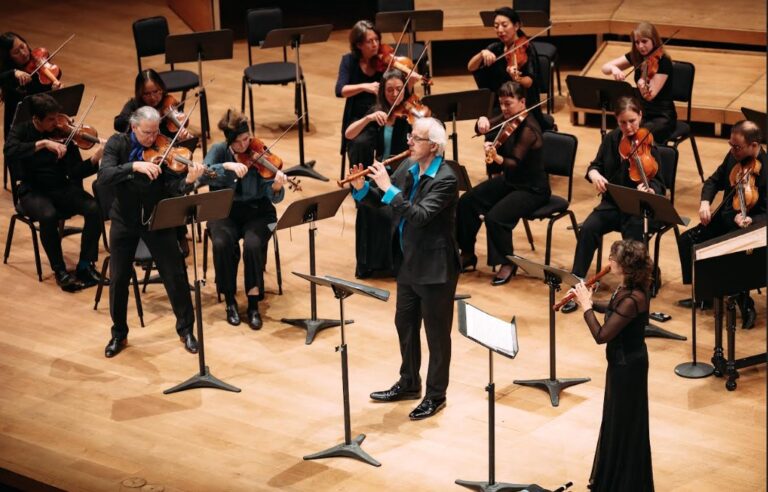
On Friday at the Maison symphonique, Ensemble Caprice and their conductor Matthias Maute presented the first of their four programs for the year 2024-2025. There was plenty of Johann Sebastian Bach and humor in this concert, with pertinent demonstrations, a fake and a real intruder.
The three Concertos brandebourgeois were each preceded by Maute transcriptions of Préludes et Fugues by… Dmitri Shostakovich! Surprising, but it’s easy to see why this is a Baroque concert.
Before the concert, the conductor explains that on his return from Leipzig, where he judged a piano competition, Shostakovich had the idea of writing his own Préludes et Fugues, in the cantor’s image. Even though they are written in an old-fashioned style, Shostakovich’s own style is quickly apparent.
Maute’s transcriptions are very well realized, even matching the orchestrations of the concertos to which the Préludes were paired.
In the 4th concerto, the dialogue between the violin and the two flute soloists is clear. The best moment is the movement, where the counterpoint is remarkable. Next comes the 1st concerto, which is denser. We’re not dealing here with soloists, but with groups of soloists; there’s the violino solo (Maute’s “baby violin”), but three oboes and two natural horns.
To demonstrate how Bach layers everything together musically, the conductor asks each section to play the first bar of the concerto separately before the performance. In this way, the audience leaves with solid reference points to follow. As the icing on the cake, to demonstrate just what a minuet is, first violinist Olivier Brault even gives a much-appreciated dance demonstration.
Musically, it’s a success, despite the fact that the violino is often lost in the density. The horns punctuate the rhythm of the movements and the ancient oboes bring an amber color, less nasal than the modern oboe. The slow movement particularly highlights this section, with a perfect balance of voices that clearly distinguishes the three instruments.
Then it all comes together until the end of the last movement, when the orchestra comes to a screeching halt to leave these same desks in a fantastic duet (or duel?), with some of them dancing while they play. Which makes you laugh before concluding.
After the interval, another Matthias Maute demonstration, this time illustrating the difference between a modern symphony orchestra and a baroque orchestra. We are treated to a simple chord, with (modern) and without (baroque) vibrato, on which the note is allowed to diminish after the attack.
Next came an excellent performance of the symbolic 3rd Brandenburg Concerto. Symbolic because for Concerto #3, there are 3 violin parts, 3 viola parts and 3 cello parts, so lots of voices.
Maute’s direction injects a great deal of energy, encouraging the musicians to move towards the first beats of the musical phrases.
They flow from one to the next. Dance rhythms are skilfully underlined. Maute picks up speed just enough to maintain the Allegro spirit, while keeping the counterpoint clear. Just follow the conductor to understand where the themes are in the two main movements.
For the second movement, “the shortest in all Johann Sebastian Bach’s music. Two chords!”, Caprice plays just the two chords, instead of letting a musician briefly improvise a cadenza, as is often the case. The Musette BWV Anh 126 that follows is party music so bewitching that you have to restrain yourself from clapping your hands. The musicians stroll and dance around the stage.
To introduce Bach’s 3rd Suite for Orchestra, Caprice plays a transcription by Maute of Tomaso Albinoni’s Adagio, the real intruder. Incidentally, the program falsely refers to Albinoni as the composer of this piece, but in reality it was Remo Giazotto who, in 1950, composed the work based on pieces from various drafts of other Albinoni pieces. Honestly, we’re still trying to figure out why this piece was included in this concert. Besides having nothing to do with Bach’s music, it breaks the mood between the Musette and the Suite. Nor was it an interpretation that will go down in history. Adagio means slowly, which is not the case with Caprice, which takes on a more moderato tempo.
The Suite is a fitting conclusion to the concert. Maute emphasizes the appearance of baroque timpani and trumpets, which then punctuate the rhythms of the various dances. In the Air, known for its ability to be played on the G string, the violins surpass themselves in phrasing and support, without vibrato, of the impeccable notes. The orchestra’s support of the dissonances contributes to the lyricism of the melody. In short, Albinoni/Giazotto goes where it has never gone before.
Crédit photos: Tam Lan Truong