For its 11th edition, the MUTEK Forum will take place from August 20 to 22 at the Monument-National with a program centered around the theme of “Radical Rituals.” In a rapidly changing world, rituals are becoming essential anchors for individuals and communities. MUTEK invites us to think of radical ritual as a tool of resistance in the face of a particularly unstable sociopolitical context.
This year, the three days of conferences and activities are structured around three themes (one per day): storytelling and narration with the Canada Media Fund, technology with the École de technologie supérieure (ÉTS), and ethical practices for the future. Sarah McKenzie, Executive Director of the Forum, opened this edition by emphasizing the importance of partnerships, particularly with the Indigenous Screen Office (ISO) for the second consecutive year.
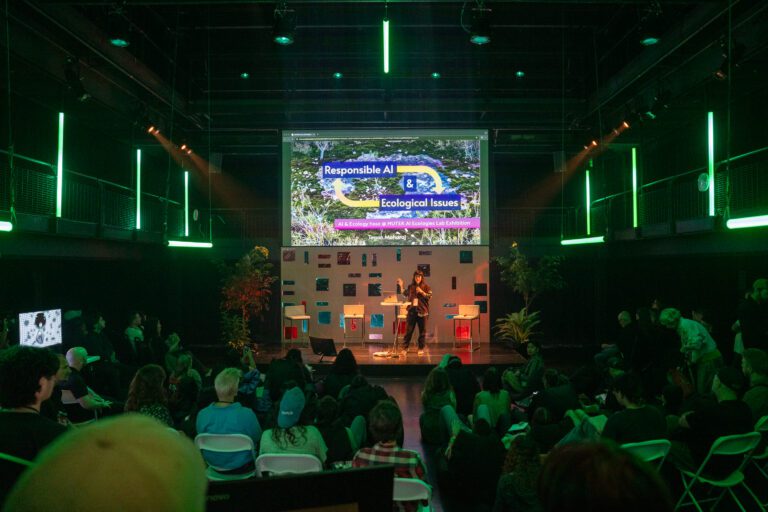
MUTEK AI Ecology Lab: When Sustainability Meets Creativity
One of the highlights of this year’s edition is the MUTEK AI Ecology Lab, whose results were presented today. This year, six projects were hosted in residence at the Society for Arts and Technology (SAT), each with the goal of thinking, reflecting, questioning, and proposing sustainable AI solutions. The projects are presented in the form of an exhibition that demonstrates a critical and creative approach to emerging technologies.
Among the projects presented, Lionel Ringenbach’s Wattsup stands out as a tool for measuring AI energy consumption, responding to growing concerns about the carbon footprint of these technologies. CITYChat, developed by Femke Kocken, Ivonna Bossert, Connor Cook and Sura Hanna, offers a roadmap for transforming data into a sustainable, private, and self-hosted chatbot—meaning one with a lower ecological impact.
These initiatives are part of a broader effort to critically reflect on the environmental and social impact of technologies, a recurring theme in the DNA of the MUTEK Forum.