Additional Information
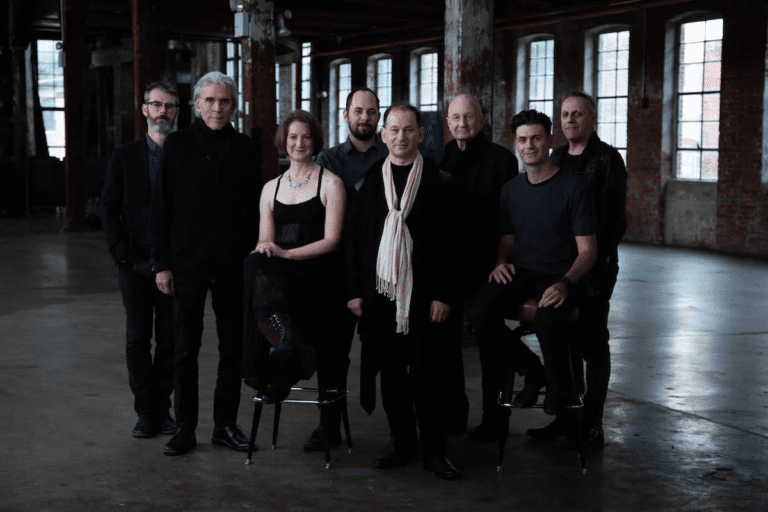
On May 24, the Philip Glass Ensemble (without Philip Glass) will present Explorations in Theater and Film, a panorama of music for stage and screen by the famous “minimalist” composer, aged 86, at Bourgie Hall within the Montreal Museum of Fine Arts. For the occasion, music lovers will be treated to a first: the Canadian premiere of a work lost for nearly 50 years and rediscovered in 2017, Music in Eight Parts.
A FEW TICKETS ARE STILL AVAILABLE. DETAILS HERE
We took the opportunity to speak with Michael Riesman, a loyal friend and unwavering advocate of Glass’ music. All sorts of topics were on the table: the resurrected piece, of course, but also minimalism, contemporary music and Philip’s latest news. Here are some excerpts.
Pan M 360: Hello Mr. Riesman. What is this story about a score that was lost for almost 50 years and then recently found? How is that possible in this day and age?
Michael Riesman: I don’t know all the details, but I think that at some point Philip must have sold that score to make a few bucks (at the time, we’re talking about the 1960s, he had to survive as best he could), but hadn’t made a copy. Then time passed and its trace was lost. It resurfaced in 2017 in an auction at Christie’s! We asked permission to make photocopies, and now it is available. We are playing it on this Explorations in Theater and Film tour, and Montreal will have the privilege of being the first city in Canada where it will be performed.
Pan M 360: Tell me about the piece itself…
Michael Riesman: It’s really in the style of Philip’s early days. At that time, he didn’t compose for a specific list of instruments. He was willing to arrange his scores for whomever would play them! So, one of the only times it was performed, there was, I think, a viola, a cello, a saxophone, some portable organs, and even a clavinet, as in Stevie Wonder’s Superstition! But really, it can be orchestrated in many ways. That’s what I did, and I wanted to modernize it a bit, with Philip’s agreement.
Pan M 360: So how did you “modernize” it?
Michael Riesman: Since this piece was written before the ensemble was formed, I immediately adapted it for our specific formation. So I added voice and winds, of course. That’s the first thing. I also adapted the music itself in two ways: first, by speeding up the tempo a little bit after the first half. Over the years, our ensemble has become accustomed to pushing the tempos. We were slower in the beginning. A sign of the times, perhaps, always more energy. Then, the second strictly musical feature was the addition of more bass towards the ⅔ of the piece and the arrival of jazzy tones. This is how I envisioned the update of Music in Eight Parts, a piece that was never intended to be played in one way, meaning the first.
Pan M 360: So you took a lot of liberty?
Michael Riesman: Yes, indeed. I feel quite free to do that, because a few years ago I did the same thing for a concert with Music with Changing Parts, at the request of Philip himself. We added brass, a girls’ choir, and a lot of other things. Philip is in complete agreement. He never wanted his music to become fixed. For Music in Eight Parts, he heard the version we’re going to play in Montreal, and he likes it.
Pan M 360: You are in regular contact with him?
Michael Riesman: I just saw him last night! We went to a concert of William Bolcom’s music, played by Dennis Russel Davies.
Pan M 360: You’re in a good position to tell us what changed the most in his music then…
Michael Riesman: He started by stripping the music down as much as possible. Those early pieces are radically minimalist, and rarely played. One of them is just a sound line, a drone without any ornamentation, no rhythm, nothing. Today, his works have nothing to do with minimalism! It was a process you know. After the initial radicalism, where could he go? So he started to reintroduce rhythm, then harmony, then melody, counterpoint. But still keeping his signature fetish, the arpeggios, the rhythmic figures like ta-taa ta-ta-taa, etc. It is as if he had brought the music back to its sonic starting point, then went back the other way by reintroducing “classical” and “romantic” elements.
Pan M 360: You’ve been with him all this time. Why did he take this path?
Michael Riesman: Initially, the minimalist movement (and I can also talk about Steve Reich, or Terry Riley) was a reaction against what they called the dead-end of the European modern school, Twelve-tone, serialism, etc. We were losing the audience! Music must be inviting. All this dissonance, this sonic ruggedness, where could we go from there? Philip said, “OK, let’s go back to the base. But further than the base, it’s not necessarily the basement, it’s also going upwards, with new concepts.
Pan M 360: After 50 years, you still enjoy playing his music?
Michael Riesman: Of course! But you know, it’s not a full time job. I do a lot of other things. And we rarely tour for more than two or three weeks. So when I come back to it, I’m always like, “Wow, this is still fun!’’
Pan M 360: Is he still writing?
Michael Riesman: He’s working on a Symphony No. 15, but it’s getting harder for him to concentrate on that kind of exercise. Otherwise, he writes a few small piano pieces from time to time. He still goes out though, to see things (like yesterday with me). But of course, time is moving on for him too…
Pan M 360: Are you an observer of the contemporary scene? What do you think about it?
Michael Riesman: I think it’s good now that the wall of rigid academicism has been broken down. Composers are much freer to write what they want. But, maybe it’s because I’m getting old (lol), I don’t hear a lot of stuff I really like… You’re more likely to meet me at an avant-garde jazz or indie pop concert.
Pan M 360: Thank you and I look forward to seeing and hearing you on May 24th!
Michael Riesman: It will be a great pleasure to come back to Montreal, a great audience, and especially to play for the first time in Bourgie Hall.