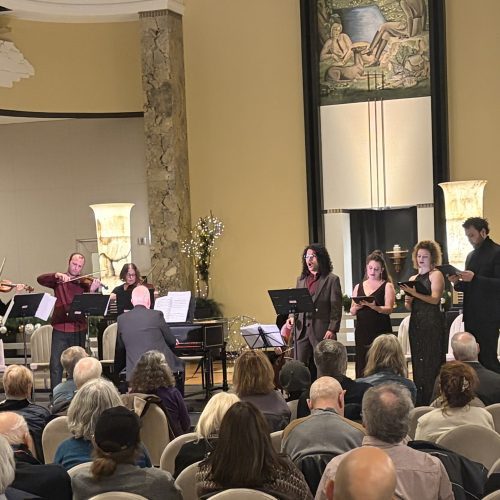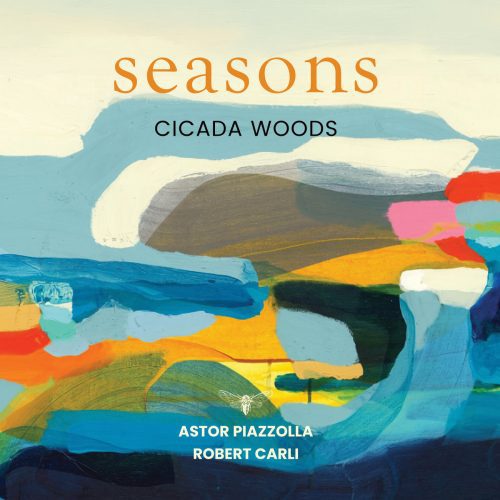
Cicada Woods is a string quartet based in Toronto. String quartet, I say, but rather atypical. Indeed, it consists of a single violin, rather than the usual two, for which a double bass takes its place. Thus, a greater roundness of the bass notes is favoured, while simplifying the textures of the treble notes. In the case of Piazzolla’s Four Seasons of Buenos Aires performed here, a specific arrangement had to be made for this unusual format, whereas versions for a traditional quartet (two violins, a viola, and a cello) already exist. The first impression that reaches the ears is the harmonic thinness of the lines associated with the melodies. Obviously, since they are predominantly and normally expressed by the two violins, here there is one less.
At first listen, I thought I would have to get used to it. After several subsequent listens, I am still not sure if I find this vision entirely happy. But I enjoy it more. That said, beyond this technical detail related to the arrangement, the incisive playing of the four musicians of Cicada Woods is inspired by that of Piazzolla’s classic quintet, the one that created the work in 1970, and whose breath of burning emotion was incomparable. Cicada Woods redistributes a version that draws inspiration from it in terms of expressive effects and rhythms. You can hear beautiful things, superb and joyful creaks worthy of Piazzolla on stage.
As a complement to the program, the ensemble offers a new composition based on the theme of the four seasons. It is the Canadian Robert Carli, a regular in composing for film and television (he has been writing the music for the series Murdoch Mysteries for CBC for eleven years), who was commissioned by Cicada Woods.
The work is divided into two movements, the first linking spring and summer, and the second, autumn and winter.
The first movement thus begins with a spring that struggles to emerge from the frost, manages to take flight on the first rays, and inspires the appearance of flowers and bustling fauna, in colours a bit more jarring than pastoral, but nonetheless luminous. Summer fully nourishes itself with this energy until a fervent finale. In the second movement, autumn is expressed from the very first notes by a touching cello solo that, strangely, reminds me of Rossini’s in the Overture to William Tell. He is joined by the other muted strings, with which a melancholic waltz rhythm gradually takes shape. The cello maintains its leadership with frequent solo lines, like nostalgic soliloquies. The material transforms, taking on a glacial sheen to accompany the winter cold, but also a very contemplative, elegiac character, supported by a poignant melody. It’s honestly very well done.
The debate remains open on these Piazzolla’s Seasons, but Robert Carli’s are convincing.