Additional Information
Obviously, I don’t remember all the discussions I’ve had with the thousands of artists I’ve interviewed, but I do remember some key moments. With composer, arranger, and conductor Mathieu David Gagnon, we had already discussed the immanence of earthly sounds in relation to the consonant choices in his orchestral writing, uniquely infused with progressive rock and Western classical music. This discussion about the creative interaction between nature and sound continues on this April 10, 2026: we’re now on the third chapter of his main project, an album released on the Secret City label, which offers us eight new tracks inspired by the St. Lawrence Estuary and the Laurentian flora that lines its banks.
Mathieu David Gagnon : I’ve never thought about it that way, but I think this album takes its time more than the previous ones. And I think that’s related to my work with ambient, but acoustic, music. When I take, for example, the track Navigation VII, there are long moments of silence. You really feel like you’re on the water. Then all of a sudden, an orchestra comes in.
PAN M 360: It’s like waves, it seems.
Mathieu David Gagnon : Yes, that’s it. Today, more than ever, contemplation is something we rarely allow ourselves. And art is closely linked to that state. When we go to a museum, we don’t dance. We absorb it, then we stop. Sometimes we even sit down. I think that, out of necessity, I make music that makes me feel good. Me, first and foremost. I often like to use the example of a cat purring to heal or soothe itself; it’s a kind of drone, a musical drone.
PAN M 360: That’s exactly it. I also observed the purring of cats very closely, especially that of my 19-year-old cat Jamie, who died about 3 months ago.
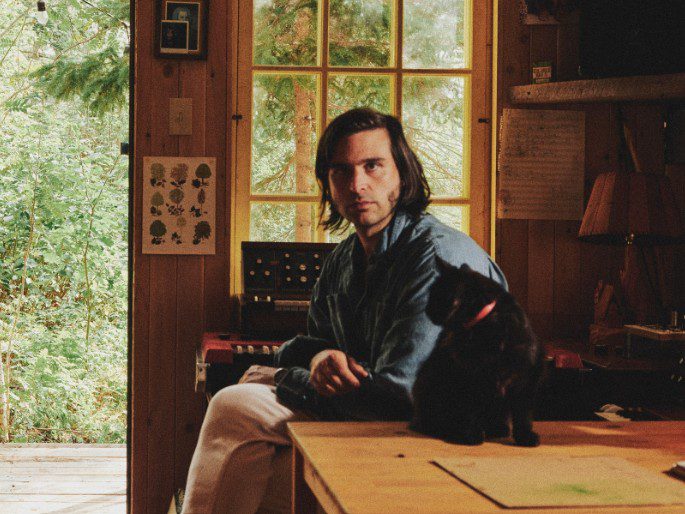
Mathieu David Gagnon : It’s funny you should say that because I recently had my 18-year-old cat euthanized. Watching him throughout his life, I thought, wow, he has a calming mechanism. I realized then that when I sit down at a synthesizer, I can just play a note and listen to how it resonates. And it soothes me, it calms me. My way of calming myself is to write things that make me feel good, things that necessarily bring light. That’s essential for me. I couldn’t make dark or violent music because it wouldn’t soothe me.
PAN M 360: Music serves all sorts of purposes. If soothing is the core value that motivates you to make music, that’s perfectly defensible. There are people for whom the musical expression of violence or other darker feelings is also defensible.
Mathieu David Gagnon : Absolutely.
PAN M 360 : The quest for tranquility or peace doesn’t necessarily involve music as simple as one might think. This is evident once again with this third album, as it was with the other two. The harmonic exploration seems quite straightforward to the average listener. But when you delve deeper, you discover the complexity of the structures, which is a virtue of your seemingly simple music. When complexity is concealed within simplicity, the mission is accomplished.
Mathieu David Gagnon : I love it when my music elicits reactions, whether positive or negative. I like to experiment. For example, in the first piece, Fleurs, I’d wanted to go from a completely acoustic orchestra to a completely synthesizer orchestra within the same piece for a while. You don’t really notice it until it becomes 100% synthesizer.
PAN M 360: Indeed, the crossfade is not easy to achieve.
Mathieu David Gagnon : Exactly. It helped a lot when we added a church pipe organ in the process and rebroadcast the synthesizers in the space to get that orchestral and grand feel.
PAN M 360: The successful relationship between acoustic instruments and synthesizers is fundamental to this album.
Mathieu David Gagnon : It’s quite a challenge to try and give synthesizers acoustic characteristics; that’s really the heart of the project. It’s about trying to take tradition out of its framework and experiment while making classically inspired music, incorporating elements of our time, like the synthesizer. Even though I use old synthesizers, particularly the Minimoog because it’s imperfect, because it has characteristics comparable to some acoustic instruments—that is, it never sounds the same and you have to tune it.
PAN M 360: It is always very difficult to obtain a satisfactory result between electronics and acoustics.
Mathieu David Gagnon : I’m really looking for a complete integration between the keyboards, the string orchestra, the harps…
PAN M 360: There is no complex theme. There are no significant solo parts in your recent work. It’s always a work of harmony and orchestration. There are no complex rhythms, no complex melodies. The uniqueness of your art lies much more in what surrounds the melody, especially in the harmonies and arrangements.
Mathieu David Gagnon : Exactly. And also in the layering, the textures, and the contrasts, like, for example, the contrast between two synth freeruns and two harps. It’s not about virtuosity; that’s not what interests me.
PAN M 360: But sometimes, composers work on both very simple and very gentle things, but they will also allow themselves to express a certain violence, much more oblique musical forms, or even sequences of high complexity for soloists.
Mathieu David Gagnon : I think that as you get older, you eventually discover what’s truly important. When you’re younger, you might be more focused on impressing others and putting on a show to compensate for insecurities. Looking back, what drives me to make music is creating emotions, creating moments, creating atmospheres. Virtuosity isn’t where you usually find it. Playing a Minimoog live, for example, is virtuosity; I have to manipulate the pitch, modulation, filter, and so on in real time.
PAN M 360: From a harmonic point of view, you might one day be asked or thought to explore other types of scales.
Mathieu David Gagnon : To modulate, you need fairly equal intervals. The problem is that the intervals are not equal.
PAN M 360: But you can explore other scales with equal intervals, like the scales of ancient Greece. You could explore scales of that type, resulting in an expansion of your language without distorting it.
Mathieu David Gagnon : That was part of my plan. I initially wanted Volumes 1, 2, and 3 to be like one large piece of my work. It’s true that Volume 3 is more contemplative. I was actually writing a double fugue for that album, but I didn’t have time to finish it. And what remained are pieces that modulate less.
What brings about the contemplative aspect is that we don’t move too much, we don’t push the boundaries of harmony too far. But when I make this kind of album, I often go through a period afterwards where I want to push things further. I’m in that phase.
PAN M 360: Tell us about the instrumentation of the works, one after the other:
Mathieu David Gagnon :
Fleurs is a string quartet that transforms into a string orchestra, with two harps, then the two harps transform into synthesizers, and the string orchestra transforms into a synthesizer orchestra.
Régate is a string orchestra piece, and it uses the Synthi, an EMS analog synthesizer used by Pink Floyd in the 70s. Brian Eno played it a lot when he was with Roxy Music. Towards the end of the piece, I applied a principle I discovered on an Eno album, Discreet Music, where he plays Pachelbel’s Canon using a mathematical formula based on the duration of the notes. So, first violin, the first line; second violin, multiplies all the note values by two. Then the viola, multiplies all the values by three. And the cello and bass by four. So, after two bars, we have an “extended” canon. This then produces new harmonies that didn’t exist before, but which are in the same key. It’s the same tempo, but we have this impression of time stretching and at the end, we’re almost in Arvo Pärt territory because we feel like we’re floating with long notes on the strings.
Petit Matin is a cello quartet playing in a ribbon echo. That was the concept.
Le temps, is also two harps in a ribbon echo.
Fleuve VII, that’s me at the piano with a string orchestra – for the whole album it’s mainly string orchestra or cello quartet and two harps.
So the next track, Fleuve VIII, is me with a funny-looking keyboard made by Rocky Mountain Instruments. It’s the same keyboard Chick Corea played on Miles Davis’s Bitches Brew album, and Tony Banks also played it with Genesis. Even Sun Ra played it!
Navigation VII: A polyphonic synthesizer, which is then doubled by a cello quartet. The cello quartet becomes the synthesizer. I tried to create a super synthesizer with a string quartet and a synthesizer. In the end, the final intervention of the string orchestra arrives like a great surge. For this, I played the track backward and recorded the reverb, as Pink Floyd had already done in the piece “One of These Days.” And then we put everything back forward.
(Through the) Chablis, it’s based on two free-form drum kits; it’s about creating chaos from which light will ultimately emerge. A very simple melody, so that we feel that through this chaos, organized sounds can emerge and bring us light with the two harps, which are, in a way, like chimes in the wind with the two drum kits.
PAN M 360: How does all of this translate onto the stage?
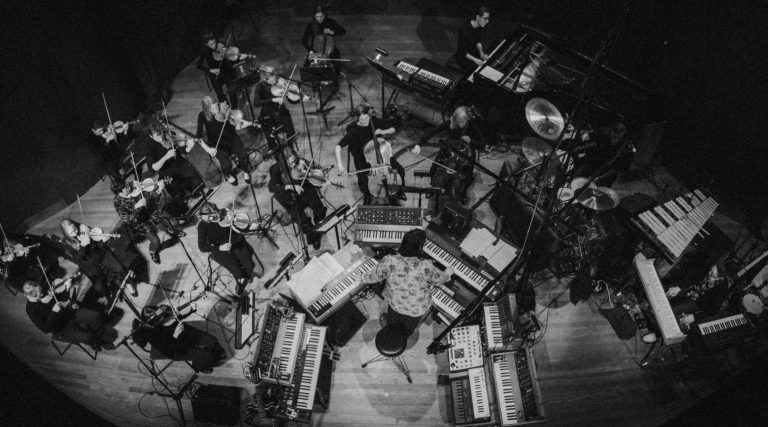
Mathieu David Gagnon : There are seven of us on stage, six in Europe: a string quartet (Mélanie Bélair, Chantal Bergeron, Ligia Paquin, Jean-Christophe Lizotte), a multi-instrumentalist who also plays percussion (Antoine Létourneau-Berger), and myself. For the Quebec leg, drummer Robbie Kuster joins us. I’m surrounded by extraordinary musicians; the goal on stage isn’t to reproduce the album but rather the concepts of these pieces and perform them in a different way. It’s about rearranging and seeing the piece from a new perspective.
PAN M 360 :In closing, I’ll mention some titles from this album : Fleurs, Régate, Navigation, Fleuve, Le temps… lots of water and nature. You’re still in the forest behind Kamouraska.
Mathieu David Gagnon : Yes, I am right in the heart of the Laurentian flora.
PAN M 360: Also in the Laurentian waters!
Mathieu David Gagnon : My father had a rowboat when I was a child in Sainte-Anne-des-Monts; we used to go jigging for cod. The bus route to school in the morning ran along the river, and I always sat on the right side to watch the water. I haven’t sailed all my life, but I like to imagine myself on the water. I love the movement that isn’t terrestrial, the idea of weightlessness, a world unto itself. The river is always different, at every time of day. It’s an endless source of inspiration.