Additional Information
In January 2023, it was announced that La Zarra, a Montreal singer who had achieved great radio success with the hit song “Tu t’en iras,” would represent France at the Eurovision Song Contest in Liverpool, UK. In May 2023, she would therefore perform “Évidemment” at this famous European competition, which Céline Dion had won earlier in its history.
Upon seeing her score given by the public as too low, the singer made a gesture that was interpreted at the time as giving the middle finger, which generated discontent among some, including managers at France 2 involved with the competition. Zarra refuted these accusations of impoliteness stemming from a supposed middle finger gesture, which she insisted had no such meaning whatsoever.
Whether it was a middle finger gesture or not, this event marked the beginning of a precipitous fall, even faster than her meteoric rise. The French tabloids turned on her, and her European career suffered profoundly. Traumatized, the Quebec singer declared that she had been “a victim of racism and manipulation.”
And then…
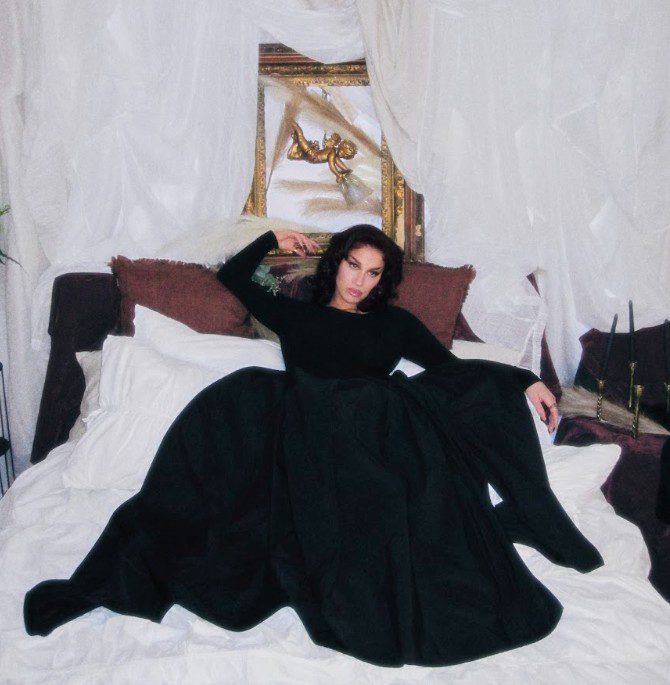
Three years later, La Zarra, whose real name is Fatima-Zahra Hafdi, intends to prove to the pop world that her career was not a flash in the pan. After founding her own company, she undertook to produce a second album: Der Zimmel (The Sky), whose songs really have very little to do with Tu t’en iras.
A unique blend of classic French chanson and Americana, this self-produced album was created in close collaboration with artists Clément Langlois-Légaré, Adel Kazi-Aoual, Claire Ridgely, Félix Dyotte, and Patrick Krief. La Zarra’s fresh start begins here, and she intends to retrace all the steps to win back her audience.
Here’s what she has to tell us!
Fatima-Zahra Hafdi : Yes, that’s true, but then, as you say, in pop music, well, I don’t consider myself to be making popular music against my will. We made two songs that came about, “Tu t’en iras,” for example, which was really at the end of the album. And well, what happened, happened, so afterwards, it kind of positioned me in the pop music scene, let’s say, in that kind of format. But that wasn’t my initial intention. Afterwards, I think maybe it’s to my advantage, but perhaps I have no real understanding of the consequences and what this or that means.
PAN M 360: So you had other intentions than making radio hits with electro music behind them?
Fatima-Zahra Hafdi: I make music, and if I can offer it to my audience and make a decent living from it, I will continue to make it.
PAN M 360: You can count on an audience anyway, but how do you assess its size since what happened at Eurovision?
Fatima-Zahra Hafdi : I don’t know. That’s the least of my worries, all that stuff. I imagine that, like with everything, I think there are people who are like you, for whom the important thing is the music. Then there were all the other personalities involved. We do live in a time when entertainment really comes from all channels, including, of course, social media. There are people who like it, others less so. But I think that today, I have a very loyal audience.
PAN M 360: And who are these loyal fans?
Fatima-Zahra Hafdi : It’s an audience from whom I constantly receive feedback. “How come you sing about my life?” So, we really have this somewhat melancholic connection from our respective stories, we live them together through my songs.
PAN M 360: Artists like you are mirrors of other people’s lives. You come from a modest or ordinary background, like the vast majority of human beings. So, it’s certain that your audience can see themselves in you.
Fatima-Zahra Hafdi : These are our life stories, our love stories, the injustices we’ve experienced, whether social or at work—there will always be some. Speaking openly about them, managing to transcribe them in a slightly more poetic way, is sure to resonate with the audience.
PAN M 360: Let’s talk about the process of the new album, we want the story of how you decided to pick yourself up and make this album.
Fatima-Zahra Hafdi : I was really tired, even before Eurovision. It was starting to get intense, both mentally and physically. After Eurovision, I finally went back to Quebec with my daughter—who is now 17. It did me a world of good to get back to my routine, my friends, my family. Then I thought, OK, what do I do now? Do I still want to make music? So many compromises, so many sacrifices… I felt I’d already made so many. And I finally agreed that I had more to give. And then there was another decision to make. Do I buy my beautiful country house in Tuscany, or do I pursue this project?
PAN M 360: So what?
Fatima-Zahra Hafdi : Thanks to a pretty good support system, I managed to complete this project. I still had this desire to make music, this desire to sing. And I also think I felt like I hadn’t been able to accomplish what I wanted when I started. So there was this feeling of being a bit unfinished; I hadn’t been allowed to do things the way I wanted. Now, I have the opportunity to do it the way I see fit. Even so, it was still difficult.
PAN M 360: We had to take action again, which is no small feat.
Fatima-Zahra Hafdi :During the first studio sessions, I couldn’t write, I couldn’t find any melodies. When I recorded something, people would tell me, “Ah, that’s great, that’s good, that’s beautiful.” I felt like it wasn’t. Even my own voice irritated me. I felt like I was listening to someone else, nothing appealed to me. So I decided to travel. In Italy, in Morocco, I met lots of people, I met musicians, I had time to live and gather new stories. It was essential because I hadn’t had any time for myself since the beginning of this adventure in 2021. It was plane, hotel, sleep, set.
PAN M 360: How did you want to package your songs?
Fatima-Zahra Hafdi : First of all, this is super important. I feel like a lot of people refer to my previous project as if it were just FM pop. But it’s true, some of the songs on the first album are similar to those on this one, actually.
PAN M 360: And what exactly do they look like?
Fatima-Zahra Hafdi : There are a lot of orchestrations, which is super important to me. I wanted to keep that style of grand French songs, full of epic arrangements, to create a sense of grandeur. I listened to a lot of Nancy Sinatra during the creative process and decided to work with the renowned producer Patrick Kreif on the songs “Johnny,” “Tombe les fleurs,” and “Beau garçon.”
I wanted to have that feel, but also an Americana element because it really resonates with me and takes me somewhere else. Very cinematic! And for the next album, I worked with Clément Langlois-Légaré (Clay and Friends) on “Entre mes doigts.” In fact, each collaborator brought what they did best, whether it was Patrick with the Americana elements or Clément with the more modern sound. I was able to offer something new, but which still has echoes of the first album.
PAN M 360: So you didn’t want to go back to the electronic approach of your supertube that launched you.
Fatima-Zahra Hafdi : The goal of this project was to create zero songs designed for radio success as we understand it today. However, if you listen to a song like “La ballade des perds” (The Ballad of the Losers), it’s a song I would play on the radio. But today’s radio has to sound like this or that famous artist. But I’m certain that we can move away from those parameters and still be successful. We’ll see how it goes. It’s a gamble, and I hope I’m right.
PAN M 360: Whatever happens, you will have tried to do it your way.
Fatima-Zahra Hafdi : Yes, and I had no intention of radio or pop success. What was important to me was to tell the story of this recent period of my life through song. That said, I’m still a good up-tempo singer and I might surprise you again! More songs will be ready this summer, the creativity is flowing, and I’ll also be bombarding you with songs at La Zarra!
PAN M 360: The return of synth-pop?
Fatima-Zahra Hafdi : I’m going to give you a good pop song in the style of Zarra.
PAN M 360: In general in pop music, the character, the lyrics and the voice of the person are part of the work, and that’s also the case for you!
Fatima-Zahra Hafdi : I never had that thought.
PAN M 360: It’s my job to think about that.
Fatima-Zahra Hafdi : That’s good, because I don’t really like thinking about it.
PAN M 360: Artists may not have to think about it, indeed.
Fatima-Zahra Hafdi : But you still have to be pragmatic about what’s achievable. I feel like I’m still at the beginning of my musical exploration. So I could release another electro album, or surprise people with a country album. You also have to make choices so as not to confuse the audience.
PAN M 360: You no longer work with a label, you’re going it alone, aren’t you?
Fatima-Zahra Hafdi : Yes, it’s my structure, my organization. I manage everything. The business managers who helped me at the beginning have given me back the reins. But I’ve always been at the heart of the project. Even when I was under contract with a label, I was doing pretty much the same work. I was always intervening with my project managers.
PAN M 360: Your career path could resemble that of Yseult, who enjoyed great success in France.
Fatima-Zahra Hafdi : She was right to do it. Look at the results now!
PAN M 360: If it’s successful in the long run, it’s sure to guarantee you much better income and also gives you freedom of action with risk capital that you can keep to pursue other ventures. And the rest of the money will go into your retirement fund.
Fatima-Zahra Hafdi : That’s exactly it. I’m betting on myself; I won’t be able to blame anyone but myself if it doesn’t work out. But I’m mostly afraid of disappointing my audience if it doesn’t work out.
PAN M 360: The album Der Himmel is an open book, the narrative thread of your recent journey.
Fatima-Zahra Hafdi : I wanted songs that reflected my state of mind when I started working on this project. I was full of uncertainty, a little lost in my intentions. Emotionally and mentally, I was exhausted. The first two songs, “Tomber les fleurs” (Falling the Flowers) and “Entre mes doigts” (Between My Fingers), capture that state of mind. Then I met some people who led me to see this work in a very positive light. It made me want to write songs that offer a little more hope and love. I decided I wasn’t going to cut anything from these personal revelations, that the audience would have a right to a certain intimacy.
PAN M 360: It’s autobiographical in diffraction. Not too much?
Fatima-Zahra Hafdi : I’ve been exposed so much in the past, and it wasn’t my real story. This time, I thought, since I’m going to do it anyway, I’ll go all in. Even though I’m different from who I was when I started making music. I’m less private about my personal life; I’ve gotten used to being in the public eye, and I can let people into my personal world.
PAN M 360: What did you learn from the adversity you experienced during the Eurovision era?
Fatima-Zahra Hafdi : I know I’m someone who doesn’t have regrets. If I had to do it all over again, I’d do the same thing during that time, beyond the gesture that was interpreted as a middle finger. I know myself. I agreed to play that game, with some people in that environment who were perhaps darker than I expected. Maybe I should have listened to myself and not listened to what others were telling me. At the same time, if I hadn’t gone through that, I wouldn’t have the tools I have today for what comes next. Because I want to make music for a long time.
PAN M 360: In a way, we have to start from scratch because there won’t be a radio tube to recreate the buzz.
Fatima-Zahra Hafdi : Yes, first I’ll have to play small venues and fill them with emotion. I’ll have to do all the little things I should have done from the start. It’ll come back. I’ll have confidence in myself. I’ll be comfortable.