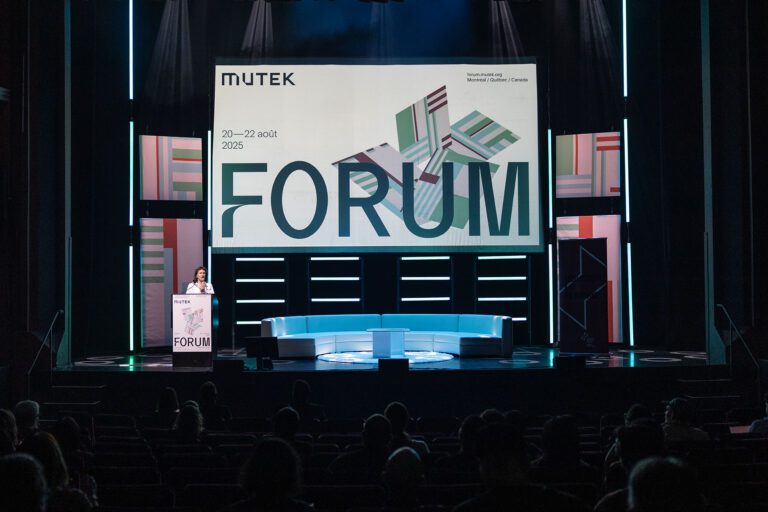
Day 2 of the MUTEK Forum continued exploring the intersection between technology and artistic practice, with a particularly fascinating session on the emergence of a quantum musical aesthetic. Presented by the École de technologie supérieure (ÉTS) and moderated by Pía Baltazar, Director of Arts-Sciences Development at the Society for Arts and Technology, this panel brought together France Jobin, a pioneering artist in the field, Sebastián Duque Mesa, physicist and artist, and Olivier Landon-Cardinal, professor-instructor at ÉTS.
The session opened with a provocative question from moderator Pía Baltazar: “Is there a quantum musical aesthetic? We are at the tip of our ignorance. What does it mean to think musically in quantum terms?” This inquiry laid the foundation for an exploratory three-part discussion.
Context: Scientific Knowledge and Music as Collective Memory
The discussion began by establishing the fundamental relationship between musical genres and their sociopolitical contexts. France emphasized how every musical genre is anchored in specific sociopolitical circumstances, citing blues, techno, and computer-assisted music as perfect examples of this phenomenon.
Sebastián Duque Mesa raised a fundamental question about the very nature of quantum music: “Does a quantum computer produce quantum music, or is it just an instrument?” In other words, do we use quantum technology as a tool or do we genuinely seek to incorporate quantum principles into compositional thinking?
Olivier Landon-Cardinal offered an interesting perspective on art’s role in making complex scientific concepts accessible. He argued that art can convey intuition about quantum science and information without requiring mathematical equations. As he noted: “In quantum mechanics, we build intuitions based on our knowledge and you can be sure they will be deconstructed by new experiments.” Art, he suggested, can help transmit quantum intuitions by transcending traditional academic boundaries, reaching a broader audience.
Practice: Quantum Concepts in Compositional Strategies
The discussion traced a lineage of pioneers who laid the groundwork for quantum musical thinking. Iannis Xenakis, the mathematician-architect-musician, was highlighted for his exploration of probabilistic composition in works like Metastasis (1955). Curtis Roads, Xenakis’s student, revolutionized electronic music with granular synthesis, which “builds acoustic events from thousands of sound grains,” as described in The Computer Music Tutorial (2023).
Sebastián noted how Curtis Roads found a way to use music as a proxy for exploring quantum concepts, inspired by Dennis Gabor’s theoretical framework from the 1940s. This approach treats sound particles that “you can’t hear” as compositional building blocks, exploring concepts like superposition and collision in works such as Half Life Part 1: Sonal Atoms (1999).
Olivier Landon-Cardinal emphasized the historical significance of wave-particle duality in both physics and music, noting how the development of computers finally provided the tools to practically explore these concepts. The recognition of quantum entanglement, first described by Schrödinger 100 years ago in his 1925 equation, represents what he called “the characteristic trait of quantum mechanics.”
Perception and Experience: Quantum Listening and the Observer Effect
The most intriguing aspect of the discussion focused on how quantum principles might transform the listening experience itself. France described her project Infinite Possibilities (Particle 1) (2024) and Infinite Probabilities (Particle 2) (2024), conceived as two albums that can be experienced separately or together. In this framework, they function as quantum systems and the listener becomes the observer whose choices determine the musical reality.
France Jodoin’s work Entanglement (2023) draws inspiration from quantum field theory’s concept of “vacuum fluctuation,” where particle pairs appear and disappear simultaneously. This piece explores how quantum concepts can generate new forms of musical experience that exist in superposition until the moment of observation.
In her installation work, particularly in environments like SAT’s dome with 95 speakers, France Jobin attempts to create different experiences for each listener within the same physical space. This echoes Olivier Landon-Cardinal’s observation that “when you interact with a quantum system, things are not real before measurement. In the case of France’s performance, we are in the same room listening to the same thing but we have a different perception of the event. Acquiring information allows us to build our own reality.”
The session concluded with France Jobin’s invitation to Forum participants to “feel the quantum” at Métropolis 1, where she will present Lueurs Quantiques with Markus Heckmann. To do this, she invites us to experiment with different perspectives by moving between the dance floor, mezzanine, and the rest of the venue to create our own reality.