Additional Information
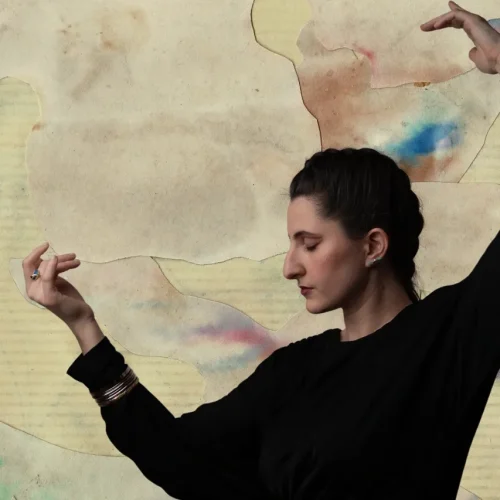
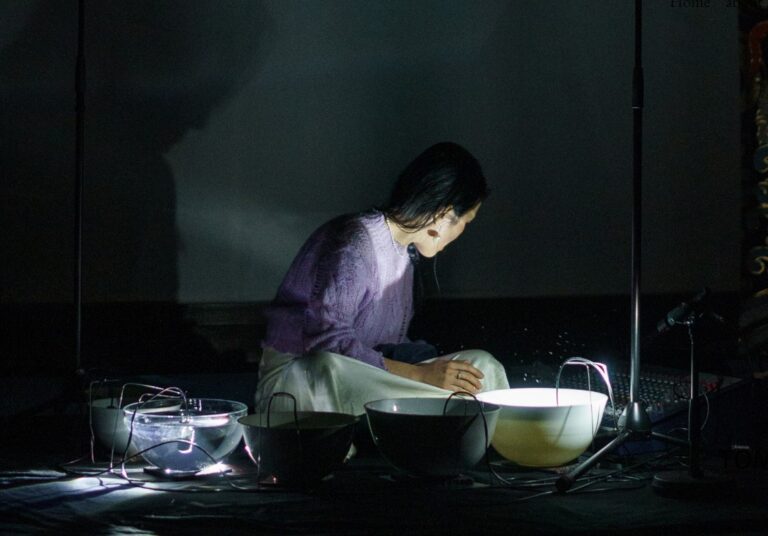
Tomoko Sauvage’s creativity and inventiveness are a subtle blend of technicality and empiricism. Her electro-aquatic approach reveals itself to be an inexhaustible source of sonorities intertwining the injunction of a mastered touch on ceramic containers and the labile result of aqua-echo.
Poetic and metaphysical, this staging of sound unfolds like an equation of chance where a liquid component metamorphoses into a voluble sonata.
For the past 20 years, this performer-musician, originally from Yokohama (Japan) and now based in Paris, has syncretized a series of practices from her background: jazz piano studies in New York, Indian classical music studies (Hindustani), album productions following the example of the album Fischgeist, released in 2020, recorded in Germany in basins with extremely singular conditions.
Now renowned for her performances with waterbowls performed all over the world, she is one of the quality guests of the Akousma festival.
For PAN M 360, she gives us the pleasure of detailing a few aspects of her past, present and future installations.
PAN M 360: Tomoko, in July 2012, I attended one of your performances at the FRAC -Fond Régional d’Art Contemporain- de Lorraine, in Metz, organized by l’association des musiques nouvelles: Fragment. You performed on a variety of bowls in a meditative, contemplative context. The audience was in raptures. Your gestures resembled a ritual. How has your practice evolved since then?
TOMOKO SAUVAGE: It’s been 11 years now! My memories are more or less vague, because every performance is different. My music has evolved enormously since then, that’s for sure. With my instrument waterbowls, I accentuate repetitions while playing on slow evolutions, all smoothly. In 11 years, I hope it’s evolved well!
PAN M 360: More recently, last February, you were invited by MUDAM -Musée d’Art Moderne du Grand Duché- in Luxembourg, in the European district of Kirchberg, to take part in the exhibition by Lebanese artist Tarek Atoui, entitled: Waters’ Witness. The artist is known for his multi-sensory installations based on sound and objects. Considering sound as a catalyst for human interaction, he collaborates with a number of specialists. How did you come up with this performance?
TOMOKO SAUVAGE: Effectively, I was invited to play echo music. The project was designed so that I could draw inspiration from the sound already existing in the room. Based on Tarek Atoui’s sound installation, I had to develop a panoply of notes. I was constantly on the lookout for opportunities to play and outwit. Sometimes, I was able to anticipate quieter moments or pauses to add my sound. It was a real challenge! The structure and configuration of the MUDAM are very special, as it’s a mixture of reinforced concrete and voluminous spaces that are conducive to strong reverberation;
PAN M 360: Regarding your presence at Akousma, given that each performance is unique, how do you approach it?
TOMOKO SAUVAGE: With waterbowls, the acoustics of the venue are decisive for the sounds I can get out of my instrument. Every venue is a technical challenge. It will be very special to play in the acousmonium with lots of speakers. It can be quite difficult to control the feedback I use as a musical element. That’s why I require a long sound test to get to know the acoustics of the venue and to set up the sound environment for my water bowls.
PANM360: Your latest album, Fischgeist, released in 2020, in Berlin-Prenzlauer Berg, in August 2019. It was recorded under very specific and particular conditions. Can you tell us more about the conditions and how they had a singular effect on the sounds?
TOMOKO SAUVAGE: It was recorded in an old water tank that has very long reverberations, either 20 seconds or more. To play with feedback, it’s pretty incredible. There were many possible and unimaginable frequencies that I managed to capture, but also very rich harmonics. The tiniest sound was naturally amplified. I loved this unique space made of old nineteenth-century bricks. The setting was damp and cold. The temperature oscillated between 8 and 10°C. It was incredible! It was incredible!
PAN M 360: Do you think this style of music should or will remain dedicated to a well-informed, initiated audience? Is there a way of democratizing it or at least raising awareness among a wider audience?
TOMOKO SAUVAGE: Actually, yes! In Europe, I’m often invited to play in rather mainstream contexts. I’ve already played in small-town media libraries, but also big electronic music festivals. These days, festival programmers want to mix genres. There are a lot of people, especially young people, who are curious to discover music they don’t know. I’m delighted!
PAN M 360: Plans for the near and distant future?
TOMOKO SAUVAGE: A lot of things, yes! I’m currently preparing new sound installations to be presented at an arts biennial in Santiago, Chile, in November. I’ve just completed the music for a short hand-drawn animated film by a French director. I’m preparing an EP release with INA-GRM in Paris. It’s a good period with a lot of inspiration for me. The multiple crises our world is going through today lead me to believe that we need music more than ever.