Contemporary / Création / saxophone

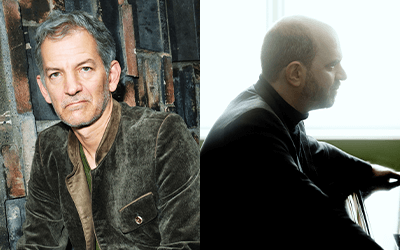
Quatuor Quasar : Cinq pièces liquides à la salle Paul-Desmarais

by Rédaction PAN M 360

Quasar propose un programme qui marie les musiques contemporaines aux œuvres de création, avec 5 œuvres qui gravitent de près ou de loin autour de l’univers musical du compositeur québécois Claude Vivier.
Le concert s’intéresse d’une part aux cercles rapprochés de Claude Vivier, avec l’œuvre d’un de ses maîtres en composition à Paris, Paul Méfano. On découvre ensuite son influence sur les compositrices et compositeurs d’aujourd’hui avec Bestiaire d’Émilie Girard-Charest, ainsi que 2 œuvres commandées spécialement pour ce projet : L’instant liquide de Florence M. Tremblay et Cinq pièces liquides de Yassen Vodenitcharov. En ouverture, redécouvrez l’œuvre phare de Claude Vivier, Pulau Dewata, que le quatuor ne cesse de jouer et de parfaire depuis près de 30 ans, dans un hommage toujours renouvelé à ce grand compositeur.

Quasar presents a program that blends contemporary music with original works, featuring five pieces that orbit—closely or distantly—around the musical universe of Quebec composer Claude Vivier.
The concert explores Vivier’s inner circle, beginning with a work by one of his composition mentors in Paris, Paul Méfano. It then traces Vivier’s influence on today’s composers through Bestiaire by Émilie Girard-Charest, as well as two works specially commissioned for the project: L’instant liquide by Florence M. Tremblay and Cinq pièces liquides by Yassen Vodenitcharov. The program opens with Claude Vivier’s iconic work Pulau Dewata, which the quartet has performed and refined for nearly 30 years—a continually renewed tribute to this remarkable composer.

Programme/program

Yassen Vodenitcharov – Cinq pièces liquides
Claude Vivier – Pulau Dewata
Florence M. Tremblay – L’instant liquide
Paul Méfano – Mouvement calme
Émilie Girard-Charest – Bestiaire

POUR ACHETER VOTRE BILLET, C’EST ICI!

Ce contenu provient du Quatuor Quasar et est adapté par PAN M 360
classique

Mahler’s Ninth by the OSM: Farewell to a Futile and Frantic World

by Judith Hamel

On Wednesday evening, Rafael Payare conducted the Montreal Symphony Orchestra in the continuation of the Mahler cycle, this time with the composer’s final completed symphony, the Ninth. A highly demanding work that reflects the consciousness of a man who knows his end is near and is bidding farewell to the world.

At the time of composing the work, Mahler knew he had been diagnosed with heart valve disease and was haunted by the recent death of his daughter. Fearing the bad luck associated with ninth symphonies (Beethoven, Schubert), Mahler had avoided numbering his previous symphonic work, but in vain: this Ninth would indeed be the last symphony he would complete.

Payare offers us a reading that is quite different from the classic interpretations marked by great dramatic tension that we associate with Mahler, right from the first movement.

In this first farewell to life, lasting around thirty minutes, it is difficult to find a clear guiding principle to hold on to. Payare’s direction evokes less the gravity of this imminent end than the vertigo of our existence in our modern era, where everything moves at high speed and everything is ephemeral. In fact, his proposal has something profoundly contemporary about it: that of a frantic, saturated world where futility takes hold.

The second movement, a Ländler, opens with a section of tightly knit bassoons and a section of rough strings. Here, Payare opts for rusticity and fully embraces the woody, earthy character. The intoxicating circularity of the rhythm, the warm cooing of the French horns, and the wavering pace of the waltz create a country atmosphere that is both joyful and melancholic. It is a farewell to the simple pleasures of life.

The Rondo-Burleske is delightfully sarcastic. It is a whirlwind of sound, a celebration that descends into frenzy. Each section of the orchestra shines with its density and energy, contributing to this brilliant and chaotic orchestral extravaganza. A gargantuan celebration, carried by a deliberately pompous ending, unapologetically ironic.

The final Adagio presents the acceptance of leaving this world. Payare’s subtlety serves this movement well. He deploys a more sober and internalized gesture, adapted to the delicacy of this last movement. Little by little, he allows the sounds to breathe, until the fear of death fades away. In this long farewell that closes this great symphony, silence becomes the last and most eloquent of notes.

A few seconds of silence were observed at the end of the symphony. This silence filled the space, imposing itself loudly. It was followed by a heartfelt ovation.

Photo Credit: Gabriel Fournier

Fado

Mariza | L’étoile du Fado à la Maison symphonique

by Rédaction PAN M 360

Pour le plus grand plaisir du public montréalais et de la communauté portugaise, la grande fadiste Mariza fait son retour à la Maison symphonique pour un concert attendu depuis plus de huit ans. Icône de la musique lusophone du XXIᵉ siècle, elle s’est imposée comme l’une des voix les plus puissantes et les plus émouvantes de la scène internationale. Depuis Amália Rodrigues, peu d’artistes portugaises ont connu une carrière internationale aussi brillante. Mariza s’est illustrée sur les scènes les plus prestigieuses du monde, recevant les éloges de la critique et accumulant de nombreuses distinctions internationales. Née au Mozambique et élevée dans la Mouraria, quartier historique de Lisbonne intimement lié à la naissance du fado, Mariza grandit dans un univers où les voix, les guitares et les récits de vie façonnent l’âme de cette musique. Très tôt, elle s’approprie cet héritage et le projette dans une dimension universelle. Dotée d’une voix exceptionnelle et d’un charisme naturel, elle conquiert d’abord Lisbonne avant de devenir rapidement un phénomène international. Depuis plus de deux décennies, Mariza parcourt les grandes scènes du monde, de l’Amérique du Nord à l’Asie, de l’Europe à l’Amérique latine, emportant avec elle l’âme et la sensibilité du Portugal. Sa carrière remarquable compte plus de cinquante disques de platine, plusieurs nominations aux Grammy Awards et une reconnaissance critique qui la place parmi les grandes voix de la musique du monde. Héritière de la tradition du fado, tout en regardant vers l’avenir, Mariza incarne une vision vivante de ce patrimoine musical. Sur scène, sa présence et la profondeur de son interprétation transforment chaque concert en une expérience rare, où l’émotion du fado se partage dans toute sa vérité.

To the great delight of Montréal audiences and the Portuguese community, the celebrated fadista Mariza returns to the Maison Symphonique for a concert eagerly awaited for more than eight years. An icon of 21st-century Lusophone music, she has established herself as one of the most powerful and moving voices on the international stage. Since Amália Rodrigues, few Portuguese artists have enjoyed such a brilliant international career. Mariza has graced the world’s most prestigious stages, earning critical acclaim and receiving numerous international awards and distinctions. Born in Mozambique and raised in Mouraria, the historic Lisbon neighbourhood closely linked to the birth of fado, Mariza grew up in a world where voices, guitars, and stories of life shaped the soul of this music. From an early age, she embraced this heritage and carried it into a universal dimension. Gifted with an extraordinary voice and natural charisma, she first captivated Lisbon before quickly becoming an international phenomenon. For more than two decades, Mariza has performed on the great stages of the world, from North America to Asia, from Europe to Latin America, carrying with her the soul and sensibility of Portugal. Her remarkable career includes more than fifty platinum records, several Grammy Award nominations, and critical recognition that places her among the great voices of world music. Heir to the tradition of fado while resolutely looking toward the future, Mariza embodies a living vision of this musical heritage. On stage, her presence and the depth of her interpretation transform every performance into a rare experience, where the emotion of fado is shared in all its truth.

POUR ACHETER VOTRE BILLET, C’EST ICI!

Ce contenu provient de Place des Arts et est adapté par PAN M 360

DJ set / Electronic

Piknic Électronik : Maceo Plex et plus au parc Jean-Drapeau

by Rédaction PAN M 360

Piknic Électronik a été fondé à Montréal en 2003 par un groupe de passionnés de musique électronique qui cherchaient à la rendre plus accessible en la diffusant au grand jour en proposant une expérience sociale immersive placée sous le signe de la convivialité. Situé dans un parc urbain à 10 minutes du centre-ville de Montréal, il rassemble des milliers d’amateurs de musique électronique tous les dimanches de l’été, de mai à septembre. Avec sa programmation variée, Piknic Électronik Montréal s’est imposé depuis plus de 15 ans comme un événement phare du circuit culturel estival montréalais.
Devenu un événement estival culturel et festif majeur à Montréal, Piknic Électronik s’exporte partout sur la planète. En 2012, un premier Piknic Électronik a vu le jour à Barcelone, puis se sont ajoutées les villes de Melbourne et Dubaï en 2014, Santiago en 2015 et 2019 verra la première édition de Paris prendre son envol. Sa formule innovante et populaire de Piknic Électronik en a fait une source de fierté locale pour chaque ville où elle s’est établie et a grandi. Le concept Piknic s’exporte au-delà des frontières de la métropole. D’autres villes à l’international sont pressenties pour se joindre prochainement à l’aventure. À suivre!

Piknic Électronik Montreal is an outdoor electronic music event aiming to offer immersive, social experiences in a friendly environment. Located in an urban park just 10 minutes from downtown Montréal, he brings together thousands of electronic music enthusiasts every Sunday from May to September. Piknic Électronik Montreal diverse programing has made it a highlight of the Montreal summer cultural circuit for over 15 years.
The Piknic concept has expanded beyond Montréal’s borders. In 2012, the first Piknic Électronik kicked off in Barcelona, followed by Melbourne and Dubai in 2014 and Santiago Chile in 2015 and Paris in 2019. More international cities are coming soon, so stay tuned!

POUR ACHETER VOTRE BILLET, C’EST ICI!

Ce contenu provient du Piknic Électronik et est adapté par PAN M 360

Contemporary / quatuor à cordes

Le Vivier : Quatuor Bozzini — Concert 25 ans — Brook, Di Castri, Miller à l’Espace orange de l’Édifice Wilder

by Rédaction PAN M 360

Le Quatuor Bozzini célèbre son 25e anniversaire avec un programme mettant en lumière son engagement pour la création et la collaboration. Le Quatuor Bozzini poursuit les célébrations de son 25e anniversaire avec trois nouvelles œuvres de compositeur-ices canadien-nes de renommée internationale, Cassandra Miller, Zosha Di Castri et Taylor Brook. Miller collabore depuis de nombreuses années avec le Quatuor Bozzini, notamment avec About Bach (2016), lauréat du prix Jules-Léger, et avec l’œuvre incroyablement intime Thanksong (2020). Sa dernière pièce pour le Quatuor Bozzini est basée sur la mémoire musicale et les souvenirs reliés à la musique. Brook, ancien participant du Composer’s Kitchen (2009) et compositeur de Musique de chambre (noire) (2012, film+musique) écrit pour le Quatuor Bozzini, invente une musique folk microtonale inspirée par la ville légendaire baltique de Vineta. Le Quatuor Bozzini se réjouit de travailler pour la toute première fois avec la compositrice Zosha di Castri, qui livre une pièce explorant les textures et les possibilités sonores du quatuor à cordes.

The Bozzini Quartet celebrates its 25th anniversary with a program highlighting its commitment to creation and collaboration. The ensemble continues its anniversary season with three new works by internationally renowned Canadian composers Cassandra Miller, Zosha Di Castri, and Taylor Brook. Miller has been collaborating with the Bozzini Quartet for many years, notably with About Bach (2016), winner of the Jules Léger Prize, and the deeply intimate Thanksong (2020). Her latest piece for the quartet draws on musical memory and the recollections tied to music. Brook, a former participant of the Composer’s Kitchen (2009) and composer of Musique de chambre (noire) (2012, film + music) for the Bozzini Quartet, creates a microtonal folk-inspired work influenced by the legendary Baltic city of Vineta. The Bozzini Quartet is also delighted to collaborate for the very first time with composer Zosha Di Castri, who presents a piece exploring the textures and sonic possibilities of the string quartet.

POUR ACHETER VOTRE BILLET, C’EST ICI!

Ce contenu provient de Le Vivier et est adapté par PAN M 360

Electronic / IDM / Industrial

Autechre à la SAT

by Rédaction PAN M 360

Autechre, le duo britannique composé de Sean Booth et Rob Brown, est de retour avec AE_2022–, une série de longues compositions, enregistrées lors de performances live à travers le monde entre 2022 et 2024.
Entre le 9 et le 12 décembre 2024, Autechre a pris les commandes de la prestigieuse série Artist In Residence sur BBC 6Music, en présentant quatre DJ sets d’une heure. Explorez les tracklists ici.
L’année 2025 marque le grand retour d’Autechre sur scène, avec une série de concerts ambitieuse. Le duo traversera l’Amérique du Nord pour la première fois en dix ans, et fera également escale au Royaume-Uni et en Europe. Ces performances, qui s’annoncent comme des expériences immersives, pourraient intégrer de nouvelles compositions issues du projet AE_2022–.

Autechre is Sean Booth and Rob Brown. In November 2024 the duo released their most recent new music. AE_2022– is a series of extended pieces recorded in front of live audiences around the world between 2022 and 2024 (so far).
In December 2024, Autechre took over BBC 6Music’s prestigious Artist In Residence series, presenting four hour-long DJ shows that were originally broadcast between 9th and 12th of that month. You can explore the tracklists here.
2025 sees Autechre take to the road in one of their most extensive series of live shows to date. This includes their first North American tour in ten years plus UK tour and key European summer dates. It is expected that some of these performances might form part of the ongoing project of new music, AE_2022–.

LES BILLETS POUR CE SPECTACLE SONT ÉPUISÉS!

Ce contenu provient de la Société des arts technologiques et est adapté par PAN M 360

Alt Folk / Folk Rock / Traditional

Mumford & Sons au Centre Bell

by Rédaction PAN M 360

Pour coïncider avec la sortie de leur cinquième album, RUSHMERE, le groupe est heureux d’annoncer une tournée d’arénas et d’amphithéâtres en Amérique du Nord.
En quatre albums, Mumford & Sons ont accumulé de nombreux prix, dont deux prix BRIT, deux prix Grammy (notamment celui de l’Album de l’année), de multiples succès d’albums en tête de classement et multi-platine à l’échelle mondiale, une série de performances en tête d’affiche de festivals (dont Glastonbury), ainsi que des tournées à guichets fermés dans de plusieurs arénas (y compris leurs plus grandes affluences à ce jour aux États-Unis, lors de la tournée Delta en 2019). Le son unique de Mumford & Sons a inspiré et influencé de nombreux artistes contemporains, qui ont eux-mêmes connu un grand succès. 

To coincide with the release of their fifth album, RUSHMERE, the band are excited to announce an arena and amphitheater tour of North America.
Through four albums, Mumford & Sons have accumulated various awards for their work, notably two BRIT Awards, two Grammy Awards (including the prestigious Album of the Year), multiple chart-topping, multi-platinum album successes right across the globe, a string of festival headlining performances (including Glastonbury), and selling out arenas tour after tour (including their biggest numbers to date in the U.S. in conclusion of the Delta tour back in 2019). A distinctively Mumford & Sons sound has since influenced and inspired recent artists to find huge success in their own right.

POUR ACHETER VOTRE BILLET, C’EST ICI!

Ce contenu provient d’evenko et est adapté par PAN M 360

Electro-Pop / Indie Pop / R&B

Oklou au Théâtre Beanfield

by Rédaction PAN M 360

La chanteuse, productrice et DJ française Oklou écrit des chansons pop oniriques et futuristes, influencées à la fois par la musique ambiante expérimentale, la trance et le R&B avant-gardiste. Des sorties comme son mixtape Galore (2020) sont à la fois introspectives et escapistes, reflétant ses émotions et son parcours de découverte de soi à travers des morceaux mystérieux et plein de désir, emplis de synthétiseurs atmosphériques, de voix électro-modifiées et d’enregistrements de terrain. Après des collaborations ou des remixes avec des artistes tels qu’A.G. Cook, Bladee et Dua Lipa, Oklou a sorti son premier album, choke enough, en 2025.

French singer, producer, and DJ Oklou writes dreamy, futuristic pop songs equally influenced by experimental ambient music, trance, and left-field R&B. Releases such as her 2020 mixtape Galore are both soul-searching and escapist, reflecting her emotions and self-discovery journey through mysterious, longing tracks filled with atmospheric synths, electronically altered vocals, and field recordings. Following collaborations or remixes with artists such as A.G. Cook, Bladee, and Dua Lipa, Oklou released her debut album, choke enough, in 2025.

POUR ACHETER VOTRE BILLET, C’EST ICI!

Ce contenu provient d’AllMusic et est adapté par PAN M 360

classique / période romantique

Samuel Hasselhorn & Ammiel Bushakevitz à la salle Bourgie

by Rédaction PAN M 360

La belle meunière, l’un des cycles de lieder les plus appréciés des mélomanes, porte sur l’errance, l’amour, le refus de recevoir cet amour en retour, la colère et l’appel de la mort. Hasselhorn et Bushakevitz tentent de faire la lumière sur cette inconnue, la mystérieuse « belle meunière » dont nous ne savons presque rien.

Die schöne Müllerin is one of the most beloved song cycles of all time: a story about wandering, falling in love, not being loved in return, raging, and finally longing for death. Here, Hasselhorn and Bushakevitz attempt to shed some light on the mysterious miller-maid—a figure almost completely unknown to us.

Programme/program

SCHUBERT Die schöne Müllerin [La belle meunière/The Fair Miller-Maid], D. 795

POUR ACHETER VOTRE BILLET, C’EST ICI!

Ce contenu provient de la salle Bourgie et est adapté par PAN M 360

Experimental

Akousma | A Concert Augmented by Bone Conduction

by Judith Hamel

On October 9, a packed house was held under the dome of the Society for Arts and Technology for the Augmented Concert presented by Akousma. This pioneering event, which for the first time used bone conduction headphones in a structured manner in an electroacoustic concert context, featured four specially commissioned mixed music works.

After a brief presentation by Andrea Gozzi, director of the research-creation project, several thanks from the collaborators and a calibration of our bone conduction headphones, we are ready for the immersion.

Nicola Giannini, La dialectique de la proximité

Posted behind his synthesizers, Nicola Giannini sculpts a dialogue between vastness and intimacy. The first minutes stretch out in various iterative patterns spatialized around us and through our headphones. A voice finally rises through our cochleas: “But I love the sound of this felt pen that goes towards you, towards me, towards us.” Giannini lingers writing with this said felt pen and we hear these gestures in our headphones. A crossing of an organic sound universe created by synthesis, a dialectic of proximity…

Duo Catalão-Thibault, INTIMITÉ INFINITÉ

Equipped with horns, Dominic Thibault and João Catalão slowly cross the space, moving from the back of the dome to the front. At each sound call, they take a few steps. Once they arrive at their installation, around the bass drum, the horns are used to produce windy whistling sounds, now transmitted directly to our headphones, creating immersion and intimacy. Then, the two artists manipulate various objects in interaction with the drum. They explore granulations, friction, complexity of sound mass and timbral qualities. The exploration of sound circularity is particularly interesting, notably through the gesturalization of a metal chain on the bass drum.

The end returns to the beginning with a slow movement of the artists out of the device. This is punctuated by alternating rattles of rattles that gradually fade away until the sound disappears completely.

Ana Dall’Ara-Majek, Polyhedral Rhythms

With his mysterious PhotoTable (an invented instrument), Dall’Ara-Majek places several vials on a glass table equipped with a light-sensitive electromagnetic device. Each vial, depending on its position, generates a distinct sonic response, modulating the density of the sounds and their rhythmic deployment. The sound material comes from modular synthesis and field recordings, creating imaginary landscapes. Around us, sounds of liquid flow and flux unfold. By methodically moving the vials across the surface with frank and calculated gestures, the artist brings out sonic textures that are sometimes tight or sparse, low or high, dense or light, sometimes tonal, sometimes more complex.

An instrument that immerses us in the transformations of matter.

Kevin Gironnay, Espèces d’espaces

To close the event, Gironnay presents a work with soprano Amy Grainger, who recites and sings excerpts from poems transmitted through bone conduction headphones. For a moment, breaths multiply through the dome, spatializing and transposing, sliding inspirations. The poems speak of space, of our souls, of the living. Grainger quotes Georges Perec: “The problem is not so much knowing how we got here, but simply recognizing that we got here, that we are here: there is not one space, a beautiful space, a beautiful space around us, a beautiful space all around us, there are lots of little bits of space.”

This concludes the evening well. An evening of exploration of space, our presence, and the tangible potential of new technologies.

Classical / Classical Period

Faust, Labadie and the OSM | Tributes to Viennese Classics

by Alexandre Villemaire

The Montreal Symphony Orchestra welcomed two powerful musical personalities for its October 8 concert. Bernard Labadie, a distinguished specialist in the Baroque and Classical repertoire, and German violinist Isabelle Faust joined forces on stage to present a program showcasing the Viennese classical spirit. And what better way to express this Viennese spirit than with two of the most emblematic composers of this period, both in terms of their energy and stylistic influence, than Joseph Haydn and Ludwig van Beethoven.

The former easily ranks among the most important and influential composers of the 18th century, notably because of his long life – he died at the age of 77 – and his jovial personality. Everything in Haydn’s music is extremely imaginative and lively, even in the most dramatic passages. Several surprises await the listener at the turn of a musical phrase. The latter also left a lasting mark on the world of music with his passion and by being the gateway to Romanticism in the history of music.

To open, the OSM musicians presented Symphony No. 103, subtitled “Timpani Roll,” so named because of the composer’s characteristic presence and entrance. After a thunderous roll, the first movement opens with an Adagio quoting the Gregorian hymn Dies Irae. This thematic material is faithfully reproduced by the composer, who modifies it slightly by inserting dissonant chords and syrupy melodic lines in the strings. The second movement, oscillating between ceremonial and ironic march, exemplifies Haydn’s humorous side. The third movement features sublime exchanges between strings and woodwinds in a light fanfare effect. The symphony’s Finale displays a variety of colors in different materials that evolve toward a climactic ending.

It is particularly in this movement that we can appreciate the characteristics of Haydn’s language, such as the sudden changes in dynamics that run through the movement. Dynamics and affects that Labadie masters with ease and clarity and where he gives the orchestra space to express itself.

Although Beethoven’s name is strongly associated with the Romantic period, the music of the impetuous Bonn musician is expressed in the style of Viennese Classicism. Known for his strong temperament and emotional fervor, which he transposed into music, Beethoven adopts here in his only violin concerto a more optimistic discourse with a light character, but retaining an intensity of line. Endowed with “clarity, audacious depth, and brilliant technique” (San Francisco Classical Voice), Isabelle Faust embraces the contours of the orchestral sound and offers controlled and sonorous dramatic flights. At first hearing the first movement, we were struck by these qualities of the musician, but also by the very technical approach of her interpretation where the expressiveness of the lines, although perfectly executed and proud, seemed cold. It was in the second and third movements—both linked together—that the expression and quality of Faust’s playing captivated us. The lyricism and gentleness of the Larghetto evoked a noble and majestic character, while the final Rondo, with its multiple thematic ideas and interplay of orchestral textures, brought the evening to a luminous close. Aside from the quality of the performance, the other engaging spectacle unfolding before our eyes was the communication, complicity, and pleasure that emanated from the interaction between Faust and Labadie during this performance. Always in contact, responding to intentions, directions, and phrase inflections with a message, the duo brought these works to life. They thus created a space of expression where intimacy and listening pleasures were combined.

Photo Credits : Gabriel Fournier

Publicité panam
afro-opéra

Maurix Baru au Club Balattou

by Rédaction PAN M 360

Originaire du Rwanda et basé à Montréal, Maurix Baru bouscule les codes avec l’Afro-opéra, un style novateur qui mêle la richesse des rythmes africains à la puissance lyrique de l’opéra classique. Premier artiste à introduire au Canada les chants traditionnels Karahanyuze, il a marqué l’été 2025 avec une tournée acclamée à Montréal, Québec, Ottawa, et ailleurs. Fort de plus de 14 ans de carrière, d’une voix saisissante et de collaborations de renom, Maurix crée un pont entre héritage et modernité. Son premier album canadien est en préparation, porté par l’ambition de faire rayonner la culture africaine sur la scène internationale.

Originally from Rwanda and based in Montreal, Maurix Baru is redefining music with Afro-Opera — a bold fusion of ancestral African rhythms and the elegance of classical opera. As the first artist to introduce Karahanyuze traditional songs to Canadian audiences, he captivated crowds during his successful 2025 summer tour across Montreal, Quebec City, Ottawa, and beyond. With over 14 years of experience, a powerful voice, and high-profile collaborations, Maurix bridges tradition and modernity to deliver unforgettable performances. His debut Canadian album is currently in the works, aiming to showcase the richness of African culture on the international stage.

POUR ACHETER VOTRE BILLET, C’EST ICI!

Ce contenu provient du Club Balattou et est adapté par PAN M 360

Subscribe to our newsletter

Inscription
Infolettre

"*" indicates required fields

Type of Suscribers