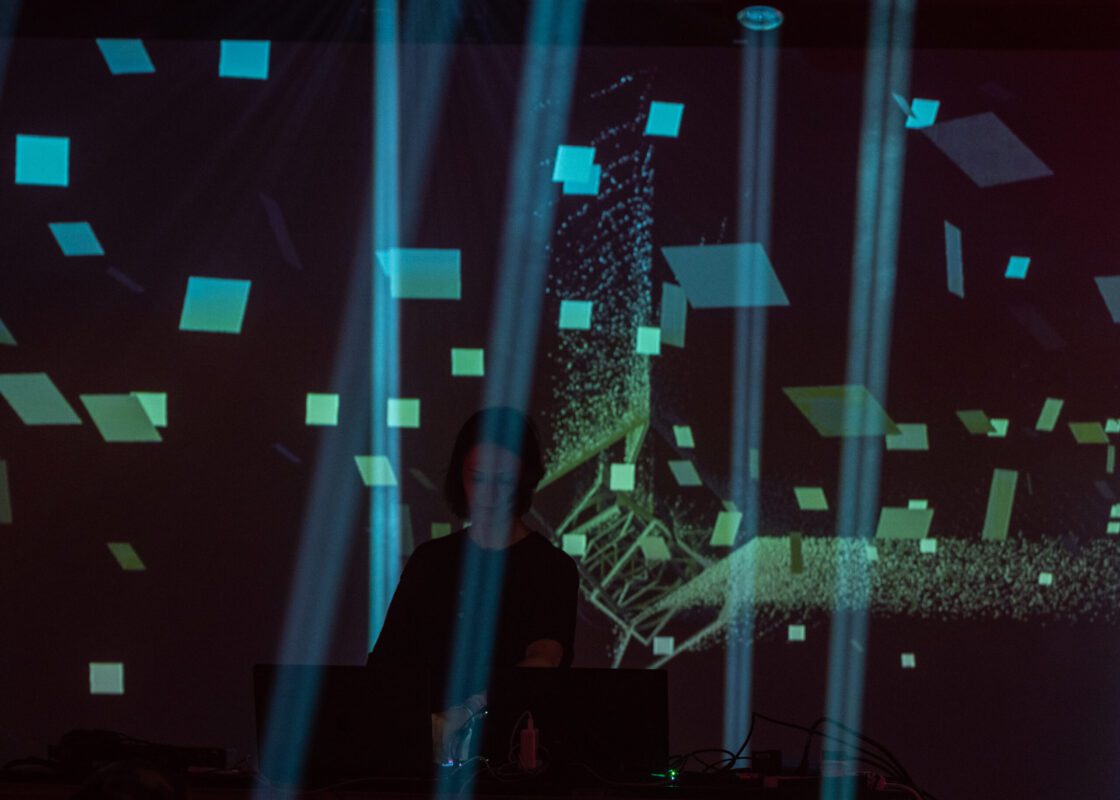
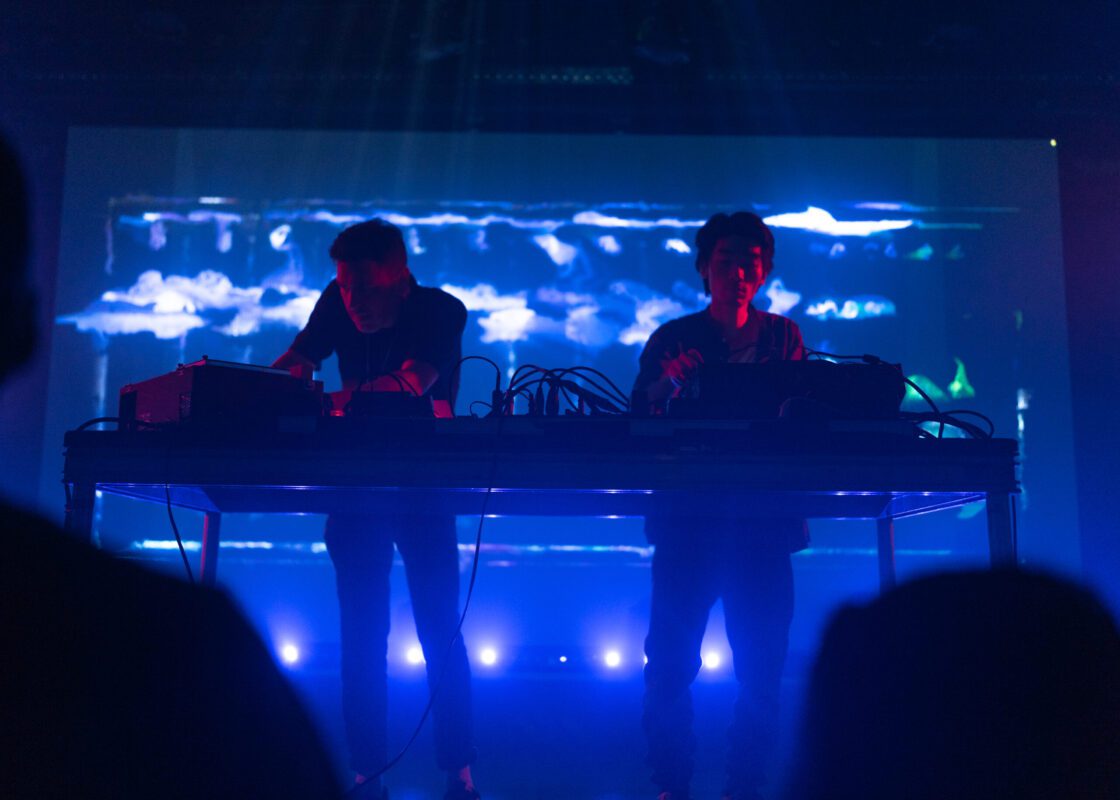
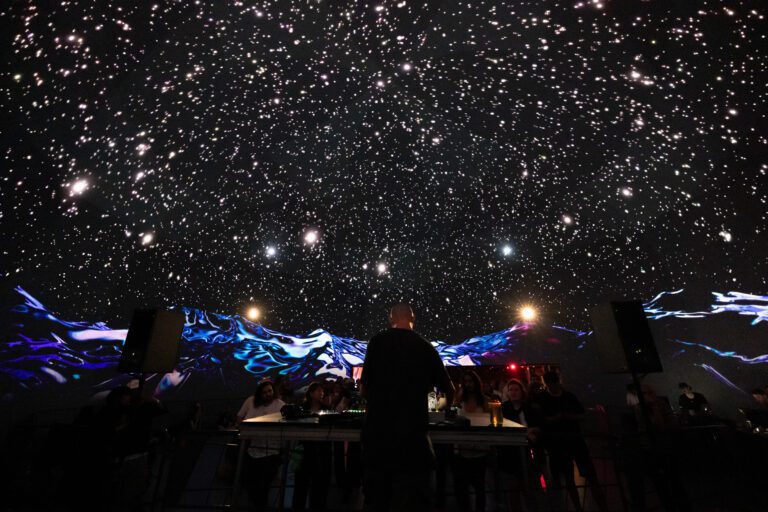
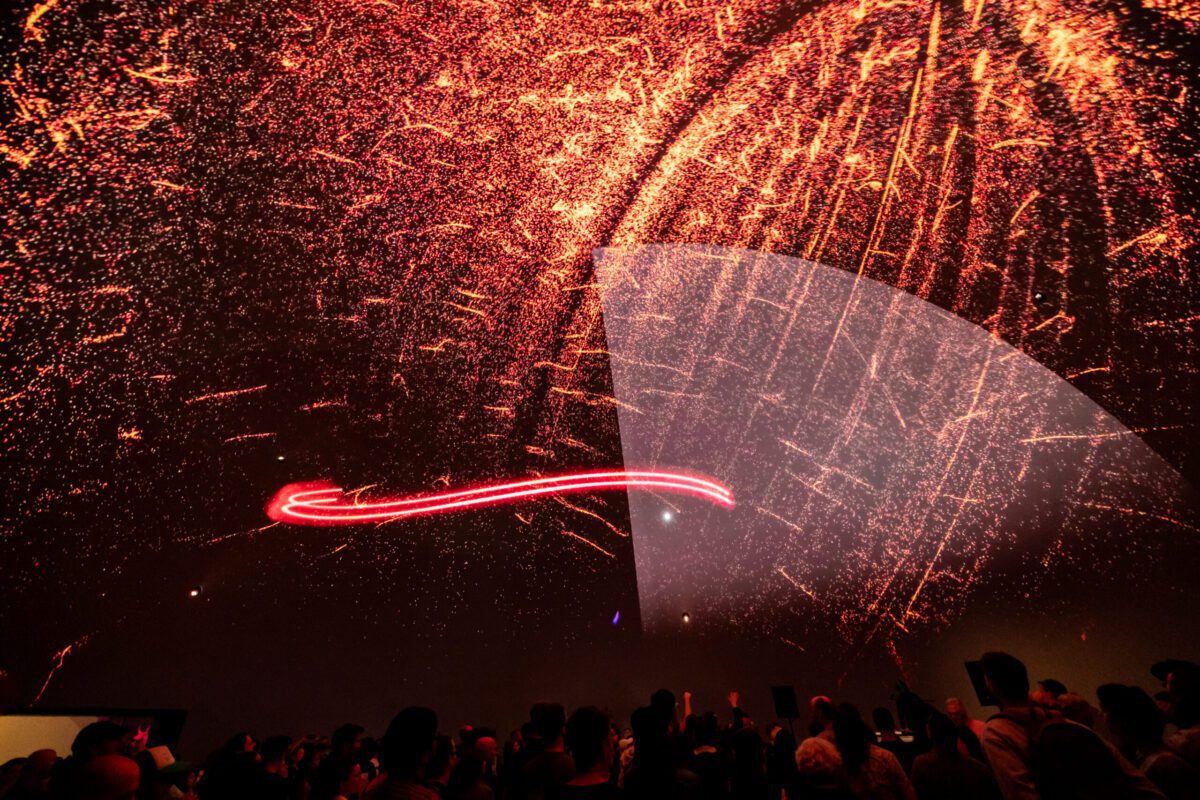
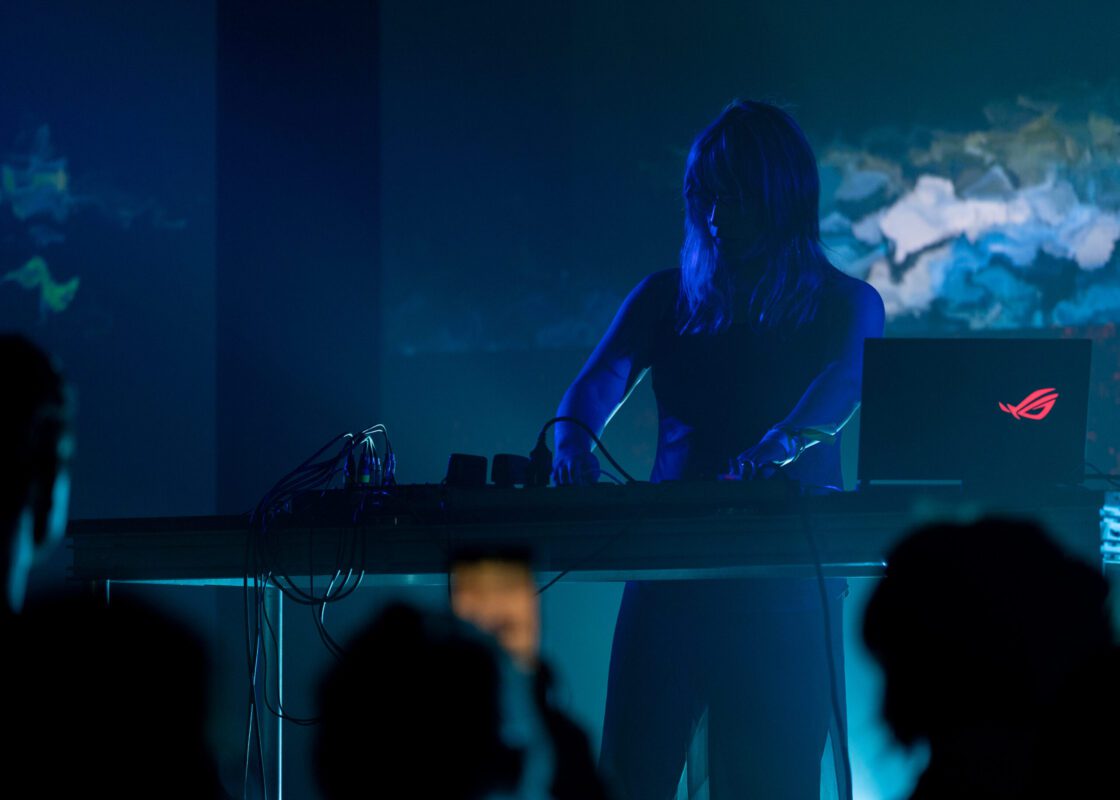
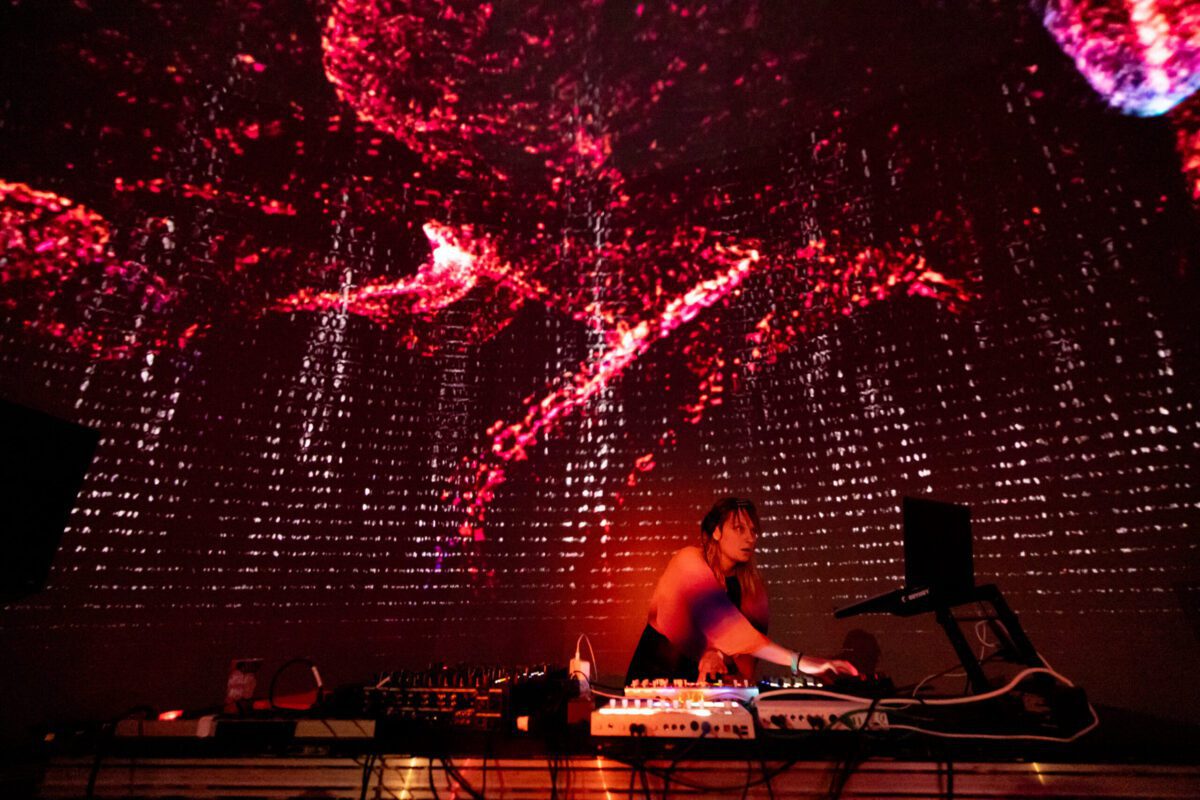
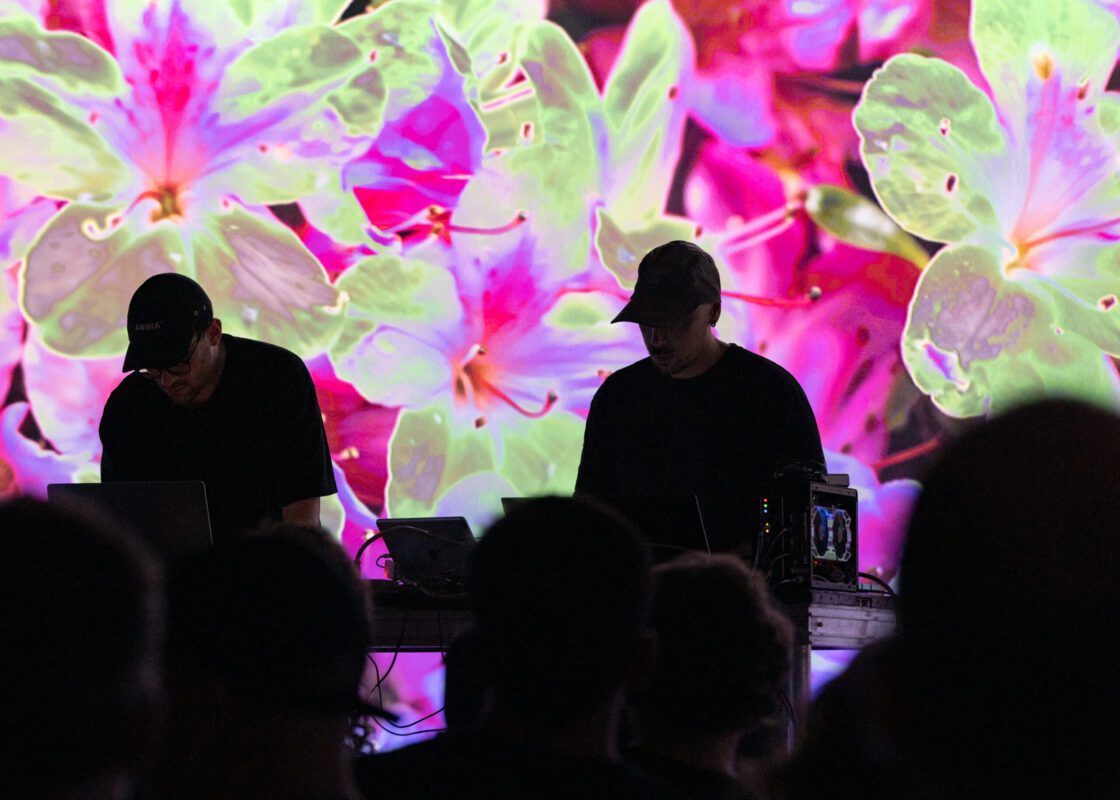
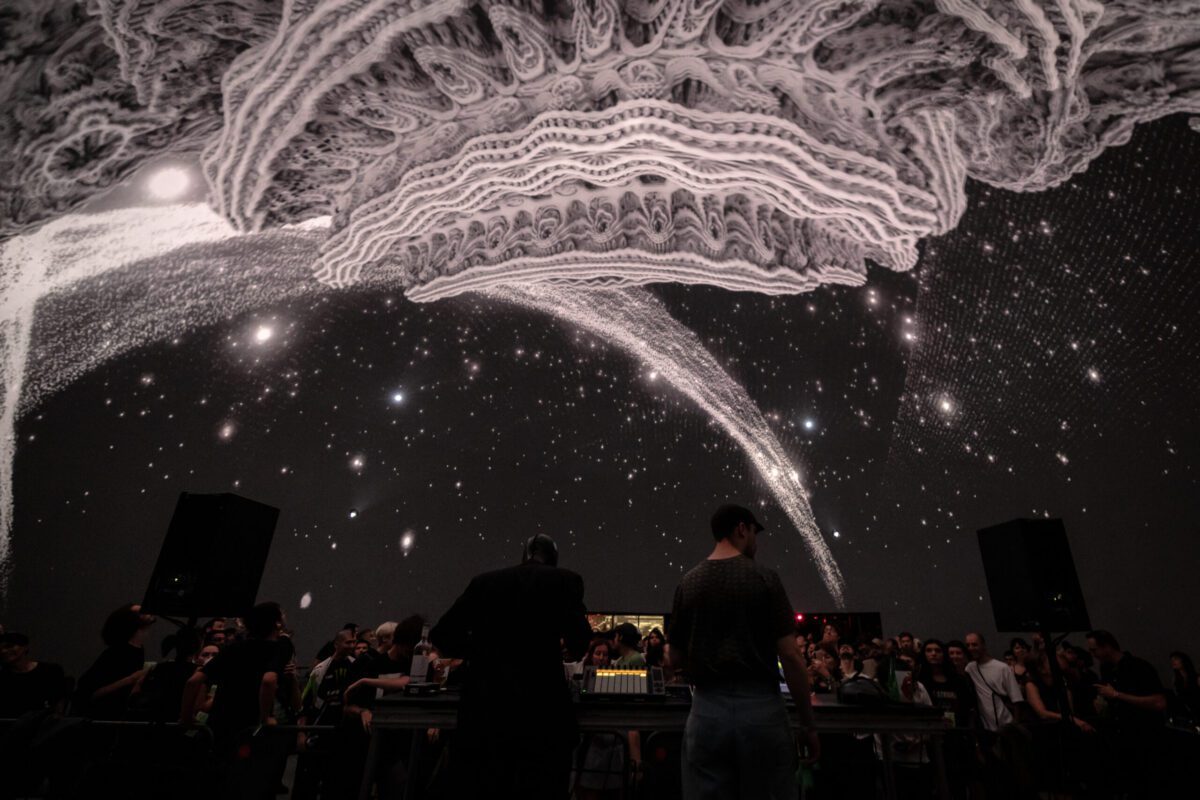
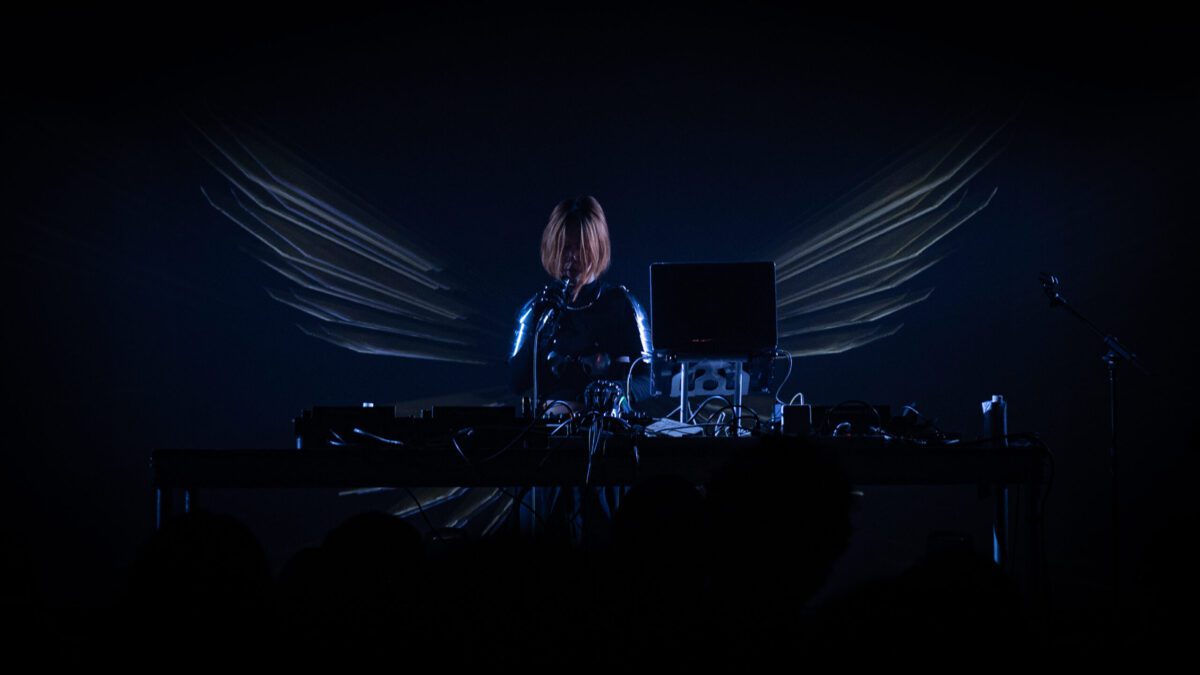
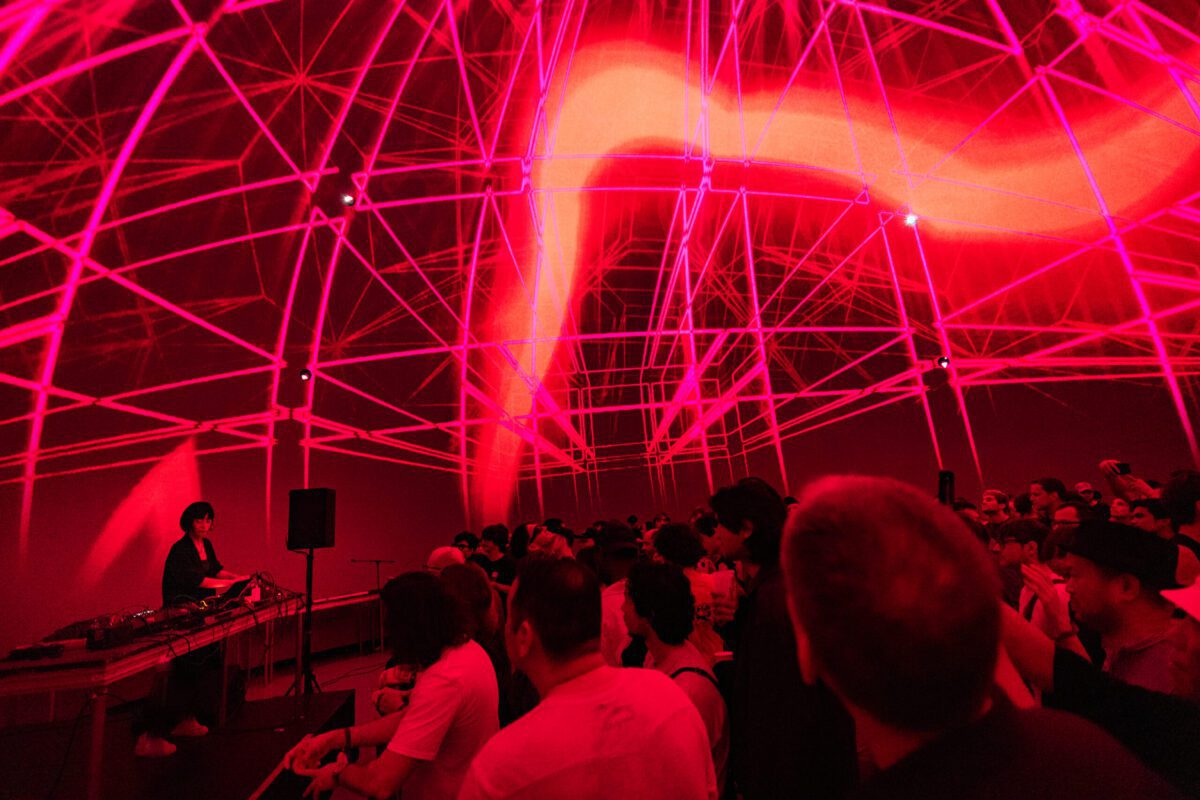
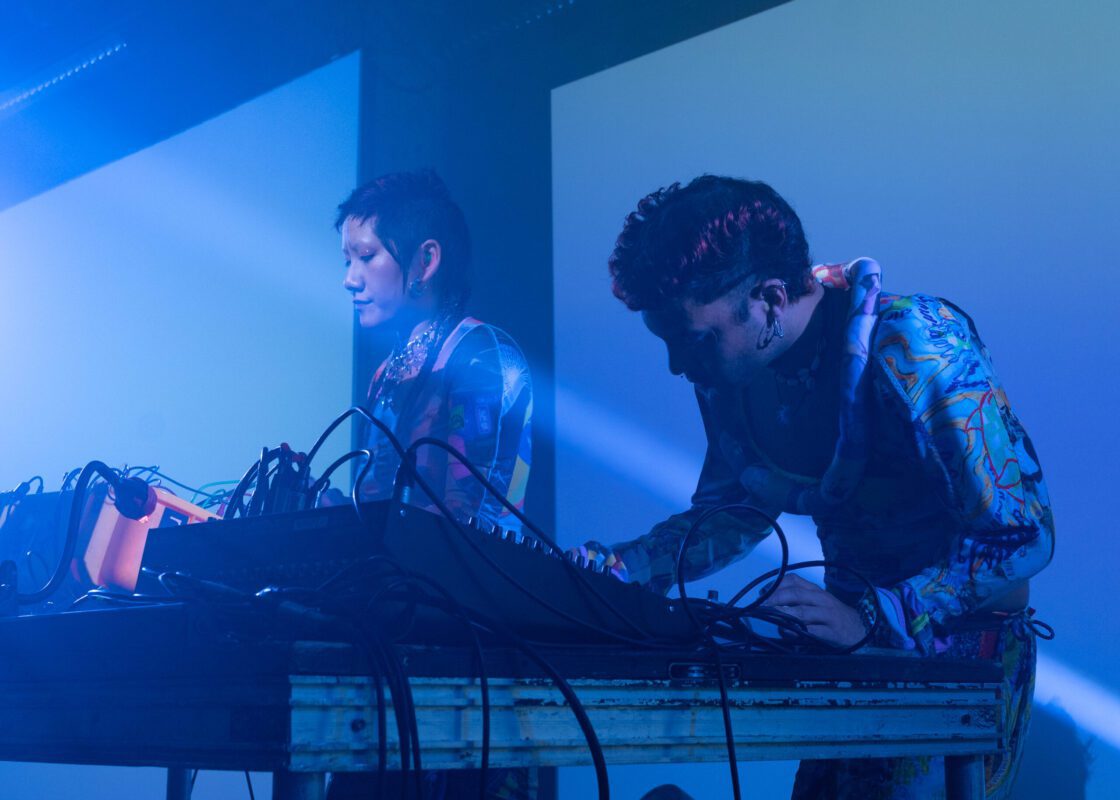
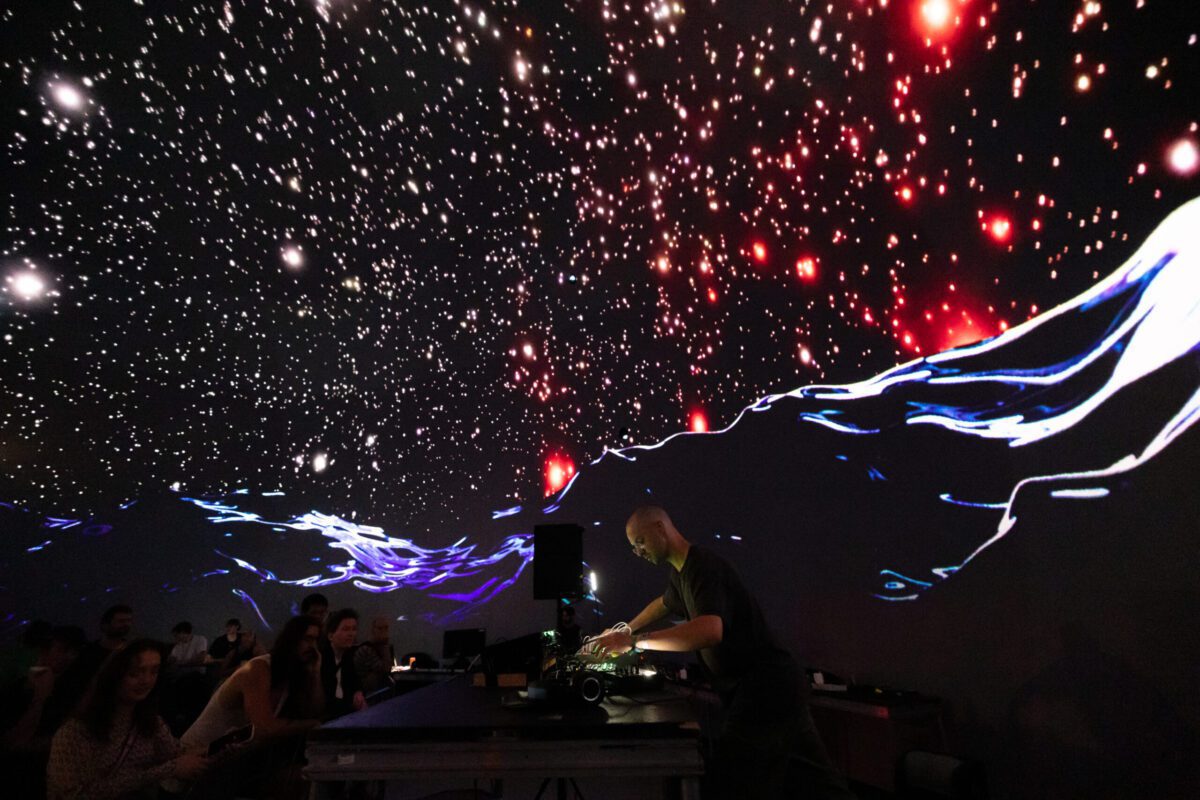
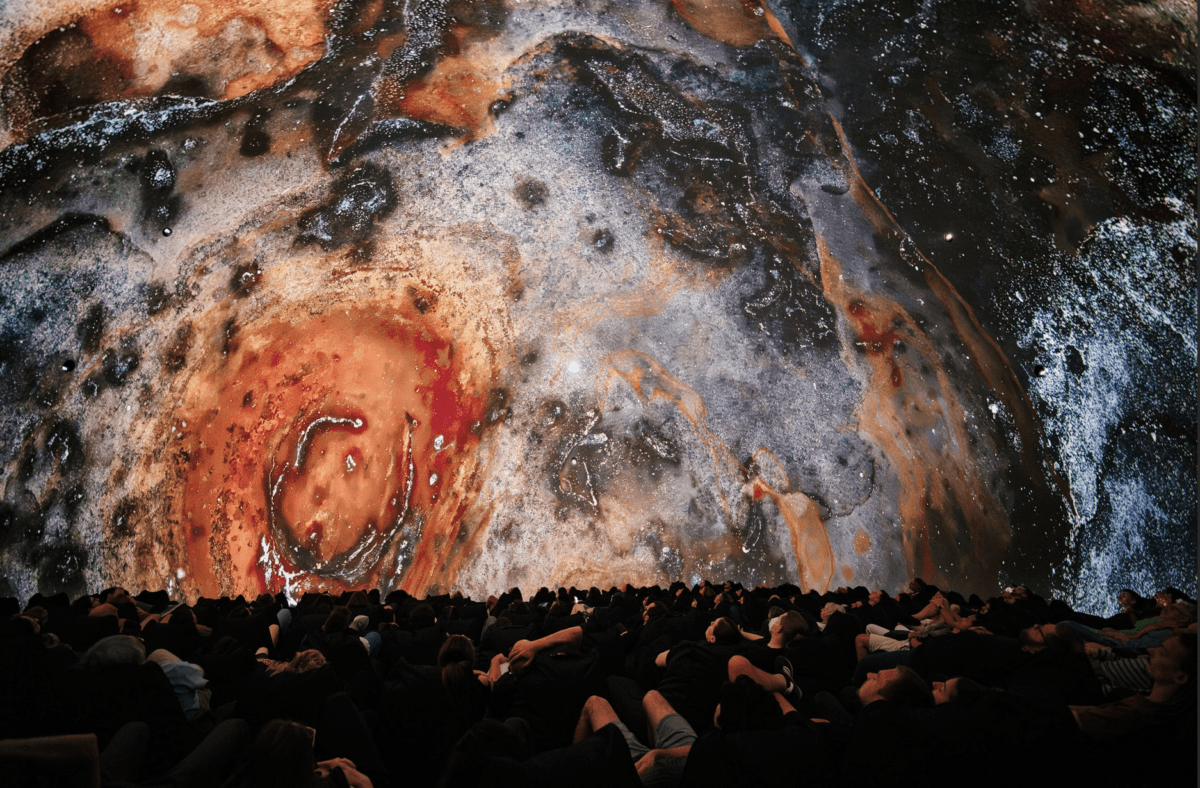
La série Nocturne prend place toute la semaine à la SAT, avec une expérience amplifiée du jeudi au dimanche, puisque les spectacles sont présentés sur deux étages, à la fois dans l’espace de la SAT et sous le dôme de la Satosphère. Le programme présente des œuvres novatrices qui réinventent la musique électronique dans un environnement visuel immersif à la fine pointe de la technologie.
Technologies of Consciousness CA/QC – Numinous Machines | Ela Minus CO | Octo Octa US | Ciel CA | Nick Schofield CA/QC | Bénédicte CA/QC | Mesocosm CA/QC – Terra Flecta | Sinjin Hawke & Zora Jones CA/QC+AT/QC – Fractal Fantasy Surround
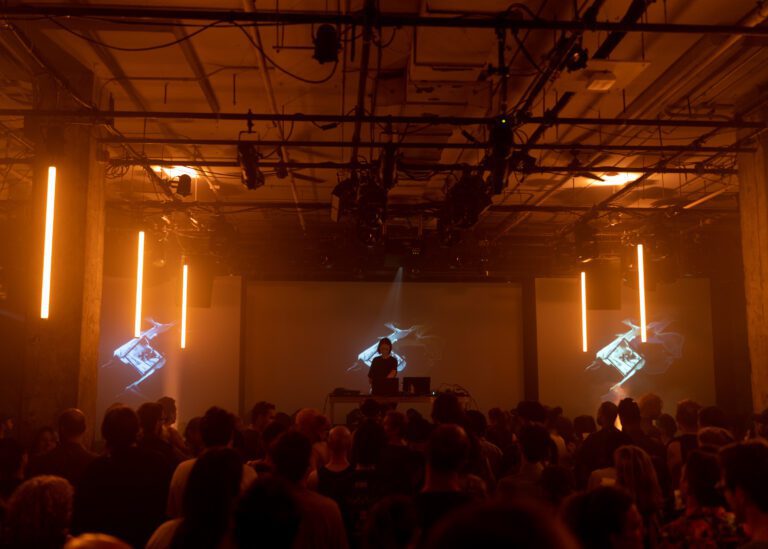
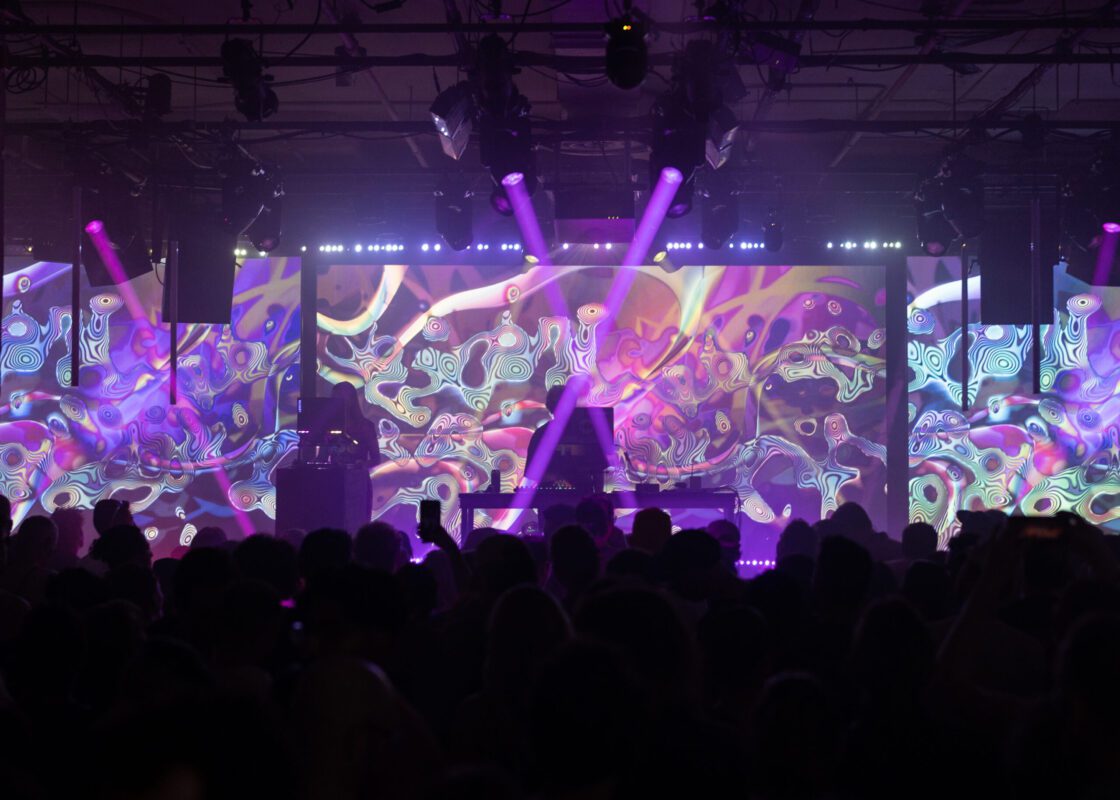
The Nocturne series takes root all week at the SAT, with an amplified experience from Thursday to Sunday, as performances are presented on two floors, both in the SAT space and under the Satosphère dome. The program features innovative works that reinvent electronic music within a state-of-the-art immersive visual environment.
Technologies of Consciousness CA/QC – Numinous Machines | Ela Minus CO | Octo Octa US | Ciel CA | Nick Schofield CA/QC | Bénédicte CA/QC | Mesocosm CA/QC – Terra Flecta | Sinjin Hawke & Zora Jones CA/QC+AT/QC – Fractal Fantasy Surround
La série Nocturne prend place toute la semaine à la SAT, avec une expérience amplifiée du jeudi au dimanche, puisque les spectacles sont présentés sur deux étages, à la fois dans l’espace de la SAT et sous le dôme de la Satosphère. Au programme, des œuvres novatrices qui réinventent la musique électronique dans un environnement visuel immersif à la fine pointe de la technologie.
Seulement CA/QC – Bricolage Architecture | No Plexus AU/NL+NL | Jacques FR – Vidéochose
The Nocturne series takes root all week at the SAT, with an amplified experience from Thursday to Sunday, as performances are presented on two floors, both in the SAT space and under the Satosphère dome. The program features innovative works that reinvent electronic music within a state-of-the-art immersive visual environment.
Seulement CA/QC – Bricolage Architecture | No Plexus AU/NL+NL | Jacques FR – Vidéochose
La série Nocturne s’installe toute la semaine à la SAT, avec une expérience amplifiée, puisque les performances sont présentées sur deux étages, à la fois dans l’espace de la SAT et sous le dôme de la Satosphère. Le programme présente des œuvres novatrices qui réinventent la musique électronique dans un environnement visuel immersif à la fine pointe de la technologie.
Lamin Fofana US | Daito Manabe JP | Nosaj Thing & Jacques Greene US+CA/QC __
Entre art génératif, photogrammétrie, visualisation de données et design sonore immersif, cette sélection propose quatre œuvres audiovisuelles immersives, chacune avec sa propre esthétique, explorant nos systèmes de représentation de la vie et du monde qui nous entoure.
Lydia Yakonowsky CA/QC | Allison Moore CA/QC | Nora Gibson US/QC | Jules Roze & Pablo Geeraert FR/QC+BE/QC
The Nocturne series takes root all week at the SAT, with an amplified experience, as performances are presented on two floors, both in the SAT space and under the Satosphère dome. The program features innovative works that reinvent electronic music within a state-of-the-art immersive visual environment.
Lamin Fofana US | Daito Manabe JP | Nosaj Thing & Jacques Greene US+CA/QC __
Between generative art, photogrammetry, data visualization, and immersive sound design, this selection offers four immersive audiovisual works, each with its own unique aesthetic, exploring our systems of representation of life and the world around us.
Lydia Yakonowsky CA/QC | Allison Moore CA/QC | Nora Gibson US/QC | Jules Roze & Pablo Geeraert FR/QC+BE/QC
Une soirée house, disco, funk avec les vétérans de la scène montréalaise Poirier et Fred Everything. Tous deux sont reconnus sur la scène internationale et ont marqué le nightlife de notre ville. Ils ont une connaissance encyclopédique de la musique et la partage à travers leurs sets chauds et groovy. À ne pas manquer!
Embarquez pour un voyage élaboré à partir de paysages sonores riches et des visuels 360° hallucinants qui promettent plus qu’un simple party – pensez univers parallèle niché au cœur de la métropole.
Profitez de la nuit comme jamais auparavant, car nous prolongeons les horaires jusqu’à 4 heures du matin. Pourquoi s’arrêter quand la vibe est aussi bonne. See ya sous le dôme!
An evening of house, disco and funk with Montreal veterans Poirier and Fred Everything. Both are internationally renowned and have made their mark on our city’s nightlife. They have an encyclopedic knowledge of music and share it through their hot, groovy sets. Not to be missed!
Embark on an elaborate journey of rich soundscapes and mind-blowing 360° visuals that promise more than just a party – think parallel universe nestled in the heart of the metropolis.
Enjoy the night like never before, as we extend the hours to 4am. Why stop when the vibe’s this good. See ya under the dome!
Ce contenu provient de la Société des arts technologiques et est adapté par PAN M 360.
Période de candidature – Résidence PHI Nord
by Rédaction PAN M 360
PHI Nord est une résidence qui offre aux musicien·ne·s établi·e·s au Canada l’opportunité d’approfondir et de peaufiner leurs projets musicaux.
Le programme propose une retraite créative de deux semaines dans un loft situé aux abords d’une rivière dans les Laurentides avec un accès exclusif à un studio d’enregistrement et un soutien technique en ingénierie du son. Cette résidence permet aux artistes d’échapper au quotidien et de s’engager pleinement dans l’exploration et l’expérimentation de leur art.
PHI Nord remercie SiriusXM Franco pour son soutien.
Les artistes sélectionné·e·s recevront:
Soutien au développement du projet et hébergement: Séjour de deux semaines dans une maison propice à la création avec accès exclusif à un studio d’enregistrement;
Allocation: Une allocation de 1 600 $;
Soutien en studio d’enregistrement: Soutien en ingénierie du son jusqu’à 8 heures par jour pendant la résidence;
Production d’un profil vidéo: Création d’un vidéo d’une prestation en direct destiné à être diffusé dans les réseaux de PHI (réseaux sociaux, site web, etc.);
Accès au réseau: Accès au vaste réseau de collaborateur·rice·s de PHI.
Critères d’admissibilité:
Être un·e musicien·ne vivant au Canada;
Avoir un projet musical défini et vouloir le réaliser dans le cadre de la résidence;
Maintenir une pratique musicale professionnelle au Québec ou au Canada ou démontrer un potentiel de développement de carrière en musique;
Avoir fait paraître de la musique qui est disponible sur des plateformes d’écoute.
Les groupes sont admissibles (jusqu’à 4 membres). Les conditions offertes demeurent les mêmes que pour les artistes solos.
PHI Nord is a residency program that offers Canadian-based musicians the opportunity to deepen and refine their musical projects.
The program offers a two-week creative retreat in a riverfront loft in the Laurentians, with exclusive access to a recording studio and technical support in sound engineering. This residency allows artists to escape the daily grind and engage fully in the exploration and experimentation of their art.
PHI Nord thanks SiriusXM Franco for its support.
Selected artists will receive:
Project development support and accommodations: A two-week stay in a creative home with exclusive access to a recording studio;
Stipend: A stipend of $1,600;
Recording studio support: Sound engineering support for up to 8 hours per day during residency;
Video profile production: Creation of a video of a live performance for broadcast on PHI’s networks (social networks, website, etc.);
Network access: Access to PHI’s extensive network of collaborators.
Eligibility criteria:
Be a musician living in Canada;
Have a defined musical project and wish to carry it out within the framework of the residency;
Maintain a professional musical practice in Quebec or Canada, or demonstrate a potential for career development in music;
Have released music that is available on listening platforms.
Groups are eligible (up to 4 members). Conditions remain the same as for solo artists.
Date limite pour le dépôt des candidatures/Deadline for applications: le 4 avril 2024, à 23h59/April 4, 2024, 11:59 pm
Ce contenu provient de la Société des arts technologiques et est adapté par PAN M 360.
MUTEK 2023 | Nocturne 3 : upsammy & Jonathan Castro, Nick León, Halina Rice, Quan & DBY
by Alain Brunet
The PAN M 360 team brings you exhaustive coverage of MUTEK Montréal 2023. Here’s a selection of the best sets presented Friday night at the SAT, as part of the Nocturne series.
Crédits photos : Nina Gibelin-Souchon
upsammy & Jonathan Castro
Cabalistic shapes are projected onto screens on plant surfaces. In the middle of it all, a woman, a man. Dutch DJ, producer and multidisciplinary artist upsammy (Thessa Torsing) likes to illustrate extremes: comfort, discomfort, harmonious beauty, desolation. She uses different colors to paint her sound frescoes: processed voices, varied rhythms and tempos, the sounds of water, the sounds of tactile manipulation, melodic-harmonic fragments, a few feverish bursts of beats contrasting with cold, arrhythmic sequences. This approach, illustrated in space by Peruvian artist Jonathan Castro Alejos, a graphic designer by profession and visual artist of the digital universe, is said to be experimental techno and IDM. Perhaps… For our part, this approach has no apparent genre a priori, apart from the use of rhythms drawn from minimal techno and cerebral ambient. What we have here is a composite language with electroacoustic underpinnings that can nevertheless hook the night owl with a few electroshocks that can make him restless.
Nick León
Floridian Nick León is an enthusiast of Latin advances in electronic music, particularly Puerto Rican and Colombian. A psychedelic curve envelops the rhythms, transforming their original identity. Psychedelia and electronica have been going hand in hand for half a century, and here we have a Latin version. Reggaeton, afrobeats, cumbia, krautrock and ambient come together live. Just enough groove for a Friday, just enough nourishment for a set worthy of MUTEK. From a partner at his side, top-notch projections back it all up, moving jewel patterns, shimmers, stylized kaleidoscopes and more. Listening to this utterly conclusive set, it’s interesting to note that reggaeton has already generated some of its most refined forms. Clearly, Nick León and his stage partner are doing great things.
Halina Rice
A suite of harmonies and melodic fragments on the keyboard, pre-recorded music modulated live. Cerebral techno, electroacoustic, IDM. Londoner Halina Rice doesn’t have the look for the job, no extravagance in her clothes on stage, you could easily see her leading a doctoral seminar. Appearances are deceptive, however, for Halina Rice creates excellent technoid music, with a convincing variety of consonant arrangements, a superb selection of industrial sounds, techno, big beat, female choral singing, and synthetic hooting not unlike that of Arab women. This succession of contrasting climates, misted with dry ice and visuals designed by the main artist herself, illustrates the conceptual scope, superior intelligence, and sensitivity of this woman who, we predict, will leave her mark on her profession.
Quan & DBY
At the heart of the night, a Montreal tandem from the Chez.Kito.Kat label plays minimal techno, archly binary for the obvious needs of the dance floor at this hour of the night – 2am to 3am. The overdubs are relatively discreet, and there’s absolutely nothing ostentatious about this program deployed at the SAT: various whispers, raucous lines, boiling micro basses and other synthesized borborygms produce a counterpoint without overpowering the beat. Rather than displaying all the science they’re known for, breakbeat, deep house, acid, ambient, dub, bass music, dub, all produced by impressive lutherie, notably the purpose-built modular synthesizers Quan and Dog Bless You (hence the acronym D.B.Y.), Samuel Ricciuti’s real name) will give us a conclusive hour of small modulations and big beats for dancers who haven’t migrated to MTELUS, where Sync is playing at the same time.
MUTEK | Nocturne 2: SAT – Twin Rising, Efe Ce Ele, Paraadiso, Animistic Belief, and more…
by Laurent Bellemare
Opening Photo By: Frédérique Ménard-Aubin
For a second night, the Société des Arts Technologiques opened its doors to Mutek 2023 for the Nocturne 2 event, showcasing a nested palette of electronic artists. With its two open performance spaces, the performances followed one another without interruption, so that it was sometimes necessary to make agonizing choices between one or other of the rooms.
Twin Rising (VJ Isotone)
// Frédérique Ménard-Aubin
Twin Rising’s mask, adorned with chains, revealed a soft, high-pitched voice, whose vulnerability contrasted with the often rough tones of the lower register. Indeed, despite a consistently harmonic framework, the undulating low frequencies marked a slow, ponderous tempo. In the heaviest moments, it was as if we were witnessing a dubstep performance as defined in the 2000s. An attentive ear could also detect deliberately asynchronous synthetic “snare drums”, creating a highly effective effect of anticipation. A balance between catchy pulsation and rhythmic deconstruction kept the audience on its toes, as did the heterogeneous visuals projected by VJ Isotone onto the satospheric dome. Between aquatic surges and granular geometry, the multicolored palette was the only thread to hold on to. In any case, these shapes went very well with Twin Rising’s music, creating a vaguely melancholy atmosphere. An excellent way to start the evening.
Efe Ce Ele
// Nina-Gibelin Souchon
Descending to the first floor, the change in atmosphere was immediately apparent. For Efe Ce Ele’s performance, the tone was decidedly darker: insistent pulsation, strobe lighting, psychedelic visuals and explicit political messages. There were echoes of techno and industrial music in this soundtrack to an anxious age. Melodically, the music evolved mainly in the low register, with occasional breakthroughs of piano, percussion and sampled vocals. More often than not, we were bathed in a complex drone of slowly modulating voices. Transitions were often articulated by superimposing sections, momentarily creating a very dense, dissonant passage.
Nadia Struiwigh
// Frédérique Ménard-Aubin
Back in a crowded Satosphere, the atmosphere created by Nadia Struiwigh was the first of the evening to be reminiscent of a rave. The experience was necessarily more physical than the others, with the Dutch artist’s music operating with consistently catchy 4/4 rhythms. Here and there, syncopations added slight echoes of drum’n’bass and breakbeat. Harmonically, held or fading chords followed each other in a simple progression. These were coupled with short, repeated melodic cells, creating an ever-present contrast of rhythmic density. Textures added to this catchy base kept the sound interesting, while the body was easily carried along by the continuous backbeats. On the visual side, artists BunBun and Alex Vlair proposed a highly successful composition. Spiral patterns, concentric circles and circular mosaics were perfectly in tune with the SAT dome.
Paraadiso
// Nina-Gibelin Souchon
Composed of artists TSVI and Seven Orbits, the Paraadiso duo delivered a much less conventional sound. The atmosphere was sometimes ethereal and consonant, and sometimes suddenly chaotic and noisy. The common denominator here was well-calculated rhythms to avoid the predictable. Strong beats were often avoided, accentuating syncopation instead. At other times, polyrhythms created highly effective phase-shifting effects. Irregular subdivisions in turn destabilized the construction of a rhythm. Overall, the duo’s sounds were abstract, closer to digital art than dance music. This experimentation was also reflected in the projections, composed of microscopic images of the natural world, which were highly processed to the point of becoming unrecognizable textures. With a rich palette of sounds, the Paraadiso duo offered a skilful performance of “music not for dancing.”
Amselysen/Racine
// Frédérique Ménard-Aubin
The Amselysen/Racine duo presented austere music, where everything was rhythm and timbre. No melody, no harmonic cues. What’s more, the pulse was drowned out by fast syncopations or fast bass drum mats. Resolutely industrial, the sound was reminiscent of Autechre in its less consonant moments. In keeping with the gray but no less exhilarating music, the visuals projected onto the dome by Diagraf were all black and white. Origami stalagmites layered with stardust were transformed into sooty nebulae. Amselysen and Racine skilfully captivated their audience despite the difficult, rigid music.
X/O
// Nina-Gibelin Souchon
Already past midnight, x/o took to the stage to present tracks from their excellent album Chaos Butterfly. This heavy music, full of contrasts thanks to dreamy vocals, reinvested many familiar musical landmarks. From IDM to metal, from dream pop to breakbeat, the Vancouver artist gave a convincing performance. Unfortunately, the vocal performance was a little too timid, and did not stand out in the sound balance. Technical problem or lack of confidence? Whatever the case, the vocals weren’t treated in a way that did full justice to the compositions, a drawback that was somewhat corrected towards the end. Nevertheless, x/o captivated their audience with ease, creating a dark atmosphere enhanced by bluish strobe lighting and hypnotic projections. One could appreciate the almost shoegaze noise flights illustrated by Japanese-drawn characters. All in all, x/o provided a moment of catharsis as heavy as it was soothing, with a well-controlled rise in intensity from one room to the next.
Kyoka
// Frédérique Ménard-Aubin
From the outset, Kyoka’s music was almost entirely inharmonic, focusing on the fullness of its sound samples and the insistence of its rhythms. The beginning of the performance was colored only by the cubist projections of BunBun and Alex Vlair. Yet, in a sudden moment of weightlessness, every trace of rhythm faded away, giving way to a long, atmospheric, harmonic passage. It was a real breath of fresh air, in an evening where the continuous pulse was king. Rhythmic, but more nuanced music with new melodic elements then emerged from this lull, bringing a sequence of euphoric variations to a close.
Animistic Beliefs
// Nina-Gibelin Souchon
It didn’t matter to Animistic Beliefs that their appearance on stage was scheduled for the early hours. The duo truly transformed the SAT into a nocturnal party, intoxicating the audience with a relentless pulse and psychedelic sounds stacked one on top of the other. Their experimental music is generated in real-time by modular synthesizer work that doesn’t pull any punches. The sound was dense, the sound was loud, and the high-pitched rough whistles assaulted the senses as much as the thundering low frequencies. The duo’s music was peppered with intriguing sonorities, from samples to vocal outbursts declaimed like a punk singer screaming into a megaphone. Animistic Beliefs are said to incorporate Southeast Asian influences into their sound, sampling Vietnamese poetry and totobuang, the gong chimes of Indonesia’s Moluccan Islands. However, this is not the kind of nuance that could have been perceived on the spot, since the duo’s show is such a smash hit. A discovery that makes you want to go and listen to their album MERDEKA (independence in Indonesian).
Eƨƨe Ran
// Frédérique Ménard-Aubin
Here’s another case where tonality was in short supply. Alternating a frantic pulse with powerful syncopated rhythms, Eƨƨe Ran had the thankless task of closing a stimulating evening. The artist’s formula might have remained a little drab were it not for the numerous misbehaviors. The Montrealer didn’t hesitate to divert his rhythmic carpet by improvising a noisy passage evoking unintelligible vocoder sounds, or by momentarily stretching or compressing the tempo. It was all about working with texture. Otherwise, the music shared that industrial coldness common to many of the evening’s artists, in which white noise is more the norm than musical note. Perhaps a little randomly, pointillist images of molecular structures and spatial nebulae were interspersed with rocky desert landscapes, all creating an atmosphere of almost nihilistic abandon to dance and decibels too many. The evening ended with a rallentando and a decrescendo into nothingness.
La série Nocturne se déroule exclusivement à la SAT cette année avec une expérience augmentée le jeudi et le dimanche puisque les performances seront présentées sur deux étages, à la fois à l’espace SAT et sous le dôme de la Satosphère. Au programme, des créations novatrices qui réinventent les musiques électroniques, que ce soit avec des technologies avant-gardistes ou avec des instruments atypiques, le tout accompagné d’images fascinantes.
The Nocturne series takes place exclusively at the SAT this year, with an enhanced experience on Thursday and Sunday as performances are presented on two floors, both in the SAT space and under the Satosphère dome. The program features innovative creations that reinvent electronic music, whether with avant-garde technologies or atypical instruments, all accompanied by fascinating images.
Les artistes présents: Outro — Intemperie | upsammy & Jonathan Castro — Germs in a Population of Buildings | Nick León & Kaminska | Halina Rice — New Worlds | Quan & D.B.Y & Line Katcho
Outro
Outro est le projet musical du producteur et compositeur argentin Juan Barallobres, basé en Patagonie. Outro allie piano, synthétiseurs et field recording afin de créer des paysages sonores de musique électronique expérimentale à saveur dance. Au cœur de son processus, se trouve l’interaction entre musique, art sonore, art visuel, cinéma et performance. Agissant comme un collectionneur, Outro recueille les sons de personnes qu’il rencontre et des lieux qu’il traverse, puis les met en dialogue avec sa propre musique. Barallobres produit également la musique d’autres musicien·ne·s grâce à El Sello Rojo, une compagnie qu’il a fondée qui agit en tant que compagnie de disques et de série de résidences créatives. Il a participé à plusieurs évènements tels que Ted X Río de la Plata, Ciudad Emergente Festival et BAFICI (Buenos Aires Cinema Festival).
Outro is the musical project of Patagonia-based Argentine producer and composer Juan Barallobres. Outro combines piano, synthesizers and field recording to create soundscapes of experimental electronic music with a dance flavor. At the heart of his process is the interplay between music, sound art, visual art, cinema and performance. Acting like a collector, Outro gathers sounds from people he meets and places he passes through, then puts them into dialogue with his own music. Barallobres also produces the music of other musicians through El Sello Rojo, a company he founded that acts as a record label and creative residency series. He has participated in several events such as Ted X Río de la Plata, Ciudad Emergente Festival and BAFICI (Buenos Aires Cinema Festival).
upsammy & Jonathan Castro
DJ, productrice et artiste multidisciplinaire néerlandaise, upsammy (Thessa Torsing) génère des espaces interstitiels savamment construits où se côtoient, paradoxalement, confort et désolation. Reflets de sa facilité à élaborer des mélodies cristallines et des rythmes recherchés, les compositions musicales de upsammy traduisent un sentiment d’infinité et de spatialité. Elles oscillent entre différentes échelles de temps tout en retenant les échos distants d’une nature aux sonorités numérisées. Son approche audacieuse et narrative à la composition se traduit également dans ses DJ sets, lesquels puisent autant dans la musique électro psychédélique que le drum and bass et la techno expérimentales. Fascinée par les rythmes et les propriétés vibratoires de son environnement, upsammy a poursuivi des études en technologies de l’image et des médias à la Utrecht University of the Arts. En tant qu’artiste multidisciplinaire, elle explore les interactions entre le son, la photographie et la vidéo; explorations qui influencent, réciproquement, sa production musicale.
Dutch DJ, producer and multidisciplinary artist upsammy (Thessa Torsing) creates skilfully constructed interstitial spaces where comfort and desolation paradoxically meet. Reflecting her facility for crafting crystalline melodies and intricate rhythms, upsammy’s musical compositions convey a sense of infinity and spatiality. They oscillate between different time scales while retaining the distant echoes of nature’s digitized sounds. Her bold, narrative approach to composition is also reflected in her DJ sets, which draw as much on psychedelic electro music as experimental drum and bass and techno. Fascinated by the rhythms and vibratory properties of her environment, upsammy studied image and media technology at the Utrecht University of the Arts. As a multidisciplinary artist, she explores the interactions between sound, photography and video, which in turn influence her musical production.
À l’occasion de sa 24e édition, le Festival MUTEK est de retour dans le dôme de la Société des arts technologiques [SAT] pour la Série Satosphère, un programme d’œuvres et performances immersives explorant de nouveaux territoires conceptuels et sensoriels.
Au programme: une exploration de la dualité entre l’analogique et le numérique (Metaract); un voyage surnaturel pour redécouvrir la transcendance de la nature (Iwakura); une immersion dans un rituel sacré d’union spirituelle (Union); une ouverture vers un monde spatio-temporel inclusif (I want to leave this Earth behind); et une expérience sensorielle autour de la physique quantique (Entanglement).
For its 24th edition, the MUTEK Festival returns to the dome of the Society for Arts and Technology [SAT] for the Satosphère Series, a program of immersive works and performances exploring new conceptual and sensory territories.
On the program: an exploration of the duality between analog and digital (Metaract); a supernatural journey to rediscover the transcendence of nature (Iwakura); immersion in a sacred ritual of spiritual union (Union); an opening onto an inclusive space-time world (I want to leave this Earth behind); and a sensory experience based on quantum physics (Entanglement).
Stefana Fratila & Diana Lynn VanderMeulen
Stefana Fratila est une artiste, compositrice et conceptrice sonore d’origine roumaine basée à Toronto au Canada. Elle est également DJ et cofondatrice du collectif Crip Rave™, une plateforme événementielle mettant de l’avant et priorisant les personnes “Crip, handicapé·e, sourd·e, fou·folle et malade” [formulations fournies par l’auteure] au sein d’espaces rave accessibles et sécuritaires. Elle a créé Sononaut, une collection de 8 plug-ins VST open-source reproduisant les conditions atmosphériques des planètes de notre système solaire, en collaboration avec des scientifiques de la NASA et Jen Kutler. Elle a exposé son travail et performé dans le monde entier, notamment au MoMA et à e-flux (New York, États-Unis), à Ars Electronica (Linz, Autriche) et au Symposium international sur l’art électronique (Paris, France). Elle a également remporté le Canadian Screen Award pour le meilleur montage sonore (2022) et ses trames sonores ont été présentées au Festival international du film de Toronto, au New York Film Festival, au Festival du nouveau cinéma de Montréal, au Centre Pompidou et à la Biennale de Vienne.
Diana Lynn VanderMeulen est une artiste multidisciplinaire qui réside et travaille à Toronto, au Canada. Sa pratique artistique se situe à la croisée des médias analogiques et numériques, avec une focalisation sur la réalité étendue et l’utilisation cyclique des matériaux, avec l’intention de créer des environnements expansifs et multisensoriels. Son projet en réalité étendue intitulé A Boundless and Radiant Aura a récemment été présenté en avant-première avec Debaser à la SAW Gallery d’Ottawa, ainsi qu’à la galerie Toutoune de Toronto. Parmi ses œuvres récentes figure une exposition en solo, à la fois physique et virtuelle, intitulée “Shimmer of a Petal, Now a Mountain Stream”, réalisée en collaboration avec Sky Fine Foods & ArtGate VR. Elle a également créé et auto-édité l’application en réalité augmentée “Swampy GoGo”, qui étend les réalités numériques à partir d’une série de paysages en techniques mixtes en 2D. En plus de sa collaboration avec Sky Fine Foods, VanderMeulen a participé à de nombreux projets publics et initiatives DIY. Elle a exposé ses œuvres à l’AGO, à l’Ambassade du Canada à Tokyo (Japon), au CADAF Paris, au Musée Gardiner et à l’Idea Exchange.
I want to leave this Earth behind est une performance immersive A/V en direct, spécialement formatée pour le système sonore multicanal de Satosphère et les projecteurs à 360 degrés. La performance est centrée sur l’exploration de l’espace, les réalités spéculatives et fictives et la futurité Crip, engageant le public dans un exercice immersif d’imagination d’atmosphères interplanétaires et sci-fantastiques – des conditions qui sont intrinsèquement invivables, irrespirables, convertissant tous les corps-esprits humains en corps-handicapés.
Stefana Fratila is a Romanian-born artist, composer and sound designer based in Toronto, Canada. She is also a DJ and co-founder of the Crip Rave™ collective, an event platform featuring and prioritizing “Crip, disabled, deaf, crazy and sick” people [wording supplied by author] within accessible and safe rave spaces. She created Sononaut, a collection of 8 open-source VST plug-ins reproducing the atmospheric conditions of the planets in our solar system, in collaboration with NASA scientists and Jen Kutler. She has exhibited and performed worldwide, including at MoMA and e-flux (New York, USA), Ars Electronica (Linz, Austria) and the International Symposium on Electronic Art (Paris, France). She has also won the Canadian Screen Award for Best Sound Editing (2022), and her soundtracks have been presented at the Toronto International Film Festival, the New York Film Festival, the Festival du nouveau cinéma de Montréal, the Centre Pompidou and the Vienna Biennale.
Diana Lynn VanderMeulen is a multidisciplinary artist living and working in Toronto, Canada. Her artistic practice lies at the crossroads of analog and digital media, with a focus on extended reality and the cyclical use of materials, with the intention of creating expansive, multisensory environments. His extended-reality project A Boundless and Radiant Aura recently premiered with Debaser at Ottawa’s SAW Gallery, as well as at Toronto’s Toutoune Gallery. Recent works include a solo exhibition, both physical and virtual, entitled “Shimmer of a Petal, Now a Mountain Stream”, produced in collaboration with Sky Fine Foods & ArtGate VR. She also created and self-published the augmented reality app “Swampy GoGo”, which extends digital realities from a series of 2D mixed media landscapes. In addition to her collaboration with Sky Fine Foods, VanderMeulen has participated in numerous public projects and DIY initiatives. She has exhibited her work at AGO, the Canadian Embassy in Tokyo (Japan), CADAF Paris, the Gardiner Museum and Idea Exchange.
I want to leave this Earth behind is an immersive live A/V performance, specially formatted for Satosphère’s multi-channel sound system and 360-degree projectors. The performance focuses on space exploration, speculative and fictional realities and Crip futurism, engaging the audience in an immersive exercise in imagining interplanetary and sci-fantasy atmospheres – conditions that are inherently unlivable, irrespirable, converting all human body-minds into disabled bodies.
Ce contenu provient de MUTEK et est adapté par PAN M 360.
MUTEK 2023 | Satosphère 2 : UNION — Nancy Lee & Kiran Bhumber
by Alain Brunet
Photo credit: Ash KG
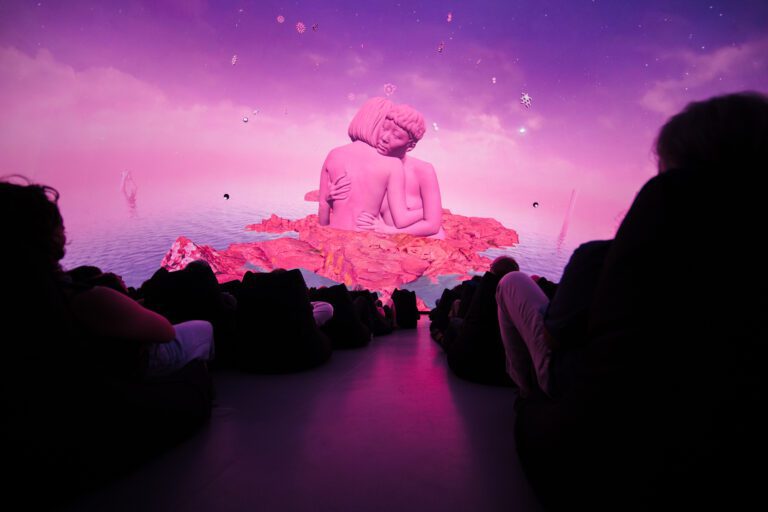
Here’s a summary of this 25-minute work, part of the Satosphère program on August 23 at MUTEK: “UNION is an immersive narrative that tells the story of two beings discovering their ancestral memories through the desire for touch and the rituals practiced during their post-apocalyptic wedding ceremony.”
Nancy Lee and Kiran Bhumber have imagined their story as an artistic illustration of their diasporic identities. Their aim is to “unveil and reconstitute cultural memory through the sacred ritual of spiritual union and physical intimacy”. In other words, this spiritual union cannot function smoothly if the strains of its actors are not identified, understood and integrated.
The immersion proposed here is based on abstract images projected onto a dome: shimmering colors mingle on the concave screen, giant hands whirl around, suspended humanoid busts, deposits of gems, two flesh-and-blood women sketching short choreographies, an evocation of post-apocalyptic marriage.
In terms of sound, the soundtrack includes a brief narration of this fictional story and offers the ear a series of electronic effects typical of this type of immersion: synthesized percussion, industrial sounds, and electroacoustic processes generally familiar to dome immersion enthusiasts. The sound quality is also exemplary.
In short, the abstraction of this work outweighs its background, the aesthetic coherence of this work needs to be perfected, the integration of forms and sounds testifies to an art that is still exploratory and above all interesting for its fragmentary effects and not for their integration into an integrated whole.
This is a recurring problem with immersive works that include sound and images: a fascination with these new creative tools rarely leads to an integrated aesthetic, and we contemplate their technological advances without being marked by a total work.
MUTEK 2023 | Satosphère 1 : Metaract et Iwakura
by Théo Reinhardt
The first Satosphère event of the MUTEK 2023 festival features a double program, with the audiovisual projects Metaract and Iwakura. The former is, according to MUTEK’s website, “an exploration of the duality between analog and digital”, and the latter, “a supernatural journey to rediscover the transcendence of nature.”
Photo credits : Ash KG
Metaract
Metaract is the first of two presentations, created by Japanese artists Manami Sakamoto and Yuri Urano. It’s an immersive film focused on nature which, in the context of the SAT, certainly questions the relationship between the natural and technological worlds.
From a dust particle in nothingness, to a drop of water in a freezing river, to a lump of earth in a forest, we seem to be taken through all the states of matter, as if we were experiencing them in first person. Things move slowly, even if it feels like we’re crossing universe-scale time jumps in the space of 20 minutes or so. What’s more, the exploratory but still modest tone of this rather abstract representation of nature is reminiscent of the curious and avid lens towards nature shown in Terrence Malick’s films, in particular The Tree of Life (2011) and his recent documentary Voyage of Time (2016).
The music remains fairly calm, with ambient layers that place us in a space without beginning or end, with a few distant sounds of bells and chimes here and there. The most recurring image is that of thousands of tiny dots floating in nothingness, which can be infinitely small or large. There’s no real scale of reference here, but even the small seems immense when sitting down, head up, under the dome of the Satosphère.
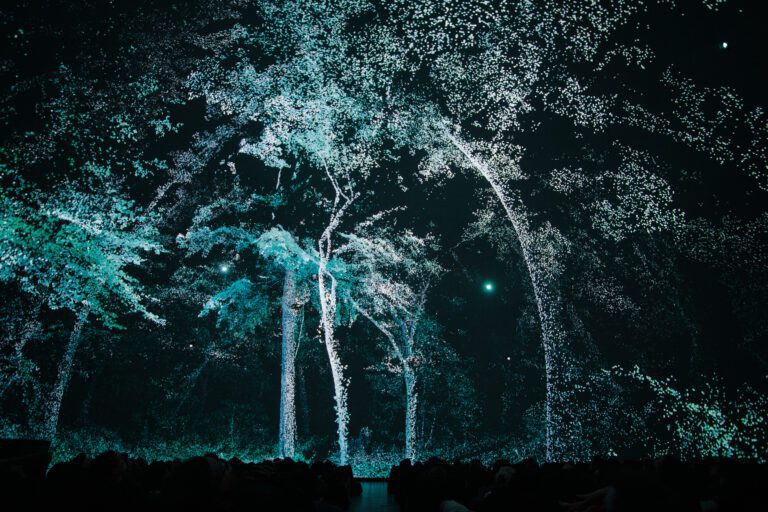
At the end of the film, as low-frequency blasts mimic a living heart, the thousands of colored dots acquire some intelligence and form trees, before hatching, falling back into galactic chaos, and finally returning as trees, their final form. At least, for the time being.
Iwakura
This second presentation, by artists Kazuka Naya, Ali Mahmut Demirel and Maurice Jones, is more abstract, more bizarre, more preoccupying and, above all, more psychedelic.
Born from what appears to be an obsession for geology, our journey begins by surveying very, very closely the walls of various caves, which merge into one another. The music here is dark, murky, calcified. It’s like being immersed in a meticulous, if not slightly fantastical, search for a fossil. But we won’t stop there. The journey will take us much further into the limbo of form, and we’re not sure we’ll be coming back.
As the images unfold, the rocky entities, now solitary in the void, follow one another, and their movement becomes increasingly supernatural: they collapse in on themselves, open out towards us in a tunnel that crushes and lengthens to infinity, at the same time hollowing out and unfolding in geometric, symmetrical excrescences, while we forget the music and all our attention is trapped in this geological black hole.
Eventually, we’re back where we started, with rock walls blending with waterfalls and trees, as the music builds in intensity, orchestration and sentimentality. Quite a journey. Have we reached transcendence? The sublime? Horror? A little of all three, maybe…
MEG Montréal présente Joris Delacroix et Stereoclip à la SAT
by Rédaction PAN M 360
Joris Delacroix
Producteur, Dj et performeur live basé en France, la carrière de Joris débute en 2010. Pianiste depuis son enfance, il découvre la musique électronique à l’âge de 10 ans avec le mouvement French-Touch et la House music britannique. Plus tard, il se tourne vers un son plus underground avec des artistes allemands de Minimal-Techno. Son style est un mélange unique de ces influences House et Techno, avec beaucoup de sons mélodiques provenant directement du piano.
Producer, Dj and Live Performer based in France, Joris’s career starts in 2010. Pianist since his childhood, he discovers electronic music at the age of 10 with the French-Touch movement and House music from UK. Later, he got into a more undergound sound with mostly german artists of Minimal-Techno. His style is a unique mix of these House and Techno influences, made with a lot of melodic gimmicks coming directly from the Piano.
Ce contenu provient de Joris Delacroix et est adapté par PAN M 360.
Stereoclip
Né à Bruxelles en 1989, Stereoclip compose une musique techno profonde, vocale et mystérieuse. Maîtrisant à la fois les performances live et la production musicale, il a été accueilli sur des labels prestigieux tels que Hungry Music, Armada Music ou Délicieuse, pour n’en citer que quelques-uns. Projeté sur le devant de la scène de la musique électronique après le succès de son premier album, l’icône belge livre aujourd’hui de nouvelles inspirations dans les festivals, les clubs et les salles de concert du monde entier.
1989 Brussels-born Stereoclip composes a deep, vocal, and mysterious techno music. Mastering both live performances and music production, he’s hosted on prestigious imprints such as Hungry Music, Armada Music, or Délicieuse, just to name a few. Thrown in the front of the electronic music landscape after the success of his first album, the Belgian icon now delivers new inspirations to festivals, clubs, and concert halls alike around the world.
Ce contenu provient d’Armada Music et est adapté par PAN M 360.