Festival d’art vocal de Montréal 2024: L’audition avec l’Orchestre de la Francophonie
by Rédaction PAN M 360
Soyez témoins de l’envers du décor en assistant à une audition d’opéra avec l’Orchestre de la Francophonie, sous la direction de Julien Proulx. Une expérience unique en son genre où de jeunes musiciens talentueux se produisent devant un jury international susceptible de les engager. Cette audition sans équivalent dans le monde offre une opportunité exceptionnelle de perfectionnement et de reconnaissance aux participants de l’Institut canadien d’art vocal.
La Salle Serge-Garant et la Salle Claude-Champagne sont les deux principales salles de concert de la Faculté de musique de l’Université de Montréal : 220, avenue Vincent d’Indy, Outremont.
Get a behind-the-scenes look at an opera audition with the Orchestre de la Francophonie, conducted by Julien Proulx. A unique experience where talented young musicians perform in front of an international jury with the potential to hire them. This unique audition offers an exceptional opportunity for development and recognition to participants in the Canadian Vocal Arts Institute.
Salle Serge-Garant and Salle Claude-Champagne are the two main concert halls of the Université de Montréal’s Faculty of Music: 220, avenue Vincent d’Indy, Outremont.
Der Kaiser von Atlantis: a modest but important production
by Frédéric Cardin
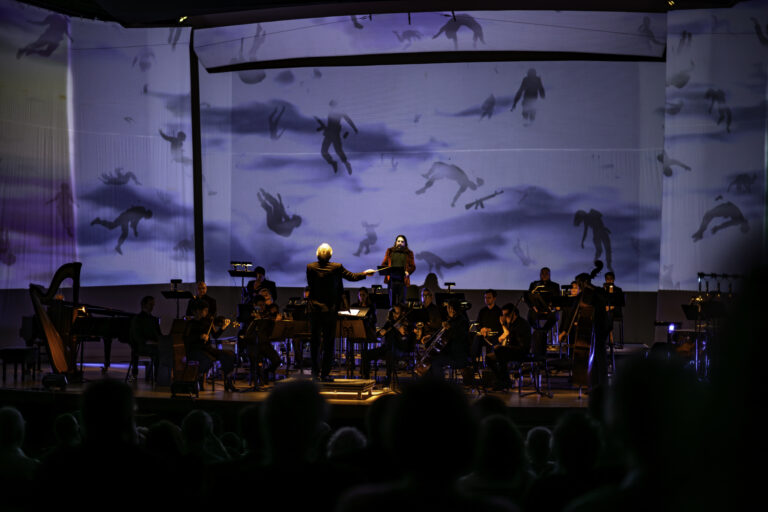
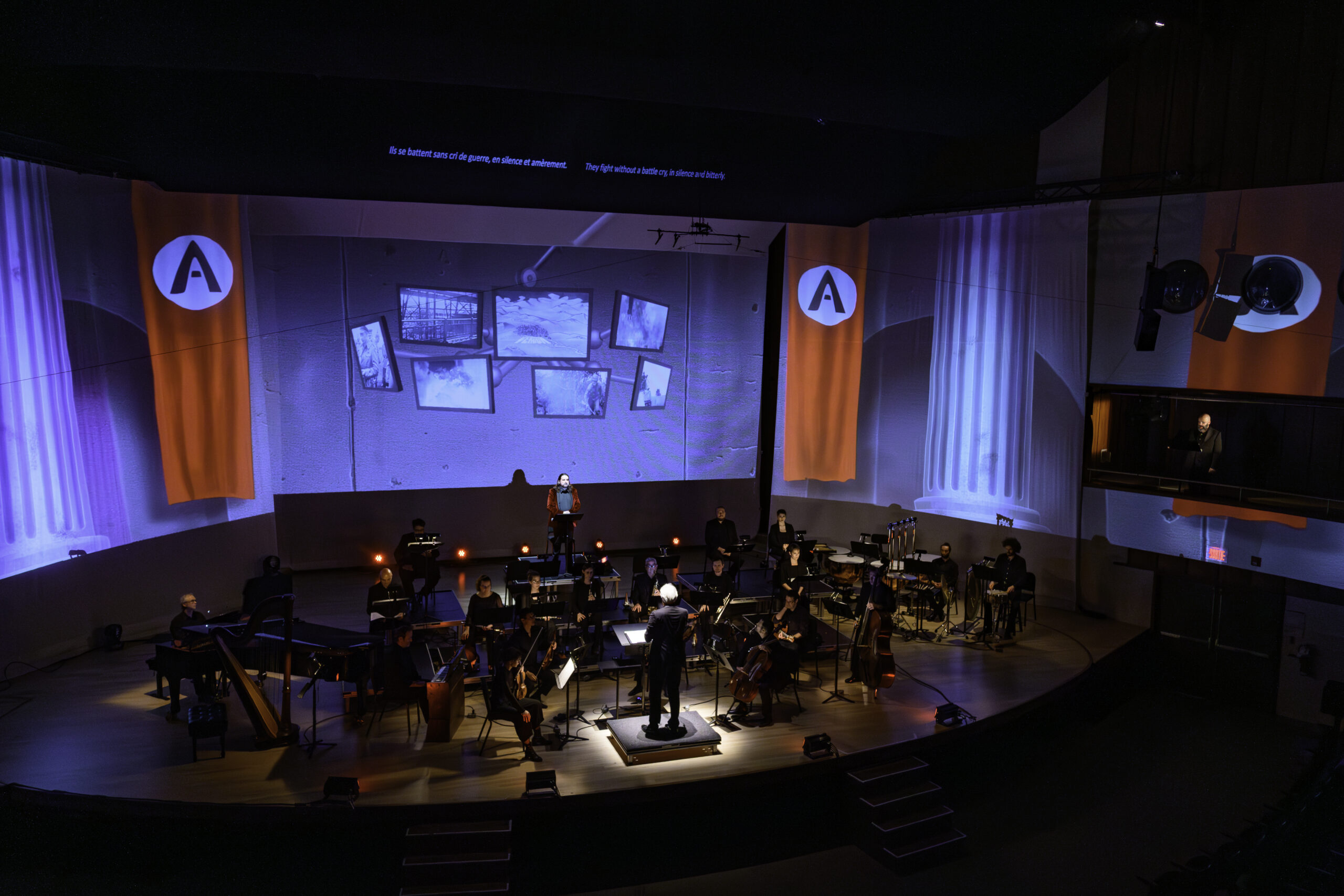
A moment I’d been looking forward to for a long time took place yesterday in Salle Claude-Champagne at the Université de Montréal: a performance of Viktor Ullman’s opera Der Kaiser von Atlantis. Well, almost what I expected, as it was a concert version, enhanced, that said, by some very fine video projections. Der Kaiser is a great masterpiece in a small format (not even an hour), a fundamental opera of the 20th century that almost disappeared under the carelessness of the Nazis, but survived for decades under an old mattress. Follow the link below to find out part of the story.
Der Kaiser tells a simple story: Emperor Overall (what an appropriate name) wages war on all his neighbors. He boasts that he has Death on his side, “under his banner”, and that with it, no enemy can survive. Death, fed up with being used like this, decides to go on strike. With no one left to die, war becomes pointless, and no one fears the evil imperial dictator. So much so that even people fall in love across enemy lines. Overall is in despair when Death appears to her and proposes a deal: she will resume her service on condition that her first victim is the Emperor himself. In a final gesture of redemption, the Emperor accepts, for the good of all. The direct reference to Hitler and fascism is obvious (minus the redemption), and serves as a powerful, hyper-focused symbol and indictment of the absurdity of megalomania. Ullmann died in Auschwitz in 1944. He never realized that his subject never had the strength of character of the fictional character.
Ullmann’s score is marvelous. An absolute masterpiece of eclectic modernism, typical of a certain style of the 1920s, 30s and 40s, which dared to mix atonal music, late Romanticism, jazz, popular music, consonance and dissonance. In short, what we’re used to today, a century ahead of its time.
The fifteen-strong chamber orchestra features a portable organ, banjo, guitar and classical strings, woodwinds and brass. The music is sparkling with motifs and snatches of melody that are juxtaposed and swiftly strung together, without ever giving the impression of amalgamating into a shapeless soup. On the contrary, ultra-smooth lines, drawn with a scalpel, sometimes anticipating those of Shostakovich. Ullmann keeps us constantly on our toes. A modernism that is often cynical, that squeaks and plays tight in corners, but full of humor and contagious vitality.
Der Kaiser von Atlantis – Festival ClassicaDer Kaiser von Atlantis – Festival Classica
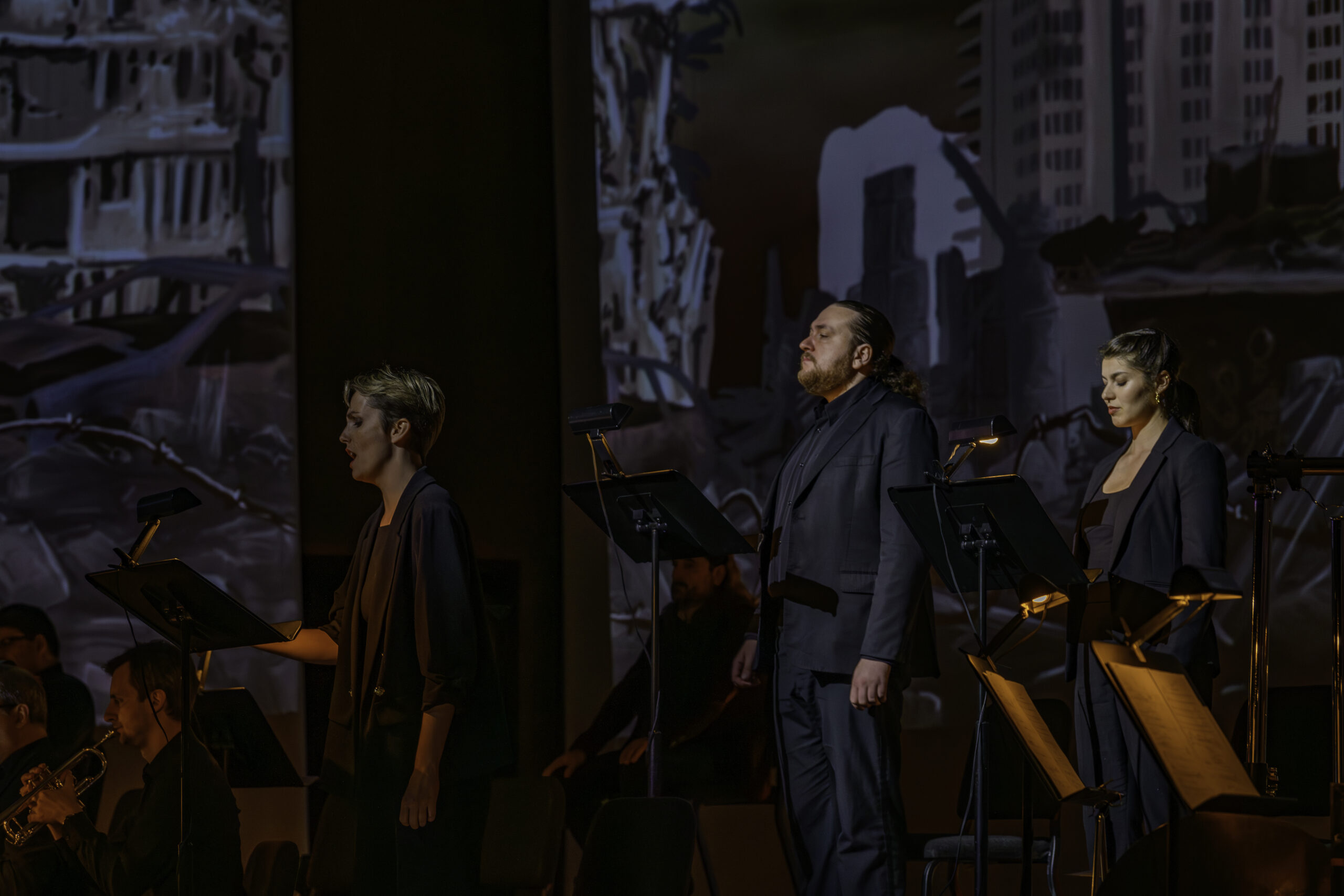
The vocal side is divided between scansions and singing. Frédéric Caton (Death) gives a fine performance, a purring bass, very much in character. Florence Bourget in the role of the Drum, with magnificent projection and a pleasant timbre. Éric Laporte as Harlequin (symbolizing Life) is adequate, but a little thin in the treble. Pierre-Yves Pruvot plays the Emperor Overall, and his grandiloquent vibrato is blessed with a character who can live with it. I’m not sure I’d have liked it in any other context. Le Haut-Parleur, the national radio station, is conducted ”imperially” by Tomislav Lavoie, but in a German that lacks clarity. Emmanuel Hasler and Sophie Naubert are very decent in their small roles as soldiers.
This was a concert version, but ”augmented”, as I said, by video projections, combining beautiful, partially animated illustrations by Maxime Bigras and a montage of archive films by Matthieu Thoër, of Lumifest en cavale. Without this visual dimension, the experience could have seemed arid. All that remains now is to hope for a real stage production in the not-too-distant future.
I disagree with a colleague who regrets the absence of costumes in a concert version. What’s the point of “graying” singers in Halloween when they’re condemned to remain stationary? It would be ridiculous. Anyway…
The concert ended with the presentation of Montrealer Jaap Nico Hamburger’s Symphony for Chamber Orchestra No. 1 “Remember to Forget”. A fitting complement, the underlying theme of this symphony being that of one train heading for death (1st movement) and another heading for liberation, or life (2nd movement).
The link with opera was also made with Hamburger’s music, which bears some resemblance to Ullmann’s, although it is built on a much more linear discursive architecture. No sudden, even violent leaps between opposing affects, textures and rhythms. Rather, the music is fairly consonant, albeit with occasional atonal outbursts, set to a steady pulse, illustrating the train’s progress. Depending on whether the train is heading for life or death, the atmosphere changes, of course. Hamburger would make an excellent film composer. Hamburger’s parents survived the Allied landings in 1944. After the murdered Ullmann, this man’s permitted existence is a positive conclusion. One train to death, another to life.
It’s a shame that Salle Claude-Champagne was only partially filled. Was it the program or the hall itself? Not its acoustics, which were excellent, but rather its location. A cul-de-sac (literally) devoid of any form of amenity in a wide radius around it (zero restaurants, bars or activities of any kind). A dormitory district. What a pity, it sounds so good.
The fact remains that such an operatic treasure, still too hidden, absolutely must be mounted and shown everywhere. It can serve as a powerful anti-totalitarian document as well as an introduction to modern opera and musical language. Its very short duration, its archetypes that can be understood by all, and the infinite possibilities it offers in terms of staging, are all elements that make it an absolute must in the art of music. It’s not what the Festival Classica will fill its coffers with, but the cultural and social importance of this kind of proposition is noteworthy. The vision and courage of the Classica team are to be commended, despite the very modest means at their disposal to realize this project. Sponsors who support this project should know: your investment will go far beyond a monetary rebate.
Concert en trois actes, les voix éclatantes et prometteuses de la jeune scène lyrique québécoise se lèvent pour célébrer l’amour accompagné du plus grand des orchestres baroques de la métropole. Tel un hommage vibrant à l’admiration que Mozart vouait à ses interprètes féminines, ce concert-collage réunit les mélodies les plus sublimes de ses chefs-d’œuvre : La Clémence de Titus, Les Noces de Figaro, et La Flûte Enchantée. Ce concert est une inspirante élégie à l’émotion et à la virtuosité vocale. Tels des tableaux, entre ombre et lumière, capturant la beauté du caractère de ces héroïnes et le tumulte de leurs passions, offrez-vous le privilège d’entendre les plus envoûtantes mélodies du compositeur le plus épris de tous les temps.
A concert in three acts, the bright, promising voices of Quebec’s young opera scene rise to celebrate love, accompanied by the city’s finest baroque orchestra. A vibrant tribute to Mozart’s admiration for his female performers, this concert-collage brings together the most sublime melodies from his masterpieces: The Clemency of Titus, The Marriage of Figaro and The Magic Flute. This concert is an inspiring elegy to emotion and vocal virtuosity. Like tableaux, between light and shadow, capturing the beauty of these heroines’ characters and the tumult of their passions, treat yourself to the privilege of hearing the most spellbinding melodies by the most passionate composer of all time.
Sinfonia de Montréal vous invite à découvrir Théodore Dubois à l’occasion du 100e anniversaire de sa disparition. Compositeur, organiste et pédagogue français, il a marqué le paysage musical du 19e siècle par des points de vue et positions musicales particuliers. Tandis que le poème symphonique Adonis nous plonge dans les émotions de ce mythe grec tragique, la Fantaisie pour Harpe et Orchestre, interprétée par Juliette Duguay, nous offre un caractère enjoué et fantastique. Quant à la Symphonie Française, elle s’élève comme une odyssée patriotique à travers les paysages sonores variés de la France.
Sinfonia de Montréal invites you to discover Théodore Dubois on the 100th anniversary of his death. A French composer, organist and pedagogue, he left his mark on the 19th-century musical landscape with his own particular points of view and musical positions. While the symphonic poem Adonis plunges us into the emotions of this tragic Greek myth, the Fantaisie pour Harpe et Orchestre, performed by Juliette Duguay, offers us a playful and fantastic character. As for the Symphonie Française, it rises like a patriotic odyssey through the varied soundscapes of France.
Der Kaiser von Atlantis s’affirme comme un opéra de chambre expressionniste captivant, mêlant habilement l’ironie et la poésie pour critiquer les ténèbres du totalitarisme. Au sein d’un monde ravagé par la folie tyrannique de l’empereur d’Atlantis, ce drame allégorique d’une puissance indéniable propose une réflexion poignante sur la nature de l’autorité, de la vie et de la mort, le tout soutenu par une musique et une dramaturgie d’une intensité exceptionnelle. Avec sept chanteurs et quinze musiciens, cette œuvre majeure du XXe siècle transcende l’unique statut d’opéra; c’est un voyage musical et philosophique, une expérience d’une beauté saisissante à ne pas manquer.
Der Kaiser von Atlantis is a captivating expressionist chamber opera, skilfully blending irony and poetry to criticize the darkness of totalitarianism. Set in a world ravaged by the tyrannical madness of the Emperor of Atlantis, this allegorical drama of undeniable power offers a poignant reflection on the nature of authority, life and death, all underpinned by music and drama of exceptional intensity. With seven singers and fifteen musicians, this major work of the twentieth century transcends the unique status of opera; it is a musical and philosophical journey, an experience of striking beauty not to be missed.
Festival Classica: La Grande messe des morts de Gossec
by Rédaction PAN M 360
Œuvre visionnaire préfigurant de plus de 30 ans le célèbre Requiem de Mozart, la Grande messe des morts de Gossec assura à son auteur une célébrité à la grandeur de l’Europe en redéfinissant ce que devrait être les messes musicales de commémoration des défunts. À la fois messe et oratorio, alliant puissance, recueillement et théâtralité, cette œuvre sera présentée pour une rare fois en Amérique du Nord par Arion Orchestre Baroque, le Studio de musique ancienne de Montréal et 5 solistes exceptionnels placés sous la direction de Mathieu Lussier, passionné par cette musique méconnue!
A visionary work prefiguring Mozart’s famous Requiem by more than 30 years, Gossec’s Grande messe des morts brought its composer European-wide fame by redefining what musical masses commemorating the dead should be. Both a mass and an oratorio, combining power, contemplation and theatricality, this work will be presented for the first time in North America by Arion Orchestre Baroque, the Studio de musique ancienne de Montréal and 5 exceptional soloists under the direction of Mathieu Lussier, who is passionate about this little-known music!
Festival Classica: Hommage à Queen – Soirée concert-bénéfice
by Rédaction PAN M 360
Joignez-vous à nous pour cette soirée concert-bénéfice revisitant les plus grands succès du groupe britannique Queen avec nul autre que Marc Martel! Musicien et chanteur aux multiples talents, connaissant un succès phénoménal à travers le monde, son talent vous fera replonger dans l’univers électrique de ce groupe mythique, le tout sous la direction de Simon Fournier. Réservez votre place dès maintenant!
Join us for this benefit concert revisiting the greatest hits of the British band Queen with none other than Marc Martel! A multi-talented musician and singer who has enjoyed phenomenal success around the world, his talent will immerse you in the electric universe of this legendary band, all under the direction of Simon Fournier. Reserve your place now!
The Nouvel Ensemble Moderne at Salle Claude-Champagne
by Rédaction PAN M 360
To close its 35th season, the NEM invites you to celebrate in style with four specially commissioned works. Complicity, pleasure and intensity are the order of the day.
Pour clore sa 35e saison, le NEM vous invite à célébrer en grand avec quatre œuvres commandées pour cette occasion. Complicité, plaisir et intensité se donnent rendez-vous.