classique / Opera

OSM : Les noces de Figaro

by Rédaction PAN M 360

L’OSM vous invite aux noces ! Assistez à un événement musical unique, Les noces de Figaro de Mozart, dans une mise en espace originale. Laissez-vous envoûter par des voix extraordinaires, qui s’épanouissent dans une acoustique exceptionnelle, et par des mélodies à la fois joyeuses et émouvantes. Cet opéra de Mozart a été créé en 1786 sur un livret de Lorenzo Da Ponte, inspiré de la pièce de Beaumarchais. L’intrigue, à la fois comique et satirique, suit les aventures de Figaro et Suzanne, deux domestiques cherchant à déjouer les avances de leur maître volage, le comte Almaviva. L’opéra critique avec finesse les privilèges de l’aristocratie tout en célébrant l’intelligence et la ruse des classes populaires. L’opéra, dans cette version avec narration, nous offre une expérience vibrante et inoubliable pour vivre le concert autrement.

The OSM invites you to a very special wedding! Experience a one-of-a-kind musical event with an innovative staging of Mozart’s Marriage of Figaro. Enjoy stunning voices in an exceptional acoustic setting, singing melodies that are both joyful and moving. Premiering in 1786, the opera blends comedy and satire, with a libretto by Lorenzo Da Ponte inspired by Beaumarchais’ play. It follows the adventures of Figaro and Suzanne, two servants trying to thwart the advances of their flirtatious master, Count Almaviva. Through its sharp wit, the opera critiques aristocratic privilege while celebrating the resourcefulness of the working class. This specially narrated version promises an exciting and memorable experience, offering a fresh perspective on a timeless masterpiece.

Programme

Wolfgang Amadeus Mozart, Les noces de Figaro, K. 492 (160 min)
Version avec narration

Program

Wolfgang Amadeus Mozart, The Marriage of Figaro, K. 492 (160 min)
Condensed version with narration

POUR ACHETER VOTRE BILLET, C’EST ICI!

Ce contenu provient de l’Orchestre symphonique de Montréal et est adapté par PAN M 360

classique

OSM : De Bartók à Mozart – flûte, improvisation et symphonie

by Rédaction PAN M 360

Le clarinettiste Kinan Azmeh séduit par son jeu fluide, nuancé et sa grande aisance à improviser. Aux côtés de l’OSM, il présente un programme où se croisent liberté créative, accents folkloriques de Bartók et sensibilité novatrice de Carl Philipp Emanuel Bach. La Symphonie no 39 de Mozart conclut ce programme avec fluidité et élégance.

Clarinetist Kinan Azmeh captivates audiences with his fluid, nuanced playing and remarkable improvisational talent. Joined by the OSM, he will showcase a program that blends creative freedom, Bartók’s folk-inspired motifs, and Carl Philipp Emanuel Bach’s innovative sensitivity. The evening concludes with Mozart’s graceful and elegant Symphony No. 39.

Programme

Béla Bartók, Six danses folkloriques roumaines (6min)
Carl Philipp Emanuel Bach, Concerto pour flûte, H.425, W.22 en re mineur (26min)
Kinan Azmeh, Suite for improvisor and orchestra (22min)
Wolfgang Amadeus Mozart, Symphonie no 39, K. 543 (29min)

Program

Béla Bartók, Six Romanian Folk Dances (6 min)
Carl Philipp Emanuel Bach, Concerto for Flute in D Minor, H. 425, W. 22 (26 min)
Kinan Azmeh, Suite for Improvisor and Orchestra (22 min)
Wolfgang Amadeus Mozart, Symphony No. 39, K. 543 (29 min)

POUR ACHETER VOTRE BILLET, C’EST ICI!

Ce contenu provient de l’Orchestre symphonique de Montréal et est adapté par PAN M 360

Classical Period / classique

Caprice / ArtChroral | Beethoven et la Révolution française

by Alexis Desrosiers-Michaud

By way of introduction, a bit of history. It is well known that Ludwig van Beethoven had a certain sympathy for the French Revolution. The most convincing example is his Third Symphony, the Eroica, originally dedicated to Napoleon Bonaparte—a dedication he famously scratched out when he learned that Napoleon had crowned himself emperor.

What Matthias Maute explained to us on Friday at the Maison symphonique de Montréal was that Beethoven incorporated patriotic popular songs into his Fifth Symphony—songs that were heard during the capture of Maximilien Robespierre, the jurist who played a central role in the Reign of Terror and whose criminal tribunal sent thousands of opponents to the guillotine, among them the famous victim Marie Antoinette. At the time, we did not yet realize that this information would open up a completely unexpected listening perspective.

After an incisive first movement (and a somewhat hastily delivered Ave Verum Corpus by Wolfgang Amadeus Mozart as an introduction), Ensemble Caprice offered us a lyrical second movement. One can debate Beethoven’s tempo markings endlessly, but the pace here was less Andante con moto than an emphasis on the phrasing of the winds, while keeping the cellos comfortable in their rapid passages. The placement of the woodwinds at the back of the stage on raised platforms proved particularly effective, leaving the brass on the floor level. The balance was perfect, with the lower strings positioned just to the left.

Remembering the historical context introduced earlier, the horn call at the beginning of the third movement took on an entirely different meaning. Instead of merely recalling the famous motif of the first movement—often described as “fate knocking at the door”—it sounded more like a call to celebration. The third movement then becomes a preparation for the jubilant finale, carried by excited strings.

After the intermission came the Mass in C minor, the “Great Mass” by Wolfgang Amadeus Mozart, performed in its original—and therefore incomplete—version. The jewel of the evening? The two soprano soloists, Janelle Lucyk and Myriam Leblanc, who truly gave back to Mozart what belongs to Mozart. This Mass contains some of the most beautiful solo lines in his sacred repertoire, and what they sang on Friday evening was not merely a succession of notes but real musical phrases and dialogues—between themselves and the orchestra—culminating in the four-part cadence (soprano, clarinet, oboe, and bassoon) of the Et incarnatus est, a masterpiece of musical intimacy.

Tenor Emmanuel Hassler performed admirably as a replacement for Philippe Gagné, who was ill, while bass William Kraushaar was solid in his single intervention. One hopes to hear him again in a concert where he will have more opportunities to shine. As for the choir, it was excellent; the division into two choirs created a fine balance among the voices and with the orchestra. At no point was it overshadowed by the ensemble.

Baroque / classique

OM : L’Italie sacrée de Vivaldi à Puccini à la Maison symphonique

by Rédaction PAN M 360

La chaleur ensoleillée de l’Italie imprègne la beauté vocale de sa musique, reconnue pour son élégance et son lyrisme naturels. Ce concert du Chœur Métropolitain met en lumière une tradition où la voix occupe une place centrale et profondément humaine. La Messa di Gloria de Puccini révèle déjà la richesse mélodique et la force expressive qui feront la renommée du compositeur. En complément, le programme présente deux piliers du vaste héritage choral italien : Monteverdi et Vivaldi, deux compositeurs vénitiens dont la musique sacrée, toujours lumineuse, a traversé les siècles.

Italy’s sun-kissed warmth is reflected in the vocal beauty of its music, celebrated for its natural lyricism and elegance. This Chœur Métropolitain concert highlights a tradition where the voice plays a central, deeply human role. Puccini’s Messa di Gloria, reveals the melodic richness and expressive power that would go on to define his fame. The program also features two pillars of Italy’s choral heritage: Monteverdi and Vivaldi, Venetian composers whose sacred music continues to shine across the centuries.

Programme/program

PUCCINI, Messa di Gloria
MONTEVERDI, Beatus vir
MONTEVERDI, Laudate pueri
VIVALDI, Laetatus sum
VIVALDI, Laudate Dominum omnes gentes

POUR ACHETER VOTRE BILLET, C’EST ICI!

Ce contenu provient de l’Orchestre métropolitain et est adapté par PAN M 360

classique / musique de film / période romantique

OM : John Williams et Rachmaninov à la Maison symphonique

by Rédaction PAN M 360

Bien que mieux connu pour sa musique de film, John Williams est aussi l’un des compositeurs de concertos les plus prolifiques de notre époque. Son Concerto pour trompette met brillamment en valeur cet instrument éblouissant, ici interprété par la virtuose Matilda Lloyd. La suite tirée du film Far and Away crée un pont avec les traditions européennes en puisant dans les sonorités de la musique irlandaise. La Deuxième symphonie de Rachmaninov partage avec la musique de Williams un langage immédiatement émouvant, fait de longues mélodies mémorables et d’une profonde nostalgie romantique. Considérée comme le chef-d’œuvre du compositeur, elle compte parmi les dernières grandes symphonies du romantisme tardif, atteignant un équilibre remarquable entre accessibilité, richesse expressive et complexité musicale.

Though best known for his film scores, John Williams is also among the most prolific concerto composers of our time. His Trumpet Concerto brilliantly showcases this dazzling instrument, performed here by virtuoso Matilda Lloyd. The suite from Far and Away creates a bridge with European traditions, drawing on Irish musical colours. Like Williams’s music, Rachmaninoff’s Symphony No. 2 features a language that moves listeners instantly, with long, memorable melodies and profound romantic nostalgia. Considered the composer’s masterpiece, it stands among the last great symphonies of late Romanticism, achieving a remarkable balance between accessibility, expressive richness and musical complexity.

Programme

WILLIAMS, Far and Away : Suite
WILLIAMS, Concerto pour trompette
RACHMANINOV, Symphonie n° 2

    Program

    WILLIAMS, Far and Away : Suite
    WILLIAMS, Concerto for Trumpet and Orchestra
    RACHMANINOV, Symphony No. 2

      POUR ACHETER VOTRE BILLET, C’EST ICI!

      Ce contenu provient de l’Orchestre métropolitain et est adapté par PAN M 360

      classique / musique de film

      OSM : La magie de Harry Potter

      by Rédaction PAN M 360

      Depuis la sortie du film Harry Potter à l’école des sorciers, il y a 25 ans, l’engouement pour la célèbre série fantastique et ses personnages de Poudlard n’a cessé de croître. Redécouvrez les mélodies légendaires de ces films emblématiques, composées par John Williams. Que vous soyez Serpentard, Gryffondor, Poufsouffle ou Serdaigle, revêtez les couleurs de votre maison et venez vivre cette aventure en famille!

      Since the release of the film Harry Potter and the Sorcerer’s Stone 25 years ago, the beloved fantasy series and its Hogwarts characters have continued to captivate audiences. Relive the unforgettable melodies from these iconic films, composed by John Williams. Whether you belong to Slytherin, Gryffindor, Hufflepuff, or Ravenclaw, don your house colours and bring the entire family for this magical adventure!

      POUR ACHETER VOTRE BILLET, C’EST ICI!

      Ce contenu provient de l’Orchestre symphonique de Montréal et est adapté par PAN M 360

      classique / musique contemporaine / Piano

      OSM : L’ensorcelant Oiseau de feu de Stravinsky

      by Rédaction PAN M 360

      Lauréat du Concours OSM en 2022 et du Concours international de piano de Leeds, le Canadien Jaeden Izik-Dzurko amorce une brillante carrière pianistique. Venez l’écouter dans ce concert au format réduit animé par Philippe-Audrey Larrue-St-Jacques, dans le Concerto de Grieg : une œuvre qui séduit par son irrésistible mélange de lyrisme et de vigueur. Laissez-vous ensuite charmer par la féérie de L’Oiseau de feu, dont les somptueuses couleurs orchestrales créent un véritable enchantement sonore.

      Canadian pianist Jaeden Izik-Dzurko, who launched a stellar career after winning the 2022 OSM Competition and the Leeds International Piano Competition, takes the stage in this intimate concert hosted by Philippe-Audrey Larrue-St-Jacques. Hear him perform Grieg’s Piano Concerto, a piece known for its captivating mix of lyricism and vigour. Then, allow yourself to be swept away by the enchanting beauty of The Firebird, where lush orchestral colours paint a mesmerizing sonic landscape.

      Programme

      Edvard Grieg, Concerto pour piano, op. 16 (30 min)
      Igor Stravinsky, L’Oiseau de feu, Suite pour orchestre (1919) (23 min)

      Program

      Edvard Grieg, Concerto for Piano, Op. 16 (30 min)
      Igor Stravinsky, The Firebird, Suite for Orchestra (1919) (23 min)

      POUR ACHETER VOTRE BILLET, C’EST ICI!

      Ce contenu provient de l’Orchestre symphonique de Montréal et est adapté par PAN M 360

      Baroque / classique

      OSM : Le Requiem Allemand par Kent Nagano

      by Rédaction PAN M 360

      Le chef émérite de l’OSM, Kent Nagano, dirige le poignant Requiem allemand de Brahms, tel qu’il fut donné en 1868 à Brême en Allemagne. Cette version historique, présentée pour la toute première fois à l’OSM, intègre des extraits d’œuvres baroques, de la Passion selon St Mathieu de Bach et du Messie de Handel. Ces pièces musicales mettent en perspective l’héritage de Brahms et soulignent le lien du compositeur avec la grande tradition musicale germanique. Une œuvre qui invite à une réflexion profonde sur la vie et la mort. Un rendez-vous musical unique !

      OSM Conductor Emeritus Kent Nagano leads a moving performance of Brahms’ A German Requiem, as it was presented in 1868 in Bremen, Germany. Making its debut at the OSM, this historic recreation includes excerpts from Baroque masterpieces such as Bach’s St. Matthew Passion and Handel’s Messiah. These musical selections offer insight into Brahms’ artistic heritage and underscore his profound connection to the rich German musical tradition. This masterpiece invites deep contemplation on life and death, promising a truly exceptional musical journey.

      Programme

      Johannes Brahms, Un Requiem allemand, sur des textes de l’Écriture sainte, op.45 (version Bremen 1868)
      Johann Sebastian Bach, Passion selon Saint Mathieu, BWV 244 : « Erbarme dich, mein Gott »
      Georg Friedrich Handel, Le Messie, HWV 56 (orch. W. A. Mozart) – extraits Œuvres pour violon et orgue de Bach, Tartini et Schumann

      Program

      Johannes Brahms, A German Requiem, from words of the Holy Scripture, Op. 45 (1868 Bremen version)
      Johann Sebastian Bach, St. Matthew Passion, BWV 244: “Erbarme dich, mein Gott” (6 min)
      George Frideric Handel, Messiah, HWV 56 (orch. W. A. Mozart) – excerpts

      POUR ACHETER VOTRE BILLET, C’EST ICI!

      Ce contenu provient de l’Orchestre symphonique de Montréal et est adapté par PAN M 360

      Afro Fusion / classique

      Successful Evening at The OSM: Steven Banks Makes The Saxophone Shine

      by Jeremy Fortin

      On Wednesday evening, the OSM presented the concert López, Childs, and Mahler: Hope in Exile, a rich and diverse program that explored the different facets of classical music.

      The first part of the concert featured two contemporary pieces, beginning with Perú Negro by Jimmy López, composer-in-residence with the OSM. This six-movement work was the ideal way to start the concert. Drawing inspiration from Afro-Peruvian music, López takes us on a journey through Peruvian culture in a rhythmic atmosphere, punctuated with effects and strongly supported by percussion.

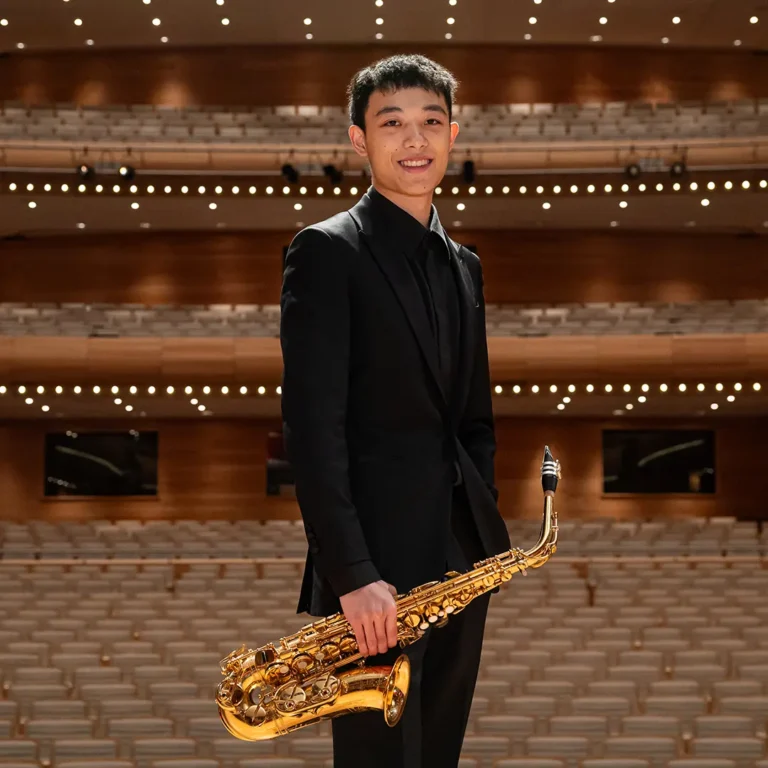
      The concert continues with American saxophonist Steven Banks, who is visiting to perform composer Billy Childs’ saxophone concerto, Diaspora. The piece, which traces the exile of the African American people, illustrates a dark world rooted in fear and internal strife for this people sent by ship to America by slave traders.

      Steven Banks’ performance lived up to expectations. Not only did the saxophonist deliver a series of virtuoso passages, but he also demonstrated great sensitivity during the cadences surrounding the three sections of the piece. After two dramatic movements, the work ends on a much more joyful note, illustrating the resilience of the African American people.

      As for the second part of the concert, Rafael Payare continues his cycle of Mahler symphonies with the composer’s Fourth. If you are used to associating Mahler with drama, think again, because this is certainly not the case with this symphony. Here, Mahler uses a much more classical language than in some of his other works.

      Payare, for his part, successfully illustrated the numerous changes in character, as well as the wide range of nuances required to bring the piece to life. The concert ended with the fourth movement, which featured soprano Nikola Hillebrand, who stepped in to replace Vuvu Mpofu, who was unable to attend. The German soprano gave a brilliant performance of this final movement, offering a particularly interesting vocal texture.

      Minimalist / Modern Classical / orgue / Post-Minimalist

      Stellar: Organ and Circus in sync

      by Frédéric Cardin

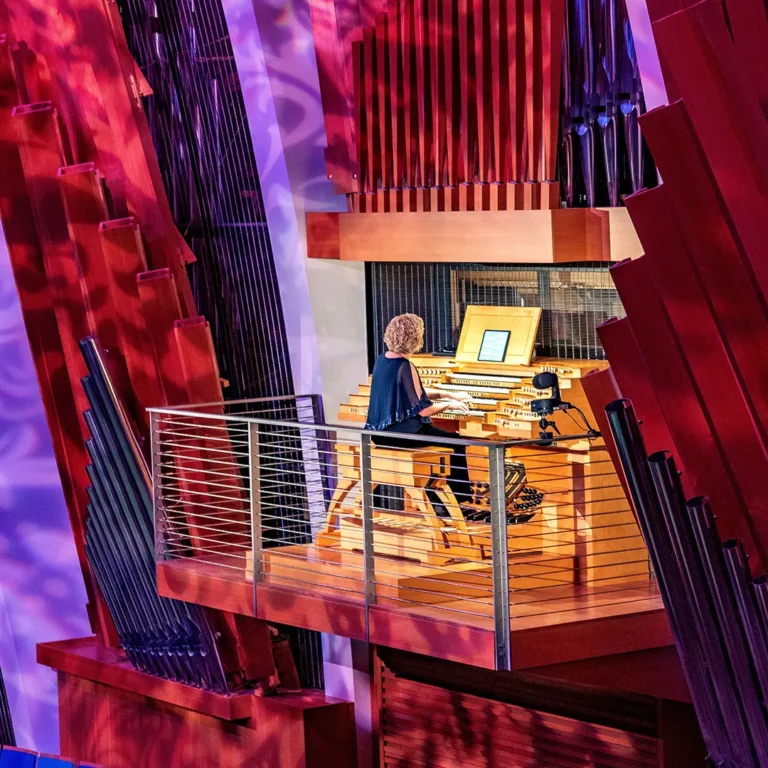
      A very beautiful idea to combine the organ with the arts of the circus! At first glance, one might think that it is the organ that needs the acrobatics of the other to increase its visibility and popularity. But once seated in the packed Maison symphonique here in Montreal, and paying attention to the “vibe,” one realises that quite a few people were there to enjoy the organ and the music offered in the program. Particularly the excerpts from the music of the film Interstellar by Christopher Nolan, which Hans Zimmer memorably dressed with a score of minimalist/epic colours, where the organ takes a lot of space. On its own, this film music has contributed more than any “democratisation” activity to give a new “coolness” to the king of instruments.

      In short, the large audience seemed to be waiting for it. And there was no disappointment, the soloist Jean-Willy Kunz showcasing his most beautiful and grand gestures to powerfully fill the entire hall. The final resonance had no time to unfold before the thousands of people were already applauding.

      100 years of organ music

      Beyond this iconic music, the audience was able to hear a selected journey through the last hundred years at the organ: the Cortège et Litanie by Marcel Dupré (1922), the Banquet céleste (1928) by Messiaen, works by Philip Glass (Mad Rush and Études 6 and 8), Spiegel im spiegel by Arvo Pärt, and two pieces I was not familiar with: the Toccata Andromeda (1999) by Paul Halley and the very recent Limina Luminis (2023) by Olivia Belli.

      Symbiotic acrobatics

      The acrobatics offered by Cirque Le Monastère were quite classic, but their union with the music brought a touch of often seductive poetry. I was particularly struck by the very beautiful hair suspension act on bungee, which, with Pärt’s ethereal music, lifted the audience with it into a very appealing and serene weightlessness. Also, the MultiLED cable act, in which Manolo Gonzalo twirled to a Glass Etude, had a rather attractive cyber-chic vibe.

      The Cyr wheel number was perfectly suited to fit with Glass’s Mad Rush and its fluttering arpeggios in perfect harmony with the swirling rounds performed by artist Cléa Perion. Camille Tremblay dared to do something that probably no one had done before: a balancing act partly performed on the organ keyboard! Jean-Willy Kunz did not seem too thrown off by it. The finale, with all the artists gathered and Olivia Belli’s post-minimalist music, offered a satisfying conclusion.

      The designers of the show had the good idea not to feel the need to accompany each piece with choreography. Thus, Cortège et Litanie, Le Banquet céleste, and part of Interstellar could be appreciated simply as music, played on stage by Jean-Willy Kunz. The organ therefore did not serve exclusively as a mere backdrop, but rather as an equal partner with the circus.

      A beautiful idea, simple and effective, successfully executed.

      classique / période romantique / saxophone

      OSM : López, Childs et Mahler – l’espoir au cœur de l’exil

      by Rédaction PAN M 360

      Bien que contrastées, les trois œuvres présentées au programme s’harmonisent autour d’une réflexion sur l’espoir face à la souffrance. López et Childs plongent au cœur de la douleur du déracinement et de la séparation, tandis que Mahler, en quête d’un Paradis unificateur, nous transporte vers une vision lumineuse des joies célestes de l’enfance. Un programme fascinant qui vous invite à réfléchir sur l’humanité, l’aspiration spirituelle et la beauté de la vie à travers la musique classique.

      This program brings together three contrasting works, each exploring the theme of hope in the face of hardship. López and Childs delve into the pain of displacement and loss, while Mahler, in his quest for a transcendent refuge, paints a luminous picture of the heavenly joys of childhood. A compelling program that uses the power of classical music to inspire reflection on humanity, spiritual yearning, and the beauty of life.

      Programme

      Jimmy López, Perú Negro (17 min)
      Billy Childs, Diaspora, Concerto pour saxophone et orchestre (23 min)
      Gustav Mahler, Symphonie no 4 (54 min)

      Program

      Jimmy López, Perú Negro (17 min)
      Billy Childs, Diaspora, Concerto for Saxophone and Orchestra (23 min)
      Gustav Mahler, Symphony No. 4 (54 min)

      POUR ACHETER VOTRE BILLET, C’EST ICI!

      Ce contenu provient de l’Orchestre symphonique de Montréal et est adapté par PAN M 360

      classique / Piano / post-romantique

      Rachmaninov : le Concerto pour piano no 2 et Les Cloches à la Maison symphonique

      by Rédaction PAN M 360

      Vivez une soirée inoubliable de puissance et d’émotion avec deux chefs-d’œuvre de Sergueï Rachmaninov. Le Concerto pour piano no 2, l’une des œuvres les plus célèbres du répertoire, séduit par ses mélodies envoûtantes et son lyrisme intense, tandis que Les Cloches, fresque chorale spectaculaire inspirée d’Edgar Allan Poe, déploie une palette sonore riche et dramatique. Du romantisme ardent du concerto aux couleurs évocatrices et grandioses de Les Cloches, ce programme offre un voyage musical captivant, entre virtuosité, poésie et puissance orchestrale. Interprété par l’Orchestre Philharmonique et Chœur des Mélomanes sous la direction de Francis Choinière, ce concert met en vedette le pianiste de renommée internationale Alain Lefèvre, ainsi qu’une distribution vocale exceptionnelle incluant Sydney Baedke (soprano), Sam Champagne (ténor) et Mikelis Rogers (baryton).

      Experience an unforgettable evening of power and emotion with two masterpieces by Sergei Rachmaninoff. The Piano Concerto No. 2, one of the most beloved works in the repertoire, captivates with its sweeping melodies and rich lyricism, while The Bells, a spectacular choral symphony inspired by Edgar Allan Poe, unfolds with vivid colors and dramatic intensity. From the passionate romanticism of the concerto to the evocative and monumental sound world of The Bells, this program offers a compelling musical journey of virtuosity, poetry, and orchestral brilliance. Performed by the Orchestre Philharmonique et Chœur des Mélomanes under the direction of Francis Choinière, this concert features internationally renowned pianist Alain Lefèvre, alongside an outstanding vocal cast including Sydney Baedke (soprano), Sam Champagne (tenor), and Mikelis Rogers (baritone).

      Programme

      Sergueï Rachmaninov, Concerto pour piano no 2
      Sergueï Rachmaninov, Les Cloches

      Program

      Sergueï Rachmaninov, Piano Concerto No. 2
      Sergueï Rachmaninov, The Bells

      POUR ACHETER VOTRE BILLET, C’EST ICI!

      Ce contenu provient de Place des Arts et est adapté par PAN M 360

      Subscribe to our newsletter

      Inscription
      Infolettre

      "*" indicates required fields

      Type of Suscribers