Minimalist

Danger : Delicate Glass

by Frédéric Cardin

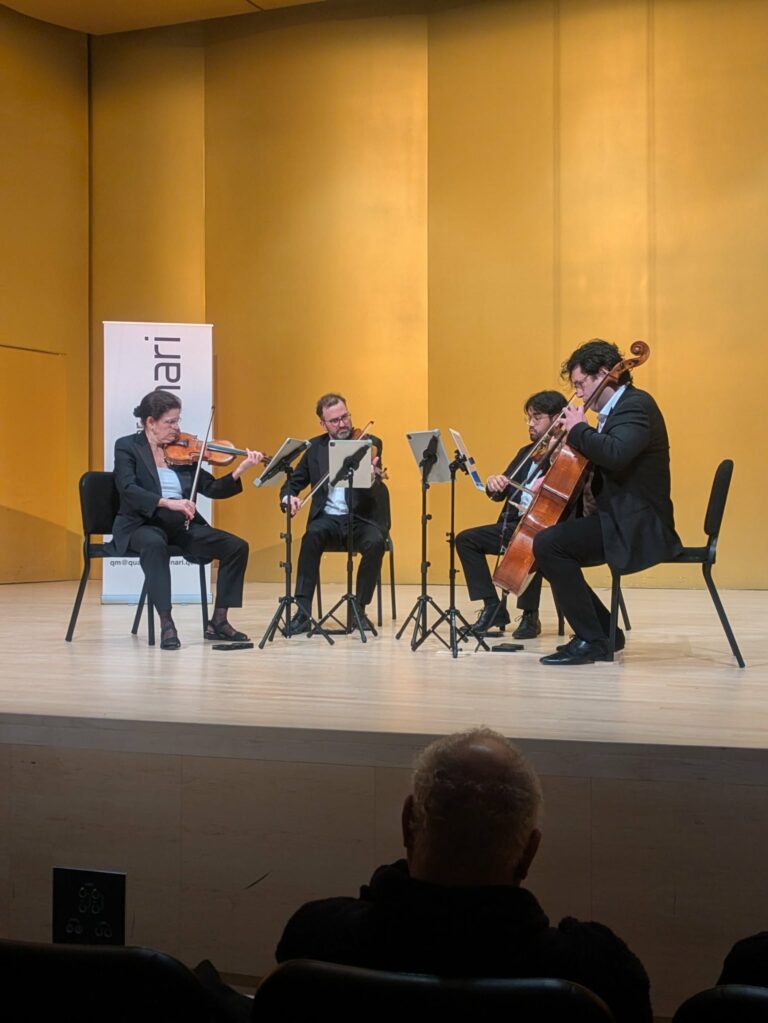
In a fairly full hall at the Montreal Conservatory, the aura of Philip Glass permeated the audience present. We were eager to be there to hear the last four quartets of the famous composer. All the more famous because he recently gave Donald Trump the cold shoulder by cancelling the premiere of his fifteenth symphony at the Kennedy Center in Washington. In reaction to the addition of the name ‘’Trump’’ before that of the former Democratic president. Bravo. Nothing more to say about that.

Unusual Glass

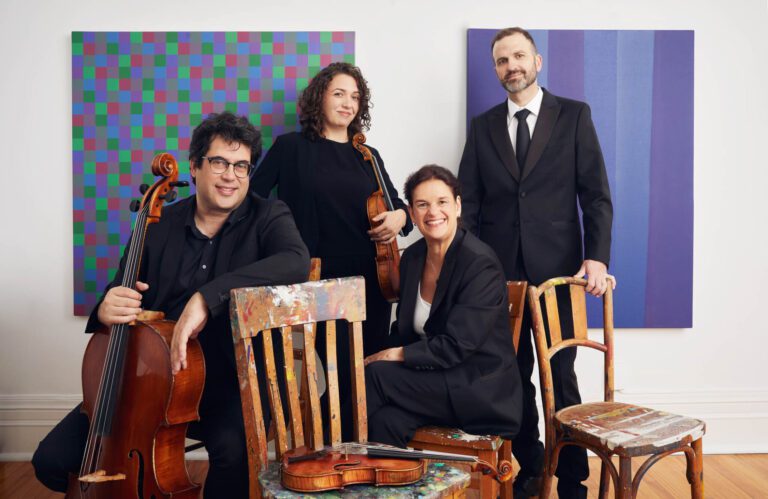
The last quartets by Glass are still quite recent and have rarely been played to date, at least here. The Molinari Quartet is preparing them for recording next August. They will be added to the others, already digitally recorded, and will form a complete set that we look forward to hear.

These latest quartets, from Glass’s chamber music perspective, are innovative, even often astonishing. You hear harmonies that were never really explored in the first five, better known ones. Melodies are sometimes distant from the sumptuous fullness of the usual Glass style, and architectural support is different from the repetitive cellular motivism to which the American composer has accustomed us (for example, in Quartet No. 9, King Lear. See further down).

They are, therefore, dangerous for interpreters because they are not “intuitive.” Traps are set everywhere, and it is easy to break their narrative and discursive strength. It often relies on very little, on tiny details that must be perfectly rendered, at the risk of seeing the entire structure crack.

The Beethoven effect

I dare to compare these quartets to Beethoven’s last ones. For Philip Glass, they might have this significance. Of course, not in terms of style and philosophical and spiritual aspirations, but certainly for the place they seem to give to the renewal of the master’s technical language. To the seeds planted for the next generation of Minimalists who will claim his school of thought.

The Bent Suite, taken from a film score, paints sober landscapes that accompany the story of the persecution of homosexuals under the Nazi regime. The score features several passages for solo, duo, and trio. A kind of intimacy of sounds, then. A refined aspect that requires careful control of sound projection, at the risk of sounding harsh. It happened a bit yesterday, in the fourth movement, for example.

Quartet Satz (Movement in German) was written for the Fifty for the Future project by the Kronos Quartet (for which Montrealer Nicole Lizée was also involved). It is a piece of barely 8 minutes, in the shape of an arch that starts in calm, swells with sound intensity before returning to tranquillity. Beautiful, effective, perfectly rendered by the Molinari.

Renewed Classicism

The String Quartet No. 8 is, they say, a “return to Glassian classicism.” My ears still tell me that it dares very unusual melodic detours for the composer. This quartet is a minefield that constantly tests the ensemble’s accuracy and the rhythmic cohesion of a group. On arpeggios with sharper lines and narrower note intervals, melodies or a dangerously chromatic counterpoint are superimposed. The final movement imposes exchanges of arpeggiated ascents and descents that are very difficult to coordinate between the instruments, at least to ensure the ideal fluidity. The Molinari came out of it with a few scrapes, but without losing its vitality, though.

A masterpiece and a legacy called Lear

The program concluded with the masterful String Quartet No. 9 King Lear. It was commissioned by Glass in 2022 to accompany a production of Shakespeare’s King Lear in New York. The composer delved deeply into the story of this mad king, who died in a storm with his daughters, to write a score that is divided into substantial pieces that return and metamorphose throughout the journey. Different from the usual method, then. In general, Glass reuses repeated motifs, short and almost atomic in their individual simplicity. Here, the arpeggios are certainly present, but embedded in larger musical pieces, each carrying its own personality, atmosphere, and character. These movements are reused alternately with others, then transformed. As if the Glassian architecture here were formed not from unique bricks, but from prefabricated blocks.

Above all, this quartet presents striking ideas, such as the rumbling cello, which seems to prepare for the final storm, or the strokes with the tip of the bow creating a frosty effect, like cracking ice. The King Lear Quartet is a masterpiece. If this were to prove to be Philip Glass’s musical testament for the quartet, it would be a memorable one that will be played often and for a long time.

The Molinari excelled here and mastered the deployment of this rich and very touching construction. 

Coming next

There are still several months before the recording, which leaves enough time to make some adjustments and fine-tune everything. What is certain is that the emotional involvement is there, and so is the conviction.

Let’s note that the usual violist, Cynthia Blanchon, who just gave birth (congratulations!!), was replaced on short notice and superbly by Sebastian Gonzalez Mora, a musician with the Montreal symphony.

Upcoming concerts by the Molinari Quartet:

March 29, 2026 (Glass and others) Molinari Foundation 

May 28, 29, 30, 2026 (Shostakovich) – Conservatory Hall
classique / musique contemporaine / quatuor à cordes

Quatuor Molinari : Rythmes canadiens au Conservatoire de Montréal

by Rédaction PAN M 360

Le second concert de la saison intitulé « Rythmes canadiens », présente trois œuvres canadiennes dont les élans rythmiques sont entraînants. De la compositrice Kelly-Marie Murphy vous entendrez Dark Energy, œuvre commandée comme pièce imposée pour le Concours international de quatuors à cordes de Banff. Le 4e quatuor de R. Murray Schafer est une œuvre en trois sections dont la section centrale est un feu d’artifice de triples croches. S’ouvrant avec un trio à cordes sur scène, le premier violon entame un chant lyrique au lointain avant de rejoindre les autres cordes pour le début de la seconde section. Enfin, l’œuvre se termine sur un hommage au poète bp nicols, dont la mort soudaine et tragique a marqué le compositeur.
Compositeur prolifique dans tous les genres, Blair Thomson est aussi reconnu pour ses grandes œuvres symphoniques et ses nombreux arrangements orchestraux de haut niveau, Blair Thompson écrit son premier quatuor à cordes Internesses pour le Molinari et il sera créé lors de ce concert.

The second concert of the season, entitled “Canadian Rhythms,” features three Canadian works with lively rhythms. From composer Kelly-Marie Murphy, you will hear Dark Energy, a work commissioned as a compulsory piece for the Banff International String Quartet Competition. R. Murray Schafer’s Fourth Quartet is a three-movement work whose middle movement is a fireworks display of sixteenth notes. Opening with a string trio on stage, the first violin begins a lyrical melody in the distance before joining the other strings at the beginning of the second movement. Finally, the work ends with a tribute to the poet bp nicols, whose sudden and tragic death had a profound effect on the composer.
A prolific composer in all genres, Blair Thomson is also known for his major symphonic works and numerous high-level orchestral arrangements. Blair Thompson wrote his first string quartet, Internesses, for the Molinari Quartet, and it will be premiered at this concert.

Programme

Kelly-Marie Murphy : Dark Energy (2007)
Blair Thomson : Internesses (création)
Murray Schafer : Quatuor no 4

Program

Kelly-Marie Murphy : Dark Energy (2007)
Blair Thomson : Internesses (world premiere)
Murray Schafer : Quartet no 4

POUR PLUS D’INFORMATIONS SUR LE SPECTACLE, C’EST ICI!

Ce contenu provient du Quatuor Molinari et est adapté par PAN M 360

classique / post-romantique / quatuor à cordes

Quatuor Molinari : Passages au Conservatoire de Montréal

by Rédaction PAN M 360

Le premier concert de la saison de la série Vingtième et plus est intitulé Passages et présente des œuvres tirées des deux plus importants cycle de quatuors à cordes écrits au 20e siècle. Dimitri Chostakovitch et Béla Bartók ont écrit pas moins de 31 œuvres pour cette formation.
Du premier, vous pourrez entendre son 4e quatuor, écrit pendant le régime stalinien et créé après la mort de Staline en 1953 et le 1er quatuor du hongrois Béla Bartók, dont les trois mouvements forment un parcours étonnant, du désespoir à l’espoir, du chant funèbre à la danse hongroise. Pour compléter le programme, les musiciens offriront le Quatuor III du bulgare naturalisé français André Boucourechliev, œuvre écrite pur le Concours international de quatuors à cordes d’Évian de 1995.

The first concert of the season in the Twentieth and Beyond series is entitled Passages and features works from the two most important string quartet cycles written in the 20th century. Dmitri Shostakovich and Béla Bartók wrote no fewer than 31 works for string quartet.
From the former, you will hear his Fourth Quartet, written during the Stalinist regime and premiered after Stalin’s death in 1953, and the First Quartet by the Hungarian Béla Bartók, whose three movements form an astonishing journey from despair to hope, from funeral dirge to Hungarian dance. To complete the program, the musicians will perform Quartet III by the Bulgarian-born French composer André Boucourechliev, a work written for the 1995 Évian International String Quartet Competition.

Programme

André Boucourechliev : Quatuor III
Dimitri Chostakovitch : Quatuor no 4
Béla Bartók : Quatuor no 1, opus 7

Program

André Boucourechliev: Quartet No. 3
Dmitri Shostakovich: Quartet No. 4
Béla Bartók: Quartet No. 1, Opus 7

POUR PLUS D’INFORMATIONS SUR LE SPECTACLE, C’EST ICI!

Ce contenu provient du Quatuor Molinari et est adapté par PAN M 360

Electronic / Experimental / Contemporary

ÉLECTROCHOC No 2 | Charles Quévillon + Sawtooth

by Rédaction PAN M 360

Charles Quevillon (ca)

Charles Quevillon est un compositeur canadien, résidant en Finlande. Diplômé du Conservatoire de Musique de Montréal, il a travaillé pendant 12 ans avec le chorégraphe Tedd Robinson sur 27 projets, présentés dans des festivals majeurs. Son approche multidisciplinaire l’a amené à collaborer avec des ensembles comme Defunensemble (FI) et Sound Initiative (FR), Kollektiv Totem (CH) et avec l’artiste visuelle Maija Tammi. Actuellement doctorant à l’Académie Sibelius, ses recherches portent sur l’usage symbolique des technologies électroniques en musique.

Charles Quevillon is a Canadian composer, residing in Finland. A graduate of the Conservatoire de Musique de Montréal, he worked for 12 years with choreographer Tedd Robinson on 27 projects, presented at major festivals. His multidisciplinary approach has led him to collaborate with ensembles such as Defunensemble (FI) and Sound Initiative (FR), Kollektiv Totem (CH), as well as with visual artist Maija Tammi. Currently pursuing a doctorate at the Sibelius Academy, his research focuses on the symbolic use of electronic technologies in music.

Sawtooth Duo (Sarah Albu + Matti Pulkki)

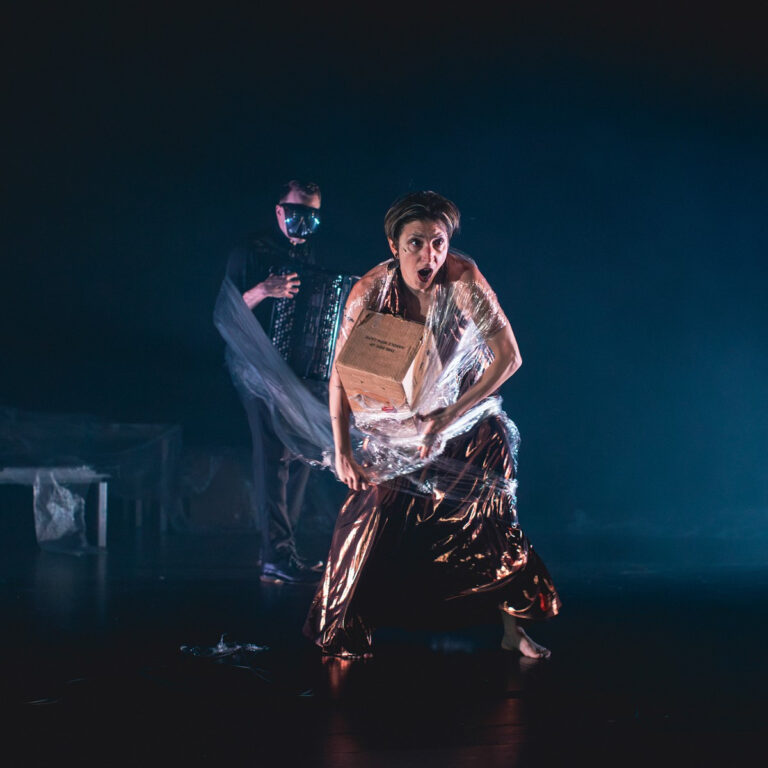
Sawtooth est un duo éclectique voix-accordéon qui explore les liens entre la musique folklorique, la musique classique et le répertoire contemporain. Avec une passion pour les textures expérimentales, la collaboration interdisciplinaire et une profonde connexion à la narration, Sawtooth recherche des répertoires de chansons obscures, adapte des pièces de chambre écrites pour d’autres instruments et développe de nouvelles œuvres en collaboration avec des compositeurs.
Sarah Albu est chanteuse, compositrice et créatrice de performances, spécialisée dans la musique nouvelle/expérimentale, le répertoire du XXe siècle et l’improvisation libre. Basée à Montréal, Sarah est membre fondatrice du collectif vocal expérimental Phth et collabore fréquemment avec des artistes travaillant dans la vidéo, l’installation, la danse contemporaine, le textile et les médias numériques.
L’accordéoniste Matti Pulkki est un interprète actif et enthousiaste du répertoire contemporain et expérimental. Jouant souvent avec différents groupes de chambre et ensembles, Pulkki cherche à explorer et à étendre les possibilités techniques et acoustiques de son instrument dans la musique écrite de notre époque.

Sawtooth is an eclectic voice-accordion duo exploring connections between folk music, classical music and contemporary repertoire. With a passion for experimental textures, interdisciplinary collaboration and deep connection to narrative, Sawtooth seeks out obscure song repertoire, adapts chamber pieces written for other instruments and develops new works in collaboration with composers.
Sarah Albu is a singer, composer and performance-maker specializing in new/experimental music, 20th century repertoire and free improvisation. Montreal-based Sarah is a founding member of the experimental voice collective Phth and frequently collaborates with artists working in video, installation, contemporary dance, textiles and digital media.
Accordionist Matti Pulkki is an active and enthusiastic performer of contemporary and experimental repertoire. Often performing with different chamber groups and ensembles, Pulkki seeks to explore and extend the technical and acoustic possibilities of his instrument in the music written in our time.

Programme

Le Baptême du Haut-Parleur (2024) 62’00”
Opéra de chambre en 4 actes pour soprano, accordéon, Genelec 8020D, marionnettiste et électronique.
Délivrance — Mémoires — Souffrance — Sublimation
Le Baptême du Haut-Parleur cherche à déconstruire la vision ordinaire du haut-parleur comme un simple objet utilitaire et à révéler ses significations archétypales et mystiques latentes. Par une approche à la fois ludique et sincère, cet opéra relie le cadre consumériste et technologique du haut-parleur au symbolisme religieux et spirituel. Par exemple, l’Acte I : Délivrance s’inspire du baptême moderne des objets technologiques : les vidéos de « unboxing » sur YouTube. Ainsi, cet opéra interroge la manière d’intégrer de façon significative un haut-parleur, avec toute son « âme » et ses facettes plus sombres, dans la vie spirituelle humaine.

Program

Loudspeaker Baptism (2024) 62’00”
Chamber opera in 4 acts for soprano, accordion, Genelec 8020D, puppeteer and electronics.
Delivery — Memories — Suffering — Sublimation
Loudspeaker Baptism aims to crack open the mundane perception of a loudspeaker as a mere commodity and activate its latent archetypal and mystical meanings. Through a playful yet earnest approach, this opera connects the consumerist and technological framework of a loudspeaker with religious and spiritual symbolism. For instance, Act I: Delivery is inspired by the modern baptism of technological objects: the “unboxing” YouTube videos. Thus, this opera asks, how to meaningfully integrate a loudspeaker, with its whole “soul” and darker facets, into human spiritual life.

POUR ACHETER VOTRE BILLET, C’EST ICI!

Ce contenu provient du festival Akousma et est adapté par PAN M 360

classique

Quatuor Molinari : Nocturnes

by Rédaction PAN M 360

Le second concert de la série Vingtième et plus du Quatuor Molinari présente le concert intitulé «Nocturnes».
Les nocturnes, ou musiques de nuit se présentent sous différentes formes; habituellement douces et calmes, elles peuvent aussi revêtir un caractère plus troublé.
Les deux courtes œuvres de Kurtág, Aus der Ferne, musique du lointain sont d’une transparence et d’une délicatesse qui nous font retenir notre souffle. Le Notturno de Luciano Berio suit un parcours qui nous mène parfois dans la tourmente mais qui se résout toujours dans le calme. Enfin, le dernier quatuor de Béla Bartók est une œuvre d’une profonde tristesse et solitude dont le thème principal, qui parcourra toute l’œuvre, est une douce et triste berceuse.
György Kurtág : Aus der ferne III et V
Luciano Berio : Notturno
Béla Bartók : Quatuor no 6

The second concert of the Twentieth and Beyond series by the Molinari Quartet is entitled Notturno.
Nocturnes or night music are presented in different forms; usually they are soft and calm, but they can also take on a more troubled character.
The two short works by Kurtág, Aus der Ferne, music from afar, are delicate, transparent and breath holding. Luciano Berio’s Notturno brings us into the turmoil but always resolves in calm moments. To close the concert, the Molinari’s will play Béla Bartók’s last quartet, No.6. A work of profound solitude and sorrow, the principal theme heard all through the work is a gentle and sad lullaby.
György Kurtág : Aus der ferne III et V
Luciano Berio : Notturno
Béla Bartók : Quartet no. 6

Ce contenu provient du Quatuor Molinari et est adapté par PAN M 360

expérimental / contemporain / Modern Classical / musique contemporaine

Semaine du Neuf | Lascaux + Mad Max

by Varun Swarup

La Semaine de Neuf de cette année, présentée sous le cadre du Le Vivier, promet d’explorer les liens entre les arts numériques et la musique de création, donnant jusqu’à présent des résultats prometteurs. La représentation de ce soir, une double programmation, a été une autre soirée réussie pour le programme de cette année, qui comprend des performances à caractère multimédia et interdisciplinaire.

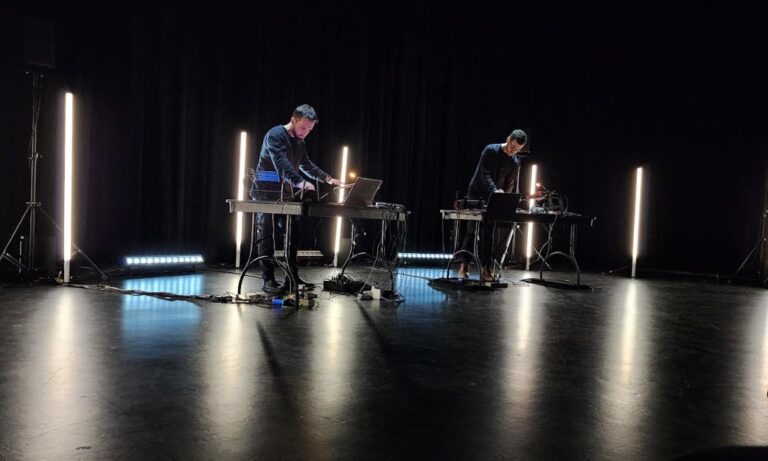
La première moitié du programme, Lascaux, a été interprétée et composée par deux artistes électroacoustiques italiens, Giulio Colangelo et Vittorio Montalti, qui cherchent à explorer le moment où l’étincelle créatrice est née dans ces célèbres grottes avec cette pièce. Il est difficile de dire si cet objectif ambitieux a été atteint ou non, mais considéré uniquement comme une expérience sensorielle et audiovisuelle, ce fut certainement un plaisir à vivre. Les deux artistes ont joué avec des sons et des bruits incroyablement tactiles et viscéraux grâce à la magnifique installation son et lumière de la salle du Conservatoire de Musique. Cependant, je n’ai pas été très convaincu par la narration de cette pièce ni ému par son arc, car il révèle beaucoup de choses dans les mêmes textures, mais c’était quand même très agréable.

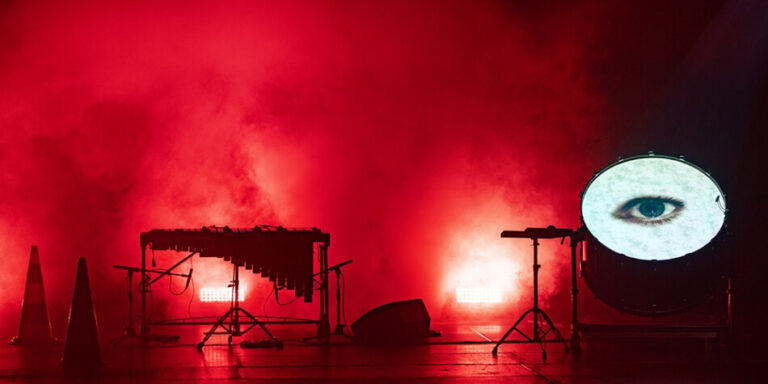
Le point culminant de la soirée a été cette interprétation éclectique de Mad Max du compositeur français de musique mixte Pierre Jodlowsky, dont l’œuvre est à l’honneur cette année. Sa vision de ce héros hollywoodien est en fin de compte un examen brutal des défauts et des vices souvent associés à de tels personnages : violence, machisme, brutalité. Charles Rambaldo a livré une performance captivante en tant que personnage principal, se frayant un chemin non seulement à travers une post-apocalypse mais aussi une partition musicale incroyablement détaillée qui impliquait beaucoup de coordination de sa part. La composition commence avec l’interprète mimant la conduite d’une moto avec des détails convaincants, avant d’interagir avec une grosse caisse sur laquelle est projetée une bouche. La pièce monte en crescendo dans sa partie du troisième acte avec l’interprète se mettant enfin au vibraphone, menant au moment le plus « musical » de la partition invoquant les sons du gamelan. Certainement une performance très amusante et réfléchie, et qui rendait justice au matériel source explosif.

expérimental / contemporain

Semaine du Neuf: Lascaux + Mad Max

by Rédaction PAN M 360

While Italian artists Giulio Colangelo and Vittorio Montalti travel 20,000 years back in time to the Lascaux caves with visual and aural lightning, percussionist Charles Chiovato Rambaldo plays a crazy, completely out-of-control biker straight out of Hollywood studios.

With Lascaux, the two Italian composers and performers pay tribute to the eponymous caves and the birth of Art. Inspired by Georges Bataille’s text on these caves painted 20,000 years ago, the performance aims to retrace and relive the unconscious moment when this creative impulse was born, leaving an imprint on history.

The performance offers a synesthetic dialogue between neon lights and electronic sounds, punctuating and progressing through tableaux marked by flashes of light and sound.
Pierre Jodlowski’s Mad Max is a sound installation combining percussion, electroacoustics and scenography. Charles Chiovato Rambaldo will play this crazy, totally uncontrollable biker who embodies everything we can criticize and disapprove of in the contemporary hero straight out of Hollywood studios: violent, macho, brutal, illiterate, stupid… personifying par excellence the harshness of a brutal, unjust world.

Tandis que les artistes italiens Giulio Colangelo et Vittorio Montalti voyagent 20 000 ans plus tôt dans les grottes de Lascaux au moyen d’éclairs visuels et sonores, le percussionniste Charles Chiovato Rambaldo interprète un motard fou et complètement incontrôlable tout droit sorti des studios hollywoodiens.

À travers Lascaux, les deux compositeurs et interprètes italiens rendent hommage aux grottes éponyme et à la naissance de l’Art. Inspiré du texte de Georges Bataille sur ces grottes peintes il y a 20 000 ans, la prestation entend retracer et revivre l’instant inconscient où est née cette impulsion créatrice qui a laissé une empreinte de l’Histoire. 

Cette performance offre un dialogue synesthésique entre néons et sons électroniques qui rythment et progresse par tableaux, marqués par des éclairs visuels et sonores.
Mad Max de Pierre Jodlowski est une installation sonore assumée entre percussions, électroacoustique et scénographie. Charles Chiovato Rambaldo interprétera ici ce motard fou et totalement incontrôlable qui incarne tout ce que l’on peut critiquer et désapprouver du héros contemporain tout droit sorti des studios d’hollywood ; violent, macho, brutal, analphabète, stupide… personnifiant par excellence la dureté d’un monde brutal et injuste.


POUR ACHETER VOTRE BILLET, C’EST ICI!

This content comes from Le Vivier and is adapted by PAN M 360.

classique

À la croisée des pianos : Erik Bertsch

by Rédaction PAN M 360

Compositions enregistrées par le pianiste Erik Bertsch lui-même (étiquette Kairos) et remarquée par la critique, les Miniature estrose de Marco Stroppa sont une œuvre à part dans le catalogue du compositeur. Ses pièces sont façonnées dans les moindre détails, à l’image des initiales richement décorées des manuscrits enluminés du Moyen-Âge. Elles donnent ainsi vie à une musique fascinante composée de «noyaux» qui migrent au fil des mouvements, comme à travers un réseau à travers lequel Bertsch chemine et transporte son public.

Critically acclaimed compositions recorded by pianist Erik Bertsch himself (Kairos label). Marco Stroppa’s les Miniature estrose stand apart in the composer’s catalogue. His pieces are crafted down to minute detail, like the richly decorated lettering on illuminated manuscripts from the Middle Ages. They give life to fascinating music composed of ‘’cores” which migrate with each movement, as if moving through a network where Bertsch transports his audience.

POUR ACHETER VOTRE BILLET, C’EST ICI!

Ce contenu provient de la SMCQ et est adapté par PAN M 360.

classique

À la croisée des pianos : Daniel Áñez et Brigitte Poulin

by Rédaction PAN M 360

Les pianistes montréalais Daniel Áñez et Brigitte Poulin illuminent à leur tour la scène pour compléter ce panorama pianistique. Berceuse d’Helmut Lachenmann, minimalisme expérimental de Gordon Monahan, mélodie envoûtante d’Anne Southam et délicatesse de Jocelyn Morlock se succèdent dans un répertoire onirique. Tandis que le microcosme radical de Berio et les tonalités singulières d’Émilie Girard-Charest ajoutent leurs couleurs uniques à ce paysage sonore inusité. Un voyage musical où s’épanouissent des mondes sonores variés et saisissants.

Montréal pianists Daniel Áñez and Brigitte Poulin illuminate the stage, completing this pianistic panorama. Helmut Lachenmann’s lullaby, Gordon Monahan’s experimental minimalism, Anne Southam’s haunting melody and Jocelyn Morlock’s delicacy follow each other in an ethereal repertoire. Berio’s radical microcosm and Émilie Girard-Charest’s singular tonalities add their unique colours to this unusual soundscape. A musical journey where a variety of striking sound worlds unfold.

POUR ACHETER VOTRE BILLET, C’EST ICI!

Ce contenu provient de la SMCQ et est adapté par PAN M 360.

classique

À la croisée des pianos : Erik Bertsch et Pamela Reimer

by Rédaction PAN M 360

La virtuosité et la précision rythmique au bout des doigts! Ce concert rassemble les pianistes Pamela Reimer et Erik Bertsch dans un répertoire des plus exigeants. Au programme, des œuvres qui vous emportent de la fantaisie et la spiritualité de Fabio Nieder aux spécificités du timbre et de la lumière (Ivan Fedele), en passant par les modèles mathématiques appliquées aux plantes (Enno Poppe) ou encore la théâtralité de la Sequenza de Luciano Berio. Sans oublier deux créations de compositeurs d’ici dont les œuvres sont régulièrement jouées à travers le monde (Yulia Zakharava et Michael Oesterle). In fine, une belle occasion de prendre le pouls de la composition pour piano solo à une échelle internationale.

Virtuosity and rhythmic precision at your fingertips! This concert brings together pianists Pamela Reimer and Erik Bertsch in a highly demanding repertoire. The programme includes works which take you from the fantasy and spirituality of Fabio Nieder to the specificities of timbre and light (Ivan Fedele), from mathematical models applied to the growth of plants (Enno Poppe) to the theatricality of Luciano Berio’s Sequenza. Included are two creations by local composers whose works are regularly performed world-wide (Yulia Zakharava and Michael Oesterle). All in all, a fine opportunity to take the pulse of solo piano composition on an international scale.

POUR ACHETER VOTRE BILLET, C’EST ICI!

Ce contenu provient de la SMCQ et est adapté par PAN M 360.

classique

À la croisée des pianos : Moritz Ernst – Music of Crossings

by Rédaction PAN M 360

Immerse yourself in the works of Sandeep Bhagwati! The SMCQ invites internationally renowned pianist Moritz Ernst to perform Music of Crossings, a cycle of 36 pieces, comprising a total of two and a half hours of music, performed over 3 successive evenings. Shaped by the structure of Georges Perec’s novel La Vie mode d’emploi and by his vast artistic involvement (literature, multimedia, theatre), Bhagwati’s work goes beyond its imposed limits to blossom with a unique stylistic, pianistic and sonic diversity. Moritz Ernst’s electrifying virtuosity invites the audience to (re) discover the composer celebrated by the SMCQ this season with a work emblematic of his eclectic repertoire.

Plongez dans l’œuvre-fleuve de Sandeep Bhagwati! La SMCQ invite le pianiste de renommée internationale Moritz Ernst à interpréter Music of Crossings, ce cycle de 36 pièces qui comprend au total deux heures et demie de musique et dont l’exécution est répartie sur 3 soirées successives. Façonnée par la structure du roman La Vie mode d’emploi de Georges Perec et par ses nombreuses préoccupations artistiques (littératures, multimédias, théâtre), cette œuvre de Bhagwati dépasse ses limites imposées pour éclore d’une diversité stylistique, pianistique et sonore unique. L’électrisante virtuosité de Moritz Ernst permet ainsi au public de (re)découvrir le compositeur célébré par la SMCQ cette saison avec une œuvre emblématique de son répertoire éclectique.

TO BUY YOUR TICKET, CLICK HERE!

This content comes from the SMCQ and is adapted by PAN M 360.

classique

À la croisée des pianos : Viktor Lazarov et Philippe Prud’homme

by Rédaction PAN M 360

Viktor Lazarov and Philippe Prud’homme, two high-flying pianists, take us to the very edge of Balkan and Quebec music. From the hypnotic waltz by Miodrag Lazarov Pashu to the dream-like or unleashed works of François Morel, the soloists take us to the crossroads of singular sounds. Pieces by talented up-and-coming musicians (Snežana Nešić, Francis Battah) and the late Silvio Palmieri also lend their respective musical poetry to this programme.

Viktor Lazarov et Philippe Prud’homme, deux pianistes de haute voltige, nous entraînent à la lisière de la musique des Balkans et du Québec. De la valse hypnotisante de Miodrag Lazarov Pashu aux œuvres tantôt rêveuses ou déchaînées de François Morel, les solistes nous amènent ainsi à la croisée de chemins aux sonorités singulières. Des pièces de la talentueuse relève (Snežana Nešić, Francis Battah) et du regretté Silvio Palmieri teintent également ce programme de leur poésie musicale respective.

TO BUY YOUR TICKET, CLICK HERE!

This content comes from the SMCQ and is adapted by PAN M 360.

Subscribe to our newsletter