Contemporary / Indigenous peoples

Festival Flux : Moe Clark + Melody McKiver à daphne

by Rédaction PAN M 360

Moe Clark

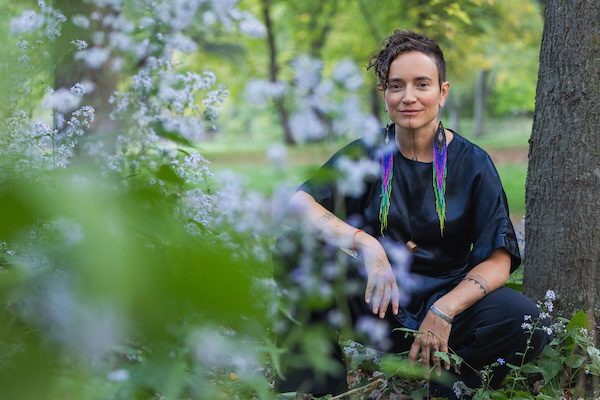
Artiste multidisciplinaire aux deux esprits âpihtawikosisâniskwêw (d’ascendance métisse et coloniale), Moe Clark (elle/iel) est un·e oiseau-tonnerre chantant. Originaire du territoire du Traité no 7, l’artiste est membre de la Nation métisse de l’Alberta et réside actuellement à Tio’tiá:ke/Mooniyang/Montréal, au Québec, où iel travaille comme artiste et pédagogue. Moe se consacre également à l’apprentissage du nêhiyawêwin (cri des plaines) et du michif et collabore étroitement avec les Aîné·es et les gardien·nes du savoir à la revitalisation linguistique par le chant. Sa pratique traverse l’improvisation vocale, la conception sonore, l’accompagnement cérémoniel ancré dans le territoire (oskapêwis) et la création scénique, pour créer des œuvres centrées sur les connaissances incarnées, la résurgence autochtone bispirituelle et les afinités créatives.

âpihtawikosisâniskwêw (Michif/mixed-settler) multidisciplinary artist Moe Clark (she/they) is a 2Spirit singing thunderbird. Born and raised in Treaty 7, they are a proud member of the Métis Nation of Alberta. Currently they reside as a guest in Tio’tiá:ke/ Mooniyang/ Montréal (QC) where she works as an artist and educator. A dedicated nêhiyawêwin (Plains Cree language) and Michif language learner, Moe collaborates intimately with Elders and knowledge keepers to advance language resurgence through song-based practices. She works across disciplines of vocal improvisation, sound design, land-based oskapêwis facilitation (ceremonial Elder apprenticeship), and performance creation, to create work that centres embodied knowledge, 2Spirit Indigenous resurgence, and creative kinship.

Melody McKiver

Melody McKiver (iel/ile) est un musicien anishinaabe, violiste, compositeur, et danseur traditional de powwow. Son origine est issue de la Première Nation de Obishikokaang Lac Seul ainsi que de l’Écosse et de la Lithuanie. Ile est professeur adjoint de musique autochtone avec l’Université de Manitoba. Melody a maintenant établi ses quartiers à Winnipeg Manitoba dans la térritoire de Traité no 1, mais était élevée en Ottawa. À titre d’artiste soliste, ile explore toute la gamme des possibilités de l’alto, de l’expression musicale minimaliste jusqu’à la musique cinématique. Melody présent Reckoning EP éponyme pour alto solo en décembre 2017.

Melody McKiver’s (they/them, do not use any other pronouns) musical work integrates electronics with Western classical music to shape a new genre of Anishinaabe compositions. A proud member of Obishikokaang Lac Seul First Nation, Melody is currently Assistant Professor of Indigenous Music (tenure-track) with the Desaultels Faculty of Music at the University of Manitoba and a member of the Mizi’iwe Aana Kwat (LGBTQ2S+ Council) within the Anishinaabe Nation of Treaty #3. They are the 2020 recipient of the Canada Council’s Robert Flaming Prize awarded annually to an exceptionally talented young Canadian composer, and a recurring invited participant in the Banff Centre for the Arts’ Indigenous Classical Music gatherings.

POUR ACHETER VOTRE BILLET, C’EST ICI!

Ce contenu provient d’Arts in the Margins et est adapté par PAN M 360
art sonore / Poetry / Soundtrack

FLUX | Poetics of Transmission and Poetry of Consciousness

by Judith Hamel

It was in the intimacy of the Indigenous artist-run centre, daphne, that Tanner Menard and Martín Rodríguez presented two unique performances on Sunday evening as part of the Flux Festival.

While waiting for the performance to begin, we wander among the exhibits Prelude to the Return of the American Indian by Buffalo Boy and Ne Karahstánion. This place itself inspires a sense of peace of mind, a communion among those present.

A few minutes after eight o’clock, Martín Rodríguez appears wandering through the galleries, wearing a beige uniform, rain boots, and a black cap adorned with gold. Loud chirping can be heard from his bag. After several detours through the space, he stops in front of the kitchen and takes out two radios and two transmitters. He fetches a ladder, places one of the radios on it, and invites the audience to gather around this new altar.

Using sound archives: birds, bullfrogs, bells, bees, trucks, cars, human voices, several explorations of interference between radio-transmitter pairs unfold. Rodríguez then creates the interference by playing with the distance between the transmitters and the radios. Each of his gestures affects the broadcast: he leans, straightens, withdraws into space; he moves objects, combines them, opposes them; he creates the interference with his own hands, erecting his transmitters like a fragile house of cards.

His performance ends with a nap, wrapped in a white jacket decorated with colorful embroidery, cap pulled down over his eyes, abandoned among the urban sounds.

After a short break, Tanner Menard takes his place. At the intersection of sound and visual poetry, his work is rooted in a search for a post-polarity-unity life and a vision of the world based on interdependence and drawn from love.

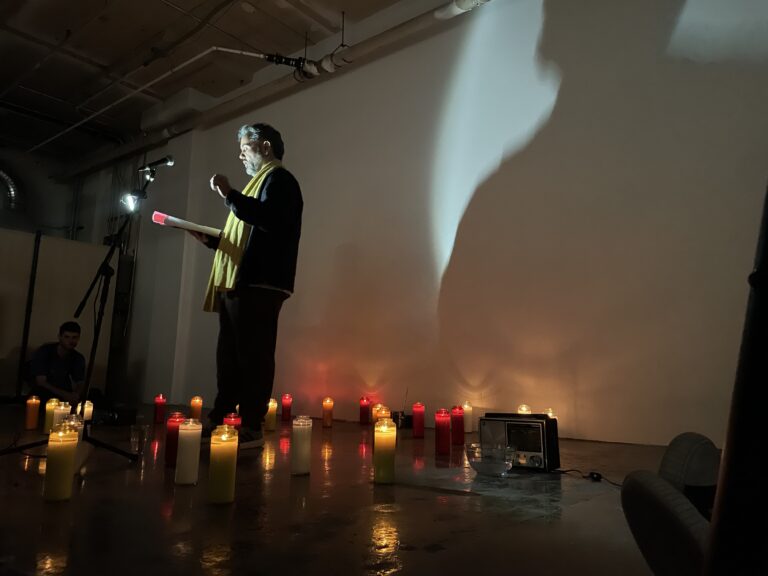
After a few shared breaths and our eyes closed, Menard recites his first poems. Around him, a pool of candles and four radios broadcasting white noise. In front of each, a bowl of water collects their waves. After this moment of poetic performance, he sits down at the computer, which projects these visual poems onto the wall. Everything is accompanied by his recorded voice and a musical score that embraces the texts’ forms in their intentions and intensities.

His words tell us about the fragility of contemporary existence and our common isolation: “The only “we” that exists is the common experience of multiplicitous isolation.”

Finally, he hands us the candles that came with him, consciously placing them in our hands. Then, with a ritual gesture, he sprinkles us with a few drops of water.

As we leave the place, the street appears different. This shared listening invites us to rethink our common individuality.

This shared moment invites us to rethink what connects us, our overall way of being alone.

Publicité panam
immersion / Indigenous peoples

Présence Autochtone : Inuit Makers au Centre d’art daphne

by Rédaction PAN M 360

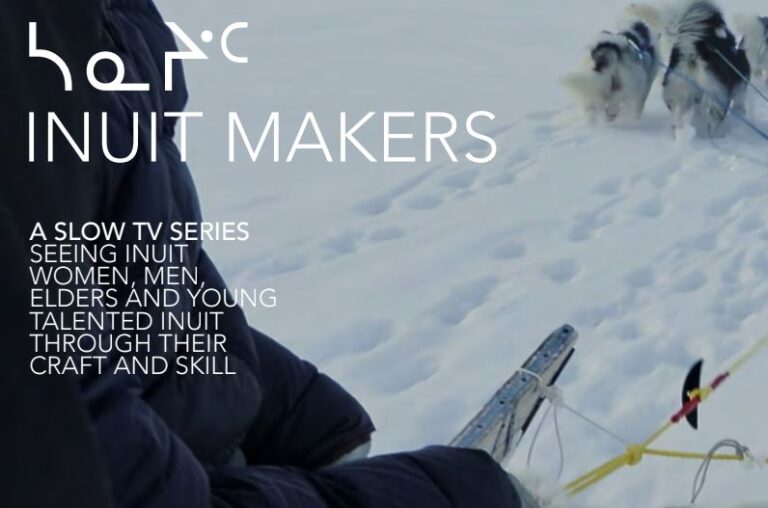
Sanajiit ᓴᓇᔩᑦ (Inuit Makers) est une série documentaire de 13 épisodes qui offre au public une expérience immersive au cœur du processus créatif, de l’artisanat, des compétences et du quotidien des créateurs inuits du Nunavut. S’inspirant des conventions du genre « Slow TV », Sanajiit célèbre les rythmes et les réalités de la culture inuite, ainsi que le processus d’apprentissage traditionnel inuit, « apprendre par la pratique », avec les aînés, les membres de la communauté et une nouvelle génération d’Inuits. Produite en inuktitut et sous-titrée en anglais, Sanajiit favorise la préservation de la langue et l’accessibilité pour le public inuit, garantissant ainsi que ces histoires continueront à inspirer les générations à venir.
1 DEBORAH QAUNAQ / COUTURE À LA MAISON 10 parties | Durée totale 657 min
2 ESA KRIPANIK / SCULPTURE 10 parties | Durée totale 570 min
3 ISRAEL IVVALU / RÉPARATION DE MOTONEIGES 6 parties | Durée totale 324 min
4 EVA SULUK / SÉCHER LE CARIBOU 8 parties | Durée totale 341 min
5 JERRY IYYIRAQ / CONSTRUCTION 10 parties | Durée totale 487 min
6 JASON NUNGIRQ / ENTRAÎNEMENT AUX INCENDIES 7 parties | Durée totale 293 min
7 QILIQTI IVALU / ENTRAÎNEMENT D’ÉQUIPE DE CHIENS 4 parties | Durée totale 190 min
8 EVIE MARK / ENSEIGNEMENT 10 parties | Durée totale 933 min
9 TRAVIS KUNNUK / PÊCHE EN FAMILLE 8 parties | Durée totale 349 min
10 ARSANIQ DEER / LE TATOUAGE D’ATUAT 8 parties | Durée totale 425 min
11 SULA QUMANGAT / MÉNAGE & CUISINE 7 parties | Durée totale 291 min
12 ARSANIQ ET MONICA / MONICA VOYAGE À MONTRÉAL 6 parties | Durée totale 280 min
13 SUSAN AVINGAQ / FABRICATION DE POUPÉES 10 parties | Durée totale 570 min

Sanajiit  ᓴᓇᔩᑦ  (Inuit Makers) is a 13-episode documentary series immersing audiences in the creative process, craftsmanship, traditional skills, and daily life of Inuit “Makers” living in Nunavut. Filmed using a unique “Slow TV” approach, Sanajiit honours the rhythms and realities of Inuit culture, and the traditional Inuit learning process of “learning by doing” with elders, community members, and a new generation of Inuit. Produced in Inuktitut with English subtitles, Sanajiit ᓴᓇᔩᑦ (Inuit Makers) supports language preservation and accessibility for Inuit audiences, ensuring these stories continue to inspire for generations to come.
1 DEBORAH QAUNAQ/ SEWING AT HOME 10 parts | Total Runtime 657 min
2 ESA KRIPANIK/CARVING 10 parts | Total Runtime 570 min
3 ISRAEL IVVALU/FIXING SNOWMOBILES 6 parts | Total Runtime 324 min
4 EVA SULUK/DRYING CARIBOU 8 parts | Total Runtime 341 min
5 JERRY IYYIRAQ/ BUILDING 10 parts | Total Runtime 487 min
6 JASON NUNGIRQ/FIREFIGHTING TRAINING 7 parts | Total Runtime 293 min
7 QILIQTI IVALU/DOG TEAM TRAINING 4 parts | Total Runtime 190 min
8 EVIE MARK/TEACHING 10 parts | Total Runtime 933 min
9 TRAVIS KUNNUK/FISHING WITH FAMILY 8 parts | Total Runtime 349 min
10 ARSANIQ DEER/ ATUAT’S TATTOO 8 parts | Total Runtime 425 min
11 SULA QUMANGAT/CLEANING & COOKING 7 parts | Total Runtime 291 min
12 ARSANIQ AND MONICA/MONICA TRAVELS TO MONTREAL 6 parts | Total Runtime 280 min
13 SUSAN AVINGAQ/DOLL MAKING 10 parts | Total Runtime 570 min

CE SPECTACLE EST GRATUIT!

Ce contenu provient de Présence Autochtone et est adapté par PAN M 360

Subscribe to our newsletter

Inscription
Infolettre

"*" indicates required fields

Type of Suscribers