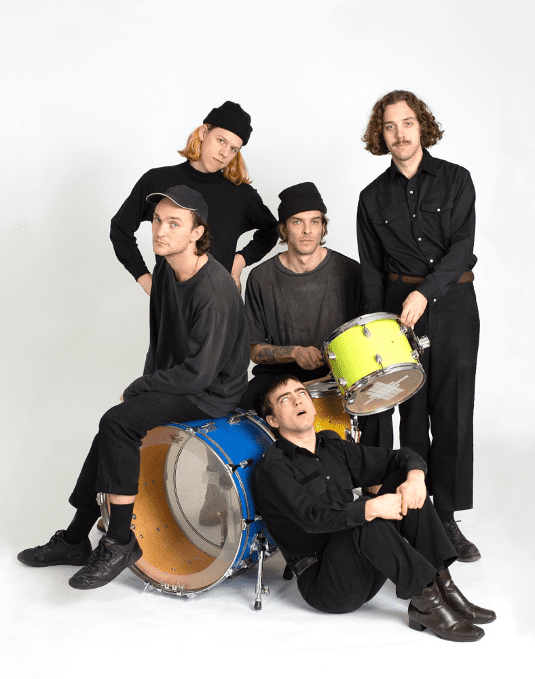
Like everyone else, NOBRO had plans. Plans for concerts with Pussy Riot at the CMW in Toronto, tours and festivals in Quebec and elsewhere… and like everyone else, those plans fell through, for obvious reasons. But there’s one project that hasn’t been cancelled, rather simply postponed for a few weeks, and that’s the release of the 4-track EP Sick Hustle, on the Toronto label Dine Alone, and the accompanying video clip. “The music video is for the song ‘Don’t Die…’ We were supposed to release all this stuff a few weeks ago, but with everything that’s happened, we thought it might not be the best idea to release it too soon,” explains drummer Sarah Dion, interviewed along with keyboard-percussionist Lisandre Bourdages, both of them in quarantine after a trip to Mexico. “We thought maybe the timing wasn’t right. I know it’s a cartoon, there’s nothing creepy or sinister about it, but we thought we’d wait a bit until the panic over the pandemic thing died down and our song wasn’t misinterpreted.”
Formed about six years ago by the fiery bassist and singer Kathryn McCaughey, NOBRO has seen many musicians pass through its ranks before arriving at the current configuration – a mutation that has transformed the sound and energy of the Montreal band. Today, the four musicians, with Karolane Carbonneau on the six-strings, play a furious mix of heavy rock – and a bit of pop – that would make L7 blush.
“When Kathryn started the band, her idea was to bring together the flashiest and most show-off musicians, put them on a stage and make fast and intense songs with them,” says the metronomic Sarah Dion. “It was really a statement, and the band’s name leaves no room for innuendo. No bro. A first EP was released in 2015, but only Kathryn from the current band was on it. Then Lisandre, Karolane and I all arrived at different times. I’d say it’s been about a year and a half since the four of us have been playing together, and this is our first record. It’s quite different from what the old band used to do. It’s like a new start.”
“It was a lot more punk before, more knockabout,” adds Lisandre Bourdages, who is also in the Shirley line-up with Sarah Dion, and Comment Debord with Karolane Carbonneau. “Now, I’d say that we’re putting more time and work into the search for tonalities, into the composition of the songs. It’s more complex and we have more confidence. The sound is much richer, less punk and more ’70s rock, stoner and even pop. We follow a lot of Kathryn’s influences – T-Rex, Betty Davis, Black Sabbath, MC5… As for me, I studied Latin percussion, Sarah had a reggae band, Karolane was in a free-jazz combo… So when you put it all together, you make sure that all these influences are coherent.”
F-Rock
Calling themselves a feminist rock band, the NOBRO girls point out, however, that this stance is not really reflected in the quartet’s lyrics. “I see myself more as a musician in a rock band,” Dion admits. “But the basic idea, the statement in fact, is that NOBRO is a group of girls who rock. To show that four women together are capable of mastering their instruments superbly, and tearing it up. But as the years go by, we’re finding that it’s becoming less and less rare to see bands made up entirely of women. The day it’s the norm, then I’ll say we’ve won our case.”
photo: Patrick O’Brien
PAN M 360: In your opinion, what’s changed with your new album?
Ishmael Butler: I don’t really think about the things done on this new album. The objective is not to achieve something specific, it’s more about relaying these unspeakable things, guided by the laws of nature. When you get high and make music, vibrations are generated, emotions are translated into music and words.
PAN M 360: Yes, but… deep down, what do you think you’ve accomplished with this new album?
Ishmael Butler: I hope that this is not a rehashing of what I did before. I always try to do something different. I try to grow artistically by incorporating new ideas, which is what I’ve been doing since I was a child. You know, artists have their own personality, I don’t really know what mine is and I think it’s better for me to see it that way. I wouldn’t necessarily describe my own music as ‘advanced’ hip hop, as some people say. For my part, I’m not in a position to analyze or define. I’m in a position to act. It’s about living and doing things, having the idea of a form and developing it.
PAN M 360: Specifically, how did you work on the concept of The Don of Diamond Dreams?
Ishmael Butler: I’m always creating songs – on my computer, in the studio, in people’s homes after a show, wherever possible. When I have free time, I compile the work I’ve done, then I distill it into smaller, more precise formats. Then there’s the lyrics, the instrumental supplements, the final reduction and the mixing. Some patterns emerge then, an overall sound, an atmosphere, an environment. The whole thing took place over a period of about a year.
PAN M 360: What is your creative equipment and how do you use it?
Ishmael Butler: Here is my gear: Ableton sequencer, guitars, keyboards, effect pedals, vocal filters, wind instruments, string instruments, bass, percussion. I always buy new material, it induces new ideas. Also, I’m looking to meet artists who have new approaches, new ideas. I also like to learn how to play popular songs and understand how they are made, that leads me to a thousand new ideas. It’s like a snowball that gets bigger when it goes down a slope.
PAN M 360: In front of an audience, do you perform with a group of musicians?
Ishmael Butler: Preferably yes, but… If you’re paid a certain amount of money for a tour, you can’t take ten people with you, because your budget doesn’t allow it. Often the restriction is directly related to your tour budget. There are also other considerations. Let’s take the example of Flying Lotus, with whom I’ve already toured. He’s chosen to offer a visual experience in line with his music, so he devotes a large part of his financial resources to this visual aspect, and therefore chooses to simplify his musical presentation. And you know, fans often want to see and hear one person. But things can change; we can see some hip hop or electronic artists on stage with the baddest cats.
PAN M 360: Who are the people who collaborated on this album?
Ishmael Butler: I first composed all the music, beats and preliminary arrangements. I then worked with Darrius Willrich, keyboards and guitars, Evan Flory-Barnes, bassist extraordinaire from Seattle, Otis Calvin on keyboards, Erik Blood, bass, Carlos Niño, percussion, Carlos Overall, saxophone. Purple Tate Nate, Stas THEE Boss, and Carlos Overall are each featured in one song. They all add their own interpretation of the original mood, taking my songs to different places. I then fine-tuned by grafting their sounds to my songs. Erik Blood and I then mixed the whole thing at Studio 4 Labs in Venice, with the help of Andy Kravitz. As a result, we have a quality of sound that we have never had on other Shabazz Palaces albums.
PAN M 360: Can you briefly describe the purpose of the three songs on The Don of Diamond Dreams?
Ishmael Butler: “Thanking the Girls” evokes all the beautiful women I have known, who have shared their experiences and generosity with me. “Ad Ventures” is dedicated to the people of Black Constellation, my artistic family in which I create and grow. “Reg Walks by the Looking Glasses” is dedicated to my father, who loves the saxophone.
PAN M 360: Looking at your lyrics, you’re a chronicler of both public and private life – neither sphere seems to prevail.
Ishmael Butler: I have the impression that all these things in life, public or private, flicker together. Heaps of layers overlap and make up our perception of reality. When you try to distance yourself from your emotions and your life experience, you find that there is no dividing line. In my mind, everything fits together. At first glance, I’m not hyper-strong in all the subjects I deal with, but rather I have a global approach. I’m guided first and foremost by my instincts.
PAN M 360 : Beyond hip hop, do you listen to other music?
Ishmael Butler: Yes, a lot. New alternative music, experimental music, weird music of all kinds. I like music in general, if a song is good, that’s what counts. What do I like at the moment? Jpeg Mafia, Kamasi Washington, Ariel Pink, Yves Tumor, a hundred others! I go through the playlists, podcasts and videos I get sent. I’m interested in young people, I don’t think the new hip hop is lame or weak. But I think a lot of young hip hop artists don’t have that sensitivity for what older people like me consider substantial, but that doesn’t make them any less substantial in my mind. The value of a work rests on the emotional responsibility and instinct of the artist observing reality. People my age might describe recent works as empty, repetitive or lacking in creativity and… none of these impressions are my concern.
PAN M 360: What is your general perception of hip hop in 2020?
Ishmael Butler: Hip hop is a form that is less easy to circumscribe than it was at its beginnings. Rather, hip hop has become a global, multi-genre phenomenon. The term hip hop cannot perfectly describe this phenomenon, this hip hop that has become global nevertheless remains a reflection of its time. We are going through a period that is at the same time materialistic, nihilistic, absurd, excessive… and hip hop creators are a reflection of this through their creative work. In the United States where I am, just look at our political situation, the crisis of the pandemic and the resulting stock market crash – hip hop will testify to this as it has done since its early beginnings.
“I must say, the hardest challenge for me is to not make the tracks too busy with all kinds of percussion layers,” says Nicola Mauskovic. “I really like creating new rhythms, but it’s not always beneficial for the song to completely squeeze it full of busy congas and guiras.”
Seems like a sensible approach, given that the group the Amsterdam-based musician and producer leads, The Mauskovic Dance Band, makes music that’s already packed to bursting with all kinds of stuff. Their first full album, an eponymous release on the Soundway label last year (after several EPs on Swiss imprint Bongo Joe), showcased their tangle of dizzy space disco, effervescent Afro-Colombian motifs, and outré NYC punk-funk, steeped in a stew of hallucinogenic howls and haunting chants, rubber-band basslines, eerie synth licks and enigmatic echoes.
Sounds like a lot of upbeat fun, and it is, but that’s a bit deceptive. Insinuated into the MDB’s sound is a subtle but certain streak of unease. “I think the hypnotic element in our music, from the repetitive rhythms, gives it kind of a darker atmosphere,” says Mauskovic.
“I have the feeling some people tend to see rhythmic music as happy music,” Mauskovic continues. “Or as soon if there is an upbeat groove, and congas or other percussion, the music is party music. Which for me isn’t the case.
“A lot of the ’70s and ’80s music from West Africa – which I listen to a lot – has, for me, a pretty dark or melancholy atmosphere. But definitely still danceable! I mean, I don’t consider techno, which is definitely made for the dancefloor, happy music.”
Let’s say, then, that MDB’s music isn’t so much gleeful as it is gregarious, in the zoological sense. A demonstration of human gathering as celebration – and in ordinary times, survival mechanism.
Mauskovic himself is a promiscuous player, with a resumé that includes Turk-psych revivalists Altin Gün, Zambian garage-rock elders W.I.T.C.H., and chamber-pop purveyor Jacco Gardner, with whom he formed the delirious duo Bruxas. Nonetheless, the MDB’s music begins in a solitary context.
“Working alone is for me the best way to really experiment and trying new things. Nobody is waiting for a result, or for when they can start to play their take. But in the end, we always finish the song with the full band, so it becomes more organic and live.”
The MDB took that principle one step further in their choice of where to record their album. Amsterdam’s Garage Noord might not match Abbey Road in its technical standards, but the atmosphere was perfect for Mauskovic and company.
“It’s a pretty smoky nightclub on the weekends, so the studio space is often used as an after-party place or the smoking room. But this also gives a good vibe to the place. It’s basically the storage room of the club, where they have a little recording set-up in the corner.
“The club and the band fit very well together. They program all kinds of music in the club but it always has a focus on the experimental, and percussive rhythms. A place where punk and techno come together.”
The approach was a bit different for MDB’s new Shadance Hall EP, due out April 17 on Dekmantel. It’s four whole new tracks, twice, and as Mauskovic puts it, “way more influenced by dub mixing and dancehall rhythms. The B-side is dub or riddim versions of the A-side.”
Working with producer Kasper Frenkel in his Electric Monkey studio, Mauskovic recalls, “We made many different versions of the tracks. Live-mixing to tape, we experimented with the reverbs and echoes he had in his studio – and used the studio more as an instrument.”
Souldia is on the line from the greater Quebec City area. Originally from the Limoilou district where he came of age, Saint-Laurent has been living happily on the outskirts of the capital.
“My maturity as a man, my musical exploration, my choices of collaboration are the main indicators of my recent evolution. In my mid-thirties, I’m certainly not writing the same lyrics as I did ten years ago. My way of life has changed, I’m at an age (35) where one wonders if the choices made in the past were the right ones. I can’t change the past, but I could do better in the future.”
Souldia’s approach remains the same in spite of the experience gained, as the 18 songs on Backstage’s programme attest.
“What I’m still doing now is 360-degree reality rap. I’m inspired by life, my own life and the lives of the people around me. It can come from a simple phone conversation.”
Photos by Mike Massa
Examples?
“The song ‘Backstage’, performed with Eli Rose, embodies the concept of the album: behind the curtains of the stage, and behind the curtains of my life. I tell my vision of things, on tour, from town to town. I confide my concern about keeping my family together through all this. I like to take my family on tour with me, and make them live that experience. My wife is a real-estate agent by profession, but she still helps me a lot artistically. Her opinions count in my choices, she has a very good musical ear.”
According to the lyrics of “Magnifique”, Kevin’s father was no angel, but his wounded soul bore enough goodness and charm to spark filial admiration.
“My father was my best friend. He passed away in 2012, so I’ve been thinking about doing this song for eight years. Until recently, I hadn’t found the words or the music, I didn’t know where to start, I really had to think about how I could talk about him. It was tricky. We’ve got less than three minutes to make this work! In the end, I tell his story while giving the impression that I’m talking about myself. In the chorus, you realize that he’s the one I’m talking about.”
The biggest star of keb rap also lent a hand:
“I’d never done songs with Loud before, I’d wanted to do that for a long time. We knew that the day he and I would do a song together, it would be explosive. ‘Rêve de jeunesse’ will be useful for both of us over the next ten years!”
Other big shots participated, on which Saint-Laurent comments:
“‘Nouveau Soleil’ brings together Eman, from Alaclair, and FouKi, who are very talented artists, who can take us to their own planet. So I created a song with them to take my audience on a journey with them.”
Very often, hip hop albums involve guest appearances by established artists, but also choice recruits… and old buddies.
“‘Every Day’ was made with White-B, with whom I worked on my song ‘Le Bonheur des autres’. I still wanted to have a one-on-one with this artist I respect a lot, and who I think will become important in the years to come. ‘Mega Mulla’, with Tizzo, is one of my favourite songs on the album. Tizzo is also an artist to watch closely. Recorded with les Sozi – the Pelletier twins – with whom I learnt to rap, ‘Joyeux Noël’ marks my belonging to the Limoilou neighbourhood.”
Apart from all these appearances by keb rappers, there’s a significant dose of hexagonal rap in Backstage:
“‘Rouge Neige’ features Sinik and Seth Gueko from France, joined by Quebecer Rick Pagano. I’m proud to have Sinik as a partner, I’ve been working with him for three or four years, and he invited me to Paris for the launch of his album at La Cigale. In France, Sinik introduced me to Seth Gueko, who’s also a pillar of the rap scene over there. And then I got involved in the production myself. I was joined by Rick Pagano, a former contestant on La Voix, also a guy from Quebec City, and we became good friends. So I managed to create this mix of French and Quebecois, because our rap roots are the same.”
Souldia worked this time with a cohort of beatmakers – in addition to the main ones mentioned, there are Oni, Ajust, Realmind, Toosik, DJ Manifest, Major:
“I’ve been working with Farfadet and Christophe Martin for a long time now and they’re always by my side. Ruff Sound is back for the track with Loud, ‘Rêve de jeunesse’. Ruff Sound is a big name, he worked a lot with Loud, it wasn’t hard to unify all that on ‘Rêve de jeunesse’. Koudjo and Dfresh worked on SKRAB, they’re excellent Quebec beatmakers who’ve worked on French rap hits.”
Among the most prolific artists of the keb rap scene, Souldia wants to avoid any redundancy:
“I really don’t like to stay in the same niche, repeating the same flows from my previous albums. That’s why I also listen to music that’s different from hip hop… which is one of the only kinds of music that can be mixed with any other musical genre. Within hip hop, I also like mixing: hard rap, afro-trap, old-fashioned boom bap, scratches from my friend DJ Fade Wizard.
“In the end, it’s more than just rap.”
Beyond the global pandemic, the launch of It Is What It Is took place in a very particular context.
“It’s been a lot of growth and change, sometimes pain, actual real-life aspects. At this point, it’s not so easy to see what has been achieved. To be honest with you, as a songwriter, I’m very proud with the body of work that it is. I guess the best way to describe the process is that I’ve never taken a break composing. I was never feeling composing for a specific project, it was an ongoing process.”
Therefore…
“Things only changed recently, when major events happen in my life. In a different way, it kind of forced me to sit down. My best friend passed away, it led me to stop drinking alcohol, many things changed since. It’s also part of life, you know, we gotta come out of this and try to lead something. I’m not the first to go through that, its okay.”
In great demand, Thundercat evolves within an extended family, several eminent members of which came to lend him a hand in the recording sessions for his fourth album.
“Between me and guys like Ty Dolla $ign, Louis Cole, Donald Glover [Childish Gambino], Steve Arrington, Zach Fox, there is something familiar. I’ve been collaborating with those people since a while, we got closer together through this recent process of creation. It changed a few things in my music. All those guys are very close friends and I feel very fortunate to have them with me on the album. I think we spent intense moments – TyDolla $ign, Lil B and me were very close to Mac [Miller], we were very upset and shaken by this loss. At the same time, Mac has been a light for us during the recording sessions. He was a very much a musician first – seriously, his musical skills were very strong. That was also an occasion to share love and friendship.”
A seasoned stage vet, virtuoso to say the least, Thundercat defines himself first and foremost as a performing artist:
“Live, my music is a sort of a stretch, it is very similar in a way. Many ways lead to the final compositions, but the live trio is the same that tours with me since a few years – Justin Brown on drums. I feel blessed to have them on stage with me.”
Until further notice, due to the coronavirus crisis, the stage performer is in retreat…
“My tour was cut short, so I’m getting back into practicing. I have a chance to practice every day, I got to adjust because life has changed. Right now, I also try to sit down and reflect. It’s a bit difficult but it’s okay. Whatever happens, life is still moving forward like it always will.”
Along with musicians such as Flying Lotus, Kamasi Washington, Terrace Martin, Taylor McFerrin, Michael League, Makaya McCraven, Shabaka Hutchings and other leaders, Thundercat is one of the great reformers of jazz, hip hop, soul/R&B and electronic music.
“For me, the blend between jazz, hip, soul/R&B and electronic music is healthy balance. Where am I? I’m at both places at the same time: songwriting and instrumental music. I’ve never seen them as separate. My music is landing itself at its place, it’s a bit of a wild card.”
While still young, Thundercat points out that he is 35 years old and needs to be open to the next generation.
“I’m very inspired by young people bringing hip hop and rap somewhere else, they’re making something different, bringing an interesting perspective to the music. Among them, I think about guys like Guapdad 4000, 645 AR, Smino, Earth Gang, Phony Ppl. The doors are opened again for creative et innovative music.”
Older jazz hounds have noted that Stephen Lee Bruner‘s music doesn’t deny the golden age of jazz fusion.
“I think that my audience is aware that I’m also doing jazz music. Also, this music is really connected with instrumental R&B and jazz-funk from the ’70s, which was a very important period for this kind of music. I grew up with jazz-funk and jazz fusion, musicians like Herbie Hancock, George Duke and Stanley Clarke are major influences in my own creative evolution.
“I know, this music became boring and commercial for a long while before becoming creative again. The musical landscape is always changing, the forms and shapes go through mutations, this is what happened with hip hop. People were hungry for something different, and created it, and that was hip hop.”
Thundercat concludes on a rather optimistic note, despite the hard trials and tribulations:
“In a way, I’m a byproduct of my environment, it explains my interest to those different music styles. I try to gather different periods of the modern music history. I feel that every instrument, acoustic, analog or digital, can be a tool for composers. Whatever is coming next in music is very exciting, I’m ready to see what happens. People from the new generation and different parts of the world are diving into the creative universe and bring different breeds into it. It’s beautiful to see! And I’m happy and grateful to be part of that.”
And that, being what it is, is that.
https://www.youtube.com/watch?v=QVOjKAOUPQQ
This is the story of four teens from relatively privileged backgrounds enrolled at the South Shore’s Collège Durocher. Like most pop, rock, or other experiments, this one began in a basement, at the home of Charles-Antoine Olivier, aka CAO, drummer of Zen Bamboo.
Simon
Larose, singer, guitarist and lyricist of the group, sums it up:
“In
the beginning, it was really nothing more than spending the weekend
jamming in the drummer’s basement. It was our main hobby as
teenagers, which gradually became professional. Today, [bassist]
Xavier Touikan and I are 24 years old, CAO and [guitarist] Léo are
each 22. None of us studied music after high school; we all took
programs in visual arts, literature, film and communications at CEGEP
and university. CAO completed an undergraduate degree in film at
UQAM, Léo was enrolled in visual arts, Xavier in digital arts, and I
in comparative literature. We all took a break from university to do
music full time.”
The music of Zen Bamboo is hard not notice, it is rich, shaggy, voluminous and ear-catching. Larose takes a new look at the stylistic side of the story:
“The
indie rock and the emo of the 2000s are very important in the matter.
Hip hop and R&B also permeate our musical culture, they are major
influences even if they aren’t apparent. When we were working on
this album, we were thinking about Frank Ocean, or even less tasteful
rappers, like Lil Peep. We were also thinking about Grimes’ pop. As
for the most crucial influences, I’m thinking of Nirvana, The
Pixies, Red Hot Chili Peppers, Built to Spill, Elliott Smith, Frank
Zappa, Jacques Brel, George Brassens, Jacques Dutronc, Richard
Desjardins.”
Although
they are of rock allegiance, the young guys from Zen Bamboo are this
apparently now classic genre to the digital age. Larose explains how
they do it.
“We
offer rock songs based on simple structures. The arrangements are
less simple, and it’s in the way we work that it happens. For
example, you can take a drum pattern and adapt it in different ways;
you can remove or inject elements from the original recording to
generate new effects. Our songs were composed with guitars, bass,
drums, and then we spent a lot of time on the computer. We tried a
thousand things, transformed the sound recordings, imagined several
collages. When something surprised us, we kept it.”
Zen Bamboo have been performing since 2015. To this day, the strength
of the group is at its greatest in front of an audience. Larose says
it loud and clear:
“It’s
what we like to do the most, and that’s how we made our name. To
this day, I find us even better on stage than on record. You know, we
play together regularly for the simple pleasure of playing, it’s
still our favourite hobby even after six years of existence. For the
next show, by the way, we plan to adapt the songs by playing them
without machines, which allows us to change the interpretation in
real time.”
Julien
Mineau, leader of the group Malajube (2006-2011) and the Fontarabie
project (2014), produced GLU. Larose describes the connection
they established:
“Our
former manager frequented a bar in the Quartier Latin where
Malajube’s bassist, Mathieu Cournoyer, was, and he put us in touch
with Mineau. Of course, Malajube is a mythical band for all young
Quebecers of my generation who play rock. In our specific case, the
influence of Malajube and Julien Mineau is mainly felt in the
layering of sounds. Also in the way their songs culminate. Having
said that, we really didn’t want to sound like Malajube, while
evoking their influence with care. What we did with him, in fact,
doesn’t fit in with the Quebec rock thread. And if there’s anyone
who wants to do something other than Malajube, it’s Julien Mineau!
Nevertheless, I admit that musically, it’s in the same creative
spirit. When it comes to writing lyrics, however, we’re not really
in the same place.”
Indeed,
Larose’s lyrics have little in common with those of his musical
mentor. He attempts an explanation:
“When
it’s confusing and sketchy in the writing, when I try to create an
imbalance, a diagonal effect, it brings me immense aesthetic and
symbolic satisfaction. To confuse, to say one thing to mean another,
or to say pointless things, or exaggerate other things, it’s a big
game for me.”
And
the tone? Simon says he feels “enraged” when he writes and
expresses his song lyrics. Why is this?
“I
try to make sense of what I see all around me and… it’s all so
strange, violent, chaotic, absurd. My references range from 9/11 to
the prospect of making children in this world in disarray. So I see
songwriting like a bull seeing red. I see our age as an absurd and
threatening monster, and that’s why I try to create another monster
to stand up to it.”
A third of a century ago, in 1985, four greasy, sneering, badly behaved Montreal teenagers (“with no previous musical experience”, as their Wikipedia page politely puts it) started out on their long journey to the pinnacle of the global garage-rock scene. With matching black turtlenecks and bowl cuts, and a band name borrowed from the creepy neighbours on The Flintstones, The Gruesomes howled in homage to the forgotten fuzz lords of the 1960s, bands that they would before long stand alongside as peers.
Back in the late ’80s, The Gruesomes were veritable trailblazers for the protean indie-rock tour circuit, crisscrossing Canada and rattling the roofbeams of countless sweaty little show bars. They broke up in 1990 and reformed a decade later, only to discover that they’d become global icons of the garage-rock revival. Live sets from these self-appointed “tyrants of teen trash” have become less frequent as the years have passed, and their rare reunions are a big deal to the Beatle-boot set.
New recordings are likewise rare. In fact, the band themselves had no reason to believe they’d ever do another. A bunch of superfans in Spain insisted otherwise, and the result is a super-cool combination comic book and seven-inch single – the ideal Gruesomes artifact.
PAN M 360 got in touch with Gruesomes guitarist and songwriter Bobby Beaton, to find out more.
PAN M 360: The Gruesomes recently returned from Spain. What were you guys doing there?
Bobby Beaton: Believe it or not, we were over there playing garage music. We had originally agreed to just play at a festival, but the promoters started offering more shows and it turned into a mini-tour of northern Spain. We didn’t know it, but Spain is crazy for rock ’n’ roll. Garage music in particular represents a larger niche than it does here. They have show-bars dedicated exclusively to the genre, and many more that feature it regularly. So everybody knew our songs and all the shows sold out and they had no problem filling opening slots with local garage bands. They even put us on Spanish national radio for an hour-long interview exploring our music and influences! I am not making any of this up. Spain has an appetite for garage that apparently cuts across all demographics.
PAN M 360: Apparently, you came back with something highly contagious… that’s right, your catchy new 45 single! What’s the scoop on that?
Bobby Beaton: The single was a suggestion from the Spanish promoters. It’s a collaborative effort from a new label called Calico Wally, a record company called KOTJ Records, a comic studio called Palmeras Y Puros, and the Wachina Wachina Festival in Zaragoza. The angle they went with was, “legendary garage band is back with a Spanish tour and new single!” People were genuinely happy to buy it and we signed tons of them at shows. We thought it was weird making a new record, but it seemed very important to these folks – they took it seriously and did a great job with the artwork, pressing and promotion.
PAN M 360: Spill the beans on the single’s two tracks. What gives?
Bobby Beaton: The A-side is a band original called “Someone Told a Lie”. I was listening to a lot of Swedish garage at the time and wrote a song in that style. The B-side is a cover of “Make Up Your Mind” by Los Mockers, the Rolling Stones of Uruguay in the ’60s, a band that we have always loved. The original version is just so crazy good that we had to change it up a bit, give it our own sound, to even justify recording it. We actually got to meet the songwriter, Esteban Hirshfield from Los Mockers, in Spain, and he liked our version.
PAN M 360: If roughly five and a half minutes of greasy Gruesomes garage rock weren’t enough, the single comes with a special bonus… a comic book! Better yet, an EC-style horror anthology comic book, in which the Gruesomes get the supernatural comeuppance they so richly deserve!
Bobby Beaton: Finally! In the first story, we’re portrayed as paranoid idiots who misinterpret the hospitality of the well-meaning Spanish locals as some sort of evil Scooby Doo plot. The second story pays homage to the Hammer horror film Dr. Terror’s House of Horrors, in which the band is cursed for playing a forbidden song. It’s an eight-page comic book by artists Furillo and Jorge Rueda. They have a company called Palmeras Y Puros and are both quite well known over there. They are big fans of the Gruesomes and quickly found the right tone for our band. They were as enthusiastic as we were about the project. We actually met the artists in Zaragoza and got a chance to hang out together. Very cool people.
PAN M 360: Where would you place this seven-inch, on your ranked list of The Gruesomes’ Greatest Contributions to Human Culture and History?
Bobby Beaton: We would compare it to a lost episode of Gilligan’s Island – of extreme cultural significance for some dedicated people, an interesting distraction for others. We are extremely proud of it. The cover art, the songs, the comic are all better than we could have hoped for. We had never thought that we would record again, so it’s just as surprising for us as anyone else.
The digital download of the “Someone Told a Lie” single can be purchased at the Bandcamp page at left. For the real-deal, vinyl version with comic book included can be ordered from Ricochet Sound.
Crédit photo: Liberto-Peiró
In 2019, Naya Ali broke what was left of the ice around her, put herself in front of an audience, and reaped a genuine esteem within the hip hop family. From the Osheaga festival to M for Montreal, she was unanimously acclaimed.
What’s next?
In this context of coronaviral confinement, which is very conducive to attentive listening to the music, it goes without saying that the rapper is launching a new recording. The eight tracks on Godspeed: Baptism (Prelude) are the first part of a diptych, the second of which is scheduled for next fall.
Born in Ethiopia,
Sarah “Naya” Ali immigrated with her family to Quebec when she
was a child. She still lives here and can draw on a rich, diverse,
composite culture. In accordance with the rules of Bill 101, she
attended elementary and high school in French, then continued her
college and university studies in English. She now speaks four
languages (French, English, Amharic and Spanish), and is a graduate
of Concordia and McGill universities.
“Before I switched
my life back to music,” she says, “I worked in marketing for
small businesses. Music was always a passion, but I wasn’t sure if I
would make it my priority. For me, music is also a medium that goes
beyond just creating, it’s a way to create movement that is useful to
communities. Music is both an artistic foundation and a means of
expression.”
Naya Ali discovered her artistic sensibilities as a teenager, from poetry to hip hop.
“I started writing
poetry first,” she says, “I started rapping when I was about 18.
I was active until I was 23, then I stopped. Why did I stop? I didn’t
know myself 100 per cent, as an artist. I’d had a lot of
influences, but I felt like the music I was creating wasn’t me. So
I chose a safer path professionally, I concentrated on my studies in
public relations and a career in marketing.”
One can only deny
their true nature for so long. Still… diving into hip hop culture
at the turn of one’s thirties can’t be easy.
“It’s never too
late,” says Ali. “Things have to be done at the right time. If
I’d got into rap in my early twenties, I probably wouldn’t have got
the result I’m getting now. When, a few years later, I made that
important decision, things changed very quickly.”
It seems that
experience serves the rapper well.
“My studies, my
life experiences, my business side, all that also plays a crucial
role in my development as an artist. I’ve got a team, I’ve got a
manager, I’ve got a recording contract with Coyote, I’m very involved
in all aspects of my project. For me, this career’s a small
business, it’s a startup where I’m the CEO. I have to make sure that
my brand is respected.”
photos by Neil Mota
And what exactly is Naya Ali’s brand?
“I’m inspired by
Kanye West in that respect – I want my music to instill confidence
in people and change their minds at the same time. My music is about
opening up dialogue, initiating conversations, promoting
introspection and reflection, and inspiring people to become the
‘manager of their world’. I do this with both humility and
confidence.”
In the studio, she
works with Kevin Figs, Chase.wav, Tim Buron, Banx & Ranx…
“They are very
strong producers, all from Montreal but also working abroad. I sit
down with each of them, we come up with ideas, we come up with
melodies, hooks, we create each song together. I’m accompanied live
on stage by DJ John Brown, who’s also very talented. He makes sure
that the vibe is always strong. We have a great dynamic, he and I.”
Our interviewee is
outspoken, self-confident, and following firmly in the footsteps of
her strongest influences. More precisely, she was educated by
listening to Kanye West, Jay-Z, Kid Cudi, Eve and Lauryn Hill, to
name only the American stars. It’s important for her to put her own
touch on the grand scheme of hip hop, which is a huge task in itself.
African influences? Ethiopian? Naya Ali’s programme does ’t include samples or quotes from Mulatu Astatke, Gétatchèw Mèkurya and Mahmoud Ahmed. What’s the deal?
“Ethiopia is
becoming a very important market,” she agrees.“ I’m from the
diaspora, I’m interested in it, that’s for sure. I’ll work on it, but
not in the short term. When I give my first shows in Africa, in any
case, it will be a great moment for me! Right now I’m making the
music I love and I’m not at all opposed to integrating African music
into my own. It’s not an obligation, but in the future I could take
action. The album cover, however, does have Ethiopian influences; you
can see this cross on a golden background that you can see there in
ceremonies and places of worship. It’s a tribute to my roots.”
The title of the
recording evokes Naya Ali’s new departure.
“In Godspeed:
Baptism,” she concludes, “it’s me who’s on stage, searching
for myself, finding my strength. I think I’ve drawn these resources
from deep within me and I begin this new chapter of my life by
recalling what it took me to get to this point. It’s the light, the
hope, the acquired mental strength, the positive vibes. But it is
also the pressure, the anxiety, the negative emotions induced by this
profession. It’s no longer a question of whether or not I’ll break
through, it’s done. I now have to deal with the daily pressure and
use the best strategies to ensure my growth.
“And stay strong.”
First topic on the menu of perceptions: of the three LJC albums released since 2012, Quand la nuit tombe (Simone Records) is the closest to Karkwa. When the observation is put to Louis-Jean Cormier, he nods in agreement.
“Yes, absolutely! We also made this observation as we progressed
through the album. It wasn’t planned and, in the end, I’m very happy.
In fact, it coincided with the return of François Lafontaine (also
of Karkwa) to my artistic life. When he wanted to change studios,
I welcomed him into mine and he set up his own synthesiser museum
there (laughs). I was in the middle of making my new album at
the time, so I thought it was cool that he got involved in the
project. He ended up playing on almost half of the repertoire in the
end.”
LJC insists, François Lafontaine’s role was decisive in the making
of the album.
“From the beginning of the album, I wanted songs that ‘come
out of the speaker’, I wanted it to go overboard. Frank went in
there like a dog in a bowling alley, knocking everything over, it was
fun! We were happy to go back to the drawing board. The next step
will be to compose together for me, for him, for Marie-Pierre
(Arthur), maybe for Karkwa… “
Some people sum up the instrumental construction of Quand la nuit
tombe: a guit-free album. Was it premeditated?
“It wasn’t… it kind of came out of a drunken evening. I took a
few chances with my friends, made an album without guitars and also
made songs to dance to – although I really don’t consider myself an
artist who makes people dance. The idea took off, and that was it!
Artists had better take on such challenges, it’s always healthy to
create under duress.
“It was very rewarding to make an album that focused on piano
and keyboards. It’s bigger, it leaves more space for the voice and
the words. The piano frees up the set, you can hear the voice, the
words, the other instruments better. Moreover, the piano is my
primary instrument; I played it for about 15 years before perfecting
my guitar.”
Five years separate the release of Quand
la nuit tombe and Les
grandes artères. Five pivotal years, Cormier points out.
“My life has changed a lot – break-up, shared custody, new
relationship, sabbatical, travels, making recordings… I was in
Ethiopia, Germany, California. I’ve stuffed myself with hip hop,
electronic music, Ethio-jazz, I’ve become aware of the cultural roots
of my Ethiopian girlfriend (Rebecca Makonnen). By the way, the song
‘Les poings ouverts’ is directly inspired by Ethio-jazz.
“My girlfriend also inspired me to get into hip hop, so much so
that I bought samplers and other synthesizers, and started digging
into my brain to master these machines. To give an example, the song
‘100 mètres haies’ features excerpts from Debussy, and is the
result of this apprenticeship. It must be said that the classical
side of this song comes from my paternal influences and those of my
brother, a violinist with the Orchestre symphonique de Québec and
sometimes with les Violons du Roy.”
Despite the absence of muscular guitars, LJC notes, Quand la nuit
tombe is not sweet.
“The word got out, I’d made a piano-vocal album. People are
going to take the plunge when they hear it! It rocks and I like it! I
wouldn’t say it’s a rock album, but it’s one of my solo projects that
pushes me the most in that direction. As well as singing on it, I
play piano, synthesizers and synth bass. Alex McMahon, one of the
best pianists in the country, doesn’t play a note of piano on this
album! He plays synthesizers, but mostly drums, simultaneously with
Marc-André Larocque. Together, they are a-maaaa-zing! Guillaume
Chartrain plays electric bass and synth bass.”
The start of the new tour was imminent but… the pandemic has
obviously changed the course of things.
“We’ve got a hundred dates planned, we’re going to play them all
eventually. I’m really looking forward to getting back on the road!
Brigitte Poupart will be stage-directing, Mathieu Roy will be
lighting. With the exception of François Lafontaine, the band that
made the record will accompany me – Alex McMahon, Guillaume
Chartrain, Marc-André Larocque.”
photo: Dominique Lafond
As for the literary aspect of the process, Cormier feels his
lyricist’s pen got sharper.
“I had a very open dialogue with Daniel Beaumont, a ‘lyric
buddy’ who helps me and doesn’t hesitate to tell me the truth. He
saves me from deleting excerpts that I considered useless, he
critiques me, and more. Other friends can also do it, I think in
particular of Martin Léon… This time, in any case, I wrote more
alone than in the past. There were moments of dazzling creation,
hands on the piano and words coming at the same time. Other songs are
the result of relay races between me and Daniel and so on. My point
has become clearer, it’s related to recent episodes in my life. I
tried to be both clear and simple, without neglecting depth and
innovation.”
Cormier also believes that he got more invested in his chosen
subjects.
“It’s a record where I put my guts on the table, more than ever
before. I’m less descriptive, I’m taking a stand. For example, I talk
to my father, telling him I’m withdrawing from religion, which
generates more shit than good. I can also raise the issue of racism
with David Boudreault; we’re both privileged white men, we have
companions of colour, our awareness is through them.”
LJC’s peripheral experiences have helped him mature. The soundtrack
of the film Kuessipan (shot with the Innu of Quebec’s
Côte-Nord region, where Cormier comes from) allowed him to evolve on
keyboards, and the Cirque Éloize show Serge Fiori/Seul ensemble
was also a revelation.
“When Alex McMahon and I reworked his music, Fiori brought us
back to the thrill, the instinct, the heart. He urged us not to be
too cerebral, to keep the imperfect recordings that carry the real
emotions. Emotion is superior to technical cleanliness!”
More audacious, a little less pop, will Quand la nuit tombe
augur another sharp turn, like the one negotiated in 2012 that
gradually led him from indie rock to reality TV and mainstream
success? Where does Cormier stand?
“At the time of Karkwa,” he recalls, “I wasn’t the most
fucked-up musician in Montreal! And on the more popular side, I’m
often perceived as a black sheep. In fact, I’ve always seen myself in
the in-between, I’m comfortable even with my ass between two chairs!
I’m capable of bridging the gap, I can make Klô Pelgag sing with
Marie-Mai. I don’t think I’ve become a transvestite for all that, a
prostitute, I haven’t lost my integrity.”
Still…
“During my sabbatical,” says the star singer and musician, “I
experienced a return to the values of art. I went to the museum, to
the theatre, I read, watched a lot of repertory films and
documentaries. I remember hearing Pasolini say that the biggest
mistake an artist made was to try to achieve unanimity. It struck
me… maybe I had been trying too hard to please everyone? So I chose
a daring project, with ‘bombs’ that explode at certain times…
knowing that when the DNA of a song is simple and effective, there’s
no need to do pirouettes. Boldness does not exclude simplicity.”
The expression: exceptional voice, exceptional phrasing, simple and substantial words. The diversity of the genres involved: French chanson, pop, trap, hip hop, soul, electro, gospel. The look: imposing size, magnificent face, opulent coiffure, unfailing sensuality despite an atypical physique. The boss of her own business: producer, manager, manager of her own company, owner of her work.
Barely out of her teens, Yseult Onguenet made a name for herself on
reality TV. Nouvelle Star launched her into the public eye in
2014, and… it could have ended there, with Yseult lost in the
nebula of generic singers. But it didn’t.
Interviewed during a recent trip to Montreal, she’s nevertheless
grateful for her time on the small screen, in front of the general
public in France.
“It was a great springboard. As a result, I was able to create
my own company, my own label. Today, I’m the producer of my videos
and recordings, I’m the owner of my content, the leader of my
project. Afterwards, it was a lot of work, management, team
management, administration, negotiations, etc., but when I see
everything that’s happening today, it’s impressive… serious… too
good!”
Let’s agree from the outset that Yseult has the predisposition and
the stature necessary to bring her boat to port without being eaten
by the big showbiz structures. Presumably, she has realized that it
takes more than just success on reality TV to really make a career.
For instance, she pulled herself out of the limelight after launching
her recording career in 2015. When she returned to the public a
couple of years later, what she announced was very different. In
turn, the Rouge et Noir EPs clearly established her as
one of the strongest newcomers on the French music scene. And that’s
exactly why the Centre Phi welcomed her: out of the ordinary,
nevertheless a conqueror, nevertheless a star.
“In Paris,” she says, “we started out with a room of 200
people. In Montreal, we started in front of 400! It was unbelievable,
something crazy!”
At the end of February, indeed, the room was packed to the brim with
fans who were more than enthusiastic. Accompanied by a keyboard
player equipped with computerized sounds, Yseult set fire to the
place – your humble correspondent can testify to this. When an
artist generates such a stir with a first public appearance, it is
clear that the buzz is bound to be considerable.
Yseult is Parisian by birth, she grew up in Bercy/Cour Saint-Émilion,
she also lived in the 20th arrondissement, near the famous
Père-Lachaise cemetery. Her parents are from Yaoundé (mother) and
Douala (father), both from the Eton community of Cameroon. Now
retired, her father worked as an executive at Land Rover.
“He studied hard to achieve that,” her daughter proudly recounts.
“It was very difficult for him in the French context. Today I tell
myself that if my father succeeded in life, it’s impossible that I
won’t succeed. He’s a great music lover, he loves jazz, classical
music, African music and more. My mother’s a big fan of French
variété, she’s into it!”
Not so long ago, Yseult might not have toasted her parents with such
admiration, she clearly experienced a generational conflict. Anxious
about her daughter’s artistic ambitions, Papa Onguenet had forbidden
her to make music and… she did as she pleased, with the results now
obvious. The Nouvelle Star jurors had in fact publicly
underlined, for her father, the evident talent of his daughter.
Today, the parents are very proud of Yseult. And we imagine that the
ties have grown closer because she says she recently lost an older
brother, without wanting to give details about this disappearance.
In order to live his life as an artist and polish her pop character,
Yseult relocated to Brussels.
“Frankly, it’s too good! With Angèle, Damso and many others, the
scene over there is hyper-eclectic, there’s a real mix. It’s
healthier, more relaxed than in Paris, where things are too fast, too
big, in my opinion. Artistically, Brussels is incredible! What’s
more, there’s a strong Anglophone influence there. It’s clearly more
mixed than in Paris. In Belgium, with the Flemings, the Walloons and
foreigners, people navigate between languages, a bit like you do in
Montreal. In fact, I feel very much at home here. You seem like
people who care!”
That’s what led Yseult to set up an essentially Brussels-based team:
“I keep the same core of producers who made my last two EPs,
musically and visually. I try not to put too much pressure on myself,
take the time to express what I feel, my inner conflicts, my
feelings, without revealing too many details of my private life. In
this spirit, I’ll release eight tracks next October. For this, I’m
working with Prinzly, who’s collaborated with Damso, and also with
Ziggy (Franzen) and Romain (Descampes), who worked with me on my
previous recordings. All based in Brussels, these producers remain in
the shadows. With them, there’s an exchange and a real artistic
proposal that I didn’t find in Paris.”
Chanson, electro, R&B, hip hop, and mainstream French pop are on
Yseult’s program. “I’m a hybrid, I like that word,” she says,
before letting a sonorous laugh erupt.
Pressed on the absence of African elements in her music, she says she
takes responsibility for her choice.
“I love French variété too much… I took my mother’s
side! (laughs) I love Barbara too much, I love Brel too much, I love
words too much. It moves me. Of course, African culture is part of
me, but what drives me first of all is the French variété.
You don’t have to be a prodigy to be able to exist, you can’t hide
behind arrangements. I think it’s cool, beautiful and strong to
introduce myself as a piano-voice artist in 2020. The most beautiful
is the simplest. You know, a lot of black artists in France would
like to do variété and don’t dare. The French music industry
doesn’t allow us to be mixed.”
Guess who’s going to change that?
Photo credit: JF Galipeau
Since forming in 2013, Les Deuxluxes have developed an image and sound all their own. Composed of singer and musician Anne Frances Meyer and multi-instrumentalist Étienne Barry, the pair had already turned many heads with their flamboyant garage-pop and colourful, provocative kitsch style, before releasing their debut album, Springtime Devil, in 2016.
Since then, Les Deuxluxes have been playing a string of shows, in Montreal and around the world, trips that have allowed them to discover, learn and gather all kinds of sounds, stories, anecdotes, good turns and bad, and many other adventures. Adventures that have served as fuel for Lighter Fluid, their second effort. “Since the album was released four years ago,” says Barry, “we’ve toured all over the world, we’ve been confronted with very different realities from our own, we’ve met fascinating people who taught us a lot, especially in Latin America and Cuba, where we played 13 concerts in sixteen days. So for this new album, we’ve assimilated and then dissected all these life experiences, sometimes bizarre, absurd, psychedelic experiences.”
Divine studio
Following their sense of adventure, the duo chose to record their new album in a small church in the Eastern Townships, and no, it’s not the one that belonged to the Arcade Fire. “Everybody asks us that,” laughs Meyer. “It was a slightly more obscure church in the corner of Sutton, a building that dates back to the 19th century but has a strangely avant-garde, slightly modern feel to it. The ornaments are all handmade, the stained-glass windows are very colourful, with a slightly psychedelic country feel.”
“We really fell under the charm of this church,” adds Barry. “It’s a magical place, very inspiring, nestled at the top of a hill. Our new songs already had a psychedelic flavour and frankly, the whole place seemed to fit the spirit we were trying to give to the record.
Lighter Fluid, released on February 28, is therefore not an album conceived like most others. For this record, Les Deuxluxes complicated their lives little. “We often complicate our lives,” Meyer says, again with a laugh. “It was also a question of economics,” insists Barry, more seriously. “It cost us a lot less than renting a studio for $500 a day, and since everything is at our expense, we explored other options. So there was this church not far from where my father has a cottage. We were intrigued by it, so we went to visit it one day and we really liked the energy it gave us. Then we checked the acoustics and made sure everything was solid and in place, especially the electricity!”
Psychedelic Mass
Recorded in about ten days, Lighter Fluid was produced by the duo and their perennial accomplice, Francis Duchesne. “We really put the emphasis on guitars and a wall of amps, to spoil ourselves. It was a kind of mass, or ceremony, at each session. We’d arrive with flowers that we’d picked, we’d burn sage, as a tribute to this temple,” explains Meyer. “I think it’s more on the level of the acoustics that this place played a role,” the singer continues. “It’s quite peculiar, with all the woodwork inside, the shape of the hall. That’s the element we hadn’t planned for, and which in the end gives the album that rather unique sound. The reverberation’s impressive!”
On this new offering of 11 tracks, the pair wanted to get out of their comfort zone a little more. Hence the title. “The idea behind the album was fan the flames a bit. These are songs that gave us a lot of trouble when they were first created. Each song was like a little puzzle or a maze,” admits mustachioed multi-instrumentalist Barry. “So Lighter Fluid seemed appropriate. And then we used Lighter Fluid over there to light up what we’d brought back from the SQDC!” General laughter ensues.
“There’s also a metaphorical aspect to the title, like the fuel to start a fire, because there’s a certain political or committed side to the album,” concedes Barry, who admits that it’s also a more experimental record. In addition to the two songs in French, another in Spanish and a nice nod to the Stooges with the medley “Down on the Street/Loose” that the band has often played live, Les Deuxluxes have not only opted for a change of scenery, but also for a slight change of sounds.
“We explored different sounds, I used different guitars on this record, including a twelve-string guitar. There’s also a little bit of flute, an instrument Anna has played since she was a little girl but we’ve never incorporated it into our music. The idea was to go back to our roots, to remain strictly a duo, because on the first record we had guests who came to play a little bass, or drums… So the objective was to do it like in a show, just the two of us on stage. Me on guitar and drums at the same time, and Anna on vocals and guitar too. We’re a very efficient little unit and that’s what we tried to show on this record, pushing the concept as far as possible.”
“We’ve gone in all kinds of directions,” says Meyer. “We used different rhythms, with modes instead of scales… in short, it was a pretty interesting mix. We tried it live a couple of times just to break the ice and practice a little bit for the upcoming tour, and it’s… um… it’s a lot of notes!”
“The juxtaposition of grit and beauty is the very essence of my art,” says Baltimore singer/songwriter/producer Elon Battle, aka :3LON. “It’s my favourite way to convey drama. I want people to feel heaviness and ethereal all at once. I want people to rage and mosh but cry and be vulnerable at the same time.”
That’s a difficult balance to strike, and to achieve it, :3LON practices a volatile alchemy. His is a unique and startling blend of sweet R&B, lush ambient, tough beats and industrial crunch. In a raw and delicate countertenor, he weaves epic yet intimate tales inspired by fantasy RPGs and Japanese animation.
“Aggression and softness. Brooding torment and violent happiness. That’s what I like about anime, it sends you through a range of emotion.”
:3LON’s “Aria of Resilience”, released last September as a precursor to a forthcoming EP, is exemplary of his approach,
“The producer, Sentinel, and I exchanged quite a few ideas about what images the song we wanted to make would provoke,“ Battle recalls. “We talked about medieval fantasy steampunk concepts, and what life in that world would entail. We agreed that we wanted to create something with an industrial, death-metal feel fused with classical elements.”
They did so, and the classical element, a memorable harp medieval lick, came from a surprising source. It’s a brilliant creative gesture in principle that totally works musically.
“Sentinel mentioned that he had heard something about a song that was written secretly in a Hieronymus Bosch painting, and we began to do research. He found this video clip of someone playing out the notes that were written on the butt of a character in the Bosch painting ‘The Garden of Earthly Delights’.
“Sentinel sampled the clip he found and began to chop it, then build around it. I immediately began writing lyrics, everything happened really fast. I wanted to tell a story about a person left behind after their loved one has gone to fight in a war against uprising forces. We got our friend Mathew Sea to add some finishing touches, and to mix and master. The rest was history.”
As one might expect, an artist of such pronounced contrasts is unlikely to limit himself to the nightclub stage, and the alternatives Battle explores are elaborate and startling.
Last year, Battle contributed to Circuit City, a choreopoem concocted by Philadelphia musician/composer Moor Mother, aka Camae Ayewa of Black Quantum Futurism Collective. “I think we’ll be doing more of that this year,” Battle notes,
Meanwhile, “Aria of Resilience” has inspired Petrichor, a video installation by Swiss-based South Korean artist Sinae Yoo (with Battle in the short film’s cast), currently popping up at high-end European galleries.
The sweaty little showbar remains a platform for Battle, though, and so he’ll be opening for savvy, subtly political synth-pop act Lower Dens (likewise from B-more) this week – looks like Friday the 13th is lucky, for a change.