Pelletier and D’Orion first worked together about eight years ago, on a reinterpretation of Ionesco’s Rhinocéros. Some time later, in 2015, they teamed up again for Radical K-O, a show inspired by boxing and the violence that underlies it, presented as the opening act for Mois Multi in Quebec City. It was at that time that the idea of making a metal Macbeth began to germinate.

“It started with a joke,” says Pelletier.

“We were like, oh wow!” exclaims Pelletier. “Then, once the idea was out there, we started thinking about it more seriously. Because the themes, the raw side of the work, the celebration of the occult forces, the whole mystical dimension… we thought it worked well with a metal concert.”

Shakespeare’s shortest play, but also one of his most frequently performed – it’s also been fodder for numerous film adaptations – Macbeth tells, in five acts, how the general of the same name, pushed by his wife, assassinates the King of Scotland to seize power, and how, prey to remorse and paranoia, the couple gradually sinks into madness.

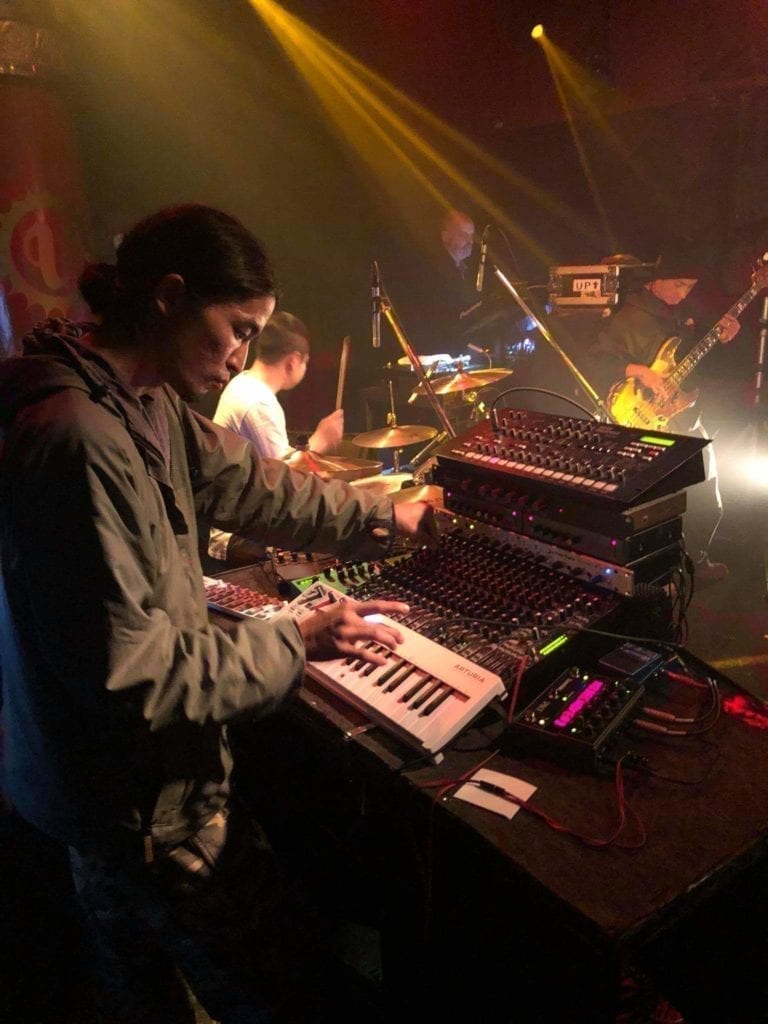
The idea wasn’t to simply match the Stratford Bard’s play with a heavy metal rock score. The actors don’t only play their parts, they’re also the musicians, supported by a drummer, Sam Bobony of Black Givre and Avec le soleil sortant de sa bouche, and D’Orion on electronics, taking care of the ambient sounds.

On the other hand, the musical work to which the actors must devote themselves seems to lead them to play differently, in a more instinctive way, their intellect being so to speak occupied with mastering the musical aspect.

“For me,” continues Pelletier, “it was a challenge not to just take on professional musicians. Because basically, it’s a way to provoke the actors and bring them to a level of playing where they are more fragile, more instinctive. It’s like a way of diverting their attention to achieve more authenticity.”

Although sticking to heavy metal, the elements of the soundtrack are of quite varied influences.

“It’s not just a death metal show,” says D’Orion. “There’s drone metal à la Sunn O))), we also have stuff that nods to bands like Slayer or even Metallica.”

Of course, all sorts of possibilities had to be explored to ensure that the dramaturgical elements, the emotions experienced by the characters, and the music complement one another.

“We’ve been looking really hard. I thought it was in the dialogue, but in the end it’s the music that expresses what’s going on,” Pelletier believes. “This sound represents the anguish or anger of the characters, the camaraderie, the fraternity, the pleasure and also that of a band playing together, tripping out, until everything crashes down. So in my directing, I always had to give up something in favour of music, which becomes a vehicle, a language.”

However, the reins had to be kept tightly in hand to make sure the music didn’t deviate from the play, and yet remained true to the heavy metal aesthetic.

“A number of times,” says D’Orion, “the actor-musicians met up, wrote songs, and then they’d come in and show us what they’d done. So we were pruning in order to keep a metal spirit. You have to understand that we have Norwegian metal makeup. If we start doing rock ’n’ roll, it’s not gonna work.”

The music influenced the dramaturgy of the play in such a way that it shaped the play even more sharply.

“It’s really in two parts,” says Pelletier. “In the first part, we’re more of a band, we celebrate in a slightly more classical way, what you’d expect from a metal concert, with beautiful costumes and make-up. After Banquo’s murder, it’s like a second show, which goes in a strange kind of radicality. It goes into nightmare. They don’t sleep and nothing’s going right for the couple.”

“In the first part, in fact,” adds D’Orion, “if you have a theatre-only audience that’s never been to a death metal or drone metal show, people will see what they’ve already imagined. They’re going to see exactly what we expect.”

“The codes have really been respected,” continues D’Orion. “We’re in between a great show by a really famous band, and a band playing in the garage.”

“But who believe in what they’re doing,” adds Pelletier.

“While with the second part,” continues D’Orion, “we really fall into experimental theatre. Much closer to what I do. It borders on noise, abstraction.”

“That part belongs more to the two musicians,” says Pelletier, “and the actors are more in their original roles. So we’re entering into something very condensed. And then, anyway, we play with the fact that people know the story.”

“Everyone who saw our earlier versions,” notes D’Orion, “and who knew Shakespeare, all said the same thing – we understand, we don’t need anything else.”

Since the first flash, a little over five years ago, the maturation process has been a long one: residency in Quebec City, presentation at the Off FTA a year and a half ago, then last February at the Mois Multi in Quebec City, but it has paid off.

“The audience might wonder how far it will go,” Pelletier says. “In the stagings I’ve seen of Macbeth, the level of tension has rarely reached the level we’ve achieved. And that’s through the music and the show. The intuition that we have had is used on the level of the play, it brings all the theatricality. After having had big a six-minute death metal jam, everything’s more open.

“Maybe that’s it, because we’re raw, it’s more porous. The theatricality, the tension, the danger, they’re there. It’s like a new look. Because we know so much history, we need to do less. It’s what else we do that’s interesting.

“The second part is more dreamlike,” he continues, “there’s hardly any script left, except for a few monologues. The witches completely possess Lady Macbeth, and then, through the possession, we finally reach a stripping down, strangely. All that remains is the music. We end on solitude. After killing everyone, Macbeth is left alone with the ghosts of his girlfriend and the friend he killed.”

“Anyway, we’ve never seen that Macbeth before. That makes it really exciting. It’s a good bad scene.”

“The music prevents us from doing psychological theatre,” concludes Guillaume Perreault (who plays Macbeth), who arrived mid-interview, “and that’s why it’s really successful. It’s very exhilarating for the actors.”

For those who are concerned about decibel levels, it should be noted that production provides earplugs.

Live from London, her frail voice and almost timid tone contrast stunningly with the flamboyant character the singer-musician projects. Finally… this time, the contrast is less marked: taken mostly from Hunter, Hunted‘s rereadings are based on generally binary rhythms – while the artist herself isn’t entirely so! Following in the footsteps of influential musicians, lyricists and composers such as Janelle Monae, St.Vincent, Courtney Barnett and Christine and the Queens, Anna Calvi clears new territories for the feminine and revisits notions of gender.

What does our interviewee think?

“For me,” says Calvi, “artistic expression is completely agender and that’s what I like in music… when you make music you can escape that kind of constraint. More and more artists, by the way, see it that way. As a woman, in particular, I like to help change the perception of how women should behave. That’s one of the reasons why I subconsciously immerse myself in music.”

Launched last Friday (March 6th), the album Hunted is the sequel to Hunter. Or maybe a response to Hunter. What spirit presided over the conception of this simple, sweet, ethereal, refined recording?

“When I went on tour with Hunter,” she explains, “I listened to ethereal versions that I had recorded for myself. I found different qualities, an intimacy and a sweetness that I liked. And so I hung on to the idea of releasing these songs, to offer another version of who I am by capturing the intimacy and vulnerability in them. Until then, these songs were private in my mind, I never thought they would be made public, or heard by anyone.”

Contrary to expectations, at least for the main interested party, these versions became public. Today, they shed a new light on Calvi’s work; this time, distillation dominates. It should also be remembered that the musician’s classical influences (Ravel, Debussy, Messiaen, etc.) had sometimes led her to cloak her rock songs in splendid arrangements. She’s taken a different tack of late.

“When I did the Hunter album in 2018, I didn’t want to have the strings present in One Breath, the previous one. That decision was based on a desire to be more rock ’n’ roll, I guess. This time, it’s softer and cleaner. Who knows what will be on the next album? All acoustic? I just like to change with each new project.”

Hunter… Hunted. So what is this relationship between hunter and hunted? Between huntress and hunted?

“They are, I guess, two sides of the same coin. Hunter is powerful, galvanizing, the hunter moves when he wants, where he wants. And I guess Hunted is more about nuance, reflection, calm, vulnerability. In a way, I needed to give examples to young women who live in one or the other of these dimensions. In one way or another, we are all multi-faceted beings. Then opposites can meet, hunter and hunted.”

Julia Holter, Courtney Barnett, Charlotte Gainsbourg and Joe Talbot’s IDLES were all invited to sing on Hunted. Calvi recounts the experience:

“When they agreed, I didn’t give them instructions, beyond the song to work on. When I listened to the results, I had many surprises.

“I had no idea what Julia was going to do on ‘Swimming Pool’, and she displayed that artistic talent that always amazes me in her own work. She creates things that are both unexpected and really beautiful, and she’s an artist like that.

“Charlotte is a great influence on me. I love the way she can sing quietly, you feel a mixture of mystery and secrecy. When I composed ‘Eden’, I had Charlotte in mind, so I thought of her for this collaboration. A dream come true!

“I’m a big fan of Courtney Barnett, amazing lyricist and guitarist. I became interested in her singing ‘Don’t Beat The Girl out of My Boy’, which also inspired me to interpret this song in a fresh and different way. I’m really happy with the way it happened.

“As for Joe Talbot and IDLES, I’m also a fan, I love the energy and strength of his voice. It was perfect in the context of the song ‘Wish’.

“All the guests brought something very unique to the songs.”

How then can we situate this album alongside the three previous ones – 2011’s eponymous album, One Breath in 2013, and Hunter in 2018?

“What interests me is here and now,” says Calvi. “I’m not motivated by what I did before, I want to work on something else for the future. My new album, for example, I like to see it as a springboard to the music I’m writing for the next album or for Peaky Blinders. I want to continue to pursue candidly what attracts me.”

After she did Hunted, did she take a step back?

“In the end,” she says, “it’s a private, intimate project that I share with trust with my audience. It’s been very important to me! I still feel that personal events in my life resonate in these songs, and in a way shape my artistic evolution. That’s why this album is particularly close to my heart. A few years ago, I might not have shared this intimacy.”

In concert, Calvi says, she’ll exploit the HunterHunted dichotomy:

“There will be three of us on stage, some songs will be calm and intimate, others will be wild and strong. The idea is to make a whole journey, to express the different moods, feelings and thoughts. All these aspects of existence are expressed through my show, so that we can get lost in it during the performance. It is a wide spectrum of colours and emotions. It corresponds to the atmosphere of the new record, but we can also make a lot of noise!”

Editor’s note: That was March 2, 2020. It was our first international interview on www.panm360.com and you know the rest… so far: the pandemic brings back the same topic, just as relevant 21 months later. The originally scheduled Caribou / Kaitlyn Aurelia Smith program has thus been postponed to this Monday, November 22, 2021 – note that the excellent producer, keyboardist and elecronic composer Kara Lis Coverdale is replacing K A Smith. That’s why we’re bringing you this text for the next 24 hours… which you may never have read.

Contacted at his home in the United Kingdom prior to the start of this world tour, the Canadian artist talks about Suddenly in all generosity. First off, the context of its creation.

“In my partner’s family and in my own,” he explains, “we are the youngest children. Suddenly we became the strong, supportive members of our families, which we had never been before because we were the youngest. In the last few years, my wife’s brother died of a heart attack. I watched my mother-in-law cope with this loss and
suffer.

“During this same period, my wife’s sister divorced. Today, we have young children, three and eight years old, and elderly parents. I feel torn between the happiness of this growing family and the melancholy of the past that my loved ones trigger as they begin the last part of their lives.”

What’s the correlation between personal life and Caribou? A source of inspiration, for better or worse.


“When I listen to my new material again, I hear the sadness of these events and the reflections that follow. I also feel the effort to comfort the people involved. My music reinforces this idea of comfort, it also represents a kind of catharsis for me.”


For Caribou, then, modesty has gradually given way to emotional transparency.

“When you dive into the new songs and you listen back to the music,” he says, “you see my willingness to share very personal things and integrate them into the music and lyrics. Take ‘Cloud Song’. for example, a reflection on what my father went through. I recorded that song for myself because it felt good. At first I didn’t want to make this song public because it was too personal and I didn’t feel comfortable
sharing it. In the end, I felt I had to do it.


“Gradually, this intimacy that was unveiled took a certain amount of space on previous albums, but it increased dramatically on Suddenly. When I perform these newer songs, I do it with more emotion, precisely because they’re rawer, because they’re linked to my life experience, whereas most of my older songs are fiction.”

Transforming his own personal emotions into creative material, in short, represents the main step forward of Suddenly.

“That’s what I’m most proud of: confronting these difficult things personally, feeling comfortable and honest enough to write, sing and share them, overcoming the obstacle of modesty and hopefully resonating with my audience.”

Snaith is then invited to comment on his progress as a complete musician.

The recipient of the Polaris Prize (for Andorra, released in 2007), became known for his pop versatility, both in terms of “classical” instrumentation and electronic devices.


“To some degree,” he says, “very little change is observable in Suddenly, the methodology remains the same. For example, a lot of the guitar-like sounds actually come from software designed to evoke the guitar from a keyboard. We live in a world where we can confuse the listener.”

Though inclined towards digital production from the very beginning, Snaith has never abandoned the world of acoustic and electric instruments, and analog keyboards.


“I’ve always felt like I had one foot in both worlds. I grew up in a small town in rural Ontario. There was hardly any electronic music where I lived, so I got into psychedelic rock and other similar styles first. In my opinion, you had to try everything, in every way possible; grunge rock, school band, wedding music, DJing…. Anything I could do, I did.”

While any notion of stylistic purity is off the table, for both Caribou and Daphni, Snaith’s recent work is tamer than earlier material.

“I don’t really feel like I’m consciously thinking about what comes from the musical worlds I love. Everything seems to fit together without me worrying about it. For
Caribou, however, it’s important to me to create songs in a dance music context.

Writing songs with verses, choruses, bridges, and harmonic changes is not very common in dance music.”


Composition, he believes, far outweighs technical performance.


“I’m not a good guitar player, I’m an okay drummer, keyboards are my main area of expression. I don’t rehearse on my instruments like I used to do all the time as a teenager. I only really play when we’re touring. Being a guitar hero or a keyboard virtuoso is not the goal. The goal is to make good songs and good music.”


To that end, playing is essentially linked to the creative process, as well as to the live setting.


“I can play the same part over and over again until I find the right one. Then I never play my new songs again until I play them live. In rehearsal, I sometimes can’t remember what key these songs are in, and what chords are involved. I actually think more in terms of the sound and the mix rendered at that stage. Usually, you know, bands come into the studio after playing their songs on tour a few times. For
me, it’s the opposite process; I play them until they’re well put together in every aspect.”


From this perspective, Snaith confronts a paradox: to learn, or unlearn?


“At the same time, it’s important for me to master the creation of better songs and keep that feeling of never holding anything back, always starting from scratch, grasping things through trial and error. Not having a clear idea of what I’m doing makes it playful, fun, creative, exploratory. ”


A hermit during the creation of Suddenly, Snaith appreciates getting together with old friends when it comes to playing in front of an audience.


“Only one other musician besides me,” he says, “came into the studio to play guitar and saxophone: Colin Fisher. For the stage, I’ve been working with the same band since 2009: Ryan Smith, a childhood friend, joined by Brad Weber and John Schmersal. It’s very important for me to play with them after months of solitude, it becomes very collaborative when we learn to play with instruments these songs
originally imagined with synthesizers and machines. It’s incredible for me to see these songs come out of the studio and start a new life.”

It’s impossible to wrap up the interview without mentioning the possible link between music and advanced mathematics, knowing that Snaith holds a degree in the field.


“Many people associate me with engineering or something like that and… it’s not that at all! For me, mathematics and music are games involving abstract ideas or sounds. These games allow me to make connections, to put things together. Since childhood, I’ve liked to find myself in these mental universes, even today, I see the same connection between mathematicians and musicians. I don’t know why they go so well together, but there are two disciplines that I like to play with.”


And why is Snaith, a complex mind if ever there was one, content to toil in the pop- cultural milieu, however refined his efforts may be?


“I listen to a lot of complex and experimental music, much of which excludes melodic elements. But when it comes to me as a composer, I’m a sucker! I can’t resist a pop melody, it’s deeply rooted in who I am. It will always be there.”

Subscribe to our newsletter

Inscription
Infolettre

"*" indicates required fields

Type of Suscribers