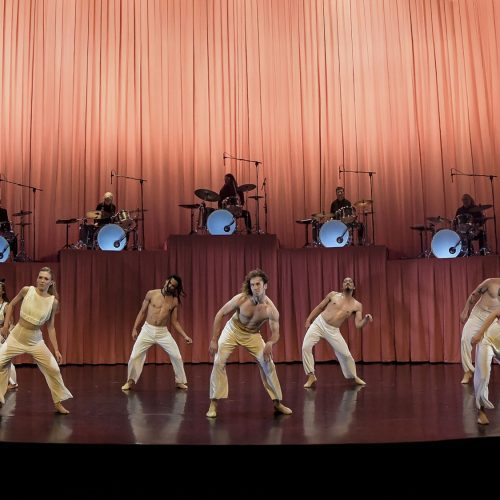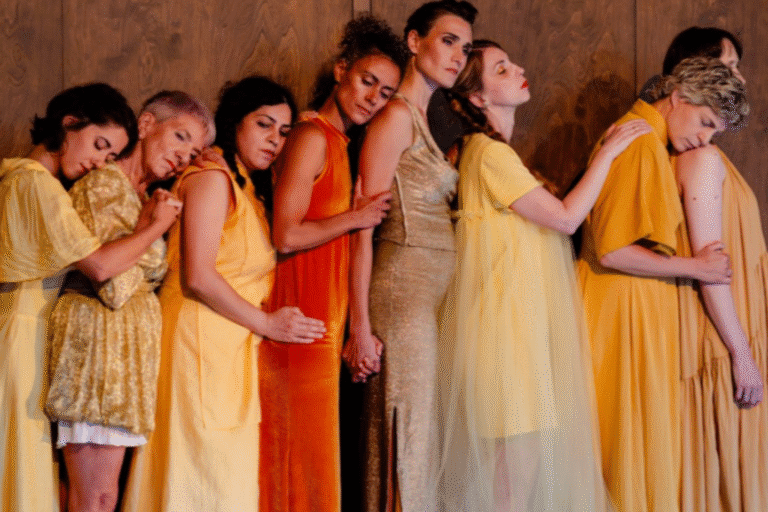
Nine women on stage, in a kind of grand theatrical gesture where all facets of a rich and complex sisterhood are evoked. From (mostly) benevolence to abandonment, from exclusion to reconciliation.
Les Veilleuses (The Watchers), by Simon Renaud (choreography and conception) and Romain Camiolo (music), thus rose on Wednesday evening at the Bourgie Hall of the Montreal Museum of Fine Arts. A rare incursion of the classical music hall into the world of dance (the first? I can’t confirm it…), but a very nice success. It must be said that the Veilleuses show is as much choreographic as it is musical. Six of the nine performers are singers in real life: Marie-Annick Béliveau, Salomé Karam, Kathy Kennedy, Elizabeth Lima, Hélène Picard and Ellen Wieser. They teamed up with professional dancers Marie-Hélène Bellavance, Nasim Lootij and Ingrid Vallus.
Of course, the dancers were not asked to sing fully, nor the singers to perform too acrobatic contortions, but the staging clearly aimed to integrate all the participants into a single community, that of these women of various sizes and builds, though not too heterogeneous. In a rather abstractly suggestive way, these women went through the hour-ish of the show to express different states of mind and above all the means to face them together, sometimes disunited, or to share them among all.
The play unfolds at a slow and measured pace. These women move in a world of mutual feeling that takes the time to express itself and be welcomed. It is the music that serves as a powerful bond for the psycho-emotional whole of the performance, supporting the visual coherence of the costumes, which are dresses of different chromatic hues related to yellow-orange-brown-ochre. The said music, all vocal (except for a pre-recorded electro drone acting as a harmonic cushion) and essentially tonal, is of course performed by the group’s singers, who act both as the emotional embodiment of each individual unit but also as a coalescence of the group relationship. Camiolo’s score is beautiful and seems to progress, at least that’s the impression I got, according to a historical chronological evolution.
At the very beginning, the voices take on a collective appearance of a Greek chorus, in a modal-type expression that subtly evokes something very ancient, perhaps archaic. Further on, one hears something like a mediaeval air. Further on, it gets closer to folk or popular song. But these are brief moments, emerging from a more ample and sustained framework of long melodic lines that would not displease several current composers working in neo-mystical choral music. On a few occasions, the harmonies tighten, until they reach saturation and a rough screech. It is in these moments, as the composer pointed out in the interview I conducted with him and the choreographer about the show (INTERVIEW TO LISTEN TO HERE), that the women of this symbolist sorority seem to drift away from each other and dissolve their bonds. The tactic is simple, but effective.
Ultimately, Les Veilleuses is a fairly accurate and poetic look at the strength, but also the perils, of a female community that has, for millennia now, had to stand together in the face of adversity and hold hands in bright episodes.
Les Veilleuses is a beautiful and complete show, complex but not hermetic, and above all perfectly suited to a wide range of engagements: in dance festivals as well as music or transdisciplinary proposals. A perfectly adequate launch for the Bourgie Hall’s Arts croisés (Crossed arts) series.
Les Veilleuses is a coproduction between Amour Amour, Salle Bourgie, Chants Libres and Corpuscule Danse