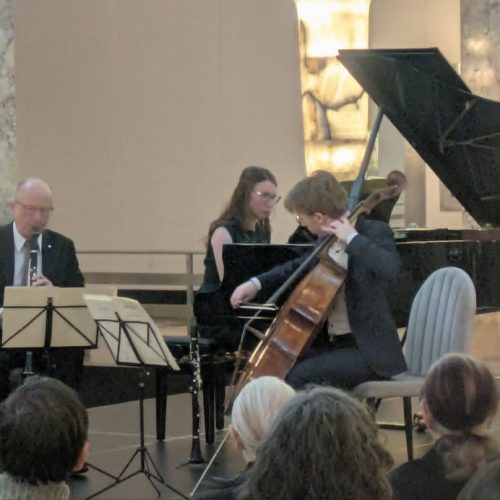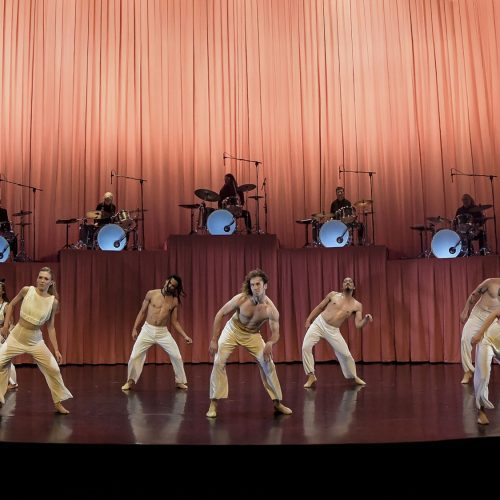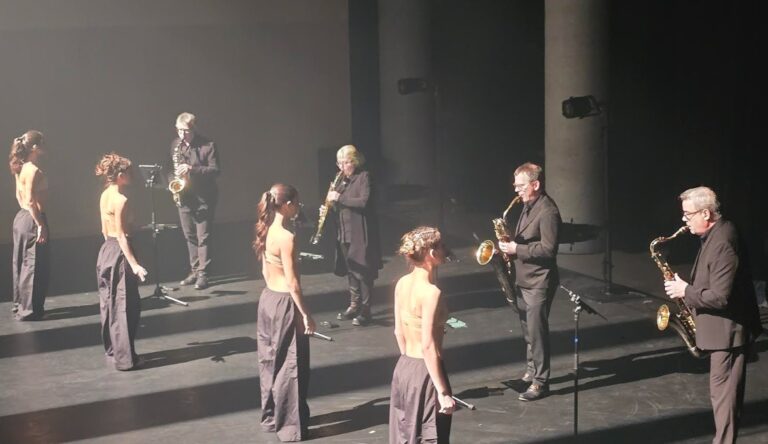
A collaboration between composer and choreographer where music and dance become one—that’s what two quartets, one made up of saxophonists and the other of dancers, brought to life. On Wednesday, Quasar presented the result of its collaboration with the Monterrey Higher School of Music and Dance. In a packed hall, the ten artists (four musicians and six dancers) immersed the audience in their world for the Canadian premiere of the concert Le souffle des corps.
Created by Mexican composer Alejandro Padilla and Quebec choreographer Danièle Desnoyers, Ouverture opens the program. In the darkness, the saxophonists’ breathing can be heard from backstage. Moving in tandem with the dancers, their entrance onto the stage occurs amid the musicians’ staccato breathing. As the dancers execute their movements in response to the saxophonists’ notes, the piece intensifies with the arrival of slaps, generating even more sudden movements from the dancers. The piece continues in a crescendo, complicating the piece’s language and liberating the dancers’ movements.
Interwoven with musical interludes composed by Chantale Laplante, the program flows seamlessly to keep the audience engaged with the movements unfolding on stage.
Next is Antichambre, by composer Eduardo Caballero and choreographer Lila Geneix. At each corner of the stage, the four saxophonists perform a series of sustained notes that, as the piece progresses, intensify in both volume and the dissonance of the chords played by the quartet—a tension that is reflected in the dancers’ movements.
Tres espacios, by composer Olivier St-Pierre and Mexican choreographer Jaime Sierra, explores movement characterized by sustained sounds produced by the instrumentalists. The piece gradually gains depth through the use of slap and polyrhythms.
This musical progression is thus also reflected in the dancers, who conclude the piece by freely taking over the entire stage and dancing to the sound of the saxophone.
Strange Attractor was created by the only all-Mexican duo: composer Miguel Vélez and choreographer Brisa Escobedo. Starting face to face, the dancers’ movements are dictated by the sound of the keys played by the saxophonists. Built as a crescendo, this piece is punctuated by a brief lull before resuming at full speed in a choreography where the dancers are torn between two opposing movements that clash.
The program concludes with Une même voix, by Quebec composer Sophie Dupuis and Mexican choreographer Daniel Luis. One by one, dancers and saxophonists take the stage. The piece is structured in this way, with each saxophonist playing a different motif. This blend of motifs creates an irregular rhythm that fuels both the music and the dancers’ movements.
In short, the music helped foster a meaningful dialogue between the musicians and dancers, and between Montreal and Monterrey.