I woke up at eight o’clock, twenty minutes after the representation had ended.
In any other context at the S.A.T., my dozing off at the tail-end of a representation would mean a crushing defeat for the artist, but in Between Dreams it meant the complete opposite. As I had spoken to artist Claire Kenway earlier that week, she explained how the project was actually meant to induce sleep.
I came prepared with a tired body from the cold weather, and a readiness to finally give in to my previous battles against the S.A.T.’s inconveniently comfortable beanbags.
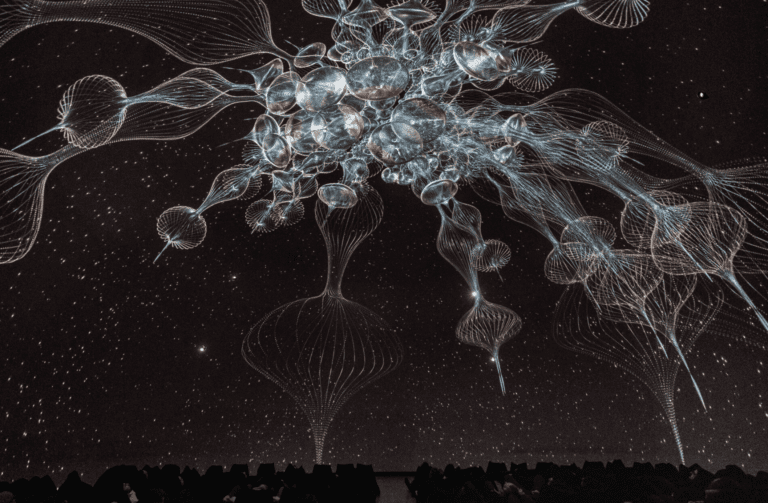
The film began in a warm orange hue that filled the room. In the first 5 minutes, my lucidity was washed away by imperceptible waves of gradient colors and noise; in the next 15, my eyes couldn’t keep up, and focus turned into feeling. Warmth slowly slipped into deep purples and blues, and into a backdrop of a starry night over which particle systems began evolving into harmonious geometry.
While the dome can be unforgiving when one does not grasp its vast emptiness, Claire Kenway and Patrick Trudeau seem to have understood the task at hand. The relationships between sound and image held a beautiful concomitance, a synchresis of slowness and wavelike gestures that very occasionally met outside of our own imagination. Spatialized delays bounced across the walls, masking the high-cut field recordings and throbbing subharmonic pitches that colored the space. The entire experience felt natural to the environment, and pleasantly welcoming.
From my earlier conversation with Kenway, I held questions in mind on how abstract representations of “sleep architecture”, and statistical models would translate in the dome. While it was not to the degree of precision of a Xenakis score, the music allowed more aesthetic freedom which probably saved us from a 40 minute atonal descent into madness (see Persepolis). Still, conceptual music exists at a delicate intersection between emotionally accessible and intellectually stimulating content. Between Dreams leans towards the former. While some elements of pitch and temporality created important ties to the underlying references to science, there lacked detail in how this applied to texture and composition. At the same time, it could be a bias from trying to decipher Patrick Trudeau’s quantum-scale visual abstractions. So I ask myself, can sound represent this type of complexity?
The experience was nonetheless powerfully memorable, and I woke up from it feeling inspired, and quite happy to know I’ll have to do it all over again to write about the last portion of the film.
Between Dreams might not “explain” the science, but it inhabits its affective space perfectly. The forty minute film was a promising prologue to the eight hour concert to be held on April 10th, and confirms that their sleep formula, although still quite mystical, works like a charm.