Baroque / Choral Music / Classical / Classical Singing

Les Violons du Roy and La Chapelle de Québec | Brilliant Messiah!

by Mona Boulay

QUÉBEC

To commemorate their fortieth anniversary, Les Violons du Roy are offering a series of exceptional concerts, including the following: Handel’s Messiah with Bernard Labadie.

First of all, the visual impact of such an ensemble on the stage of the Palais Montcalm cannot be overstated: a baroque chamber orchestra with an eye-catching theorbo in the center, behind which the soloists perform and wait, all overlooked by the choir of La Chapelle de Québec, thirty singers harmoniously arranged in a semicircle around the stage. The view is grandiose, worthy of the famous oratorio we’re about to hear.

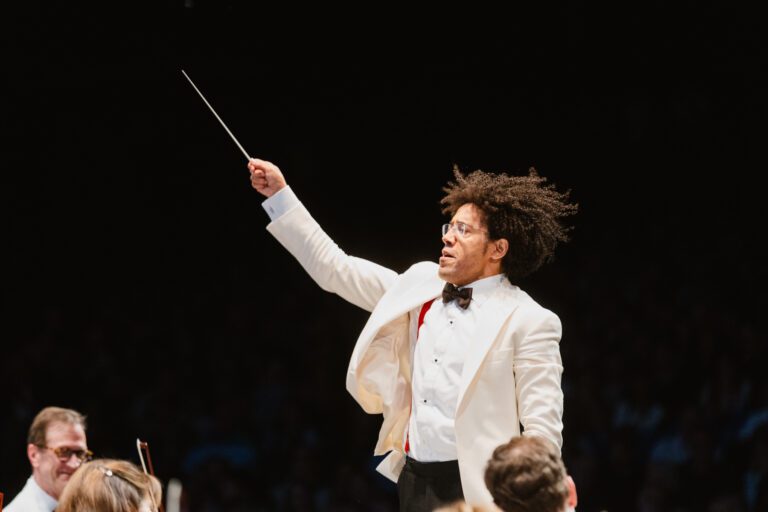
Conductor Bernard Labadie, founder of Les Violons du Roy, returns to take his place for the duration of the concert, a chair he has left since 2014 to Jonathan Cohen. It’s under his guidance that our concert begins, with a perfectly executed instrumental overture. We continue immediately with the first soloist, tenor Andrew Haji, who captivates us from the very first notes of “Comfort Ye”. The singer handles nuances with great virtuosity and never tries to overdo it: his notes held without vibrato are a real treat for our ears, as are his perfectly mastered melismas. The choir then makes its first appearance with “And the glory of the Lord”, and its power is striking: what an impact! The group seems to form a single angelic voice, the purity of the sopranos mingled with the depth of the basses, the blend of timbres total. And already we hear “Thus saith the Lord”, the first solo by bass William Thomas, a young British singer with a great future ahead of him. This is contrasted by countertenor Iestyn Davies’s “But who made abide”, an impressive performance supported by the chamber orchestra, particularly with its velocity and precision of prestissimo. As the oratorio continues, we finally hear Liv Redpath, soprano. Her entrance is perhaps less remarkable at first than that of the other soloists, with a play in nuances that at first seems restricted, despite impressive vocal precision. The first interventions seem to lack a little life.

Messiah unfolds throughout the evening, punctuated by strong moments (how could one not shudder during the “Hallelujah” closing the second part?), but also occasionally by a few long stretches. A case in point is “He was despised”, a long countertenor solo that never ends. Whether Handel’s hand was too heavy, or the interpretation lacked direction, I couldn’t say, but time seemed to run longer during this aria). It ends beautifully with the perfectly executed “Amen”, a profusion of intense joy.

The concert is made brilliant by the instrumental ensemble, which has had the opportunity throughout to demonstrate its great capacity for contrast, always handled with the elegance and purity typical of Baroque music. Not once is a note overemphasized, not once does it fall into the realm of excess. For once, Les Violons du Roy excel in subtlety. The soloists are each outstanding, despite the criticisms set out above, one is aware of hearing a certain elite of lyrical singing. The choir of La Chapelle de Québec is excellent in its role, and doesn’t disappoint us once: its interventions are always a moment of great pleasure. All in all, a successful evening, and a brilliant one at that.

Photo Credit : David Mendoza Hélaine

Handel’s Messiah with Les Violons du Roy and Bernard Labadie will be presented at the Maison symphonique de Montréal on Saturday, December 14 at 7:30 pm. Tickets are available here.

Classical

Prix du violon d’or 2024-2025 | Finalists Announced

by Alexandre Villemaire

As rain, wind and cold descended on the evening of December 11, a small crowd gathered, braving the inclement weather to hear and see the instrumental playing of the six semi-finalists in this year’s Prix du violon d’or.

At the end of the semi-final round, violinists Jueun Lee, Joey Manchin and Justin Saulnier were recommended by the jury to move on to the final round on Friday, December 13.

Their performances respectively highlighted qualities of playing, interpretation and technical mastery in diverse programs of contrasting dynamics. South Korean-born Jueun Lee, accompanied on piano by Itamar Prag, drew the audience into the sparkling world of Mozart with the Sonata for Violin and Piano No. 22, and into the folkloric world of Edvard Grieg with the Violin Sonata No. 2 in G major. In addition to her clear sound and precise articulation, it was the young performer’s stage presence and energy, as well as her apparent complicity with her pianist, that captured the audience’s attention.

Joey Manchin offered a heartfelt, polished interpretation of the second movement of Beethoven’s Piano Sonata No. 2 in A major, Paul Hindemith’s Sonata for Solo Violin No. 2 and the first two movements of César Franck’s Sonata in A major. The intimate dialogue between piano and violin in Beethoven’s work highlighted the purity of sound and clarity of lines exchanged between the two instrumentalists. Plunging the audience into a completely different aesthetic, Hindemith’s sonata was packed with chromatic lines and different playing techniques, which Manchin was able to demonstrate. In Franck’s sonata, accompanied by Veola Sun, he expressed in the work’s vaporous sonorities a frank control of the different dynamics, moving from languorous lines to lively, animated passages.

Justin Saulnier shone with pure lines and limpid musical discourse in Schubert’s Sonatina in D major, while Paganini’s short Caprice No. 17 in E flat major, with its velocity of violin lines, showcased his technical mastery. He was also the only semi-finalist to include two pieces by contemporary composers in his program: Ana Sokolovic’s Chant and the third of the Sonata for violin and piano by composer and conductor Dinuk Wijeratne. The presentation of this type of repertoire, the antithesis of the majority of the works we heard during the evening, provided a welcome dose of variety, and demonstrated Saulnier’s abilities in this type of musical language and discourse, where he was supported by Gaspard Tanguay-Labrosse.

The three competitors who didn’t make the cut have nothing to be ashamed of. Violist Alexander Beggs impressed us with his warm, woody and stable sound. His program, consisting of Franz Joseph Haydn’s Divertimento in D major – in an arrangement by Gregor Piatigorsky – and Rebecca Clarke’s Sonata for Viola and Piano, was the most aesthetically introspective. This enhanced her musicality, but perhaps did her virtuosity and contrasts a disservice. American-Japanese violinist Satoka Abo opted for a program in which technical virtuosity took precedence. Her performances of Brahms’ Sonatensatz and Franz Waxman’s Carmen-Fantaisie were high-flying moments, but lacked precision in places. The sparkling first movement of Mozart’s Sonata in B flat major and Amy Beach’s warm Romance brought contrasts and calm to his explosive program. Finally, cellist François Lamontagne offered a contrasting performance with an excerpt from Beethoven’s Cello Sonata No. 3 and Gaspar Cassado’s Suite for Solo Cello, which was beautifully intense but could have been more danceable.

The final of the Prix du violon d’or 2024-2025 will take place on Friday December 13 at 7pm in the Tanna Schulich Hall.

FREE ADMISSION

To view the webcast, click here

Lost in the Labyrinth at the Yoo Doo Right + Victime Album Launch with We Owe

by Lyle Hendriks

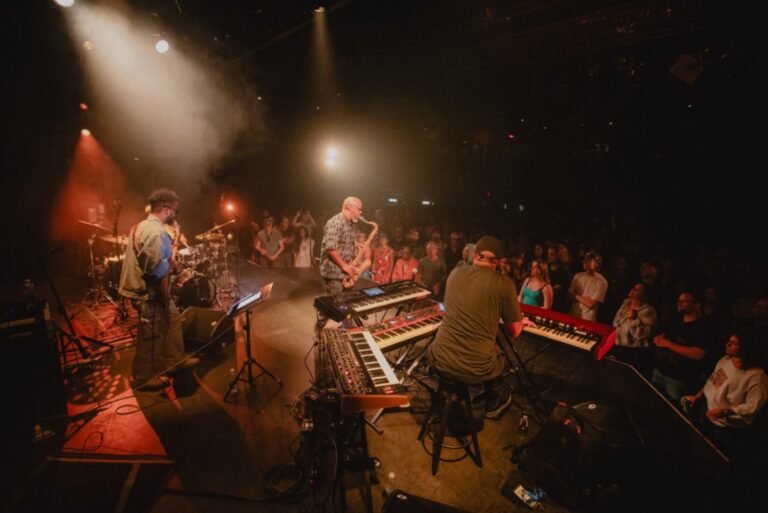
There’s no party like a Mothland party. With a sea of concertgoers dressed in black, shitty beer freely flowing, and an industrial buzz all around, it’s a familiar scene as we step into Théâtre Plaza for the double album release of Victime and Yoo Doo Right.

First though, we witnessed the first-ever show from We Owe, the solo project of Christopher Pravdica (Swans, Xiu Xiu). Armed with his bass and backed up by Brian Chase (Yeah Yeah Yeahs) on drums, Pravdica launched into a trance-inducing medley of industrial noise that lurched forth like heavy excavating equipment turned over for the first time in decades.

With some kind of effect that doubled his bass, We Owe sounds like the work of far more than a duo, both of whom skillfully wield their instrument with a satisfyingly playful ease. Each grinding virtuoso seemed to have more composite parts than the last, like an ever-taller sonic Jenga tower that, against all odds, was still standing tall by the end. For fans of adventurous, hypnotic instrumentals, We Owe’s second show (whenever that will be) is sure to please.

Sandwiched in the bill was Victime, who debuted their latest release En conversation avec (2024). There’s an urgency to this post-everything power-rock trio that borders on pained at times, with lead vocalist Laurence Gauthier-Brown often doubled over as she delivered growling proclamations and catalytic climaxes. Freeform, aggressive, and impossibly abstract, Victime’s sound crawls down your spine with its doom-bringing bass, screeching guitars, and frenetic, unpredictable percussion. It’s a sound that denies the convenience of drama, insisting on its own complicated tapestry of influence that feels impossible to parse. If it seems like I’m reaching in my attempts to explain Victime’s sound, it’s because I am. If you like it rough, Victime is more than happy to oblige.

Finally, it was time for Montreal darlings Yoo Doo Right, whose sound was pre-empted by their utterly ridiculous stage set-up of towering amp stacks. As I watched each cab get switched on, I pushed my earplugs in and braced myself for the noise. Yoo Doo Right’s new album, From the Heights of Our Pastureland is utterly anxiety-inducing—panicky, shallow breaths that never reach the bottoms of your lungs, leaving your shoulders heaving and your heart racing. They stride through change upon change, never staying in the same place long enough to let you get your footing. The album’s cover art (a diabolically apocalyptic-looking tornado) couldn’t be more appropriate for the music. It’s a hellish maelstrom, debris, and dust whizzing by faster than you can identify it, all while a low, dreadful roar fills your body beyond its limits. 

Fortunately for me, there was a welcome reprieve near the end of this set as the band got stuck into their the track “Lost in the Overcast,” featuring a sombre but beautiful section from two guest trumpet players (who were utterly drowned out by a wall of bass for the rest of the performance). This track feels as though the clouds are parting, as rays of sunshine cautiously reach out and kiss the scars the storm left behind. It’s gorgeous, complex, and contemplative, and was the highlight of their set. After this, we were treated to a few older cuts from just the original trio, who seemed completely intent on inflicting severe hearing damage to as much of the world as possible. Despite my ringing ears, it was a pleasure to watch Yoo Doo Right do right by their fans.

Baroque / classique / Sacred Music

OM and YNS Choose Messiah’s Immersion at Notre-Dame Basilica

by Alain Brunet

Notre-Dame Basilica played host on Monday to the first of two concerts of Handel’s classic Messiah by the Orchestre Métropolitain (OM), its Chorus and conductor Yannick Nézet-Séguin, back home for the holiday season.

Attending Handel’s Messiah in such a Catholic temple is in itself an immersive experience, characterized by special acoustics: more reverberation than in a hall designed for music, less intelligibility as the distance between the stage and the pew increases; as you move beyond half the floor towards the back, clarity declines. The perception of sound is therefore different depending on the position of the seat – but then, it’s also a great way to reflect on the holiday season and enjoy the ambience inherent in Notre-Dame de Montréal Basilica.

Yannick Nézet-Séguin has perfectly grasped this acoustic challenge and created a Messiah for this venue, performed with gentleness, sobriety, contemplation and precision. The curve of dramatic intensity was also well planned by the Quebec conductor, with a pastoral and comforting first part (prophecies and Nativity), the second part (passion, resurrection and ascension of Christ) culminating at the 39th station with the famous Alleluia of the resurrection sung by the choir, followed by a shorter and more abstract third part, Handel’s compositional meditation on Christian redemption.

Of the cast of soloists, mezzo Emily D’Angelo’s circumspect contribution is the most noteworthy, as she repeatedly achieves the ideal balance between the fervent expressivity of the religious text and the mystical state perceptible in the roundness of her voice, a state intrinsic to the interpretation of sacred song.

Tenor Frédéric Antoun was also eloquent and solid in context, though it would be interesting to hear more from him about his assumption of slight asperities in timbre in certain passages.

Soprano Anna-Sophie Neher also shone with sobriety, purity and power, and the OM cast also proved highly relevant in this respect, in her 9 interventions over the course of Messiah’s 47 stations.

Baritone Geoffroy Salvas brilliantly replaced his colleague Jonathon Adams.

The snow and cold of that Monday evening provided the perfect backdrop for walking the streets and taking refuge from the warmth of such a program in downtown Montreal’s most substantial of Christian temples. An experience of tradition and spirituality on the winter solstice, whatever our beliefs or skepticism about the afterlife.

Photo Credit: François Goupil

LE MESSIE IS PLAYED AGAIN BY L’OM AT THE BASILIQUE NOTRE-DAME DE MONTREL, WEDNESDAY, DECEMBER 11. TICKETS HERE

Baroque / Classical

A Baroque Christmas with Arion | When The Hurdy-Gurdy Awakens The Holiday Spirit

by Judith Hamel

On Sunday afternoon, the Arion baroque orchestra played to a full house at Salle Bourgie, presenting a program devoted to French, Swiss and German Noëls. The instrumentation included strings, harpsichord, theorbo and bassoon, and three soloists – on flute, oboe and hurdy-gurdy – enriched the concert with a succession of well-known and obscure Baroque Christmas tunes.

The concert opened with the excerpt “Où s’en vont ces gais bergers” from Michel-Richard Delalande’s Simphonie des Noëls, a familiar choice of tune that set a cheerful tone for the concert.

Mathieu Lussier then introduced the first soloist, Tobie Miller, a renowned virtuoso hurdy-gurdy player. As he announced her, it was instead flautist Vincent Lauzer who took to the stage, triggering open laughter from the audience. This light-hearted moment was followed by Michel Corrette’s Concerto No. 4 “Noëls suisses”, a piece for recorder and ensemble which, in a mixture of mischievousness and virtuosity, allowed Vincent Lauzer to shine with his expressiveness.

“It’s funny, it sounds like the recorder, the hurdy-gurdy,” announces Mathieu Lussier, referring to his shell. This time, Tobie Miller takes the stage in earnest to perform a work by Nicolas Chédeville, the Concerto “Les Plaisirs de la Saint-Martin”. This piece celebrates Saint-Martin’s Day, which used to bring celebrations almost as important as the feast of Saint-Nicolas. Although the work is by Chédeville, he would probably have copyright problems today, since he borrows much of his material from Vivaldi.

The third soloist, Daniel Lanthier on oboe, performed Bonaventure Gilles’ Concerto a 5 con oboe obligato. His lively, expressive playing made you want to be on stage with them. The energy of the soloist and the musicians was infectious, and the music seemed palpable.

Before intermission, the ensemble performed seven Christmas arias by Charpentier, bringing the first part of the concert to a close. Mathieu Lussier took the opportunity to invite the audience to slip an Arion record into their Christmas stockings this year. A suggestion that makes you want to opt for a Baroque soundtrack for this year’s festivities!

During the intermission, educational projections provided information on the tuning of Baroque instruments, the manufacture of period instruments and the repertoire presented. A great way to contextualize their artistic approach and enrich the audience’s experience.

On his return, Vincent Lauzer took the stage again with Michel Corrette’s Concerto No. 5 “Noël allemand”. The slow movement captivated with its delicacy, while the Allegro, with its rhythmic syncopations, added a playful touch.

Then it’s Tobie Miller’s turn to return to the stage. After telling us a little about the history of the hurdy-gurdy, she performs Nicolas Chédeville’s Concerto “L’Hiver”, a magnificent work, particularly for its Largo, which places the solo instrument in the open and allows us to hear all the subtleties of hurdy-gurdy playing.

Finally, the orchestra performed Les Saturnales by François Colin de Blamont, a little-played but much-appreciated composer. This piece, taken from the Symphonies des Fêtes grecques et romaines, perfectly recreated the festive atmosphere of these ancient celebrations, bringing the concert to its conclusion.

With a Christmas hat on the double bass scroll and on Mathieu Lussier’s head, the concert ended with a surprising encore: Minuit Chrétien. It’s not every day that an audience sings “Peuple debout” accompanied by a hurdy-gurdy!

Alt Folk / électro-minimal / Indie Pop

Dear Criminals at Théâtre Outremont | Rallumer la flamme

by Sami Rixhon

Long time no see! How are you, Dear Criminals? Electro-minimal trio Dear Criminals gave their first major performance in their hometown of Montreal in five years this weekend at Théâtre Outremont.

Dear Criminals last performed in the metropolis in a regular format at Le Gesù in 2019. A lot has happened since then. It seems the world has become a little more violent, a little more anxious. Fortunately, we still have music.

The band kicks off their performance with Visions, Starless and Waste Land, three tracks from their album Fatale. Virtually the entire 2017 project will be performed tonight, and it’s no coincidence: the compositions require the contribution of a string quartet, which is present tonight (as are a bassist and a drummer), something rather rare in Dear Criminals shows. For their only Montreal performance of the year, we might as well go all in,” Frannie told me in an interview a few days ago.

What’s striking about Dear Criminals’ live performances is the band’s ability to quickly create a steamy, tender atmosphere. There’s an almost sensual tension in the air, so carefully and sparingly are the notes sung and played.

What also strikes the listener, even more so on stage than in the studio, is how completely the three members of the band complement each other. Frannie Holder’s voice is crystalline and fragile, Charles Lavoie knits in a kind of arrogant romanticism, while Vincent Legault brings the Dear Criminals sound to life with his keyboards. There’s nothing like Dear Criminals in Montreal, and that’s all to their advantage.

While the overall performance was highly enjoyable, it was clear that this evening’s show was closer to a “running-in” than to the grandiose proposition to which the band has been accustoming audiences for the past 10 years. In previous shows, Dear Criminals had enlisted the services of a high-school choir (in the Saint-Jean-Baptiste church, no less), 3D effects and contemporary dancers.

Today’s offering is more conventional… and that’s no bad thing. The trio need to reunite with their old songs, they need to rekindle the flame before returning to the stage with an even crazier concept. The year 2025 will probably also see a new stage or studio production for the band, once again from a reliable source (the information comes from Frannie Holder, in fact. Couldn’t be more reliable).

Dear Criminals closes the regular segment of their show with Stay Tonight, probably the most beautiful song the band has ever written. I have a special relationship with this song. I heard it in May 2020, when Covid was raging, at the Lion d’Or cabaret. The project was called Lone Ride. I was cloistered behind three Plexiglas walls. I was alone on stage, they on the other side were three, playing and watching me. Strange times, eh? It seems a long time ago all of a sudden. I’d only been allowed one song, so I had to leave my place to someone else alone afterwards. The whole thing only lasted three, four minutes, and yet it stuck. I still consider that moment to be one of the most powerful musical experiences I’ve had in recent years.

It was the first time I’d heard the song live. It was 800 times less intimate (800 being the number of people present that evening), and yet it made me realize just how far we’ve all come since then.

It’s good to be together again.

LIST OF SONGS ON THE PROGRAM

1. Visions
2. Starless
3. Waste Land
4. Little Thief
5. Yet Not the End
6. Mark my Words
7. Nelly
8. Coldwave
9. Gravedigger
10. Song for Elisabeth
11. Lover’s Suicide
12. At Bay
13. Lies in Blue
14. Lala
15. Coco
16. Rose
17. Slowdisco
18. Stay Tonight

Encore

1. 7
2. Petite mort
3. Where We Started

Photo Credit : @yagubphotography

chanson keb franco / Neo-soul / R&B

Rau_Ze at Club Soda | The voice of Montreal Youth

by Sami Rixhon

Braving the cold for a dose of R&B, another of soul. Rau_Ze, a project revolving around a young duo formed by Rose Perron and Félix Paul, treated itself to an extra performance at the launch of Virer nos vies at Club Soda, its first career show. Well, not really.

Not really, because a little over two years ago, the Saint-Laurent venue saw Rau_Ze win the 26th edition of the Francouvertes. In a way, they had come full circle there, on these stages, before reaching even greater heights.

Talkin’ ’bout my generation

The line in front of Club Soda stretches for half the block several dozen minutes after the doors open. The checkroom is full (literally) and we’re struggling to find a seat in the balcony. The fervour is real.

Rau_Ze and a half-dozen musicians take to the stage and open their set with the title track from their album, Virer nos vies. Everyone repeats it, everyone already knows it, but what a gift Rose Perron has for singing. Her personality is unique, she exudes confidence the more she lets herself be carried away by her vocal flights. Yet Perron seems immediately more shy when the words she utters are not accompanied by musical notes, when she impromptu addresses such a loyal crowd between songs. Music transforms us.

Sumerset, Pas la peine, L’Habitude (especially L’Habitude): barely six months after the launch of their album, Rau_Ze can already look back on real hits that are probably on many a Montrealer’s playlist. In fact, I’ve seen the duo’s name mentioned several times in recent days in my friends’ Spotify and Apple Music retrospectives. It’s simple: Rau_Ze is the biggest Generation Z musical phenomenon in Quebec since Hubert Lenoir, in 2018. It’s no mean feat to completely fill Club Soda after a successful first launch, which took place in a venue half the size, and without having released any new material since.

Rau_Ze plays all the pieces on Virer nos vies, offers a cover of Claude Dubois’ Femmes de rêve, and closes the set with two insane jams of free-punk-jazz-psychedelic-experimental that leave room for pogos at the foot of the floor.

In their early twenties, the members of Rau_Ze are a true example of success and rigor for anyone their age who aspires to excel. The offering is professional and particularly mature, and the ceiling, already very high, will get higher the more experience the band gains.

A MTELUS with them in a year or two will be devilishly pleasant.

Photo Credit : Camille Gladu-Drouin

Afrobeat / konpa

Joé Dwèt Filé Set The Olympia On Fire

by Sandra Gasana

A huge crowd lined up in winter temperatures to see THE konpa star of the moment, Joé Dwèt Filé, at the Olympia. The cameras were all focused on the stage, even before he made his appearance. Black hat, sunglasses, muscles in full view, and a bright red microphone, that’s how he appeared, accompanied by his five musicians.

“Montreal, how are you tonight?” he repeats several times during the concert. In fact, he’s already set a date for December 12, 2025 at the Bell Centre, no less. Although the audience was predominantly young and female, there was a mix of generations in the room, with a predominance of the Haitian community. “Are there any single women in the room?” he asks. “A lot of women are suffering right now, and this song is for them,” he announces before songs from his albums Goumin Terminé, Calypso: Winter Edition and Daddy9. Several times during the concert, the crowd, who knew the lyrics by heart, sang along. He and his musicians alternated between Tayc-style afrobeat and konpa, much to the delight of fans of this style of music. He added his famous signature “zigizigizizag ” to punctuate his songs, preparing the arrival of synthetic keyboards.

“Are there any married people in the room?” he asks before singing Oui. In short, love stories are at the heart of this crooner’s songs. Some tracks were shorter, allowing a more fluid flow between them.

JDF often interacted with the crowd, notably when he brought two young women up on stage to sing Confiance with him. “Careful, you’re going to represent Montreal tonight,” he told them, just to put the pressure on them, but they rose to the challenge anyway, with one of them breaking down in tears after the exercise. A moment they’ll long cherish.

He ended with a run-through of all his hits, including Kitem Ale, Abimé, Merci à mon ex and Jolie madame, on which he featured Ronisia. For some of his songs, all you had to do was hear the first note and the audience would start screaming. This was the case for Pozysion, another of his hits. He even took the time to hold a little contest with four members of the audience who had to recognize the songs as quickly as possible.

He ends the evening with a crowd-pleasing walk across the Olympia floor, cell phones following him at every step, accompanied by his bodyguard, before ending the evening with the two biggest tracks of his career Fem Voyé and of course 4 Kampé, which has reached 15 million listens on Spotify and as many views on YouTube since its release a few weeks ago. The only snag of the evening was the time it took to get out of Olympia because of the long queue to collect coats. After a 90-minute show, it took us almost an hour to get out of the venue. An organization that could have been better managed, in my opinion.

Photo Credit: Shadia Uwanje


Bond symphonique, First and Foremost a Festival of Theme Songs

by Alain Brunet

Quebec fans of Agent 007 are in for a treat this weekend, with a program of 18 symphonic performances and an encore. They fill 3 Salle Wilfrid-Pelletier to enjoy a program largely dominated by theme songs/trailers from as many films by James Bond, the famous fictional agent of Her Majesty’s Secret Services. Under the baton of Francis Choinière, the Orchestre FilmHarmonique presents precisely 6 instrumental excerpts and 13 soundtracks by Véronique Dicaire and Benoît McGinnis.

These 19 performances highlight the work of well-known composers and lyricists Monty Norman (famous James Bond theme), John Barry (Thunderball, Goldfinger, We Have All the Time in the World, Moonraker, A View to a Kill, You Only Live Twice, Diamonds Are Forever), Lionel Bart (From Russia with Love), Pål Waaktaar du groupe A-Ha (The Living Daylights), Marvin Hamlich & Carole Bayer (Nobody Does It Better), Jimmy Napes & Sam Smith (Writing’s on the Wall), Bono & The Edge (Goldeneye), Duran Duran (A View to a Kill), Leslie Bricusse (You Only Live Twice), Michel Colombier & Madonna & Mirwais Ahmadza (Die Another Day), David Arnold (You Know my Name, Night at the Opera, The World Is Not Enough), Paul & Linda McCartney (Live and Let Die), Adele & Paul Epworth (Skyfall).

It’s worth noting that the artistic direction of this Bond marathon excludes projections of film extracts, relying instead on the entertaining animation of the singers and their interpretation of all those megatubes engraved in the collective global imagination.

Of the 19 performances, only 6 are strictly instrumental. We deduce from this that the general public essentially retains the theme song of these famous blockbusters, the songs served up as trailers and played during the credits.

There’s no doubt that Véronique Dicaire and Benoît McGinnis have a solid background in theater or comedy, and that’s a plus for the smooth running of this production. They express their attachment to these blockbusters starring the agent devoted to the British crown, a fictional character imagined in the 1950s by English novelist Ian Fleming (1908-1964). Among other things, Véronique has a soft spot for Sean Connery and Daniel Craig!

Benoît McGinnis’s undeniable talent as an actor is well known, his stage presence is well recognized, and his real skills as a tenor/counter-tenor are also appreciated… although they are inferior to those of Véronique Dicaire (mezzo and contralto), who is more powerful, more textured, a better technician in every respect and, as everyone knows, capable of imitating many female vocalists. That said, the difference in the level of the performers is of little importance, as the theatrical interventions between each piece are also factors conducive to the success of the enterprise.

As for the FilmHarmonique orchestra, Francis Choinière’s direction is closer to that of a symphony orchestra than to that hybrid form between modern symphony and jazz big band that some of the crucial composers of these soundtracks, especially those of the 60s and 70s, were hoping for. We don’t always get the desired sparkle from the wind instruments, especially the horns and trombones so beloved of John Barry, to name but one. But then, we imagine that each evening to come will see the orchestra gain muscle and improve.

And we can assure you that fans will have a great time, whether the pleasure is guilty or fully assumed.

Photo Credit: Karl André

Bond Symphonique is presented December 6 and 7 at Salle Wilfrid-Pelletier, as well as March 8, 2025

March 27 at Grand Théâtre de Québec

classique / Jazz / Orchestral Pop / Pop / trad québécois

The sparkling magic of Christmas, Yannick Nézet-Séguin… and Antoine Gratton!

by Frédéric Cardin

Far be it from me to diminish the quality of yesterday’s performances by the guest artists at the (now) classic eclectic Christmas concert by the Orchestre métropolitain and Yannick Nézet-Séguin. Mélissa Bédard makes a strong impression in Glory Alleluia and Minuit, chrétiens (O Holy Night). Her full contralto (non operatic) voice, very accurate and free of unnecessary embellishments, stood out. Kim Richardson did the same with other classics such as White Christmas and I’ll be Home for Christmas. Then there was the lyrical sensation of the hour, Élizabeth St-Gelais, who gave us Les Anges dans nos campagnes (Angels We Have Heard On High) and a rather successful Sainte Nuit (Silent Night) sung in Innu (St-Gelais’ indigenous Nation). There was also a fine duet with Michel Rivard, with a heartfelt Gens du pays. Rivard also offered C’est dans la famille, initially a little vocally fragile, but authentic. 

Taurey Butler, Mr ‘’Charlie Brown Christmas’’ at Bourgie Hall each season, with the excellent Wali Muhammad on drums and Morgan Moore on double bass, gave us some lovely jazz flights of fancy on the piano (no Charlie Brown, though. That’s reserved for the other hall) in a few traditional titles from the repertoire, and fiddler David Boulanger treated us to a very pleasant Petit concerto for Carignan and orchestra by André Gagnon, with Oleg Larshin, OM’s first violin. Well-controlled contrasts between the ‘classical’ solos of Larshin and Boulanger’s fiddlings, modern echoes of Yehudi Menuhin and Jean Carignan, for whom the work was composed. A true miniature masterpiece, it was accompanied by another of Gagnon’s must-haves: an extract from his 1992 album Noël, the warm and gently melancholy Ronde des bergers (Shepherd’s dance). I’d never paid attention to this detail before, but the horn solos are formidable! Even the ever-perfect Louis-Philippe Marsolais learned this the hard way. Of course, the finale was performed by everyone at the same time, an essential communion embodied by the Beau Dommages/Michel Rivard classic: 23 December. It was a great success, bringing people together in an ecumenical way and reflecting the image of a Quebec that is both ‘’traditional’’’ and coloured by its modern diversity. Well done.  

In short, everyone rose to the occasion, and then some. Good humour reigned supreme, and the stage and the entire Maison symphonique shone with a thousand colours, in a cosy, inviting atmosphere. So hats off to them. But the reason I wanted to include Antoine Gratton’s name in my title is that the supreme link between all the pieces, all the performances, all the musical styles evoked in this secular and musical mass, the unifying factor that enabled us to spend almost two hours, without intermission and without any boredom, well hooked into the proceedings, this indispensable secret of success, is Antoine Gratton’s arrangements.

The singer-songwriter, who once called himself A Star, has also been a skilled arranger of symphonic pop concerts for some years now. Yesterday, he came up on top thanks to the originality of the scores he produced for the orchestra and choir, which provided a brilliant accompaniment to the above-mentioned performances. No matter how well-known the tunes, Gratton knows how to sprinkle his arrangements with a host of surprises for the ears, be they harmonic, colouristic or rhythmic. Here’s just one example: the counterpoint between the orchestra’s bells and the backing singers’ clapping hands in a passage from My Favourite Things. Delightful. 

The arranger is too often forgotten in this kind of event, but he shouldn’t be, especially not in the case of this concert, which could have turned into a litany of syrupy melodies strung together interminably, had it been for other, less creative pens. Thousands of dinners of turkey, tourtière and cranberry sauce are the same all over Quebec during the festive season. But sometimes there’s a chef in the kitchen, hiding behind his or her pots and pans, who manages to reinvent the classics and bring them all together in a way that’s original enough to be noticed. And all this without going overboard and leaving a bitter taste in the mouth. In cases like this, let’s invite that person to the table and honour him-her (which is what happened on stage yesterday). 

Let’s not doubt for a moment that there will be a 2025 edition.

Classical

Schulich | Horatio Quartet wins the Chamber Music Competition 2024-2025

by Judith Hamel

After four vibrant performances by the finalist ensembles, the Horatio Quartet has won the grand prize in the Schulich School of Music’s annual chamber music competition. The musicians win a residency at the Mozarteum University in Salzburg and a performance at the Canadian Centre for Architecture as part of Schulich@Bon-Pasteur series. 

The finals took place at Tanna Schulich Hall and were broadcast live. The jury for this stage was made up of Catherine Cosbey, Sara Laimon, Jacqueline Leclair and David Stewart. 

The Trio At Work ensemble, comprising violinist Abigail Sunde, cellist Conrad Sobieraj and pianist Jisu Yeum, opened the evening with the Allegro from Mozart’s Trio for Violin, Cello and Piano No. 3. Their light-hearted interpretation transported us into Mozart’s elegance and clarity. In Mendelssohn’s Trio for Violin, Cello and Piano No. 1, which followed, a certain rigidity was felt at times, occasionally depriving the interpretation of vulnerability, but the climaxes were musically well controlled. Clean articulations and just nuances demonstrated their great technical mastery. 

The second ensemble to perform, the Lyra Quartet, featured Lucy Nemeth and Jessica Tovey on violins, Hudson Maness on viola, and Ellamay Mantie on cello. From the very first bars of the Allegro from Haydn’s String Quartet No. 2 in F major, Op. 77, their cohesion was evident. The semi-circular placement typical of string quartets certainly favors fluid visual and gestural communication. Still, despite this advantage, each movement seemed naturally amplified by the other, giving us the impression that they were both breathing from the same breath. Their performance culminated in Shostakovich’s String Quartet No. 3 in F major, Op. 73. By turns carrying innocence and gravity, they exploited the full dynamic potential of this work. Their impeccable phrasing and accuracy of both intonation and emotion offered a moment of rare intensity, both rigorous and profoundly human.

After the intermission, the Horatio Quartet, comprising violinists Justin Saulnier and Joey Machin, violist Alex Beggs and cellist Gabriel Vincent, performed Haydn’s String Quartet in D major No. 4, Op. 20. Their exemplary precision and solidity were evident from the very first lines. The first violin, carried by Justin Saulnier, brilliantly sustained its predominant role throughout the work, infusing the ensemble with constant vitality. Their performance continued with the first movement of Debussy’s String Quartet in G minor, Op. 10, where they demonstrated sensitivity and expressive contrasts. 

The evening concluded with the Alexa Trio, made up of violinist Joseph Tsao, cellist Alexander Lewis and pianist Chris Peng. Their performance began with the first movement of Beethoven’s Trio for Violin, Cello and Piano No. 1 in D major, Op. 70, where the piano evoked a softness in the ensemble. They then performed Smetana’s Trio for violin, cello and piano in G minor, Op.15, which opens with a poignant violin solo, followed by the piano’s entrance, bringing depth and nuance. The work is remarkably well-balanced, giving each player an individual voice to let his or her instrument and musicality shine. Their interpretation was breathtaking, exalting the work’s intense, vibrant emotions.

classique / Jazz / Vocal Jazz

Schulich | Christmas classics with the McGill Jazz Orchestra

by Vitta Morales

It was a pleasant coincidence that the McGill Jazz Orchestra’s performance of Duke Ellington’s Nutcracker Suite coincided with the first veritable snowy evening of the year.

This fact did not go unnoticed by conductor Marianne Trudel who was quick to point it out jokingly before the band began their festive selections. “Cozy” wouldn’t be the first superlative I’d use for Tanna Hall but under the circumstances, it did feel as though we in the audience had assembled in the aim of getting toasty and losing ourselves in some classic 60s big band fare. Truly, we were only missing mugs of hot chocolate.

Tchaikovsky’s Nutcracker is, of course, a darling of the public domain and has been (re)interpreted countless ways by countless musicians. Ellington and Strayhorn, however, managed to capture something truly special back in 1960 with their arrangement of this prolific Russian ballet; and The McGill Jazz Orchestra’s execution of it was more than solid. It was impressive, as it always is, to see such young musicians achieve such high levels of playing. Some of them, I would say, already have the chops to drop out of their studies and play professionally (I won’t say who in order to avoid potentially angry parents). Having said that, student concerts almost always have a few elements that are rough around the edges. We might call them small reminders that these young cats are, in fact, still learning.

It wasn’t until the third movement, for example, that the bass and drums finally imposed a more confident time feel and stopped acquiescing to those around them. Playing tentatively does nothing to serve the groove so it was a relief when they finally started to trust themselves. Additionally, some solos among the horns seemed to meander at times. Worth mentioning are the soloists who were, by contrast, quite intentional in their playing including Rafael Salazar, Shai Geballe, Maude Fortier, and Jeremy Sandfelder (Although Sandelfer is a more established jazz man in Montreal who found himself subbing on the night so this is perhaps a bit unfair to the students).

The second half of the concert featured Élizabeth Cormier singing a selection of Irving Berlin songs as they were arranged for Ella Fitzgerald. Having recently attended a Caity Gyorgy concert of identical repertoire, it was hard not to get a bit of déjà vu. I should say that Cormier, for her part, is a lovely singer with a nice tone and good stage presence; the one element that I would say needs improvement is her English diction. A troublesome word here and there betrayed her Quebecois accent which is perhaps not ideal when performing Ella’s repertoire but otherwise a harmless enough feature of her singing.

Overall I think the orchestra’s members can, and should, take pride in a job well done as their semester winds down. I have no doubt that, as long as the desire is there, these young players will continue to make strides in their musicality. For now they should probably catch up on some sleep before their winter session. And maybe reach for some hot chocolate.

photo: Tam Lan Truong

Subscribe to our newsletter

Inscription
Infolettre

"*" indicates required fields

Type of Suscribers