Electronic

Igloofest, Saturday, January 25 / Fight the Cold With Dance, featuring Skepta (Mas Tiempo), MNSA, Dennis Ferrer, Cheba Iman and Many Others.

by Léa Dieghi

Two stages, two atmospheres. And always more dancing. For this evening of January 25, 2025, the Igloofest team decided to offer us a particularly different program between the main Sapporo stage, and its little Vidéotron sister. While the former was an ode to house music, the latter was a blend of traditional North African and contemporary electronic music.

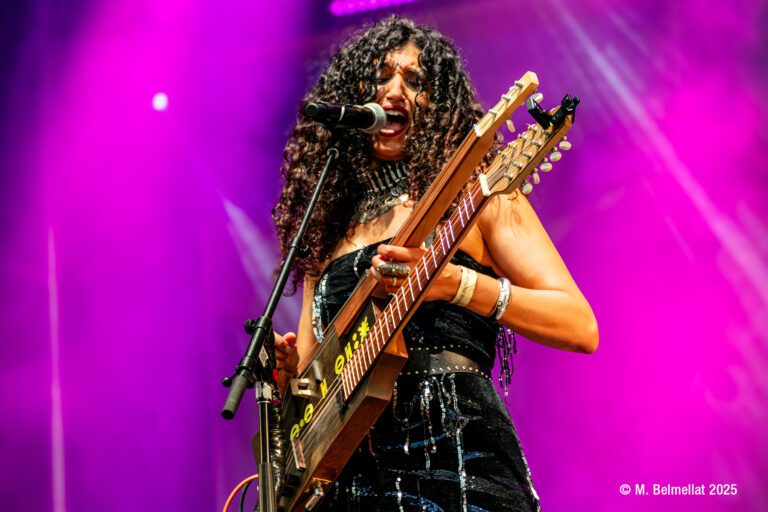
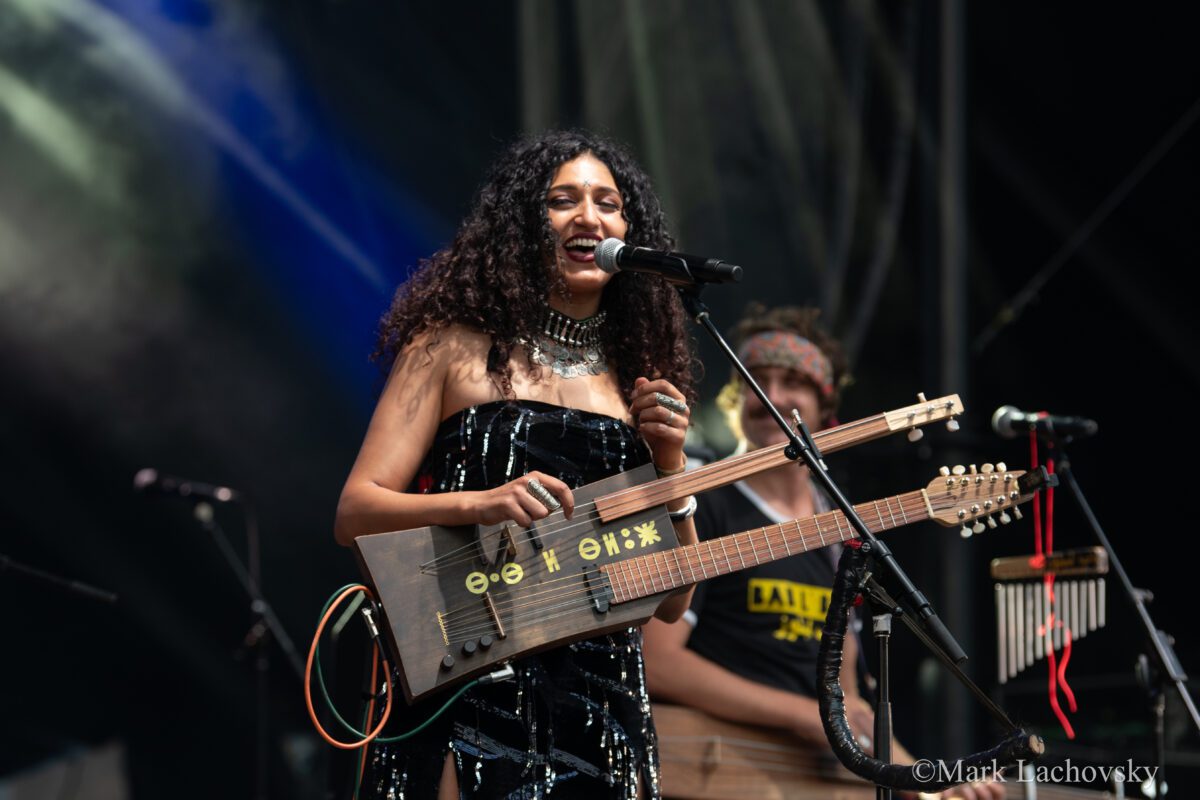
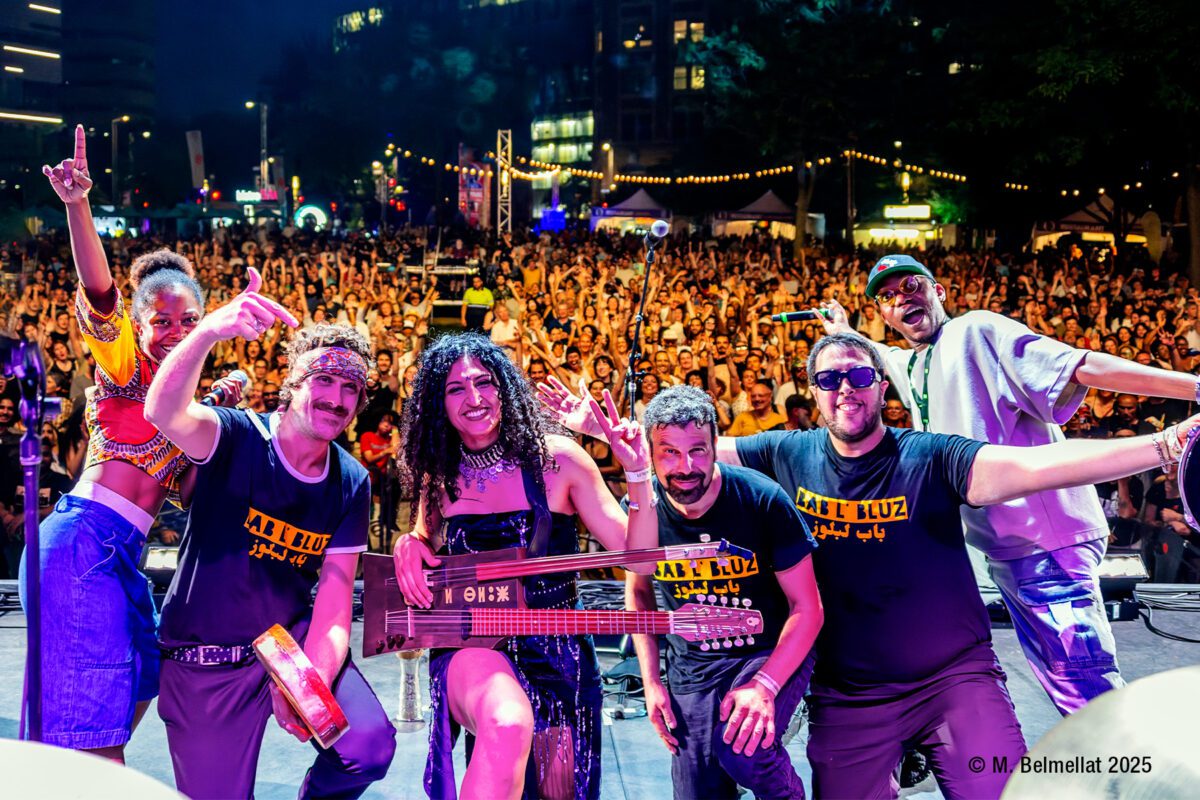
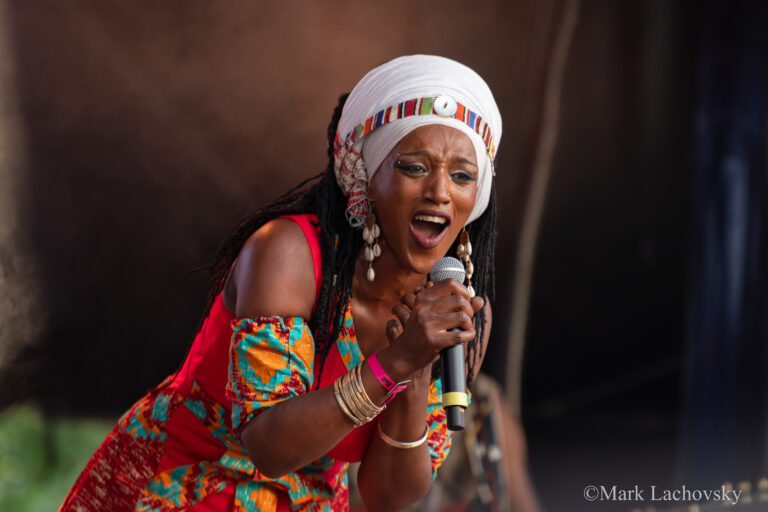
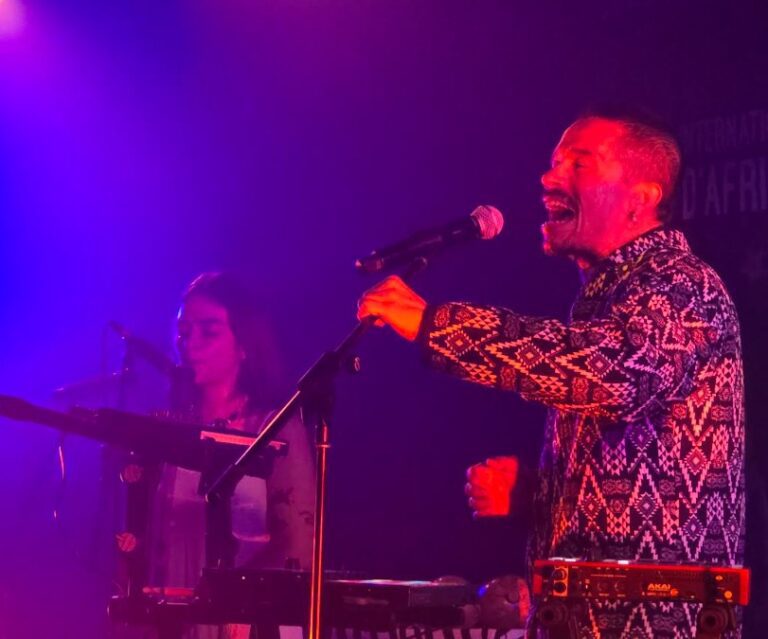
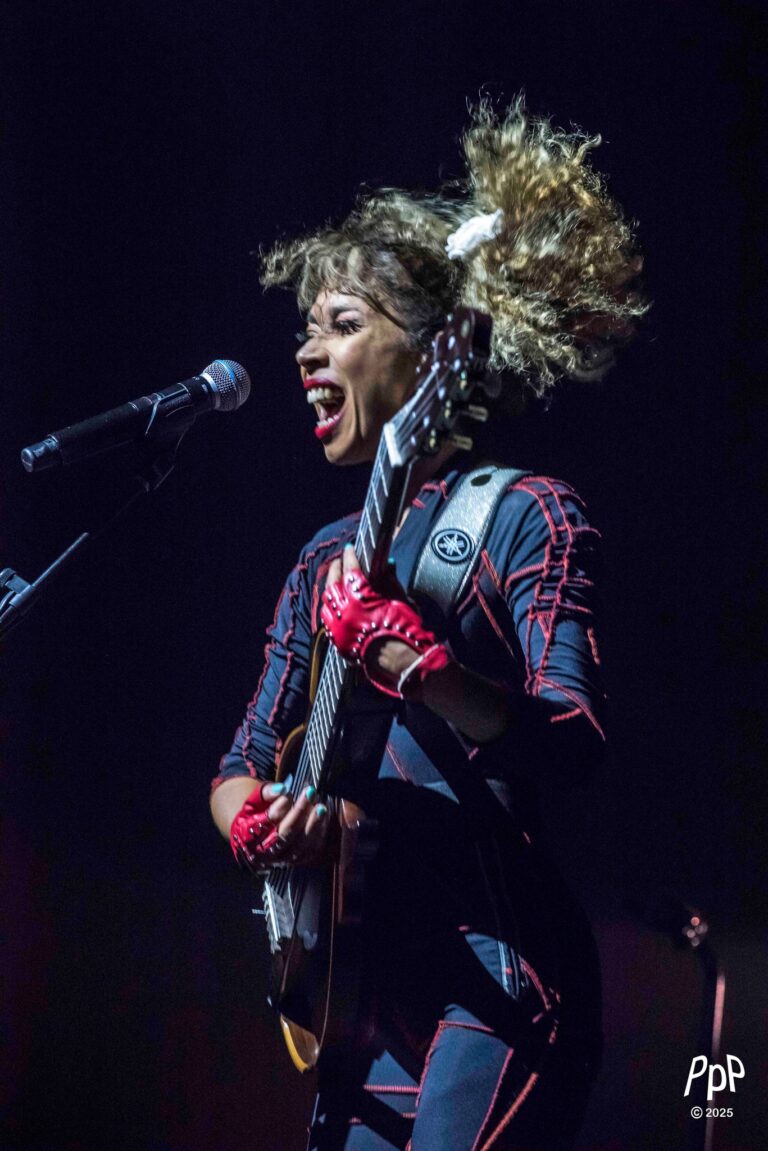
VIDEOTRON: Manalou, Mnsa, Nadim Maghzal, Cheba Iman. 

Deconstruction, reconstruction, hybridization between different genres… The sets on the small Videotron stage shone through their sonic interweaving and interweaving. And even though the stage is four times smaller (we didn’t take the time to measure, but we can imagine!), the sets by these mostly Canadian artists melted the snow beneath our feet.

Imagine the setting. We flee behind the main stage and enter the Videotron stage through a tunnel of light. What awaits us there? An audience literally jumping to the beat of the percussion.

Afro-beat, drum and bass, drill, downtempo, hip-hop, but also tech-house, all mixed with traditional Arabian music.

Mnsa, proudly wearing his Palestine scarf, was like sunshine on a winter’s night. With his contagious good humor and his succession of sounds at different tempos, he didn’t let the audience down for a single minute. Between pop classics, heavy bass lines and traditional Arab music, all mixed against a techno backdrop, my fingers, previously chilled by the beer in my hands, quickly warmed up.

A perfect opening for Nadim Maghzal‘s set, who, in his own way, took up the torch and brought the crowd – literally – to the front of the stage. What’s on the bill? The kind of percussive electronic music we love, always associated with North African sounds and UK Bass.

These four artists, from Manalou to Cheba Iman – who also offered us some particularly singular performances – proved the beauty of the synergy between North American and African music. They also showed us how being a DJ is above all about community, and sharing a certain joie de vivre, together.

SAPORO: Lia Plutonic, Syreeta, Dennis Ferrer, Skepta (under his house label Mas tiempo) “HOUSE HOUSE HOUSE

A word that resonates as I dance in front of the main stage.

From Lia Plutonic (Residente Montréalaise) to Dennis Ferrer, house music classics follow one another, all remixed in their own style!

Sapporo

Behind the four DJ-producers of the Sapporo scene, four different visions of house music and its variations. A genre that crosses time and space, and that brings together an audience from diverse backgrounds. 

If Syreeta offered us sounds a little more rooted in the British house music culture (where she comes from), her mix between techno, melodic voices and UK house rhythms proved to be a particularly fertile ground to welcome her colleague from overseas: Denis Ferrer, an influential artist of the electronic scene for more than fifteen years. 

While Syreeta and Lia Plutonic surfed a little more on the hybridization of house and techno, Dennis Ferrer clearly returned to the roots of New York house, to offer us a very disco-funk-tech-house set. Very melodic, very progressive, very 90s, with classics like Ain’t Nobody (Loves me better).  At the front of the stage, a crowd of all ages danced. Proof, once again, of the unifying capacity of house! 

Their very vibrant sets were able to welcome with undisguised joy the main artist of the evening, Skepta, performing under her project Mas tiempo, which quickly increased the BPM a notch. Although he is better known for his performance-productions as an MC-rapper, the London-based artist has been able to stand out in recent years with his very rhythmic mixes, sometimes deconstructed, but nevertheless particularly progressive and always very house. 

On the agenda: UK Drill and Grim, drum and bass, house, to finish on techno prog. The crowd was already unleashed, while more than a dozen couples saw, from the top of my terrace, climbing on each other’s shoulders. There are balloons flying in the air, bodies colliding while dancing, voices screaming and snowflakes falling on the tops of our heads. 

A very nice end to the winter evening, for a very nice program of this Saturday evening of Igloofest.

Africa

Alain Oyono: The New Saxophonist in Town!

by Sandra Gasana

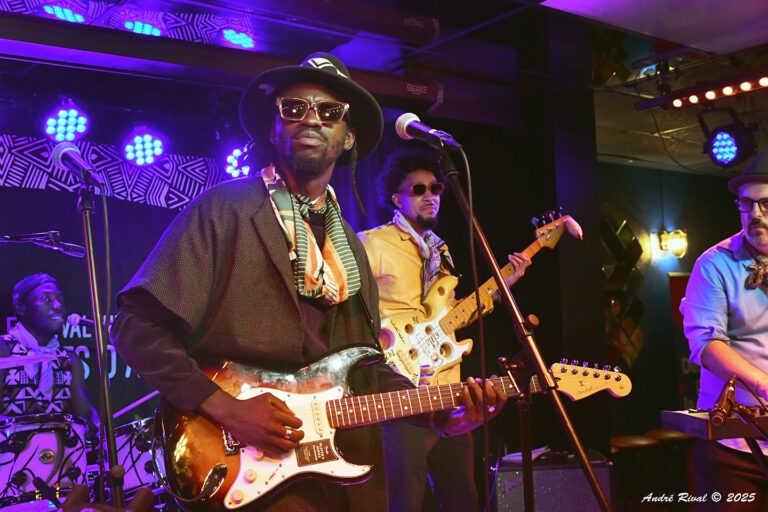
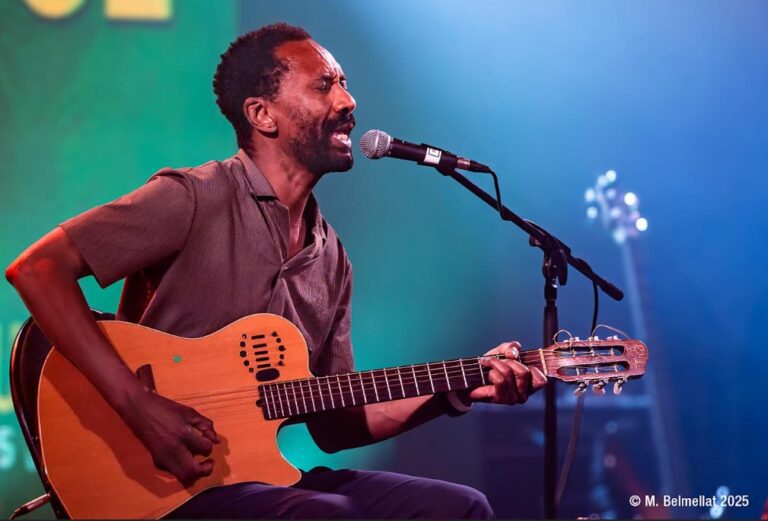
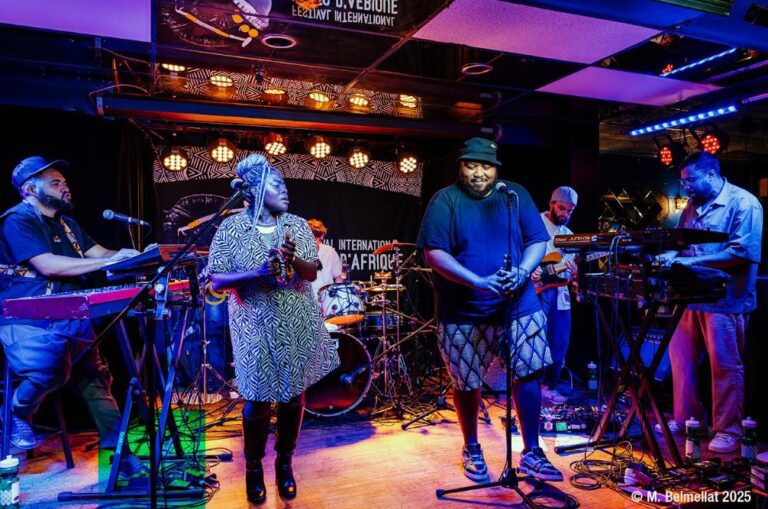
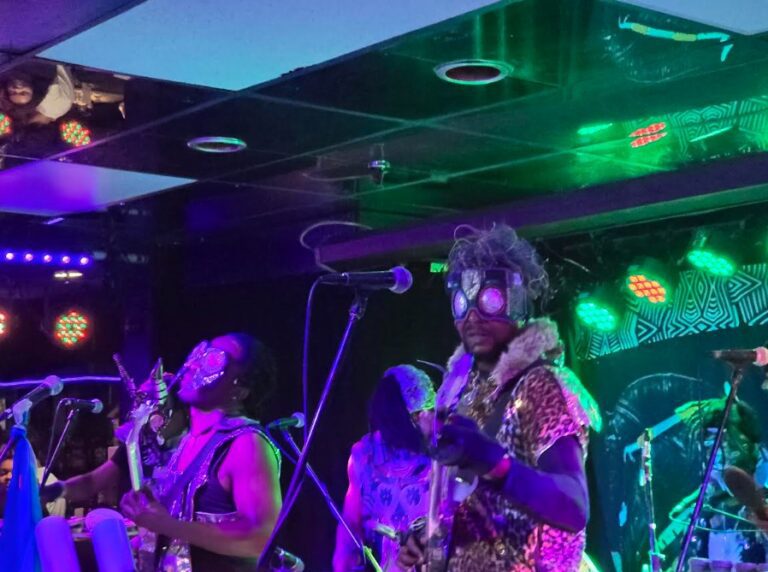
Initially, I wasn’t planning to cover last Saturday’s show at La Brassée, I was going as a spectator, to discover the man everyone’s talking about at the moment, Alain Oyono. Originally from Cameroon, but living in Senegal for over a decade, the saxophonist, who is a member of Youssou N’Dour’s “Super Étoile de Dakar” orchestra, gave us an amazing show. So much so that it was hard to keep it to myself, so here it goes.

By way of introduction, he opts for gentleness with The Beginning, which also marks the start of the artist’s solo career, before showing us his singing talents on Loba, which means God in Douala, the language spoken in the coastal region of Cameroon. These tunes immediately remind me of Kenny G, whom I used to listen to over and over again in my youth.

Against a backdrop of carefully arranged instrumentals, and equipped with a laptop, pedals and mini-console, Alain, who is also an author, composer and performer, manages not only to play his instrument but also to engineer it. On some tracks, notes from piano, afrobeat or afro jazz are used as a basis for him to improvise on as he pleases. On other tracks, he introduces pre-recorded ambient noises, backing vocals and other sounds to complement his instrument.

In his latest EP released in 2023, entitled Transcendance, he pays tribute to nature, notably in the track “Ma nature”. “This album is dedicated to the ecosystem, especially in these difficult times. Fortunately, you’re bringing the warmth back here tonight,” he says, addressing the crowd.

Several instruments are added one after the other in the second half of the concert.

Alain returns to the stage first accompanied by Dauphin Mbuyi on bass, then a few songs later, Deo Munyakazi joins the duo with his inanga, a traditional Rwandan string instrument similar to the zither. Together, they create magic before our astonished eyes. They are joined by Dicko Fils, from Burkina Faso, with a bewitching voice reminiscent of the Sahel, and the charming Sylvie Picard, who enchant us each in their own way.

And just as we thought the concert was drawing to a close, Raphaël Ojo arrived with his djembe to add the finishing touch. The concert turned into a jam session, much to the delight of the audience, who gradually realized that they were in for a unique experience. The owner of La Brassée told me that this was one of his favorite concerts. “Are you enjoying it as much as I am right now?” he asked me between songs. “I’m floating,” I replied.

The concert couldn’t end without a tribute to the giant Manu Dibango, with a cover of the classic Soul Makossa, which pleased the couple sitting next to me. All in all, La Brassée audiences can count themselves lucky to have discovered an artist who will surely be making a name for himself on the Montreal art scene in 2025 and beyond!

Photo Credit: Peter Graham

Classical / période romantique

OSM | Between Icelandic Basses and Bruch’s “Unforgettable” Concerto

by Judith Hamel

The Orchestre Symphonique de Montréal (OSM), under the direction of conductor Dalia Stasevska and violin virtuoso Randall Goosby, presented a program on Wednesday evening featuring composers Thorvaldsdottir and Price, as well as Bruch and Dvořák.

Anna Thorvaldsdottir’s Archora, commissioned by several major orchestras and premiered in 2022, opened the concert with a spellbinding 20-minute soundscape. Designed to evoke a textured universe, the work transports the audience into an exploration of the ensemble’s sonic and energetic potential.

From the very first notes, the hypergraves invade the space, creating an imposing, palpable sound mass. The screeching cymbals add an organic dimension, while the winds click their keys and use their breath to amplify the work’s mystical atmosphere. All this adds up to an almost living narrative. Then the organ, with its imposing presence, amplifies the impression of immensity, of a room larger than ourselves. The twenty minutes passed with great fluidity, like a single wave that sweeps over us. The apparent stability of the sounds, achieved by the interweaving of the musicians’ breaths, gave a superhuman impression.

American soloist Randall Goosby then took to the stage to deliver a straightforward performance, carried with finesse by his great mastery of the instrument. Max Bruch’s “unforgettable” Violin Concerto No. 1, though somewhat frustrating for the composer in its eclipsing power over his other concertos, remains a landmark work in the German Romantic repertoire. Tonight, in the “Adagio”, Goosby was able to express the full intensity of this inner romance. It was in the third movement, however, that the soloist really came into his own. He unfurled himself in the passionate, dancing themes that hint at Bruch’s Hungarian origins, as well as in the final, technical passages. These playful accents resonated particularly well with his light, easy-going playing. A young virtuoso who didn’t overwhelm us with his musicality, but whose technique and ease are impressive.

Florence Price’s Adoration opened the second half in an orchestrated version for violin and orchestra by J. Gray, putting a second female composer in the spotlight. This short piece was particularly well suited to Randall Goosby, who effectively conveyed the emotional charge through his straight but honest playing. However, an OSM concert is no exception: just as he was about to raise his bow, Goosby was interrupted by the telephone of an audience member who was listening to the recording of his performance of the first part at full volume. With humor and patience, he lowered his bow and said: “You can play it again if you want”. But no sooner had he started to play than a cricket buzzer sounded in the hall. Fortunately, the crickets were out of place, but they gave the audience a good laugh.

Although the concertante gave the evening its title, it was Dvořák’s Symphony No. 8, fiercely conducted by Dalia Stasevska, that stood out as the highlight. Dalia Stasevska’s conducting was particularly noteworthy for its emphasis on drastic contrasts of nuance and the exaggeration of certain rhythmic passages. This symphony, with its bucolic atmosphere, was thus deployed through moments of lightness, straight trumpet lines and the exaggerated popular character of certain dancing themes. The fourth movement, which opens with a flamboyant trumpet call and ends with groovy chromatic passages, ended the concert on a welcome note of youthfulness.

Photo credit:  Randall Goosby – Kaupo Kicks ; Dalia Stasevska – Antoine Saito

Electronic

Igloofest 2nd Night: Wild Card with Apashe, Marie Davidson, Dileta

by Loic Minty

Marked with wild musical contrasts and daring approaches, this second night of Igloofest is another reminder of Montreal’s vibrant local scene. We once again witnessed the power of breaks and bass in full effect as big name dj’s turned the dial up, and saw the rising starpower of local homegrown harvest legends in a perfect exhibition of dance music.

Headlining the Videotron stage was none other than Marie Davidson. In this dj set, her emblematic synthwave sound revealed its origins in a steady stream of late night analog techno crowned with some of her own tracks like “Work it” which had the crowd losing its mind. Marie Davidson showed us a guideline into her musical genius and as in her live shows, the wide-eyed presence and honest spoken word effortlessly enticed the crowd into her unapologetically bold aura.

Matching this energy, Honeydripp proved once again to be the queen of kinetic sounds as she liquefied genres into her own spaced out mix of breaks, bass and a groovy remix of Fergalicious. Playing with silence and space, her rhythms teased the line of recognisable patterns, occasionally broken by bassy dub influenced sections which shook the stage.

Ending on a high note with chopped breaks going in and out of time, homegrown harvest’s reputation for long nights dancing was not let down. As Dileta put us in a time warp of progressively rich drum patterns and acid bass sequences to tear the roof off, the crowd quickly understood this was an experience like no other. Dileta’s vast selection of dark leftfield tracks, seamless transitions and sharp accents of retro samples had people young and old grooving from side to side in unisson.

Meanwhile on the Sapporo stage we witnessed an ascent into craze as Jeska displayed a virtuoso performance of drum and bass, accelerating from a wide sound with minutely precise breaks into head banging, hard style territory. Imanu had no problem keeping this energy up with his feel good, synthpop textures and kept the crowd bouncing to classic pop samples mixed between densely energetic house.

It seemed the night would go on in this boundary breaking succession of increasingly ecstatic sounds until in a sudden turn of events, classical music from Apashe’s repertoire transformed the entire festival into a scene from Dante’s inferno.

As the haze from the river gradually blanketed the fluorescent lights, people started slowing down, almost expecting a ballerina to come out in “pas chassé”. But this was all part of Apashe’s master plan. After a solid 20 minutes, a manifesto appeared on the screen and in an instant the scene was flooded with strobes. The rest of the night belonged to Apashe’s, and with his artistic conception of EDM combined with the stadium scale scenography and sound, it will be one to remember. Notable to his “majestic” style was the display of cinematic visuals paired in synchronicity with transitions and instruments that created a mesmerizing audiovisual experience. After an emotionally evoking set, Apashe leaves us once again with the soft sounds of an orchestra walking us out into the streets. The buzz of the crowd turns into screams and we all know what we just witnessed. Igloofest is living up to the hype.

First Igloofest Evening: DJ Minx on the Techno Side

by Loic Minty

With smoke blowing over the turntables, DJ Minx appeals to the spirit of electronic music with his infectious presence.

As a pioneer of Detroit techno, it’s more than appropriate that she’s playing on this first night of Igloo Fest, and it’s easy to see why. She performs with ease and joy, but it’s her approach that makes her shine. People arriving from Sapporo, approach in disbelief to this intimate space where the crowd dances in trance in front of the 4 subwoofers. Classic Detroit-style soul and disco samples fill the imagination with lyrical excerpts, and the bass thrills the whole body. She ends her performance on a fiery track that Felix Patry masters and relaunches with a breakbeat to kick off her eclectic set at high speed. Navigating with ease between a panoply of styles such as Baltimore club and Euro-dance, her carefree presence doesn’t do justice to the people who jump up and down in delirium until the very end, losing their clothes in the process. This slim glimpse of the Homeby6 collective and the Igloo Fest festival gives a thirst for nightlife that will have to be continued another time. Fortunately, this is just the beginning.

First Night of Igloofest 2025: Tali Rose and Michael Bibi’s Party

by Félicité Couëlle-Brunet

It’s 8:30 p.m. and everyone is eagerly awaiting the London producer and DJ at the Sapporo Stage. Joy and good humor reign over a rhythmic beat brought to us by our entourage dressed in matching winter suits for an evening of festivities.

We’ve been bopping along to Tali Rose’s melodious indie-house beats for a while now. The rhythm is good, the dance is organic and the house is progressive. Little by little, people start to go into a trance as the Montreal DJ gradually increases the frequencies of her melodies, until we’re dancing to an almost tribal tune to set the scene for her colleague’s entrance.

Michael Bibi is quick to introduce an assertive house dimension to the evening, bringing the crowd to its feet. It’s from this point on that you feel like you’ve travelled back to the 2010s dance-pop style, thanks to a crowd of upbeat dancers on up-beat melodies. Bibi regularly emphasizes his lifelong love of the blues and jazz scene, and this is evident in his samples of songs remixed with tech-house. At the end of three hours of excitement in the snow, the evening comes to a close with the electro deep-house classic “Pump Up The Jam”, which breathes new energy into the very end of the evening. The good energy stays with us – the first night of Igloofest 2025 has been one of celebration.

Classical / Classical Singing / orchestre / période moderne / période romantique

OSM | Mahler, Payare and The OSM: Between Inner Turmoil, Light and Fatality, a Powerful Evening.

by Hélène Archambault

The OSM has made an enlightened choice to present the works of Alma Mahler and those of her husband, Gustav, in the same concert to inaugurate 2025. The performance of Alma’s works alongside those of her illustrious husband is a contemporary nod to a time when many female musicians are giving up their careers to support those of their husbands.

At the age of twenty-three, Alma, née Schindler, frequented the Viennese artistic scene, composing lieder and insisting on her artistic and intellectual independence. She met Gustav Mahler in November 1901. Twenty years her senior, he made a deal with her: to become his wife, she had to give up her aspirations as a composer. Passionately in love, she accepted, and the marriage was celebrated on March 9, 1902.

Despite this “ban” on composing, Gustav suggested that Alma rework the lieder and have them published (in the program notes, Catherine Harrison-Boisvert notes that “Gustav seems to have wanted to make amends”). It is fortunate that Alma’s Lieder have been rescued from anonymity in this way. Their performance is a first for the OSM. With these 5 lieder, the orchestra offers a sensitive listening experience, and, in my case, one of discovery. In meins Vaters Garten (In my father’s garden) is particularly touching. Mezzo-soprano Beth Taylor’s deep, radiant voice is enhanced by the composer’s expressive writing. My only downside? The orchestration by Colin and David Matthews. A slight mismatch between the two scores is unfortunately to the detriment of the voice.

Of the Sixth Symphony, called “Tragic”, Alma writes that it is her husband’s most personal work, the one that sprang most directly from his heart. She also reports that in writing the Sixth Symphony, Gustav anticipated his own life in music. Three blows of fate, symbolized by as many hammer blows in the finale – only two of which are retained – also befell him: the loss of their daughter Maria to scarlet fever, a diagnosis of incurable heart disease, and the loss of his position at the Vienna Opera. As Mahler’s Sixth was written before these events, this interpretation is debatable. But the story is worth telling, if only to stir the imagination! And perhaps also a little to allow ordinary people to become a little more attached to the composer?

Speaking of attachment, the OSM and Payare, in their interpretation, go the right way. From the very first bar, the tempo is energetic without being frantic. The tone is set. The first movement unfolds between the military and the evocation of Alma, embodied by the strings. The orchestra alternates between rumble and light. Payare seems to play with rhythm. Though regulated like a metronome, time with him seems more supple, more alive. The beautiful pages of the second movement feature a dialogue between woodwinds and brass, in which the orchestra’s playing is limpid. The third movement, almost dreamlike, and the finale follow one another without a break. This sequence seems to allow the orchestra to bewitch us, before plunging us into an emotional stampede in the style of “being Gustav Mahler” right to the end. Just writing it makes me breathless – the energy deployed by the conductor must be the envy of the greatest sportsmen and women. Tragic” symphony, you say? Between enchantment, sweetness and tragedy, one does not leave the symphonic house completely unscathed.

Photo Credit: Gabriel Fournier

Fresh Finds at Bar Le Ritz

by Vanessa Barron

I wound up at Bar le Ritz last Saturday night to catch a showcase of five mostly local bands, ranging from power-pop and jazz-punk to emo and noise. Throughout the course of the night, I found friends, familiar faces, and most importantly, some new favorite bands. Here are the highlights.

Photos by Amir Bakarov

Fresh Wax

The standout act of the evening was Fresh Wax, a bass guitar-and-drum duo who showed up with sick sunglasses and a blasting energy that shook the paint off those primary-coloured planks on the Le Ritz walls. They ripped the wildest riffs in left-field time signatures and took turns on vocals, shouting punchy lines that I didn’t understand and honestly, didn’t need to. The chops of both of these guys were up there with professional jazz musician levels of technique and fervour. I‘ve heard their shows get even wilder at smaller venues, so I will 100% be seeing them again.

Gondola

Gondola was a pleasure as always, as I must confess I’ve seen them at least five other times this year. This four-piece indie-pop group delivered a full range of dynamics and complementary solo moments, maintaining a tight cohesion balanced by moments of unrestrained jamming. Lyle on lead vocals was really sending it on this particular evening. His booming baritone carried melancholic lyrics with full force, evoking the bitterness of heartbreak with an edge of defiance. My favourite of the night was a newer song inspired by the reality show MILF Manor, entitled “Moment I’d Like to Forget.” I have yet to analyze these lyrics from a Freudian perspective, but boy, is it a catchy melody!

Wakelee

I was pleasantly surprised to find that I really vibed with Wakelee’s set. Generally, I’m skeptical of Brooklyn-made emo music in the year 2024 (if they were from a cultural hotbed like Central Pennsylvania or Ohio, perhaps I’d be less prejudiced…), but this set was tight, well-balanced, and totally won me over. I particularly loved how the backup vocals from the bass guitarist weaved into the main melody. These two-part vocals and the singer’s unmistakable emo affectation reminded me of the classic Blink-182 ballad “I Miss You.” I have since re-listened to their single “mildlyinteresting,” which succinctly captures the pathos of asking for advice on Reddit, confessing in its catchy refrain that “every question I have, I post on the Internet.” 

Room

I wish I had caught more of the opening band, Room, which had all the powerhouse belting and radiant bubblegum rock energy of groups like Beach Bunny and Remember Sports. I caught two of their songs, probably the happiest music in an otherwise doomer-toned lineup.

Lastly, I’ve gotta give some credit to the headliner Evergreen. Noise-punk is not my specialty, and my ears couldn’t quite pick up on chords, melodies, or lyrics to comment on. I did, however, see moshers at the front having a great time, and that’s what counts.

classique persan

Centre des musiciens du monde: Persian delight with Kayhan Kalhor

by Frédéric Cardin

Last night at the Centre des musiciens du monde in Montreal, we heard almost 90 uninterrupted minutes of sublime music performed by one of the world’s greatest musicians, Kayhan Kalhor, master of the kamancheh. I’m not just talking about his status in Persian classical music, for which he is certainly THE musician of his time, and perhaps of all times, but about his genius as a musical artist in all genres. Kalhor is a virtuoso and performer in a class of his own.

Yesterday, he was on stage to give the final concert of an extensive tour for the Chants d’espoir (Songs of Hope) programme. He was joined by Montrealers Kiya Tabassian on setar and Hamin Honari on tombak, as well as his compatriot Hadi Hosseini on vocals. 

Paris concert (without Hadi Hosseini) : 

An artistic tour de force in which instrumental improvisation sits naturally alongside classical Persian poetry (that of Saadi, who lived in the 13th century) rendered with brio by Hosseini, one of the most assertive and accomplished voices in classical Persian singing today. Long, skilfully ornamented melodies intermingled with the comments of the instrumentalists, linking contemplative, introspective episodes with others that were more energetic and lively. The tunes, which flowed into one another without pause, were partly drawn from the scholarly repertoire, but mostly from the spontaneity of the musicians on stage, all of whom are remarkable improvisers. It was a sold-out concert, attended in large part by members of the Iranian community, but not exclusively. A very attentive and respectful audience, from which I didn’t hear a single unexpected phone ring! Symphony audiences should learn a few lessons from this…

Concert on December 16 in Montreal : 

Montreal can be proud of this kind of event, because it’s partly thanks to this city that it exists. Kiya Tabassian, of the Constantinople ensemble, is a former student of Kalhor, who himself lived close to the metropolis for a time (he has a Canadian passport as well as an Iranian one), and Hamin Honari moved from Vancouver here to Montreal to take advantage of the artistic opportunities offered here. And in the midst of it all, the Centre des musiciens du monde, which continues to impress with the quality of its projects and the growing influence it exerts on the non-Western scholarly music scene, is actively helping to build Montreal’s reputation as one of the best cities for world music in the West, perhaps the best in America. 

FROM JANUARY AT THE CENTRE DES MUSICIENS DU MONDE: A NEW SERIES OF INTIMATE CONCERTS, ONE WEDNESDAY A MONTH. DETAILS TO COME ON THE ORGANISATION’S WEBSITE

Contemporary

Émanants (Ensembles ILÉA & Bakarlari) – Composing for space; spatializing with the audience

by Laurent Bellemare

You stroll through the corridors of the Chapelle Cité-des-Hospitalières, between the low-pitched drones of modular synthesizers and the clanging of keys on wind instruments. The performers fully inhabit the space, in motion or perched on the third floor. The acoustic tones of traditional instruments blend perfectly with those of amplified and electronic instruments. Your trajectory completes the spatialization of this full, site-specific sound space. It’s the perfect way to rekindle the flame of happening in contemporary music.

The last in a series of four performances, the Émanants show presented by the ILÉA and Bakarlari ensembles, in partnership with Innovations en concert, elegantly exemplified the kind of proposition that can only be captured in a live setting. These two seasoned improvising ensembles put together a program lasting around 1h15, in which spontaneous collective playing and solo pieces followed one another in a coherent progression. For the most part, these transitions were very fluid, blurring the beginnings and ends of the pieces.

At its best, this fluidity created a real continuum of sound, particularly striking between the fifth improvisation and the piece Une musique soluble dans l’air, performed on organ by Gabrielle Harnois-Blouin.
This haunting composition by Kevin Gironnay built, varied and then deconstructed beautiful static harmonies reminiscent of the music of Ellen Arkbro.It was also in such stasis that many of the compositions imagined for the venue unfolded. Think of Corps suspendu / Ballet for Past Skin by Kim Farris-Manning, performed by bass clarinettist Charlotte Layec. This work used loops activated by a looper, over which counter-melodies produced a lamenting effect. At times, what seemed to be a renewed amplification and distortion of the instrument enriched the palette of timbres, as did the sung and declamatory interventions.

In contrast, a work like Ruderalia, written by Olivier St-Pierre for trumpeter Émilie Fortin, was much more sparse in its articulations and made good use of silence. The piece also exhibited a number of extended techniques, performed with dynamism and virtuosity. Andrew Noseworthy’s Insightful, Instructive, Geometrically Satisfying! was a massive rumble of low frequencies.

Performed on modular synthesizers by Pierre-Luc Lecours, this piece immediately had the audience on the move to receive the full force of these vibrations from various listening points. While this piece got the whole chapel vibrating, its transition to the following improvisation fell a little flat. Later, a “Remix” of the same work set up a dialogue between trombonist Kalun Leung and the natural resonances of the chapel, in a language that moved easily from roughness to lyricism.

For their part, the seven improvisations captured attention in one way or another. Between the spectral qualities of the fourth segment, which could have been mistaken for a work by Gérard Grisey or Tristan Murail, and Bakarlari’s luminous harmonies on the fifth, most of the textures one might have wished from such contemplative music were exploited. We were also treated to a gradual rise in intensity in the second improvisation, as everyone moved from a certain quietude to more howling instrumental sounds. The concert also ended with a moment of spontaneous creation, in a sort of energy transfer from one performer to the next, re-exposing the soloist qualities of each one one last time before fading out on a vocal improvisation that we would have liked to have lasted longer.

While classical decorum and disjointed programs are de facto accepted in the world of new music, it’s an event like Émanants, entirely sculpted for a place and according to a thoughtful expressive narrative, that really justifies going out of one’s way to hear live contemporary music.

Classical

Justin Saulnier Wins The 2024-2025 Golden Violin Award

by Alexandre Villemaire

After a tough competition, Ottawa violinist Justin Saulnier won the 2024-2025 Golden Violin Award. The nineteen-year-old will receive a cash prize of $30,000, as well as a concert performance as part of the Schulich@Good Shepherd series, to be held on February 26, 2025 at the Canadian Centre for Architecture. Second prize went to Joey Machin, who was awarded a $15,000 bursary. Jueun Lee rounded off this year’s edition of the Prix du violon d’or with a cash prize of $5,000.

In front of a packed Tanna Schulich Hall, Justin Saulnier delivered a technically skilful program imbued with flawless musicality. His program opened with Robert Schumann’s Three Romances. In each of the pieces, he deftly infused a different character, while in Ysaÿe’s Sonata for solo violin, he illustrated his technical mastery in a virtuoso display of precise violin lines.

But the central portion of his program dedicated to Alfred Schnittke’s Violin Sonata No. 1, a complex work featuring a multitude of playing techniques on both violin and piano, was the highlight of his performance. This work was a judicious choice, and to her advantage. Like his semi-final program, Saulnier was the only one to offer a work firmly rooted in 20th-century language – the other exception being Ellen Taafe Zwilich’s Fantasy for solo violin, performed by Jueun Lee. This change of character was more than welcome in an evening program that was otherwise steeped in the tonal universe of the 19th century. Compared to his colleagues, Saulnier presented the most varied and versatile program in terms of style and technique.

Jueun Lee took to the stage with Zwilich’s Fantaisie, Fauré’s Violin Sonata No. 1 and Ravel’s Tzigane. Lee presented her repertoire with the same vigor that characterized her semi-final appearance. She displayed virtuoso aplomb in many respects, particularly in the works by Zwilich and Ravel. At times, however, the intensity of her interpretations took precedence over her virtuosity. The play of timbre and texture, as well as the display of idiomatic traits present in Ravel’s piece, were well present, but uneven, particularly in the extremely velocity passages or in the changes of playing technique. The main instrumental work on his program, the Fauré sonata, which oscillated between melancholy and intensity, was executed with zeal, but lacked sparkle in the expression of this curious harmonic language.

Succeeding Jueun Lee, Joey Machin performed Prokofiev’s Five Melodies, Henryk Wieiniawsky’s Souvenir de Moscou and the third and fourth of César Franck’s Violin Sonata. He, too, maintained a certain continuity with his semi-final program, offering a refined, clear performance. Prokofiev’s melodies were presented with an even, stable sound, as was Franck’s sonata. His playing and mastery of dynamics were demonstrated in the Wieiniawsky piece, where he brought out the folk elements running through the work with great accuracy and style. A performance that was nevertheless marred by a few minor hiccups at the end in the high-pitched passages marked più vivo.

Andrée Azar, Carole Sirois, Joshua Peters, David Stewart and Jonathan Crow acted as judges for the semi-final and final rounds. Professor André Roy acted as non-voting chairman. The finalists were accompanied on piano by Gaspard Tanguay-Labrosse, Itamar Prag, Félix Marquis and Veola Sun respectively.

Photo Credit : Tam Lan Truong

Baroque / Choral Music / Classical / Classical Singing

Les Violons du Roy and La Chapelle de Québec | Brilliant Messiah!

by Mona Boulay

QUÉBEC

To commemorate their fortieth anniversary, Les Violons du Roy are offering a series of exceptional concerts, including the following: Handel’s Messiah with Bernard Labadie.

First of all, the visual impact of such an ensemble on the stage of the Palais Montcalm cannot be overstated: a baroque chamber orchestra with an eye-catching theorbo in the center, behind which the soloists perform and wait, all overlooked by the choir of La Chapelle de Québec, thirty singers harmoniously arranged in a semicircle around the stage. The view is grandiose, worthy of the famous oratorio we’re about to hear.

Conductor Bernard Labadie, founder of Les Violons du Roy, returns to take his place for the duration of the concert, a chair he has left since 2014 to Jonathan Cohen. It’s under his guidance that our concert begins, with a perfectly executed instrumental overture. We continue immediately with the first soloist, tenor Andrew Haji, who captivates us from the very first notes of “Comfort Ye”. The singer handles nuances with great virtuosity and never tries to overdo it: his notes held without vibrato are a real treat for our ears, as are his perfectly mastered melismas. The choir then makes its first appearance with “And the glory of the Lord”, and its power is striking: what an impact! The group seems to form a single angelic voice, the purity of the sopranos mingled with the depth of the basses, the blend of timbres total. And already we hear “Thus saith the Lord”, the first solo by bass William Thomas, a young British singer with a great future ahead of him. This is contrasted by countertenor Iestyn Davies’s “But who made abide”, an impressive performance supported by the chamber orchestra, particularly with its velocity and precision of prestissimo. As the oratorio continues, we finally hear Liv Redpath, soprano. Her entrance is perhaps less remarkable at first than that of the other soloists, with a play in nuances that at first seems restricted, despite impressive vocal precision. The first interventions seem to lack a little life.

Messiah unfolds throughout the evening, punctuated by strong moments (how could one not shudder during the “Hallelujah” closing the second part?), but also occasionally by a few long stretches. A case in point is “He was despised”, a long countertenor solo that never ends. Whether Handel’s hand was too heavy, or the interpretation lacked direction, I couldn’t say, but time seemed to run longer during this aria). It ends beautifully with the perfectly executed “Amen”, a profusion of intense joy.

The concert is made brilliant by the instrumental ensemble, which has had the opportunity throughout to demonstrate its great capacity for contrast, always handled with the elegance and purity typical of Baroque music. Not once is a note overemphasized, not once does it fall into the realm of excess. For once, Les Violons du Roy excel in subtlety. The soloists are each outstanding, despite the criticisms set out above, one is aware of hearing a certain elite of lyrical singing. The choir of La Chapelle de Québec is excellent in its role, and doesn’t disappoint us once: its interventions are always a moment of great pleasure. All in all, a successful evening, and a brilliant one at that.

Photo Credit : David Mendoza Hélaine

Handel’s Messiah with Les Violons du Roy and Bernard Labadie will be presented at the Maison symphonique de Montréal on Saturday, December 14 at 7:30 pm. Tickets are available here.

Subscribe to our newsletter

Inscription
Infolettre

"*" indicates required fields

Type of Suscribers