Contemporary

Quigital Corporate Retreat: how to destroy corporate culture while having a great time

by Frédéric Cardin

How to describe the concept behind Quigital Corporate Retreat by the Architek percussion ensemble, soprano Sarah Albu, and creators Eliot Britton, Patrick Hart, David Arbez, and Kevin McPhillips? I won’t repeat what has already been said in the interview I conducted with Ben Duinker from Architek, Sarah Albu, and Elliot Britton. I therefore invite you to consult it without delay (French and English).

WATCH THE INTERVIEW HERE

I will rather focus on the show itself, which I attended on November 13, 2025, at the Sala Rossa in Montreal. What must be said, first of all, is that this show represents a renewed form of the concept of total art in which the audience is involved. A good half hour before the first notes are played, we are already in the show itself. We are welcomed not as spectators, but rather as employees of the Quigital corporation. The event is a professional retreat, a session of boosting and motivation, collective brainstorming, but also, unbeknownst to us, an evaluation of our performance. We receive an official identity card and a downloadable application connects us to other “employees” with whom we are called upon to exchange ideas for products to launch, to build a network, and above all, to accumulate Quigital points. With these points, we can even buy promotions!

Once this intro is over, the show begins. This is a fairly playful roller coaster whose success, I am told, is due to the advice of the director and choreographer Marie-Josée Chartier. We quickly get caught up in it, so well is everything managed, and the musicians also act as more or less effective managers of the event’s progress. But the person who ensures the impeccable running and the maintenance of the breathless energy is the MC (Mistress of Ceremony), a kind of crowd animator/Club Med GO/pushy motivator of the evening: the soprano Sarah Albu. She’s the one who holds it all together, who sings, talks, encourages to the point of saturation to repeat the ridiculous mantras of this big fictional, but not so fictional, company. Here’s an example: If you’re on time, you’re late; We strive for Data Completeness!; It’s up to all of us to live and breathe the sunset-type environment; Aim to find out your Complete Edgeboard Storylines, and a bunch of other nonsense like that. We are bombarded with hollow propaganda, covered in false-good-feelings that underpin a mind-numbing productivism that seems straight out of an updated version of Orwell’s 1984.

All of this, of course, is a scathing but lucid critique of the contemporary corporate world, which seems unable to avoid the trap of its own extremist caricature leading to absurdity.

The event consists of songs that form a complete cycle (a Songbook) of six tracks, evoking conventional platitudes that one might hear or read in the usual activities of a workday:

Can You Forward This To Me?
I Hope This Email Finds You Well
Exciting News!
Just Wanted To Circle Back
You Left Something Behind
We Love You

All of this is interspersed with sometimes frenetic instrumental moments, like when the host overloads her coworkers by pushing them to always go faster. These (the guys from Architek) type faster and faster on computer “keyboards” that also serve as percussion or funny instruments like a melodica!

The great success of this show, unlike any other I have ever seen in contemporary music, is that, firstly, the staging is precise to the millimetre and timed to the millisecond. Secondly, the proposed socio-economic critique is not done in a heavy-handed or leftist preaching manner. Although the content is undeniably left-wing, the humour and ridicule present throughout serve as a lightning rod against any potential impression of militant political action. Then, thirdly, the music composed by Elliot Britton and Patrick Hart is perfectly suited to the subject matter and the flow. The Montreal composer plunges us into a tornado of sounds, notes and well-turned melodies that evoke as much the muzak of a telephone voice mail or the corporate jingle as the typical song of an American musical and, also, more contemporary instrumental episodes, but always inhabited by an irresistible propulsive energy. The simple little themes associated with Quigital’s “ads” will remind those who remember them of the stereotypical jingles from the fake commercials in films like Robocop (the original from 1987, a very dark satirical masterpiece by Paul Verhoeven) or Total Recall (also the original, with Arnold Schwarzenegger in 1990, and also by Verhoeven and based on a short story by Philip K. Dick). As if the superficial and propagandist tendencies of multinationals have not changed at all… Nowadays, it even seems that a fusion movement is taking place with a certain religious fringe of society, especially in the United States.

The creators probably noted it very well, as the majority of this corporate retreat is divided into six parts associated with a ritual initially launched with the “prayer” Oh Growth, Heed My Call. The six parts follow, whose titles leave no doubt as to the religious links: Invocation, Thanksgiving, Confession, Supplicata, Intercession, Adoration. Imagine then the host who, following the dismissal of some employees, offers very superficial and useless “thoughts and prayers”!! A particularly strong moment when you know how and in what contexts they are used by our southern neighbours.

In the end, Quigital Corporate Retreat is a bold, very bold show, but one that certainly has the potential to reach a wide audience in search of a change of scenery and social critique that is as virulent as it is comical, without forcing anyone to tear their hair out trying to understand what’s going on. That is a very rare thing in contemporary so-called “avant-garde” creation.

When you burn bridges, people fly!

classique / violon

OSM : Carte blanche à Andrew Wan

by Rédaction PAN M 360

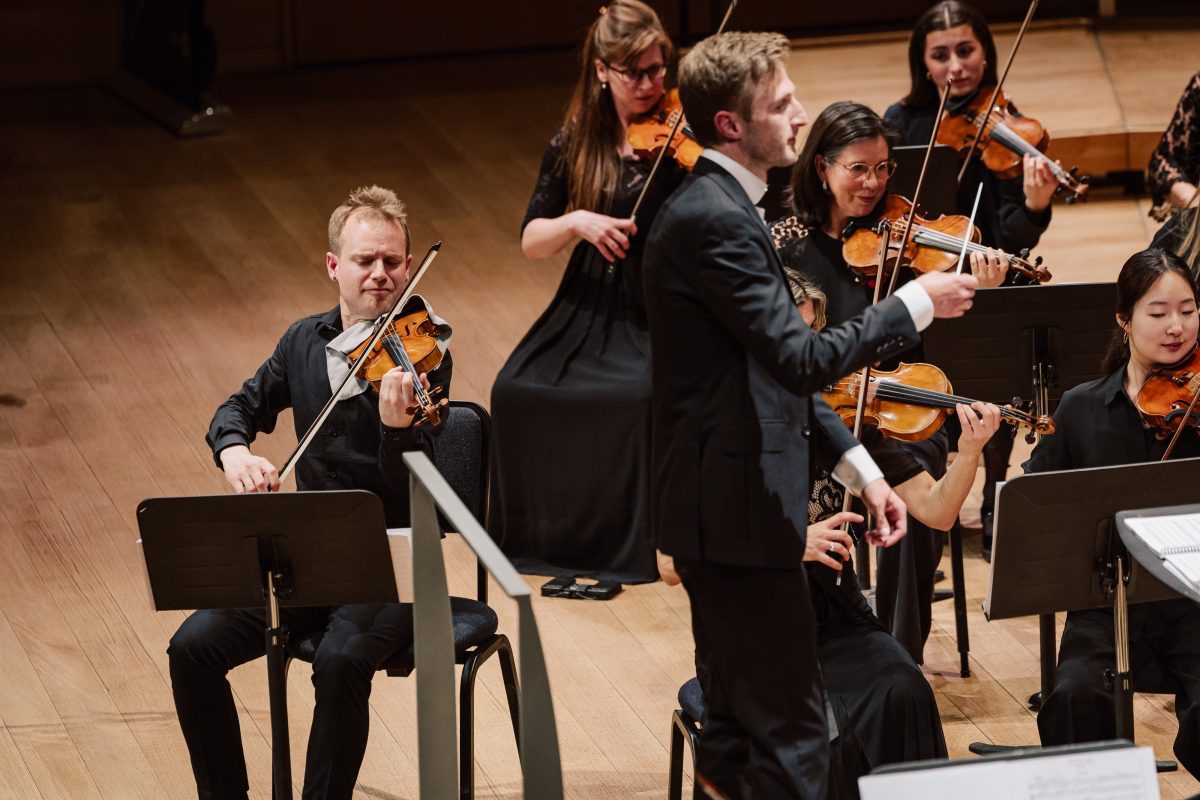
Venez découvrir les solistes de l’OSM dans un concert unique, réunissant Victor Fournelle-Blain, alto solo, et Andrew Wan, violon solo, qui jouera et dirigera l’orchestre avec brio. À l’occasion de l’anniversaire de sa femme, Wagner compose une œuvre pleine de douceur et de tendresse : un véritable hommage à l’amour. Ces sentiments résonnent également dans l’Andante de la Sinfonia concertante de Mozart. Ne laissez pas passer l’opportunité de voir ces deux talents de l’OSM illuminer la scène!

Discover the OSM soloists in a unique concert featuring Principal Viola Victor Fournelle-Blain and Concertmaster Andrew Wan, who will perform and lead the orchestra. For his wife’s birthday, Wagner composed a heartfelt tribute to love, a piece brimming with warmth and tenderness. These sentiments also resonate in the Andante of Mozart’s Sinfonia Concertante. Don’t miss the opportunity to see these two exceptional OSM musicians shine on stage!

Programme

Edvard Grieg, Suite Holberg, op. 40 (21 min)
Richard Wagner, Siegfried Idyll, WWV 103 (18 min)
Wolfgang Amadeus Mozart, Sinfonia concertante pour violon et alto, K. 364 (30 min)

Program

Edvard Grieg, Holberg Suite, Op. 40 (21 min)
Richard Wagner, Siegfried Idyll, WWV 103 (18 min)
Wolfgang Amadeus Mozart, Sinfonia Concertante for Violin and Viola, K. 364 (30 min)

POUR ACHETER VOTRE BILLET, C’EST ICI!

Ce contenu provient de l’Orchestre symphonique de Montréal et est adapté par PAN M 360

classique / quatuor à cordes

Quatuor Molinari : Dialogue sur le Plateau – Rythmes canadiens à la Maison de la culture du Plateau Mont-Royal

by Rédaction PAN M 360

Le compositeur Blair Thomson sera l’invité du Molinari lors de ce Dialogue qui permettra au public de découvrir la toute nouvelle oeuvre du compositeur intitulée «Internesses» et écrite pour le Quatuor Molinari.
Ce Dialogue présente, analyse et discute des oeuvres au programme du concert de la série Vingtième et plus du 5 décembre qui sera donné au Conservatoire de Montréal. Les musiciens  joueront des extraits et discuteront avec le public des oeuvres au programme de ce concert. Outre la création de Blair Thompson, vous y entendrez des extraits de l’entraînant 4e quatuor de R. Murray Schafer et du dynamique  «Dark Energy» de Kelly-Marie Murphy.
Une soirée énergisante vous attend!

Composer Blair Thomson will be the Molinari’s guest during this Dialogue, which will give the audience the opportunity to discover the composer’s brand new work entitled “Internesses,” written for the Molinari Quartet.
This Dialogue presents, analyzes, and discusses the works on the program for the December 5 concert of the Vingtième et plus series, which will be held at the Conservatoire de Montréal. The musicians will play excerpts and discuss the works on the concert program with the audience.
In addition to Blair Thompson’s new work, you will hear excerpts from R. Murray Schafer’s lively 4th Quartet and Kelly-Marie Murphy’s dynamic “Dark Energy.”
An energizing evening awaits you!

CE SPECTACLE EST EN ENTRÉE LIBRE!

Ce contenu provient du Quatuor Molinari et est adapté par PAN M 360

classique / période romantique

OSM : La Symphonie «Pathétique» de Tchaïkovski

by Rédaction PAN M 360

Plongez dans un tourbillon d’émotions avec deux chefs-d’œuvre poignants. D’abord, le Concerto pour violoncelle d’Elgar, où le soliste Nicolas Altstaedt mettra cet instrument en lumière avec une intensité saisissante. Ensuite la Symphonie n° 6 de Tchaïkovski, dans laquelle, sous des accents nostalgiques, un véritable drame intérieur se déploie. Entre tumulte des passions chez Tchaïkovski et mélancolie chez Elgar, chaque note sublime les tourments et les craintes.

Embark on an emotional journey through two profoundly moving masterpieces. First, soloist Nicolas Altstaedt will bring Elgar’s Cello Concerto to life with powerful intensity, followed by a performance of Tchaikovsky’s Symphony No. 6, a piece brimming with nostalgia and inner drama. From Tchaikovsky’s turbulent passion to Elgar’s poignant melancholy, every note unveils the complexities of human anguish and fear.

Programme

Samuel Coleridge-Taylor, Ballade, op. 33 (11 min)
Edward Elgar, Concerto pour violoncelle, op. 85 (30 min)
Piotr Ilitch Tchaïkovski, Symphonie no 6 op. 74 en si mineur, « Pathétique » (45 min)

Program

Samuel Coleridge-Taylor, Ballade, Op. 33 (11 min)
Edward Elgar, Concerto for Cello, Op. 85 (30 min)
Pyotr Ilyich Tchaikovsky, Symphony No. 6, Op. 74 (“Pathétique”) (45 min)

POUR ACHETER VOTRE BILLET, C’EST ICI!

Ce contenu provient de l’Orchestre symphonique de Montréal et est adapté par PAN M 360

classique / post-romantique

OSM : De l’Europe au cinéma

by Rédaction PAN M 360

Concert en formule Apéro symphonique où nostalgie, racines européennes et mélodies hollywoodiennes vous transporteront! Ce concert de 60 minutes vous donnera également l’occasion de rencontrer l’humoriste Philippe-Audrey Larrue-St-Jacques, hôte de la soirée et de découvrir ou de redécouvrir la violoniste Simone Lamsma, acclamée lors de sa performance en 2024!

Discover the Happy Symphonic Hour version of our December 3 program and be swept away by nostalgic European sounds and iconic Hollywood melodies. This 60-minute concert also offers a chance to meet comedian Philippe-Audrey Larrue-St-Jacques, who will be hosting the evening. Plus, you’ll have the opportunity to discover—or rediscover—the incredible violinist Simone Lamsma, acclaimed for her outstanding performance in 2024.

Programme

Claude Debussy, L’isle joyeuse (arr. B. Molinari), L. 106 (7 min)
Erich Wolfgang Korngold, Concerto pour violon, op. 35 (24 min)
Béla Bartók, Concerto pour orchestre, Sz.116, BB 123 (36 min)

Program

Claude Debussy, L’isle joyeuse (arr. B. Molinari), L. 106 (7 min)
Erich Wolfgang Korngold, Concerto for Violin, Op. 35 (24 min)
Béla Bartók, Concerto for Orchestra, Sz.116, BB 123 (36 min)

POUR ACHETER VOTRE BILLET, C’EST ICI!

Ce contenu provient de l’Orchestre symphonique de Montréal et est adapté par PAN M 360

Baroque / classique

Festival International Bach Montréal 2026 : Cinq clavecins pour Luc Beauséjour – Bach et ses illustres mentors à la Chapelle Notre-Dame-de-Bon-Secours

by Rédaction PAN M 360

Puisqu’il est principalement englobé par l’époque baroque, le répertoire pour clavecin est parfois perçu comme manquant de variété. L’idée est à déconstruire! Nombreux sont les styles et les approches qui se succèdent sur cette période de 150 ans.
Cet instrument central dans l’œuvre de Bach devient ici le fil conducteur d’un voyage envoûtant à travers les générations du baroque.
Complice de longue date du Festival, Luc Beauséjour mène cette exploration lumineuse, faisant revivre des œuvres emblématiques de maîtres du clavier qui ont influencé Bach lui-même.
Moment rare, cinq clavecins baroques sont réunis sur scène le temps d’une soirée. 

Since it is largely associated with the Baroque era, the harpsichord repertoire is sometimes perceived as lacking variety. This idea deserves to be challenged! Countless styles and approaches unfolded over the course of those 150 years.
This instrument, so central to Bach’s work, becomes the guiding thread of a spellbinding journey through generations of Baroque music.
A long-time collaborator of the Festival, Luc Beauséjour leads this luminous exploration, bringing back to life iconic works by keyboard masters who influenced Bach himself.
A rare moment: five Baroque harpsichords will be gathered on stage for one unforgettable evening.

POUR ACHETER VOTRE BILLET, C’EST ICI!

Ce contenu provient du Festival International Bach Montréal et est adapté par PAN M 360

Africa / Afro-Colombian / Eastern European / japon / latino / Musiques du Monde

Mundial Montreal | A World Tour for The 15th Edition

by Sandra Gasana

Colombia, Japan, France, Lithuania, and the Democratic Republic of Congo were represented on this second day of Mundial at Café Campus. We were treated to a musical tour around the world, wandering from room to room, from one universe to another.

Less Toches

To kick off this 15th edition of Mundial, Less Toches brought their infectious energy back to Café Campus. You’ve probably seen them on several Montreal stages since their appearance at Syli d’Or or MUZ. In a 25-minute show, they managed to set the place on fire, thanks in part to the band’s percussion instruments but also to the accordion. Added to this are the voices of the musicians providing backing vocals. Cumbia is at the heart of this Colombian band’s universe, but they don’t hesitate to add bolero, sung in French no less, to demonstrate their versatility, before returning to cumbia in the same song. The camaraderie between the musicians was palpable, giving the impression of a house party teleported onto the stage. They took care to address the audience in both of Canada’s official languages, ensuring that they reached the many broadcasters in the room. Their electrifying energy appealed to the audience, who even had the opportunity to sing along with them.

Maïa Barouh

My favorite part of the evening was undoubtedly this Franco-Japanese artist with her eclectic style, who has mastered the art of performance. She began her performance in the audience with her two percussionist sidekicks, megaphone in hand. Unfortunately, this part was not visible to the whole room, but she brought that energy back to the stage a few minutes later. Dressed in a patterned kimono and traditional Japanese hats, she spoke sometimes in English, sometimes in French between songs. Patterned Japanese lanterns decorated the room, setting the mood for her mixed-culture universe. She blends traditional Japanese songs with rock, electro, and rap, adding her own unique theatrical touch. She dances at times, shouts loudly at others—in short, she constantly surprises us. In addition to singing, she plays guitar on a few songs and finishes with the flute, which she plays while singing, revealing all her talents, one after the other. Her song “Je ne suis pas Chinoise” (I am not Chinese) addresses this quest for identity and her frustration at being greeted with “Ni Hao” (hello in Mandarin) on the street. She got the audience involved, making them sing in Japanese, accompanied by the percussionists who were also her backing singers. She will be in Ste-Hyacinthe and Gatineau in the coming days, giving us the opportunity to discover her talent.

Sutartronica

The bar was already set very high with Maïa, so it wasn’t easy for the next group to do better. Three women, all dressed in white dresses, appeared on stage, accompanied by a DJ/musician. Together, they mix Lithuanian polyphonic songs with electro, reminiscent of Gregorian chants but with a modern twist. They were rather shy at the beginning of the concert, but as it went on, they loosened up, adding dance moves and stage presence. On some tracks, the DJ added rhythmic sounds from his computer, while on others he played his electric guitar instead. Their music takes us back in time, even several centuries ago, when some women were treated as witches because they sang. “If we’re here tonight, it means they didn’t succeed,” adds one of them, who seems to be the leader of the group. They sometimes sing a cappella and even taught us a few words in Lithuanian. What began as a solemn, almost religious performance ended in a festive atmosphere, combining singing, hypnotic harmonies, and dancing.

Killabeatmaker

There are three of them on stage, but they seem like ten because of the intense energy they project, particularly percussionist Hilder Brando Osorno, who also works the console to create electrifying Afrobeats and Afrohouse sounds mixed with Colombian rhythms from the Caribbean and Pacific regions of Colombia. He is accompanied by Guadalupe, a young musician who also plays percussion, maracas, and the traditional Colombian flute. The third member is the band’s drummer, with a gigantic drum in front of him on which he goes wild throughout the performance. After a few songs, the rhythm is so frenzied that it feels like being in a nightclub. They even had the chance to add a song to their repertoire when one of the members suggested it to the audience.

Kin’Gongolo Kiniata

The second night of Mundial ended with the long-awaited performance by Kin’Gongolo Kiniata, the band we talked about in PAN M 360 when they played at the Nuits d’Afrique festival. Known for using stuff they find on the street and recycling it to make their instruments, they show us that you can make music with anything. Composed of five members from the Democratic Republic of Congo, they all take turns singing and know how to get the crowd going. The bassist, a true showman, had an instrument that looked like a banjo, but he played it perfectly while interacting with the audience. The electric guitar was much smaller than what we usually see, but it was just as powerful. In the center of the stage, two musicians played on a wooden box into which they had inserted metal and plastic percussion instruments. Ah, there was even a tin can that served as an instrument and added ambient noise. They got the audience singing by having them repeat their name, while the drummer played on boxes, using an old 1980s TV as a support. Despite the fact that the activities had started at 8 a.m. that day, the participants still had energy to burn at 11 p.m. thanks to this group that kept them awake. Like Killabeatmaker, Kin’Gongolo Kiniata was treated to an extra song as the audience demanded more. And since it was the 15th, some rules were more flexible, allowing the fun to last a little longer.

Alternative Rock / math rock / Post-Rock

M pour Montréal : Patche & Angine de Poitrine au Ausgang Plaza

by Rédaction PAN M 360

LES BILLETS POUR CE SPECTACLE SONT ÉPUISÉS!

Ce contenu provient de M pour Montréal et est adapté par PAN M 360

classique / musique contemporaine

OSM : Ravel immortel

by Rédaction PAN M 360

Le tombeau de Couperin de Ravel rend hommage à la grande tradition musicale française du XVIIIe siècle et aux camarades du compositeur morts au combat. En écho, l’œuvre d’Escher honore Ravel dans un style très français. S’inspirant toutes deux de danses baroques, ces œuvres se distinguent par leur instrumentation finement colorée et nuancée.

Ravel’s Tombeau de Couperin pays homage to the rich French musical inheritance of the 18th century and to the composer’s comrades who fell in battle. Similarly, Escher’s composition honours Ravel in a distinctly French manner. Inspired by Baroque dances, both works feature intricately textured and nuanced instrumentation.

Programme

Caroline Lizotte, création pour flûte et harpe (12 min) – commande de l’OSM
Maurice Ravel, Le tombeau de Couperin, M. 68 (arr. Jocelyn Morlock), (17 min)
Rudolf Escher, Le tombeau de Ravel (25 min)

Program

Caroline Lizotte, Premiere for flute and harp (12 min) – OSM commission
Maurice Ravel, Le tombeau de Couperin, M. 68 (arr. Jocelyn Morlock), (17 min)
Rudolf Escher, Le tombeau de Ravel (25 min)

POUR ACHETER VOTRE BILLET, C’EST ICI!

Ce contenu provient de l’Orchestre symphonique de Montréal et est adapté par PAN M 360

alt-rock / Indie Folk / Pop

M pour Montréal : School Night TO avec Reuben And The Dark, Willa Owen, Rachel Bobbitt & Mah Moud au Ministère

by Rédaction PAN M 360

Rejoignez-nous le jeudi 20 novembre pour une soirée musicale mettant à l’honneur certains de nos artistes coups de cœur du moment, ainsi qu’un album que nous écoutons depuis déjà dix ans ! School Night est toujours gratuit et affiche complet chaque année, alors réservez votre place et arrivez tôt !
À propos de School Night:
Depuis sa création en 2010, School Night! est devenu le showcase live le plus respecté, où l’industrie musicale et les premiers fans découvreurs se rencontrent pour des débuts inoubliables d’artistes devenus têtes d’affiche et lauréats de Grammy®.

Join us on Thursday, November 20 for an evening of music featuring some of our favourite artist we’re listening to these days, and a record we’ve been listening to for ten years now! School Night is always free and each year has been a memorable sellout, so RSVP and get there early!
About School Night:
Since its inception in 2010, School Night! has become the most respected live music showcase where industry and early-adopter fans meet for unforgettable debuts by chart-toppers and Grammy® winners.

POUR RÉSERVER VOTRE PLACE (GRATUITEMENT), C’EST ICI!

Ce contenu provient de M pour Montréal et est adapté par PAN M 360

chanson keb franco

Plume Latraverse – Rémissionnaire (Le Trio Laid frappe encore) au Théâtre Maisonneuve

by Rédaction PAN M 360

Depuis des siècles, depuis de nombreuses années, sur les scènes des cabarets et des théâtres, Plume Latraverse a traîné sa carcasse, sa guitare et ses chansons… Entraîné dans une mission ménestrelle sans issue, missionnaire autoroutier et souterrain à travers toutes les folies de ce monde. Et qu’est-ce que ça lui a donné?
Un public fidèle, fantôme et grandissant qui, une fois de plus, viendra se greffer à la mythologie plumesque pour cette tournée RÉMISSIONNAIRE… en compagnie de Jean-Claude Marsan, à la guitare, et de Grégoire Morency, à la basse. Hé oui… LE TRIO LAID frappe encore!

For centuries—for many years now—on the stages of cabarets and theaters, Plume Latraverse has dragged along his frame, his guitar, and his songs… Swept up in a minstrel’s mission with no way out, a highway and underground missionary through all the madness of this world. And what has it given him?
A faithful, elusive, ever-growing audience that, once again, will join the “plumesque” mythology for this RÉMISSIONNAIRE tour… alongside Jean-Claude Marsan on guitar and Grégoire Morency on bass. Yes indeed… LE TRIO LAID strikes again!

POUR ACHETER VOTRE BILLET, C’EST ICI!

Ce contenu provient du Quartier des spectacles et est adapté par PAN M 360
Subscribe to our newsletter