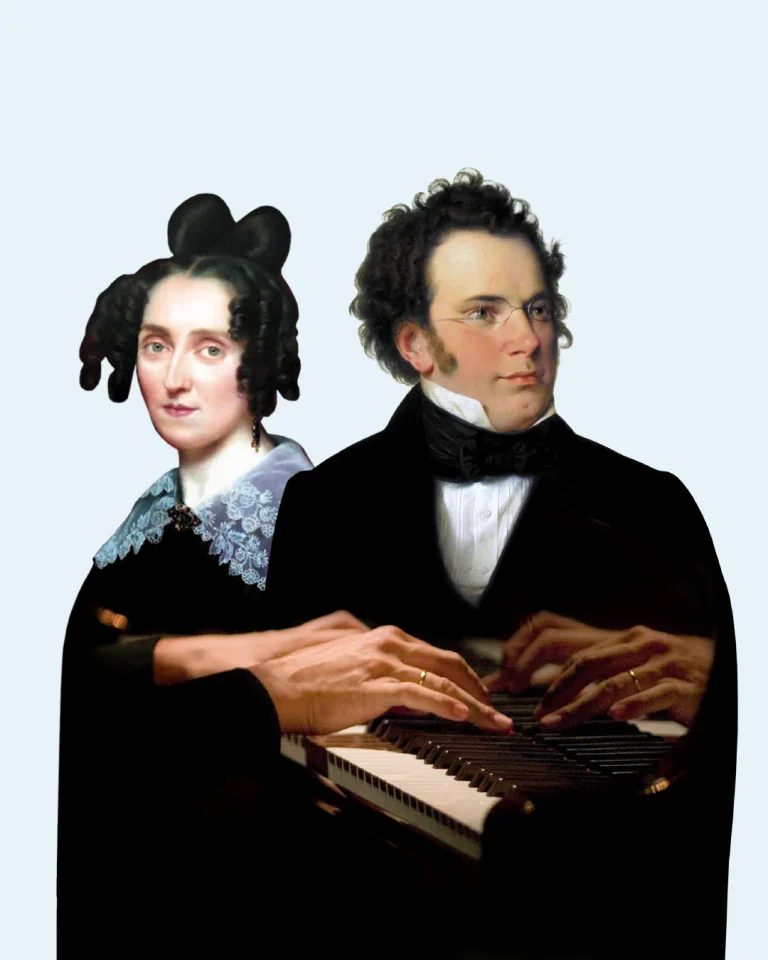
Poursuivez votre exploration du plus grand compositeur de lieder de l’histoire ! Quatre jeunes artistes lyriques et une pianiste présentent certains des plus beaux opus schubertiens avant de se réunir dans une poignante prière pour quatuor vocal.
Dive deeper into the world of the greatest lieder composer of all time! Pianist Chloé Dumoulin accompanies four young singers in a selection of gems from Schubert’s song catalogue, ending with the composer’s poignant prayer for vocal quartet.
Programme
SCHUBERT Osterlied [Chant de Pâque], D. 168a Die Liebende schreibt [L’amoureuse écrit], D. 673 Gretchen im Zwinger [La prière de Marguerite], D. 564 Geistes-Gruss [Salut d’un fantôme], D. 142 Der Fluss [Le fleuve], D. 693 Mélodie hongroise en si mineur pour piano, D. 817 Schwestergruss [Salutation de la sœur], D. 762 Rastlose Liebe [Amour sans repos], D. 138 Der Alpenjäger [Le chasseur alpin], D. 588 Wandrers Nachtlied [Le chant de la nuit du voyageur], D. 768 Gebet [Prière], D. 815
Program
SCHUBERT Osterlied [Easter song], D. 168a Die Liebende schreibt [The woman in love writes], D. 673 Gretchen im Zwinger [Gretchen’s prayer], D. 564 Geistes-Gruss [Phantom-greeting], D. 142 Der Fluss [The river], D. 693 Hungarian Melody in B minor for piano, D. 817 Schwestergruss [Sister’s greeting], D. 762 Rastlose Liebe [Relentless love], D. 138 Der Alpenjäger [The Alpine hunter], D. 588 Wandrers Nachtlied [The wanderer’s night song], D. 768 Gebet [Prayer], D. 815
Trio Fibonacci – Compositeurs voyageurs à la salle Bourgie
by Rédaction PAN M 360
Partez sur les traces de compositeurs dont l’œuvre est teintée par les cultures d’origines et les terres d’accueil. Les trios de George Onslow et de Sergueï Rachmaninov se distinguent en effet par les couleurs musicales de leurs destinées respectives. Compositeur franco-britannique, Onslow incarne une figure cosmopolite du romantisme européen, mêlant classicisme viennois et sensibilité française. Son trio, à la fois élégant et plein de vitalité, témoigne du talent d’Onslow, souvent surnommé le « Beethoven français ». Rachmaninov quant à lui exprime à la fois son admiration pour Tchaïkovski et sa propre voix musicale naissante dans son trio élégiaque. Lyrisme slave, virtuosité pianistique et profondeur dramatique y annoncent déjà la richesse expressive de ses œuvres futures. Une création de Katia Makdissi-Warren, dont le style est influencé par les musiques du Moyen-Orient, de l’Occident et Autochtones, complétera ce programme.
Follow in the footsteps of composers whose music reflects a profound dialogue between cultures, homelands and diverse influences. The trios of George Onslow and Sergei Rachmaninov are distinguished by the musical colours of their respective destinies. A Franco-British composer, Onslow was a cosmopolitan figure of European Romanticism, blending Viennese classicism with French sensibility. His trio, at once elegant and full of vitality, testifies to the talent of Onslow, often dubbed the ‘French Beethoven’. Rachmaninoff expresses both his admiration for Tchaikovsky and his own nascent musical voice in his second Trio élégiaque. Slavic lyricism, pianistic virtuosity and dramatic depth already foreshadow the expressive richness of his future works. A new work by Katia Makdissi-Warren, whose style is influenced by Middle Eastern, Western and Aboriginal music, will complete the programme.
Programme
George ONSLOW Trio en sol majeur, op. 27 Sergueï RACHMANINOV Trio élégiaque n°2 Katia MAKDISSI-WARREN Création
Program
George ONSLOW Trio in G major, Op. 27 Sergueï RACHMANINOV Trio élégiaque n°2 Katia MAKDISSI-WARREN Premiere
Victoire Bunel, mezzo-soprano & Gaspard Dehaene, piano – Schubert et la mélodie française à la salle Bourgie
by Rédaction PAN M 360
Ce programme ancre Schubert sur la terre ferme tout en lui faisant miroiter les mers qu’il n’a pas connues, dépeintes par des mélodies françaises qu’il n’aura jamais entendues. Ces tourments du voyageur sont racontés dans ses lieder auxquels répond, telle une consolation, la danse des flots de Fauré, Chausson, Marguerite Canal et Lili Boulanger.
An image of the sea that Schubert never glimpsed, depicted in French mélodies that he never heard, entices him while he remains stuck on dry land. As a form of consolation, the suffering of the Schubertian traveller recounted in these lieder is answered by the play of the waves in songs by Fauré, Chausson, Marguerite Canal, and Lili Boulanger.
Programme
SCHUBERT Geisternähe [Proximité des esprits], D. 100 Erinnerung [Souvenirs], D. 101 Seufzer [Soupirs], D. 198 An die untergehende Sonne [Au soleil couchant], D. 457 In der Mitternacht [À minuit], D. 464 Lied des Orpheus, als er in die Hölle ging [Chant d’Orphée, comme il est allé aux enfers], D. 474 Abschied [Adieux], D. 475 Rückweg [Le chemin de retour], D. 476 Der Jüngling und der Tod [Le jeune homme et la mort], D. 545 FAURÉ Les berceaux, op. 23 n° 1 La chanson du pêcheur, op. 4 n° 1 Au bord de l’eau, op. 8 n° 1 Mirages, op. 113 (extraits) L. BOULANGER Reflets JAËLL La mer (extraits) CHAUSSON Sérénade italienne, op. 2 n° 5 La chanson bien douce, op. 34 n° 1 CANAL Chanson à l’aube Écoutez la chanson bien douce Largue la voile RAVEL Jeux d’eau SCHUBERT / LISZT Aufenthalt
Program Geisternähe [Proximité des esprits], D. 100 Erinnerung [Souvenirs], D. 101 Seufzer [Soupirs], D. 198 An die untergehende Sonne [Au soleil couchant], D. 457 In der Mitternacht [À minuit], D. 464 Lied des Orpheus, als er in die Hölle ging [Chant d’Orphée, comme il est allé aux enfers], D. 474 Abschied [Adieux], D. 475 Rückweg [Le chemin de retour], D. 476 Der Jüngling und der Tod [Le jeune homme et la mort], D. 545 FAURÉ Les berceaux, op. 23 n° 1 La chanson du pêcheur, op. 4 n° 1 Au bord de l’eau, op. 8 n° 1 Mirages, op. 113 (extraits) L. BOULANGER Reflets JAËLL La mer (extraits) CHAUSSON Sérénade italienne, op. 2 n° 5 La chanson bien douce, op. 34 n° 1 CANAL Chanson à l’aube Écoutez la chanson bien douce Largue la voile RAVEL Jeux d’eau SCHUBERT / LISZT Aufenthalt
Ce contenu provientde la salle Bourgie et est adapté par PAN M 360
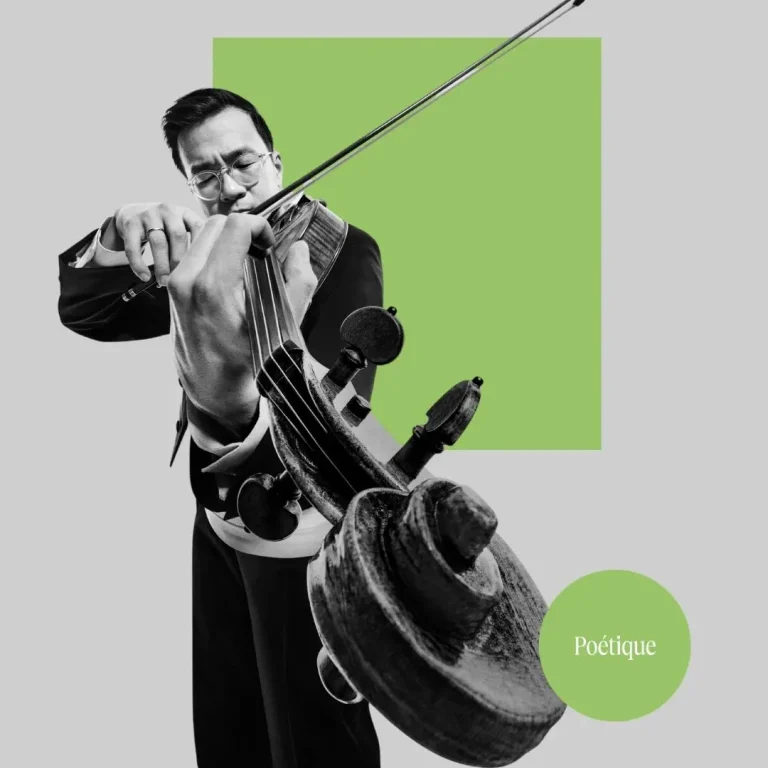
Jinjoo Cho, violon & Henry Kramer, piano à la salle Bourgie
by Rédaction PAN M 360
Pour leur premier récital à la Salle Bourgie, la violoniste virtuose Jinjoo Cho et le charismatique pianiste Henry Kramer ont choisi des œuvres tantôt empreintes du lyrisme typique de la fin de l’époque romantique, tantôt remplies de l’excitation fébrile du début du 20e siècle. Un concert rempli d’émotions fortes!
For their first recital at Bourgie Hall, violin virtuoso Jinjoo Cho and charismatic pianist Henry Kramer have chosen lyrical works typical of the late Romantic period, mirrored by thrilling pieces filled with the feverish excitement of the early 20th century. A concert filled with strong emotions!
Programme
STRAVINSKY Suite italienne pour violon et piano, tirée du ballet Pulcinella SCHULHOFF Sonate pour violon n° 2 CHAUSSON Poème, op. 25 SAINT-SAËNS Sonate pour violon n° 1 en ré mineur, op. 75
Program
STRAVINSKY Suite italienne, for violin and piano, from the ballet Pulcinella SCHULHOFF Violin Sonata No. 2 CHAUSSON Poème, Op. 25 SAINT-SAËNS Violin Sonata No. 1 in D minor, Op. 7
Bruno Deschênes – La flûte à travers le monde à la salle Bourgie
by Rédaction PAN M 360
La flûte est l’un des plus vieux instruments de musique et sa famille est immense : on en compte des milliers de variations de par le monde. Ce concert inusité, éclaté et vibrant vous en fait découvrir plusieurs de ses plus beaux spécimens, entre la flûte baroque et le shakuhachi japonais, le dizi chinois et le ney moyen-oriental.
Flutes are among the oldest instruments on Earth, with thousands of varieties found across the globe. This vibrant, variegated, one-of-a-kind programme brings together several members of the flute family, from the European Baroque flute to the Japanese shakuhachi and the Chinese dizi to the Middle-Eastern ney.
Programme
VIVALDI Concerto pour violon en mi majeur, RV 269, « Le Printemps » (arr. pour flûte seule par J.-J. Rousseau) BOISMORTIER Concerto pour cinq flûtes, op. 15 n° 1 Ziya TABASSIAN Lovebird Jean LÉRIGÉ-LAPLANTE Évanescence (Création) Ziad CHBAT Nostalgie ANONYME Printemps à la rivière (trad. chinois, arr. Bruno Deschênes) Bruno DESCHÊNES Tsuru no sugomori [La nidification de la grue] Shin Etenraku [Composition sur l’ancienne mélodie Etenraku]
Program
VIVALDI Violin Concerto in E major, RV 269, “Spring” (arr. for solo flute by J.-J. ROUSSEAU) BOISMORTIER Concerto for Five Flutes, Op. 15, No. 1 Ziya TABASSIAN Lovebird Jean LÉRIGÉ-LAPLANTE Évanescence (premiere) Ziad CHBAT Nostalgie ANONYMOUS Printemps à la rivière (trad. Chinese, arr. Bruno DESCHÊNES) Bruno DESCHÊNES Tsuru no sugomori [The crane nesting] Shin Etenraku [Composition on the traditional melody Etenraku]
Intégrale des sonates pour piano de Prokofiev – Concert 3 : Le siège de Leningrad à la salle Bourgie
by Rédaction PAN M 360
L’un des 15 meilleurs pianistes canadiens de tous les temps selon la CBC, David Jalbert nous mène sur le chemin passionnant des sonates pour piano de Prokofiev ! Dans une intégrale en trois concerts-événements, ce projet s’inscrit dans la foulée de ses enregistrements chez ATMA Classique. Entre introspection et virtuosité, romantisme et modernité, ces œuvres reflètent le parcours et la vie de ce compositeur visionnaire.
David Jalbert—one of the 15 greatest Canadian pianists of all time, according to the CBC—takes his audience on a journey through Prokofiev’s complete piano sonatas! This three-part concert series was inspired by Jalbert’s Prokofiev recordings for ATMA Classique. With works both introspective and virtuosic, both Romantic and modern, this programme offers a glimpse into the life and works of the visionary composer.
Programme
PROKOFIEV Sonate n° 9 en do majeur, op. 103 Sonate n° 10 en mi mineur, op. 137 (inachevée) Six pièces d’après Cendrillon, op. 102 : I. « Valse : Cendrillon et le Prince » Sonate n° 3 en la mineur, op. 28 Dix pièces d’après Roméo et Juliette, op. 75 (extraits) Sonate n° 7 en si bémol majeur, op. 83
Program
PROKOFIEV Sonata No. 9 in C major, Op. 103 Sonata No. 10 in E minor, Op. 137 (unfinished) Six Pieces from Cinderella, Op. 102: I. Waltz: Cinderella and the Prince Sonata No. 3 in A minor, Op. 28 Ten Pieces from Romeo and Juliet, Op. 75 (excerpts) Sonata No. 7 in B-flat major, Op. 83
Grâce à l’ajout d’un second violoncelle dans son Quintette, Schubert redessine les frontières de la musique de chambre et donne à son œuvre une ampleur quasi orchestrale. Sommet d’expressivité, l’Adagio revêt un caractère intemporel.
By adding a second cello instead of the traditional second viola to his String Quintet, Schubert redefined the boundaries of chamber music, giving his work an almost orchestral depth. The timeless Adagio is a pinnacle of expressiveness.
Programme
Franz Schubert, Trio pour cordes, D. 471 (12 min) Franz Schubert, Quintette à cordes, D. 956, op. posth. 163 (55 min)
Program
Franz Schubert, String Trio, D. 471 (12 min) Franz Schubert, String Quintet, D. 956, Op. posth. 163 (55 min)
Benevolent sisterhood of Les Veilleuses (the Watchers) at Bourgie Hall
by Frédéric Cardin
Nine women on stage, in a kind of grand theatrical gesture where all facets of a rich and complex sisterhood are evoked. From (mostly) benevolence to abandonment, from exclusion to reconciliation.
Les Veilleuses (The Watchers), by Simon Renaud (choreography and conception) and Romain Camiolo (music), thus rose on Wednesday evening at the Bourgie Hall of the Montreal Museum of Fine Arts. A rare incursion of the classical music hall into the world of dance (the first? I can’t confirm it…), but a very nice success. It must be said that the Veilleuses show is as much choreographic as it is musical. Six of the nine performers are singers in real life: Marie-Annick Béliveau, Salomé Karam, Kathy Kennedy, Elizabeth Lima, Hélène Picard and Ellen Wieser. They teamed up with professional dancers Marie-Hélène Bellavance, Nasim Lootij and Ingrid Vallus.
Of course, the dancers were not asked to sing fully, nor the singers to perform too acrobatic contortions, but the staging clearly aimed to integrate all the participants into a single community, that of these women of various sizes and builds, though not too heterogeneous. In a rather abstractly suggestive way, these women went through the hour-ish of the show to express different states of mind and above all the means to face them together, sometimes disunited, or to share them among all.
The play unfolds at a slow and measured pace. These women move in a world of mutual feeling that takes the time to express itself and be welcomed. It is the music that serves as a powerful bond for the psycho-emotional whole of the performance, supporting the visual coherence of the costumes, which are dresses of different chromatic hues related to yellow-orange-brown-ochre. The said music, all vocal (except for a pre-recorded electro drone acting as a harmonic cushion) and essentially tonal, is of course performed by the group’s singers, who act both as the emotional embodiment of each individual unit but also as a coalescence of the group relationship. Camiolo’s score is beautiful and seems to progress, at least that’s the impression I got, according to a historical chronological evolution.
At the very beginning, the voices take on a collective appearance of a Greek chorus, in a modal-type expression that subtly evokes something very ancient, perhaps archaic. Further on, one hears something like a mediaeval air. Further on, it gets closer to folk or popular song. But these are brief moments, emerging from a more ample and sustained framework of long melodic lines that would not displease several current composers working in neo-mystical choral music. On a few occasions, the harmonies tighten, until they reach saturation and a rough screech. It is in these moments, as the composer pointed out in the interview I conducted with him and the choreographer about the show (INTERVIEW TO LISTEN TO HERE), that the women of this symbolist sorority seem to drift away from each other and dissolve their bonds. The tactic is simple, but effective.
Ultimately, Les Veilleuses is a fairly accurate and poetic look at the strength, but also the perils, of a female community that has, for millennia now, had to stand together in the face of adversity and hold hands in bright episodes.
Les Veilleuses is a beautiful and complete show, complex but not hermetic, and above all perfectly suited to a wide range of engagements: in dance festivals as well as music or transdisciplinary proposals. A perfectly adequate launch for the Bourgie Hall’s Arts croisés (Crossed arts) series.
Les Veilleuses is a coproduction between Amour Amour, Salle Bourgie, Chants Libres and Corpuscule Danse
Les Violons du Roy : Les Violons à Rome, de Corelli à Nino Rota à la salle Bourgie
by Rédaction PAN M 360
Corelli y a forgé le concerto grosso, Respighi en a célébré la beauté et Nino Rota y a signé d’innombrables musiques de films. Pour Handel, Rome a eu une importance déterminante alors qu’il était jeune compositeur, même si son opéra consacré au plus célèbre empereur romain a été composé à Londres. Un concert hommage à la Ville éternelle qui sera l’occasion des débuts de la contralto Rose Naggar-Tremblay et du jeune chef Kyrian Friedenberg avec Les Violons du Roy.
Rome is where Corelli developed the concerto grosso, where Respighi was inspired while celebrating its beauty, and where Nino Rota composed countless film scores. For Handel, Rome played a decisive role during his early career, even though his opera about the most famous Roman emperor was composed in London. This tribute to the Eternal City will mark the debut of contralto Rose Naggar-Tremblay and young conductor Kyrian Friedenberg with Les Violons du Roy.
Programme
A. CORELLI Concerto grosso en fa majeur, op. 6 n° 6 G.F. HANDEL Extraits de Giulio Cesare in Egitto, HWV 17 O. RESPIGHI Il tramonto pour voix et cordes N. ROTA Concerto pour cordes
Program
A. CORELLI Concerto grosso in F Major, Op. 6 No. 6 G.F. HANDEL Excerpts from Giulio Cesare in Egitto, HWV 17 O. RESPIGHI Il tramonto for voice and strings N. ROTA Concerto for strings
Les Violons du Roy : Souvenir de Florence à la salle Bourgie
by Rédaction PAN M 360
L’une des pages les plus personnelles de Tchaïkovski donne son titre à ce concert qui promet un voyage dépaysant et sensible, aux trajectoires à la fois géographiques et à celles, plus intimes, de la mémoire et des impressions profondes. Le périple comprendra une escale proposée par la compositrice Barbara Assiginaak à l’intention de la flûtiste Ariane Brisson qui en assurera la création.
One of Tchaikovsky’s most personal works lends its name to this concert, promising a transporting and deeply felt journey that spans both geographical routes and more intimate paths of memory and profound impressions. Our voyage also includes a new piece by composer Barbara Assiginaak, written for flutist Ariane Brisson, who will be performing its premiere.
Programme
M. MOZETICH Postcards from the Sky B. ASSIGINAAK Œuvre pour flûte et cordes (création) G. FAURÉ Fantaisie, op. 79 (arr. pour flûte et cordes Y. Talmi) P.I. TCHAÏKOVSKI Souvenir de Florence, op. 70 (version pour orch. à cordes)
Program
M. MOZETICH Postcards from the Sky B. ASSIGINAAK Piece for flute and strings (premiere) G. FAURÉ Fantaisie, op. 79 (arr. for flute and strings Y. Talmi) P.I. TCHAÏKOVSKI Souvenir de Florence, op. 70 (version for string orchestra)
Arion Orchestre Baroque : Les larmes de Marie à la salle Bourgie
by Rédaction PAN M 360
L’on vous promet autant de larmes de bonheur que de tristesse, et parfois les deux à la fois, lors de ce programme qui a comme point focal le nom Marie. Marie comme la mère du Christ au pied de la croix dans l’émouvante cantate Il pianto di Maria de Giuseppe Battista Ferrandini. Mais aussi comme dans le prénom de trois compositrices d’exception du XVIIIe siècle qui ont laissé leur marque à l’opéra – Grimani, Walpurgis et Agnesi – cette dernière nous offrant également un concerto pour clavecin. Pour ce programme Arion accueille la contralto Anthea Pichanick qui vous ravira assurément, et la cheffe et claveciniste Marie van Rhijn, à la carrière florissante, que nous accueillons toutes les deux pour la première fois à Montréal.
You are promised as many tears of joy as of sorrow, and sometimes both at once, in this program centered around the name Marie. Marie, as in the Mother of Christ at the foot of the cross in Giuseppe Battista Ferrandini’s moving cantata Il pianto di Maria. But also Marie as in the first name of three exceptional 18th-century women composers who left their mark on opera – Grimani, Walpurgis, and Agnesi – the latter also offering us a harpsichord concerto. For this program, Arion welcomes contralto Anthea Pichanick, who is sure to delight you, and conductor and harpsichordist Marie van Rhijn, whose flourishing career brings her to Montréal for the first time, along with Pichanick.
Programme/program
Œuvres de/works by Maria Teresa Agnesi, Giovanni Battista Ferrandini, Maria Margherita Grimani, Antonio Vivaldi et Maria Antonia Walpurgis
Arion Orchestre Baroque : Le Roi danse à la salle Bourgie
by Rédaction PAN M 360
À l’occasion du 300e anniversaire de la mort de Michel-Richard de Lalande, Arion renouvelle sa collaboration fructueuse avec le Centre de musique baroque de Versailles en présentant deux œuvres rares autant que magnifiques du grand compositeur français. L’on découvrira les beautés et splendeurs de la pastorale L’amour fléchi par la constance, créée en 1697, et des extraits du Ballet de la jeunesse, présenté à Versailles pendant le Carnaval en janvier 1686. Interprétées ici avec le concours de quatre voix lyriques exceptionnelles sous la direction de Mathieu Lussier, ces œuvres se démarquent autant par la grâce des lignes vocales que par la richesse des couleurs orchestrales.
On the occasion of the 300th anniversary of Michel-Richard de Lalande’s death, Arion renews its fruitful collaboration with the Centre de musique baroque de Versailles by presenting two rare yet magnificent works by the great French composer. Audiences will discover the beauty and splendor of the pastorale L’amour fléchi par la constance, premiered in 1697, along with excerpts from the Ballet de la jeunesse, performed at Versailles during Carnival in January 1686. Brought to life here with the participation of four exceptional vocal soloists under the direction of Mathieu Lussier, these works stand out as much for the grace of their vocal lines as for the richness of their orchestral colors.
Programme/program
Michel-Richard de Lalande (1657-1726) L’amour fléchi par la constance, S. 143 Ballet de la jeunesse, S. 136