Classical / classique

A Celestial Journey: Holst’s The Planets with the OPCM

by Varun Swarup

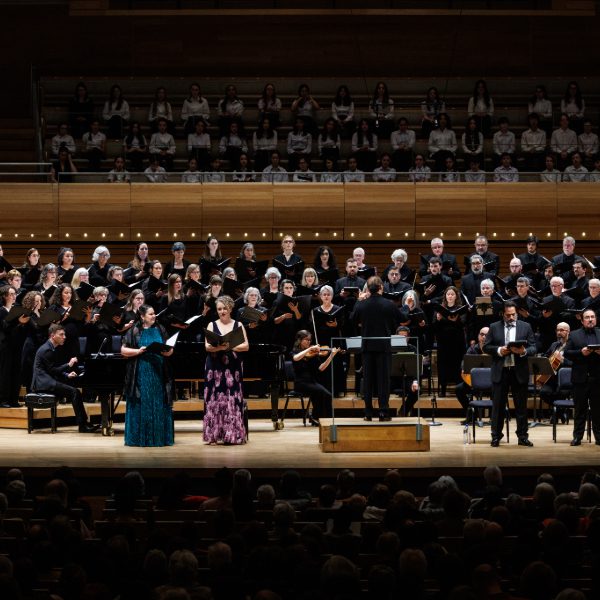
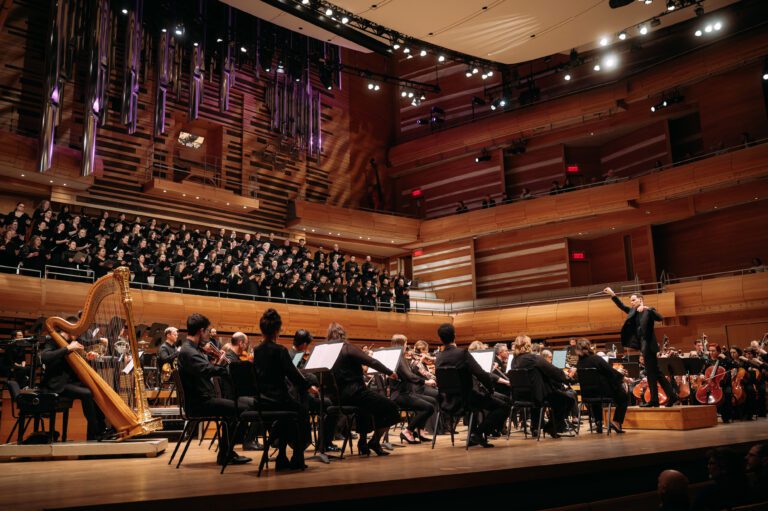
More than a century after its premiere, Holst’s The Planets continues to hold a central place in the orchestral repertoire, and under the direction of François Choinière with L’Orchestre Philharmonique et Chœur des Mélomanes (OPCM), the work’s intricate textures and emotional breadth were rendered with clarity and purpose. The Maison Symphonique’s near-capacity audience reflected this monumental suite’s enduring appeal.

The performance unfolded with a keen attention to detail, capturing the distinct character of each movement. From the relentless, percussive energy of Mars to the ethereal, fading strains of Neptune, the orchestra demonstrated both technical precision and a deep understanding of Holst’s expansive vision. The audience’s enthusiastic applause after each movement underscored their connection to the music. Particularly notable was the rendition of Venus, which unfolded with a serene, lyrical quality that contrasted effectively with the surrounding movements. However, it was Neptune that left the most lasting impression. With the women’s chorus positioned strategically far above the audience, their disembodied voices gradually receded into silence, creating an otherworldly effect that lingered in the hall long after the final note. The collective stillness of the audience before the eruption of applause spoke volumes about the performance’s impact.

The second half of the program shifted gears with Karl Jenkins’ Gloria, a large-scale choral work that, while undeniably vibrant and rhythmically engaging, felt somewhat incongruous alongside the introspective and cosmic qualities of The Planets. Despite this programming contrast, the OPCM choir delivered a committed and polished performance, navigating the work’s dramatic shifts with precision and energy.

Choinière’s leadership remained a unifying force throughout the evening. His conducting was both expressive and controlled, balancing the score’s dynamic extremes with a clear sense of direction. His ability to draw out the orchestra’s full range of colors and textures was evident, particularly in the more delicate passages, where his nuanced approach allowed the music to breathe.

While the pairing of Holst and Jenkins may have highlighted differing musical sensibilities, the evening ultimately showcased the OPCM’s versatility and Choinière’s skill as a conductor capable of navigating both the monumental and the intimate with equal assurance.

Classical / Modern Classical

OSM and Khachatryan | Music, Politics and The Human Condition

by Hélène Archambault

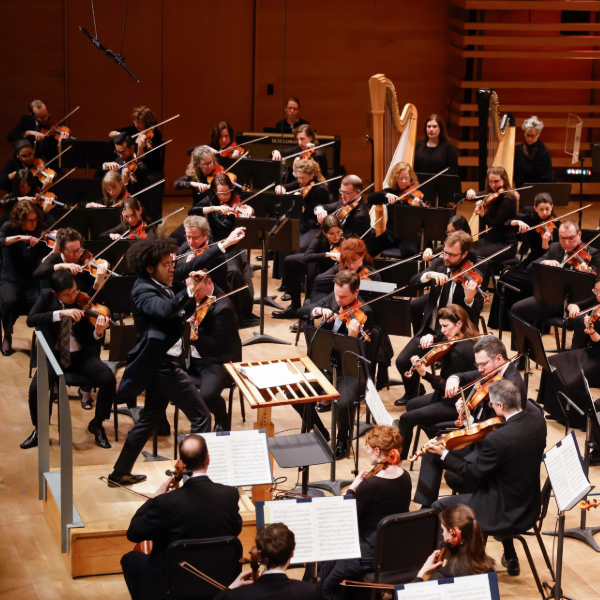
There are moments when you feel privileged to be where you are. Such was the case on Wednesday evening at the Maison symphonique. I think the feeling was mutual, at least if I’m to judge by the encore given by violinist Sergey Khachatryan, who gave a superb performance of Tchaikovsky’s Violin Concerto in D major, Op. 35.

The orchestra provided a setting in which he could express his sincerity, as when the flutes pick up at the end of his very personal cadenza, or again in the opening bars, as the strings introduce the solo violin.

The reminder is a piece by Grigor Narekatsi, a 10th-century Armenian mystic poet and saint of the Armenian Apostolic Church. In 2015, in commemoration of the 100th anniversary of the Armenian genocide, Pope Francis declared St. Gregory of Narek (Frenchized name), Doctor of the Church, the 36th, for his timeless writings. Timeless, Havoun, havoun is. More than 1,000 years apart, his play resonates.

After intermission, Payare and the OSM attack Shostakovich’s Symphony No. 11, Op. 103 “The Year 1905”. 11 young instrumentalists from Montreal’s Conservatory, McGill, and Université de Montréal music schools join the orchestra for the occasion. Knowing the history of this symphony is the key to fully appreciating it because it’s not the kind of piece you listen to while preparing a chickpea salad on Monday morning before catching the metro. The program notes are illuminating. Symphony No. 11 is intimately linked to the history of Russia, and later the Soviet Union, both in its writing and its reception by the regime. With the USSR having decreed Shostakovich’s music an enemy of the workers in the aftermath of the Second World War, new compositions had to wait until the 1950s. Composed at the beginning of 1957, Shostakovich recounts in music the popular uprising of 1905 against the Russian Empire.

The first movement, “Palace Square”, opens with a hostile winter scene, where bloody repression soon unfolds. Military snare drums, bugles, and folk song illustrations are all sound manifestations of the violence of the repression. The second movement evokes Red Sunday, and here again, Shostakovich uses musical material to depict the horror of the massacre and the desolation of death. The third movement, “Eternal Memory”, is reminiscent of the Revolutionaries’ Funeral March. As for the Finale, “Tocsin”, this is revolutionary fervor, characterized by trumpets and low strings, interrupted by an English horn melody, and ending with the sounds of cymbals and bells. When the music stops, you wonder what you’ve just experienced. I was moved, disturbed, and thrown to the ground. This concert embodies the human condition in all its fragility.

Photo Credit: Antoine Saito 

Baroque / classique

Les Violons du Roy : Bach, les premières cantates et Bernard Labadie

by Rédaction PAN M 360

On s’imagine facilement et même presque exclusivement le grand Johann Sebastian Bach en homme âgé, pétri des plus grands savoirs  musicaux que seuls l’expérience et le temps  apportent. C’est pourtant un tout jeune homme, au début de la vingtaine, qui nous lègue les puissants et parfaits chefs-d’œuvre que sont ses toutes premières cantates. Des œuvres qui ouvrent l’une des plus importantes sommes musicales de tout l’Occident, livrées ici avec La Chapelle de Québec, dans toute leur splendeur.
Bernard Labadie, chef
Myriam Leblanc, soprano
Daniel Moody, contre-ténor
Hugo Hymas, ténor
Stephen Hegedus, baryton-basse
Avec La Chapelle de Québec

It is easy to imagine the great Johann Sebastian Bach almost exclusively as an elderlyman, steeped in the greatest musical knowledge that only time and experience can bring. Yet it was a young man in his early twenties who handed down to us the powerful, true masterpieces that comprise his very first sacred cantatas. These works are the first of one of the most important musical collections in the whole of the western world, delivered in all their splendour here with La Chapelle de Québec.
Bernard Labadie, conductor
Myriam Leblanc, soprano
Daniel Moody, countertenor
Hugo Hymas, tenor
Stephen Hegedus, bass-baritone
With La Chapelle de Québec

Programme

J.S. BACH
Cantate Christ lag in Todes Banden, BWV 4
Cantate Gottes Zeit ist die allerbeste Zeit, BWV 106
Cantate Aus der Tiefe rufe ich, Herr, zu dir, BWV 131
Cantate Nach dir, Herr, verlanget mich, BWV 150

Program

J.S. BACH
Cantata Christ lag in Todes Banden, BWV 4
Cantata Gottes Zeit ist die allerbeste Zeit, BWV 106
Cantata Aus der Tiefe rufe ich, Herr, zu dir, BWV 131
Cantata Nach dir, Herr, verlanget mich, BWV 150

POUR ACHETER VOTRE BILLET, C’EST ICI!

Ce contenu provient des Violons du Roy et est adapté par PAN M 360
Choral Music / Classical / Classical Period / Renaissance music

Beethoven’s 9th, Montreal, 200 Years Ago…

by Alexis Desrosiers-Michaud

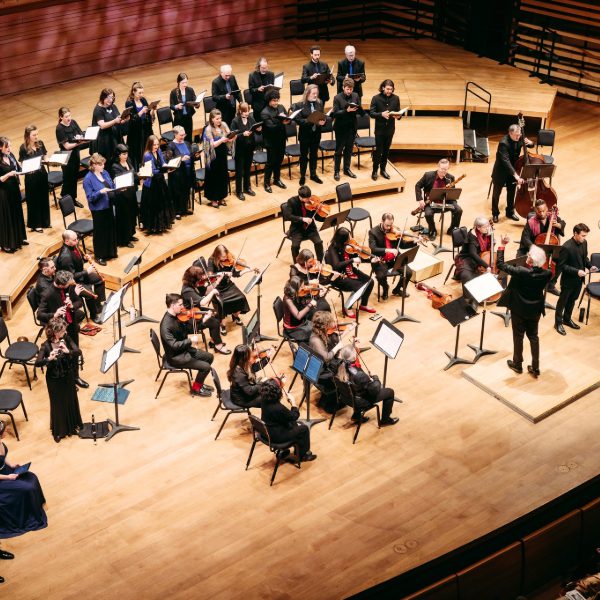
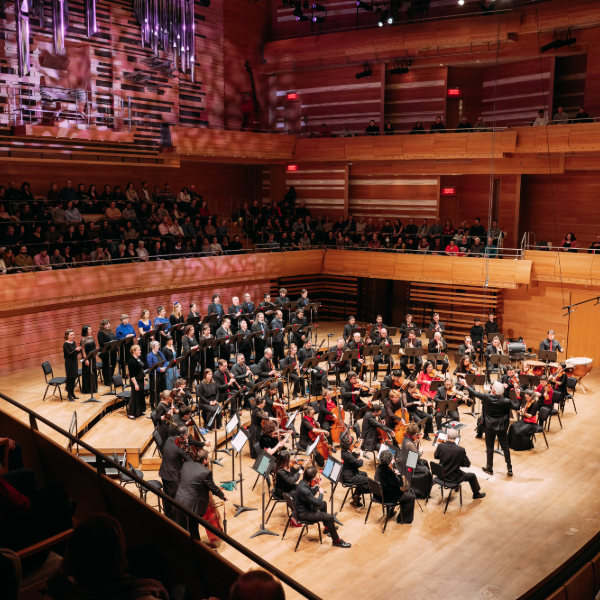
On this Valentine’s Day, we were treated to a premiere at the concert by Ensemble Caprice and Ensemble ArtChoral: Beethoven’s 9ᵉ symphony on early instruments, conducted by Matthias Maute.

The original program was to have opened with the little-known cantata Hiob by Fanny Mendelssohn-Hensel. Instead, we were treated to two Yiddish pieces, Ernst Bloch’s Yih’yu L’ratzon and a traditional aria calledOy dortn, as well as Gregorio Allegri’s famous Miserere.

The two Jewish pieces feature soprano Sharon Azrieli and her imposing vibrato. Acting as cantor, she announces psalmodies and the choir responds. We don’t know if it’s a microphone or projection problem, but she was barely audible from the back of the audience. All the same, it’s very pretty, and reminds us that this Jewish and Hebrew music is too rarely performed in our concert halls.

The Miserere is a jewel of musical genius that leaves no room for error. Unfortunately, there were mistakes. Firstly, the voices of the quartet perched high up in the Maison symphonique are not homogeneous; those of the men do not vibrate, whereas those of the women do. What’s more, it’s not always right. Then, there’s no change in volume throughout the piece, and as this piece is often repeated, it becomes redundant and loses all its intimacy. Then, in the psalmodies, different notes are accentuated by the choristers, instead of being lightly pressed, and it’s sometimes unclear in the cuts and consonants. In short, this is a fine work, but it would have deserved a more consistent rendering.

The real treat of the first half is Höre auf meine Stimme, written by William Kraushaar, also a chorister in the bass section. Maute warned us that the melody would stick in our heads, and for good reason. Simple without being kitschy, repeated often enough without our noticing it too much, it is supple and expressive. The accompaniment doesn’t impose itself, leaving the choir to sing along, acting as a harmonic carpet. Were it not for a few dissonant chords from the language of Morten Lauridsen and his contemporaries in the a cappella passages, we would have placed this work between the styles of Mendelssohn and Schubert, and on our first listen, this piece seems accessible to most amateur choirs. When will it be published?

According to conductor Maute, this is the first time in Montreal that Beethoven’s Ninth has been played on period instruments. It takes a few minutes to adapt to the new sound, but it’s very pleasant and successful, despite a few lapses in accuracy and precision. The sound isn’t fat, and the loud passages don’t give the impression that Obelix is lifting the Sphinx, but the tension is there. In the first movement, which Maute conducts at breakneck speed, you can hear all the elements of the musical dialogue, and the second really has the feel of a dance, something you don’t get from many other conductors. However, the middle section of this movement is too fast, and the winds don’t keep up. The third movement is certainly not adagio, but very cantabile. One enjoys the phrases without lingering or falling into the moon.

The last movement opens smoothly and lightly. Finally, the cello/bass recitatives are not too heavy! And all is exalted before the entrance of the chorus, with the recitative of bass Dominique Côté. But as soon as the chorus begins, something annoys us: a soprano pierces more than the rest of her section, especially in the high register, which is like saying almost all the time in Beethoven. Once this is targeted by the ear, it’s extremely difficult to ignore. My seatmate, who was also bothered by it, confided to me at the end of the evening that it wasn’t the first time it had happened to this tandem. If you don’t want one person’s work to unbalance a rare, high-level performance, this is something to be corrected.

photos: Tam Photography

Classical / Modern Classical

OSM | Payare and Weilerstein: Passion for Two From Prokofiev to Ravel

by Alexandre Villemaire

On the eve of Valentine’s Day, February 12 and 13, the setting couldn’t have been more propitious for the pairing of Rafael Payare and Alisa Weilerstein on the Maison Symphonique stage.

If Maurice Ravel’s Daphnis et Chloé can be deliberately associated with the idyll of love, both in its subject matter and in its music, Sergei Prokofiev’s Symphony Concertante for Cello, with its eclecticism and biting, percussive sounds, could appear out of step with the program’s aesthetic. On the contrary, the works were highly complementary in terms of timbral language, dynamics and passionate playing.

Opening the evening, Sergei Prokofiev’s Symphonie concertante. Written between 1950 and 1952, this mature three-movement work by the Russian composer is a reworking of an earlier cello concerto that was roundly criticized. Prokofiev’s language is textured and composite, drawing on the full range of the cello’s sound, as well as orchestral and rhythmic sonorities and passages reminiscent of jazz. At the podium, Payare was as fiery as ever, but more restrained than usual in his gestures for this complex score, where the orchestral interventions are velocity-laden in terms of texture and technique. Payare’s direction was precise and the orchestra of great intensity.

The second and third movements (Allegro giusto and Andante con moto) particularly appealed to us, respectively for their virtuosity, their use of dynamic orchestral effects and their folk accent in the cadenza of the second movement, where Alisa Weilerstein demonstrates the full range of her technique and the possible interplay of her instrument with evocative ease. Even if what sounds false to the ear is in fact well calculated, written and conveyed with naturalness. The cello lines are as swift as the orchestral lines, blending with the different sections in a rich, inventive orchestration. On stage, Alisa Weilerstein transports us into a world of her own, where she doesn’t just play the music. She is the music. She embodies a character like an actress on a stage, where her facial expressions and gestures are as significant as the accompanying music. The audience gave her a standing ovation for several minutes.

The second part, dedicated to the music of the ballet Daphnis et Chloé, plunged us into a dreamlike, colorful world. Here, Payare becomes a painter before a blank canvas which he paints with precision. Even if we’re dealing with repertoire that’s all too familiar, it’s always a delight to see the dynamics and colors imagined by Ravel unfold. The arrangement of the choir, which was installed higher than usual due to the recording, was also interesting. It’s a nice touch, too, to have the rows of choristers enter successively during the introduction, to simulate the effect of voices arriving from afar and gaining in power. A minor criticism: the processional effect would have had even greater impact if this entrance had been sung without a score! For the rest, the choir’s interventions were excellent, delivered with fine control of nuances and dynamics. In the orchestra, Rafael Payare danced across the stage, instilling vigor and character into the various orchestral forces, both in the more diaphanous moments and in the thunderous, brassy passages reminiscent of the language of George Gershwin. The astonishingly complementary and passionate interpretation of the evening’s two works richly deserved the thunderous applause of a packed Maison symphonique, and gave the orchestra great material for their forthcoming album releases, which we look forward to discovering.

Photo Credit: Antoine Saito

Africa / classique / période moderne

OSM : Angélique Kidjo chante Glass

by Rédaction PAN M 360

Beethoven dépeint poétiquement les chants d’oiseaux et le murmure des ruisseaux, alors que Janácek, en fin observateur, oppose la quiétude de la vie sylvestre au monde conflictuel des humains. De son côté, Glass s’inspire de poèmes africains évoquant le mythe de la création du monde et celui des dieux du royaume d’Ifé. La musique nourrit l’imaginaire d’Angélique Kidjo qui donne vie aux légendes avec sa voix puissante et profonde.

While Beethoven poetically depicted birdsong and rippling streams, Janácek, a stark observer, contrasted the stillness of forest life with the conflict-filled world of humans. Meanwhile, Glass drew inspiration from African poems that tell of the creation myth and deities of the ancient Ifé Empire, fuelling the imagination of Angélique Kidjo, who brings these legends to life with vocal depth and power.

POUR ACHETER VOTRE BILLET, C’EST ICI!

Ce contenu provient de l’Orchestre symphonique de Montréal et est adapté par PAN M 360
classique / période romantique / Piano

OSM : Mozart et l’élégance d’Angela Hewitt

by Rédaction PAN M 360

Il y a beaucoup de charme et d’éclat dans ce Concerto de Mozart interprété par la pianiste Angela Hewitt. En introduisant des citations de Beethoven et Haydn dans son œuvre, Colgrass crée une fascinante passerelle entre les époques musicales et propose un véritable voyage à travers le temps. Plongez ensuite dans la nostalgie hivernale de Tchaïkovski, qui évoque avec émotion ses promenades enneigées dans sa Symphonie n° 1.

Brought to life by pianist Angela Hewitt, Mozart’s Concerto dazzles with its charm and brilliance. Colgrass creates intriguing connections between musical eras by incorporating quotes from Beethoven and Haydn, taking listeners on a journey through time. The program concludes with Tchaikovsky’s Symphony No. 1, which captures the nostalgic beauty of the composer’s snowy winter walks.

Programme

Michael Colgrass, As Quiet As (13 min)
Wolfgang Amadeus Mozart, Concerto pour piano nᵒ 26, K. 537, « du Couronnement » (30 min)
Piotr Ilitch Tchaïkovski, Symphonie no 1, op. 13, « Rêves d’hiver » (44 min)

Program

Michael Colgrass, As Quiet As (13 min)
Wolfgang Amadeus Mozart, Concerto for Piano No. 26, K. 537 (“Coronation”) (30 min)
Pyotr Ilyich Tchaikovsky, Symphony No. 1, Op. 13 (“Winter Dreams”) (44 min)

POUR ACHETER VOTRE BILLET, C’EST ICI!

Ce contenu provient de l’Orchestre symphonique de Montréal et est adapté par PAN M 360

classique

OSM : Clarinette, improvisation et traditions

by Rédaction PAN M 360

Lors de ce concert éclaté, découvrez le célèbre clarinettiste Kinan Azmeh, dont la critique salue la maitrise instrumentale et l’aisance à évoluer dans divers genres musicaux. Il se produira en compagnie du compositeur et pianiste Dinuk Wijeratne dans After Béla, une œuvre mêlant tradition et approche novatrice du piano. Marquées par une grande liberté expressive, les Danses de Kodály, celles de Bartók et la Suite de Azmeh se rencontrent autour de la clarinette, instrument au cœur de cette aventure musicale mettant au programme improvisation et musiques traditionnelles!

In this edition of the Concerts éclatés series, discover the acclaimed clarinetist Kinan Azmeh, widely praised by critics for his instrumental mastery and versatility across musical genres. With remarkable expressive freedom, the program showcases dances by Kodály and Bartók and Azmeh’s suite, where the clarinet takes centre stage in a dynamic musical dialogue that blends improvisation with traditional melodies.

Programme

Béla Bartók, Six danses folkloriques roumaines, BB76 (6 min)
Dinuk Wijeratne/Kinan Azmeh, After Béla, pour clarinette et piano (9 min)
Kinan Azmeh, Suite for improvisor and orchestra (22 min)
Zoltan Kodály, Dances de Galanta (16 min)

Program

Béla Bartók, Six Romanian Folk Dances (6 min)
Dinuk Wijeratne/Kinan Azmeh, After Béla, for clarinet and piano (9 min)
Kinan Azmeh, Suite for Improvisor and Orchestra (22 min)
Zoltan Kodály, Dances of Galanta (16 min)

POUR ACHETER VOTRE BILLET, C’EST ICI!

Ce contenu provient de l’Orchestre symphonique de Montréal et est adapté par PAN M 360

classique / Jazz

OM : Chants d’espoir à la Maison symphonique

by Rédaction PAN M 360

C’est l’espoir d’un monde meilleur, plus solidaire, plus empathique, qui a inspiré la programmation de ce concert dirigé par Yannick Nézet-Séguin, avec la pianiste Hélène Grimaud.
« J’ose lever les yeux », nous dit Florence Price, première compositrice afro-américaine, dans son Chant d’espoir. Suivant ses traces, Margaret Bonds s’inspire directement du mouvement pour les droits civiques pour ses Variations Montgomery, dédiées à Martin Luther King.
L’union nait des liens que l’on tisse, des ponts que l’on bâtit. Que ce soit entre humains ou entre genres musicaux. C’est ce que réalise Gershwin avec son Concerto pour piano près du jazz, interprété par l’une des pianistes les plus acclamées de notre époque, Hélène Grimaud. C’est aussi une marque de Bernstein qui, dans ses Chichester Psalms, balance entre optimisme et pessimisme, entre violence et réconfort.

Hope for a better, more united, more empathetic world inspired the programming of this concert, directed by Yannick Nézet-Séguin, with pianist Hélène Grimaud.
“I dare look up,” says Florence Price, the first African-American composer, in her Song of Hope. Following in her footsteps, Margaret Bonds drew inspiration from the civil rights movement for her Montgomery Variations, dedicated to Martin Luther King.
Unity is born of the bonds we forge, the bridges we build. Whether between people or between musical genres. Gershwin draws on this richness in his jazz-adjacent Piano Concerto, performed by one of the most acclaimed pianists of our time, Hélène Grimaud. This dynamic also comes through in the work of Bernstein, whose Chichester Psalms masterfully navigates the tension between optimism and pessimism, violence and compassion.

Programme

Price, Song of Hope
Gershwin, Concerto en fa
Bonds, The Montgomery Variations
Bernstein, Chichester Psalms

Program

Price, Song of Hope
Gershwin, Concerto in F
Bonds, Montgomery Variations
Bernstein, Chichester Psalms

POUR ACHETER VOTRE BILLET, C’EST ICI!

Ce contenu provient de Place des Arts et est adapté par PAN M 360

Chanson francophone / hommage / orchestre

OSM : Ferland symphonique

by Rédaction PAN M 360

Dans le cadre de la Série Prestige & Patrimoine, GSI Musique et Oziko présentent Ferland symphonique; un hommage grandiose et vibrant créé sur l’œuvre du Petit Roi, l’unique Jean-Pierre Ferland.
Cette grande aventure musicale prendra vie grâce aux arrangements symphoniques de Blair Thomson et sera interprétée par l’Orchestre symphonique de Montréal, sous la direction du chef Alain Trudel. Des éléments de scénographie et de mise en scène seront annoncés sous peu… et à l’image de l’artiste qu’il était, ce sera rempli de poésie.
Grand poète et bâtisseur, Jean-Pierre Ferland aura tissé des ponts entre la chanson à texte et la culture populaire, d’où l’importance de célébrer son héritage exceptionnel.

As part of their Prestige & Patrimoine series, GSI Musique and Oziko present Ferland symphonique; a bold, vibrant tribute to the work of the Petit Roi, the unique Jean-Pierre Ferland.
This epic musical journey will come to life thanks to the symphonic arrangements of Blair Thomson and will be performed by the Orchestre symphonique de Montréal, under the baton of conductor Alain Trudel. Scenography and mise-en-scène elements will be announced shortly. In the image of the artist Ferland was, it will all be very poetic.
A crowd-pleasing poet, Jean-Pierre Ferland built bridges between literary songwriting and pop culture, hence the importance of celebrating his exceptional heritage.

POUR ACHETER VOTRE BILLET, C’EST ICI!

Ce contenu provient de Place des Arts et est adapté par PAN M 360

classique / humour

OSM : Pérusse symphonique – du Snack bar à l’OSM

by Rédaction PAN M 360

Verrez-vous François l’humoriste ? Entendrez-vous François le chanteur, Pérusse le musicien ? Vous ne voudrez certainement pas rater cette rencontre épique ! Du premier Album du Peuple qui célèbre son 35e anniversaire à aujourd’hui, son oeuvre immense, riche et humoristique en version symphonique risque de marquer l’imaginaire. Sous la direction du chef d’orchestre Simon Rivard et avec des arrangements symphoniques signés Hugo Bégin, François livrera plusieurs extraits célèbres de son imposant répertoire, entouré d’invités surprise pour l’occasion. Soyez aux premières loges !

Will you see François the comedian? Will you hear François the singer, Pérusse the musician? You definitely won’t want to miss this epic encounter! From the first Album du Peuple, which celebrates its 35th anniversary, to today, his immense, rich and humorous work in a symphonic version will certainly leave a lasting impression. Under the direction of conductor Simon Rivard and with symphonic arrangements by Hugo Bégin, François will deliver several famous excerpts from his imposing repertoire, surrounded by surprise guests for the occasion. Don’t miss it!

POUR ACHETER VOTRE BILLET, C’EST ICI!

Ce contenu provient de l’Orchestre symphonique de Montréal et est adapté par PAN M 360

classique / musique de jeux vidéo

OSM : Heroes – Symphonie de jeux vidéo

by Rédaction PAN M 360

En mai, Heroes : Symphonie de jeux vidéo nous plongera, sous la baguette de Kevin Zakresky, dans les plus grands thèmes de jeux vidéo, de Fallout à Assassin’s Creed, en passant par World of Warcraft et Final Fantasy avec des projections et séquences de ces jeux marquants pour plusieurs générations.

In May, under the baton of Kevin Zakresky, Heroes : A Video Game Symphony will immerse us in the greatest video game themes, from Fallout to Assassin’s Creed, as well as World of Warcraft and Final Fantasy, with projections and sequences from these landmark games for several generations.

Programme/program

Jeremy Soule, Heroes Opening from The Elder Scrolls: Oblivion (orch. Robert Puff)
Gareth Cocker, Prince of Persia : The Lost Crown (orch. Vicent Tobar)
Jack Wall, Mass Effect, (orch. Robert Puff)
Borislav Slavov, Baldur’s Gate 3: Main Theme (orch.Georgi Andreev)
Garry Schyman, Bioshock, (orch. Robert Puff)
Matt Uelmen, Russel Brower, Derek Duke, Neal Acree, Diablo Suite (orch. Arturo Matsumoto)
Jesper Kyd, Assassin’s Creed: Ezio’s Family Theme (orch. Benoit Grey)
Tyler Bates, God of War: Ascencion Main Theme (orch. Robert Puff)
Mike Morasky/J.S. Bach, Portal 2 Variations (orch. Geoff Knorr, Andy Brick)
Harry Gregson-Williams, Nobuko Toda, Metal Gear Solid IV (orch. Shota Nakama)
Jason Hayes, World of Warcraft (orch. Adam Klemens)
Inon Zur, Starfield, (orch. Paul D. Taylor)
Inon Zur, Dragon Age (orch. Paul D. Taylor)
Kinuyo Yamashita, Masahiro Ikariko, Michiru Yamane, Oscar Araujo, Castelvania Medley (orch. C. Seiter)
Kow Otani, Shadow of the Colossus (orch. Nic Raine)
Inon Zur, Fallout Suite (Paul D. Taylor)
Marty O’Donnell, Michael Salvatori, Halo Medley (Andy Brick, Arnie Roth)
Jeremy Soule, The Elder Scrolls: SkyrimDragon Bourne Theme (orch. Larry Kenton)

POUR ACHETER VOTRE BILLET, C’EST ICI!

Ce contenu provient de l’Orchestre symphonique de Montréal et est adapté par PAN M 360

Subscribe to our newsletter

Inscription
Infolettre

"*" indicates required fields

Type of Suscribers