Clearly, Niineta is one of the most significant recordings from contemporary Aboriginal culture. The slow, dramatically heavy rhythms and organic linearity of this cohesive ten-piece journey represent a milestone of the sonic landscape portrayed by artists from North America’s first peoples.
Vocalist and producer Joe Rainey has taken a major step forward: his native values of meditation and contemplative connection with the universe are matched by an uncommon electronic language. Ambient, dub, industrial, techno and post-minimalist music all merge into a another kind of pow wow.
The traditional song of this Ojibwe artist is thus inscribed in a new context, at the same time concerned with the oral tradition and a dizzying leap into the present and the future. The digital world becomes a perfect complement to the expression of this artist who is concerned with updating the musical legacy of his ancestors.
Since Joe Rainey is on the same program as Tortoise this Saturday, in the context of Pop Montreal, PAN M 360 reaches the artist at his home in the Green Bay area, Wisconsin.
We’ll be talking mainly about the excellent Niineta, co-produced with his colleague Andrew Broder, electronic musician and producer from Minneapolis. Let’s remember that the album was released last May under the 37d03d label.
PAN M 360: So you’re based in an urban area, right?
JOE RAINEY: I’m an Ojibwe from the Red Lake Reservation in Minnesota. However, I was born and raised in Minneapolis. I’ve never lived on the Red Lake Reservation for any length of time, but I’ve visited there a lot. So I am an urban native.
PAN M 360: This is indeed evident in your deep interest in electronic music and other experimental forms. At the same time, it’s impossible to say that you are not close to your roots. Wow!
JOE RAINEY: People might reduce my work to pow wow music singing with electro beats but… it’s actually something I’m very proud of. The musical fusion that took place with my friend Andrew Broder is original compositions on my part. They were done by listening to what Andrew Broder sent me as he went along. So I sat down in the same place I’m talking to you from, and created each song you hear, molded into the beatmaking that Andrew suggested.
PAN M 360: The result is very special, no doubt.
JOE RAINEY: Thank you! But at first, you know, I didn’t intend to make it public. What you heard was going to be a personal project. But towards the end of that process, I started thinking about who I was as a contemporary Aboriginal artist. And if I had something to say, it would be exactly that. So I wanted to go towards that, with everything that was behind me, everything that I knew about my musical culture and that had come before me.
PAN M 360: You mean your personal life and culture are the foundation of your music.
JOE RAINEY: Yeah, I didn’t do that on my own, it’s just the idea I had in my head that you hear. So I wanted to express that idea somehow and I had a friend who helped me.
PAN M 360: There are now some indigenous artists involved in new forms of music, instrumental or electronic, but we don’t really know of any other ambient music like that! Also, music with refined harmonization as you suggest is rare.
JOE RAINEY: Well, some church music in the indigenous culture has harmonies, so it’s not that new. However, I was not inspired by this music…I can also point to some pow wow songs as being harmonies. And when Broder said to me “Hey, do you know you have any?”, I said “No, I didn’t know”. And some of my takes ended up harmonizing naturally, with the help of my colleague.
PAN M 360:How would you describe what came to mind in doing this important work?
JOE RAINEY: Collaborating over the last five or six years with different artists that have been sampled, it kind of created a space in my mind for that creativity to flourish. During that creative time, I was also listening to indigenous experiments in electronic music, A Tribe Called Red for example. So I think that all of that just kind of clumped together in my mind. And then it all came out in my 40s, just with the ability to have that time to really internalize. Everything I did on this album was done during the quarantine, in this room, with these instruments and computers.
PAN M 360: Before the pandemic, what were you doing? We didn’t say it was totally different, or that you were electronic producers who sang.
JOE RAINEY: I’ve been a pow wow singer for quite some time. I’m also an archivist. I harvest, I compose, I record, I sing. Plus, I have a day job because I have a family to support. But I’ve been lucky enough to meet people through music, it’s really opened up my musical side which has always been there my whole life. So this album is the culmination of all these years of work, research and meetings, I may have created my own thing.
PAN M 360: What kind of archivist are you?
JOE RAINEY: I use archives from all periods from the 1940s on. I know someone who has them all, so I can work with that material.
PAN M 360: Like Jeremy Dutcher in Canada?
JOE RAINEY: You know, I’ve had a few conversations where he’s been introduced to me. The album that he did, it’s very beautiful, very well done. But until recently, I didn’t know that. And it’s right up my alley.
PAN M 360: How do you play this music live?
JOE RAINEY: Andrew Broder and I perform as a duo. We’ve known each other for a number of years, we’ve done things together before this album. And he left the door open for me to ask him for help. So I asked him to help and he was involved in the whole process. He’s the other half, he’s more responsible for the production, and I’m responsible for the vocal side.
PAN M 360: Are you also involved in the production?
JOE RAINEY: Oh yeah! A lot of the samples you hear are my samples, so I co-produced it, exchanging information and music throughout the quarantine and it was never a difficult process, never a difficult process to work with Broder, just because it was so natural. Broder sent me a long series of beats and sounds. I had to think about what I wanted to sing and what I wanted to convey. It was like each of us defining the other’s phrase.
PAN M 360: Is there an audiovisual proposition to your concert?
JOE RAINEY: Not exactly. We try to let everyone experience the music, determine the meaning. Just through sound, we wanted people to go through a lot of emotions, whether it’s happy, sad, scared, soft or loud. We just wanted people to be completely immersed, to really feel what they hear, more than what they see.
PAN M 360: Would you agree that your work can also be trance-like or meditative?
JOE RAINEY: That’s the way I’ve thought about it too.
Since the beginning of his very young career, he has accumulated more than 35 million listens online, the apathy song being his most listened to song on the listening platforms.
But who is this guy, famous to some and unknown to others?
Born in Ottawa, Maxime Trippenbach, aka Maxime., recently moved to Montreal. At the age of 13, he was charmed by Deadmau5’s music during a car ride with his father. “When I got home, I discovered that the Canadian DJ was using FL studio software. I immediately downloaded the software and learned how to use it,” he says.
The 24-year-old singer-songwriter and producer navigates between indie pop, bedroom pop, and indietronica. Last August, Maxime. launched Rubber Checks, a five-track EP. Through this project, he addresses the loneliness of a young artist. “I wrote most of my EP shortly after I moved to Montreal,” he says.
Maxime. wants to “create something different that draws listeners in from the first moments of his songs.”
At his POP Montreal show at the Diving Bell Social Club on Wednesday, Maxime. plans to play his most popular songs as well as a few unreleased tracks. “In concert, I like to modify my songs and offer a different version than the one available on online listening platforms. Otherwise, what’s the point of coming to my shows,” he says with a laugh.
On stage, he is accompanied by James Clayton on guitar and Lucas Kuhl on drums, two long-time friends.
Pan M 360 spoke with him to find out more about his music, his creative process, and his presence at Pop Montreal.
PAN M 360: How and why did you start making music?
MAXIME.: I started making music when I was 13 years old. When I was young, I took guitar lessons. My father always had compilations on CD in the player of the family car. One day he played a Deadmau5 song and I thought it was really good. When I got home, I discovered that the Canadian DJ was using FL studio software. Immediately, I downloaded the software and learned how to use it. When I was about 20 years old, I decided to leave electronic music behind, pick up my guitar and start singing. That’s when the musical universe of Maxime. started.
PAN M 360: What are your musical influences?
MAXIME.: I grew up listening to a lot of electronic music, from Cage the Elephant to Radiohead. Today, I listen to mostly alternative and indie music. When I create, I incorporate elements of EDM, because I still produce on the same software since my childhood. All my drums are electronic, I modify my voice a lot and use a lot of synthesizers.
PAN M 360: What is your creative vision?
MAXIME.: I want to create something different that attracts the listeners from the first moments of my songs. Also, I want my music to be a real earworm. Melodies are very important to me and I like when my music is close to pop. Also, I like to make unpredictable songs.
PAN M 360: You recently released your EP Rubber Checks. Tell us about the creation of this project?
MAXIME.: I wrote most of my EP shortly after I moved to Montreal. I didn’t know many people and I didn’t go out much. I stayed in my room a lot and wrote songs. I write about my life and my moods at that time. My lyrics are vague to let my listeners interpret them in their own way.
PAN M 360: You are performing on Wednesday at the POP Montreal festival. What does this experience mean to you?
MAXIME.: I didn’t expect to be accepted to be part of the festival, I just started doing shows. In fact, my performance at Pop Montreal will be my fourth ever. On stage, I am accompanied by Clay (guitar) and Lucas (drums). They are two of my friends and we have a lot of fun playing together. What I like about Pop Montreal is that the different events are not all in the same place. There are a lot of artists to discover. Also, I love Montreal so it’s a good excuse to be there!
PAN M 360: How did your first shows go?
MAXIME.: So far, I’m having a lot of fun. However, I’m starting to understand how difficult it is from a technical point of view to do a show without pitfalls. I recently did a show in Montreal and the power went out halfway through my last song. I wasn’t sure what to do, it was a very strange ending. I hope everything will be fine on Wednesday.
PAN M 360: What should we expect from you on Wednesday night?
MAXIME.: I’m going to play my most popular songs and some new ones. When I play live, I like to change my songs and offer a different version than the one available on online listening platforms. Otherwise, what’s the point of coming to my shows?
Originally from Morocco, YouYou was born in Montreal. After listening to Vince Staples’ Summertime ’06 album in 2015, he got into music. In his most recent creations, the producer draws heavily from Afro house and Carioca funk. YouYou describes his music as “diverse and enchanting. When he creates, his main goal “is for people to be able to forget about everyday life for a few minutes and be transported into his world.”
Early in his career, YouYou was part of the Montreal beatmaking collective Jeune et Ambitieux. In fact, the group opened for rapper YBN Nahmir at Club Soda in 2018. During the pandemic, it began releasing its own songs. In early October, YouYou plans to release an Afro house-tinged EP. His latest track, Soweto, is part of that project. “This is the result of many hours of hard work. I couldn’t be more proud of the result,” he says.
On a daily basis, the young artist listens to many artists of different musical styles such as Citizen Deep, Kaytranada, Hubert Lenoir and Lydia Képinski. “I like many different musical styles and I think that allows me not to lock myself into a musical style when I create,” he says.
On Wednesday night, YouYou will be on stage at Casa del Popolo as part of the POP Montreal festival, which is just beginning: “I feel like this is one more step towards my ultimate goal. I want to popularize Afro house in Montreal and be an important figure in Montreal DJing,” he says, smiling.
Pan M 360 chats with YouYou about his musical career and his participation in the Pop Montreal festival.
PAN M 360: When did you start and why?
YOUYOU: I started making music in 2015 after listening to Vince Staples’ Summertime ’06 album. I loved it, especially the percussion. At the time, I was a boy who was easily bored and didn’t do much. In the beginning, I was part of a collective called Jeune et Ambitieux (J&A) with two good friends. We did several shows and we opened for YBN Nahmir at Club Soda. My experience with J&A taught me a lot. So I’ve been in the music business for a while. During the pandemic, I started to release more solo tracks.
PAN M 360: What are your musical inspirations?
YOUYOU: I am very inspired by world music. Lately I’ve been listening to a lot of carioca funk. It’s a very rhythmic and catchy musical genre. Also, I really like afro house. I’m going to release an EP at the beginning of October and it sounds very much like afro house. Then I really like to work with samples from North Africa. On a daily basis, I listen a lot to the music of the South African producer Citizen Deep. He is one of the biggest figures in afro house right now. I also listen to Kaytranada, High Klassified, Hubert Lenoir and Lydia Képinski. I like a lot of different styles of music and I think that allows me to not lock myself into one musical style when I create.
PAN M 360: What is your goal when you create?
YOUYOU: When I create, I imagine the reaction of my listeners. When someone listens to my sounds, I want them to focus on what they are feeling. I want people who are going through a rough patch to be able to channel themselves and find themselves in my songs. On other songs, I want my listeners to get caught up in the beat and dance. My main goal is for people to be able to forget about everyday life for a few minutes and to be transported into my world.
PAN M 360: Would you like to have artists to put their voices on your next productions?
YOUYOU: Certainly, I would love to collaborate with artists in the future. I have tried in the past, but it was a bit complicated. Artists like Kaytranada and High Klassified started out as solo beatmakers and were eventually able to invite artists onto their music. I’d like to get to that point too. Most of the songs I’m creating right now are made for someone to sing on. As soon as I get an opportunity like that, I will take it.
PAN M 360: Do you think the Montreal DJing scene will continue to grow in the next few years?
YOUYOU: I believe that the Montreal DJing scene is capable of going even further. It may be hard to believe, but no one thought that one day a Montreal DJ would win two Grammys (Kaytranada). When I see artists from here doing such things, I tell myself that anything is possible. Of course, we have to work very hard and we need the music industry to support electronic music. This summer, CRi made history with his set at the International Jazz Festival. We’re on the right track and I’d like to be part of that growth.
PAN M 360: You released your track “Soweto” in early September. How did this track come about?
YOUYOU: At the beginning of the pandemic, I started listening to a lot of Afro house and I dove into that world. I was impressed by the African chants, the percussion and the electronic influence. I started creating Soweto in March 2022. The more I discovered the world of Afro house, the more I wanted to add elements to my song. So, the creation of Soweto was spread out over several months. I am very happy with the result.
PAN M 360: You are participating in the POP Montreal festival. What does this occasion represent for you?
YOUYOU: This festival means a lot to me. I’ve been interested in this event for several years and I want to participate. This year was the first time I suggested I apply. When I received the confirmation of my selection, I was in Morocco with my family. I was extremely happy to be able to be part of POP. I feel like this is one step closer to my ultimate goal. I want to popularize Afro house in Montreal and be an important figure in this movement.
PAN M 360: What kind of show will you be playing on Wednesday night?
YOUYOU: I’m going to play some songs that I’ve been working on for a very long time. Some of them are already online, others are new. In fact, I’ll be previewing my next EP. The show is the result of a lot of hard work over the last few years. This will be the first time I will be able to show the public the extent of my art. People will be able to feel different emotions and hear different musical styles. You have no idea how much I’m looking forward to it!
One artist from Alberta, Sister Ray, might be finally getting the recognition they deserve. The debut album, Communion, was released this past May on Royal Mountain Records and is still a shining stalwart example of the intricacies and simplicity you can achieve in the indie/ alternative folk genre.
Behind Sister Ray is the songwriter, Ella Coyes, a musician who cut their teeth in Edmonton and beyond by touring with a mostly improvised set of solo guitar music. The lyrics of Coyes are deadpan but visceral, pulling back layer after layer of personal history and reconciling with the past.
We had a great chat with Coyes about songwriting and finding a funny side to otherwise, existential, powerfully dark, and personal lyrics, before their set at this year’s POP Montreal on Sept 30.
PAN M 360: Hey Ella. It’s pouring here in Montreal. How’s Toronto?
Ella Coyes: Hey, we have an overcast day here and I’ve been enjoying it a lot.
PAN M 360: Yeah you’re from Edmonton too. So am I. You don’t really get Fall there at all.
Ella Coyes: Oh my God, when I first moved here it was in the pandemic. I moved in 2020, which was funny, but Fall came and I was like, ‘I’m fine. This was a great choice. I have a long fall.’ And I love it so much.
PAN M 360: What prompted the move? I’m guessing music?
Ella Coyes: Well, I was supposed to move in March of 2020. To make a record and play music. Like I got a Canada Council Grant. And I was ‘OK ‘I’ll move. I’ll make this record.’ And then it just got delayed for a little bit.
PAN M 360: You used to play improvised guitar sets back in Edmonton and toured them a bit. Is that kind of like how some of the songs on Communion were written? Just like you playing them differently and improvising them over the years?
Ella Coyes: Yeah, it was the beginning of a few of them. It’s like, two-thirds of “Crucified” was written that way. And then, a few other tracks, kind of started at those shows. I’ve had a couple of them for quite a few years, a couple of them I wrote between, March and September of 2020. I think just out of not having, you know, really anything else to do? I was writing so much. So they come from a pretty long, long period of time.
PAN M 360: Would you say you learn more about yourself from writing these songs about your past?
Ella Coyes: I think something that I’ve really felt from playing the shows again, and touring a bit is I have learned from them over such a long period of time. I think I’ve got it sometimes. And then now that I’ve been on the road a bit more, I am realizing maybe even how little I knew about them when I wrote them, which is really exciting for me. The song “Justice” has really changed drastically for me from the time I wrote it.
PAN M 360: Lyrically?
Ella Coyes: I think lyrically … I love making music, but so much of it for me is about the lyrics. Because it’s an opportunity to communicate in a way where there’s phrasing involved. It’s like we’re talking in a different way. And for me, it really sits in a different place. And I think I’m asking myself different questions now when, when I play that song. I think some of my favourite songs are the ones that kind of give me an avenue, to be honest with myself. And sometimes when I write them, I’m not quite ready to be as honest with myself as I am once I’ve been able to kind of look at it for a while and observe it and experience it with different people and in different places.
PAN M 360: And Communion is a very vulnerable record and it seems like much of the lyrical content is derived from your personal experiences. Having said that, have you ever thought ‘maybe I’m being too personal?’ Or on the flip side, not personal enough?
Ella Coyes: Yeah, I think about that all the time. Sometimes, I really will listen to myself play the songs, like when I’m practicing at home. And I really think about what they’re about. And I’m like, ‘Jesus, I could have dialed it back a little bit.’ But not actually I don’t think that’s the true path. But yeah it’s very personal. And I hadn’t put out a record before, so it was I was kind of stunned at this point. When it came out I was like, ‘Oh my God. I did say that.’ I put that on a record’ (laughs).
PAN M 360: Did you grow up religious at all? Because there’s a bit of religious imagery within the album. Especially in “Crucified” to Communion you know, just those words. How did those kinds of things make their way into the lyrics?
Ella Coyes: So I definitely grew up Catholic. And like, more specifically, I grew up Metis-Catholic which is like the intersection for me that I find always very interesting. There just seems to be a lot of conflicts there for me a lot of the time; about being both of those things, but then really going together. When I was a kid, I loved being Catholic. I felt really close to God when I was a kid and when I was a teenager, it was a huge part of my life. And kind of later in my teens, I went pretty late in my teens until I started to not have had that in my life as much anymore, and at this point, kind of not at all, but I think it was just like I was going through some feelings of loss with it.
And those words, in particular, I find those words to be really full in my mouth. I really liked those words a lot. In a lot of songs, I’ll start with one word that I really like and grow them into a small phrase that … I don’t know any other way to say it, but that just fills up my whole mouth. And a lot of those words really feel really whole and complete to me when I am saying them but especially when I’m singing.
PAN M 360: The language and just the cadences you sing in are very conversational. As if you’re speaking to the listener like they’re a long-lost friend over the phone. There’s that one line in “I Wanna Be Your Man” that always sticks with me. The apostle line.
Ella Coyes: Yeah where I talk about tonsils? [Full Line is: I wanna be your man/ Be a very good apostle / Reach in deep inside for your tonsils / Maybe there then I would find only you]
PAN M 360: Yeah the first time I heard it I was like ‘Woah. This is very vivid and I have no idea what to make of it.‘
Ella Coyes: That’s so funny that you say that because when I went to SXSW by this year, and I played that song, someone laughed very loudly in the audience, which is really funny because that’s not really something that happens. I’m playing solo guitar music, so I wouldn’t say there’s a lot of laughing.
For me, my favourite shows are the ones where I feel like someone is kind of talking to me and having a conversation with me. And that’s what I like about music; is that it’s obvious we’re not having a conversation. But when I feel like someone is kind of just chatting with me, I really like that a lot. But yeah, the lyrics are like the thing I spend the most time on when I’m writing and I really enjoy them and kind of the like, the intricacies of them.
PAN M 360: They’re also very deadpan, the lyrics, but also very mystical and light-hearted which is refreshing because you’re singing about some pretty heavy topics.
Ella Coyes: Yeah if it’s too serious, it doesn’t feel right. And I don’t think that is the best way for me to communicate to be super on the nose serious all the time, even though I’m talking about quote-on-quote “serious shit.” Because I feel like I need room to breathe a little bit being in it and not just have like a feeling of I don’t know constant dread or something like that. It just doesn’t sit right. I like the lyrics to have little moments. Like when that person laughed. I was like, ‘That’s right. That’s how I feel about it.’ Also, I am laughing a little bit when I sing some of those lines. On the inside.
“Nunami nipiit” (Echoes of the Earth) for voice, throat singing, choir and orchestra, orchestrated by François Vallières assisted by Jean-Sébastien Williams.
This is the very first work in the very first program of the season of the Orchestre Métropolitain conducted by Yannick Nézet-Séguin.
This Sunday afternoon at the Maison symphonique, the three-part symphonic version of Maurice Ravel’s ballet “Daphnis et Chloé” will be preceded by a dialogue between the orchestra and Inuit culture, embodied here by singer and percussionist Sylvia Cloutier as well as Elisapie, to whom the proposal was first made.
That’s why she lends herself to PAN M’s questions, a few days before fully experiencing these orchestral auroras with the OM and its audience.
PAN M 360: How did this project come about?
ELISAPIE: It’s crazy! The desire of the Metropolitan Orchestra is there, to go and meet the diversity, the communities. I felt it during the first edition of the Grand Solstice in 2021, for the National Aboriginal Day on June 21. I was perhaps stubborn about wanting to have the Orchestre Métropolitain with us for a TV show that was not in Montreal. Finally we managed to get the OM to collaborate with Jeremy Dutcher, to create a meeting. I demanded that Yannick (Nézet-Séguin) be there, I bit like a symbolic meeting between conductors to make peace. In my opinion, the conductor had to come because it was to him that we asked for the invitation to our celebration. Then a small group from OM, about ten musicians, came to Jeremy Dutcher’s side, and it was a magical moment. Beyond that, Yannick had a problem with the customs because he had changed his date of entry into the country and the formalities of the COVID held him back. He was on the verge of tears when he had to face the facts, he felt so bad! So we had to present him in a video conference so that he could talk. He was very generous and his band was magical.
PAN M 360: Did the invitation to a concert of the OM follow or was it already planned?
ELISAPIE: There was already an interest of the OM to invite me, Yannick wanted to collaborate with me and also with other native artists, he deplored that we did not have enough space in the public space and he agreed on the necessity of a real work of exchanges. It wasn’t clear at the time, but around the holidays, I received the invitation. I was working on my new album at the time, I didn’t think I could do it and … I finally decided that everything could be done and that we would work on this invitation from OM in the spring. Great conversation starter!
PAN M 360: Is this sequence presented next Sunday with OM the result of a commissioned work?
ELISAPIE: I didn’t have a commission… I was just told that OM would like to open (this Sunday) their season in the period coinciding with the National Day of Truth and Reconciliation (September 30th). It was a real wish and they suggested a 20-minute carte blanche. I could do what I wanted and they would entrust me to François Vallières for the orchestra arrangements.
PAN M 360: So how did you arrange these 20 minutes?
ELISAPIE: Obviously, I didn’t want to improvise this sequence, I wanted to create a mood to make people in the room shiver. So I opted for a mix of original music and songs from my culture of origin, starting with throat singing, drums from home, evocation of sounds from home… I wanted the audience to go on an adventure. And there is also my work, my proposals, my voice. So OM encouraged me to include two songs from my repertoire, this time in Inuktitut, without imposing anything – Qanniuguma, which is about the lightness and the crazy freedom of snowflakes, and Una another one more personal, more emotional, dedicated to my biological mother.
So this sequence will include songs from my repertoire linked with other sounds and symphonic arrangements to create a mood with François’ arrangements.
PAN M 360: So the idea of an adventure is important.
ELISAPIE: Yes, people have to feel in vast territories where there are not many humans, where the sounds are different, where people from the South are destabilized and moved by the real North and not by the North that we visit in an organized trip. The inspiration is to invite people from the South to the North. And it’s not just a little snow that falls gently. It can also be steep, tough, and you have to have faith in life (laughs).
PAN M 360: More specifically, did you connect your two songs with new orchestral bridges?
ELISAPIE: Yeah, kind of. I don’t want to go into too much detail but the songs are part of the soundscape. Let’s imagine ourselves in the Great North, there is the extreme softness, the intimacy between humans, but also the hard side of life there. All of this is addressed and what lies beyond the songs brings us back to the purity of the people of the North, of who we are. We are also people who are prone to hypnotic behavior or trances. The ayaya for example, are very slow songs or tales that tell a story that puts us in a particular mood.
PAN M 360: Will you have other colleagues at your side?
ELISAPIE: Sylvia Cloutier will be there, on percussions and throat singing. She is originally from Kuujjuaq, Nunavik. We will also be able to count on a choir that lends itself very well to certain sequences of our creation. I don’t want people to understand the words in Inuktitut, but to feel the emotions and intentions. I think we have an amazing window!
PAN M 360: What will the orchestra be doing, roughly speaking, according to the arrangements of François Vallières and his colleague Jean-Sébastien Williams?
ELISAPIE: I asked to support the rhythm of the drums, all the evocations of nature, also the chaos.
PAN M 360: Will there be pre-recorded sounds? Sounds of nature for example?
ELISAPIE: No, everything is live. We are the nature! (laughs)
PAN M 360: And you will be at the center of it all?
ELISAPIE: Not really in my perception. I don’t like to say at the center, I see myself more as an accompanist who comes with my songs, my voice and my emotions. I am not in the center but with the herd.
PROGRAMME
ELISAPIE : “Nunami nipiit” (Echoes of the Earth) for voice, throat singing, choir and orchestra (orch. and arrangements F. Vallières, coarrangements and co-writing J.-S. Williams)
RAVEL : “Daphnis et Chloé”, ballet in three parts
ARTISTS
conductor: Yannick Nézet-Séguin
ORCHESTRE MÉTROPOLITAIN
SINGER : Elisapie
SINGER AND PERCUSSIONIST: Sylvia Cloutier
CHORUS: Chœur Métropolitain
CHORUS LEADER: François A. Ouimet
CHORUS LEADER: Pierre Tourville
CHORUS: Senior Choir of the Vincent-d’Indy School of Music
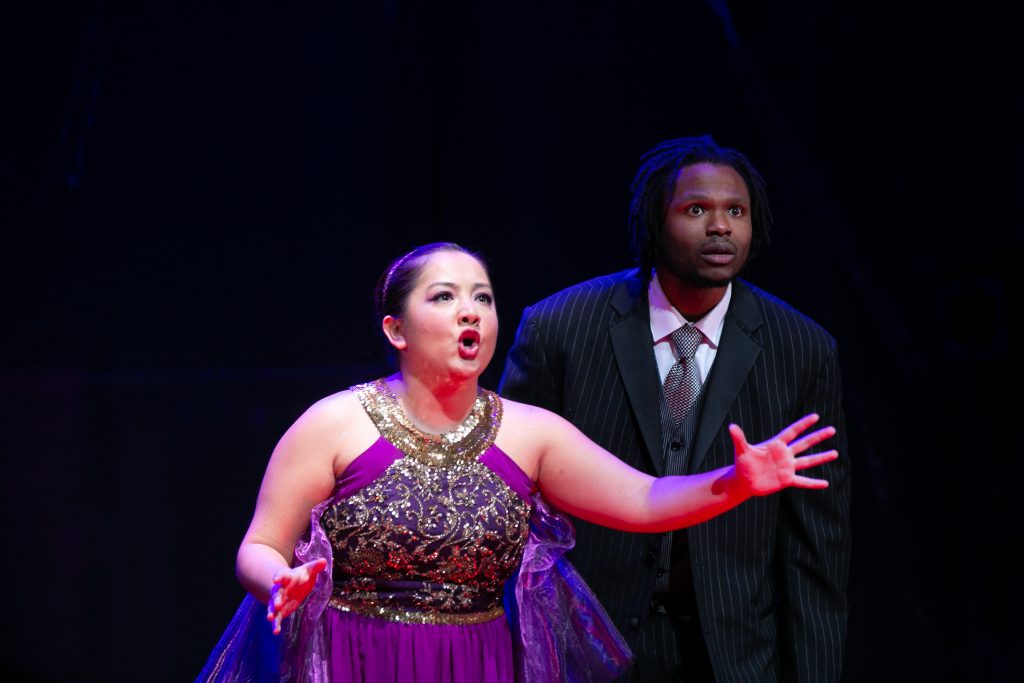
With Le Vivier, Chants Libres and Bradyworks present Backstage at Carnegie Hall, a chamber opera about “racism and the electric guitar” on Friday and Saturday. Premiered at the Centaur Theatre, the work is the first in a series of four by composer and guitarist Tim Brady, founder of Bradyworks and leader of various groups including the electric guitar ensemble Instruments of Happiness.
Socially engaged, this upcoming tetralogy is entitled Hope (and the Dark Matter of History) and intends to explore the themes of racism, de-formation, abortion rights, space colonization, artificial intelligence and climate change.
But first things first: in addition to performing in Backstage at Carnegie Hall, Tim Brady has written the music, while actress and author Audrey Dwyer has written the libretto.
Tenor Ruben Brutus plays the lead role of Charlie Christian, a guitarist who pioneered modern jazz like Django Reinhardt. Sopranos Alicia Ault and Frédéricka Petit-Homme as well as baritones Clayton Kennedy and Justin Welsh will give him the lead.
Musical direction is by Véronique Lussier and staging is by Cherissa Richards. Apart from Tim Brady, the instrumentalists involved in the performance of the work will be Pamela Reimer, keyboards, Ryan Truby, violin and Charlotte Layec, bass clarinet.
With the composer and lead singer of Backstage at Carnegie Hall, let’s see how it all came together.
PAN M 360: “Meet Charlie Christian, a jazz guitar pioneer, backstage at his now legendary December 24, 1939 concert at Carnegie Hall, as a panic attack takes hold of the 23-year-old” says the synopsis.Why this particular event?
TIM BRADY: This imaginary opera based on real historical figures and events allows me and my librettist to explore the depth of human experience with a certain liberty that, we hope, might get us to a deeper truth than “just the facts”. But, to be clear – most of the story is fiction – Time Travellers do not exist, Charlie Christian ever met Rufus Rockhead or Orville Gibson, for example. Call it artistic licence.
In concert with Le Vivier, Chants Libres and Bradyworks present Backstage at Carnegie Hall, a chamber opera about “racism and the electric guitar” on Friday and Saturday. Premiered at the Centaur Theatre, the work is the first in a series of four by composer and guitarist Tim Brady, founder of Bradyworks and leader of various groups including the electric guitar ensemble Instruments of Happiness.
Socially engaged, this upcoming tetralogy is entitled Hope (and the Dark Matter of History) and intends to explore the themes of racism, de-formation, abortion rights, space colonization, artificial intelligence and climate change.
But first things first: in addition to performing in Backstage at Carnegie Hall, Tim Brady has written the music, while actress and author Audrey Dwyer has written the libretto.
Tenor Ruben Brutus plays the lead role of Charlie Christian, a guitarist who pioneered modern jazz like Django Reinhardt. Sopranos Alicia Ault and Frédéricka Petit-Homme as well as baritones Clayton Kennedy and Justin Welsh will give him the lead.
Musical direction is by Véronique Lussier and staging is by Cherissa Richards. Apart from Tim Brady, the instrumentalists involved in the performance of the work will be Pamela Reimer, keyboards, Ryan Truby, violin and Charlotte Layec, bass clarinet.
With the composer and lead singer of Backstage at Carnegie Hall, let’s see how it all came together.
PAN M 360: “In his delirium, he is projected in time and space, between dream and reality.” Where is the reality in the opera ? Where is the fiction?
TIM BRADY : In addition to Charlie Christian, the other main character is a Time Traveller. So this is clearly fiction! So the Time Traveller helps Charlie move among several different times – 1939, 1932, 1926, 1902, 2014 – each scene being rooted in the reality of that era. But Time Travel is pure fiction – a theatrical device, which my librettist Audrey Dwyer uses to great effect.
PAN M 360: Why this theme “racism and electric guitar” ?
TIM BRADY: The electric guitar has a history of moving across the race line: Charlie Christian/Django Reinhardt, Chuck Berry/Scotty Moore, Jimi Hendrix/Eric Clapton, to mention 3 historical pairs of players who developed jazz, rock‘n roll, and modern rock. So the electric guitar is a potentially powerful metaphor for the evolution of race relations in Western civilisation.
Racism is an ongoing major problem in the world, and I am interested in writing operas that touch on complex social and historical issues. This might not be easy, but I and my librettist are interested in the challenge. “Opéra engage” – we might call it.
The opera is also very much built around my use of the guitar in chamber music. So, from a purely musical perspective, it is an opera “about the electric guitar”.
PAN M 360: “His journey takes him from the slaveholding United States to Little Burgundy in Montreal. A gallery of characters crosses his path, including his ancestors, his father, the founder of the Montreal jazz club Rockhead’s Paradise, Rufus Rockhead, the luthier Orville Gibson, the clarinetist and bandleader Benny Goodman, and the singer Marian Anderson, emblematic figure of the American civil rights movement of the 1930s.”
Here we have a mixture of historical references between the United States and Montreal. Was this the will of the librettist or the composer or a common agreement between the librettist and the composer?
TIM BRADY : I (as composer) had a basic idea of what the opera should be about – I had the basic characters in mind when I approached Audrey about this collaboration. But Audrey (Dwyer) developed this very simple outline into a full-fledged, powerful story with characters with deep, complex interior lives. It was a real collaboration.
PAN M 360: What is your relationship with opera? What are your favorite operas?
TIM BRADY: I like contemporary opera because of the theatrical and musical ideas that are explored – a real linking of music, text and theatre. It is a big challenge for a composer, but working with a great libretto like “Backstage” makes me find other ways to use and expand my musical language.
I am not that interested in traditional 19th century “grand opera” – the stories are often quite simplistic, the characters are often more like caricatures, and the singing style generally obscures the words. So my interest in opera is much more linked to a contemporary approach.
PAN M 360: What are you trying to exploit in this opera as a composer?
TIM BRADY: This libretto has made me explore the full range of my musical experience. There are pretty melodies, dramatic arias, chaotic noise improvisations, minimalist grooves, with different kinds of harmonic and contrapuntal variations. The music follows the story, and the story goes to so many fascinating places that I found all sorts of musical inspiration in the libretto.
PAN M 360: If this is a chamber opera, what is the instrumentation of this Bradyworks version?
TIM BRADY: The band is electric guitar (with some pedals), digital keyboard, violin and bass clarinet. We can sound very calm and transparent like chamber music, or almost like a rock band, or anything in between. The electric guitar references Charlie Christian, the bass clarinet references (in a slightly more oblique manner) Benny Goodman, the piano comes from both jazz and classical, and the violon references the “classical” world that is Carnegie Hall. It also is just a great sound with great players. It’s really fun being in the band.
PAN M 360: What is the composer’s intention here to support the theatrical narrative ?
TIM BRADY: It is very important for me to accomplish two things when writing opera: first – to express the interior life, the psychological and emotional depth, of the character and – second – to make sure the listener can actually hear the words and understand them (at least most of the time). So I have to understand the motivation of each character, and of each scene, and find a music that sustains and builds on that perspective.The I have to find note and rhythms that convey these experiences in a way that the singers have something great to sing, and that makes the text as clear as possible. A challenge.
PAN M 360: How were the soloists chosen and involved in this multidisciplinary production?
TIM BRADY: We have been doing workshops for the opera since 2019, working with a range of partners from Montréal, Toronto and Winnipeg. This process helps the production slowly build a strong team. We’ve also collaborated with other companies – Tapestry Opera in Toronto and Black Theatre Workshop in Montréal, as two examples – to find the best artists for each role in the project. Opera is a very demanding art form – you are basically mounting a very complex piece of theatre on top of a very complex piece of music. So it requires folks who are very talented, experienced, focussed and have a generous spirit. We have a great cast, a great director – on all levels, a great team.
PAN M 360: Where were you trained as a classical tenor?
RUBEN BRUTUS: I was trained in classical singing at the Faculty of Music of the University of Montreal. I have done a little bit of contemporary music, I have worked with Chants libres then led by Pauline Vaillancourt but that is not exactly my bag. I usually stick to the classical repertoire but also to the popular or jazz repertoire when I sing in corporate events or private parties – weddings, etc. So I sing with both techniques and it has helped me a lot with Tim’s music. Before I seriously studied voice, by the way, I did a B.A. in jazz at Concordia University – with Jeri Brown.
PAN M 360: Because your Haitian roots and culture, you probably did some choral singing, right?
RUBEN BRUTUS: Totally. I grew up singing gospel music in church, that was my first musical experience and then I participated in the Jireh Gospel Choir under the direction of Carol Bernard and then I realized that I would really like to go further in music and become professional.
PAN M 360: You have had several roles in operas since your professional debut?
RUBEN BRUTUS: Yes, several roles, including the title role in The Gypsy Baron in 2017, I’ve often found myself in the choirs of the Montreal Opera, the OSM.
PAN M 360: You find yourself in a contemporary context, how do you feel about it?
RUBEN BRUTUS: It’s a far cry from A Midsummer Night’s Dream! (laughs). What’s great about Tim’s (Brady) work is that he’s been able to incorporate spoken word into his music, it’s more than just sprechgesang or recitative. I also like his stylistic evocations on the guitar, he can reproduce Charlie Christian’s playing very well for example. The rhythm is not regular like in opera, it moves a lot. I told Tim that playing his music is like memorizing Modus Novus (study of atonal melodies) or singing to Steve Reich’s music (laughs). We are in another language, in another universe where words have a beautiful place, a real importance. I like the composition of the ensemble, the original use of the bass clarinet and the violin… It is sure that it makes the workload and the learning almost impossible but we can count on an extraordinary team. Seriously we have a great team of artists, the director managed to do a very good job.
PAN M 360: How do you see your character evolving in the dramatic framework?
RUBEN BRUTUS: Throughout the opera, the character is in reality. Charlie had both feet on the ground and he’s capering. We are in his head during several scenes, but we don’t have to overact because we are in realism, a panic attack is quite common in humans especially in a context of racism and also of obligation of performance of a young black man. It is therefore close to me this role, I love this role. And I will tell you that anxiety attacks do not really exist in Haitian culture, we are told to go calm down and have a tea… The performing arts can be anxiety-provoking and it must be remembered that kindness was not omnipresent in Charlie Christian’s time. Today, we admit the reality of stress and anxiety, fortunately, we work with the friendly people rather than the unpleasant ones regardless of their talent.
PAN M 360: As an Afro-descendant and classical musician, how do you see an opera about a jazz guitarist?
RUBEN BRUTUS: I’ve asked Tim before, “Why an opera? We’re into jazz and black music, we’re into electric guitar, so why opera? I don’t remember exactly what his answer was (laughs), but I think opera is an elitist art form, you never hear about racism or electric guitar in opera. Opera was not originally accessible to the disadvantaged or marginalized. Of course, it has evolved and such an opera can have a social impact and Tim is doing the right thing in that sense, especially since he allows us to go outside the operatic voice sometimes, we can also sing in a musical way. Tim prioritizes sharing the story. I regularly tell him that his music is really messed up but that I am committed to telling the story to the best of my ability.
MAIN PHOTO CREDIT (RUBEN BRUTUS AND JUSTIN WELSH): PIERRE-ÉTIENNE BERGERON
The Burning Hell, one of Canada’s most singular DIY indie art-folk/rock projects, has been making music for over a decade, always striving for quick-witted imagery and easy-to-latch enjoy instrumentation. They’ve always been a band that makes music for themselves, dipping their toes in almost every genre in the book, but never settling. Simply, every album by The Burning Hell is quite different from the last.
This notion rings true with their latest effort, Garbage Island, a concept album somewhat inspired by the real-life Trash Vortex circling our seas. Though the album does touch on the very real environmental implications plaguing our world, Garbage Island imagines what a distant future may look like for birds and humans.
Stuck between provinces due to the pandemic, the band had oodles of time to record, mix, and produce Garbage Island themselves, honing in on the DIY aesthetic and artistic style of the band.
We spoke with The Burning Hell’s founder/multi-instrumentalist, Mathias Kom, about the concept of Garbage Island, not taking yourself too seriously, and the choice to make fictional narratives over personal ones.
PAN M 360: The Burning Hell has always been a DIY band, but Garbage Island has to be your most DIY project yet. You recorded, produced, engineered, and mixed the album yourself. Was that out of necessity because of the pandemic or was it in the cards for The Burning Hell anyways?
Mathias Kom: It was partly out of necessity—we were stuck in three different provinces for most of the first year of the pandemic and knew that we’d have to get creative if we wanted to make a record together. At the same time, we’ve been heading in this direction for a while now. We all have varying levels of experience recording and mixing, but more importantly, I think we all appreciate being able to take our time and bounce ideas off one another without the pressure of the studio clock. PAN M 360: There are those couple of phrases in “Fuck the Government, I Love You” from 2014 or so that really stuck with me since the first time hearing it. “I told you I was in a band/ I asked what the band was called, I said it’s called The Burning Hell/ I said I’ve never heard of you, I said that’s probably just as well.” After hearing that I was like, ‘Holy shit, you can really do anything with music and not take yourself so seriously.’ So with that lead-up, do you take yourself seriously as a DIY indie band?
Mathias Kom: That’s a complicated question! I think I’ve always taken what I do seriously. But I try not to take myself too seriously if that makes sense. It’s important to maintain a sense of humour and perspective about everything, and maybe especially playing music.
PAN M 360: Was that really Ariel’s first crack at animation with “Nigel the Gannet?” You could have fooled me!
Mathias Kom: Yes! She spent months doing that and I think she’s found her new passion.
PAN M 360: Do you find it’s easier to write these fantastical narratives with made-up characters and names as opposed to writing a more personal narrative?
Mathias Kom: I’m not so good at writing personal songs, though we did release a whole album—Flux Capacitor—of songs that are more or less autobiographical. Still, I always find it more fun to create brand-new worlds in songs than in mine or my own past for material.
PAN M 360: Musically and instrumentation-wise, every song is so different on this album. Were there basically no rules when composing Garbage Island? Find a cool sound and run with it kind of thing?
Mathias Kom: More than any other album we’ve released, Garbage Island is the product of all of our different influences, and I think that’s why it’s so wide-ranging in terms of sounds and genres. We didn’t sit down and decide that this or that song should follow a certain style; because of the back-and-forth way that we produced it, sending parts to each other in different provinces, the songs evolved kind of organically into what they finally became. The relatively epic amount of time we had to make the record also allowed us to try whatever ideas came to us, including building a glass harmonica and a hammered dulcimer, especially for the album.
PAN M 360: I’m sure I don’t have to tell you, but the world, from an environmental perspective, is at its worst right now. Is this where the idea for the narrative of Garbage Island comes from?
Mathias Kom: Exactly. Garbage Island is a colloquial name for the Pacific Trash Vortex, which is one of many trash vortices currently swirling around the world. But the album isn’t so much about contemporary environmental concerns as about what the distant future might look like long after we’ve finally wrecked the planet for good. It’s bleak, but it does end on a note of hope.
PAN M 360: Yes. We have an actual garbage island floating somewhere in the Pacific, that grows every day. I’m sure birds land there all the time, but in the album, they reign supreme?
Mathias Kom: Although the Pacific Trash Vortex (and similar phenomena in other parts of the world) is a constantly shifting thing, in the world of the album, I imagined that it had eventually congealed into a solid land mass, or at least solid enough for certain creatures to make a home there. Many of the world’s birds are in extreme danger from climate change, habitat loss, and other forms of environmental catastrophe, but at the same time, I have a feeling that at the end of the world, there will be a handful of feathered survivors.
PAN M 360: How important is the context for a Burning Hell song? Do you believe fans follow the stories or are they just pieces of pleasurable, quirky/surrealist alt-indie rock to them? And does that really matter to you, the songwriters?
Mathias Kom: That’s a great question. I think when you write and release a song you have to kind of let it go, and recognize that people will engage with it in whatever way they will, or not at all, and there’s not much you can do. In a live situation, I occasionally set a song up to give it context, but typically I just let them stand on their own. Some fans definitely love the dense narratives, and I appreciate that, but if people are enjoying something I’ve made I’m just happy that they’ve connected to it, even if they don’t hear a word of the lyrics.
PAN M 360: You actually became faux-ornithologists by making this companion book, The Illustrated Field Guide to Birds of Garbage island. What was that experience like? It must have been stupid fun.
Mathias Kom: I actually got into birding just before the pandemic, and then being stuck on P.E.I. for two years allowed me to dive deeper. And the book kind of emerged from that, really. I had a lot of fun imagining what a post-apocalyptic bird guide might look like, and partly it was an excuse to work with some of my favourite illustrators. I basically gave everyone the same prompt—create a real or imaginary bird you think might live on Garbage Island—and I had so much fun creating the fictional narratives that went along with each one.
PAN M 360:I’ve never seen you guys live, so with this album, is there any sort of imagery associated with the live performance? Visuals, costumes? Or are you basically taking the role of the narrators?
Mathias Kom: If we ever had the sort of budget that would allow us to do it I’m sure we’d leap at the chance to have an elaborate stage show with costumes and sets and a touring lighting engineer and so on. But for this tour, we’ll just have a simple hanging backdrop made of garbage, and we’ll try our hardest to be diligent narrators.
As one of Canada’s most beloved acts, Saskatoon’s four-time Juno award-winning rock ‘n’ roll five-piece The Sheepdogs,are headed back out on the road following the release of their latest LP, Outta Sight.
The album is a return to form for The Sheepdogs, who have enjoyed widespread international success over their 18-year history as a band. The multi-platinum group has delivered a highly-focused, concise, and well-crafted album with Outta Sight that is downright quintessential for fans of the neo-classic rock genre.
Bandmates Ewan Currie, Ryan Gullen, Sam Corbett, and Shamus Currie are also joined by Gatineau-born guitarist Ricky Paquette for this tour, who will be supporting them throughout the coming months as they do shows across Canada and overseas.
We spoke with the bassist and founding member of The Sheepdogs, Ryan Gullen, just a day before their first performance in Sherbrooke, QC, before they play Montreal’s MTelus on September 22.
PAN M 360: You’re finally back, with Outta Sight signifying your return to your default state as a touring rock ‘n’ roll band. After a few months on the road, how does it feel to be back at it?
Ryan Gullen: It feels good. Post-pandemic touring has its unique challenges, but we’ve done a tour of the UK, Europe, and some stuff in Canada. It just feels really great. So much of what we were doing was just waiting for it all to come back, so it feels really good. A huge part of what we’ve always done is playing live. That’s how we make income, how we promote ourselves—it’s literally what our job is. To have that not be a part of our anatomy as a group for quite a while there was a tough thing. It’s amazing to be back and to put out music, play it for people, and have that shared experience that I think we’ve all been longing for this past while.
PAN M 360: Would you say the vibe of your shows feels any different than it would prior to the pandemic?
RG: It’s tough to say, it’s been so long. We definitely did shows during the pandemic, we were arguably one of the busier Canadian bands doing different unique shows. We played on a hotel rooftop to people on their balconies, we played drive-in shows.
But I think the biggest thing is getting back to playing in a room to a bunch of people on top of each other and the excitement that comes from that. People are just really happy to be back. Back in November of last year, we were one of the first shows when Toronto finally reopened for indoor shows. We did four sold-out nights at Lee’s Palace [in Toronto], and we recorded the show and ended up releasing a live record of that. The energy of relief of people being happy to be back to what they were doing was amazing that weekend.
And that continued – when we got back to England we were one of the first shows that people were going to. The excitement is still there, I think it’s a little bit of one of those ‘you don’t know what you’ve got until it’s gone’ situations, in that people are really happy to be back doing things they love, and I think there’s something special about people being in a room together experiencing music together.
PAN M 360: How has it been touring with Ricky Paquette?
RG: It’s been great, we’ve done one show with him so far, and rehearsals and stuff. He’s a guy we were familiar with over the years, and a guy we respected as a guitar player, so when we needed to fill this position on the tour it was kind of a no-brainer.
He’s such a monster of a player, but he’s also such a nice guy and has such great energy. We don’t know him very well personally but having spent time together and having jammed and played a show together it’s been amazing. It really brought a lot of life and positive energy into what was kind of a tricky situation.
We try to not make every show the same. We think it’s important not to just go up and go through the motions every single night. And Ricky’s such a great player and has a new vibe to add to things to make them fresh and exciting. It’s also gonna be fun to learn about somebody on the bus but also onstage too. It’s cool to experience that.
PAN M 360: On the note of the album, it’s being pointed to as one of your most focused, refined projects yet. What were the band’s overall impressions of it once the recording was wrapped up?
RG: The funny thing is the process of the record was probably the most unique we’ve ever done. Pretty much every record we’ve ever done we’ve set out in some way or another to make a record. Changing Colours was sort of unique in that we went into the studio, tried things, and messed around, and six months went by and we had a record. But it was fairly focused during the time we were working on it.
With this one, it was different because we didn’t necessarily sit down and say ‘we have these 12 songs.’ Basically, it was ‘we don’t know when we’re gonna be able to go back and do what we do,’ and generally feeling pretty down about not having any certainty. Even when this record was coming out we had to postpone a tour in Europe in February and March. It was sort of this constant repetitive situation, so we thought, let’s do what we normally used to do: get in a room and make music and record it.
We’d just sit in a circle and jam something, and then when it was feeling really good we’d hit record. We’d play together and finish that song over the next day or so. It made for something that was both a surprise, but also concise, in a sense that it was all made the same way even though it was over many months of getting together when we could.
As a result, it is very focused in the sense that it’s back a little bit back to the earlier days of our band when there wasn’t a lot of hubbub going on. It was a bit more of a workman’s attitude where we’d get up and set aside days to get up in the morning and work on music together and see what came out of it. That was probably part of the reason why it feels so focused. We also didn’t want to get super crazy, we wanted to make a straight-ahead rock ‘n’ roll record. Once it started taking shape we recognized that.
There weren’t people from the label coming around. It wasn’t like ‘let’s try to wrap up here because I’m going out for dinner …’ you couldn’t go to dinner. It was this funny thing. And then we made the EP in Montreal, we were there in full-on lockdown. We were staying in a hotel and we literally were the only people in the hotel, including the hotel staff! It was like The Shining. It was just the five of us in our own rooms in this big hotel in downtown Montreal. You couldn’t go out for dinner anywhere, we’d just sit and drink beers and hang out. It was the same thing as this, there was nothing else we could be doing, so it was a nice way to work with no distractions.
A lot of the subject matter or vibe of these songs is us looking forward to what was hopefully coming after the pandemic ended. The energy is us looking to the future, and as a result, it has a specific vibe that was the soundtrack to the future of things. It was very concise and focused because we were just doing that as much as we could to hold us over and keep us sane during one of the most uncertain times for the world, and for us as a band.
PAN M 360: In the past, you guys have talked about the music that’s influenced your work, like The Beatles, CCR, Led Zeppelin. Were there any new influences on Outta Sight that weren’t present in your other projects?
RG: One of the influences that Ewan has been really into that’s shining through on the record is J.J. Cale. He’s Ewan’s number one listened-to artist on Spotify for the past couple of years. We have a song that has a drum machine that is literally the same setup as J.J. Cale, so that’s an influence that wasn’t there as much during Changing Colours. And I think a lot of it is trying to not do the same thing over and over again, but also not suddenly coming out with, like, an EDM record. We’re basically trying to look at what we’ve done, and trying to not make it again and lean on it, but at the same time, not reinvent the wheel.
Some songs lean more towards the later 70s. “I Wanna Know You” is the first song we ever used a synthesizer on, which is leaning more on like Boston or Loverboy, that was a bit different. We weren’t all, like, crushing Loverboy, but it was one of those things we were all interested in exploring more.
PAN M 360: Let’s talk about bass for a second. What was your inspiration to pick up the bass in the first place?
RG: It was the band. Ewan, Sam, and I started it as three guys getting together to jam. Ewan had just bought a guitar and Sam was interested in playing the drums, and I kind of just wanted to learn how to play the bass. We literally all started playing our instruments together, which almost sounds too good to be true but is 100% the truth.
In the music I was exposed to growing up in the late ‘90s and early 2000s, the bass was a lot of holding down root notes with a pick. But when I started listening and paying attention to the bass, I could see players use the bass as an interplay between drums and guitar. I see it as kind of the glue that holds everything together because it’s a rhythmic instrument but you’re also playing notes.
PAN M 360: Did you find it tough to stay in practice during the major lockdowns at the beginning?
RG: Oh yeah. I basically didn’t play an instrument forever. It was sort of a weird thing because some people took on a lot, but others did the opposite. I didn’t think it would last that long, so I didn’t think to keep my chops up.
As time went on I became interested in experimenting with other instruments. I played a lot of pedal steel, but no, I didn’t spend a lot of time playing until we finally got back together. It wasn’t something I did a lot of. It felt like ‘we’re gonna take a little break, take a couple of long weekends, and move on.’ I just chilled my brain for, basically, the first time in my adult life.
PAN M 360: Did you pick up any new hobbies or pastimes during the lockdowns?
RG: I took to cooking a lot more for me and my girlfriend, and that was fun for the first while. I played video games which is something I don’t do too much, I played a lot of Red Dead Redemption. I tried to learn pedal steel, that’s a real bastard of an instrument to try and learn. I messed around a bit but not in any sort of real capacity. I mostly just took advantage of having downtime.
As an artist and musician, you’re forever in a state of thinking super far ahead, and also in a state of F.O.M.O. I’m not thinking about the tour starting tomorrow, I’m thinking about the next tour or the next record.
PAN M 360: What’s next for The Sheepdogs after this tour (and presumably, a solid rest)?
RG: It’s always tough to say, you’re catching me on day zero, and these dates go until the end of January. There are obviously things we’ve started having conversations about – everything gets planned very far in advance. We always want to be making music and we definitely want to challenge ourselves to increase the frequency that we put out music.
Will we have a new record off the top of next year? No. But the plan is to go on tour, continue moving forward, chase different opportunities, and always be trying.
Once we do take a bit of rest after this long, busy time, we’re gonna take the time to do new music, enjoy the tour, be in the moment, and figure it out once the dust settles – without waiting too long. We’ve been a band for 18 years, and things have changed, but we’ve never really strayed from the formula of it all: friends getting together and making music.
The Sheepdogs play w/ Boy Golden at MTelus on September 22. Tickets Here!
Although we don’t hear as much about him today as we did twenty or even thirty years ago, Fatboy Slim’s name is undoubtedly linked to the beginnings of the rave epic. Hits such as “Rockafeller Skank,” “Praise You” and “Right Here Right Now,” all three from his second album You’ve Come A Long Way Baby (1998), made the DJ and producer known worldwide.
From his early days with the indie band Housemartins to the present day, through Beats International, Freak Power, Mighty Dub Katz and his popular alias Fatboy Slim, Norman Cook’s career has been as impressive as it has been eclectic, and that’s part of the reason his name is still around today.
Inactive on record since 2004, Fatboy Slim continues to travel the world, displaying his musical knowledge and technical prowess from party to party, to the delight of old and young ravers alike.
On the eve of his highly anticipated appearance at the MEG festival–he was supposed to perform at last winter’s aborted Igloofest–, we spoke to the famous DJ who talked at length about his journey, the music that marked him, the beginnings of the Fatboy Slim epic, the big beat, his passion for Djing, the Woodstock 99 disaster, the place of irony in his work and the intoxicating chaos of the party.
Check it out now, the funk soul brother!
PAN M 360: What were your first kicks in music, what did you start with? Remember what was your first album?
Norman Cook: I used to love pop music when I was young. I remember at the age of 8 telling my parents that I wanted to be a pop star. And that’s where I was heading until punk came along. Then I didn’t want to be a pop star, I just wanted to be part of the music world, without being a star. I remember the first record I bought was Suzi Quatro’s Devil Gate Drive… I then learned to play some instruments and it was when I discovered punk that I got into it and started playing in bands. I became a DJ a bit by accident; I was buying a lot of records at the time and they would invite me to parties to play them. So at these teenage parties, someone would often spill their drink or throw up on my records. So at one point, a friend invited me to her party and asked me to bring my records. I said I would come, but without my records. So the friend in question offered to rent turntables and asked me to be in charge of the music for the whole evening so that I would be the only one handling the records. And that’s how I started. I also realized that I liked to share my appreciation of certain songs with others. I liked to play songs and try to guess what people would like to hear next, to create a kind of performance. That’s how I started, I must have been 14 or 15 years old.
PAN M 360: And what did you play at that time?
Norman Cook: I was playing punk rock! It was towards the end of punk and the beginning of new wave… That and some of the pop hits at the time. And it was also during that period that I discovered electronic music, bands like Human League, Heaven 17, and all that stuff associated with the new romantic movement. A friend of mine and I had bought two turntables and in order to break even we used to do weddings, school parties, and I even DJed funerals…
PAN M 360: You actually witnessed this incredible period in British music.
Norman Cook: Yes, I consider myself very lucky to have been able to experience that. For me, it was the golden age of music. Being my age, I’ve seen and heard a lot of it. I grew up with 70’s pop, then punk-rock, hip-hop, electronic music… I think I still have the basic spirit of punk rock, which is not to follow the established order, not to follow the rules, to change things, and to do it yourself. I got more seriously into Djing when I was old enough to go to nightclubs. By then I was playing funk, electronic music, rare groove, and then house. It was really exciting to go to clubs at that time. But it was more of a hobby to be a DJ during that period. We got ridiculous fees. So I played in bands during the day and at night I was a DJ, if I didn’t have a show with one of my bands.
PAN M 360: You played in a few bands and, of course, the Housemartins. I’ve always been intrigued by the difference between the music you played with that indie-rock band at the time and what you turned to afterward. Because after the Housemartins disappeared, you made a name for yourself with Beats International, then after Pizzaman, Mighty Dub Kats, things completely opposite to the Housemartins. Were you tired of playing in bands?
Norman Cook: I was a white kid in a suburb in the South of England and all the music I really liked was black music, like funk, hip-hop, house. During that period I felt that playing black music when you’re white was not okay. There were very few white bands playing black music at that time. So I turned to white indie music with the Housemartins, a band that came from punk. But as a DJ, I didn’t mind playing black music. Then came drum machines and samplers and from then on white people could make music similar to black music without pretending to be black themselves. So that’s what I did, and I dropped the Housemartins. To be honest, I never really liked playing with the Housemartins. It was Paul (Heaton)’s band and I was just the bass player.
PAN M 360: In these other adventures before becoming Fat Boy Slim, you also reveal your love for reggae and dub.
Norman Cook: Yeah, I play a lot of that as a DJ too. It’s the most authentic black music I grew up with. Where I lived, there was always reggae music around me, so I grew up loving that music. But then again, I didn’t want to be that white guy trying out reggae. As soon as samplers came along, you could put all these influences, ideas and different sounds or rhythms into a song and add your own personal touch without pretending to be black.
PAN M 360: So how did the Fat Boy Slim saga begin?
Norman Cook: I continued to play with bands while DJing. There was Beats International and Freak Power, which was a kind of acid funk band. But after about ten years of playing in bands by day and DJing at night, I realized that more people came to see me for my DJ sets than for the gigs of the bands I was playing with. Fatboy Slim was one of my many DJ projects. There was Mighty Dub Katz, Pizzaman and I played with Freak Power. So the last thing I wanted was another project. With Fatboy Slim, it was a way of combining all these different influences into one entity: the catchiness of pop music, the rhythms of hip-hop and the energy of acid-house became a sound of its own, which we called big beat. It all quickly became more and more important in my professional life and I no longer had time to play in bands, I was still up from the night before because of Fatboy Slim. Over the years, I made Fatboy Slim just me, no longer pretending to be a bass player trying to write traditional songs, with lyrics, choruses, verses… The punk rocker in me gave up all that. It was a chance for me to finally create the music I really like, mixing all these samples, instead of making the music I thought I should make.
PAN M 360: For me, the Big Beat sound was a sort of mix between the energy and aggressiveness of punk and the groove of hip-hop, with the added bonus of dub madness.
Norman Cook: Yes, it is! That’s kind of what I like about music. I like the rebellious side of punk and the idea that you don’t have to be a musician to make a record, mixed with the grooves of black music that I like but with a certain pop sensibility. I didn’t want to be too much of an underground artist, I like to entertain people and that penchant for entertainment came across in my sets, where I would jump around, where I could play hip-hop tracks on 45s and techno tracks on LPs, just to fuck with the genres. And with the samplers, the big beat allowed me to keep doing that.
PAN M 360: How did the big beat evolve, if at all, and what is the big beat today?
Norman Cook: The thing is, the big beat never really evolved. It was more of a rule-breaking, genre-bending thing. The only common link from record to record, or artist to artist, was that there was a big beat. Then it became a genre, then a formula and soon everyone started making big beat albums that all sounded the same, and that’s what killed the big beat in a way. It was only a matter of three or four years. But I think the genre still has a place. If you think about it, garage came from the Paradise Garage in NYC, house came from the Warehouse club in Chicago and big beat came from my club in Brighton, the Big Beat Boutique. I’m really proud of that.
PAN M 360: You have all these wacky aliases (Margaret Scratcher, Chimp McGarvey, Son of Wilmot, Yum Yum Head Food… over twenty!), funny song or album titles… To what extent would you say that humor or irony is an integral part of your work?
Norman Cook: I think it’s a huge part of my work. The irony, more than the humor. I don’t make comedy records but I do like to twist things around. Also, I don’t take myself too seriously. There are a lot of musicians who think they’re a gift to the world from God, but I’m just an idiot who likes to show off; I like to make people smile, make them dance. I’ve never seen Djing as a high art form and I’ve never seen myself as a genius artist or a sex symbol… It’s just me making records. And by not taking myself seriously, I think it’s harder for people to criticize me. But also, there’s a huge amount of emotion and reference in music and humor is often an aspect that gets overlooked. As I said, my job is to make people dance and smile, not necessarily to educate them, to start a rebellion, or anything like that. It’s often just about empathy or sex. For me, Fatboy Slim is all aspects of my personality rolled into one.
PAN M 360: Your last album, Palookaville, was released in 2004… almost 20 years ago. Do you plan to release another one sooner or later?
Fatboy Slim: Not really. I don’t seem to like making albums anymore. I did a few and then I just didn’t want to do it anymore. I lost that passion but I didn’t lose the passion to play music for people. But who knows, maybe one day I’ll get tired of going around the world DJing and staying up until indecent hours and I’ll get the urge to make an album again. Never say never, but to be honest, the concept of an album seems a bit stale in this streaming age. I might put out a few new songs, but once I’ve released enough to put it on an album, it’s going to feel redundant.
PAN M 360: Maybe then you’ll bring out your old bass…
Norman Cook: Yes, I still play bass from time to time, for birthdays and weddings. If my friends put a band together for one of these occasions, I’m always the designated bass player! I still enjoy it but I consider myself a better DJ than a bass player, I can assure you!
PAN M 360: What have you been doing lately? Any new projects in the pipeline?
Norman Cook: We recently celebrated the 20th anniversary of the big party we did in Brighton Beach, which was really exciting. Also, I’ve finished organizing my first festival where we take over a holiday camp for a weekend. It’s one of those huge British holiday camps that nobody goes to in the winter. So I’ve selected 35 DJs to take turns at the All Back To Minehead festival weekend. Minehead is a tiny seaside resort in the West of England.
PAN M 360: How do you work on your DJ sets? Do you follow a certain strict pattern with some room for improvisation or do you just let yourself go, following the mood?
Norman Cook: I go with the flow. I know what the first three and last three songs of my set are but what happens in between depends on the crowd, the mood… On the other hand for the big shows, I take fewer risks. People are there to hear the hits. The smaller the show, the more fun I have and the more freedom I give myself. I play with Serato, my laptop, and CDJs.
PAN M 360: A lot of people saw you recently in the documentary about the Woodstock 99 disaster. Was that the most chaotic event you’ve been to as an artist or have there been worse ones?
Norman Cook: Oh no, it wasn’t the worst (laughs). It was chaotic but I wasn’t there on Sunday when things started to get really bad. It was just too big an event. It was full of drunken American kids and when you have that many of them in one place, it can become a problem. But I’ve been to gigs that were far less organized than Woodstock, and gigs where the behavior was far worse and I was really more scared! That will be the subject of another documentary perhaps…
PAN M 360: Could you mention one?
Norman Cook: Um… no (laughs). A gentleman never kisses and tells.
PAN M 360: You said in the documentary that you like chaos when you perform, is it still the case? And what kind of chaos are you referring to?
Norman Cook: I like chaos because dance music is mainly about uniting people but also freeing them for a few hours to forget their stress and boring lives. People are free, people are together, people are sexy and I try to make them forget about the daily train by putting them in a fantasy world full of bright lights, loud music, and solidarity. As long as there is a community spirit, as long as people don’t hurt each other or break anything, I like the chaos you feel when they lose their minds. You feel it and you can see it in their eyes. You see some of them look at you and seem to say “what the hell are you doing here?” and I look at them like “yeah this is fun, let’s go”… For me it’s really exciting because I’m the one who controls that energy, I’m the one who tries to make them go crazier and crazier and they totally lose themselves in the music. That’s the kind of surrender I’m trying to get. I’m not trying to cause a riot, I want the crowd to lose themselves and let go together. That’s the kind of chaos I like and seek when people go crazy, but stay within the bounds of decency and public safety. The crowd is as important as the DJ. If you’re in a band, you can put on an amazing show for a shitty crowd, but as a DJ, it’s a conversation you’re having with your audience. If the crowd doesn’t respond to what you say, then it becomes a monologue.
PAN M 360: Do you play your hits (“Rockafeller Skank,” “Praise You,” “Weapon Of Choice”) in all your sets? Do you sometimes feel like the Rolling Stones, obliged to play “Satisfaction” at every show?
Norman Cook: I actually play Satisfaction mixed with “Rockafeller Skank”! I don’t mind that at all! I would say I play “Right Here Right Now” and “Praise You” quite a bit all the time, but I have so many different versions and mashups and remixes of those songs that I never get bored. I think these are probably the two songs that the public would be disappointed not to hear. “Rockafeller Skank” is not always included in my set though, only if I think people deserve it…
PAN M 360: Do you have anything to say to the people who will attend your show in Montreal?
Norman Cook: First of all to apologize to the Montrealers for taking so long to come, to thank them for their indulgence. Then to invite people to come and get lost in a collective euphoria, to escape… and not to forget their dancing shoes!
FATBOY SLIM PLAYS THE “OFF PIKNIC” THIS SATURDAY, SEPT. 3 AT 4 P.M. BUY YOUR TICKETS HERE!
With his calming, cool José González, has been compared to the likes of a contemporary Nick Drake. González’s newest album, Local Valley, is his deepest and most philosophical album yet, with songs about love, death, humanism, and futurism, González imagines a world that reverts back to a somewhat tribal point of view—where everyone depended on each other in a global village. For example, the song “Visions” could also be called González’s magnum opus.
We spoke with González about parenthood, his artistic style, and dancing apes, as he was pushing his one-year-old son, Matteo, in his stroller, through a park in Gothenburg, Sweden.
José González: I’m actually just walking right now with my boy. He should be sleeping but he’s not. He’s one year old. I’m just walking through Slotsugen park in Gothenburg, Sweden.
PAN M 360: You weren’t a father when you released Vestiges & Claws. How has becoming a parent changed your perspective on songwriting?
José González: The period of time when I was about to become a dad and then became a dad, there were some changes in life, natural changes. Trying to go and see every band that came to town to be OK with not seeing them. I definitely think more about what I value each week. It’s a bit more calm living. As for the music, I didn’t feel as rushed to write local Valley and I let it take the time it did. The pandemic gave me even more time. I think you can sense that when you compare the two albums.
PAN M 360: That calmed state of mind?
José González: Yes. With Vestiges & Claws I had high ambitions with the type of songs I would write. I tried to only do it with one guitar but had to do overdubs. So I think I let go of some of my youth, dogmatic standards.
PAN M 360: This is probably you’re biggest album, theme-wise. You’re speaking or singing to humanity as a whole. Would you say that introspection came from being a new father.
José González: I would say partly. With Vestiges & Claws I was inspired by humanism, effective altruism, and the long future… not only for humans but all sentient beings. In a way, I was already there, but with kids, it gave me more perspective and felt more real in a way. These discussions are a bit abstract, about how civilization might look in 100 or 2000 years from now.
PAN M 360: There’s this philosophical narrator approach to the new album as well. You just quoted one of your songs “Visions,” with the whole sentient beings line. It kind of feels like I’m experiencing a university philosophy class all over again.
José González: I admit that I’ve been reading more and more over the years. And walking around with the stroller, I get to listen to full books and many of those books are philosophy books. It was kind of fun to release that inner nerd. But yes it’s just like a nerdy science class.
PAN M 360: The album art was made by your partner, Hannele Fernström, a designer/illustrator. Did you two talk about the art or was it just her?
José González: We talked a lot. Aesthetically we were both on the same page. We both like Jospeh Frank, the textile designer. We wanted the album cover to be something more colourful. I was involved quite a bit in deciding which animals made the cover too. But once she started doing her thing, it was all her. She’s very into details and we both have very strong opinions.
PAN M 360: I’m always really excited when there is another album coming from you because they don’t happen every few years. You take time in between your releases, especially in this day and age when musicians release albums every one-two years.
José González: Yes I definitely take my time. I had my demos half ready for a while and with Local Valley, I waited until my daughter went to preschool and then really dedicated time to working on it. I was relaxed, but it came from being frustrated about not having the time as a new father. I was still playing and yes, I can bang out a song by just playing, but I wouldn’t like it. The way I work is I sit and write with complex chords or amazing arpeggios and from that demo, the finished song can take years. It’s mainly about combining and finding the lyrics perfectly sit. I need meaning too. So yeah, I’m a slow writer.
PAN M 360: You sing in Spanish, Swedish, and English on Local Valley. Have you tried that before?
José González: Yes, but it never quite fit. I tried that on Vestiges & Claws, but it was easier to sing in English in the end. But I felt it was kind of weird to be this Swedish, Argentinian artist who only sings in English. So this time it felt very natural.
PAN M 360: You said that it’s important for you to find meaning in your songs, but your song “Swing” is a dance track about, moving your body and being free. It’s not a huge idea…
José González: Yes when I say meaning I mean working on many different layers, with the rhythms, and from an album point of view, I tried to have other layers. So I have some songs with the drum machine and playing around with loops. I wanted many different styles on the album. So songs about death, but also a song about moving your body. “Swing” isn’t deep but it does serve a purpose on the album. In my mind, I was thinking about “Happy” by Pharell Williams, When I saw videos of people dancing in secret to that song, undercover, I guess I was inspired by that. It’s not in the lyrics, but it does highlight that, independent of your sexual orientation or religion, we’re basically apes that like dancing.
Born from the wacky minds of Montreal producers and DJs The Fitness (Darien Pons), Lou Roots (Louis Racine) and GabaGhoul (Gabriel Chenart), The Mugzy and Maam Show is a playful and zany cross between the Muppet Show and underground dance music. Like the Puppetmastaz or Mr.Oizo’s Flat Eric, the Mugzy & Maam Show brings a bit of madness and derision to DJ sets or electro shows that are too often static and linear. On the other hand, the three heads behind these puppets don’t fall into gaudiness and easy humour. There is a real work of conception and reflection behind the comical aspect of these two cardboard aliens who have fallen by accident in Montreal, a city where they have set themselves the goal of producing music, seeking happiness, and alerting humans to the dangers of losing their community.
The Fitness, Lou Roots and GabaGhoul talked to us about this unusual show.
PAN M 360: Tell us how this crazy project came about.
Lou Roots: The idea came about in December 2019. It stems from the desire to bring a more visual and playful aspect to the generic DJ set. We were inspired by Daft Punk or Mr. Oizo with his Flat Eric puppet.
The Fitness: Once the puppets were imagined, we had to give them a personality, create a story, a setting. So we worked a lot on that, hoping to ultimately bring some fun and extravagance to the underground dance scene. It’s ultimately easier to comment on our society and this underground scene through puppets as well.
PAN M 360: What does the show consist of?
The Fitness: The Mugzy & Maam Show is two puppets doing a DJ set for about an hour. Since we handle the puppets, we can’t really play live so all the music was pre-recorded by us three. But since MUTEK asked us to do a longer show, we added half an hour. There’s a secondary character called Shteve Kelly, who I play, who is a kind of awkward party boy and a fan of Mugzy and Maam. At one point during the set, he spills his drink on the puppets’ audio equipment, frying the circuits and muting the sound. So this forces the puppeteers to reveal themselves and take their instruments and machines for a half hour live set.
GabaGhoul: Mugzy and Maam bring a more theatrical side to DJ sets that are too often similar, where you see a DJ behind his machines and not much else. We’re transforming that a bit to give a live performance at Mutek, with different instruments and machines. It’s a way to show that we are the ones making the music, and who we are.
PAN M 360: Who are Mugzy and Maam?
The Fitness: They are two aliens from a distant planet, who have to flee from it because it is being invaded by a huge fungus. So the pair escape in a spaceship built by Mugzy, which ultimately crashes in Montreal. A little lost, without family or friends, the two protagonists find comfort in underground dance music. They discover a mode of expression and a community of friends, which ultimately saves them.
PAN M 360: Who designed these puppets?
The Fitness: Our friend Gen Wade’s company Material Things made the puppets. We asked her about three years ago because we think she does beautiful work.
PAN M 360: Will the show at MUTEK be the first of the Mugzy & Maam Show?
Lou Roots: The project hasn’t been fully unveiled yet despite a few performances here and there, at Mural for example. So we consider the show at MUTEK as the real premiere of the Mugzy & Maam Show.
The Fitness: I think puppets take a lot of adults of a certain generation back to their childhood, with Sesame Street and the Muppet Show for example, but in a more underground context. It’s very fun and accessible and we’re surprised that MUTEK was interested in us, because our music is not very experimental. But with the sets, the puppets and the music, it gives a more alternative dimension. This motivated us to develop our show. Although it doesn’t sound very serious, this show is not a joke, because we don’t make jokes at MUTEK (laughs).
GabaGhoul: It’s not very MUTEK sounding, but we are quite proud and grateful that MUTEK trusted us without even really seeing the show. I think it shows once again how MUTEK likes to open the boundaries of electronic music.
THE MUGZY & MAAM SHOW TAKES PLACE AT ESPLANADE TRANQUILLE on SUNDAY AUG 28 During « EXPÉRIENCE 6 » at 5 PM. FREE, INFO HERE!
Donia Leminbach is enjoying the full freedom she gained with the re-launch of her career, marked by the release of recordings under the Draw Me A Silence banner. A few years ago, the producer began a new chapter in her life.
A divorce, the heritage of a small palm grove built by her late mother in the Tunisian Sahara, a life divided between the southwest of France and her mother’s house. These personal events coincide with a real professional success in the circuits related to the genres and subgenres techno, dub, breakcore, hardtek, bass music family.
Given the success of her recent recordings, she travels around North Africa, France, the world… All this also coincides with the appearance of her new alias, Azu Tiwaline, which will be highlighted this Sunday at MUTEK.
PAN M 360: Tell us about the birth of Azu Tiwaline, this alias that brings you authentic success.
AZU TIWALINE: I am based between the south of Tunisia and the southwest of France (on the border of the Landes and the Basque country. In Tunisia, I stay quite close to the Chott el-Jerid, a vast saline plain which is in fact an old dried-up sea and which sometimes covers itself with a few centimeters of water, once or twice a year. It becomes another magical landscape. Five or six years ago, I decided to live there and come to France from time to time. My mother, twenty years earlier, had bought a piece of land with sand, she built her house little by little, she planted palm trees little by little, she passed away 5 years ago and I decided to settle there. It is a small palm grove, it is really a paradise there but I have to take care of it and I am an only child. For two years now, I have to spend half of my time in France, because it’s not easy to spread out in Europe and in the world from Tunisia. That’s why I have another base in the southwest of France, which allows me to travel.
PAN M 360: Going back to Tunisia was necessarily a great source of improvisation, how does this manifest itself in Azu Tiwaline?
AZU TIWALINE: So I was born in France of a Tunisian mother and a Cambodian father, but I grew up in the Ivory Coast, in Abidjan. I came back to France when I was 14 years old. I always had a link with France and the French-speaking world, my parents spoke French, it’s my mother tongue, so I quickly integrated myself into France. I then became interested in rave culture and started to make electronic music, having access to equipment from my friends who were making electronic music.
PAN M 360: How does your living environment impact your music?
AZU TIWALINE: There are rhythmic elements from North Africa in my music, I work on ternary rhythms, I also use instruments that can be found in Berber music. Also, I record a lot of sounds from my immediate environment, I like that we can situate ourselves with these sound recordings on the terrain of North Africa, the street, the village, the calls to prayer, a kind of sound postcard. But above all, there is an emotion underlying these sounds put in context, the desert in my music can also mean silence. And people can stick to the meaning they want. But I don’t claim to be a North African ethno-musician at all.
PAN M 360: You are more a citizen of the world, where you are is a matter of creation, isn’t it?
AZU TIWALINE: Exactly.
PAN M 360: Your aesthetic is clearly electronic, in fact.
AZU TIWALINE: I’m more techno and dub, even if this dub is not fundamentally reggae.
PAN M 360: How has your art evolved recently?
AZU TIWALINE: For the moment I am surfing on this wave from my first album under the pseudo Azu Tiwaline. I take advantage of this good energy, the support I received, it allows me to tour and continue the work of creation. Last winter, I finished composing a second album which should be released in 2023. That’s what’s happening in the short and medium term. And then in the long term, I don’t know yet. I want to do artistic residencies, which I’ve done many times before. Another dream of mine in the long term is to be able to do film music.
PAN M 360: Did you study music?
AZU TIWALINE: Not really in a sustained way. I took music lessons when I was a kid but it didn’t produce the desire to be an instrumentalist, I don’t think I had any teachers to produce the click. It’s rather when I discovered electronic music in raves that I wanted to understand how the machines worked. I had friends who had equipment and that’s how it started. As a self-taught person, little by little, I bought machines, software, etc. I was doing all that at the same time. I was doing all this at the same time as I was studying, so I didn’t necessarily think I would make a career out of it. It was a passion and, at the end of my studies, I was already starting to earn a living with music. I gave myself two or three years to enjoy it and we’ll see. More than twenty years later, I’m still making music. It’s going well right now but there are periods where there are ups and downs, there is no stable income, it’s the art of managing your emotions without panicking when there are less busy periods professionally.
PAN M 360: Azu Tiwaline?
AZU TIWALINE: I would translate Azu Tiwaline as ‘the eyes of the wind’. A Berber might not translate these two words like that, but for me, the combination of these two words can lead to this translation. In my imagination, at least, that’s how I perceived it, especially when I started living in Tunisia. And so, when I finished my first album, I chose this alias to mark this change and create a new identity. Everything changed in my life at that moment, I wanted to signify the coming of this new cycle with a new identity.
PAN M 360: Affinities with certain artists, labels, etc.?
AZU TIWALINE: I first received a warm welcome in England, this open door there allowed me to radiate internationally, while being close in my way to UK bass music. My signature at Livity Sound also helped me a lot in this sense, I was able to meet several artists that I admired and with whom I could make new collaborations. Then I have a link with the Tunisian electronic scene, which is rather experimental, rather noisy. Of course, I live in the Sahara and I’m not necessarily connected with the community of Tunis where it happens mostly, but I still have links. And here I like to spend a lot of time alone and live in the desert to enjoy this solitude.