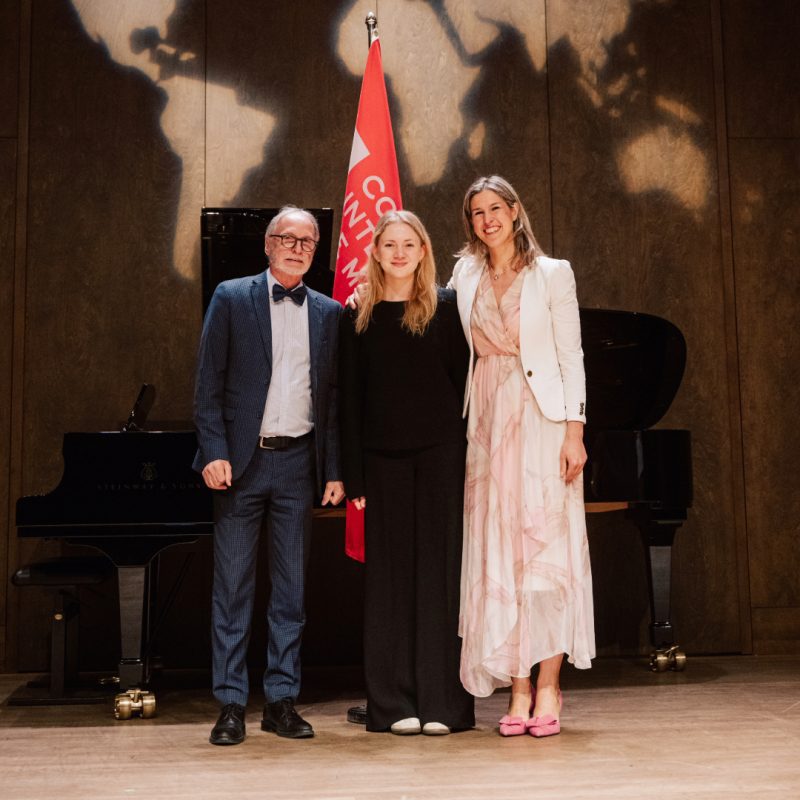
Pianist Louise Bessette is featured on the most recent ATMA Classique release: Olivier Messiaen’s Quartet for the End of Time. In this all-Canadian version, she is joined by cellist Cameron Crozman, violinist Mark Lee (of the Nova Scotia Symphony) and clarinettist Dominic Desautels (of the Hamilton Philharmonic). This resplendent recording (READ MY REVIEW HERE) is a testament to the wonderful communication between the four performers. We can say that “something happened” on the day they first played the piece together in concert. Louise Bessette tells us about this experience and the unusual circumstances that led to the formation of their ensemble.

READ THE REVIEW OF QUARTET FOR THE END OF TIME UNDER THE ATMA CLASSIQUE LABEL, WITH LOUISE BESSETTE, CAMERON CROZMAN, MARK LEE, AND DOMINIC DESAUTELS

PanM360: Hello Louise! Can you explain to us what led to the formation of your quartet for this recording? You, Cameron Crozman, Mark Lee, and Dominic Desautels?

Louise Bessette: It’s a beautiful story. In June 2024, I was invited by Simon Docking, the artistic director of the Scotia Festival of Music in Halifax. His thing is that he doesn’t invite already formed ensembles. When he conceives his programming, he invites solo artists, and he assembles the musicians according to what he thinks will form a beautiful connection. We had talked a few times and he suggested some names. Dominic, I knew him a little, I had already played with him in Toronto. I had done a concerto by Gilles Tremblay and he was in the ensemble.

Cameron, of course, I knew his name, his playing, all that, but we had never met. And then Mark Lee, he lives in Halifax, he’s Associate Concertmaster with the Halifax Orchestra. I didn’t know him at all.

Simon would say to me, “Ah Louise, I can imagine the four of you together, I’m sure you’ll get along well.” The festival took place, we played the Quartet, and it was a very powerful musical moment.

Simon calculated on his watch: it took a full minute of silence before people started applauding at the end.

PanM360: That’s rare…

Louise Bessette: No one wanted to break the spell. We came off stage, we were crying! It was really, really incredible. So, I came back to Montreal and immediately called Michel Ferland, who was still at ATMA Classique at that time. I said, “Michel, I have a project for you.” I told him about it. He said yes. So, there you go.

PanM360: He had a good intuition, this gentleman…

Louise Bessette: Ah yes. We never stop thanking him.

PanM360: We hear this strength, this transcendence, on the album. It was recorded at Domaine Forget in March 2025, some months after Halifax. What was the atmosphere like there?

Louise Bessette: It was about seven, eight months after the Halifax festival. Right away, we felt the same thing. All four of us. We were really, really immersed in the work. At Domaine Forget, we had wonderful conditions with Karl Talbot, the recording director. We worked in exceptional conditions.

PanM360: Remind us of the genesis of this work.

Louise Bessette: It was written during the Second World War, in the Stalag (a prisoner of war camp, different from the extermination camps for Jews – Editor’s note). Then, Olivier Messiaen was there, with other musicians. He used what he had: a clarinettist, a cellist, a violinist, that’s all. He said, well, okay, I’ll do something with that. And that resulted in this Quartet, in 1941.

PanM360: What is the Quartet for the End of Time about? Is it the end of times as in “apocalyptic” or is it something else?

Louise Bessette: Well, yes, of course, it’s the end of time. We know that Messiaen was very, very, very devout and religious. That’s the whole atmosphere. It takes us to the afterlife. When we listen to the last movement, for violin and piano alone, Praise to the immortality of Jesus… I mean, the music is on the verge of being impalpable.

PanM360: These are very original harmonies. Messiaen innovated both rhythmically, harmonically and melodically. He used formulas and techniques that were not common in Western music. From Indian music, among others.

Louise Bessette: Absolutely! In the sixth movement, the Dance of Fury for the Seven Trumpets, we are in unison from beginning to end, with very complex rhythms. But we have a blast playing it!

PanM360: Fool’s Dance, as my grandmother would say. But there are also lots of bird songs in there. How do you feel about these bird songs?

Louise Bessette: Ah, it’s… the whole universe of Messiaen is in this work. His complex rhythm, his chords, his bird songs, the emotion, the very, very fast movements, the extremely slow movements.

PanM360: It’s also a tremendous amount of colour work. You must master your instrument in an exceptional way.

Louise Bessette: Yes, absolutely. And also being attentive. A lot.

PanM360: It’s a bit of the pinnacle of chamber music. Musicians are in absolute listening mode. Listening to themselves and others.

Louise Bessette: Yes, and that’s the pleasure we had working together. Each one adjusted to the other.

PanM360: There is a second layer of meaning in this “end of time.” The end of time, yes, but not just a reference to Religion. A more subtle reference to rhythmic time, very Western, very square. In the Quartet, there is never any “square” time. There is never a true 4-4. There is never a 1-2-3-4, then we start again with a beat. All the phrases are extraordinarily free. There is an impression of wild freedom. But perfectly written.

Louise Bessette: Yes indeed. But I’ve played it often, so I’m starting to “get it in my fingers.”

PanM360: There is one last piece on the program, as a supplement. A Fantasy for violin and piano, from 1933. What can you tell us about it?

Louise Bessette: We were looking for a piece to complement the Quartet. There are very few works of chamber music by Messiaen. I suggested to Marc Lee one of the two pieces for violin and piano by the composer. There is the Theme and Variations from 1932 and there is the Fantasy. Marc preferred the Fantasy. I was very happy because I had never played it. It’s an early work that was published after Messiaen’s death. It’s like a score that was found. We can hear that it’s a youthful work, but at the same time, his entire universe is already there.

PanM360: It’s perhaps a bit, how to say, less assertive.

Louise Bessette: Juvenile.

PanM360: Yes, but a beautiful piece. Honestly, it’s a nice discovery.

Louise Bessette: Allow me, before finishing, to add how proud and very, very moved I am by all the work that has been done, not only with the sound team (thank you Karl Talbot), and then the video team as well, because we have beautiful videos, but also with the entire Atma Classique team.

PanM360: Yes, and the visual is very beautiful too, the one on the cover.

Louise Bessette: Ah yes, that’s fantastic. The photo was sent to us by the Messiaen Memorial in Görlitz, where Stalag VIII-A was located, in which Messiaen was held prisoner. I found this photo by chance on their website. With Atma, we wrote to them and they sent us the photo. They allowed us to use it for the album cover. So, it’s very touching. And in the booklet there is one of Messiaen young, in the 40s, precisely. It was sent to me by the Olivier Messiaen Foundation of the National Library of France. They told me “Go ahead, use it.” 

The entire album, the whole product, is a beautiful tribute.

On February 8, 2026, at Bourgie Hall in Montreal, the 29th Opus Awards Gala will take place and will honour artists competing in 33 categories, covering classical music, jazz, world music, and traditional Quebecois music. For the past few years, the Gala has been innovating with a formula praised by artists and the public, in addition to offering former winners and nominees the opportunity to perform in front of an in-person audience and online (the ceremony is broadcast live). I spoke with the artists who will be performing, Gentiane MG, Marie Nadeau-Tremblay, Elisabeth St-Gelais and Jean-Félix Mailloux with the Cordâme ensemble. I asked them what it feels like to receive an Opus Award or to be nominated, and if it has an impact on an artist’s career. Here is Jean-Félix Mailloux (for the other artists, follow the links below).

DETAILS AND TICKETS

LINK FOR WEBCAST (FEBRUARY 8, 3 PM)

INTERVIEW WITH SOPRANO ELISABETH ST-GELAIS

INTERVIEW WITH THE VIOLINIST MARIE NADEAU-TREMBLAY

INTERVIEW WITH THE PIANIST GENTIANE MG

DISCOVER MORE ABOUT THE OPUS AWARDS

https://youtu.be/c_rxJAfQW5A

On February 8, 2026, at Bourgie Hall in Montreal, the 29th Opus Awards Gala will take place and will honour artists competing in 33 categories, covering classical music, jazz, world music, and traditional Quebecois music. For the past few years, the Gala has been innovating with a formula praised by artists and the public, in addition to offering former winners and nominees the opportunity to perform in front of an in-person audience and online (the ceremony is broadcast live). I spoke with the artists who will be performing, Gentiane MG, Marie Nadeau-Tremblay, Elisabeth St-Gelais and Jean-Félix Mailloux with the Cordâme ensemble. I asked them what it feels like to receive an Opus Award or to be nominated, and if it has an impact on an artist’s career. Here is Gentiane MG (for the other artists, follow the links below).

DETAILS AND TICKETS

LINK FOR WEBCAST (FEBRUARY 8, 3 PM)

INTERVIEW WITH SOPRANO ELISABETH ST-GELAIS

INTERVIEW WITH VIOLONIST MARIE NADEAU-TREMBLAY

INTERVIEW WITH JEAN-FÉLIX MAILLOUX, OF CORDÂME

DISCOVER MORE ABOUT THE OPUS AWARDS

https://youtu.be/XZYUZlXBCMU

On February 8, 2026, at Bourgie Hall in Montreal, the 29th Opus Awards Gala will take place and will honour artists competing in 33 categories, covering classical music, jazz, world music, and traditional Quebecois music. For the past few years, the Gala has been innovating with a formula praised by artists and the public, in addition to offering former winners and nominees the opportunity to perform in front of an in-person audience and online (the ceremony is broadcast live). I spoke with the artists who will be performing, Gentiane MG, Marie Nadeau-Tremblay, Elisabeth St-Gelais and Jean-Félix Mailloux with the Cordâme ensemble. I asked them what it feels like to receive an Opus Award or to be nominated, and if it has an impact on an artist’s career. Here is Elisabeth St-Gelais (for the other artists, follow the links below).

DETAILS AND TICKETS

LINK FOR WEBCAST (FEBRUARY 8, 3 PM)

INTERVIEW WITH PIANIST GENTIANE MG

INTERVIEW WITH VIOLONIST MARIE NADEAU-TREMBLAY

INTERVIEW WITH JEAN-FÉLIX MAILLOUX, OF CORDÂME

DISCOVER MORE ABOUT THE OPUS AWARDS

https://youtu.be/HK-ygpUz4-g

On February 8, 2026, at Bourgie Hall in Montreal, the 29th Opus Awards Gala will take place and will honour artists competing in 33 categories, covering classical music, jazz, world music, and traditional Quebecois music. For the past few years, the Gala has been innovating with a formula praised by artists and the public, in addition to offering former winners and nominees the opportunity to perform in front of an in-person audience and online (the ceremony is broadcast live). I spoke with the artists who will be performing, Gentiane MG, Marie Nadeau-Tremblay, Elisabeth St-Gelais and Jean-Félix Mailloux with the Cordâme ensemble. I asked them what it feels like to receive an Opus Award or to be nominated, and if it has an impact on an artist’s career. Here is Marie Nadeau-Tremblay (for the other artists, follow the links below).

DETAILS AND TICKETS

LINK FOR WEBCAST (FEBRUARY 8, 3 PM)

INTERVIEW WITH SOPRANO ELISABETH ST-GELAIS

INTERVIEW WITH PIANIST GENTIANE MG

INTERVIEW WITH JEAN-FÉLIX MAILLOUX, OF CORDÂME

DISCOVER MORE ABOUT THE OPUS AWARDS

https://youtu.be/kwJ0bF5JIa4

Under the direction of Matthias Maute, the ArtChoral Ensemble delves into the Jewish choral tradition in relation to Western cultures. Their album, Hallelujah, has just been released on the Atma Classique label and will be performed this Tuesday, February 3rd, at noon in Le 9edu concert hall at the Eaton Centre.

ArtChoral will welcome for this occasion the cantor Gideon Zelermyer, who distinguished himself ten years ago in some songs of You Want It Darker, the last offering of the late Leonard Cohen which earned the cantor international renown.

The experience of the album Hallelujah and this intercultural relationship between Jewish and Western cultures produced polyphonic songs that are both close to the sacred music of the Christian world and also to Jewish vocal traditions, formerly monophonic and then converted to polyphony from the 18th century.

Thus, this opus reveals sacred and secular songs, works composed in the 19th, 20th and 21st centuries by well-known Jewish artists such as Leonard Cohen, Leonard Bernstein or Kurt Weill, to which are added those of renowned composers in the more specialized world of Jewish choral singing – Salomone Rossi (Italy), Fromental Halévy (France), Giacomo Meyerbeer (Germany, France) or Rona Nadler (Canada).

Reached on the eve of the concert, Matthias Maute explains this material from the recording programme of the 9th as well as the works also on the programme (and not recorded) by Jaap Nico Hamburger (Montreal composer), Ernest Bloch, Naftali Herstik (mentor of Gideon Zelemyer) and Raymond Goldstein.

TICKETS AND INFO HERE

Publicité panam

PAN M 360: What are the characteristics of these composers? How do they differ from Western sacred chant, for example? Where do the differences lie? It’s not so obvious, is it?

Matthias Maute : No, because generally, it’s part of Western music. Whether it’s Lutheran, Catholic, or European Hebrew, we immediately recognize ourselves in it. For example, Salomone Rossi writes motets with Hebrew texts. Discovering his work, you realize that it was once very difficult, even dangerous, to be Jewish in Italy, to live or work there. So, it was revolutionary in itself that Salomone Rossi’s music could express Hebrew texts. That’s where the Hebrew influences really emerge. That’s where this album truly finds its meaning, with the difficulty of living in the background.

This music is very expressive, and in a very different way from what Leonard Bernstein offers, who stands out for his choice of themes, the depth of his symphonies, or in this Mass: Almighty Father. For Bernstein, Jewish identity is a quest for self. And composers like Giacomo Meyerbeer are known and appreciated by music lovers of all Judeo-Christian faiths.

PAN M 360: But if we isolate the music from the text, it’s not so different from the rest of European music, is it?

Matthias Maute : There are differences, but we can still find our way around because we’re more familiar with this music than we realize. There are many familiar elements, just as we know Italian, French, or Indian cuisine well. The pieces by composer and singer Rona Nadler are expressed in Yiddish, others in Hebrew or Old German. Fromental Halévy expresses a Hebrew language reflecting sacred Jewish music in 19th-century France.

We did more of this kind of piece where a cantor is accompanied by us; it was new for us, for me as conductor, as well as for the choir members.

PAN M 360: Let’s move on to more modern pieces. Take Lost in the Stars by Kurt Weill, a German Jew who composed music influenced by modern European music and American jazz of the time. You also have Leonard Bernstein’s Mass and Leonard Cohen’s well-known anthem, Hallelujah, arranged by the South African choirmaster André van der Merwe. So this repertoire is very diverse! You’ve also chosen modern pieces from the, in quotes, popular repertoire, but not as popular as one might think, because Bernstein was a great conductor and a great classical composer. The same goes for Kurt Weill, who wrote a lot of music for the theatre, but also for a repertoire that could be described as sophisticated. Or Leonard Cohen, an eminent Jewish artist of Montreal origin.

Matthias Maute : We wanted to reflect the vast scope of the Jewish universe; it’s not just one thing or one element. So I really appreciate this variety, but beyond that, the incredible quality across all the genres highlighted in this album. Whether it’s secular or sacred music, Jewish composers and musicians have been able to showcase incredible talent. In this album, we see the range of musical colors that the composers have found, inspired in part by their own culture.

PAN M 360: Why did you choose to do this, Matthias? You are of German origin, you are not Jewish, and we know the atrocious history of the Jews in Germany. So?

Matthias Maute : We know that Germany was terrible for the Jews, and this humbly led me to find ways to rebuild a bridge between our cultures, at least musically. So we began a collaboration with Montreal cantor Gideon Zelermyer, with a spirit of respect and a hope that all cultures can remain true to themselves without being overshadowed by those of their neighbors.

PAN M 360: In your case, it’s a way of Truth and reconciliation with Jewish culture.

Matthias Maute : For me, absolutely. When you see what’s happening in the world, it’s terrifying, but you have to start somewhere. So, with the Caprice ensemble, we work a lot with musicians from different cultures, musicians from Palestine or Lebanon, for example. We establish contacts on all sides. I think that’s important because music can truly reach everyone, and it’s very important in our world today to find ways, to find harmony among all these cultures that are at war.

PAN M 360: And we mustn’t forget that, in each of these cultures, there are many human beings who are completely opposed to the conflicts that afflict them. Who instead want peace and reconciliation.

Matthias Maute :  It’s really not easy to convince people with this peaceful approach. But we’re actively working with Caprice and ArtChoral, reaching out in every direction to create lasting connections, a platform for understanding that could ultimately work for everyone. Because we have no other choice but to live in peace.

PAN M 360: Indeed, war is no longer conceivable as it has been since the dawn of human civilization. With the power of today’s weapons, war becomes an existential threat to humanity rather than a means of domination.

Matthias Maute : And that’s why we’ve invited Gideon Zelermyer to sing with us for this concert on the 9th floor. The cantor sang with the Shaar Hashomayim choir on the album You Want It Darker, Leonard Cohen’s last album, which earned him international acclaim and a Grammy Award by association. We just rehearsed Hallelujah the day before our concert on Tuesday, February 3rd, at noon.

Cantor Gideon Zelermyer

Sons of Arrakis, a Montreal-based stoner rock band whose songs are inspired by the universe of Dune, will perform this February 14 at Les Enfants du Rock for their only Montreal date of 2026. Frédéric Couture, the band’s founder, sits down with us for an interview where past, present, and future collide.

PANM 360: Hi Fred. Bless the maker.

Frédéric Couture : Bless the maker and his water. I always say it after our first song when we play live.

PANM 360: Being a Dunehead myself, I am very happy and proud to know that a Quebec band is making excellent music inspired by this universe that is so dear to my heart.

Frédéric Couture : Thanks Simon, we’re really glad you’re coming along for the ride.

A soundtrack for a world in decline.

PANM 360: The universe of Dune, rich in ecological reflections and analyses of authoritarian mechanisms, resonates strongly with contemporary issues. At what point in your journey did you discover Frank Herbert’s work, and why has it become central to your musical project?

Frédéric Couture: I discovered Dune around the age of 25, at a time when I was searching for a real direction for a new musical project. It was my father who introduced me to it. It was a shock. I quickly felt that this universe was a broken mirror of our society—a subtle yet powerful way of exploring power, geopolitics, authoritarianism, social dynamics, and ecology. Dune became a lens through which I could reflect on our times without naming them directly. From there, everything fell into place: the concept and identity of Sons of Arrakis. As for the sound, I continued in the vein of the band The Hazytones, with which I was heavily involved on their first album, before deciding to leave and start the Sons of Arrakis project.

PANM 360: The titles of your songs include references that seem to draw from the six volumes of the saga. What is your favorite book in the saga and why?

Frédéric Couture: The very first Dune. It is a seminal work, incredibly rich, and each reading reveals new layers of meaning to me.

It is also in this first volume that we truly grasp the vastness of the universe, particularly through the appendices, which, in my opinion, are essential for understanding the issues and interrelationships in such a complex world.

In terms of adaptation, Denis Villeneuve’s work is exceptional in my opinion. He has managed to capture the grandeur, slowness, and mystical weight of the universe without betraying it. But it leaves me with a bitter aftertaste that Villeneuve had to make a blockbuster to appeal to the general public. It’s still clearly the best adaptation to date… even though, deep down, I would have loved to see what Jodorowsky could have done with his project. I think I would have been sold.

Existing in the midst of the crowd

PANM 360: You describe your sound as Melange Rock or Cinematic Sci-Fi Rock, a fusion of heavy riffs and sci-fi atmospheres. How did this identity assert itself or transform between Volume I and Volume II, particularly after your tours in Canada, Mexico, and the United States?

Frédéric Couture : Initially, the idea of Melange Rock or Cinematic Sci-Fi Rock came mainly from a need to differentiate ourselves from the stoner/doom/desert rock niche. We didn’t want to be just another heavy riff band: we wanted to tell stories, create images, build a universe. In fact, it was critics who started calling us Melange Rock, and we thought it summed up what we were trying to do. On Volume I, it was still very instinctive and raw.

The tours in Canada, Mexico, and the United States really shaped us: we understood how these songs come alive on stage and what moves the audience.

With Volume II, we pushed the cinematic aspect even further: transitions between songs, a more conceptual approach to the album, live passages with excerpts from the novel, blue lighting, a more immersive atmosphere.

We wanted the show to be a real journey, not just a series of songs. During our tour of Europe in September and October 2025, we really managed to strike a balance between pure, hard rock and the immersive aspect we want to infuse into our shows.

PANM 360: When listening, you can hear a mix of influences ranging from the hypnotic side of Tool, epic solos and riffs reminiscent of Iron Maiden, Pink Floyd-style psychedelia, Black Sabbath-style bass, to more direct accents evoking Metallica. What musical influences shape the soundscape and identity of Sons of Arrakis?

Frédéric Couture: Our influences are many, but at the core of everything is the quest for the riff. We’re just as into the hypnotic side of Tool as we are the epicness of Iron Maiden, the psychedelic atmosphere of Pink Floyd, the heaviness of Black Sabbath, and the more straightforward impact of Metallica.

There’s also all the proto-metal heritage from the late ’60s and early ’70s, bands like Mountain. The ’70s prog scene, like Yes, also influenced us, especially in terms of slightly more complex, prog-inspired song structures.

We’re also heavily inspired by The Sword (Age of Winters, Apocryphon), Sleep, High On Fire, Mastodon, and that whole heavy, massive, organic vibe. Personally, Priestess and Mickey Hepner were huge influences for me—I even had the chance to meet them.

In the end, what unites us is this obsession with the riff and the desire to make music that tells a story, that hits you, that transports you.

Jim Laflamme de GOREPUNK CO.

PANM 360: I have to take this opportunity to compliment you on the visual identity of the project. The visuals are really well done.

Frédéric Couture: Thank you. We always surround ourselves with people who really understand that dimension. For the albums, it’s Alex Goulet who handles all the visuals, and for show posters, it’s Jim Laflamme from GOREPUNK CO. We stay loyal to our collaborators because they understand where we want to go. They get the idea, the concept, the aesthetic, and above all, the spirit of Dune. Everything has to tell the same story, both in the music and the visuals.

[Poster from Jim Laflamme – GOREPUNK CO.]

PANM 360: Finally, what foresight or visions do you have regarding your February 14 show at Les Enfants du Rock, as part of the Taverne Tour?

Frédéric Couture: We’re expecting an intense, almost ritualistic evening. It’s our only Montreal show of the year, so we really want to make it count with a true, heavy, and sincere desert ceremony. After that, we’ll be heading to Europe at the end of July and early August, playing festivals in Germany like Krach am Bach, Rock im Wald, Blue Moon, Trafostation 61, and also in Austria at Sauzipf Rocks. At the same time, we’re working hard on Volume III, which will strike a balance between Volume I and Volume II: rawer, more intense, still cinematic, and better structured.

Little scoop: we’ll be seeing you in Montreal on January 22, 2027, for the album release. Stay tuned!

Sons of Arrakis hit the stage on February 14, 2026, at Les Enfants du Rock as part of the Taverne Tour, and return to Montreal on January 22, 2027, for the release of Volume III.

[Tickets are here]

👉 15 things you definitely can’t miss at the Taverne Tour

Photo : Rémi Deschênes

She had dazzled us before, but the program featuring her as both soprano and maestra with the performance of La Voix humaine in 2024 blew us all away. Phenomenal! Two years later, the great Canadian artist (based in France) Barbara Hannigan returns to captivate us with a completely different program, more precisely a pair of programs highlighting works conducive to dance, imbued with the popular music of the different eras in which they were composed: Joseph Haydn’s Symphony No. 90, Hob. I: 90, Aaron Copland’s Dance Symphony, Kurt Weill’s Lost in the Stars and Yukali, and Jacques Offenbach’s Gaîté parisienne.

Wednesday’s program will be performed according to established norms, while Thursday’s program promises to be more eclectic, with the same works interspersed with dance and popular songs from the European repertoire and the Great American Songbook. Under the direction of Barbara Hannigan, the OSM will also welcome contralto Marie-Nicole Lemieux, whose role will be expanded on the second evening, taking center stage in front of the dance floor!

Reached in Paris before crossing the Atlantic, Barbara Hannigan grants PAN M 360 this generous interview.

PAN M 360: You’re here for two different events with a relatively similar program: the first is a concert and the second is a dance event. Interesting!

Barbara Hannigan : Yes, two different events. The first program is indeed a bit more serious, the second program is a bit more fun, presented in a different context, because there will be dance. So on the first evening, I’m performing Aaron Copland’s Dance Symphony, which is an extraordinary piece that the composer wrote while studying in Paris. He had seen Fritz Lang’s film Nosferatu at the cinema. And he was so inspired by this film that he composed ballet music conceived around zombie characters. We also have Haydn’s Symphony No. 90, which is super fun, brilliant, very spectacular, very virtuosic for the performers. Finally, we’re presenting Jacques Offenbach’s Gaîté Parisienne and two works by Kurt Weill, Yukali and Lost in the Stars. And on the second evening, we have my special selection of Gaîté Parisienne again, very joyful but also very soulful. There will also be champagne! It’s a wonderful program and I’m very excited that Marie-Nicole Lemieux is participating.

PAN M 360: What will she sing?

Brbara Hannigan: She won’t be singing much in the first evening’s program. For the second program, which is more focused on dance (Lambada, Moonlight Serenade, I Could Have Danced Last Night, etc.), she’ll be doing more than just accompanying me on the songs from Gaîté Parisienne. I’ve always wanted to sing with her; I’m just being a bit of a fangirl!  

PAN M 360: Parisian gaiety and the Great American Songbook, a kind of mashup between Paris and New York!

Barbara Hannigan : Yes, super fun! There will even be dance classes at the Maison symphonique! The world will be able to dance and drink champagne; it will be a wonderful evening. It’s so cool that the OSM put all this together.

PAN M 360: This is very promising, and you are the ideal person to embody both classical and popular, French and American traditions! You have lived in Europe for several years (currently in Paris) and you are a perfectly bilingual Canadian. So tell us a little about Parisian gaiety.

Barbara Hannigan : Actually, I started doing the Gaîté té four years ago. It’s great music, really virtuosic for the orchestra. But it’s also joyful. I like serious music, I like singing in operas where I die—it’s really fun to die on stage. But it’s also fun to express joy on stage! And then you really feel like you’re in Paris in the 1920s.

PAN M 360: In short, it looks very different from your fabulous performance of La voix humaine (Poulenc/Cocteau) where you sang and conducted the OSM simultaneously!

Barbara Hannigan : Yes, it was a fantastic stay in Montreal two years ago. After the first night, social media exploded, and we had a full house the next day. I restaged this piece a few months ago at La Scala in Milan, and it was another smash hit! Many people there came two nights in a row; I’m really proud of that performance! It was a lot of work to achieve, but the result is thrilling. However, I didn’t want to come back with a similar offering; I wanted another special, spectacular event. I have to maintain my reputation, haha!

PAN M 360: And this time, you achieve a balance between “serious” music and pop music that has become a classic in its genre. French and American songs come from popular culture, but… the world

Barbara Hannigan : Exactly. I would add that even Haydn, in his time, aimed for this balance, as he was very involved in popular music.

PAN M 360: Indeed, he also did vaudeville and operetta.

Barbara Hannigan : Yes, he did theatre and opera. Yes, yes. And in Aaron Copland’s play, I would point out that there are also many jazz influences in the work on the program.

PAN M 360: Aaron Copland and Kurt Weill (who was also influenced by jazz) can indeed work very well in the same program. Did you bring these concert pieces together with the OSM’s artistic direction?

Barbara Hannigan : I designed the first program myself. For the second program, the people at the OSM told me they wanted to present a very dynamic concert, so we had many conversations to define its direction. And we chose new material for this Thursday’s program, material I had never used before in this original program. We also have new arrangements; it’s a collaborative effort. We’re going to have a lot of fun. Some of the musicians might even sing! I don’t think I’ll ask them to dance, though (laughs). This orchestra is versatile and open-minded; it’s going to be fantastic!

PAN M 360: Regarding the evolution of your brilliant career, I would like to ask how you achieve a balance between operatic singing, conducting, and artistic direction? Isn’t artistic direction also very important in your approach?

Barbara Hannigan : Indeed, I’m not just a conductor and singer; it’s more than that. I create my own programs, I have my own seasons, and I participate in numerous festivals. Last week, I was in Gothenburg, Sweden, for two weeks. I had three different programs in those two weeks, including a recital with pianist Bertrand Chamayou. I sang, I conducted, and I even gave a solo recital. It was like a mini-festival. I prefer to take this approach rather than coming to Montreal for just one program and then leaving. I prefer to create an event around my visit.

PAN M 360: In 2025, you won the prestigious Polar Prize in Scandinavia, a huge international recognition for your artistic excellence. Another important milestone in your brilliant career!

Barbara Hannigan : For me, it was incredible to be alongside jazz pianist Herbie Hancock, and also Queen guitarist Brian May and drummer Roger Taylor, who also won this award. We were together for three days of events surrounding the prize! It was very special, a very important milestone in my life, a kind of Nobel Prize for music. This great honor gave me even more confidence in my abilities. I thought to myself, after all, I deserve it, haha!

PAN M 360: What’s so cool is that you, a great artist of the classical world, have rubbed shoulders with icons of rock and jazz, three musical cultures that coexist better than we think.

Barbra Hannigan : Yes, it’s incredible, I’m so happy!

PAN M 360: We wish you many more years of continued masterful work, and PAN M 360 will be in the audience this week! I’m coming on the second night!

Barbara Hannigan : You’re going to love it! We can then dance in the lobby!

PAN M 360 : Absolutely! 

WEDNESDAY PROGRAM

Artists

Barbara Hannigan, conductor and soprano

Marie-Nicole Lemieux, contralto

Works

Joseph Haydn, Symphonie no 90, Hob. I : 90 (24 min)

Aaron Copland, Dance Symphony (20 min)

Intermission (20 min)

Jacques Offenbach, Gaîté parisienne (arr. M. Rosenthal), excerpts (25 min)
Opening
I. Allegro brillante
II. Polka
XIII. Valse lente
IX. Tempo di marcia
X. Valse moderato
XI : Vivo
Barcarolle
XV. Allegro
XVI. Cancan
XX. Allegro
XXI. Allegro
XXII. Vivo

Kurt Weill, Youkali (6 min)

Kurt Weill, Lost in the Stars (4 min)

Thursday Program: Dance with Barbara Hannigan!

What awaits you:

– 7:30 p.m. to 8 p.m.: Free dance class at the Antonia-Nantel Community Center with professional dancers (tango, waltz and foxtrot).

– 8:30 p.m.: Concert.

– 9:45 p.m. to 11 p.m.: Performances and dance floor open to all with music and entertainment for a most festive evening!

On January 5, 2026, the Orchestre classique de Montréal (OCM) will welcome soprano Marie-Josée Lord. The artist from Trois-Rivières will sing Andre Previn’sHoney and Rue song cycle for the occasion. A work that presents certain challenges, as the singer explains in the interview I conducted with her. It should be noted that the OCM concert, under the baton of Kalena Bovell, is being offered on the occasion of Black History Month. There will also be works by Afro-descendant composers on the program: Joseph Boulogne, Chevalier de Saint-Georges (Concertante Symphony in C major, op. 9 no 1); William Grant Still (Mother and Child) and Florence Price (Symphony for Strings in G major). The occasion was perfect to catch up with Marie-Josée on her life since the pandemic and her upcoming projects.

DETAILS AND TICKETS

PanM360: Hello Marie-Josée. What’s new in your life?

Marie-Josée Lord: I have been teaching for a year now, in a music-focused school in Shawinigan. I have to get up at 5 a.m. every morning, which is new for me!

PanM360: And all this in parallel with the gradual resumption of concert activities and the career of a singer. Which brings us to this concert on February 5 in Montreal. You will be singing Andre Previn’s vocal cycle, Honey and Rue. What can you tell us about it?

Marie-Josée Lord: It’s a cycle of songs written from poems by Nobel laureate in literature Toni Morrison. It’s a cycle I sang in 2024 with the Nova Scotia Symphony. I had to learn it for the occasion.

PanM360: What kind of challenge does this work pose?

Marie-Josée Lord: It’s quite difficult. Previn’s music is very influenced by jazz. The rhythm is irregular and the harmonies are complex. It “rubs” a lot, from major to minor, etc.

PanM360: You’ve already sung with the OCM a few times, right?

Marie-Josée Lord: Yes, 3 or 4 times. In 2017, I believe, the last one?

PanM360: You are gradually getting back into the swing of things on stage. What other projects do you have ahead of you?

Marie-Josée Lord: I created a show about twenty years ago, Chants de mon pays (Songs of My Country), in tribute to Quebec poets and lyricists. These are the lyrics of songs that were part of my childhood and that I discovered as I grew up. You know, we do German lied, French melody, etc., but in Quebec, we have that quality also. Texts and melodies that talk about the country, the people, the cold. A poetry that has been carried overseas, but that we don’t sing about in a lyrical way. I like to make this version of our Francophone roots known, landlocked and alive in America. It’s not a new project, but I admit that I dream of recording it one day. The arrangements by François Vallières, which adorn my voice with a string quartet, are very beautiful.

PanM360: Opera? The Recital?

Marie-Josée Lord: Yes, I really want to go back to the opera. When the pandemic broke out, I was getting ready to sing Violetta (La Traviata) in Montreal. It was postponed three times, then cancelled. For me, it was a tough blow. It was my dream to sing that. For the recital, it’s also an idea that has been with me. I would like to build a program around Honey and Rue, and explore a repertoire related to that.

PanM360: You also told me about a conference project?

Marie-Josée Lord: Yes. They’re quite ready. Three conferences that I title My Voice, My Therapist. It’s partly autobiographical. I talk about the search for authenticity through my voice. For example, for me, it was quite an intense battle. I had to tame that voice and, consequently, myself afterward. In my youth, my voice had a roundness that inhabited a body that didn’t seem ready to receive it. It took me years of searching to find my identity there. It was a slow process, a journey to fill that psychological gap. In the conferences I talk about that, about the fact that my voice and I, for a while, were more enemies than friends. I think it can resonate with other people, even if their case doesn’t involve singing. I think everyone can relate to it in one way or another. The search for authenticity, the difficulties related to the maturation of the body, especially as a young girl, etc.

PanM360: It’s an open door to your intimacy…

Marie-Josée Lord: Yes. That’s maybe why it takes me some time yet to go public with it. In theory, the conferences are ready. But I spend my time correcting things, fine-tuning….

PanM360: And then teaching, does that inspire you?

Marie-Josée Lord: I would really like to open my workshop, my singing studio. I discovered that I really enjoy giving master classes!

PanM360: In any case, you don’t lack ideas.

Marie-Josée Lord: These are things that have been on my mind for a long time, but I didn’t think I was old enough! …

PanM360: Thank you for allowing us to get to know these facets of yourself a little better.

This isn’t their first visit to Montreal. In fact, Grèn Sémé already played at Club Balattou a few years ago. But this time, they’ll be there to present their latest EP, Maloya Gazé, as well as tracks from their previous albums and several songs from their upcoming album. In short, they’re preparing an unforgettable evening, dedicated to maloya, a musical style originating from Réunion Island, born out of slavery, also known as the “blues” of the Indian Ocean. For their show scheduled for February 14, 2026, at Balattou, the Grèn Sémé group will be in full band, meaning there will be five of them on stage, accompanied by their sound engineer, and they fully intend to get us dancing on this Valentine’s Day evening. Our journalist Sandra Gasana spoke with Carlo De Sacco, the group’s leader, live from Reunion Island as they prepare to experience a thermal shock in the middle of a Canadian winter.


The 29th edition of the Opus Awards Gala holds a special significance for PanM360. Of course, as every year, we follow with attention the unveiling of the winners, artists that we love and whose activities we cover as often as possible. But, this year, PanM360 will be, indirectly, celebrated through the awarding of the Tribute Prize to our founder and colleague Alain Brunet. Never, until now, had a music journalist received this award. The occasion was perfect to talk about the Gala, the 2026 programming, and the rather complex general logistics of establishing a list of candidates. Welcome behind the scenes of the Opus Awards, with General Manager Dominic Trudel.

INFORMATION AND TICKETS

LIST OF FINALISTS

LINK FOR WEBCAST

https://youtu.be/4W30z28Vjek

For Igloofest 2026, Mathieu Constance is once again at the helm of programming for the four consecutive weekends taking place at Quai Jacques-Cartier until February 7. As a media partner of Igloofest, PAN M 360 presents the artistic recommendations of its lead architect each week of the event, highlighting a top pick for each program.

PAN M 360: We’re now on weekend 3! It’s January 29th.

Mathieu Constance:  Hamza, on January 29th. We managed to pull off this show outside of Piknic a few years ago. Hamza is perhaps one of the biggest French rappers in the world right now. Being able to bring him to Igloo, I think it’s going to be something really special and also something on a scale we don’t necessarily see every year. A must-see, that’s for sure.

PAN M 360: And that caps off a very big weekend. Very good catch!

Mathieu Constance: It’s going to be a hip-hop night! High Klassified, Manaré, Yaya Labae…  

PAN M 360: Friday, January 30th now.

Mathieu Constance: The one you absolutely have to see is A-Trak. It’s incredible to have DJ Snake on the lineup, an artist I’ve wanted for ages!

And as a Montrealer, being able to produce A-Trak in this context, knowing who he is and all the accolades he’s received, is truly special. All the impact he’s had, winning the DMC Championship at 15, putting everyone around him on the map, always working hard since his beginnings—more or less thirty years (since his teens) of a career. I’m really looking forward to seeing what he’ll do in this perhaps less conventional, or at least different, context. There will be things expected and others unexpected; I’m sure it’s going to be great! And it will definitely set the tone for the evening, something glorious and special.

PAN M 360: The 31st now.

Mathieu Constance:  Lost Frequencies is a must-see. We performed it in Quebec City two years ago, and that show really impressed us. We tried to figure out how we could bring it back to Igloofest, this time in Montreal, and how we would present it on the main stage. Everything fell into place, and it’s going to be one of our more melodic, vocally driven, and sonically progressive nights. A bit of a pop vibe, actually. I’m really looking forward to seeing what Lost Frequencies will do on that stage.

Publicité panam
Subscribe to our newsletter