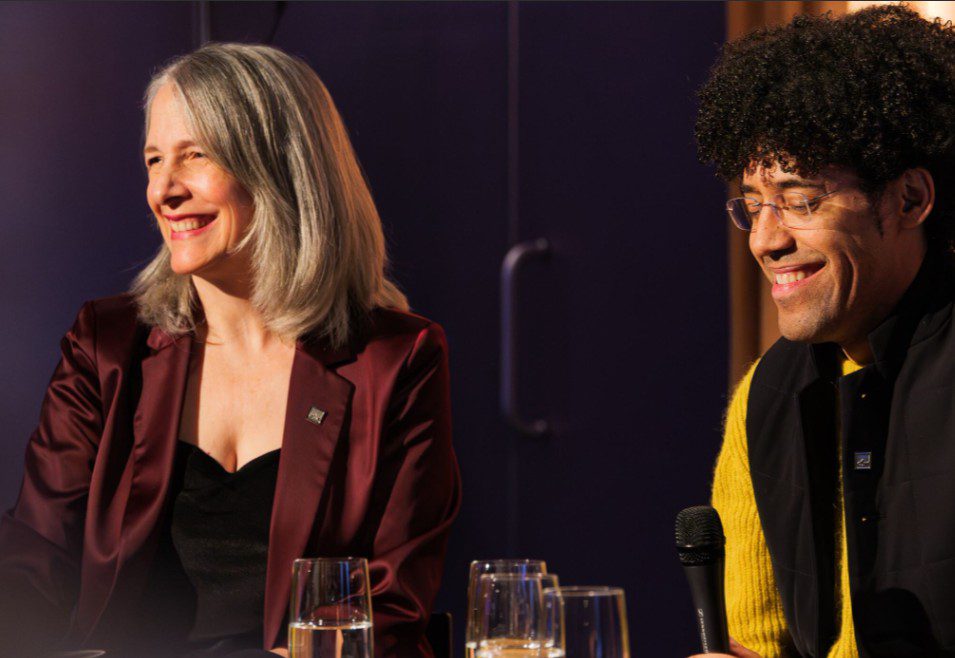
Conducting a tribute to an album released before she was even born, and doing so three times in the same weekend (December 13 and 14, 2025) at Maison symphonique, with the Orchestre Métropolitain, is the challenge that young conductor Léa Moisan-Perrier, trained under Yannick Nézet-Séguin, among others, is about to take on. In the interview she granted me, Léa tells us about her connection to André’s music, the pleasure of conducting such an iconic piece as the album Neiges, and also tells us a little about the rest of the program for these concerts, almost all of which are sold out. Indeed, Neiges will be accompanied by several other pieces, ranging from a traditional concerto by Antoine Gratton to choral music by John Rutter and a few appropriate Christmas carols.

INFO AND TICKETS (IF ANY REMAIN!)

This content was produced by PAN M 360 in partnership with La Vitrine, which also shares information about this OM program.

Publicité panam

Certainly one of Canada’s finest concert pianists, Quebec’s David Jalbert completed his recording of the complete cycle of piano sonatas by Russian composer Sergei Prokofiev this past fall. For the third and final recording of this cycle on the Atma Classique label, Jalbert brings together three key works: Sonatas Nos. 8 and 9, as well as the Sarcasms, Op. 17. Since his early teens, Jalbert has dedicated himself to mastering Prokofiev’s sonatas, exploring their full pianistic richness. Here, he explains the nature of these works, their structure, their technical challenges, and their expressive range. PAN M 360 reached him at his home in the National Capital Region, where he is a full professor of piano at the University of Ottawa. David Jalbert also embodies this repertoire on stage: the first of 3 programs was given this fall at Salle Bourgie, two others are planned for March and June 2026.

TO BUY THE ALBUM FROM ATMA CLASSIQUE, CLICK HERE

TO ATTEND PROGRAM 2 OF THE PROKOFIEV CYCLE AT THE BOURGIE HALL ON MARCH 5, 2026, CLICK HERE

TO ATTEND PROGRAM 3 OF THE PROKOFIEV CYCLE AT THE BOURGIE HALL ON JUNE 3, 2026, CLICK HERE

The annual tradition of Handel’s Messiah by the Classical Orchestra of Montreal continues this year. The crypt of Saint Joseph’s Oratory will be occupied for the occasion, on Thursday, December 11, 2025, by the ensemble under the direction of its brand new musical director, Andrei Feher, as well as by soloists Jacqueline Woodley (soprano), Camila Montefusco (mezzo-soprano), Adam Luther (tenor), and Jamal Al Titi (baritone). Les Filles de l’île and Les Chantres Musiciens will join them to form the choir. I met with the young conductor Andrei Feher to talk about this Messiah, his first with the ensemble, but also one of his first as he conducted Handel’s masterpiece for the first time only a year ago.

INFO AND TICKETS FOR THE MESSIAH BY THE CLASSICAL ORCHESTRA OF MONTREAL AT THE CRYPT OF SAINT JOSEPH’S ORATORY, ON DECEMBER 11, 2025 AT 7:30 PM.

Interview in French

Fifty years ago, an iconic album of Quebec, and indeed international, pop was released. André Gagnon’s Neiges shattered sales records and remained in the Billboard top 10 for six months! Twenty-five musicians were in the studio (including Jean Carignan), in addition to the backing vocalists, including Renée Claude. As the Orchestre Métropolitain prepares to pay tribute to this little masterpiece of instrumental pop (with some choral parts), why not revisit the memories of one of the musicians who played on it, percussionist Robert Leroux? Those famous conga solos in “Wow”? That was him! At the time, Robert Leroux was a very young musician, primarily associated with classical and contemporary music (as he has been throughout his life), but contracts and gigs in pop and advertising music were also on his radar. Here is a look behind the scenes of André Gagnon’s album Neiges, with a privileged witness, one of the few still alive to talk about it.

INFORMATION AND TICKETS FOR THE ORCHESTRE MÉTROPOLITAIN CONCERTS IN HOMAGE TO ANDRÉ GAGNON’S NEIGES

PANM360: How did you come to participate in this recording?

Robert Leroux : They were short a percussionist, so they called me in. It was my first time working with André. I was replacing the guy who’d been working with him before. I was keen to do it because I knew André wrote interesting timpani parts. Later, André asked me to keep on and do the shows. It was such a success! Honestly, we musicians who were there weren’t expecting it. “Wow” was the driving force, and the funny thing is, it was the song that was the least ready when we went into the studio.

PANM360: How did it go?

Robert Leroux : That was the last piece André wanted to add, but he wasn’t sure what he wanted. He had the melody in his head, but not the rest. He asked us to try things out, and we fiddled around for a while. I was trying out rhythms on the congas, but it wasn’t working. And then, at some point, we found the right balance between my congas, Jean-Guy’s (Chapados) bass, and André’s driving keyboard part. That worked!

PANM360: Absolutely! The bassline is irresistible, and the congas are unforgettable! And recorded with such presence! They are brought to the forefront in a spectacular way.

Robert Leroux : Yes. The sound engineer, Pete (Pierre) Tessier, did a very, very good job. The timpani were also well recorded. I’ve often worked with him and I’ve always appreciated his work. But you know, this solo really isn’t difficult. I had suggested other, more complicated rhythms, but my colleagues didn’t like them. So we settled on the now well-known, very simple formula.

PANM360: Were you generally well prepared, with the music sheets in advance and everything?

Robert Leroux : Except for “Wow,” everything was ready, everything was well organized by André. He was very well prepared. We didn’t have the sheet music in advance, but it was on the music stands when we arrived. It was well organized.

PANM360: What did you and others think when you first saw this? What was the atmosphere like?

Robert Leroux : I don’t know about my colleagues, but for me, it was initially just another job. I’d arrive, set up, and play. But with André, the atmosphere was fantastic. We had so much fun. Later on, when he asked if I could play in one of the touring shows, if it fit my schedule, I gladly went. It wasn’t really my thing; I was more into contemporary music, even though I still often recorded commercials (with Dompierre or François Cousineau). But whenever I had the chance to go back with Dédé, I always accepted, it was just so enjoyable.

PANM360: Difficulty level, nothing to report?

Robert Leroux : No, the music was quite simple, and besides, André had meticulously prepared everything. The only one that required a bit more work was “Wow,” as I said. He hadn’t fully developed that one in his mind. It was still a work in progress. Ultimately, it became THE hit of the album.

PANM360: What is your perspective on this? And on the fact that 50 years later, the Orchestre Métropolitain is paying tribute to him?

Robert Leroux :We weren’t thinking about it at all back then, when we were recording. But in our line of work, there are often surprises like that. I can’t say I’m surprised, but I certainly wasn’t expecting so much success when I was playing the parts. The stars really aligned at that time. If I had known, I would have negotiated my contract differently! (Laughs) At the same time, I’m not complaining; we were all paid fairly, according to the going rates at the time.

PANM360: Any thoughts on this musical style?

Robert Leroux : It was in the air. At that time, there was this movement to mix classical and popular music. It manifested itself through this kind of sound. It’s perhaps the modern equivalent of neoclassicism. Of course, the two styles are quite different, but in the principle of classical music, finding a specific language to reach a very wide audience, there are parallels to be drawn.

That said, Neiges is a rather unique album in André’s discography. His true style was long, romantic melodies, and he would return to this in the 1980s, using many strings or just the piano, focusing on it until the end of his career. Nelligan also belongs to this lyrical vein. So, Neiges remains a very particular creation.

PANM360: Did you often play with him afterwards for shows?

Robert Leroux : Sometimes, yes. But I also had a career in contemporary and classical music, which meant that at one point, I was replaced by Luc Boivin, who stayed with André longer. But every time I went, I really enjoyed it. André was incredibly talented, and he also put on a great show for the audience. He had the soul of an entertainer. He even did a tap dance number at one point in the show.

PANM360: I didn’t know this side of him… This tribute from the Orchestre Métropolitain, what do you imagine?

Robert Leroux : I’m not entirely sure, but I’m very curious to see how they’re going to transform all of this.

——————————————————————————————————-

Montreal since 1973, he was Vice-Dean of Undergraduate Studies from 1985 to 1988, and Dean from 1988 to 1997. In 2007, he participated in the founding of the Sixtrum Percussion Ensemble, which we have often talked about here at PANM360.

Credits for the album Neiges, according to the website Québec Info Musique : 

Musicians – 

André Gagnon: piano, synthétiseur, piano électrique; 

Mauricio Fuks: violin; 

Michel Fauteux: drums; 

Jean-Guy Chapados: bass; 

Gilles Pinard: guitar; 

Richard Ring: guitar; 

Marcel Rousseau: electric piano; 

Jean-François Roch: timbales; 

Richard Beaudet: flute; 

Robert Leroux: percussions, timbales; 

Jean-Carignan: violin.

Chords – 

first violins: Mauricio Fuks, Adolfo Bornstein, Reynald L’Archevêque, Pierre Jean Ireneusz Bogajewicz; 

seconds violins: Mario Masella, Denise Sergent, Claude Hamel, Françine Bang, Ronald Taddeo; 

altos: Marc Bélanger, Lorraine Desmarais, Charles Meinen, Sylvie Laville; 

cellos: Jean-Luc Morin, Michael Kilburn, Kristina Melnyk.

Choir: Renée Claude, Chœur des étudiantes de l’École Normale de Musique.

Arrangements: André Gagnon

Directed by: André Gagnon, Pierre Tessier

Sound: Pierre Tessier

Mixing: Pierre Tessier

Studio: studio Son Québec

Production: Les Disques Star inc.

Pouch and booklet –

Graphic design: Marcel Cadieux;

Photos: Jean-Guy Thibodeau

Based at Studio Bell in Calgary, a venue that deserves to be better known in Eastern Canada, the National Music Centre opened a satellite space in Montreal’s Quartier des Spectacles in mid-November, next to the new ADISQ headquarters. At the official opening of the location on Wednesday, November 19, a mural by artist Mathieu Potvin, entitled Merci Beau Dommage, was unveiled.

Andrew Mosker, founder, president, and CEO of the CNM, is a Montreal native who was committed to building a lasting extension of the institution in his hometown, with a particular focus on Francophone culture. He believes that the CNM’s arrival in the area could strengthen the Centre’s relationships with creators, artists, businesses, industry partners, and the public in Quebec and Eastern Canada.

This initiative is based on ties forged over the years between the CNM and the Quebec music scene, starting with ADISQ, its immediate neighbour. More specifically, the Montreal location will host numerous activities showcasing the CNM’s capacity to present musical events, thematic exhibitions and other activities befitting such an institution whose purpose is to “stimulate the love, sharing and understanding of music, as well as preserve and celebrate the history of Canadian music from its premises at Studio Bell, in the heart of Calgary’s East Village.”

Since Andrew Mosker was in Montreal, as he is again this Saturday, December 6, in the context of a multigenerational show presented at the chic 9e, featuring in particular Montreal veteran Andy Kim in order to raise funds for sick children, Andrew Mosker granted this interview to PAN M 360.

More information about the CNM space

Andrew Mosker, Photo: Sylviane Robini

PAN M 360: First, let’s catch up a bit: how did it all start?

Andrew Mosker : In the early 2000s, I sold the idea to benefactors in Calgary. Patrons, therefore private funds. Today, about ten private foundations, mostly based in Western Canada, but also major groups like TD, RBC, and Power Corporation, are funding our project.

PAN M 360: What did you do before?

Andrew Mosker : I was, and still am, a pianist. I studied music at Grant MacEwan University because the music program had a pop, commercial, and jazz focus. It was a very good program. I followed that program to learn arranging, soloing, and improvisation.

Right after that, I started my career in Alberta; I wanted to be involved in performance. I tried that for a few years.

Then I realized I wanted to stay in the music industry, less as a performer and more by helping the ecosystem thrive. I met some benefactors, including the city of Calgary, which wanted to revitalize a run-down, abandoned neighborhood. There was also an old hotel there, the King Edward, whose bar was a home of the blues, a bit like Bistro à Jojo in Montreal. The city bought the building, and we participated in the beginning of the neighborhood’s revitalization plan. That was 25 years ago. At that time, I was traveling the world and noticed that Canada didn’t have a national music museum. So many Canadians couldn’t discover the works of Robert Charlebois, Leonard Cohen, Nickelback, Céline Dion—all these artists inducted into a space with exhibitions, collections, recording studios, and so on. The Junos had already considered it but hadn’t created the necessary conditions to make it happen.

PAN M 360: It’s still pretty special that it finally happened in Calgary. It was all because of you!

Andrew Mosker : Yes, because of me, but also because of the benefactors. We could also count on the support of Stephen Harper, who came from Alberta and who welcomed the creation of such a center in Calgary. In his inner circle, Stephen Harper counted several conservative music enthusiasts who wanted a center independent of the state. And the mayor at the time, David Bronconnier, wanted to revitalize the neglected East Village neighborhood, where the hotel was located. For us, the timing was perfect.

PAN M 360: The structure of such a cultural center is somewhat American-style, actually. More privately funded, independent of the state.

Andrew Mosker. Yes, exactly. But there are still government resources available—federal, municipal, and provincial. We renovated the King Eddy building, then built around it, expanding from 25,000 square feet to 160,000.

PAN M 360: And how did you bring together the Canadian music ecosystem to create the center?

Andrew Mosker : I convinced various organizations across the country, such as ADISQ and CARAS, to join us in creating this space dedicated to celebrating Canadian music. We reached agreements with these associations. Today, the CNM/NMC boasts five distinct spaces. We have a team of 37 full-time staff and numerous volunteers from across Canada.

PAN M 360: It is also a museum.

Andrew Mosker : Lively and interactive. Our permanent exhibitions account for 30% of our offerings, while our travelling exhibitions make up the remaining 70%, with 5 to 8 new exhibitions each year. The exhibitions vary in size, and we utilize 22 immersive galleries to accommodate them. We also have recording studios where you can even use instruments from our historical collection, such as a Keith Emerson Moog synthesizer or a Randy Bachman amplifier. Artists come here for residencies and to record. From Quebec, we have been visited by artists such as Diane Dufresne, Émile Bilodeau, Klô Pelgag, and Louis-Jean Cormier.

PAN M 360: The approach is multi-genre, then.

Andrew Mosker : Yes, it ranges from North American popular music to classical. The spirit of the center is inspired by American or European centers, such as the Cité de la Musique in Paris.

PAN M 360: And now you have an extension of the center in Montreal. It took an English-speaking Montrealer to fully grasp the issue!

Andrew Mosker :Exactly. I lived in Montreal for a good part of my life, and the French language greatly influenced my music career. I also know that Montreal’s music scene is still very creative and innovative. So, when I moved to Alberta and had the opportunity to build and improve the music ecosystem, I brought my Montreal experience with me.

Now, with this 3,000-square-foot space, I want to participate in the music ecosystem of Quebec and Eastern Canada. I want to build a bridge so that our Quebec counterparts understand what we do in Alberta and how we can bring everything we do, such as preserving our national musical history.

Even today, you know, there are many people in Canada who don’t realize that Oscar Peterson, Joni Mitchell, Robbie Robertson, Leonard Cohen, or Glenn Gould are Canadian artists. Music lovers should also be reminded of the contributions of Francophone artists like Beau Dommage, Charlebois, Dufresne, and others.

That too is a challenge.

The countdown is over for MikeZup: it’s time to hang up the mic and make way for the next generation, the rapper announced in an Instagram post, on the sidelines of the release of his latest project.

Rather than an impulsive act, this decision stems from a reflection that began several years ago. “In 2019, I promised myself that if I didn’t reach a certain level before I turned 30, I would have to consider moving on to something else,” he explains. Today, the artist has chosen to focus his energy on supporting the next generation of artists he is developing within his label, 630MG, a role in which he feels completely at home.

For his final hurrah, the thirty-something unveils Compte à Rebours (Countdown), a hard-hitting project—the most refined and accomplished of his career. Surrounded by a roster of key artists from his musical journey, the Saint-Michel native shines in a decidedly drill and trap universe. Reflecting his new life realities, MikeZup moves away somewhat from the raw gangsta rap that long defined his work, exploring lighter sounds, notably on the excellent track “Cavale” with Souldia.

With this final offering, he opens a last window onto a troubled, yet very real, life. True to form, the lyrics are powerful, genuine, and sincere. These forty minutes of music flow seamlessly, allowing him to take a grand bow.

A few hours before the release, PAN M 360 chatted with him about his recent social media announcement, the creation of Countdown, his future ambitions and much more.

PAN M 360: First of all, tell me about your social media post in which you announced that this is your last career project. What is the reason behind this decision?

MIKEZUP : I’d been thinking about it for a while. I turned 30 this year, and when I released MAUVAISE HUMEUR in 2019, I promised myself that if I didn’t reach a certain level in my career before I turned 30, I’d have to consider moving on. Since then, a lot has happened: I’ve started a label, I’m managing other artists… I have less time for myself, and I’m more focused on other people’s careers. And I really enjoy it.

PAN M 360: And precisely, what was this level you were aiming for at the time?

MIKEZUP : I would have liked to go to Europe. I did manage to get to a respectable point, but I would have preferred to leave Quebec and live 100% off my music. Today, I have to do more collaborations with other artists to make a living, and that’s okay too. But I think I’m going to focus more and more on my own artists. It’s a win-win situation.

PAN M 360: In your post, you state that it’s time to make way for the next generation. Where did this idea come from? Did your role within the label play a significant part in it?

MIKEZUP : Exactly. The artists I manage are all younger, in their 20s. When I started taking music seriously, I was about that age. Now, I know what to do and what to avoid. I know the mistakes I’ve made. I think I’m a good leader for the next generation.

PAN M 360: Let’s come back to that later. First, let’s talk about your new offering, Countdown. What is the narrative thread of this project?

MIKEZUP : Comptes à Rebours, the title alone announces the theme: this is my last album. The countdown is over. As I said, I set myself a deadline of 30, and here we are. The collaborations are mostly with people I’ve worked with in the past and whom I appreciate. It was a way of coming full circle with the artists who have been important in my journey.

PAN M 360: What made this project so significant that it could potentially be your last?

MIKEZUP : Unlike my other projects where I was very productive—I could record three or four albums in a year—this one took an enormous amount of time. We started in December 2024 and finished it last month. That had never happened to me before. I put my heart and soul into it. I like the result; it has a very fresh sound. Before, I sometimes used older tracks from my archives. Not this time. Everything is new. I’m proud of it.

PAN M 360: Which track are you most excited for your audience to discover?

MIKEZUP : I have two. First, “Pierre Tombale” with Izzy-S. This collaboration was highly anticipated. Throughout my career, people kept telling me to do a song with him, but it never happened. It’s finally the last song we recorded for the album. The sound is killer, and Izzy-S has a similar journey to mine. We both went through significant weight loss, so we made a solid gym beat.
And then there’s “Cavale” with Souldia. I love the vibe of that track. It’s a song that can be listened to anywhere and by anyone. I’d say those two.

PAN M 360: Does this collaboration with Souldia reflect the new sounds you are exploring on the album?

MIKEZUP : Yes, exactly. And even if I say this is my last album, I’ll continue making music here and there. I want to continue exploring these more mainstream sounds. All the harder stuff, gangsta rap, hardcore… I’m leaving that behind.

PAN M 360: And why do we one day feel the need to turn the page on this type of sound?

MIKEZUP : My children are growing up. That’s the main thing. My old songs reflected a lifestyle I no longer have. I’ve changed: I’ve moved on to other things, I’m more settled in my life. I’m a father. My children listen to my songs and are starting to understand what I’m saying. It makes them think. I love making music, but I want to make music that everyone can listen to.

PAN M 360: What word best summarizes the Compte à Rebours creation process?

MIKEZUP : Emotions. There were a lot of them. We had a few disagreements with the producers here and there—nothing serious—but there was a lot of logistics, a lot of adjustments. We sometimes redid a mix 15 times. We were meticulous. Details we would have overlooked before, we didn’t neglect this time.

PAN M 360: What would you say to MikeZup when he was starting out in the business?

MIKEZUP : When I started, I had no expectations, and I think that was the best way to make music. When you start having expectations, you inevitably end up being disappointed. When it became too serious and I had to sell albums to pay for my things, it started to stifle my creativity. If I could talk to myself, I’d say: keep going, just focus on making music. And if all else fails, make a backup plan so you can continue to create freely.

PAN M 360: What is your best career memory, as an artist?

MIKEZUP : There are so many. I’ve performed on big stages, I’ve collaborated with important figures in Quebec rap, people I listened to when I was little. My feature with Sans Pression, for example, was a defining moment in my career as an artist. He’s an artist I’ve listened to forever. It was symbolic, almost magical. I’ll always remember it.

PAN M 360: After the music, who is MikeZup? Does that scare you a little?

MIKEZUP : Yes, a little. I’m worried because I’ve been making music since I was 11. I’ve always been known as MikeZup the rapper. Now, it’s like I’m shedding that label to move on to something else… something I don’t know yet. But I tell myself that life has a way of working out. Yes, it creates stress, but it’s a positive kind of stress.

Photo Credit: JRDN PHOTOGRAPHY

Five times between December 17th and 20th, Fred Pellerin and Kent Nagano reunite for the seventh time at the Maison symphonique, presenting their seventh symphonic tale, a practice that has become a holiday tradition. Fred’s next story promises to be a new chapter in the joyful mythologizing of Saint-Élie-de-Caxton, a Mauricie village that has acquired a reputation comparable to Natashquan.

Here is the beginning of the narrative: “The story of the origin and founding of Saint-Élie-de-Caxton was long a mystery. What happened on the first day of the municipality’s existence? How did it become a village? The first three pages of the municipal archives having been torn out, the matter had always remained secret and shrouded in mystery. Today, thanks to numerous lively collections and cross-referencing of approximations, the truth is finally revealed. There was a world, a church steeple, a priest, and a widow… and, one day, a child with white hair. And the village was born!”

It will also be about nativity, the unexpected conception of a child without a known father… and an interaction between storytelling and the orchestra, serving Fred Pellerin but also Beethoven, Wagner, Hindemith, Berlioz, John Adams, Yuliya Zakharava, and even Jacques Michel! At home in his village, which has become legendary thanks to him, Fred Pellerin recounts this chapter of his symphonic adventure with Maestro Nagano.

This content was produced by PAN M 360 in partnership with La Vitrine, which is disseminating information about this OSM program.

Publicité panam

For its second concert of the season, the University of Montreal Orchestra (OUM) will focus on the instrumental families that make up an orchestra. Led by the bassoonist and associate professor at the Faculty of Music, the orchestra’s students, whose wind section is particularly prominent in this year’s ensemble, will respond to the intimate and dynamic interplay of the strings in a concert where the orchestra’s diverse colors will interact in varied instrumental dialogues. This is an opportunity for young musicians to listen to different timbres and pay attention to the interplay between their respective instruments and the others, which can take on a new perspective in works ranging from Dukas to Hindemith, Mendelssohn, Mozart, and Brahms.

With Alexandre Villemaire of PAN M 360, Mathieu Lussier discusses these elements as well as his role as an educator in the orchestra as a conductor for students.

Mendelssohn, Brahms et Hindemith :dialogues in color

Mathieu Lussier, conductor 

Yukari Cousineau, alto (solo violin of the Metropolitan Orchestra)

Musical program

Wolfgang Amadeus Mozart 
Divertimento en ré majeur, K.136

Felix Mendelssohn 
Overture in C major for wind instruments, Op. 24

Paul Hindemith
Der Schwanendreher (Concerto pour alto)

I. Zwischen Berg und tiefem Tal (Entre montagne et vallée profonde) 
II. Nun laube, Lindlein, laube ! (Maintenant couvre toi de feuilles, petit tilleul !) 
III. Variations : Seid ihr nicht der Schwanendreher ? (N’êtes-vous pas le cuisinier chargé de rôtir le cygne ?) 

Intermission

Paul Dukas
Fanfare pour précéder « La Péri »

Johannes Brahms
Sérénade no 2 en la majeur, op. 16 

I. Allegro molto 
II. Scherzo. Allegro non troppo – trio. Poco più moto 
III. Adagio non troppo 
IV. Menuetto I – Menuetto II 
V. Scherzo. Allegro – Trio 
VI. Rondo. Allegro 

TICKETS AVAILABLE HERE

Pianist, composer, arranger, teacher and conductor Julian Gutierrez Vinardell regularly offers jazz and world music evenings with his students at the Claude-Champagne Room of the University of Montreal. One of them was the subject of an excellent interview with my colleague Michel Labrecque last spring. This time, another of these attractive Latin evenings will serve as an antidote to the cold and the growing darkness of this seriously wintry December. It will take place on Monday, December 8, 2025, still at the Claude-Champagne room. I met Julian to talk about this concert in particular, and his program choices (including Michel Legrand’s Waltz of Lilacs, in a Latin version, of course!). Note that, as usual, the concert is completely free.

INFOS

As cold and snowy weather becomes more frequent, Cruzito recently unveiled the perfect remedy: La Voix du Barrio, his first project where French is at the forefront.

A veteran of the international Latin scene, the master of reggaeton has surrounded himself with 13 big names from here — including Rymz and Imposs — to transport us to where it is hot and where everything becomes possible.

Stepping outside his comfort zone, the Quebecer of Honduran origin had only one goal: to offer a resolutely multicultural Latin fusion, deeply Montreal at its core. And it must be said, he has more than succeeded. The result is a sweet, cohesive, vibrant project that unites his roots and his local identity in a single breath. Without a doubt, Cruzito has the recipe for a hit, regardless of the language.

PAN M 360 spoke with him to learn more about his creative process between Latino, pop, rap, R&B and Afrobeat, his motivations behind La Voix du Barrio, the place of Latin music in Quebec and the projects that await him.

PAN M 360: One week after the release of La Voix du Barrio, how are you feeling and how are you experiencing the first reactions from the public?

CRUZITO : Listen, so far so good, I’m really happy with the response so far. I’ve received a lot of positive feedback on social media, from all walks of life and different communities. Even after 20 years in the business, I still consider myself an emerging artist because this is my first entirely French-language project. I usually cater mainly to a Latino and Spanish-speaking audience. Now, I’m discovering a new openness from people, who seem surprised—but in a positive way—by this side of me. It really touches me. The project is still very new, so I’m eager to see how it will evolve in the coming weeks and months.

PAN M 360: What motivated you to break out of your routine and attempt an artistic approach like this?

CRUZITO : I’ve always been a huge fan of French-language music. I’ve lived in Quebec for a long time, and for me, it was natural to want to fuse my two cultures. Yes, I’m Latino and very attached to my roots, but I also grew up here. Quebec welcomed me, my friends speak French, I watch French TV… The idea had been on my mind for a long time, but I didn’t want to disappoint my Latino audience. In the end, it was a significant, but necessary, challenge to show Quebec who I truly am as an artist.

PAN M 360: How would you describe the sonic identity of this record?

CRUZITO : It’s definitely a Latin fusion, because I always want to showcase our culture. But I also often talk about the Montreal Sound, an identity that comes from the mix of influences and the journeys of local artists. It creates an authentic sound, unique to Montreal, and that’s exactly what I wanted to highlight. It’s a blend of my roots and what I experience here. The title “La Voix du Barrio” reflects that: it’s Latin, Francophone, and very Montreal.

PAN M 360: The contrast between the release in the middle of winter and the warmth emanating from the album is striking. Was this intentional?

CRUZITO : Yes, absolutely. I’ve often wanted to release my projects in the summer, because that’s when everyone goes out, parties, and dances. But this time, I wanted to bring some light during a period when many experience a certain seasonal gloom. The idea was to offer something to warm up the cold evenings. And despite the winter release, I fully intend to keep the album shining next summer.

PAN M 360: What was the first piece created for this adventure, the one that made you want to push La Voix du Barrio further?

CRUZITO : It’s funny, because the first song was entirely in Spanish, very commercial and very Latin. Then my manager suggested I do a French version and invite a local artist. We contacted several people, and Adamo—who’s a friend—immediately jumped on board. That was really the spark for the project. From that collaboration, I started to imagine a larger work, with several local artists. That’s when, about a year and a half or two years ago, everything started.

PAN M 360: There are thirteen collaborators on your project. What did this diversity bring you creatively?

CRUZITO : Often, artists work within the same circle and hesitate to share the spotlight. For me, as a Latino immigrant, it was important to show that I’m here to collaborate and be an ally. I wanted it to be a collective project. And since this is my first creation in French, I wanted to surround myself with local talent to achieve the result I was looking for. The feedback on the collaborations has been really positive, and that makes me proud.

PAN M 360: If you had to choose only one collaboration from all those in the project, which one would you highlight, and why?

CRUZITO : I would say the opening track, LA VOZ. It sets the tone for everything people are going to hear. I created it with Gabriella Olivo, a Mexican-Quebecois artist who was recently nominated for an ADISQ award. I have a lot of faith in her. It was important to me that the first track be in Spanish, to pay tribute to our mixed heritage. I have a great affection for this song.

PAN M 360: Since 2020, you have been managing Joy Ride Latino, the Latin division of Joy Ride Records. What is your role and what are your ambitions?

CRUZITO : I help the label find promising artists and support them in their development. I’m also a project manager for various projects. For now, we don’t have many artists, but we hope to sign one or two soon. We’re working with Mariana Gueza, a Mexican artist who lives here. Joy Ride Latino is really about showcasing local Spanish-speaking talent. There’s so much potential in Montreal, but we don’t always have the resources. Our mission is to change that.

PAN M 360: How do you perceive the current state of the Latino scene in Quebec?

CRUZITO : I’m pleased with the progress. Five years ago, a festival like Fuego Fuego probably wouldn’t have been possible here. Now, we see Latin artists filling the Bell Centre or performing at festivals. The Latin music scene is exploding internationally, and we’re feeling it. In Quebec, we’re a little behind, but support is growing. We have to keep working, keep knocking on doors. Projects like mine help put our artists in the spotlight. I’m convinced that Quebec will catch up with other major North American cities.

PAN M 360: What’s next for you?

CRUZITO : I would like to continue in this direction and create other projects of the same kind. I’m eager to see how the work will fare at festivals, and I hope to receive support from programmers and presenters. I want to perform more live and raise my profile. I’m keeping my fingers crossed that I’ll play more concerts in Quebec and continue to showcase my art.

Photo Credit: Le gars des archives

Essential works such as Handel’s Messiah and J.S. Bach’s Christmas Oratorio are partially performed by the ensembles Caprice and ArtChoral, both conducted by Matthias Maute, also a virtuoso recorder player. In collaboration with the Festival Classica, Caprice and ArtChoral present a “luminous” program featuring Bach’s cantata Jauchzet, frohlocket, Handel’s ever-popular Hallelujah, and Part 1 (Nativity) from Messiah, as well as an original composition by Matthias Maute, Hallelujah.

Program :
Matthias Maute
, Hallelujah
Johann Sebastian Bach, Oratorio de Noël BWV 248, Cantate I Jauchzet, frohlocket
George Frideric Haendel, Le messie HWV 56, Part I (Nativity)
George Frideric Haendel, Le messie HWV 56, Part II: no. 44. Choir: Hallelujah

TICKETS AND INFO HERE

Their friendship began in Haiti, specifically in Pétion-Ville, 11 years ago. Today, they both live in Montreal and have decided to continue their artistic collaboration. Behind Kwaliti are Ronald Lebeau and Alain Jean Louis, as well as their behind-the-scenes producer, Fridody Jean, and together they created the album Caribbean Groove 7 Renaissance, a blend of Haitian sounds and Afropop with a Caribbean twist. The album was released on November 14th, but it became available on all platforms on November 18th, an important date commemorating the Battle of Vertières. The choice of December 5th for the concert at Balattou is also significant, as it’s another date marking the discovery of Haiti. Our journalist Sandra Gasana spoke with the duo for PAN M 360 a few days before their concert.


Subscribe to our newsletter

Inscription
Infolettre

"*" indicates required fields

Type of Suscribers