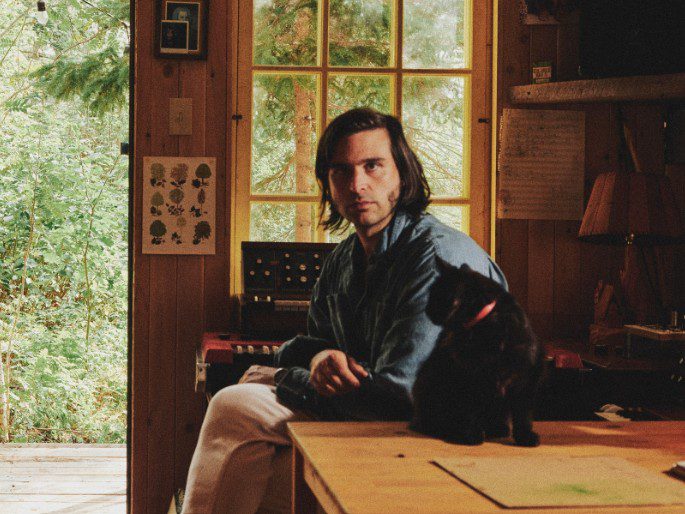
Irem Bekter has lived in Quebec for 18 years. Before that, she lived in Argentina, Mexico, the United Kingdom, and Turkey, her native country. Having worked in theater and dance, this multidisciplinary artist now focuses her work on music. Her broad cultural background and independent spirit have led her to release a new album, This Winding Road, on Friday, April 17. Produced by none other than the highly talented Jean Massicotte (Arthur H, Pierre Lapointe, etc.), this album takes us on the winding roads of her long journey, drawing inspiration from each stage: Ottoman melodic segments, Balkan influences, electric jazz, electrotango, dub-reggae, Spanish-language rap, groove, and more. The Montreal launch concert is scheduled for that same Friday (Le Ministère), after which Irem Bekter will perform in Sutton on April 25 (La SAG), in Toronto on April 30 (Drom Taberna), and in Quebec City on May 2 (Morrin Centre). And since it’s never too late to express oneself, Irem Bekter offers a dozen original songs in which she explores childhood, love, friendship, exile, and resilience through laughter, loss, and even forgetting. What’s more, Irem Bekter is also involved in supporting seniors with declining independence—another sign of her great humanity.
VISIONNEZ CETTE INTERVIEW !
Directed by Michel Faubert, a leading expert on the future perfect tense in traditional music, Le Vent du Nord’s new show returns home between two legs of its international tour. The flagship of the trad keb scene will focus primarily on the album *Voisinages*, interspersed with the group’s classics. It will also be an opportunity to discover the talent of André Gagné, a multi-instrumentalist and singer who has found his place within VDN. Dédé is, in fact, part of the conversation that follows; here, he joins Nicolas Boulerice to talk to us about this new show by the fiery quintet, featuring new staging, new set design, new projections, and new lighting. We’re chatting with Le Vent du Nord!
WATCH THIS INTERVIEW!
Publicité panam
Publicité panam
How does one become a singer-songwriter capable of churning out hit after hit on FM radio? Let’s take a look at Gabriel Fredette, who has given us radio hits like Triste automne, À deux, À quoi ça sert, Serre-moi dans tes bras, and Je te choisirai, to name just a few. At 24, this former firefighter is undoubtedly one of the stars of Quebec and Francophone popular music, a true specialist in the art of expressing love through song. On the day of the release of his very first album, April 8, we met with him at Éditions Bloc-Notes so he could tell us about himself, just as he does in rhyme on the album Qui je suis, released on the Maison Rose label.
PAN M 360: I heard you started out as a firefighter. Are you still one?
Gabriel Fredette : No, I stopped doing that last August. Because at that time, I was focusing on music.
PAN M 360: Where are you from?
Gabriel Fredette :I’m from Saint-Hyacinthe.
PAN M 360: Were you a firefighter in Saint-Hyacinthe?
Gabriel Fredette : I was a firefighter in Trois-Rivières for a year and a half.
PAN M 360: Back in the day, Saint-Hyacinthe was the Liverpool of Quebec. So many bands from the 1960s flocked to Saint-Hyacinthe!
Gabriel Fredette : My grandfather had a band when he was young, but he never really talked to me about that time.
PAN M 360: So you went to work in Trois-Rivières. Did you start making music there?
Gabriel Fredette : I’ve always played music. I started playing the violin with my grandfather, who introduced me to music, and then my family paid for me to take violin lessons for about three years.
PAN M 360: And after that, you learned to play instruments—we can imagine what happened next.
Gabriel Fredette :That’s right. I play the piano and the guitar. Singing came later. It really took off in 2023, when I competed on La Voix—the recordings aired in 2024. That was my first real professional experience in music… A wonderful experience that taught me a lot.
PAN M 360: You were taught how to make good FM pop. Is that what you’re doing?
Gabriel Fredette : Yes. It’s French-language pop, but it’s also folk. I have some songs that are more folk-oriented and others that are pretty pop. There’s always a guitar—an acoustic guitar.
PAN M 360: Kind of like Ed Sheeran.
Gabriel Fredette : Yes, and Noah Kahan, Lewis Capaldi, and Chance Peña, too.
PAN M 360: I imagine you listened to singers like them when you were a teenager.
Gabriel Fredette : Yes, though I listened to a lot of Céline Dion—my dad is a huge fan. When I was a teenager, I mostly listened to songs in English. And I’d say my love for Quebec music came later. It’s become a cause for me. Quebec teens don’t listen to French-language music; I find that boring, and that’s why I wanted to dive into it 100%, but also by focusing on social media like TikTok and Instagram. It’s easily accessible for young people like me—I’m 24. There are a lot of young people between the ages of 10 and 20 who listen to music. I think it’s fun to bring these young people back to French-language music.
PAN M 360: Who are your influences in French-language music? Who do you admire?
Gabriel Fredette : I’d say Louis-Jean Cormier—one of the artists I listen to, especially for his lyrics. I also listen to Fredz, who is of French origin but lives in Quebec. I’ve also listened to quite a bit of KEB rap, like Koriass, Loud, or Rymz, who’s also from Saint-Hyacinthe. KEB rap lyrics have influenced me too, since I listened to a lot of it, just like people my age. I didn’t listen to much English-language rap, though.
PAN M 360: In any case, you have an innate sense of melody, catchiness, and the dramatic progression of a song!
Gabriel Fredette : Thank you. I want to capture the emotion.
PAN M 360: Your writing focuses on interpersonal relationships, especially romantic ones; there’s a lot of romance and innocence in it.
Gabriel Fredette : That’s not bad. These are personal relationships I’ve actually experienced. Intimate stories, yes.
PAN M 360: You decided to dive right in. You’re definitely not afraid of emotions!
Gabriel Fredette : Absolutely. I’m an open book; I’m capable of being vulnerable.
PAN M 360: That’s clear! You really open up. I don’t know how autobiographical it is, though.
Gabriel Fredette : All these stories are true, I’m telling you. They’re my stories or those of my friends, some of whom also write songs—like my friend Justin Roy. Also, I don’t always write my songs from start to finish; I sometimes collaborate with other artists. We rent cabins together sometimes, and we start writing songs.
PAN M 360: A classmate from your other group, the Middle Class.
Gabriel Fredette : There are four of us in Classe Moyenne (Phil Rxcket, Justin Roy, and Zach Chico)—everyone sings and plays multiple instruments. I get to bring out my violin! On stage, we’re joined by a DJ/producer, and there are lots of visuals. It’s a very different energy from my solo work. Each of us has original songs. The goal was to showcase each artist through this project. It’s pop, folk, and also country. We have all that in common, and we often write together. We also write for other artists.
PAN M 360: How has your work as a lyricist evolved?
Gabriel Fredette : I always try to broaden my horizons. I read other songwriters’ work, and sometimes poetry that I buy at the local bookstore. It’s become a hobby. But what matters most is having new experiences and turning them into songs.
PAN M 360: To be so comfortable expressing your emotions, you must have had really great parents who let you flourish in that way!
Gabriel Fredette : Absolutely. My mother is older than my father; she had already had a family before, and then she started a second family with my father. I get along well with everyone; I grew up in an environment where everyone really loves one another.
PAN M 360: Where are you based today?
Gabriel Fredette : I live with my musician friends in Saint-Mathieu-de-Laprairie, not far from Saint-Constant.
PAN M 360: Do you plan to continue “specializing” in pop-folk love songs?
Gabriel Fredette : Absolutely. I love the team I work with. I love the artistic direction I’m taking, and I also love the work my label, Maison Rose, is doing under Benjamin Nadeau’s leadership, as well as my editor Diane Pinet at Bloc-Notes, not to mention Martin Véronneau at Local 9 for radio tracking.
PAN M 360: Your stage performances seem to be focused more on the band Classe Moyenne, at least for now. At Club Soda this week!
Gabriel Fredette : Yes, we’ll be touring extensively over the next few months. The balance will shift after that. In 2027, my solo tour will take up more of my time, but I’m already performing songs from this new album, and I already have about twenty dates lined up for 2027.
PAN M 360: And who’s your audience? More girls than guys, right?
Gabriel Fredette :Yes. There are definitely a lot more girls.
PAN M 360: I’d say there are about four girls for every guy who comes to see you and is dating one of those four girls.
Gabriel Fredette : That’s right… But the audience is pretty diverse—it ranges from 16 to 40 years old.
PAN M 360: So you’re going to keep going in the same direction, I guess?
Gabriel Fredette : Well, yeah, that’s my niche. I’m in this field and I love what I do. I’m on X.
PAN M 360: This is your first album, but you’ve released several songs before.
Gabriel Fredette : Yes, since appearing on La Voix in 2024, I’ve been releasing singles. I also released a 6-song EP in November 2024 (Forêt Noire) and another 4-song EP last March (Je te choisirai).
PAN M 360: On stage?
Gabriel Fredette : Max Lalanne and Kaven Girouard are with me, and there are also pre-recorded segments to round out my two main acts. It’s more intimate than Classe Moyenne, which is all about the party. On May 9, I’ll be opening for a French artist, Yuston 13, at MTELUS.
PAN M 360: Thank you, and good luck with everything from here on out, young man!
On April 30 and May 2, the celebrated Russian pianist Yulianna Avdeeva will play Fryderyk Chopin’s Piano Concerto No. 1 with the Montreal Symphony Orchestra conducted by Simone Young. We reached her to talk about it with her.
PANM360: You are known to the international public for winning the Chopin Competition in 2010, can you tell us something more about your relationship with the Polish composer and with Concerto No. 1?
Yulianna Avdeeva: Concerto No. 1 is a very special piece, full of lyricism, and in some way also the one that closes the composer’s youthful compositional phase. I find, in general, that the works of the more mature Chopin are of greater depth than those of the younger Chopin: for this reason, I try to deal more often with the later works. In the case of the Concertos, however, the piano is really highlighted, and it is always a great pleasure for me to play both of them.
PANM360: On this occasion you will play with the Montreal Symphony Orchestra, can you tell us how you feel about sharing the stage with this orchestra?
Yulianna Avdeeva: For me it is the third time in Montreal, after 2015, when I played Stravinsky with Kent Nagano, and 2025, when I played the complete Preludes and Fugue op. 87 at the Lanaudière Festival. I’m really excited to play again with an orchestra of excellent musicians and in a hall with amazing acoustics!
PANM360: You are active both as a soloist and with orchestra, do you think there are differences between these two ways of performing? Which ones?
Yulianna Avdeeva: In a recital, I am totally responsible for the outcome of my performance and on a physical level I have a lot of space to share the music with the audience in the room. These two aspects are at the same time a great advantage, but also a great responsibility. In a concert with orchestra, however, the responsibility is shared with all the musicians, and the physical space is much more restricted. All this happens, however, in the name of the spontaneity of making music together. These are two rather different experiences, which I love in equal measure.
PANM360: You have a leading career in the international classical music scene, what can you tell us about your path?
Yulianna Avdeeva: I don’t really like to think of my musical activity in terms of a career, because for me there is music, piano and repertoire and everything I do revolves around these aspects. Clearly, winning a prestigious competition like the Chopin has opened many prestigious doors for me, but I prefer to think in terms of artistic objectives and I consider myself privileged to carry out this activity which is also a responsibility.
PANM360: Can you tell us about your upcoming musical commitments?
Yulianna Avdeeva: Last year, as I said, I performed the complete Preludes and Fugue op. 87 by Shostakovich, this year I am dedicating myself to Bartók’s Concertos. Next year will be the time for the first volume of The Well-Tempered Clavier and the premiere of a contemporary piece written for me.
PANM360: We can define you without a shadow of a doubt as a very successful pianist, do you have any advice for emerging pianists?
Yulianna Avdeeva: The most important thing is the passion for music, as I always say to the young people I meet during masterclasses. Then, you have to find your artistic voice in a way that doesn’t copy any other performer and doesn’t put the emphasis on technique. I say this because the primary aspect of playing in public is to share emotions with others, so I encourage young people to follow their artistic instinct and their interpretative individuality!
Photo Credit: Maxim Abrossimow
The “Great Romantics” series presented by Pro Musica continues this Sunday at Salle Pierre-Mercure, April 12, with the duo of Armenian cellist Narek Hakhnazaryan and his pianist colleague Georgy Tchaidze, who is of Russian-Georgian descent. Together, they will perform a mix of Russian, Armenian, and Georgian music that is both romantic and modern. Modern composers Tsintsadze, Bagdasarian, and Harutyunya are indeed part of the romantic lyricism tinged with Caucasian folk colors. Our 37-year-old interviewee is no slouch: First Prize and the Gold Medal at the 14th International Tchaikovsky Competition at just 22 years old, Narek Hakhnazaryan is one of the most sought-after cellists of his generation. For his part, his colleague Georgy Tchaidze won First Prize at the Honens International Piano Competition in 2009; he was also artist-in-residence at the Queen Elisabeth Music Chapel in Belgium, under the artistic direction of our very own Louis Lortie. This more than justifies this interview, conducted in English with the very affable Narek Hakhnazaryan.
Once upon a time, there was a modern Quebec composer, one of the most performed in the world, who wrote a concerto for violin, cello, and piano with a large orchestra. Few were his colleagues who had dared to do that. Only one, really, had created a masterpiece (and what a masterpiece!): Beethoven. Hétu’s concerto (which is called the Triple Concerto, like its illustrious predecessor) was played only once in its intended form, on July 26, 2003, at the Amphithéâtre de Lanaudière under conditions, they say, that were not very favourable (which had nothing to do with the quality of the performers at the time, OSM/Jacques Lacombe and Trio Hochelaga, but rather due to temperature issues and the arrangement of the musicians because of a nearby choreographic performance). As a result, and with the exception of a chamber interpretation at the Conservatoire de Montréal in 2025, no ears have had the opportunity to appreciate this music since.
INTERVIEW WITH ANNE ROBERT ON THE HISTORY OF THIS CONCERTO (Watch the video interview below)
On April 17, 2026, at the Maison symphonique de Montréal (which didn’t even exist in 2003!), the “resurrection” of Jacques Hétu’s Triple Concerto will take place in due form. One could even say that it will be its true birth, given that the conditions will, this time, be perfect. For the occasion, the Orchestre métropolitain (OM) will be conducted by François Leleux, and the solo performers will be the three members of the Trio Hochelaga (for whom the concerto was written), namely Anne Robert on violin, Dominique Beauséjour-Ostiguy on cello, and Dantonio Pisano on piano. Hétu (who passed away in 2010) will also have the immense pleasure, from his celestial seat, to share the stage with his friends Maurice Ravel (the suite Ma Mère l’Oye), Mel Bonis (1858-1937) (Le Rêve de Cléopâtre), Georges Bizet (Symphony in C major).
It should be noted that this program will be produced on a tour through the Montreal boroughs, with a few modifications: Hétu will be played ONLY during the concert at the Maison symphonique, whereas in the boroughs, it will be replaced by the Pelléas et Mélisande suite by Gabriel Fauré.
I spoke with the violinist Anne Robert about Hétu’s Triple Concerto and its tumultuous history.
Around twenty musicians will soon be gathered around the great Catalan musician Jordi Savall, beginning with the ensembles La Capella Reial de Catalunya and Hespèrion XXI, not to mention special guests from Canada and beyond. Entitled Chants, batailles et danses de l’Ancien et du Nouveau Monde 1100–1780, Jordi Savall will take us on a journey through seven centuries of history! On the program: conquests, suffering, oppression, slavery, but also hopes, redemptions, fruitful encounters between cultures, and luminous and successful fusions. Drawn from distant periods, from the medieval and Renaissance eras, the songs and dances of this ambitious program also highlight the universal nature of music as the quintessential language of communication between peoples, whether at war or at peace. Set to music, this historical panorama will be presented on Saturday, April 18, at the Maison symphonique de Montréal. Reached at his home in Europe, Jordi Savall cordially explains to us the contents of his next stop in the New World.
VISONNEZ CETTE INTERVIEW !
Obviously, I don’t remember all the discussions I’ve had with the thousands of artists I’ve interviewed, but I do remember some key moments. With composer, arranger, and conductor Mathieu David Gagnon, we had already discussed the immanence of earthly sounds in relation to the consonant choices in his orchestral writing, uniquely infused with progressive rock and Western classical music. This discussion about the creative interaction between nature and sound continues on this April 10, 2026: we’re now on the third chapter of his main project, an album released on the Secret City label, which offers us eight new tracks inspired by the St. Lawrence Estuary and the Laurentian flora that lines its banks.
Mathieu David Gagnon : I’ve never thought about it that way, but I think this album takes its time more than the previous ones. And I think that’s related to my work with ambient, but acoustic, music. When I take, for example, the track Navigation VII, there are long moments of silence. You really feel like you’re on the water. Then all of a sudden, an orchestra comes in.
PAN M 360: It’s like waves, it seems.
Mathieu David Gagnon : Yes, that’s it. Today, more than ever, contemplation is something we rarely allow ourselves. And art is closely linked to that state. When we go to a museum, we don’t dance. We absorb it, then we stop. Sometimes we even sit down. I think that, out of necessity, I make music that makes me feel good. Me, first and foremost. I often like to use the example of a cat purring to heal or soothe itself; it’s a kind of drone, a musical drone.
PAN M 360: That’s exactly it. I also observed the purring of cats very closely, especially that of my 19-year-old cat Jamie, who died about 3 months ago.
Mathieu David Gagnon : It’s funny you should say that because I recently had my 18-year-old cat euthanized. Watching him throughout his life, I thought, wow, he has a calming mechanism. I realized then that when I sit down at a synthesizer, I can just play a note and listen to how it resonates. And it soothes me, it calms me. My way of calming myself is to write things that make me feel good, things that necessarily bring light. That’s essential for me. I couldn’t make dark or violent music because it wouldn’t soothe me.
PAN M 360: Music serves all sorts of purposes. If soothing is the core value that motivates you to make music, that’s perfectly defensible. There are people for whom the musical expression of violence or other darker feelings is also defensible.
Mathieu David Gagnon : Absolutely.
PAN M 360 : The quest for tranquility or peace doesn’t necessarily involve music as simple as one might think. This is evident once again with this third album, as it was with the other two. The harmonic exploration seems quite straightforward to the average listener. But when you delve deeper, you discover the complexity of the structures, which is a virtue of your seemingly simple music. When complexity is concealed within simplicity, the mission is accomplished.
Mathieu David Gagnon : I love it when my music elicits reactions, whether positive or negative. I like to experiment. For example, in the first piece, Fleurs, I’d wanted to go from a completely acoustic orchestra to a completely synthesizer orchestra within the same piece for a while. You don’t really notice it until it becomes 100% synthesizer.
PAN M 360: Indeed, the crossfade is not easy to achieve.
Mathieu David Gagnon : Exactly. It helped a lot when we added a church pipe organ in the process and rebroadcast the synthesizers in the space to get that orchestral and grand feel.
PAN M 360: The successful relationship between acoustic instruments and synthesizers is fundamental to this album.
Mathieu David Gagnon : It’s quite a challenge to try and give synthesizers acoustic characteristics; that’s really the heart of the project. It’s about trying to take tradition out of its framework and experiment while making classically inspired music, incorporating elements of our time, like the synthesizer. Even though I use old synthesizers, particularly the Minimoog because it’s imperfect, because it has characteristics comparable to some acoustic instruments—that is, it never sounds the same and you have to tune it.
PAN M 360: It is always very difficult to obtain a satisfactory result between electronics and acoustics.
Mathieu David Gagnon : I’m really looking for a complete integration between the keyboards, the string orchestra, the harps…
PAN M 360: There is no complex theme. There are no significant solo parts in your recent work. It’s always a work of harmony and orchestration. There are no complex rhythms, no complex melodies. The uniqueness of your art lies much more in what surrounds the melody, especially in the harmonies and arrangements.
Mathieu David Gagnon : Exactly. And also in the layering, the textures, and the contrasts, like, for example, the contrast between two synth freeruns and two harps. It’s not about virtuosity; that’s not what interests me.
PAN M 360: But sometimes, composers work on both very simple and very gentle things, but they will also allow themselves to express a certain violence, much more oblique musical forms, or even sequences of high complexity for soloists.
Mathieu David Gagnon : I think that as you get older, you eventually discover what’s truly important. When you’re younger, you might be more focused on impressing others and putting on a show to compensate for insecurities. Looking back, what drives me to make music is creating emotions, creating moments, creating atmospheres. Virtuosity isn’t where you usually find it. Playing a Minimoog live, for example, is virtuosity; I have to manipulate the pitch, modulation, filter, and so on in real time.
PAN M 360: From a harmonic point of view, you might one day be asked or thought to explore other types of scales.
Mathieu David Gagnon : To modulate, you need fairly equal intervals. The problem is that the intervals are not equal.
PAN M 360: But you can explore other scales with equal intervals, like the scales of ancient Greece. You could explore scales of that type, resulting in an expansion of your language without distorting it.
Mathieu David Gagnon : That was part of my plan. I initially wanted Volumes 1, 2, and 3 to be like one large piece of my work. It’s true that Volume 3 is more contemplative. I was actually writing a double fugue for that album, but I didn’t have time to finish it. And what remained are pieces that modulate less.
What brings about the contemplative aspect is that we don’t move too much, we don’t push the boundaries of harmony too far. But when I make this kind of album, I often go through a period afterwards where I want to push things further. I’m in that phase.
PAN M 360: Tell us about the instrumentation of the works, one after the other:
Mathieu David Gagnon :
Fleurs is a string quartet that transforms into a string orchestra, with two harps, then the two harps transform into synthesizers, and the string orchestra transforms into a synthesizer orchestra.
Régate is a string orchestra piece, and it uses the Synthi, an EMS analog synthesizer used by Pink Floyd in the 70s. Brian Eno played it a lot when he was with Roxy Music. Towards the end of the piece, I applied a principle I discovered on an Eno album, Discreet Music, where he plays Pachelbel’s Canon using a mathematical formula based on the duration of the notes. So, first violin, the first line; second violin, multiplies all the note values by two. Then the viola, multiplies all the values by three. And the cello and bass by four. So, after two bars, we have an “extended” canon. This then produces new harmonies that didn’t exist before, but which are in the same key. It’s the same tempo, but we have this impression of time stretching and at the end, we’re almost in Arvo Pärt territory because we feel like we’re floating with long notes on the strings.
Petit Matin is a cello quartet playing in a ribbon echo. That was the concept.
Le temps, is also two harps in a ribbon echo.
Fleuve VII, that’s me at the piano with a string orchestra – for the whole album it’s mainly string orchestra or cello quartet and two harps.
So the next track, Fleuve VIII, is me with a funny-looking keyboard made by Rocky Mountain Instruments. It’s the same keyboard Chick Corea played on Miles Davis’s Bitches Brew album, and Tony Banks also played it with Genesis. Even Sun Ra played it!
Navigation VII: A polyphonic synthesizer, which is then doubled by a cello quartet. The cello quartet becomes the synthesizer. I tried to create a super synthesizer with a string quartet and a synthesizer. In the end, the final intervention of the string orchestra arrives like a great surge. For this, I played the track backward and recorded the reverb, as Pink Floyd had already done in the piece “One of These Days.” And then we put everything back forward.
(Through the) Chablis, it’s based on two free-form drum kits; it’s about creating chaos from which light will ultimately emerge. A very simple melody, so that we feel that through this chaos, organized sounds can emerge and bring us light with the two harps, which are, in a way, like chimes in the wind with the two drum kits.
PAN M 360: How does all of this translate onto the stage?
Mathieu David Gagnon : There are seven of us on stage, six in Europe: a string quartet (Mélanie Bélair, Chantal Bergeron, Ligia Paquin, Jean-Christophe Lizotte), a multi-instrumentalist who also plays percussion (Antoine Létourneau-Berger), and myself. For the Quebec leg, drummer Robbie Kuster joins us. I’m surrounded by extraordinary musicians; the goal on stage isn’t to reproduce the album but rather the concepts of these pieces and perform them in a different way. It’s about rearranging and seeing the piece from a new perspective.
PAN M 360 :In closing, I’ll mention some titles from this album : Fleurs, Régate, Navigation, Fleuve, Le temps… lots of water and nature. You’re still in the forest behind Kamouraska.
Mathieu David Gagnon : Yes, I am right in the heart of the Laurentian flora.
PAN M 360: Also in the Laurentian waters!
Mathieu David Gagnon : My father had a rowboat when I was a child in Sainte-Anne-des-Monts; we used to go jigging for cod. The bus route to school in the morning ran along the river, and I always sat on the right side to watch the water. I haven’t sailed all my life, but I like to imagine myself on the water. I love the movement that isn’t terrestrial, the idea of weightlessness, a world unto itself. The river is always different, at every time of day. It’s an endless source of inspiration.
Singer-songwriter Valérie Clio released her new album, Crépuscule, on March 27th. With this fourth album, she presents a world where love stories are experienced in all their beauty, fragility, and truth. Between sunset and twilight, Crépuscule explores the stirrings of the heart. It showcases Valérie Clio’s strengths: sincere, delicate, and ever-evolving lyrics, carried by music that is both contemporary and warm. Acoustic guitar, Caribbean rhythms, and touches of blues, jazz, and pop converge in an intimate, enveloping, and gently danceable soundscape.
Valérie Clio has been a fixture on the Quebec music scene for over 30 years. Born in Montreal to Haitian parents, she possesses a unique contralto voice, a blend of gospel, jazz, blues, folk, pop, and Haitian roots. With Crépuscule, she offers a soulful, luminous, and profoundly human album. Our contributor Keithy Antoine spoke with Valérie Clio for PAN M 360.
She defines herself as Chiliquoise, being Chilean on her father’s side and Québécoise on her mother’s. But one of the musical styles that shaped Mikhaëlle’s childhood is Brazilian music, which continues to inspire her. She has just returned from her very first trip to Brazil, and it certainly won’t be her last. For the Mozaïk series, Mikhaëlle will present “Camino de mujeres” and will be accompanied by Marie-Neiges Harvey, Carmelle Gauvin, Judith Little-Daudelin, and the talented Brazilian percussionist Lara Klaus. Taken from the album of the same name, which has received several prestigious awards, Mikha.elles is preparing an intimate, more personal, and authentic evening, while also addressing the social aspect behind this collaboration. Our journalist Sandra Gasana spoke with Mikhaëlle for PAN M 360 to learn more about the artist and her journey.
Franky Freedom II is the signature project of drummer, composer, and producer François Laliberté. One of Quebec’s finest drummers on the neo-jazz, R&B, and electro-fusion scene, Laliberté indulges himself with a selection of artists that rivals the best international productions of the genre. His second self-produced album is well worth a listen; fans of high-performance polyrhythms combined with solid harmonies and catchy melodies will be simply delighted by this encounter between Quebec drummers and international heavyweights: bassists Gary Willis, Robin Mullarkey (Jacob Collier, Steven Wilson), and Evan Marien (Tigran Hamasyan, Wayne Krantz); guitarists Mark Lettieri, Loïk Martin, Johan Modrin, and Lorenzo Ceci; singers Léonie Gray and Mel Pacifico; and saxophonists Julien Fillion and Guillaume Carpentier. François Laliberté, his friends, and his guests explore multiple layers of jazz fusion, R&B, and electronic music. Franky explains it all to us in detail.
Visionnez cette interview!
Publicité panam
The lutenist Esteban la Rotta has just released a fascinating album on the history and birth of the modern lute playing style, published by ATMA. It was in Germany that he rediscovered these roots, particularly with a composer named Conrad Paumann (nicknamed “Orbus Ille Germanus,” the blind German). Ironically, the man left no manuscript of music for the instrument, even though he was recognised as an exceptional performer, capable of playing polyphonically, while no one else did so at that time. It was rather through several detours that Esteban la Rotta managed to reconstruct what this style of playing might have sounded like. I spoke with the musician about this music and the album dedicated to it.
PanM360: Hello Esteban. Why did you decide to dedicate an album to the music of the origins of modern lute playing?
Esteban la Rotta: There is very little knowledge about this music, and I wanted to dive into it and understand how it came about.
PanM360: Just how did you go about it? Exactly, how did you proceed?
Esteban la Rotta: Since no scores have come down to us, I had to use all sorts of alternative methods. I started with what we know: a certain Ottaviano Petrucci published several books of musical scores. He was the equivalent of Gutenberg in Italy, and focused on music. He invented mobile caracters for musical notes and other musical symbols, just like Gutenberg did for letters. He thus brought music into the modern era of printed dissemination. He printed the first books for playing the lute, there weren’t any before. There weren’t many more manuscripts, in truth.
PanM360: Why?
Esteban la Rotta: This is another reality of the lute of the time: there were very few composers who wrote for the instrument as a soloist. In fact, originally, the lute was exclusively an accompanying instrument, playing bass or melodic lines, but unique and simple ones. No one wrote handwritten scores for the musicians who knew how to accompany in a very free and spontaneous manner.
PanM360: What did this Conrad Paumann do to change that?
Esteban la Rotta: That’s what’s interesting. Paumann began to play polyphonically on the lute, that is, playing multiple voices at the same time, like on a piano or organ. Nowadays, we are used to hearing the lute this way, as we often hear Bach, Weiss, etc. But at that time, it was completely unique. It is said in Italy how the audience was amazed by Paumann’s playing technique. Nobody had ever heard anything like it!
PanM360: So, have you delved into Mr. Paumann’s scores?
Esteban la Rotta: Well, no, it’s impossible, because he left no written document of the music he played on the lute. However, he left behind collections of scores of pieces written for the keyboard (probably the organ), with all sorts of details on how to combine the voices, one over the other, etc. I first studied these scores and immersed myself, if you will, in the spirit of his music. These books are called the Buxheimer Orgelbuch and the Lochamer Liederbuch.
PanM360: But that wasn’t enough…
Esteban la Rotta: No, I also consulted a specialist in German music from that era, who himself studied documents, including one called the Wolfenbüttel Lute Tablature Fragments. These are what are believed to be the first written scores for the lute, but not in polyphony. That said, it features the technique of “strumming” the strings, as done in modern times, but with a plectrum, which was used at the time.
PanM360: What is the connection with Italy, more specifically?
Esteban la Rotta: Paumann travelled there and, as mentioned, he impressed the audience. They even asked him to stay, they offered him a position. He refused because he was afraid they would assassinate him!
PanM360: Really?
Esteban la Rotta: Yes! He even had his own German cook with him, to avoid being poisoned. Was he right to be suspicious? We don’t know. But, back then, professional jealousy could lead to certain extremes, and people were poisoned for less than that…
PanM360: Ouch.. But he still left a strong mark
Esteban la Rotta: Yes, he stimulated polyphonic playing on the lute, which then developed widely in Italy, and later spread again to the rest of Europe, including Germany itself. The rest of the story is a straight line to us, today.
PanM360: It’s fascinating. We probably can’t imagine, in a biased way, Germany influencing Italian music…
Esteban la Rotta: No, indeed.
PanM360: So you basically fused all that information together and came up with what sounds like what this music might have been like. And you event composed a few pieces in the same style.
Esteban la Rotta: Yes and I had a lot of fun doing it.
PanM360: What is the essential reason that led to the autonomy of the lute and the development of its more complex polyphonic playing?
Esteban la Rotta: The only way to hear music at that time without Spotify, CDs, etc., was to go to church or play it yourself at home! However, having a lute was simpler and more accessible than having a keyboard. In turn, this development ensures that the demand for lute pieces increases significantly. And the more one wants to play it, the more some want complex, demanding works. If we played the lute before, we accompanied a mass written by Machaut, or Binchois, or Dufay. Quite limited interventions. Before that, one was a troubadour or trouvère, a profession in itself. For simple pleasure, the possibilities were few. Let’s add to that, as I said, the arrival of printing technology, and we have the ingredients for a spectacular flourishing.
PanM360: All of this is frankly enlightening. Thank you immensely for this research work and of course for a very beautiful album that showcases the results.