FME DAY 2: Annie-Claude Deschênes, RIP Pop Mutant, FouKi, La Sécurité

by Rédaction PAN M 360

Two writers from PAN M 360 are currently in Rouyn-Noranda for the 21st edition of the Festival Musique Emergente (FME) Festival, a musical takeover of the city to witness some of the best and brightest upcoming bands from Quebec, Ontario, and the international scale dabbling in alternative rock, shoegaze, new wave, dream pop synthpop, art rock, psych, and more. So without further ado, here are a few acts we wanted to shed a little spotlight on for Day Two.

Photos par Stephan Boissonneault

Annie-Claude Deschênes au restaurant
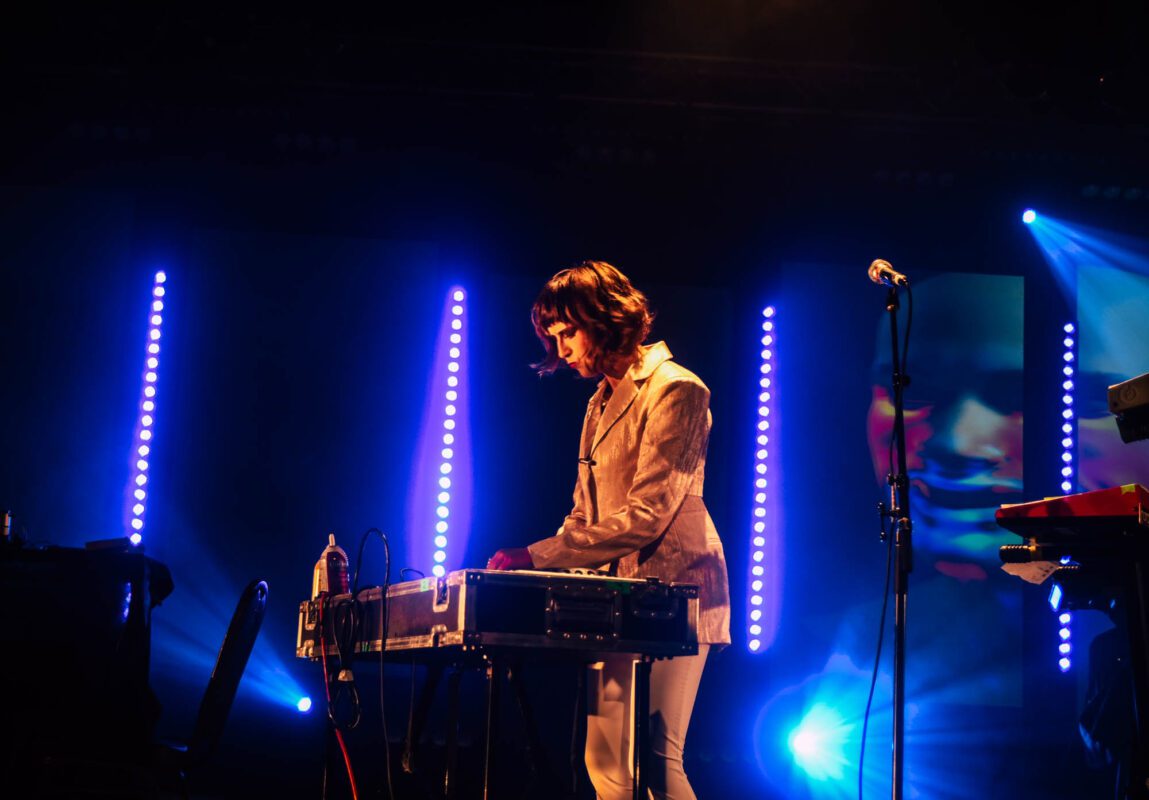
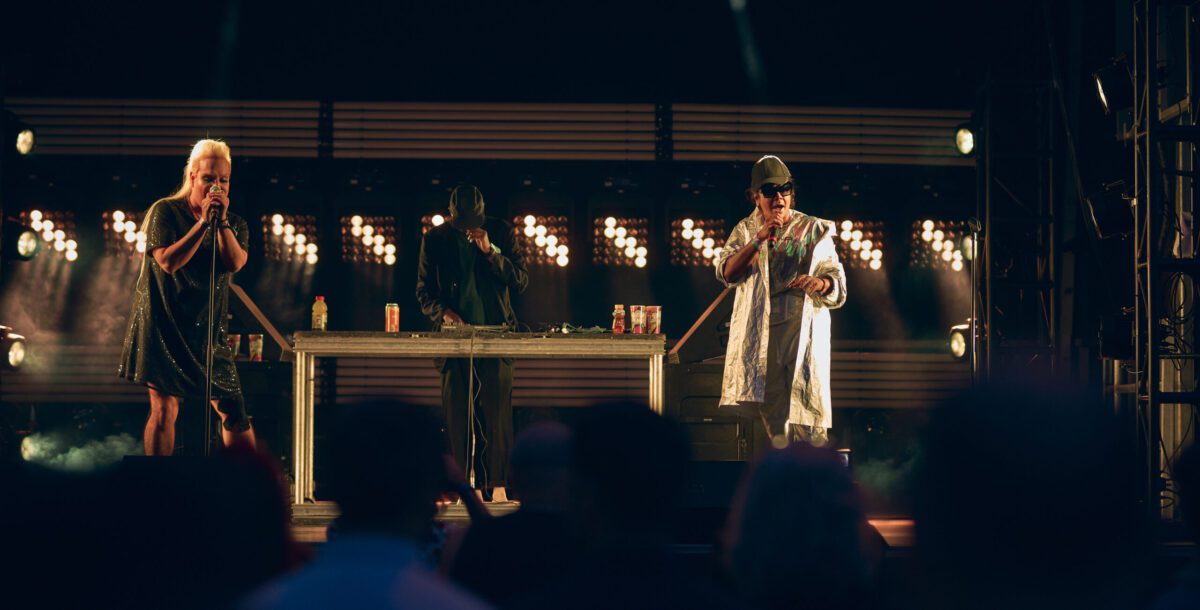
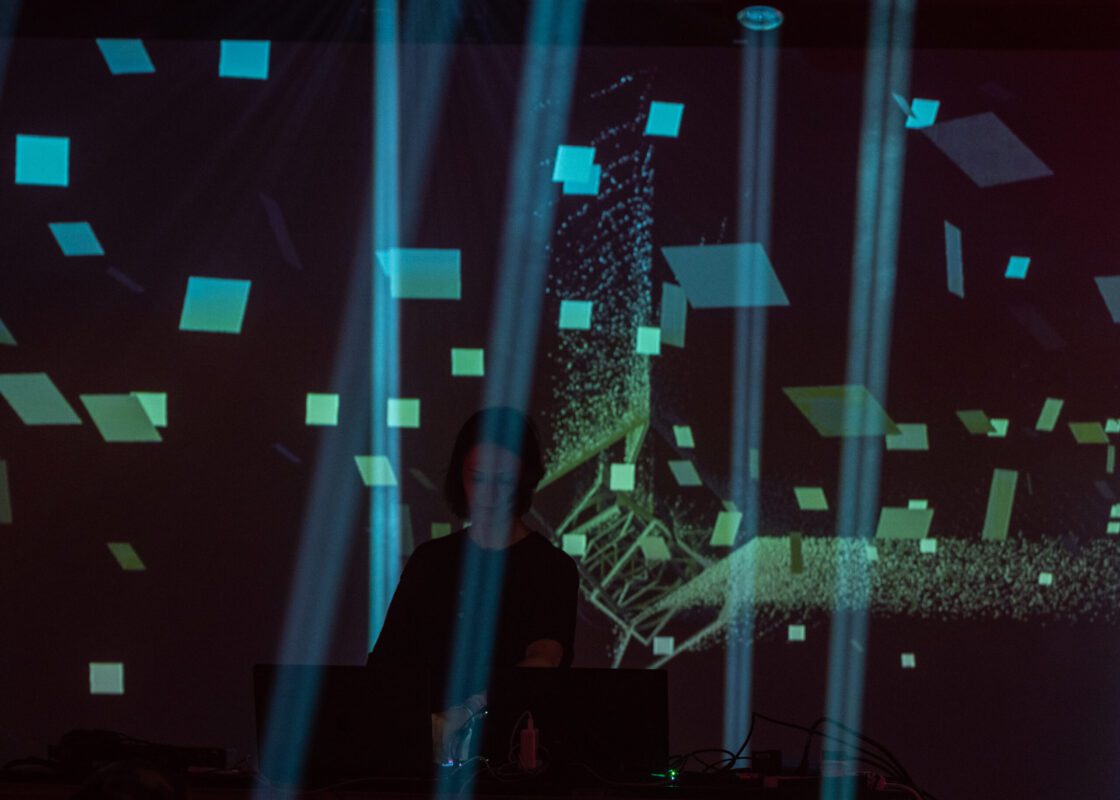
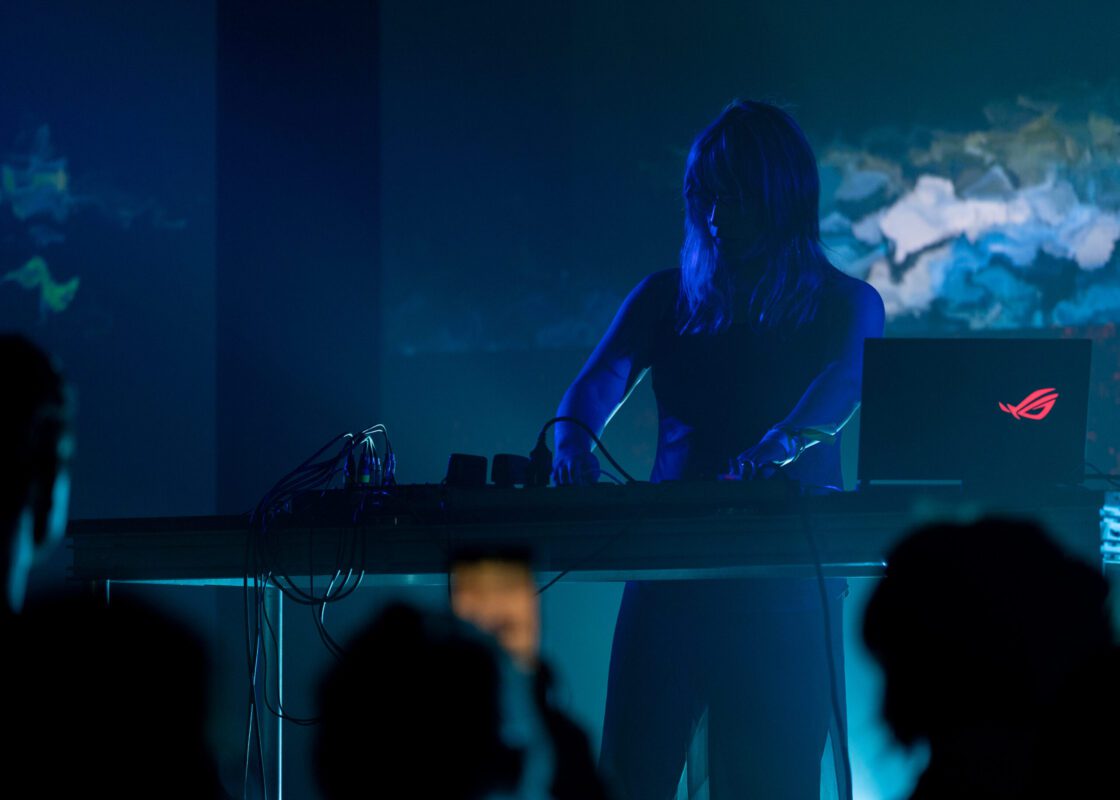
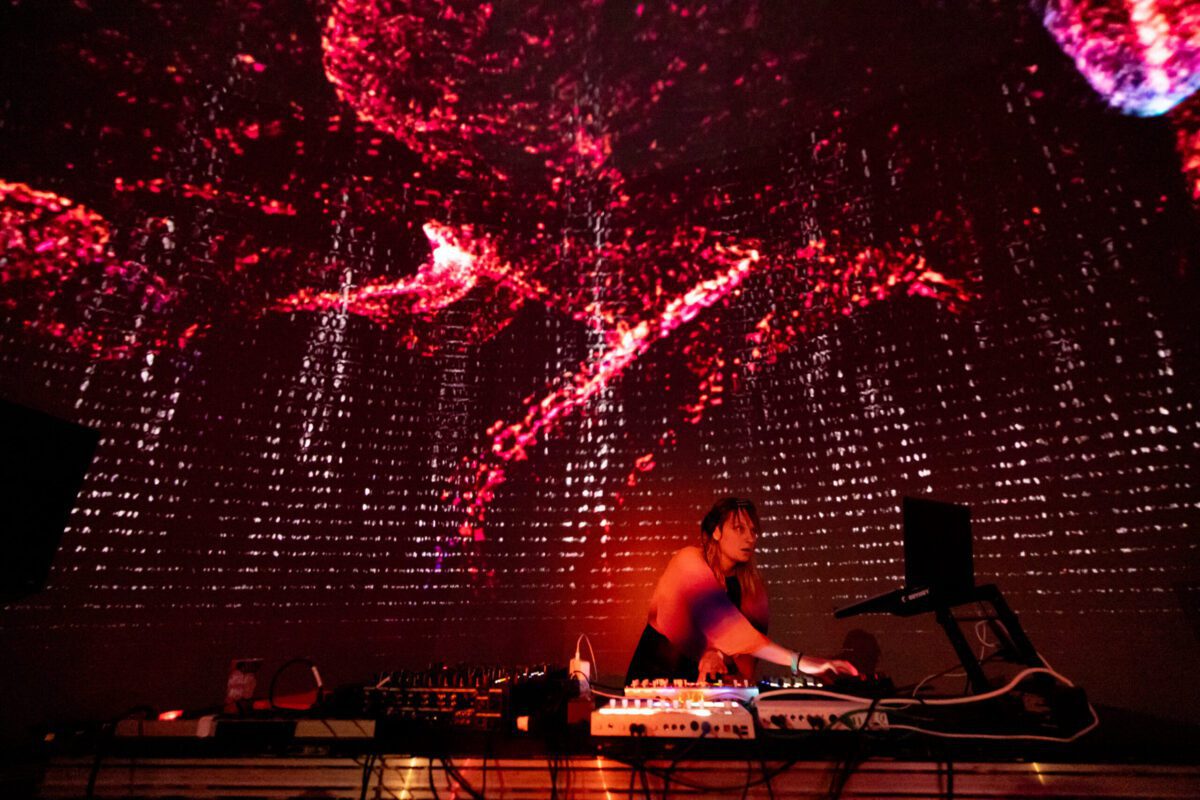
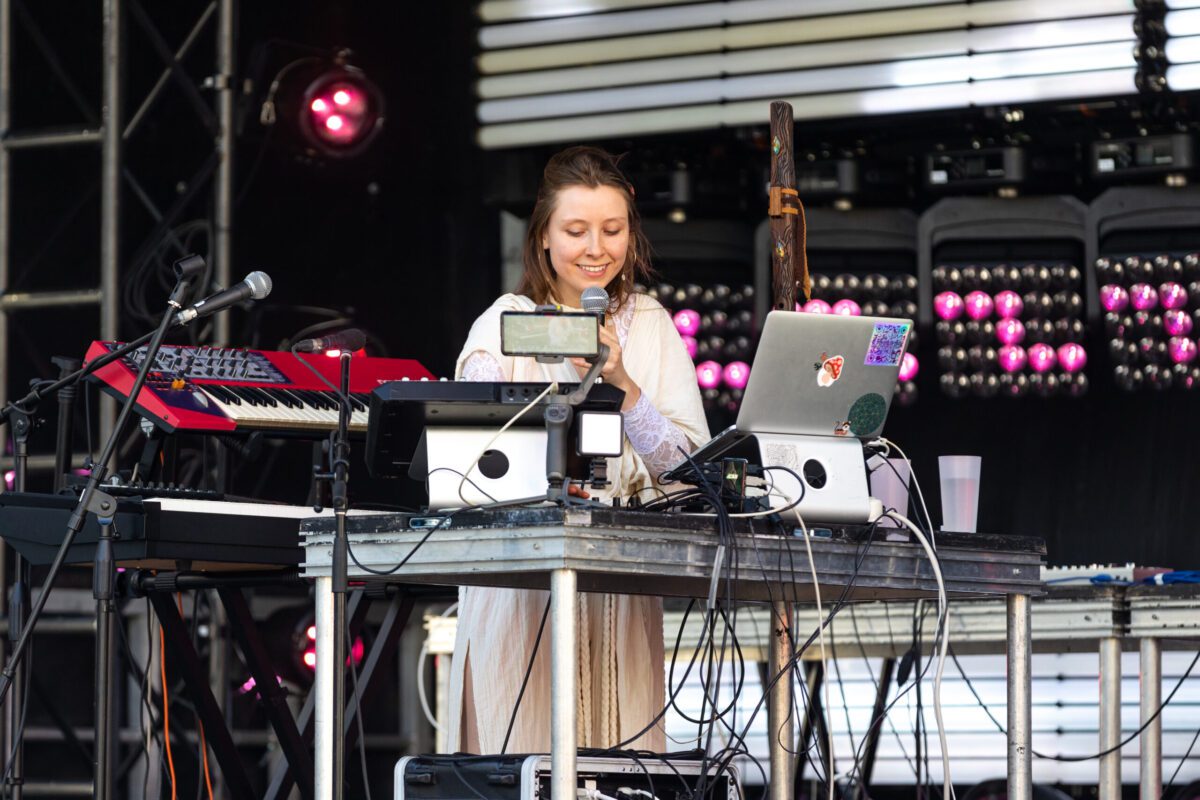
The very theatrical Annie-Claude Deschênes (PYPY and Duchess Says) put on her restaurant-themed synth wave show for Le Petit Théâtre du Vieux Noranda, and stuff got weird. Well, everything is weird about the persona Annie-Claude takes on stage live, but it is quite captivating to watch. She lays down some dark techno and “answers” a phone call about a reservation taking place and sets up the table. The backdrop is a bunch of floating spatulas, mixers, spoons, and forks. The show is more of a play than a concert, but Annie-Claude’s little synthpunk freakouts are why many stayed till the end. It was a multi-dimensional experience, pretty on-brand if you know Annie-Claude Deschênes or any of her other projects.

– Stephan Boissonneault

La Sécurité’s Lessons on Staying Safe!
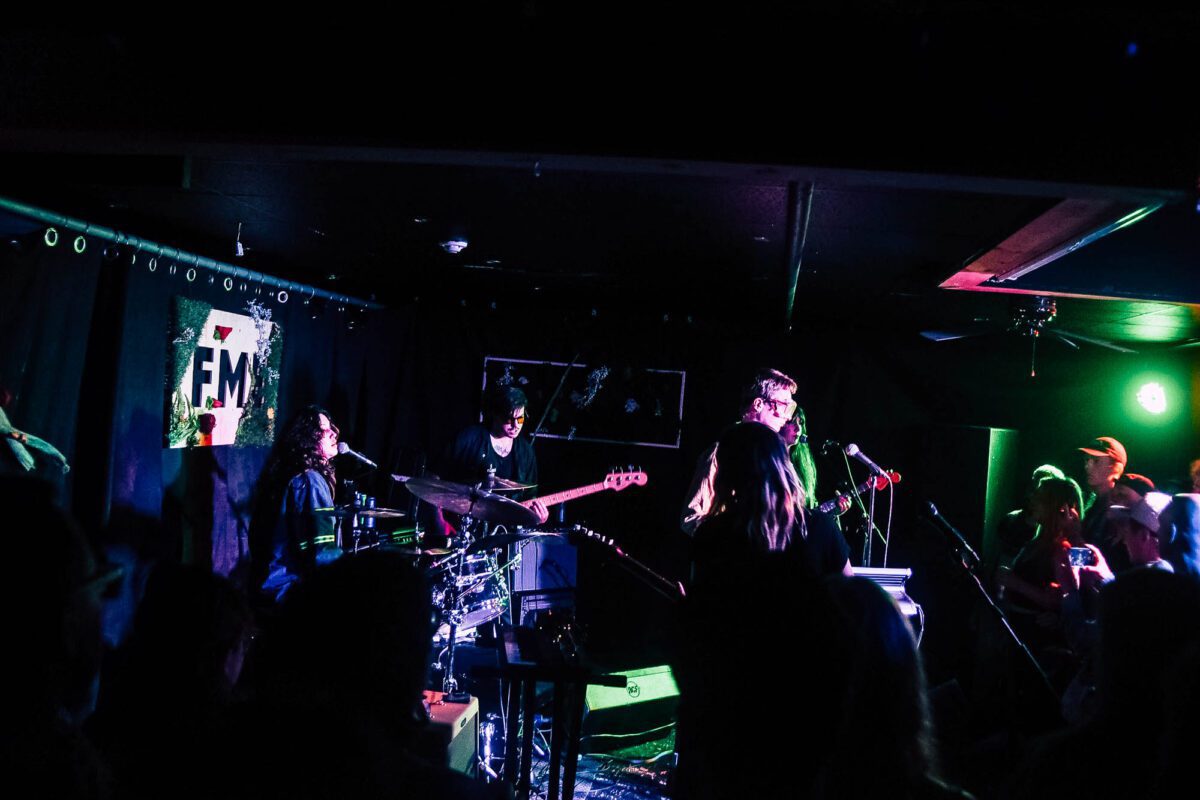

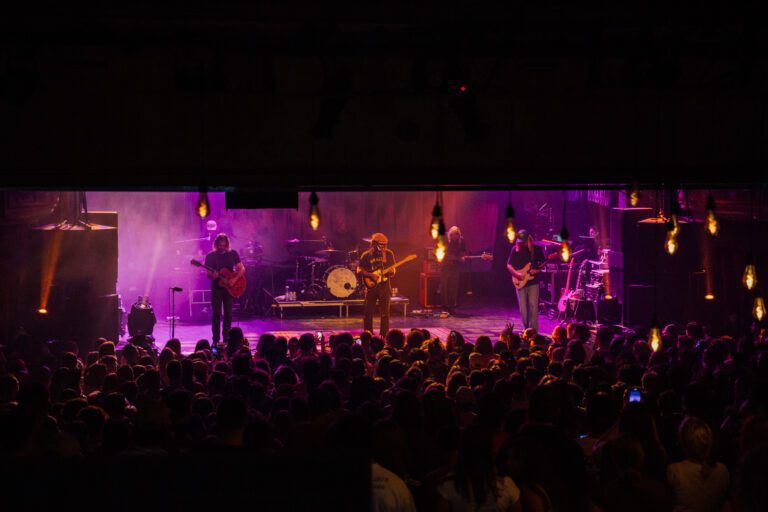
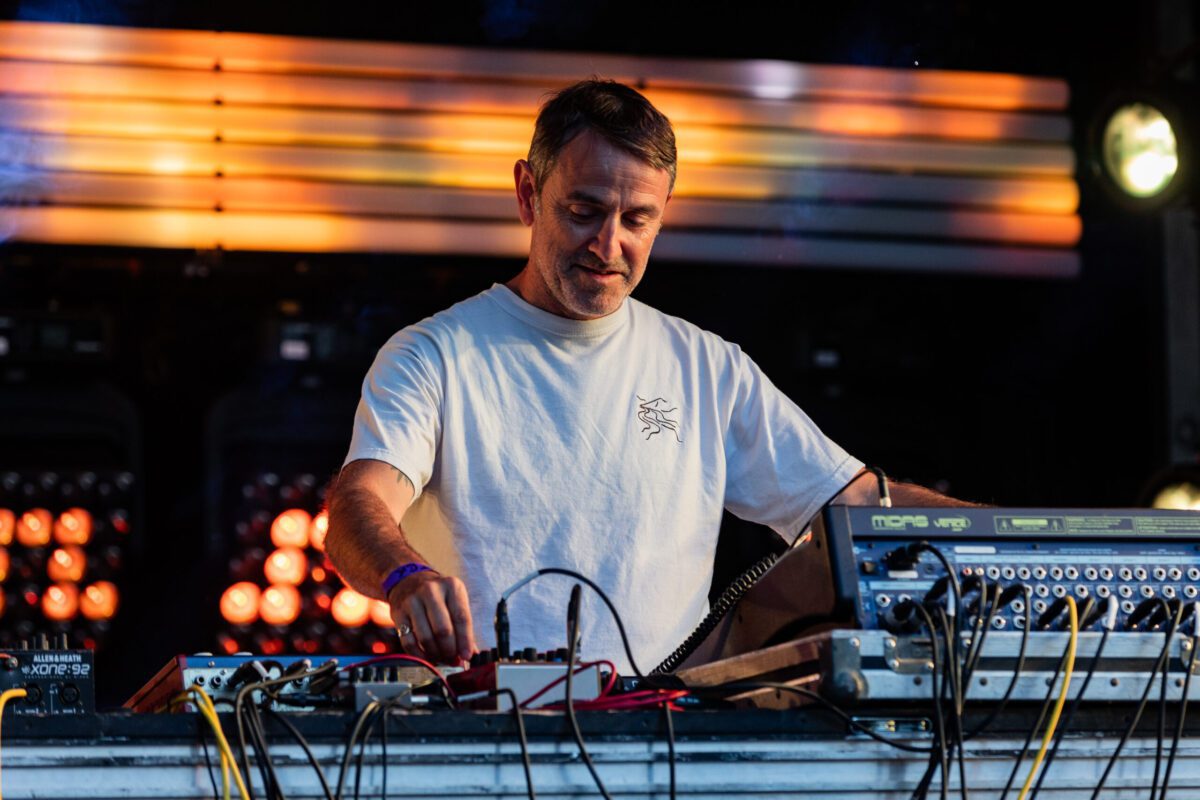
If you’ve been following PAN M 360 in the last year or so, you know we are huge fans of Montreal the new wave, post-disco punk group, La Sécurité, and their performance at Diable Rond did not disappoint. As I walked in I realized we were going to be getting more of a B-sides, deeper cuts set from La Sécurité’s Stay Safe! debut, with the shoegazey, “K9,” riot-punk-tinged “Hot Topic” and the little joke song “Waiting For Kenny.” Eliane’s dancing was of course on point, putting the audience in a sweaty, frenzied trance. Co-founder/ bass player, Félix Bélisle, was actually on tour with Chose Sauvages at the time, but the fill-in, Jean-Philippe Bourgeois (of Mothland/shoegaze pop band Karma Glider), played every note perfectly. Especially during the funky “Serpent,” which made me think Félix Bélisle had just appeared on stage.
– Stephan Boissonneault

Turning it Up With FouKi


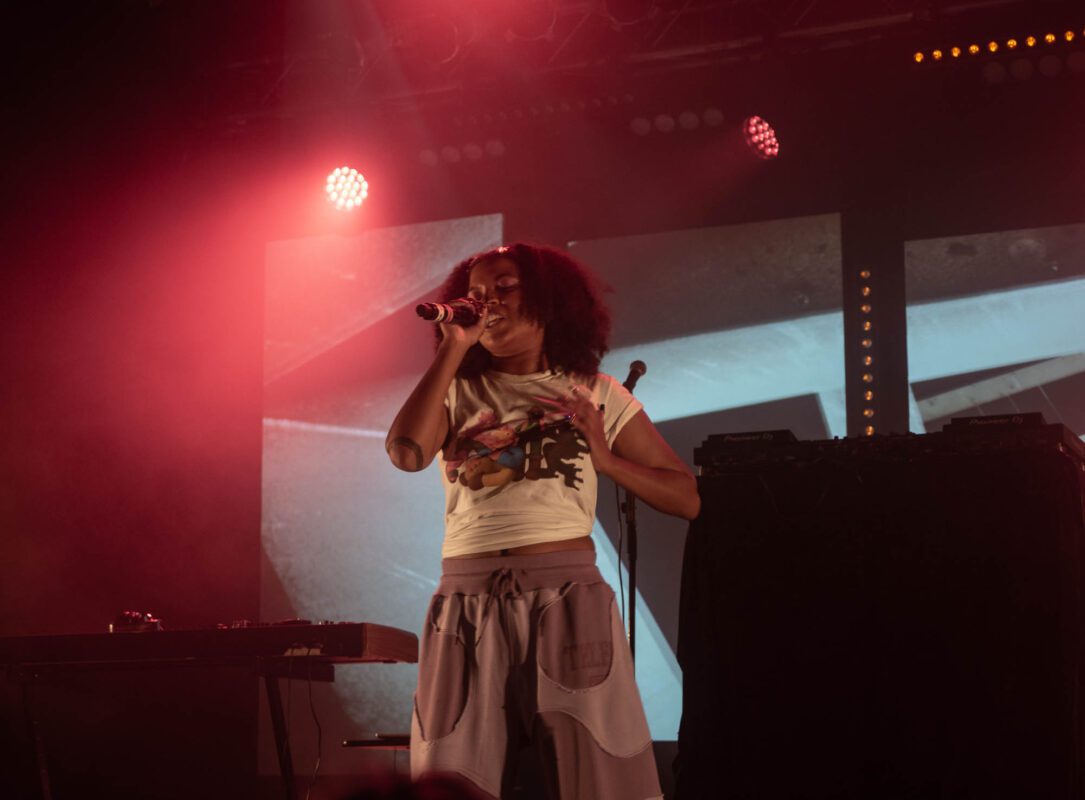
Sometimes, all you need is a little pop act to get you feeling yourself. For me, this relief came in the form of FouKi, a Montreal-based rapper who brought nothing but hype and energy to the people of FME. Smack dab in the centre of the huge crowd, it was hard not to feed off the vibrating people around us—most of whom were singing along to every word. 

FouKi has a commanding stage presence and confidence in his delivery that makes him hard to ignore. Though his beats feel like quite standard club sounds and he possibly over relies on his Travis Scott-esque autotune, he had thousands of us in the palm of his hand. Even when he blew out a speaker near the end of the set, the crowd seemed not to mind, happily hopping along to crunchy kicks and distorted, throaty vocals. FouKi was dumb fun and plenty of it—the perfect way to kick off Friday night at FME. – Lyle Hendriks


Rip Pop Mutant Gets Weird With it at FME
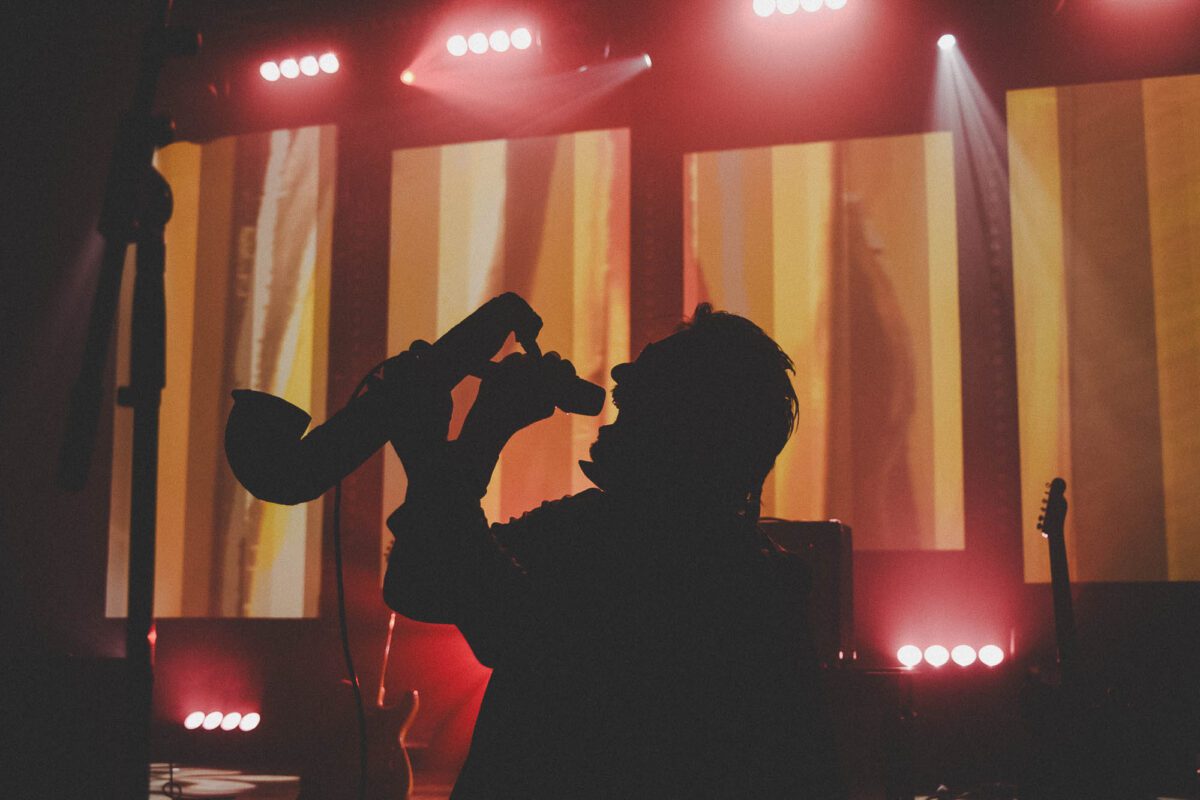

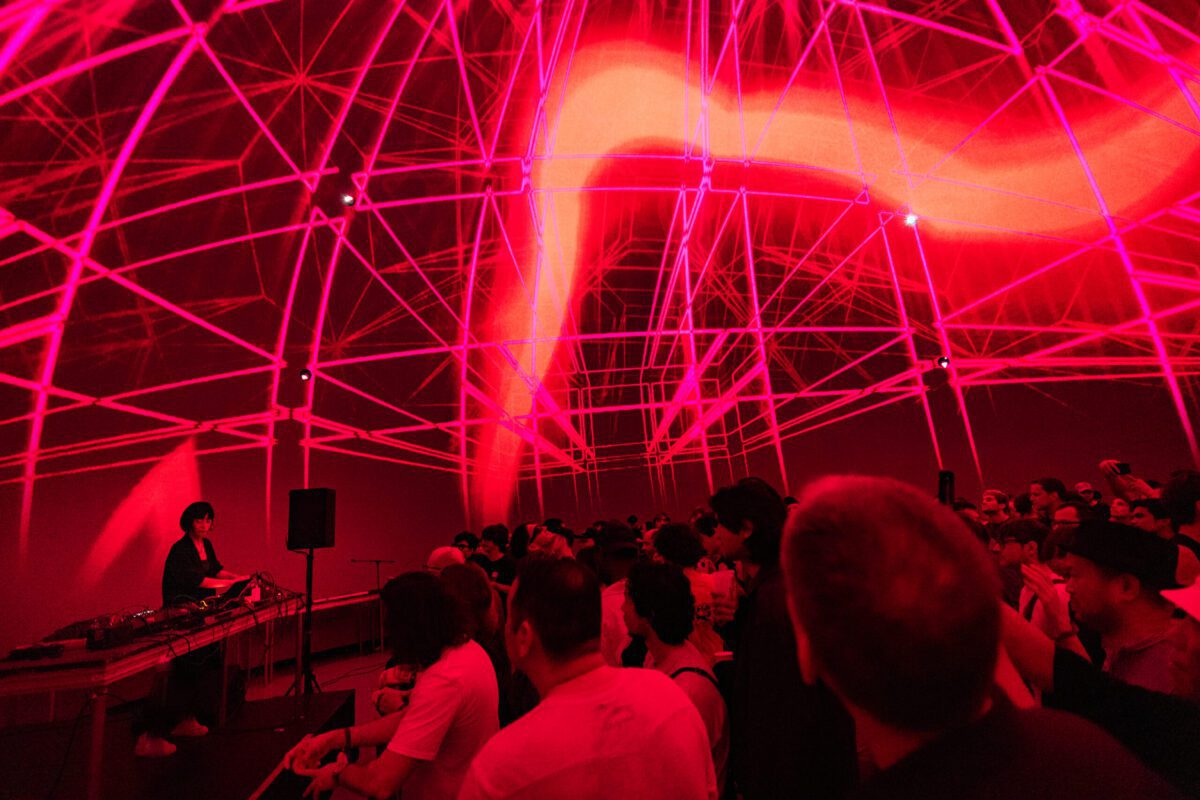
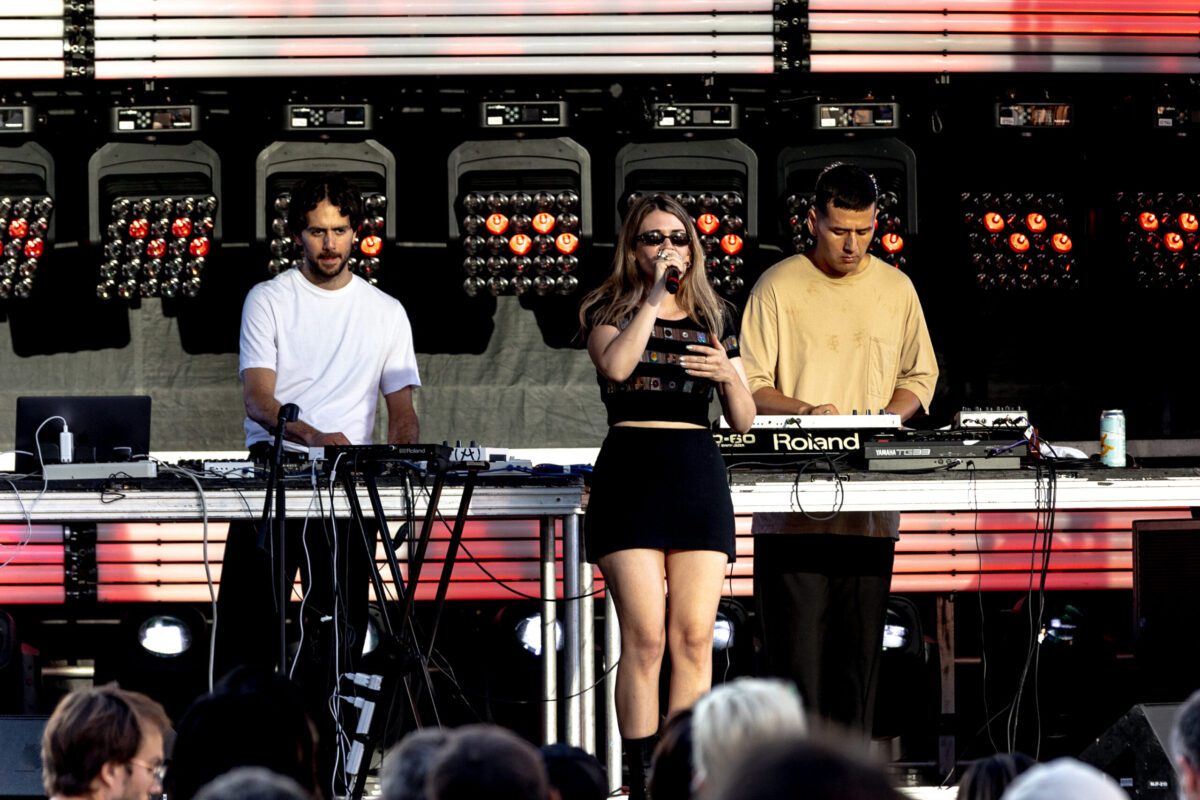
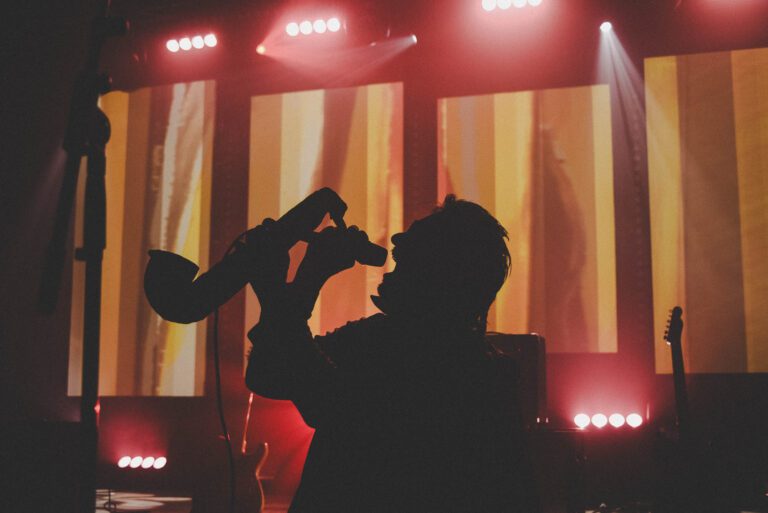
Synthy, dark, trippy, futuristic, Rip Pop Mutant took the stage by storm Friday night at FME. With grinding, brooding instrumentals driven by heavy bass, spacy keys, and trance-inducing drums, lead singer Alex Ortiz soared above it with heavy effects on his voice, belting in three languages and undeniably feeling himself. 

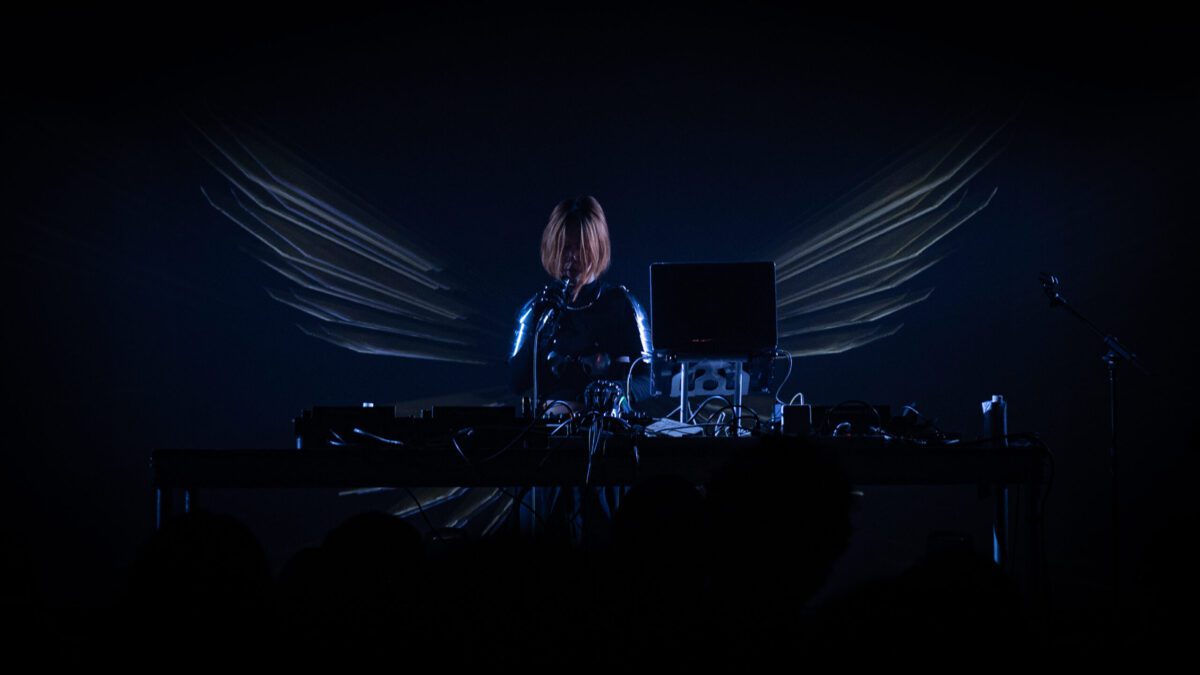
Ortiz wore a snakeskin housecoat on stage, bringing a quirky vibe to his set that I initially didn’t expect when set against the darker pop-adjacent music before me. One highlight of the show was Ortiz grabbing a fake paper saxophone just in time to ‘play’ his solo, dropping to his knees, and gasping into it with everything he had in him. There’s a rawness and authenticity to Ortiz’s vision here, all rough edges and total commitment to imperfection. But rather than feeling sloppy or low-effort, it’s all clearly by design. I think you’ll agree that Rip Pop Mutant’s name feels so appropriate when you hear the twisted, mutated shades of pop music that arise from this high-energy three-piece. – Lyle Hendriks
FME Day 1: Laurence-Anne, Myst Milano, Margaret Tracteur, Population II, Pressure Pin, YOCTO

by Rédaction PAN M 360

Two writers from PAN M 360 are currently in Rouyn-Noranda for the 21st edition of the Festival Musique Emergente (FME) Festival, a musical takeover of the city to witness some of the best and brightest upcoming bands from Quebec, Ontario, and the international scale dabbling in alternative rock, shoegaze, new wave, dream pop synthpop, art rock, psych, and more. So without further ado, here are a few acts we wanted to shed a little spotlight on for Day One.

Photos by: Stephan Boissonneault

Laurence-Anne makes magic at the Agora Des Arts


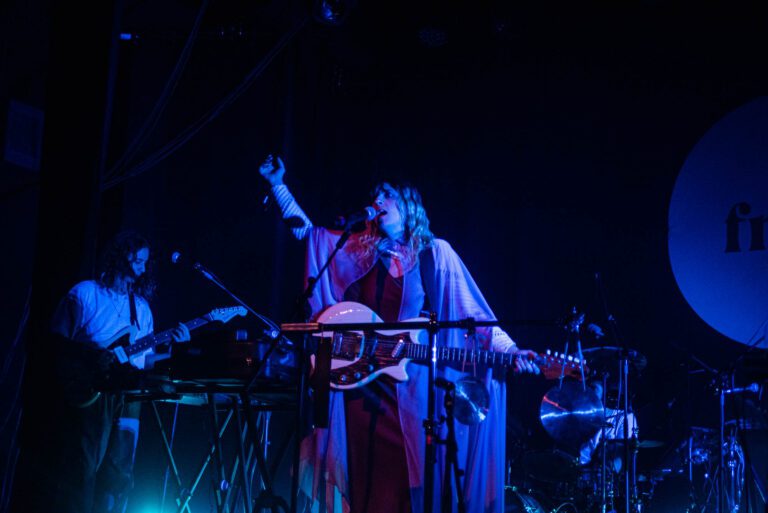
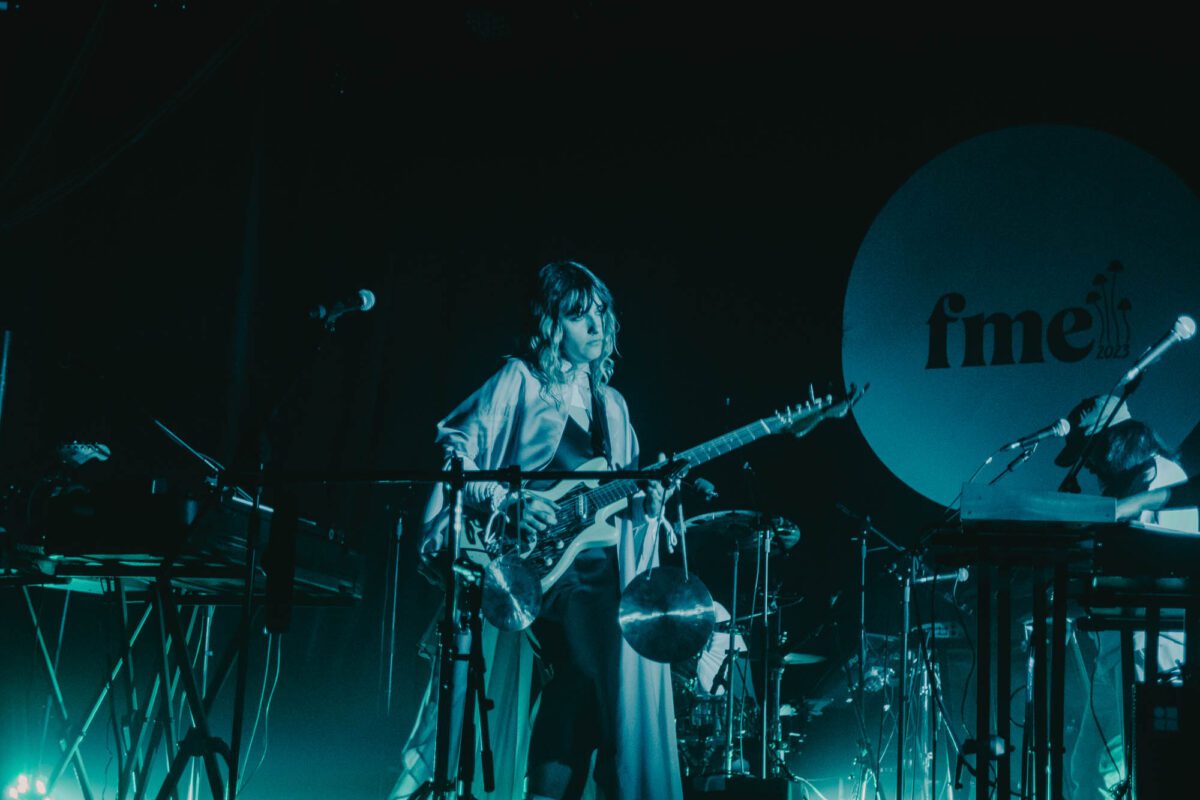
After a moving set by PAN M 360 favourite, N Nao, Laurence-Anne appeared on stage in a wispy purple cloak to open the set with a few tracks off her upcoming full-length Oniromancie. It’s a fitting title for the spooky dream pop of Laurence-Anne, that utilizes an array of dealy pedals, synths, vocalizers, and at one point, a few gongs. The song “Flores,” Laurence-Anne’s second song in Spanish, is absolutely gorgeous live and her falsettos and powerful sustain vocal tones left us in awe. I got crazy vibes of The Mars Volta during the spacey looped vocals.

The venue was beautiful but it was a seated show, and you could tell the crowd wanted to get up and move as Laurence-Anne led us all through her dream world. At one point she walked off stage and into the crowd to get a better vantage point. It was all very theatrical, much like a heavier rendition of something like A Midsummer Night’s Dream, but with way more hazy synth-wave instrumentation.
– Stephan Boissonneault

Margaret Tracteur is cut short too soon


I wish I could say I heard more of the folk-punk yodeling sensation, Margaret Tracteur, but the start of their set was cut quite short due to the headliner of the main stage, the uber-popular Québec Redneck Bluegrass Project, playing way over their allotted set time (about 30 minutes). The main stage crowd was definitely into it, but a small phalanx of people near the entrance alley of the main stage was ready to groove to the tunes of Margaret Tracteur. We got one song from the album L’heure du thé avec Margaret Tracteur, and it was a drunken ol’ time before the band was told to wait until the main stage headliner was done. This was just poor form, and I don’t know whose fault it was, either the Québec Redneck Bluegrass Project for deciding to play way longer than anticipated, or the main stage planning team, but you could tell Margaret Tracteur was a little irritated—and I don’t blame them. They did get to play after all, but to a much smaller crowd, due to the fact that everyone needed to hop between shows at different venues. But who knows, maybe they’ll get a secret show a recompense.
– Stephan Boissonneault

Myst Milano Brings Bad Bitch Energy to FME’s First Night

Toronto-based rapper/DJ Myst Milano described their sound as ‘bad bitch music’ last night, and I’m hard-pressed to think of a better way to describe it. Oozing with attitude, but never losing their essential playful attitude and apparent joy onstage, Milano’s set was irresistible in every sense of the word. Milano effortlessly flipped between hard, aggressive bass tracks paired with fierce vocals a-la Rico Nasty, all the way to more intimate, sexy numbers complete with ample instrumental breaks for them to show off their dance skills. Whether you’re doing crimes in the street or getting freaky in the sheets, Myst Milano had a track to fit the vibe. 

Perhaps most impressive was the sheer confidence and energy that Milano brought to the stage. Despite being all on their own up there, they performed with complete and utter commitment, as if we were an arena of adoring fans who’d been lined up all day for this. And if this relatively new act keeps up like this, it surely won’t be long until they truly are tearing it up stadium-style.
– Lyle Hendriks
Emma Beko Tears It Up at the Poutine Joint


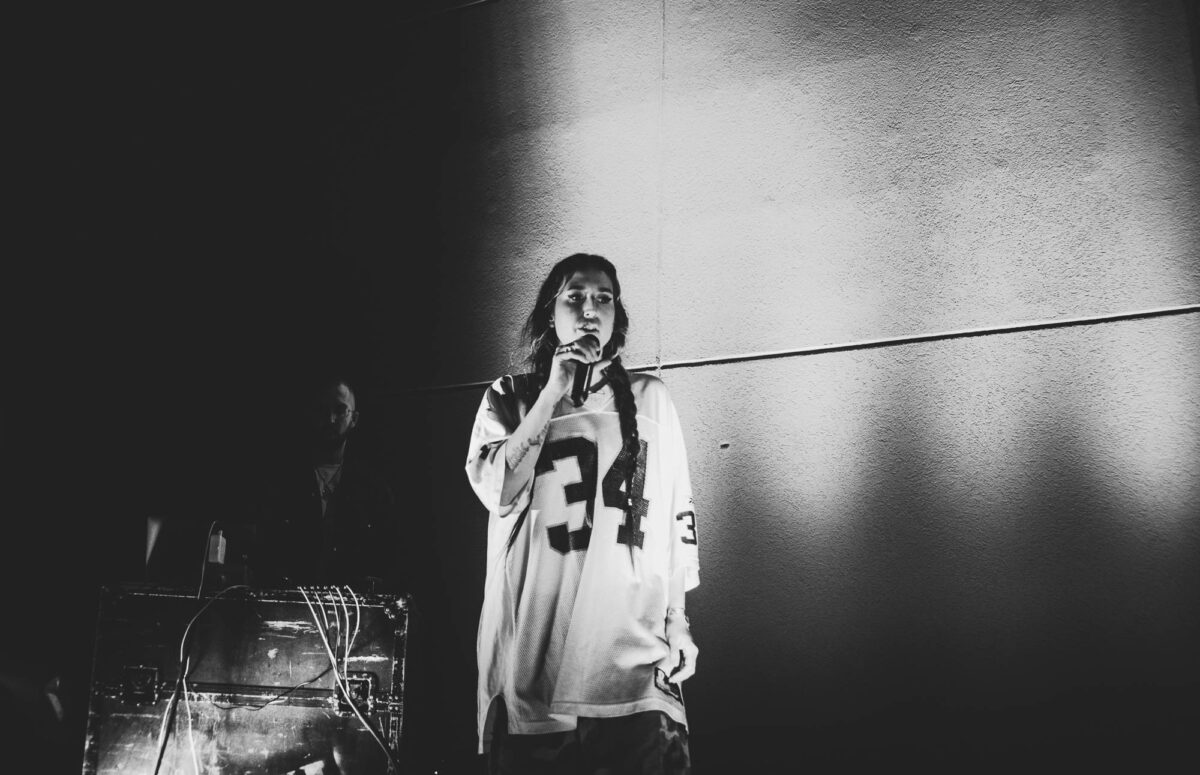
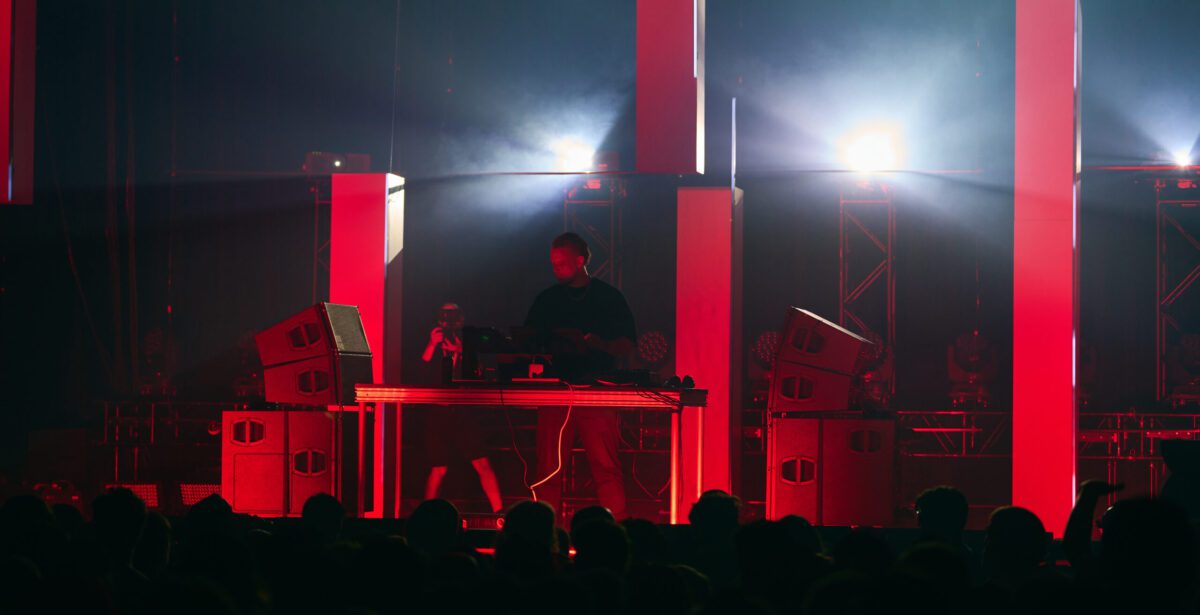
Dripped out in an NBA jersey, massive camo shorts, and the essential pair of Timbs, Emma Beko’s semi-lo-fi, half-sung half-rapped performance felt oddly perfect against the backdrop of Morasse Poutin. The red light, rich DJ textures, and vulnerable bars contrasted nicely against the fluorescent lighting and throngs of hungry cheese-curd-devourers behind her, emphasizing the not-too-serious, not-too-goofy approach that Beko brought to her set. 

Throughout her performance, Beko’s love for what she was doing was completely apparent. And despite absolutely cheesing it at the parking lot crowd after each track, her demeanour shifted to one of armour-clad confidence as soon as the beat for the next song started. And with an incredible singing voice to compliment her more lyrically focused rap sections, it was clear that Beko and her DJ/partner in crime, (who sang along to every single word) aren’t planning on slowing down any time soon.
– Lyle Hendriks
Population II – The Queb Doom Prog Act You’ve Been Waiting For 


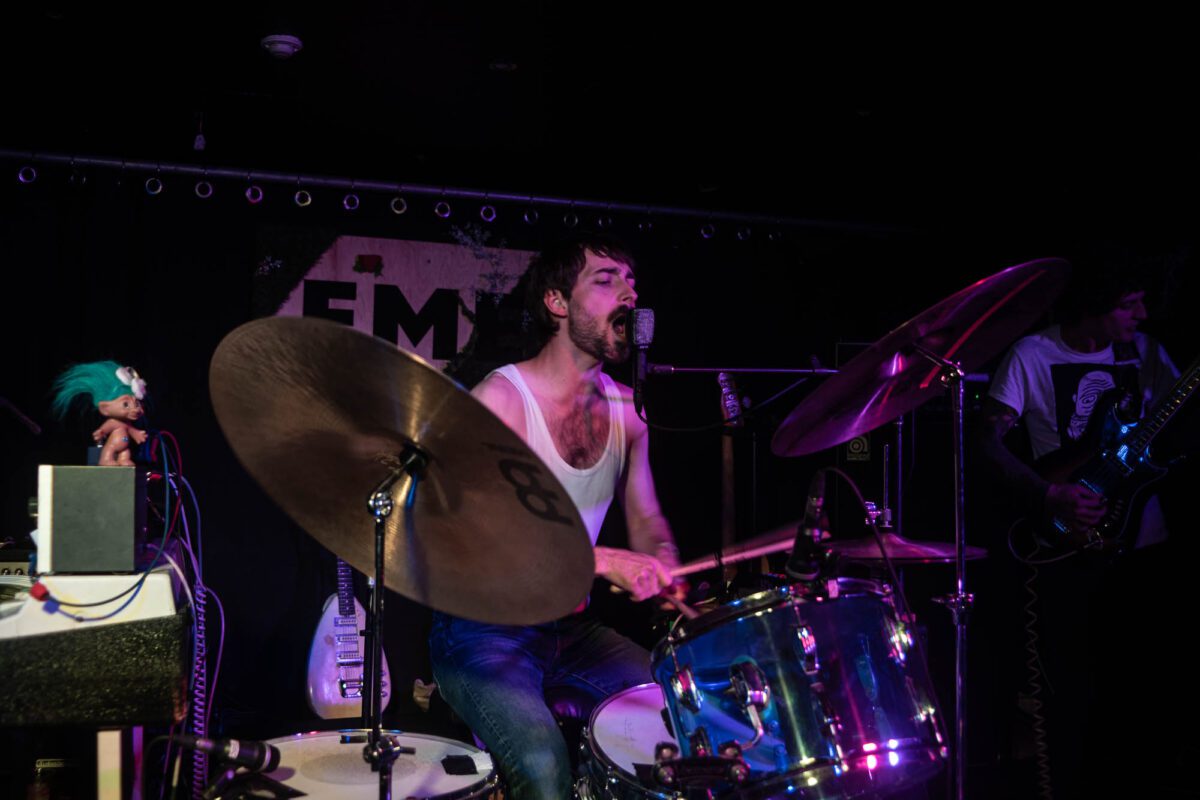
Brooding, boisterous, at times, belligerent—Population II was nothing short of a sensation on Night 1 of FME. With an expansive sound that far exceeds their apparent capacity as a three-piece, this young trio brought an energy, intensity, and a closeness to each other and the music that couldn’t be ignored. Population II was unbelievably tight despite the massive, blown-out tones and frenetic changes in time, tempo, and style that they’ve clearly become accustomed to. Beyond the clear and apparent passion that all three have for their creation, each track seemed to evolve and shapeshift before us, like unfolding a piece of origami to find a brutalist watercolour painting within. And at the centre of it all was singer/drummer Pierre-Luc Gratton, the literal beating heart of the group and the driver of each song, delivering meticulous percussion work all while providing soaring vocals over the mix. With Population II’s sophomore album, Électrons Libres du Québec on its way in October, this is one act to pay attention to as we enter the fall release season.
– Lyle Hendriks
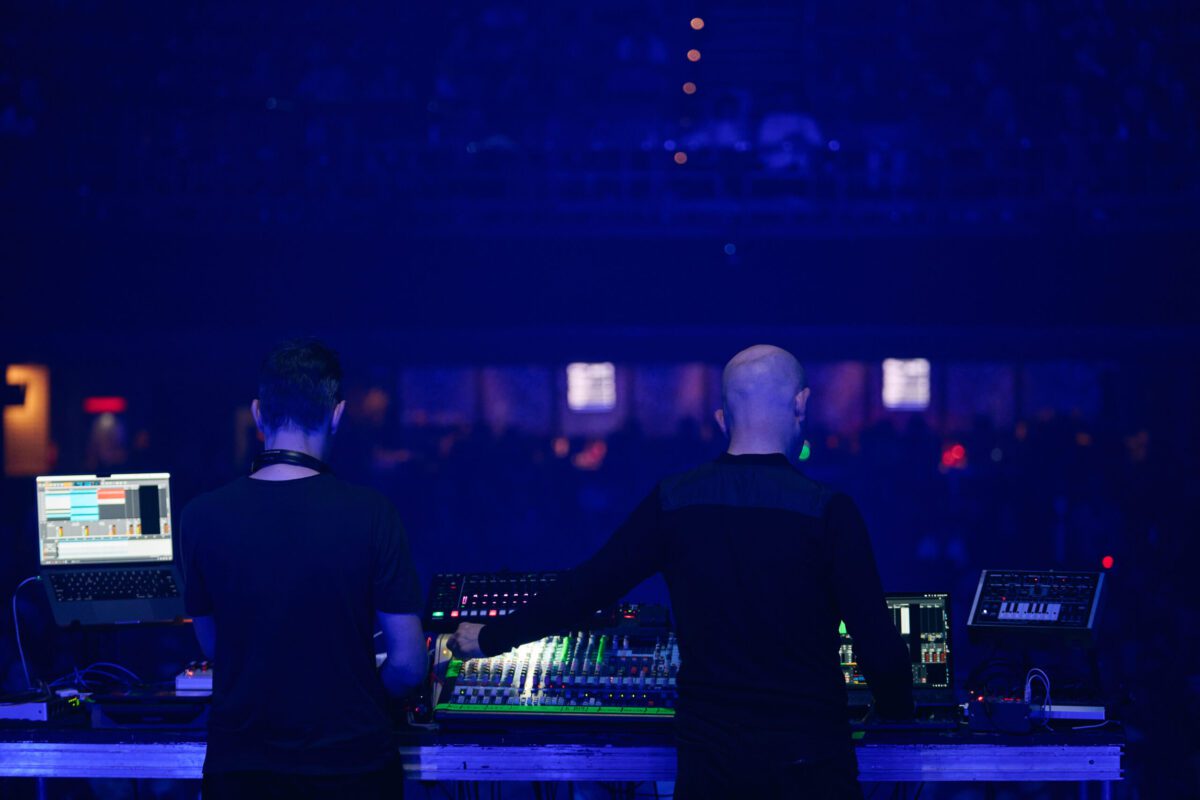
YOCTO Brings a Sci-Fi Sopa-Opera to the Cabaret de la Dernière Chance


One of the bands newest to the Montreal art rock, post-punk, jangle pop scene is YOCTO (somewhat of a supergroup made up of members of Chocolat, Jesuslesfilles, and IDALG) and they absolutely crushed their 1 a.m. set at the Cabaret de la Dernière Chance. Taking us through their debut LP, Zepta Supernova, a sci-fi tale of megalomania, ray gun rivals, and late-stage spacey totalitarianism. The theme is a loose one, meant to glue together the wild sounds of YOCTO, which bring to mind the ’70s new wave bands of Talking Heads, The Human League, and the 80s flavour of someone like the Tom Tom Club. Though the lyrics were conceptualized by member, Jean-Michel Coutu (bass, guitar, synths), vocalist Yuki Berthiaume-Tremblay is a marvel to watch as she runs around the stage, perfectly jumping into the staccato vocal lines as the band jumps from heavy prog rock to a more poppy new wave. I have to give some notice to the drummer, Félix-Antoine Coutu, for keeping the madness on time. The record sounds great, but this is a band meant to be experienced live.
– Stephan Boissonneult

Pressure Pin’s in-the-red feedback art punk


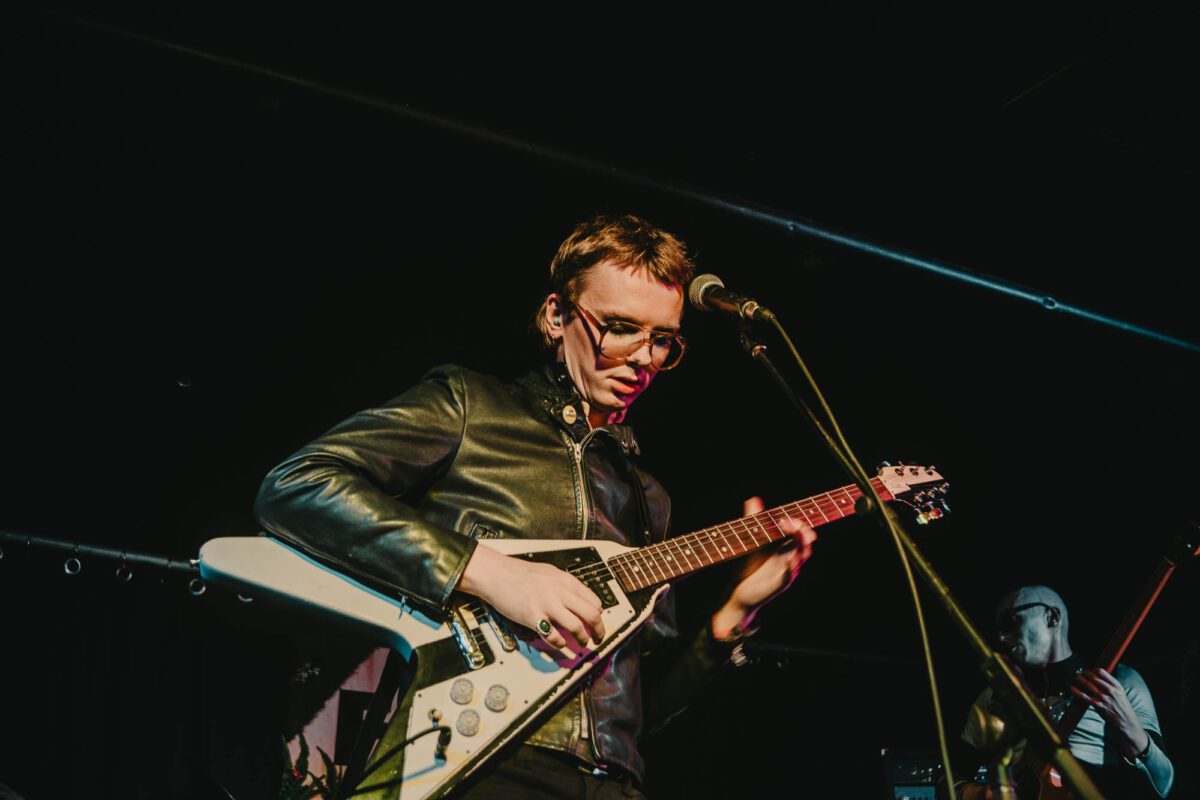
Pressure Pin, the solo project of Kenny Smith (drummer and sometimes synth player of La Sécurité) has been playing a ton of shows around Montreal as of late, and this has to be why they keep getting tighter and tighter with every set. The early morning FME set at Diable Rond was easily one of the loudest of the night, but the band’s chemistry is fun as hell to watch. Smith had intermittent and frenetic-shredding solos on his Flying V guitar only to be followed up by crunchy and well-calculated chord changes and post-hardcore vocals; like Devo and Scream on a healthy dose of powerful stimulants. They played most of the tracks from the previously released Superficial Feature and had a few maddening instrumental jams. Population II is a hard act to follow up, but Pressure Pin was happy to oblige.

The bassist, Danny Howse, played some of the most disgusting bass pops and ripping riffs in near-perfect timing as the drummer, Luca Caruso Moro, absolutely thrashed the kit—I wonder what the toms looked like after. The pageantry of Pressure Pin was also on point; Smith dressed like an Italian ’80s greaser biker, and Howse’s whole face was painted a shiny chrome for the entire set, adding to the collective madness. Though the sound levels were kind of all over the place in Diable Rond—it’s hard to sound perfect with punk like that and honestly, it’s better a little gritty—Pressure Pin showed how much conscious noise you can make with three dudes.
– Stephan Boissonneault

Taking a Stroll Down Ocean Alley

by Lyle Hendriks
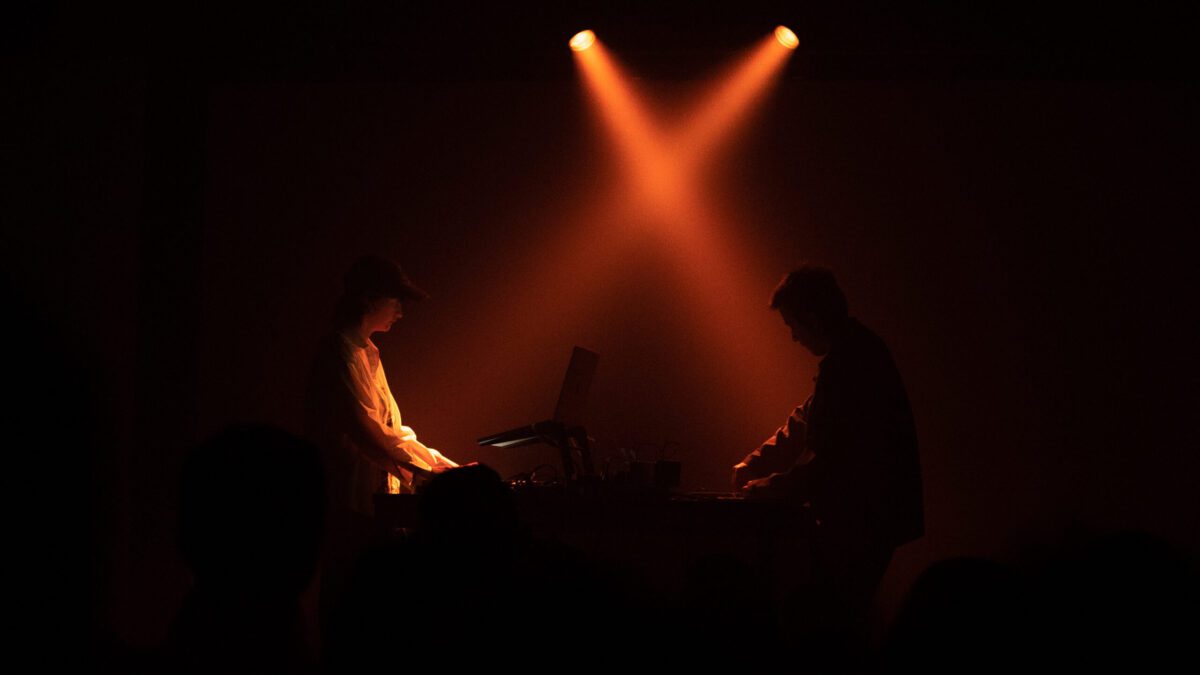
Photos by: The Sauce

There’s something about the tradition of Australian alt-rock that feels so inherently relaxing, even when the music itself is reaching climactic altitudes. There’s perhaps no better example of what I mean than Ocean Alley, a six-piece from the Northern Beaches that has continued to take the world by storm since 2013.

Before the Ozzies took the stage at the sold-out Theatre Beanfield on August 25th, we were treated to a set from Brooklyn-based band Juice. Funky, tight, and offering incredible energy to the already vibrating crowd, Juice was a smash-hit of an opener. They took us through an incredible set of dancy tracks, featuring violin (and a killer rap verse) courtesy of Christian Rose, unflappable drums from Miles Clyatt, and a truly jaw-dropping performance by lead singer Ben Stevens. After such a refined, energizing set, we were primed and ready for our main act.


From the instant lead singer Baden Donegal and his troupe walked on, there was a feeling of total joy emanating from the stage. After erupting into a classic cut from 2016, “Lemonworld,” with no preamble whatsoever, Donegal addressed the crowd: “Hi Montreal, happy to be back!” He went on to explain that this was their first-ever sold-out show in the city, something they were clearly thrilled about.

The feeling was mutual. It wasn’t long before Ocean Alley sunk into “Knees,” one of their most popular (and singalong-worthy) numbers. The crowd was more than happy to oblige, chanting along to the hook as Donegal’s hair-raising vocals soared above us. We carried on this way, grooving in place and feeling an overwhelming sense of positivity radiating from the band and reflecting right back from everyone that surrounded us.


After an electric set of restrained, yet utterly expansive psychedelic, reggae-inspired rock, the crowd burst into cries for an encore. Seemingly overwhelmed by the excitement, Ocean Alley returned for just a little while longer. Someone passed a joint up to guitarist Mitch Galbraith, which he puffed and passed back to the front row, all while shredding it in the most relaxed possible way. 

The overall highlight though was when a New Balance sneaker was passed all the way to the front, a tall-boy can of overpriced beer seated squarely inside. A perfect example of the warmth and acceptance of the evening, Donegal eventually succumbed to the old Australian tradition of the shoey, pouring the beer into a stranger’s shoe and crushing it in one go, all with the biggest smile on his face. 

MUTEK 2023 | A/Visions 2 : Hatis Noit, DATUM CUT, SPIME.IM

by Laurent Bellemare

The PAN M 360 team brings you comprehensive coverage of MUTEK Montreal 2023. Here’s a selection of the best performances on Saturday night at Théâtre Maisonneuve, as part of the A/Visions series.

Crédits photos : Nina Gibelin Souchon

Hatis Noit

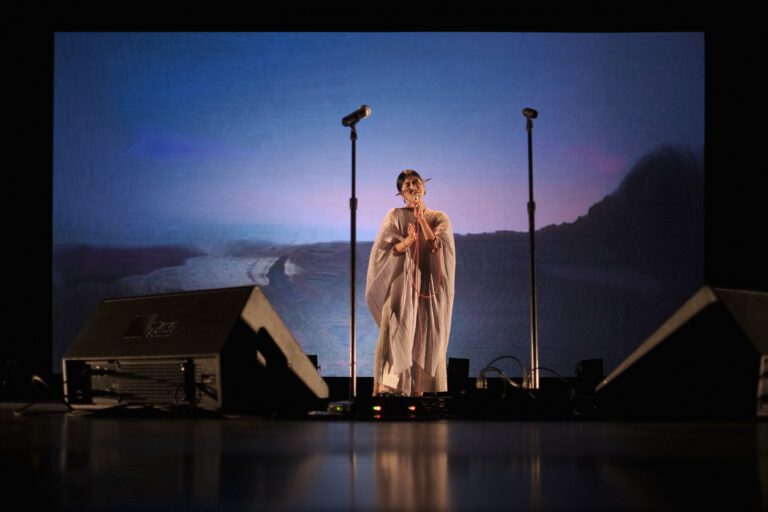
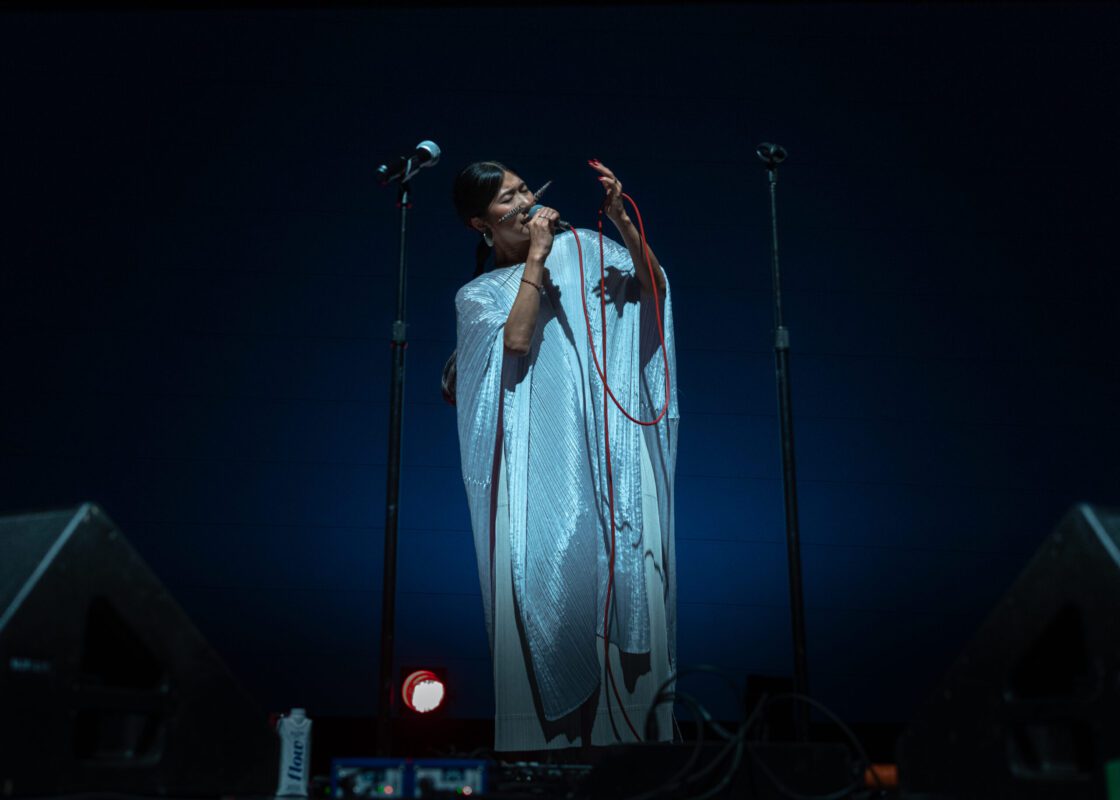
“I only use my voice, is it okay to play at Mutek?” This was the question Hatis Noit posed during her first address to the crowd. The London-based Japanese artist effectively had only a loop pedal and projections as technological hardware, operating the bulk of her art from her vocal folds. From a technical point of view, Noït was impressive, moving easily from operatic singing to yodeling very close to what Eastern European singers do in traditional music. Imitations of animal cries and other textures were also on the menu. Voices were superimposed in arrhythmic textures, always tonal. However, the composer did not take a maximalist approach, her pieces limiting their thickness to a few loops. The various melodic layers were therefore always perceptible to the ear wishing to break down the mass. With her movements and stage presence, the artist delivered a performance out of the ordinary, and one of the most unique of the festival. Verbal communication with the crowd between pieces and Yuma Kishi’s projections were a bonus. Even with sound alone, the show would have been just as captivating. Yes, Hatis Noit, it’s okay that you’re playing at Mutek!

DATUM CUT

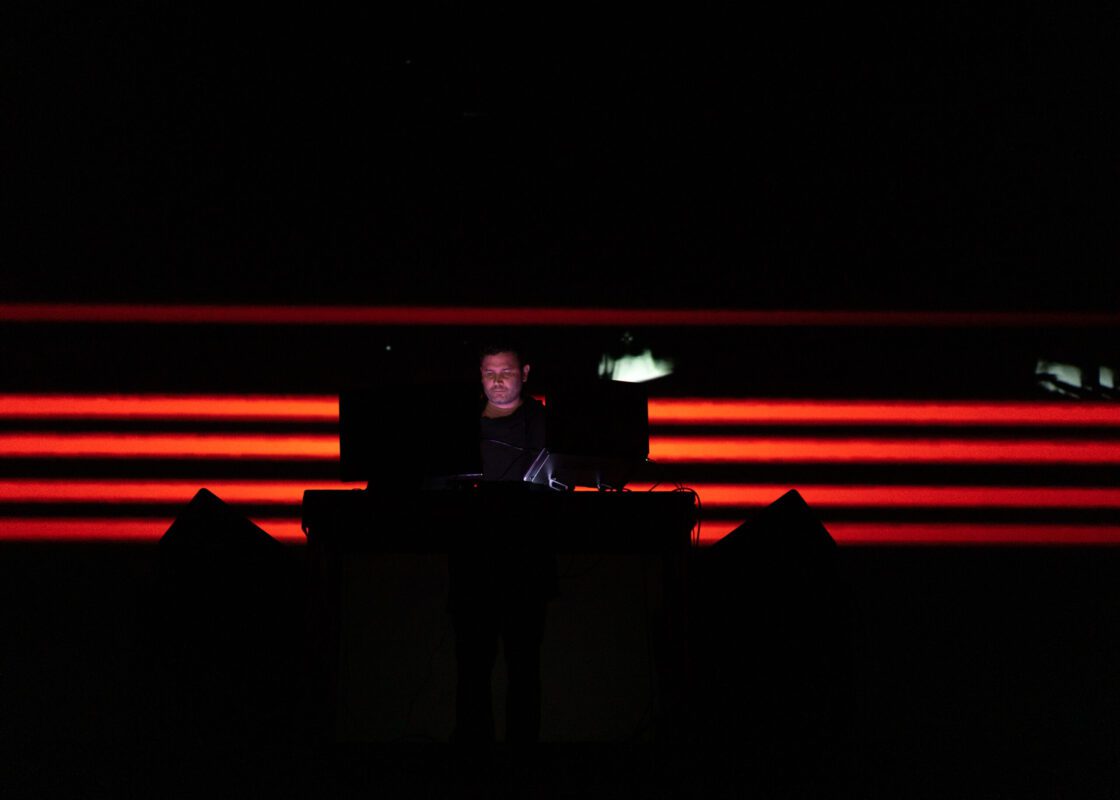
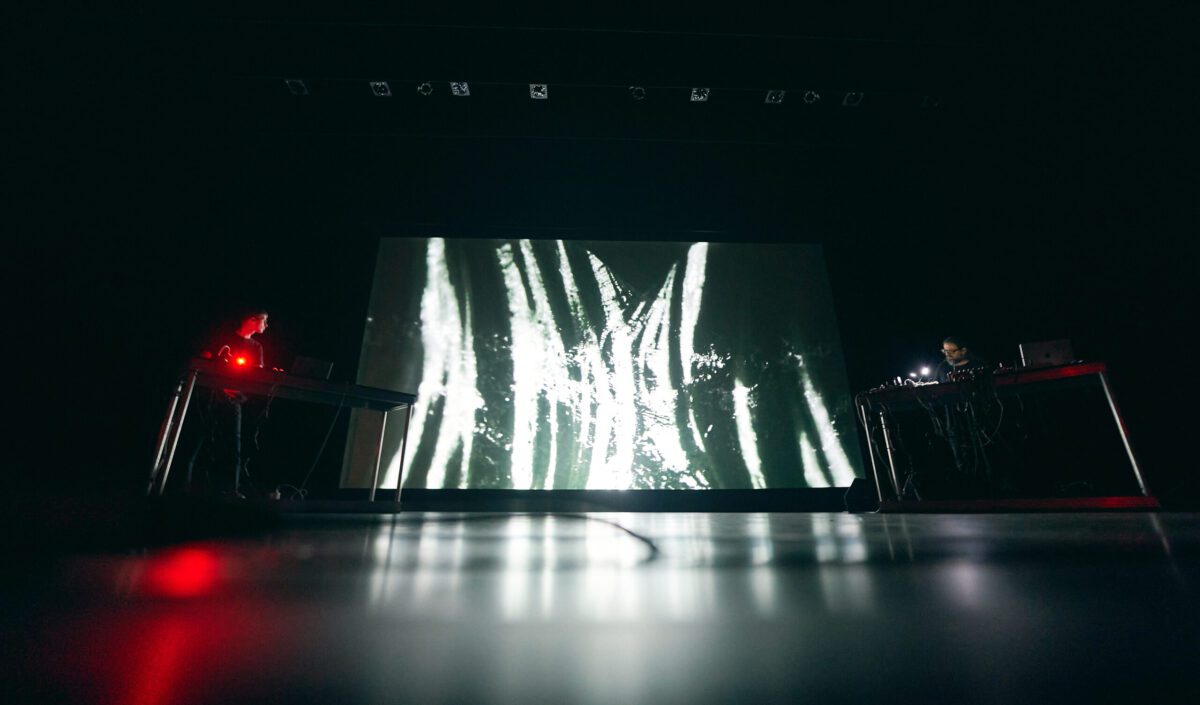
Behind his screens and synthesizers, Maxime Corbeil-Perron composed a massive yet harmonically simple drone. One had the impression of being immersed in a chord throughout the entire performance, the artist taking the time to deconstruct and vary the harmonic content in all its forms. A complex sequence of rougher sounds was added to this relatively static framework. With no discernible pulse, the composition was nevertheless highly rhythmic, with rapid, sporadic percussive attacks. The music developed in micro-montages, revealing complex sonic events hidden within the overall texture. The highs seemed to have been filtered, which clearly softened the aggressiveness of the noisier sounds. Aesthetically, it was reminiscent of a band like Yellow Swans, who develop a form of “harmonic noise”. Visually, photographs of metallic textures alternated with computer-generated images in a neon palette. Inex.materia was a good example of an accessible work informed by academic practice. This is just one of the sonic manifestations of Corbeil-Perron, who operates under several aliases.

SPIME.IM


Italian collective SPIME.IM certainly don’t beat about the bush when it comes to kicking ass. In duo format, the artists began the performance in a rather minimalist fashion, with rhythmic industrial and noise music lit up by white strobes. But it soon became much more eclectic… and political. All the abjections of our contemporary world were represented: military culture, digital individualism, pollution, overconsumption, materialism, obscenity, the destruction of the natural world and so on. These images were decomposed and recomposed in sequences that were sometimes refined, sometimes visceral. Particularly striking was a long mise en abîme in which the pixels of each new image expanded to plunge into new images, which in turn expanded to reveal new images. There was something therapeutic about seeing all these representations of violence being reused in an artistic way.

The music, always highly experimental, became increasingly intense, hammering out highly saturated sounds with a few echoes of harmony when the desired dramatic effect demanded it. For example, a sudden progression of chords interspersed with silences allowed the words “Where are we going then? to appear one by one. This passage, like many others in the performance, could well have closed the number. Perhaps that was SPIME.IM’s flaw: not knowing when to stop. The dramatic climaxes were so frequent that the audience applauded them like the end of a solo in a jazz show. In short, the audience was treated to a scathing critique of the media images that pervade our daily lives. The apocalyptic soundtrack accompanying these surging clichés skilfully underscored the brutality of the issues we face. Captivating from start to finish.

MUTEK 2023 | Expérience 5: Sara Berts, Sheenah Koh, OBUXUM, ROSINA

by Théo Reinhardt

MUTEK Montréal 2023 and PAN M 360, a combination that makes perfect sense! That’s why our team is focusing on it this week. Fans of cutting-edge electronic music and digital creation are in Montreal this week, so follow our team’s vibrant coverage through Sunday!

Photos credits : Bruno Aiello Destombes

Sara Berts

Sara Berts is a designer of parallel worlds. I arrived slightly after the start of her performance, and from the first sounds I heard as I left Saint-Laurent station, I felt gently transported elsewhere.

The Italian composer and sound artist uses round, smooth tones and others that clatter a little like a marimba, as well as recordings of wave sounds, crickets and other nocturnal noises, all in a very elemental way. It’s a real treat for the ears. Often, while the low melodies move slowly, other, higher-pitched sounds spin much faster: arpeggiated chords, little synthesized soap bubbles, electronic chirps… The compositions are layered, from underground to ground, from ground to clouds, from clouds to atmosphere.

In this way, Berts creates sonic spaces that strangely resemble living worlds, rich and ripe for the act of contemplation. Calm, strangely wild worlds, harmonious all the same. “A conversation between natural ecosystems and synthesizers,” explains the artist’s page on the MUTEK website. 

It’s a sound very reminiscent of the crazy, tribal electro flavors The Knife advanced on their album Shaking the Habitual, only more relaxed. The same world, perhaps, but on a different continent, in a different era, under different skies, with different creatures. Just as enchanting.

Sheenah Ko

“I’m not a DJ,” says Sheenah Ko before beginning her 100% improvised performance. “The energy I’m going to get from you, I’m going to send back to you”. A spontaneous set, then.

It begins with a slow percussion loop and a buzzing bass. The artist quickly darkens the sound, using an unusual scale. It doesn’t take her long to start singing some reverb-drenched semblance of lyrics. After gradual changes in effects, polyrhythmic interplay, heavier bass stabs and intensified vocals, we’re in strangely celestial territory. One wonders where the Chinese-Irish musician might go next. She, too, probably.

The percussion is then buried, and the overall pace slows, for a new section. New, angry, metallic percussion sounds, accelerated tempo, luminous chord progressions that swell like waves, adding a touch of clarity and hope to the atmosphere. Fifteen minutes later, a whirring bass and club rhythm take over, while arpeggiated chords of varying intensity sail overhead, their timbre mostly reminiscent of the ’80s, an aesthetic that the artist often uses in her work.

The whole thing ends with a very cinematic musical brightening, a general zoom-out wide shot… on the synthesizer, followed by a panning movement towards the sky… also on the synthesizer. Back to the real world. A very fluid performance, certainly the result of rigorous preparation on Sheenah Ko’s part, as well as impressive mastery of her sonic arsenal. Above all, a satisfying glimpse into her atypical creativity.

OBUXUM

OBUXUM’s sounds are varied. We go from what might be a hip-hop sample to drums and sticks, to retro cyberpunk electro, to an abstract industrial groove, and lots more of these sounds that don’t seem congruent at all. All the same, and despite the abrupt transitions, there’s a narrative sense to the experience. We feel that a story is being built, that each little piece will eventually fit into the order of the others. 

Through the confusing rhythms, the 90-degree turns, and the generally kaleidoscopic nature of its approach, OBUXUM is perhaps making an anthological work, a somewhat random raking over different eras of musical history. What she presents is a mosaic of creative samples from the four corners of the world and the mind, a great exercise in variety, in historical sonic bricolage that an hour can barely contain… or something like that. A towering work surely hides behind this music, and it’s not hard to appreciate.


ROSINA

It may be said of Rosina that they are not “people-pleasers”. Yet let’s look at their demands: a world where anyone can love the person they like, a world where people have their basic needs met, a world where people can feel joy. Wouldn’t these things make people happy?

The ROSINA trio is led by poet, singer and producer ROSINA, as well as drag performer and multidisciplinary artist Franny Galore-Wngz, with producer Murr at the DJ station. Eccentric personalities, the two pretend to be English during their performance, adopting the accent and everything. This is just a glimpse of the mischievousness that radiates from these two people.

The members of ROSINA like to play their music at dusk. A symbolic reminder of their mantra: that nothing lasts forever, that everything is ephemeral, both joy and suffering. “We’re tired. We don’t want to be mad all the f****** time.”, says ROSINA (the artist). In the face of adversity, these weeds that grow in the cracks of hope decide to turn towards love, towards others, to embrace the sensual weirdness of our outer and inner worlds. A reconquest of the world through a reconquest of the self, which, as they say, can be scary. All of this with a self-assured, liberated, almost punk attitude, the DIY spirit in full force, against a backdrop of danceable music, embellished by affirmative lyrics like “I want to feel joy”, and mantras that seem to come from a pure, unadulterated train of consciousness. Consciousness that has surely been tested, bent, twisted and scratched by the world, but honest nonetheless.
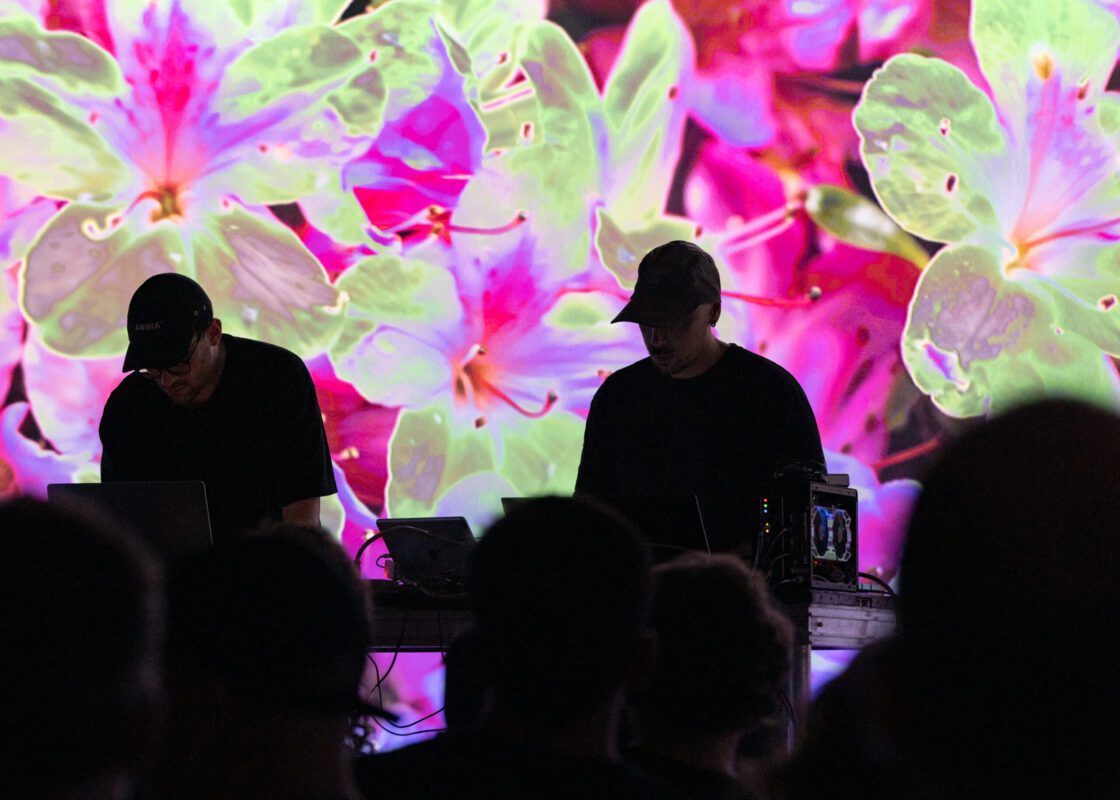
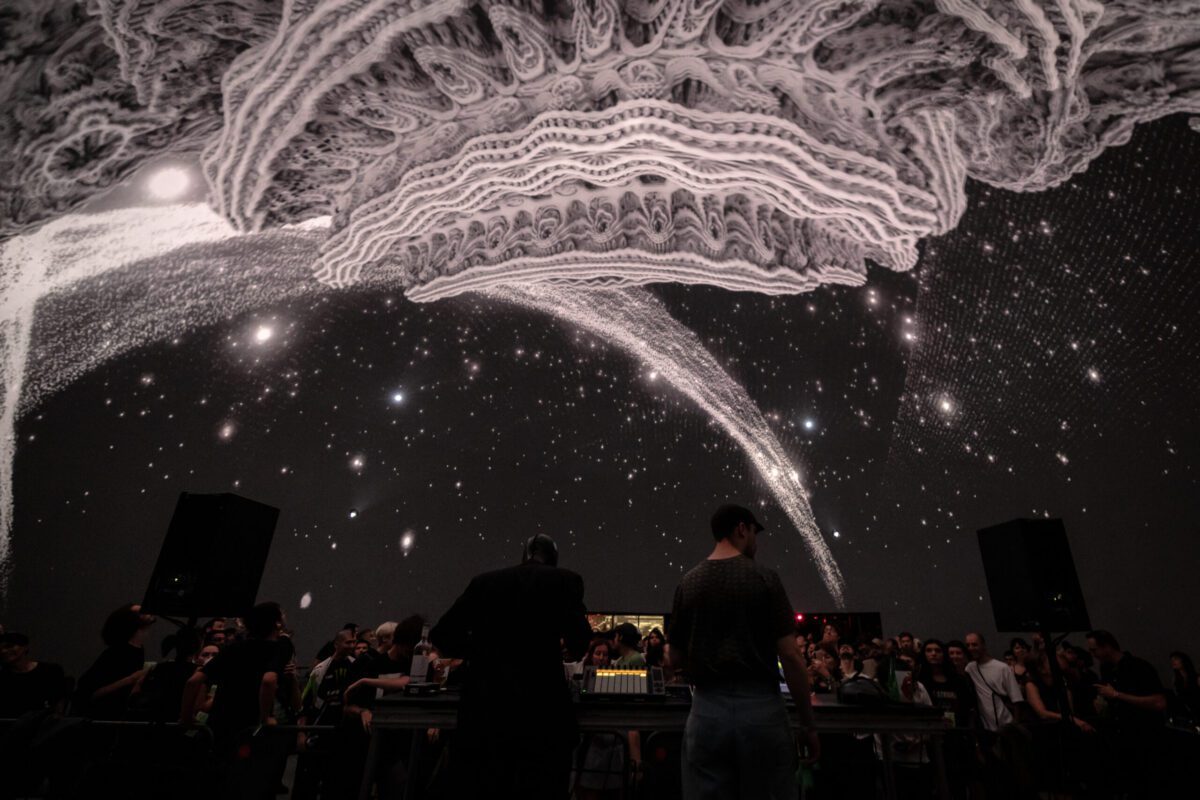
Maybe not the most coherent, or smooth, or musically impressive performance, but ROSINA’s strength definitely lies in the free-flowing energy. One of the best, rooted in the euphoria, the terror, the flourishing rollercoaster that is queerness, and ultimately provoking great pleasure, and, no doubt, great liberation to whoever needs it.

MUTEK 2023 | Métropolis 1: .VRIL, E-Saggila, SYNC. (AtomTM & Peter Van Hoesen)

by Salima Bouaraour

Legs numb from dance, eyes full of stars and shouts of joy: Métropolis 1 was a profusion of love! This first MUTEK evening devoted to Techno was astonishingly formidable right up to first light. The finely thought-out programming offered the public a more than effective formula. The result: a crowd electrified by dazzling binary rhythms.

Crédits photos : Bruno Aiello Destombes


.VRIL

VRIL wandered through break, house and female vocals, bringing a smooth, percussive and progressive set to a powerful kick. In the middle of the night, the atmosphere was enriched by cold, repetitive industrial sounds, creating the sine qua non for an experience worthy of a German underground club.


E-Saggila

Using energetic strings, Canada’s E-Saggila raised the intensity of the high-voltage evening. The composer activated the detonator with a mass of heavy, round and massive beats. The bass picked up your body and your heart. Delicately interspersed with steamy synth sounds, her performance plunged us into the hidden abysses of the festival.


SYNC. (AtomTM & Peter Van Hoesen)

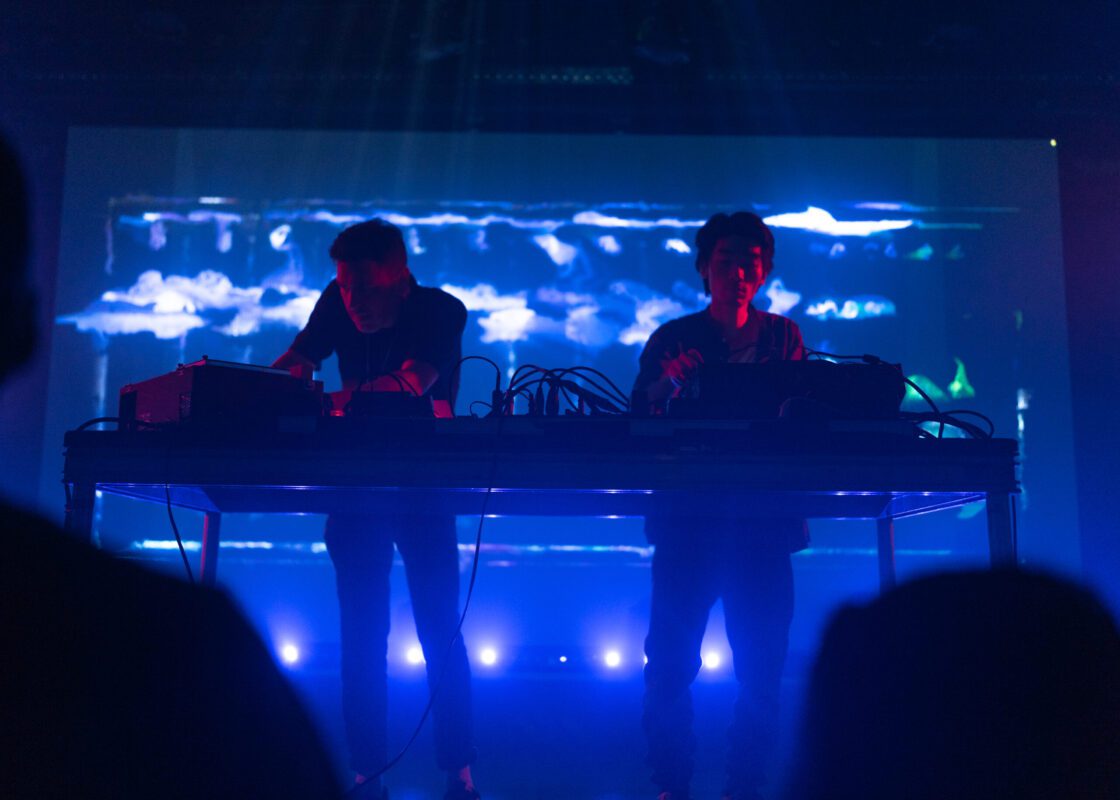
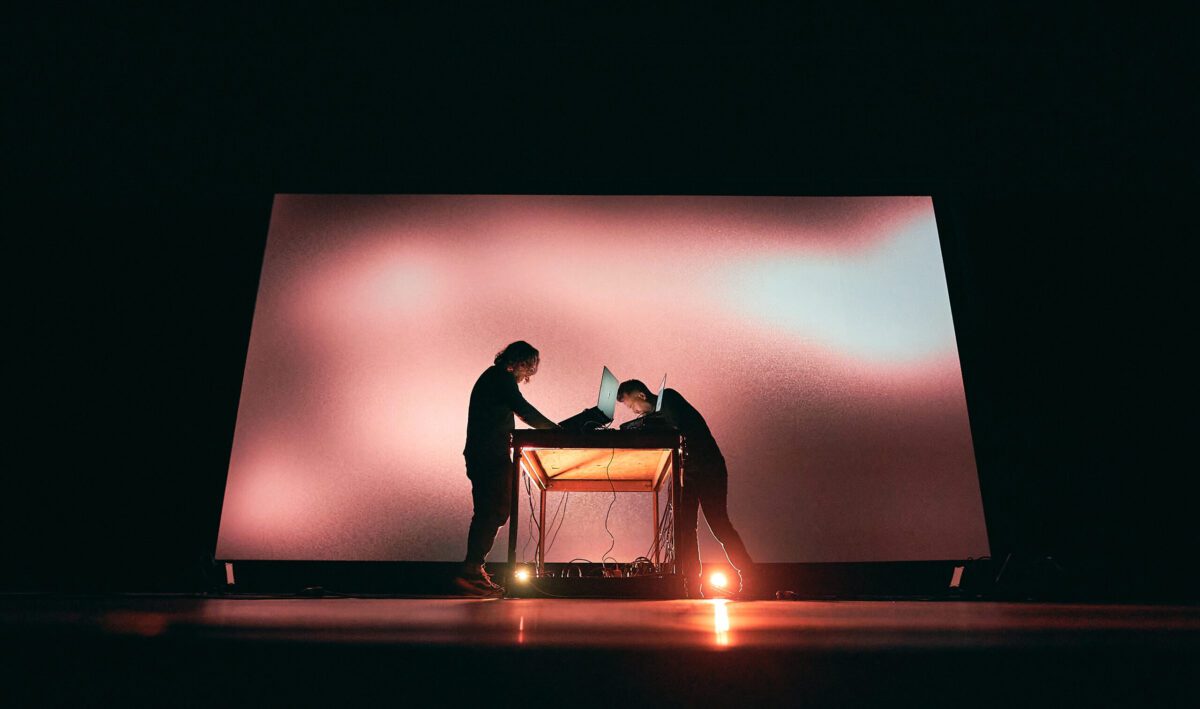
The long-awaited AtomTM & Peter Van Hoesen took to the stage with a long, 3-meter table featuring a hybrid hodgepodge of analog machines, modular, drum machines, effects pedals, controllers and a CDJ…. Although all the sets were of the highest quality, the hardware performance was outstanding. After an introduction tinged with groovy bass, the duo let loose in a wild free dialogue for three hours!

In an arborescence of pure techno, the packed Métropolis generously lost itself in the knowledge that MUTEK’s wild ride will continue unabated on Saturday and Sunday!

MUTEK 2023 | Nocturne 3 : upsammy & Jonathan Castro, Nick León, Halina Rice, Quan & DBY

by Alain Brunet

The PAN M 360 team brings you exhaustive coverage of MUTEK Montréal 2023. Here’s a selection of the best sets presented Friday night at the SAT, as part of the Nocturne series.

Crédits photos : Nina Gibelin-Souchon

upsammy & Jonathan Castro

Cabalistic shapes are projected onto screens on plant surfaces. In the middle of it all, a woman, a man. Dutch DJ, producer and multidisciplinary artist upsammy (Thessa Torsing) likes to illustrate extremes: comfort, discomfort, harmonious beauty, desolation. She uses different colors to paint her sound frescoes: processed voices, varied rhythms and tempos, the sounds of water, the sounds of tactile manipulation, melodic-harmonic fragments, a few feverish bursts of beats contrasting with cold, arrhythmic sequences. This approach, illustrated in space by Peruvian artist Jonathan Castro Alejos, a graphic designer by profession and visual artist of the digital universe, is said to be experimental techno and IDM. Perhaps… For our part, this approach has no apparent genre a priori, apart from the use of rhythms drawn from minimal techno and cerebral ambient. What we have here is a composite language with electroacoustic underpinnings that can nevertheless hook the night owl with a few electroshocks that can make him restless.


Nick León

Floridian Nick León is an enthusiast of Latin advances in electronic music, particularly Puerto Rican and Colombian. A psychedelic curve envelops the rhythms, transforming their original identity. Psychedelia and electronica have been going hand in hand for half a century, and here we have a Latin version. Reggaeton, afrobeats, cumbia, krautrock and ambient come together live. Just enough groove for a Friday, just enough nourishment for a set worthy of MUTEK. From a partner at his side, top-notch projections back it all up, moving jewel patterns, shimmers, stylized kaleidoscopes and more. Listening to this utterly conclusive set, it’s interesting to note that reggaeton has already generated some of its most refined forms. Clearly, Nick León and his stage partner are doing great things.


Halina Rice

A suite of harmonies and melodic fragments on the keyboard, pre-recorded music modulated live. Cerebral techno, electroacoustic, IDM. Londoner Halina Rice doesn’t have the look for the job, no extravagance in her clothes on stage, you could easily see her leading a doctoral seminar. Appearances are deceptive, however, for Halina Rice creates excellent technoid music, with a convincing variety of consonant arrangements, a superb selection of industrial sounds, techno, big beat, female choral singing, and synthetic hooting not unlike that of Arab women. This succession of contrasting climates, misted with dry ice and visuals designed by the main artist herself, illustrates the conceptual scope, superior intelligence, and sensitivity of this woman who, we predict, will leave her mark on her profession.

Quan & DBY

At the heart of the night, a Montreal tandem from the Chez.Kito.Kat label plays minimal techno, archly binary for the obvious needs of the dance floor at this hour of the night – 2am to 3am. The overdubs are relatively discreet, and there’s absolutely nothing ostentatious about this program deployed at the SAT: various whispers, raucous lines, boiling micro basses and other synthesized borborygms produce a counterpoint without overpowering the beat. Rather than displaying all the science they’re known for, breakbeat, deep house, acid, ambient, dub, bass music, dub, all produced by impressive lutherie, notably the purpose-built modular synthesizers Quan and Dog Bless You (hence the acronym D.B.Y.), Samuel Ricciuti’s real name) will give us a conclusive hour of small modulations and big beats for dancers who haven’t migrated to MTELUS, where Sync is playing at the same time.

MUTEK 2023 | A/Visions 1 : Kyoka & Shohei Fujimoto, Alexis Langevin-Tétreault & Guillaume Côté, Alessandro Cortini & Marco Ciceri

by Laurent Bellemare

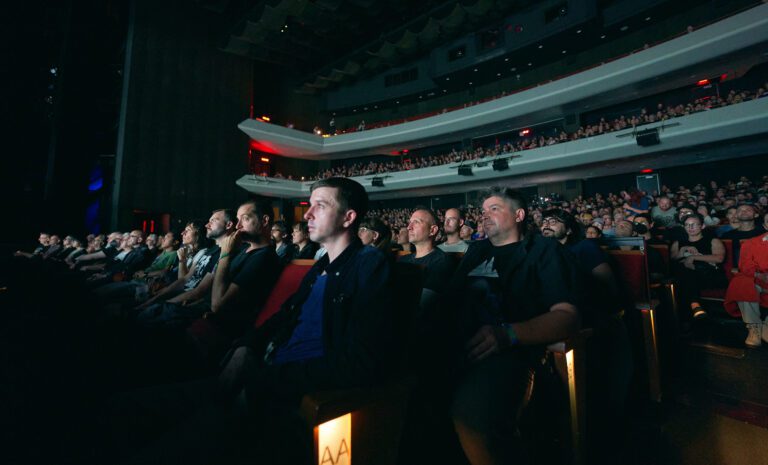
For the first part of its A/Visions series, the MUTEK festival welcomed its audience in a Théâtre Maisonneuve equipped with a single giant screen. It was indeed through projections and loudspeakers that all the artistic action was communicated to the audience, at least for the first of the acts. In all, three artist duos were featured in this concert of experimental and immersive videomusic.

Crédits photos : Bruno Aiello Destombes

Kyoka & Shohei Fujimoto

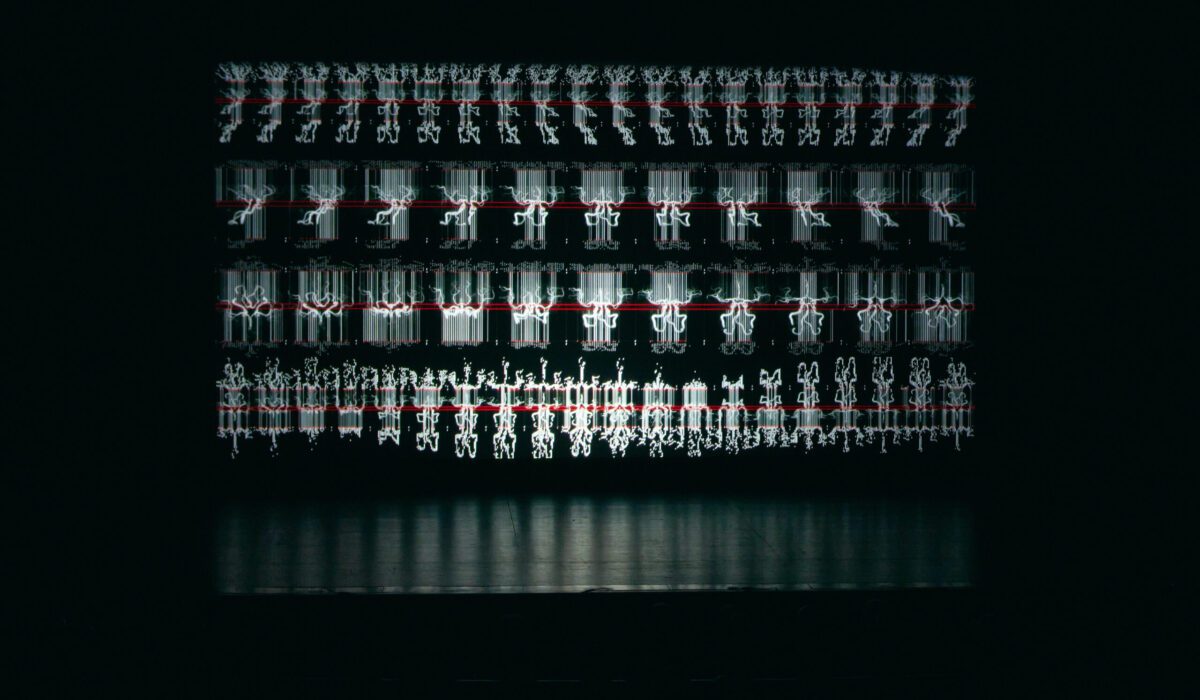
The first quarter of Cinema Blackbox immediately sounded like a Ryoji Ikeda pastiche, with its high-pitched, sinusoidal tones and disembodied visuals. In fact, it featured many of the codes of the Japanese master of sound installations: exclusive use of black, white, and red, stroboscopic lines and rectangular shapes, minimalist aesthetics, and an abundance of synthesized sounds. Later, the composition became more complex, tackling more structured rhythms and multiplying visual planes tenfold into fast-moving mosaics. A brief moment of static brought in a few defined pitches, coloring an otherwise very industrial music, true to Kyoka’s performance presented the day before at the festival. Samples of voices and water drops also brought the work back to the earthly plain. Otherwise, Cinema Blackbox seemed to deliberately adopt a self-referential stance, where technological art chooses to represent technology itself. On the screen, we could see countless elements of sonograms, encephalograms, radar quadrants, and programming codes.

Alexis Langevin-Tétreault & Guillaume Côté

For the second part of the show, a table with electronic devices was added to the set. This was only natural, as Alexis Langevin-Tétreault’s approach is based on “electroacoustic performance”, i.e. the live creation of music usually conceived entirely in the studio. With his partner Guillaume Côté, he effectively evolved the sound mass that is Aubes by varying the timbral and melodic layers with a modular synthesizer. The meticulousness imposed by the highly academic style of electroacoustics could be heard, as the textures were rich and complex. However, the atmosphere always remained that of a reverie, even an escape from the physical world. The harmonic content always kept the audience in major keys, filling an otherwise rather cerebral proposition with hope and emotion. The visuals, too, were composed of colorful yet complex textures, confirming a balanced formula of experimentalism and catchy elements. It’s easy to forgive the intrusive, highly recognizable Macintosh sound that punctuated an abrupt change at the center of the work.

Alessandro Cortini & Marco Ciceri

The Italian duo presented a much heavier performance. In addition to a much slower tempo, the whole piece retained a minor key and was therefore perceptibly more melancholy. Arpeggios played on the synthesizers progressed slowly, resulting in a relatively static framework that grew happily denser during the finale. At this point, the harmonic spectrum quietly approached white noise, while the melodic elements were still clearly perceptible. Visually, the projections were a kind of study of the microscopic patterns of bee wings. Alessandro Cortini impresses with his invented synthesizer and a resume full of prestigious collaborations from Nine Inch Nails to Merzbow. His performance at A/V Visions, however, was less enthusiastic. Without being soporific, the music on offer was far from out of the ordinary. It was nonetheless effective as a mantra to reflect on the possible disappearance of pollinating bees and the disruption of plant fertilization cycles.

MUTEK | Nocturne 2: SAT – Twin Rising, Efe Ce Ele, Paraadiso, Animistic Belief, and more…

by Laurent Bellemare

Opening Photo By: Frédérique Ménard-Aubin

For a second night, the Société des Arts Technologiques opened its doors to Mutek 2023 for the Nocturne 2 event, showcasing a nested palette of electronic artists. With its two open performance spaces, the performances followed one another without interruption, so that it was sometimes necessary to make agonizing choices between one or other of the rooms.

Twin Rising (VJ Isotone)

// Frédérique Ménard-Aubin

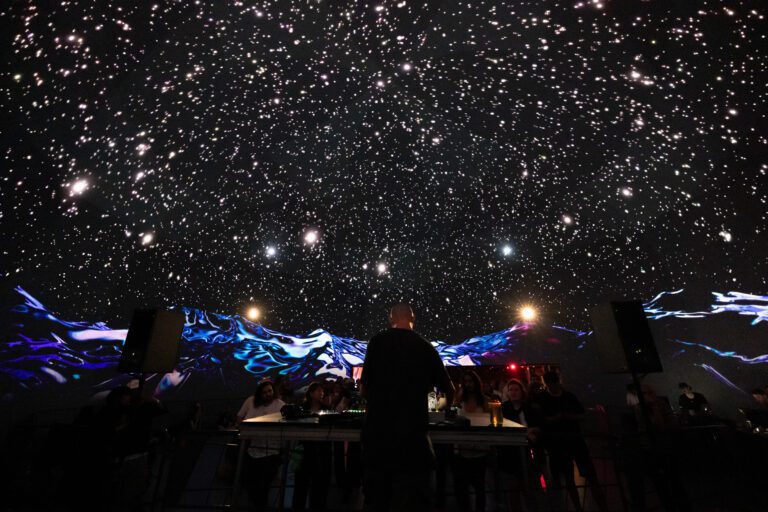
Twin Rising’s mask, adorned with chains, revealed a soft, high-pitched voice, whose vulnerability contrasted with the often rough tones of the lower register. Indeed, despite a consistently harmonic framework, the undulating low frequencies marked a slow, ponderous tempo. In the heaviest moments, it was as if we were witnessing a dubstep performance as defined in the 2000s. An attentive ear could also detect deliberately asynchronous synthetic “snare drums”, creating a highly effective effect of anticipation. A balance between catchy pulsation and rhythmic deconstruction kept the audience on its toes, as did the heterogeneous visuals projected by VJ Isotone onto the satospheric dome. Between aquatic surges and granular geometry, the multicolored palette was the only thread to hold on to. In any case, these shapes went very well with Twin Rising’s music, creating a vaguely melancholy atmosphere. An excellent way to start the evening.

Efe Ce Ele

// Nina-Gibelin Souchon

Descending to the first floor, the change in atmosphere was immediately apparent. For Efe Ce Ele’s performance, the tone was decidedly darker: insistent pulsation, strobe lighting, psychedelic visuals and explicit political messages. There were echoes of techno and industrial music in this soundtrack to an anxious age. Melodically, the music evolved mainly in the low register, with occasional breakthroughs of piano, percussion and sampled vocals. More often than not, we were bathed in a complex drone of slowly modulating voices. Transitions were often articulated by superimposing sections, momentarily creating a very dense, dissonant passage.

Nadia Struiwigh

// Frédérique Ménard-Aubin

Back in a crowded Satosphere, the atmosphere created by Nadia Struiwigh was the first of the evening to be reminiscent of a rave. The experience was necessarily more physical than the others, with the Dutch artist’s music operating with consistently catchy 4/4 rhythms. Here and there, syncopations added slight echoes of drum’n’bass and breakbeat. Harmonically, held or fading chords followed each other in a simple progression. These were coupled with short, repeated melodic cells, creating an ever-present contrast of rhythmic density. Textures added to this catchy base kept the sound interesting, while the body was easily carried along by the continuous backbeats. On the visual side, artists BunBun and Alex Vlair proposed a highly successful composition. Spiral patterns, concentric circles and circular mosaics were perfectly in tune with the SAT dome.


Paraadiso

// Nina-Gibelin Souchon

Composed of artists TSVI and Seven Orbits, the Paraadiso duo delivered a much less conventional sound. The atmosphere was sometimes ethereal and consonant, and sometimes suddenly chaotic and noisy. The common denominator here was well-calculated rhythms to avoid the predictable. Strong beats were often avoided, accentuating syncopation instead. At other times, polyrhythms created highly effective phase-shifting effects. Irregular subdivisions in turn destabilized the construction of a rhythm. Overall, the duo’s sounds were abstract, closer to digital art than dance music. This experimentation was also reflected in the projections, composed of microscopic images of the natural world, which were highly processed to the point of becoming unrecognizable textures. With a rich palette of sounds, the Paraadiso duo offered a skilful performance of “music not for dancing.”

Amselysen/Racine

// Frédérique Ménard-Aubin

The Amselysen/Racine duo presented austere music, where everything was rhythm and timbre. No melody, no harmonic cues. What’s more, the pulse was drowned out by fast syncopations or fast bass drum mats. Resolutely industrial, the sound was reminiscent of Autechre in its less consonant moments. In keeping with the gray but no less exhilarating music, the visuals projected onto the dome by Diagraf were all black and white. Origami stalagmites layered with stardust were transformed into sooty nebulae. Amselysen and Racine skilfully captivated their audience despite the difficult, rigid music.

X/O

// Nina-Gibelin Souchon

Already past midnight, x/o took to the stage to present tracks from their excellent album Chaos Butterfly. This heavy music, full of contrasts thanks to dreamy vocals, reinvested many familiar musical landmarks. From IDM to metal, from dream pop to breakbeat, the Vancouver artist gave a convincing performance. Unfortunately, the vocal performance was a little too timid, and did not stand out in the sound balance. Technical problem or lack of confidence? Whatever the case, the vocals weren’t treated in a way that did full justice to the compositions, a drawback that was somewhat corrected towards the end. Nevertheless, x/o captivated their audience with ease, creating a dark atmosphere enhanced by bluish strobe lighting and hypnotic projections. One could appreciate the almost shoegaze noise flights illustrated by Japanese-drawn characters. All in all, x/o provided a moment of catharsis as heavy as it was soothing, with a well-controlled rise in intensity from one room to the next.


Kyoka

// Frédérique Ménard-Aubin

From the outset, Kyoka’s music was almost entirely inharmonic, focusing on the fullness of its sound samples and the insistence of its rhythms. The beginning of the performance was colored only by the cubist projections of BunBun and Alex Vlair. Yet, in a sudden moment of weightlessness, every trace of rhythm faded away, giving way to a long, atmospheric, harmonic passage. It was a real breath of fresh air, in an evening where the continuous pulse was king. Rhythmic, but more nuanced music with new melodic elements then emerged from this lull, bringing a sequence of euphoric variations to a close.

Animistic Beliefs

// Nina-Gibelin Souchon

It didn’t matter to Animistic Beliefs that their appearance on stage was scheduled for the early hours. The duo truly transformed the SAT into a nocturnal party, intoxicating the audience with a relentless pulse and psychedelic sounds stacked one on top of the other. Their experimental music is generated in real-time by modular synthesizer work that doesn’t pull any punches. The sound was dense, the sound was loud, and the high-pitched rough whistles assaulted the senses as much as the thundering low frequencies. The duo’s music was peppered with intriguing sonorities, from samples to vocal outbursts declaimed like a punk singer screaming into a megaphone. Animistic Beliefs are said to incorporate Southeast Asian influences into their sound, sampling Vietnamese poetry and totobuang, the gong chimes of Indonesia’s Moluccan Islands. However, this is not the kind of nuance that could have been perceived on the spot, since the duo’s show is such a smash hit. A discovery that makes you want to go and listen to their album MERDEKA (independence in Indonesian).

Eƨƨe Ran

// Frédérique Ménard-Aubin

Here’s another case where tonality was in short supply. Alternating a frantic pulse with powerful syncopated rhythms, Eƨƨe Ran had the thankless task of closing a stimulating evening. The artist’s formula might have remained a little drab were it not for the numerous misbehaviors. The Montrealer didn’t hesitate to divert his rhythmic carpet by improvising a noisy passage evoking unintelligible vocoder sounds, or by momentarily stretching or compressing the tempo. It was all about working with texture. Otherwise, the music shared that industrial coldness common to many of the evening’s artists, in which white noise is more the norm than musical note. Perhaps a little randomly, pointillist images of molecular structures and spatial nebulae were interspersed with rocky desert landscapes, all creating an atmosphere of almost nihilistic abandon to dance and decibels too many. The evening ended with a rallentando and a decrescendo into nothingness.

MUTEK 2023 | Satosphère 2 : UNION — Nancy Lee & Kiran Bhumber

by Alain Brunet

Photo credit: Ash KG

Here’s a summary of this 25-minute work, part of the Satosphère program on August 23 at MUTEK: “UNION is an immersive narrative that tells the story of two beings discovering their ancestral memories through the desire for touch and the rituals practiced during their post-apocalyptic wedding ceremony.”

Nancy Lee and Kiran Bhumber have imagined their story as an artistic illustration of their diasporic identities. Their aim is to “unveil and reconstitute cultural memory through the sacred ritual of spiritual union and physical intimacy”. In other words, this spiritual union cannot function smoothly if the strains of its actors are not identified, understood and integrated.

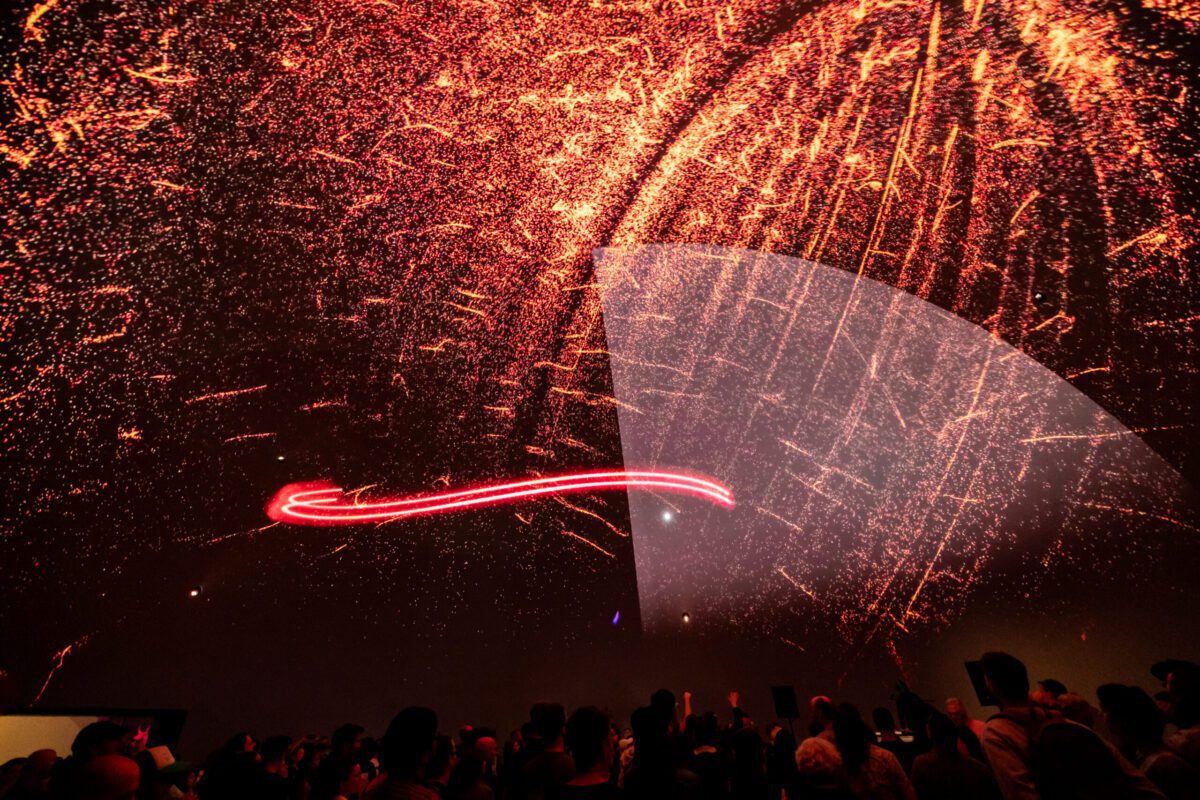
The immersion proposed here is based on abstract images projected onto a dome: shimmering colors mingle on the concave screen, giant hands whirl around, suspended humanoid busts, deposits of gems, two flesh-and-blood women sketching short choreographies, an evocation of post-apocalyptic marriage.

In terms of sound, the soundtrack includes a brief narration of this fictional story and offers the ear a series of electronic effects typical of this type of immersion: synthesized percussion, industrial sounds, and electroacoustic processes generally familiar to dome immersion enthusiasts. The sound quality is also exemplary.

In short, the abstraction of this work outweighs its background, the aesthetic coherence of this work needs to be perfected, the integration of forms and sounds testifies to an art that is still exploratory and above all interesting for its fragmentary effects and not for their integration into an integrated whole.

This is a recurring problem with immersive works that include sound and images: a fascination with these new creative tools rarely leads to an integrated aesthetic, and we contemplate their technological advances without being marked by a total work.

MUTEK 2023 | Experience 2 : Airhaert, Dawn To Dawn, The Mole

by Théo Reinhardt

MUTEK Montréal 2023 and PAN M 360, a combination that makes perfect sense! That’s why our team is focusing on it this week. Fans of cutting-edge electronic music and digital creation are in Montreal this week, so follow our team’s vibrant coverage through Sunday!

Photo credits : Frédérique Ménard-Aubin

Airhaert

Airhaert doesn’t so much crowd the stage as she fills it, like a cloud of smoke. Her music, like her, finds its source in the depths of the earth, and seeks to bring us back to it. Between trip-hop rhythms, ambient techno and draped vocal passages reminiscent of Grouper, the meditative, spiritual aspect of the project is heard and felt. The voice is used as a stream of celestial energy flowing through the otherwise dark space of the music. I imagine ghosts of a phrase, a thought, long forgotten in the depths of being, deconstructed perhaps in form, but having acquired a whole new meaning. These voices are texture, they are a stream, and it’s tempting to let them enter us for how they might affect our currents, hot and cold, uncertain and obsessed. Because, after all, water is a sure current that always finds its way.

Airhaert’s recent album, I. I. (for Intuitive Intelligence) is an exploration of the depths of Being, a hypnotic, meditative, grounded and introspective experience that seeks to explore the notion of therapeutic music. On stage, the album seems to take a few spontaneous turns, no doubt at the whim of the moment and the lure of the buttons, wheels and indicators that surround the artist. Despite the improvisation and the few harder-cut transitions it brings, we can still lose ourselves in the music, or… in ourselves!

Dawn to Dawn

Dawn to Dawn is a trio made up of Montreal singer Tess Roby, along with Patrick Lee and Adam Ohr. Together, they possess that twilight electro sound which caresses the ears and seems perfect for imagining a high-speed nocturnal stroll through a futuristic, neon-lit cityscape.

Borrowing from pop structures, their style is clean and effective. The synths are round and glistening, like clouds at dusk, while the bass and percussion, with their techno and breakbeat accents, are predominant. Tess Roby’s voice is soaring, dancing lightly in the fine light of the landscape they conjure.

Towards the middle of the show, the songs rise in energy and tempo. Roby’s voice, performing from the front of the stage, soars with the music. This trio may not be the flashiest, but sometimes we like having the lights dimmed. Dawn to Dawn’s music is like that: warm, light and appealing, like distant lights on a summer’s night. The ones that remind us we’re not alone.

The Mole

After more than 20 years in Berlin, The Mole, aka Colin de La Plante, is back in Canada. 

The man who made his name in Montreal as a DJ in the 2000s offers a sample-heavy proposal. Cut-up vocals, excerpts from instrumental breaks, bits of lyrics, all these flow together in a sound space built block by block and with great care. His “Go Wiggle!” project, which he presents on the Esplanade Tranquille stage, is based on lyrics from Parliament-Funkadelic.

In his performance, Colin de La Plante weaves together the different parts of his musical presentation with fades. Rhythms enter while others leave, a new melody overtakes the previous one, and, gradually, new sounds are integrated, to the point where we no longer remember what was coming out of the loudspeakers a few minutes earlier.

Working partly with vinyl, de La Plante is definitely searching for a retro aesthetic. The proposition remains fairly conventional and doesn’t get too experimental. Instead, each piece unfolds slowly and meticulously, revealing a sensitivity as well as an instinct for progression on the artist’s part, who leaves us time to notice the changes, fluctuations and disruptions he engenders. All in all, this becomes a show that has a good groove, and which manages to be pleasantly varied and spellbinding.

FORUM MUTEK JOUR 2 | Confronting the Future of Artificial Intelligence

by Elsa Fortant

At its inception, the MUTEK Forum was held 6 months before the festival. In 2018, the two events have been grafted together, offering a unique perspective on digital creativity. Programmed by Sarah Mackenzie and hosted by Claudine Hubert, the 9th edition is entitled “Courants d’avenir” and will be held all week long at Les 7 doigts de la main. MUTEK offers us the chance to delve into a wide range of contemporary themes: the relationship between culture, technology and the climate crisis; accessibility and inclusion within immersive technologies; the power of tech; art, governance and artificial intelligence; and the future of festivals. Here’s a report on the second day’s main conference, which focused on artificial intelligence.

Crédits photos : Maryse Boyce

Conference

Shifting narratives of AI : confronting tech’s power

Sarah Myers West – AI Now Institute

“We are at a moment when critical work must not be reduced to worst-case scenarios, but can be firmly rooted in its origins, in the possibility of an alternative vision of a world where small-scale democracy is possible.”

Sarah Myers West’s words struck a chord. Her message is clear: artists and creative workers have an essential role to play in addressing the issues raised by artificial intelligence (AI) and in shaping the world we want to live in.

AI is a hot topic, and the term is becoming overused, as the researcher reminds us, starting by questioning the appellation itself. The term artificial intelligence is often used as a marketing tool. It’s a “floating signifier” filled with ideas and visions, detached from a material and above all technical reality. In other words, we lend AI powers it doesn’t necessarily have. A whole imaginary world has been created around it, largely nourished by the great works of science fiction.

Artificial intelligence is also a term sometimes used to refer to applied statistics and linear regression. Then, Sarah Myers West quotes the definition of AI given by American AI ethics researcher Meredith Whittaker. This technology, since it is fed by user data and used commercially, can also be defined as a form of surveillance by-product. In this respect, it’s important to point out that not only are companies lacking in transparency about the provenance of the data they use to train AI models, disregarding issues of copyright and intellectual property.

Faced with the rise of AI and, above all, the desire of companies to develop these models on a large scale – which causes environmental and discriminatory problems and affects workers – Sarah Myers West reminds us that there are other possible trajectories.

Meaningful change requires tackling different forms of advantage:

  • The data advantage: information asymmetry between companies and the public
  • The computational advantage: dependence on infrastructure, hardware and software
  • The geopolitical advantage: framed by (the absence of?) regulation, and governments that support the development of AI as a strategic and economic asset

Going beyond the regulatory framework of public policies

Negotiations to regulate AI in the USA, Canada and the European Union are underway, but for the time being, safety is a priority, rather than the issue of algorithmic bias and discrimination. To date, we still lack information on the data used to train models like GPT-4, and Sarah Myers West reminds us that we can’t take companies at their word when they tell us they know what they’re doing. So far, they’ve proved that they’re ready to market their technologies even if they’re not.

Mechanisms need to be put in place to hold companies accountable for their actions. And the Frontier Model Forum, “a new industry body to promote the safe and responsible development of cutting-edge AI systems” launched by Anthropic, Google, Microsoft and OpenAI, isn’t enough.

How can we take action and make our voices heard? We need to confront the concentration of corporate power and get organized, says Sarah Myers West. Workers, creative workers and artists are at the heart of the resistance to these tech giants. They are in a position, collectively, to create leverage to ensure that AI is not used to devalue their work. The most recent strike by WGA authors is an example of this struggle.

Not wanting to hear about AI is one thing, but what’s certain is that the train has left the station and you’d better be ready to ride it, to be able to act collectively.

Subscribe to our newsletter