Ensemble Obiora | A Successful Evening of Firsts and Discoveries

by Alexandre Villemaire

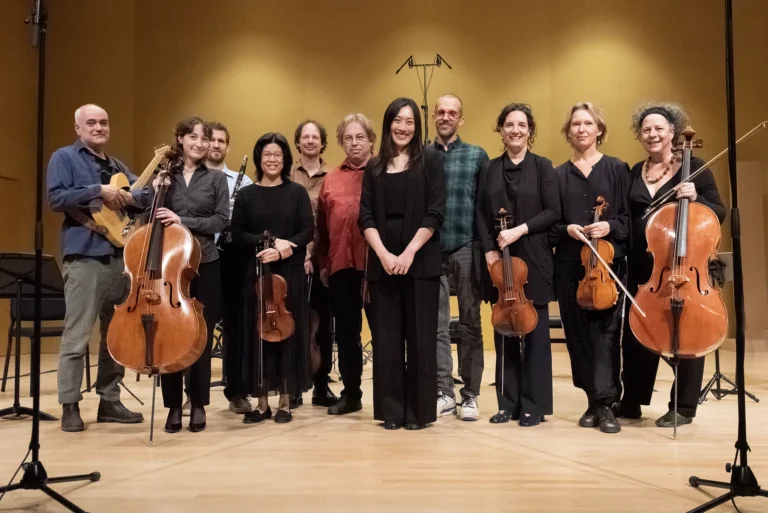
It may not have been the opening night that Ensemble Obiora had originally envisioned, but it was nonetheless a remarkable evening of double premieres. For the opening concert of its 2023-2024 season, “Canada’s first classical music ensemble composed essentially of professional musicians from culturally diverse backgrounds” was to welcome Venezuelan Glass Marcano as guest conductor. Noted for her spirit and energy at the La Maestra Competition in Paris in 2020 – where she was awarded the orchestra’s Special Prize – the young conductor was due to give her first North American concert with the Montreal ensemble. Unfortunately, for health reasons, she had to cancel her participation in the concert. French conductor Samy Rachid stepped up to the podium at the last minute to replace her. A former cellist with the Quatuor Arod, this young man in his thirties, who has just been appointed assistant conductor of the Boston Symphony Orchestra and has already worked at the Opéra National du Rhin and the Verbier Festival, was also making his North American debut.

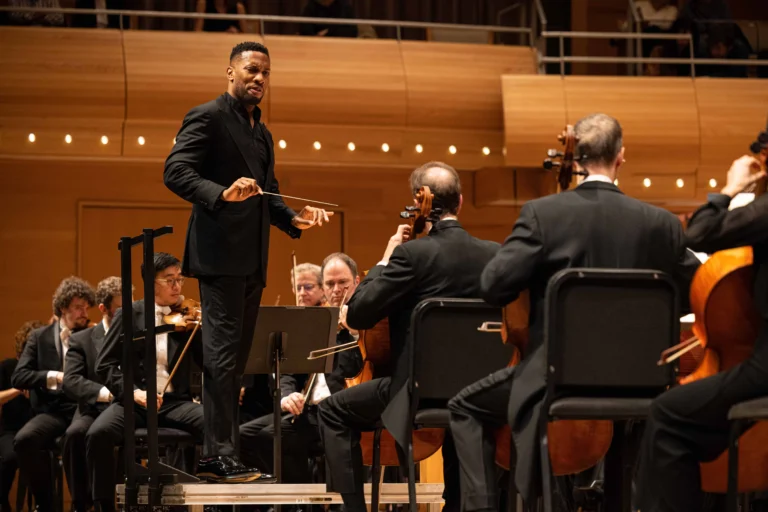
The evening’s program featured both romantic and modern repertoire. Opening with Ravel’s Le Tombeau de Couperin, with its particularly colourful timbres, inspired by the dance suites of the Baroque period and paying homage to 18th-century French music. Originally written for piano, Ravel extracted four of the six movements (Prelude; Forlane; Menuet; Rigaudon) for orchestration. Rachid’s clear conducting, with its airy, energetic gestures full of meaning, brings out the nuanced sonorities of the orchestra and the intrinsic character of each dance.
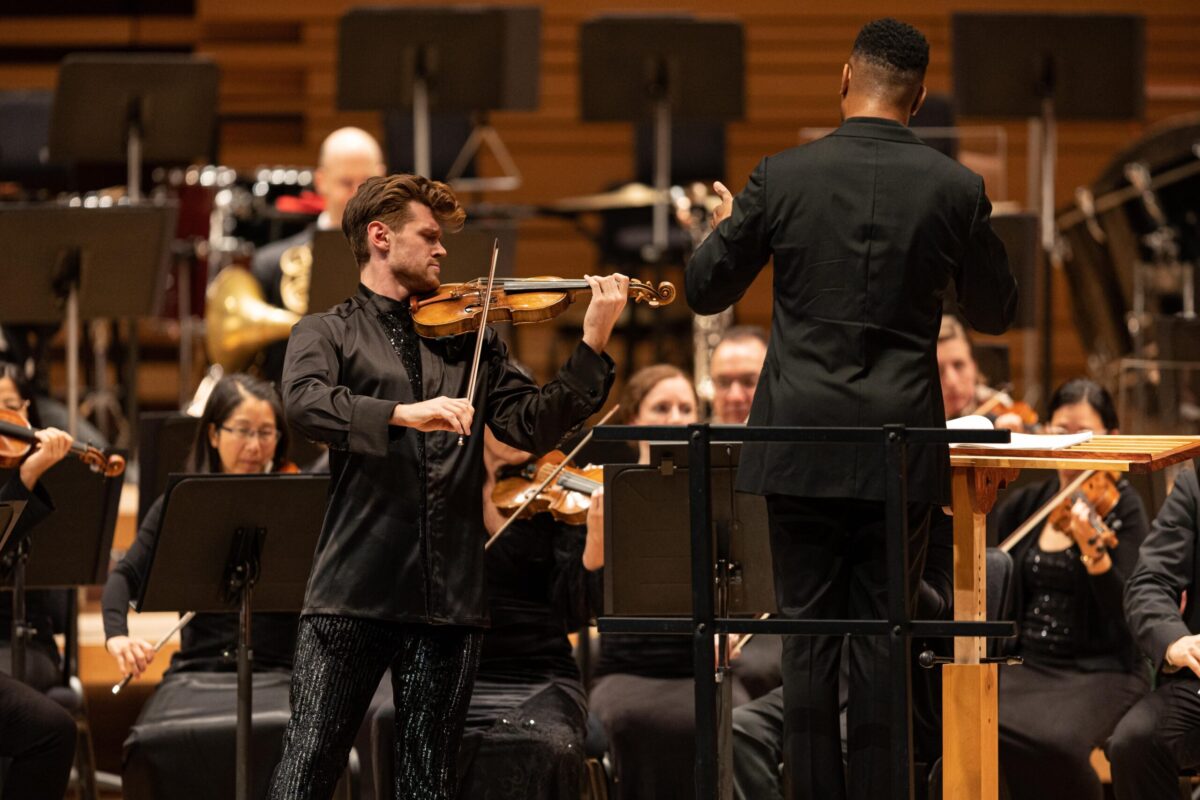
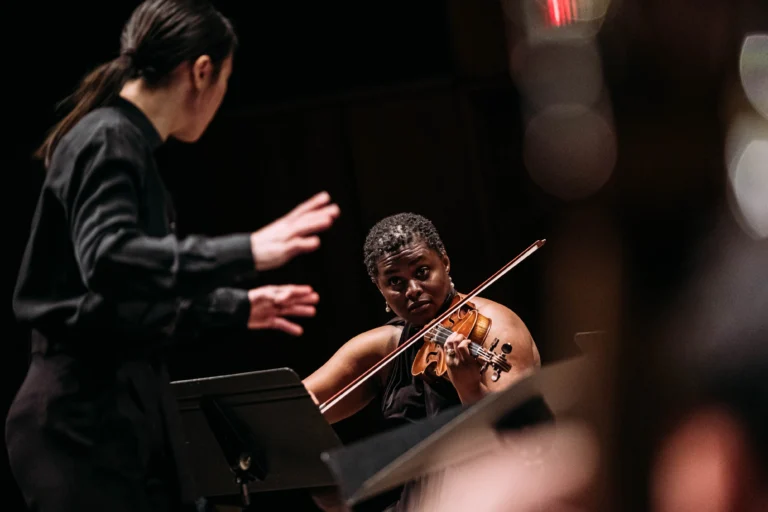
The centrepiece of the concert, Florence Price’s Violin Concerto No. 1 in D major, performed for the first time in Canada, was a wonderful discovery. Classically structured in three movements (Tempo moderato, Andante, Allegro), it clearly bears the mark of its composer’s origins. Carried by Obiora Tanya Charles Iveniuk’s violin solo, the first movement in particular evokes many of the characteristics of Afro-American music, such as gospel inflections, call-and-response orchestral interplay and even blues. Offering several solo moments, it showcased the soloist’s technique in lines of great virtuosity. The second movement, more lyrical, was marked by melancholic flights of fancy, while the last movement returned to festive, joyous virtuosity, with the orchestra accompanying the soloist with rhythmic accents and an enveloping carpet of notes, ending in a dazzling finale. The concert concluded with Brahms’s Variations on a Theme by Haydn, a contrasting work in which the composer’s variations on a chorale theme from the Feldpartie in B-flat major range from low drama to dance-like lyricism, culminating in a victorious, trumpet-like finale.

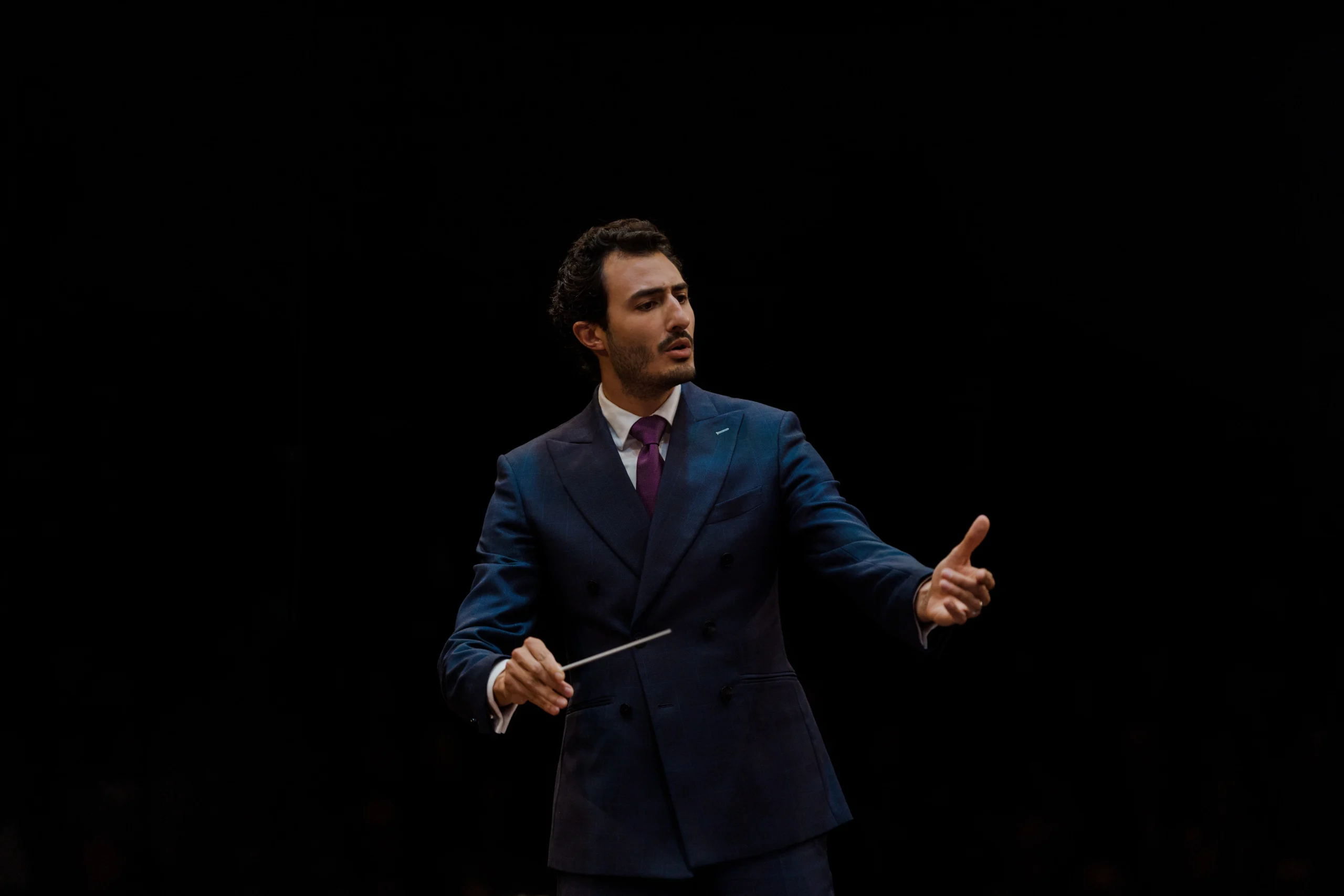
As impressive as Tanya Charles Iveniuk’s playing was Samy Rachid’s direction. With careful direction and simple yet immensely meaningful gestures, he communicates a palette of dynamics and colours with ease. His energy is playful yet restrained, never excessive, and his direction highlights the architecture of the pieces, finely shaping the sound of the orchestra. A conductor to follow and, above all, to invite back!

Only two years after its creation, and having grown from an orchestra of 25 musicians to more than twice that number, Ensemble Obiora can certainly say that, with the lively and original program offered on Saturday evening, and the interest and diversity of the audience in attendance, it is more than ever a fixture on the Montreal musical scene.

Photo credits: Tam Lan Truong (Tanya Charles Iveniuk) et Therera Pewal (Samy Rachid)
OFF Jazz | Bogdan Gumenyuk: Seeds of Ukraine in a Well-Beaten Jazz Soil

by Frédéric Cardin

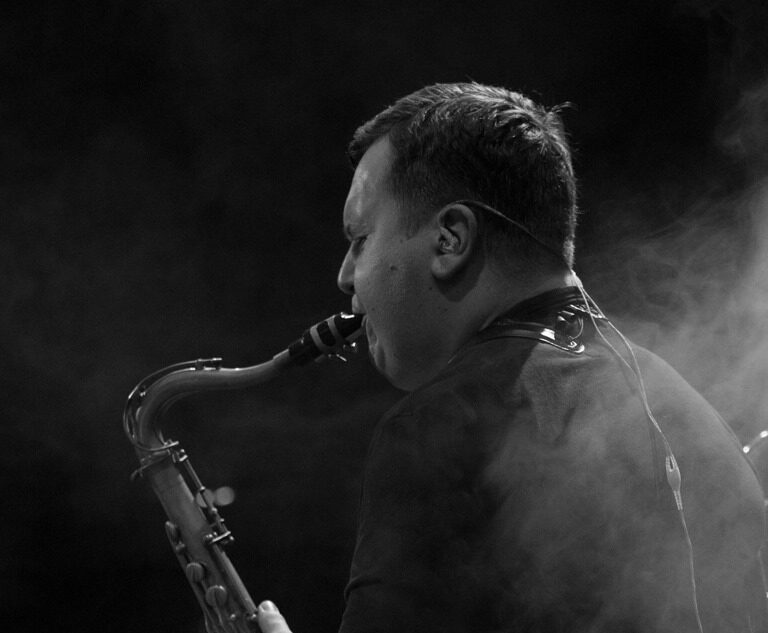
Ukrainian-born Montreal saxophonist Bogdan Gumenyuk gave a concert last night in which he introduced traditional wind instruments from his native country into his music. The announcement promised a journey through a repertoire inspired by traditional Ukrainian pieces and unusual sounds. The result was much more conventional than expected. The sonic incongruities of instruments such as the rig (a cow’s horn) and the double sopilka (a flute) were occasionally present, but no more. That said, some of them did have a spectacular effect, such as the trembika, a large flute (enormous!, about 3 metres long!) that protruded well beyond the stage and was almost in the audience when Gumenyuk played it. With the sound of a wooden hunting horn, more or less, it thundered quite loudly in the little Dièse Onze club.

The music itself navigated fairly classic jazz waters: ballads that would not have been disowned by the West Coast tenors of a certain era (Getz, Gordon), feverish bop, swaying blues, and so on. We enjoyed a melody that came from the popular Ukrainian repertoire, of course, and also a few more modern incursions like La Terre en soi, released as an EP not long ago (and which I invite you to read my review of). On the whole, though, we were treated to a more careful product than his 2022 album Love Letters to the Other Side (despite the presence of two tracks from the album in question), which handled hard bop of the highest quality with conformity but plenty of fire and sincerity. The touches of unusual instrumentation gave more the impression of a sprinkling than a real conceptual basis.

Nevertheless, and more importantly, there were some fine, inspiring solos from all members of the quartet: Paul Shrofel on piano, Sandy Eldred on double bass, John Hollenbeck on drums and, of course, Bogdan himself on tenor (and a sturdy blower at that). In fact, the packed audience often applauded warmly.

Photo credit: V. Yanuk

OFF Jazz | Ruiqi Wang: Wanderings From East to West, and Back Again

by Frédéric Cardin

As part of the Apéroffs series at OFF Jazz 2023, Ruiqi Wang, a fresh young singer and McGill graduate, gave a concert yesterday. Now pursuing her studies in Bern, Switzerland, she is keeping in touch with Montreal (both professionally and emotionally), notably by returning to present material from her forthcoming album, Subduing the Silence, due out on 27 October.

In a chamber format with seven musicians (eight including her), a piano-bass-drums trio (very good Stéphanie Urquhart, Summer KoDama and Mili Hong) enhanced by a string quartet, Ruiqi Wang dazzles or lulls the audience, depending, with vocal elaborations that are either traditional Chinese litany (but revisited), contemporary onomatopoeia (influences from Meredith Monk, Pauline Oliveros and pages of Ligeti are detectable), spoken word or even more classical jazz singing. The voice lacks breath in the upper register, but it’s not devoid of pretty timbres in the lower. In any case, it’s beautiful and tonally accurate, and pleasant to listen to. The chromatic modernism, sometimes atonal, in the harmonies is generally the order of the day, although at times we find ourselves tenderly reminded of Evans or even Strayhorn. It’s a mix that marks out the learned and artistically elite well-sourced inspirations of the young composer.

The structure of the pieces, and more broadly that of the programme as a whole, is rigorously structured and guided. Improvisation is liberated under precise conditions, at chosen moments. In my opinion, Ruiqi Wang’s music is mainly conceived as a written structure onto which improvisation can later be docked under well-defined parameters. These are well rendered and brought to life by the three musicians in the basic trio accompanying Ruiqi. Urquhart, KoDama and Hong are truly solid. Montreal’s up-and-coming female jazz musicians are impressive and point to an exciting future.

For these structural reasons, the concert resembled, with some inevitable accommodations because, after all, this is jazz, the forthcoming album. In other words, listening to the album (already available to listen to on Bandcamp) and the concert are very much the same experience. Which in no way diminishes its quality, don’t get me wrong.

The concert took place at Montreal Improv, a great little space on Notre-Dame Street West in Griffintown. Even if it is focused primarily on theatrical improv, we’d like to see the place get a proper, regular jazz programme in the not-too-distant future. There’s so much musical talent in this city that new venues and opportunities to play in front of an audience are urgently needed.

Jacques Schwarz-Bart Concludes Off Jazz with a Dive Into Harlem

by Michel Labrecque

The closing concert of the Festival OFF Jazz de Montréal, on October 14 at Studio TD, left us satisfied. Jacques Schwarz-Bart, the immense Guadeloupean musician-turned-American, delivered a performance inspired by his latest album, The Harlem Suite. With the invaluable assistance of Montreal-based Guadeloupean singer Malika Tirolien.

Jacques Schwarz-Bart wears many hats: he contributed to the jazzification of gwoka, the traditional music of Guadeloupe; he has also worked with many “neo-soul” artists such as D’Angelo, Erykah Badu and trumpeter Roy Hargrove; today, he is a professor at the prestigious Berklee College of Music in Boston.

The Harlem Suite is a vibrant tribute to Harlem, the New York neighbourhood where Schwarz-Bart lived for almost two decades. The emblematic neighbourhood of the black community and its culture for over a century. This album is more jazz-oriented than the Guadeloupean’s other creations.

The concert began with a deluge of notes, on an ultra-fast rhythm. In addition to Schwarz-Bart, the quartet included three of his Berklee students, Ian Banno on bass, Hector Falu Guzman on drums and Domas Zerosmskas on piano. Promising, impetuous youngsters who demonstrate the excellence of this musical college.

We’ve heard covers of Herbie Hancock’s “Butterfly,” Betty Carter’s “Look No Further” and John Coltrane’s “Equinox,” formidably reinvented by Jacques Schwarz-Bart and his musicians. All these covers appear in The Harlem Suite.

Malika Tirolien is an exceptional and innovative singer! The singer with American bands Bokanté and Snarky Puppy can take us into musical stratospheres. She’s brilliant.

But it was really with compositions by Jacques Schwarz-Bart that the concert reached its zenith. From Gorée to Harlem, evoking the African presence in Harlem, and the jazz tribute to Roy Harper gave us moments where emotion joined musical complexity.

The icing on the cake: our man speaks French, of course, and talks at length about the spirit of his compositions, while updating us on the state of racism in the United States. The man studied political science in Paris and knows how to analyze life in his host country.

The concert rounded off the Off Jazz Festival in style. The Festival also crowned local band BellBird as a promising newcomer.

The festival demonstrated the strength of local jazz in all its forms.

Le Vivier | Quatuor Bozzini + Dedalus + Peyee Chen : Meditation and Contemplation

by Elena Mandolini

The Quatuor Bozzini performed last night at the Conservatoire de Montréal, in collaboration with several collectives. The concert was presented as part of Québec musiques parallèles, an initiative by the Quatuor Bozzini (Alissa Cheung and Clemens Merkel on violin, violist Stéphanie Bozzini and cellist Isabelle Bozzini) to bring new music outside the major urban centers. The program presented in Montreal has already been performed in Trois-Rivières and will be in Jonquière on Sunday.

The work presented is Grounds of Memory, by composer Jürg Frey, for soprano and chamber orchestra. Quatuor Bozzini was joined by the Dedalus ensemble, comprising Didier Ashour (guitar), Joris Rühl (clarinet), Stéphane Garin (percussion), Silvia Tarozzi (violin), Cyprien Busolini (viola) and Audréanne Filion (cello), as well as soprano Peyee Chen. All these performers offered an evening of introspection and meditation to the audience gathered for the occasion.

Jürg Frey’s piece could almost be described as minimalist. Indeed, the focus is more on the sounds that the various instruments can produce. The sonic atmosphere is uncluttered, with each instrument playing one note at a time, in turn. The atmosphere is soaring, conducive to contemplation and calm. Throughout the hour-long Grounds of Memory, the sound level remains more or less the same, with the exception of a percussion crescendo towards the middle of the piece. The musicians are exceptional listeners, sharing the melody in such a way that the instruments and their timbres blend together. If one had listened to this work with closed eyes, one might have thought there was only one violin instead of three, such is the concern for uniformity.

The accompanying text, sung by soprano Peyee Chen, is a collage of poems written by Jürg Frey himself, as well as by Arakida Moritake and Emily Dickinson. Once again, the singing responds to a pared-down aesthetic, where each syllable is enunciated clearly and slowly, and almost entirely monodic. The text, though printed and inserted in the evening’s program, remains clear without the need for simultaneous reading. Chen’s voice is clear and pure, with no vibrato despite the notes held. This is a constant throughout the piece: the notes held are immutable, which makes this work and this interpretation all the more remarkable for the accuracy, quality and solidity of the sound.

The piece ends much as it began, with a solitary violin note that fades into space. A long moment of contemplation separates the end of the piece from the applause. Applause well deserved, as the musicians delivered a performance of the highest level.

For more concerts by Le Vivier, click HERE.

Photo credits: Elaine Louw Graham

OSM | Roderick Cox and Blake Pouliot Offer an Energetic and Brilliant Evening

by Elena Mandolini

The OSM welcomed some distinguished guests last night. Conductor Roderick Cox and violinist Blake Pouliot delivered solid performances that lived up to expectations and their respective reputations, in a powerful evening of vitality and virtuosity.

The concert opened with Tchaikovsky’s symphonic fantasy The Tempest. The work was inspired by Shakespeare’s play of the same title. It is a highly evocative work, constructed in several tableaux describing the play’s events in music. We could hear the waves, illustrated by the string section, and all the drama of the play, evoked by powerful brass instruments. The performance of this work is remarkable: the orchestra plays perfectly together, even in the fastest, most charged passages. Cox’s precise, sweeping and evocative gestures guide the orchestra brilliantly through the work. The interpretation is rich in contrast and nuance, and all performed with great success.

In the second half, the most eagerly awaited work of the evening: Samuel Barber’s Violin Concerto. Soloist Blake Pouliot shines on stage. The solo violin can be heard very well, even when the orchestra is playing with more power. Pouliot’s interpretation is solid and convincing, and the themes are interpreted in a very singable way. The higher passages are clear and assertive. Pouliot seems at ease on stage, relaxed as he plays, smiling during the orchestral passages alone. The third movement, the concerto’s most virtuosic, is surprisingly short. But Pouliot and the OSM put so much energy into it that the finale is unforgettable. This is a performance of the highest order, amply justifying all the praise received by both Cox and Pouliot.

Crédit photo : Antoine Saito

After intermission, Roderick Cox conducts the Negro Folk Symphony, composed by African-American composer William Levi Dawson. The work presents a fairly standard musical language as far as symphonic orchestral composition is concerned, but the score nevertheless contains some nice surprises that are a pleasure to hear. The symphony is strongly inspired by spirituals, and this influence is clearly audible. In each of the three movements, a lilting, sometimes syncopated melody is first introduced by a solo instrument, then taken up by the orchestra. Once again, Cox and the OSM offer a performance rich in contrasting nuances and moods. The tone is sometimes luminous and playful, sometimes grave and solemn. The work of the percussion section is also noteworthy, particularly in the second movement.

The audience was treated to an exhilarating evening, full of (re)discoveries and solid, precise and convincing interpretations. The program will be presented again on Saturday, October 14, and is not to be missed!

For info and tickets, click HERE.

OFF Jazz | Mark Nelson: Head in the Stars

by Frédéric Cardin

Montreal drummer Mark Nelson wanted to musically illustrate all the “weird things” that exist beyond the earth’s atmosphere, far beyond, that is, into other solar systems and even other galaxies. It’s this idea that underpins the conceptual content of Postcards From the Cosmos, a jazz collection of impressions from far away, presented last night at Dièse Onze as part of OFF Jazz 2023. Interstellar jazz, philosophically speaking, but very little solar in its harmonic architecture. We find ourselves in a serious, complex sound universe, supported by an often insistent rhythmic drive by Nelson himself, of course, and the discreet but elaborate Levi Dover on double bass. The piano, in truth, is where it’s at. The excellent Andrew Boudreau builds a sophisticated constellation that oscillates between Webernian atonal and reasonable chromaticism.

In this journey, we land somewhere on a planet where it “snows” sunscreen (Kepler 13Ab – yes, yes, it’s true), and admire the so-called Sombrero galaxy (one of the most beautiful captured by telescopes) while trying to perceive the tenuous, highly abstract echoes of the song “Mexican Hat Dance” in the instrumental framework, and we hear a “weird blues” defining the asteroid Oumouamoua (which some have mistaken for an alien spaceship) and a vaguely Schoenbergian funk doubled by pianistic chords reminiscent of Messiaen tells us of a planet with two suns, like Tatooine in Star Wars. There’s even Pluto, nostalgically hailed as a former planet (it’s now a “dwarf planet”). Nelson obviously knows his stuff.

However, we would have liked a little more “sense of wonder” in this high-level music, to sometimes avoid the impression of cerebrality. The title track, “Postcards From the Cosmos,” arriving towards the very end, gave us a touch of that. It was a little late. Stars, galaxies, colourful nebulae, and eccentric exoplanets, were all imbued with a kind of visual and spiritual magic that we’d have hoped would be more faithfully replicated in the musical constructs. Nevertheless, the end result is ferociously intelligent, skilfully woven into several layers of harmonic and rhythmic discourse, and produced with musicians in great technical shape (once again, Boudreau, impressive. Fellow pianist Félix Stüssi was present and said the same thing). We may not have been amazed, but we were certainly impressed and jazzistically satisfied.

OFF Jazz | Levitating With Melissa Pipe

by Michel Labrecque

A confession to start with: I didn’t know Melissa Pipe before the OFF Jazz festival. Listening to her album Of What Remains totally enchanted, impressed and seduced me. And the concert on October 11th in a totally transfixed Ministère only added to my delight.

Melissa Pipe plays bassoon and baritone saxophone. But first and foremost, she’s a brilliant composer and arranger. She focuses on chamber jazz, in which brass and wind dominate, but in which each musician is in total symbiosis with his or her compatriots. Well-crafted solos to boot.

We’re in a kind of velvet halo, which doesn’t exclude occasional bursts of dissonance and explosions, but what predominates is a formidable harmonic and meditative quilt.

“As you may have noticed, I’m very fond of the low register,” Melissa Pipe tells us between two pieces. It’s true that it’s a characteristic of her musical colours. When you play bassoon and baritone saxophone, it influences the register of your compositions.

Incidentally, Melissa Pipe speaks French like a native Québécoise, and a third of the tracks on Of What Remains have French titles. This sextet once again reflects Montreal’s diversity: Philippe Coté on tenor saxophone and bass clarinet, Solon McDade on double bass, the formidable Mili Hong on drums, Andy King on trumpet (Lex French plays more on the album) and Jeff Johnston on piano (Geoff Lapp on the album). This band is exquisite, let’s not mince words.

Compared to some of my colleagues on this site, I don’t possess an encyclopedic knowledge of jazz. But the lover of good music of all genres that I am levitated during these eighty minutes of music.

From now on, when I hear that Melissa Pipe is giving a concert, whether with her sextet, her bassoon quartet, or in some other form – I hear she also collaborates with rock or hip-hop musicians – I’ll keep my ears open.

I end this review with Of What Remains in my headphones. What magnificent harmonies. What symbiosis. Ideal music to transcend the anxieties of the present age.

Chant pour un Québec lointain at Salle Bourgie – Tribute To An Artist Who Left Too Soon

by Rédaction PAN M 360

On Wednesday evening, the Salle Bourgie paid tribute to a remarkable composer who would have loved to attend the premiere of her work. Rachel Laurin, who died on August 13, should have been the first composer in residence at Bourgie, but life had other plans.

It is in the hands of pianist Olivier Godin and baritone Marc Boucher that the Chant pour un Québec lointain, a three-part, fourteen-song cycle based on poetry by Madeleine Gagnon, published in 1991, is presented at its true value. Being an almost total creation (the first cycle having already been performed), we can avoid the incessant debates and inherent subjectivity toward interpretation expectations. We’ll just have to take it as it is, and that’s what counts.

Chant pour un Québec lointain appears to be firmly rooted in the French tradition of recital with piano and voice, or of the lieder as found in Schubert. At several points, parallels can be drawn with works from this repertoire. For example, the first poems evoke the journey through the landscapes of wild Quebec, and the mixture of melancholy, cautious optimism and references to death (the last movement of the first cycle is like a funeral march at times) is sometimes reminiscent of Winterreise. The prose poems and the rich harmonies and sonorities are reminiscent of Ravel’s Histoires naturelles, with an assumed freedom in the construction of the melodies. Nevertheless, the form is solid, accessible and clear. Some of the tunes, especially in the more danceable parts, seem to have been taken from popular or traditional music. However, it’s hard to break out of the French tradition, and we regret the lack of a truly “Québécois” feel, beyond the references and content of the poems.

The cycle undergoes a metamorphosis as it progresses. It begins by depicting the sublime yet rugged landscapes of the land but ends by illustrating not the landscapes, but rather the fundamental values of the Québécois of yesteryear, or their changing realities as the seasons go by. The narrator seems to be balancing his gaze between the past and the future. It’s also a cycle of contrasts, both in the music and in the lyrics. Often, we start a poem in a grave, severe tone, then shift to a lighter one, almost suddenly, and vice versa. Once again, we find ourselves balancing, this time between the themes of hope, or beauty, and the theme of death, or solitude.

The performance by Marc Boucher and Olivier Godin was exemplary. As the poems are not always suitable for singing, the baritone’s agility and strength brought the score to life. His voice, clear and powerful for its register, lent itself to the majestic character of many of the verses. The piano was just as good, with a score that didn’t sound simple, filled with rapid motifs and floating harmonies. As the music was literary and close to the text, one felt the two musicians in deep communion, with the piano often continuing the melodic lines of the voice. With Salle Bourgie superbly adapted to this concert format, the conditions were perfect.

The concert wasn’t perfect, but it won over the audience. The audience, sparser than the day before, heard a special work that deserves to be heard more often. It’s a fine tribute to Quebec roots and the sacrifices of previous generations, and its presentation by Salle Bourgie is just as significant in honouring the life of Rachel Laurin and her works. We look forward to keeping an eye on her other works on the program.

For more information on the other concerts dedicated to the memory of Rachel Laurin, visit the Salle Bourgie’s website.

OFF Jazz | Chuck Copenace, jazz moderne et autochtone

by Michel Labrecque

I was very intrigued by this concert by Objibway trumpeter Chuck Copenace, who lives in Winnipeg, the capital of Manitoba, which has just elected Canada’s first-ever aboriginal prime minister.

First Nations are on the move, in politics and culture, and not just in Quebec. Listening to his latest opus, Oshki Manitou suggested an interesting mix of traditional Indigenous music, electronic music and jazz.

However, the concert version of this album (Wednesday evening at the Ministère) left me a little disappointed. It was more of a traditional, groovy jazz show, lightly marked by traditional chants on two occasions. The absence of keyboards, omnipresent on the album, transformed the band’s sound.

Once that’s said, the shy colossus that is Chuck Copenace is very touching when he tells his story. He talked a lot. The fact that an Objibway from Northern Ontario, raised by a mother who overcame her substance abuse problems, managed to become a trumpet player is a tremendous accomplishment. That he reconnected with his roots by frequenting Winnipeg’s many sweat lodges, where many of his recent compositions originated. For, in these huts, there’s a lot of singing.

Chuck Copenace is a competent trumpeter. Guitarist Victor Lopez provides the harmonic framework with a crystalline, reverberant sound. The quintet has played Herbie Hancock and Freddie Hubbard in addition to Copenace’s own compositions.

I’d like to see this band again in a version more in keeping with the latest album, where the fusion of genres is expressed more convincingly. Chuck Copenace’s trajectory remains to be followed, as he is committed to bringing native musicians together to build a new jazz.

Isata Kanneh-Mason Offers a Dazzling Performance at Salle Bourgie

by Rédaction PAN M 360

Tuesday evening’s concert at Salle Bourgie was nothing short of exhilarating. Isata Kanneh-Mason was in town and treated the audience to a remarkably well-constructed and, above all, virtuoso program.

Pianist Isata Kanneh-Mason, born in 1996, enjoys a well-deserved international reputation. Her stage presence is mesmerizing. The eyes of the entire audience are riveted on her, as she soaks up the music she sees flashing through her mind. Because yes, one of the highlights of the concert was the fact that she played all four works, some 1h30 of them, almost completely by heart! She not only mastered the scores, but also the particular rhythms of the pieces, especially the Chopin in the last part, and seemed to vibrate, almost dancing to the rhythm of the bars. She also demonstrated solid concentration throughout the concert, ignoring the distractions and pitfalls of the scores. She excelled in conveying the emotions and intensity of the program.

A trend, or rather a thread, ran through the entire program. The works, in chronological order, told the story of Romanticism. Starting with Haydn’s Piano Sonata No. 60 (1794-1795), we could hear the first traces. A rather late work, probably composed for the pianoforte, the forerunner of the modern piano, the humour and quality of the themes are typical of Haydn’s pen. The chromaticism in the second movement, which evolves into a scale that seems to disappear into the mist, is noteworthy and delicately realized. The second work, Fanny Mendelssohn’s Ostersonate (1828), is fully Romantic, with a great breadth of movement and intensity that captivates the listener. The canon in the second movement is delightful, underlining the clarity of the voices both in the score and in the pianist’s playing.

The second part somewhat echoes the first, with a brighter piece followed by a more eventful one. Robert Schumann’s Kinderszenen (1838) is a sequence of fairly simple themes that evoke images of a child’s life. Their joys, dreams, fears, anxieties and so on. Taking the form of a story, perhaps a lullaby, one is almost tempted to fall asleep with the child after the poet’s conclusion. The final work was Chopin’s Piano Sonata No. 3 (1844). Here, Kanneh-Mason had the opportunity to demonstrate all her expertise, all her mastery of the repertoire, and all her virtuosity through the deluge of notes, the volcanic climbs and delicate descents that painted a delicious musical landscape. The voices that appeared and seemed to disappear as if by magic kept the attention of the already satisfied audience, and the particular rhythms of the last movement were more than intriguing. Once again, we could feel how dear this music seemed to the pianist. She repaid the audience’s warm welcome with a short encore, an etude by Chopin (him again!), which was utterly majestic.

Salle Bourgie has once again spoiled its audience with a world-renowned artist who brought the repertoire and the program to life. No doubt many listeners will see these works differently after hearing Isata Kanneh-Mason’s interpretation.

OFF Jazz | Razalaz… Intriguing Fusion Jazz Worth Discovering

by Michel Labrecque

Razalaz is the band of Olivier Salazar, who composes and directs the music.

This sextet calls itself a jazz-funk band. For my part, I’d add that it also has prog-rock and atmospheric film music influences.

At least, that’s how I felt at Razalaz’s concert at Le Ministère on October 10, as part of Off Jazz. Olivier Salazar loves mixes and fusions. His track record bears witness to this: he’s played with the likes of Louis-Jean Cormier, Jacques Kuba Séguin and the funky The Brooks.

He plays keyboards and vibraphone. Maybe it’s his vibraphone that reminds me of progressive rock. He plays more like Kerry Minnear of Gentle Giant than Gary Burton. At times, I had the impression of hearing King Crimson or Snarky Puppy, the American jazz-fusion band.

But Razalaz invents its own sound. The group offered a renewed version of its latest album, Jungle Givrée, released less than a year ago. It was also able to perform a few tracks from its debut opus, Océan Sucré, from 2019.

Just by reading the titles of this album, you understand that Razalaz also has a sense of humour, which you can feel in the music. And it’s even clearer when Olivier Salazar tells you on stage the genesis of what inspired the song titles. The story of Bronzage Napolitain is very funny: a white Québécois-Chilean who burns under the Brazilian sun. It’s the story of Olivier Salazar.

Razalaz doesn’t take itself too seriously but sometimes makes serious, inspired music. Jazz, funk, some very gentle moments. Among the instrumentalists, Andy King’s trumpet stands out.

Also featured are Émile Farley on bass, Alex Francoeur on saxophone, François Jalbert on guitar and Noam Guerrier-Freud on drums.

Razalaz is an intriguing bug that we’ll have to keep listening to, to see how far it will go and how it will mutate.

Subscribe to our newsletter