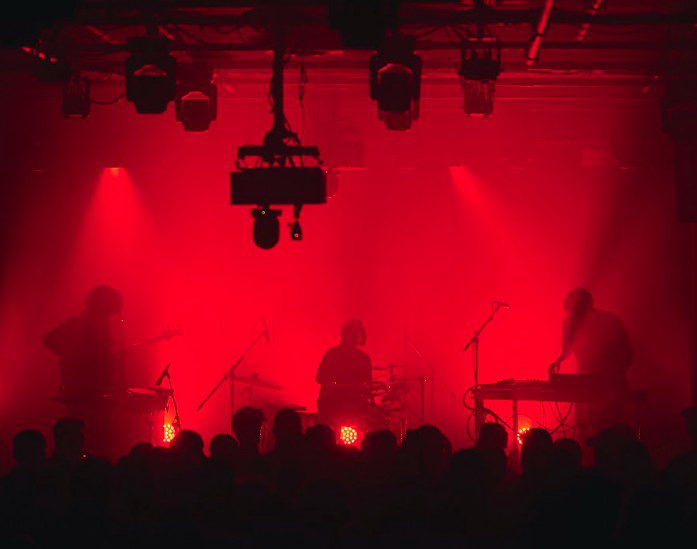
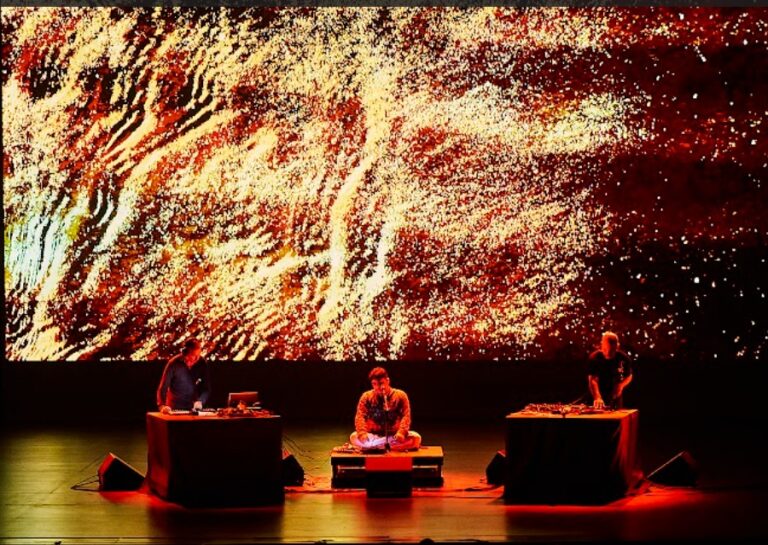
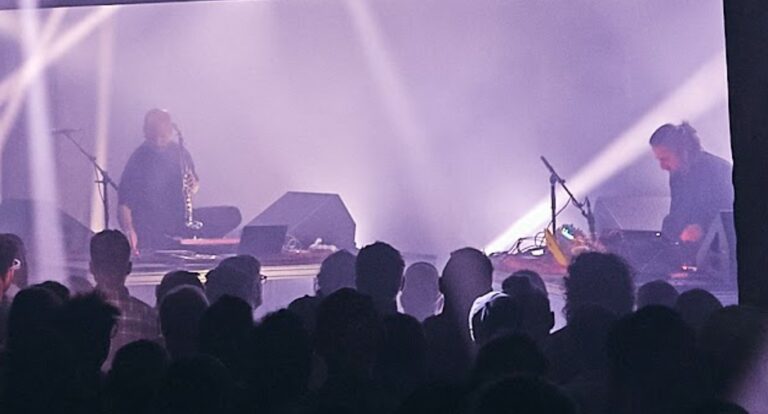
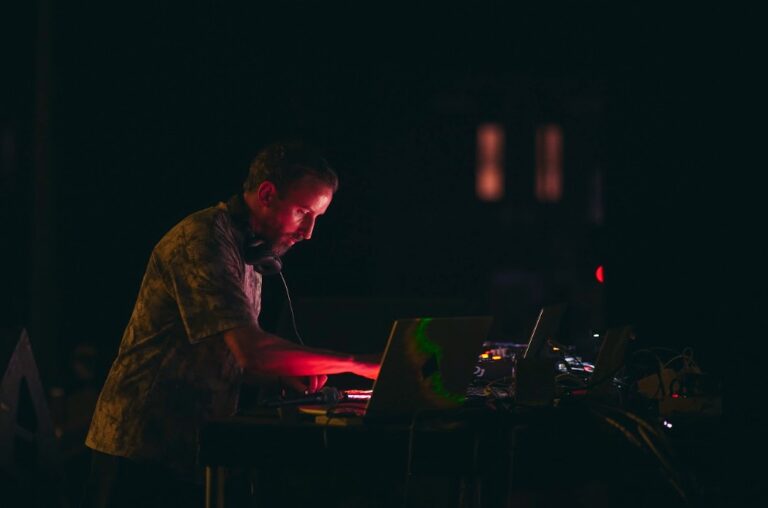
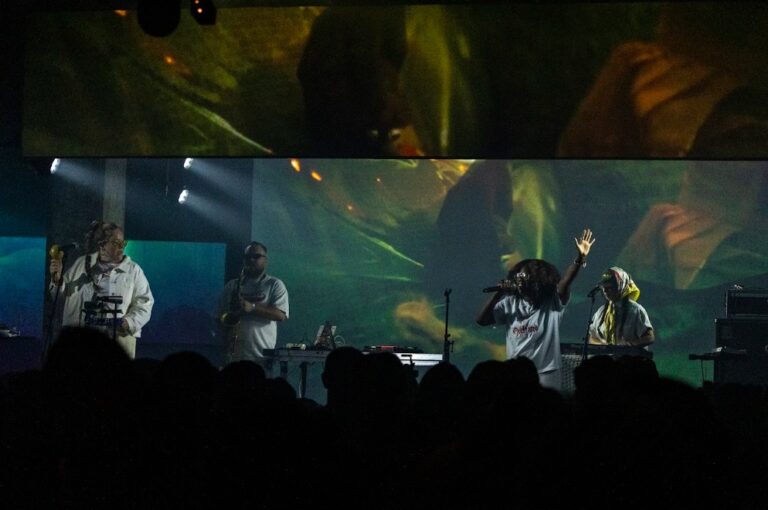
On Thursday night, Holy Tongue’s performance was one of the highlights of the Nocturne series. The London trio has been around since the end of the previous decade and can count on solid experience, with two albums to their credit and a third soon to be released, not to mention the convincing collaboration of Sam Shackleton (album The Tumbling Psychic Joy of Now), which shows the respect the master has for the trio.
Thus, percussionist Valentina Magaletti responded to producer Al Wootton (formerly known by the pseudonym Deadboy) and Japanese bassist and producer Zongamin, whose real name is Susumu Mukai.
Together in this halo of bluish or glowing colors, they transform Jamaican dub into a transcultural and exploratory journey that is typically British—we can trace its roots and spirit back to the 1980s and 1990s, the heyday of Jah Wobble and Transglobal Underground. More specifically, the overall vibe is dub, but these thick layers of sound draw on psychedelia, post-punk, ambient, and even ancient European music.
The bass is electric, the rhythms are acoustic or electronic, and the harmonic and textural environment is generated by Wooton. It was during this set in particular that we were able to appreciate the skill of percussionist Valentina Magaletti, who was welcomed as a star of the 26th MUTEK, performing there three times. Her strokes are precise, the sound of her drums and cymbals has been rigorously fine-tuned, and this queer woman is an excellent percussionist, at least for the stylistic corpus to which she devotes herself with her colleagues.
Perfect for gliding through the night with minimal effort.
MUTEK | RICO X PARIA Ensemble, heritage and radical futurism
by Félicité Couëlle-Brunet
Last night, at l’Esplanade Tranquille, I attended the premiere of RICO X PARIA Ensemble and was struck by its contrasts and intensity! The set opened in a dark, almost punk atmosphere, where the haunting voice of RICO RICA carried a raw energy, filled with tension and character. The electronic textures of Bclip accentuated this sense of urgency, as if we were witnessing a liberating cry from the margins.
Then everything changed. When accordionist Jose Daniel Rico Nieves and percussionist Elias Musiak joined the stage, a whole new dimension unfolded. The traditional Colombian sounds brought a vibrant softness that suspended time. It was as if the memory of a carnival or village festival had suddenly filled the space, reminding us of the enduring power of a living musical heritage.The encounter between these instruments and Bclip’s electronic manipulations gave the impression of a fragile but powerful dialogue, where each note resonated with depth.
The final part blew everyone away. The rhythms quickened, the bass thickened, and RICO RICA projected her voice in an irresistible electro-Latin frenzy. Guaracha, champeta, and mutant reggaeton—all fused into a collective energy that filled the crowd with exhilaration. This powerful, vibrant, and danceable finale was not just a musical celebration, but a liberation, a moment when tradition and queer futurism came together in a single incandescent breath.
MUTEK | Quayola, Luce – Between memory, cognition, and technology’s interpretation
by Z Neto Vinheiras
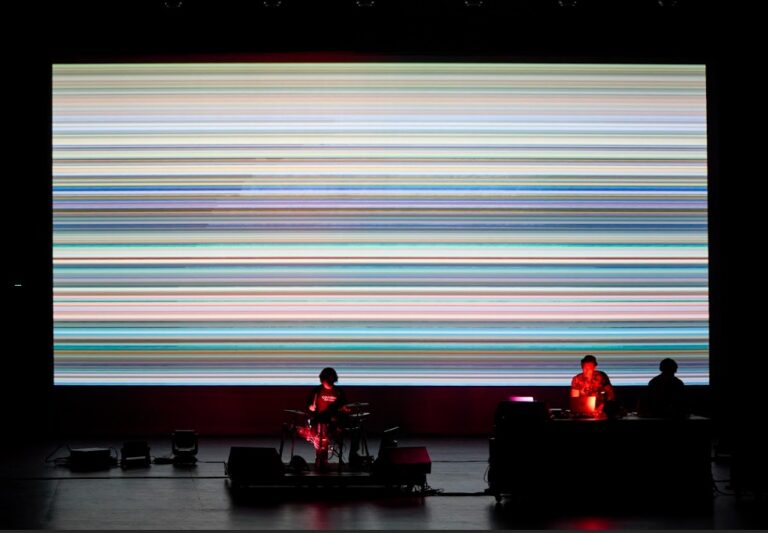
We see one human but Quayola is not alone: the machine speaks as a second entity in what appears to be co-creation between the Italian artist and that which he gives autonomous life to.
Quayola presents us Luce, an audiovisual piece emerging from the space between memory, cognition, and technology’s interpretation.
As virtually as vividly articulated, Luce is a space for reflection – images from the Archivio Luce become impressionist glitches, messing with the perception of the past with the fragility of the future. There’s a clear interplay with dichotomies – tradition and technology, human and machine, past and future, old and new, figurative and abstract, opposition and equilibrium – in Quayola’s neat approach to sound and image.
But referring only to sound and image feels reductive: what we see is a fusion of seemingly distinct worlds into a critical dimension of reality that is algorithmically operated, questioning what remains real and human in such a present time where machines and artificial intelligence take over; what hybrid forms of perception, experience and interpretation are being created and developed between the obsession and the caution with technology. Luce is a reminder that perhaps one thing we have in common, humans and machines, is the inevitability of error.
MUTEK | K-Phi-A – organic digital breezes and mechanofluidity
by Z Neto Vinheiras
A very just example of the synergy between human and machine, the Vancouver’s trio K-Phi-A bends, twists, re-imagines the limits between the organic and the virtual and takes us into that portal – an ecstatic voyage of pure sensorial exaltation… and a feast to the body-machine.
Revival invades not just the scene but the whole room and the insides of our bodies in a perpetual movement and collision – multiplying, expanding, mutating – an experience of continuing renewal, which might address its title, conveys a reality in which we live now, where information and even time travels in velocities beyond our sane comprehension while our breath is taken away (which might, again, address its title?).
K-Phi-A investigates, dissects the potential of the creative relation between human and artificial intelligence in a space of ultimate spontaneity – Revival is the result of real-time audiovisual composing and dynamic dialogue with designed AI systems, where image responds to sound, machine responds to human and human to machine – a whole ecosystem that is very much alive, that crosses both dimensions in and out, permeates the barriers – a wall becomes a membrane, and it is extremely elastic.
K-Phi-A is composed by Keon Ju Maverick Lee, electronic drummer designing and improvising with AI systems; Philippe Pasquier aka Monobor, researcher and composer performing live-electronics; VJ Amagi designing and operating audio-reactive systems and AI agent Autolume.
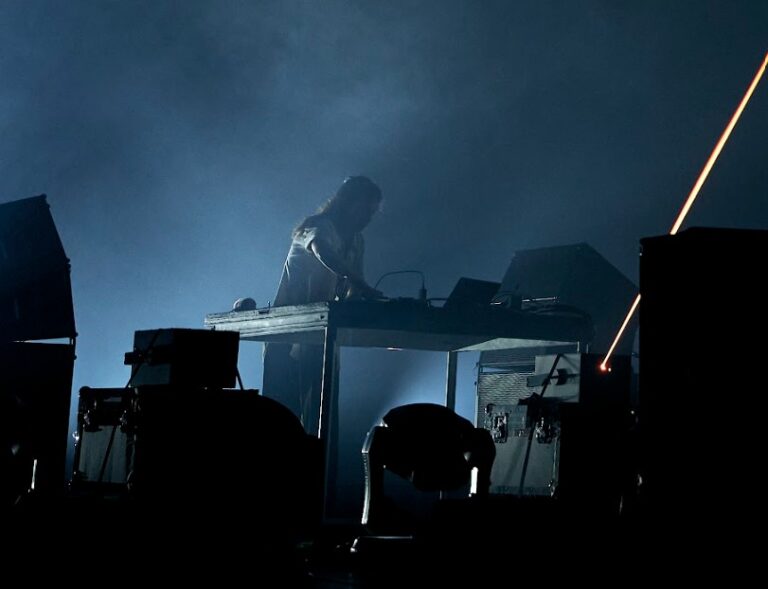
In an already feverish atmosphere, Montreal composer Phoebé Guillemot, aka RAMZi, opened the second evening of the Métropolis series at MTELUS. Opening for legendary Japanese DJ Satoshi Tomiie, the artist immersed the audience in a lush universe where hybrid rhythms and surreal soundscapes intertwined.
For over a decade, RAMZi has been developing a unique musical mythology, driven by his forest alter ego, a spirit animal who watches over an imaginary ecosystem that is both backward-looking and futuristic. His latest album, balmini, released on his FATi label, served as the matrix for this performance: a lush mosaic where elastic dub, fourth-world ambient, and post-tropical grooves intersect.
On stage, Guillemot played music that was sometimes vaporous, sometimes catchy, enriched by the intriguing sounds of his Electronic Wind Instrument, a sort of digital saxophone reminiscent of the experiments of trumpeter Jon Hassell. These electronic breaths gave the ensemble a mysterious and tribal aura, reinforced by a voice transformed into short, high-pitched, almost childlike incantations that seemed straight out of an anime.
The visuals perfectly complemented this parallel world: lasers and light effects bathed the room in contrasting palettes, shifting from the warmth of reds and oranges to the cool atmospheres of blues and magentas.
By offering this constantly evolving set as an opening act, RAMZi established a poetic and immersive intensity that ideally set the stage for the rest of the evening. A performance that confirmed his essential role in Montreal’s electronic music scene.
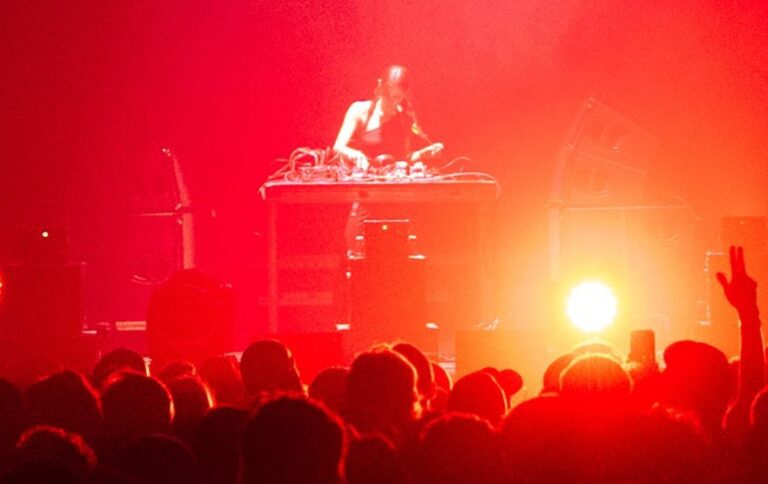
Brooklyn’s own Aurora Halal took to the stage on the opening night of MUTEK’s Métropolis series, a program dedicated to the most physical and hypnotic forms of electronic music.
Known for her as a resident DJ at NYC’s Nowadays and a regular at iconic clubs like Berghain and De School, Halal brought her signature shadowy, mysterious sound to Montréal to an extremely receptive audience.
She began with a restrained opening of ambient textures, gradually filling the cavernous room with the steady thump of 808s. Letting tension simmer, she eased the crowd into motion before rising into a feverish flow.
As the dancefloor swayed from side to side, totally immersed in the powerful visuals accompanying her set, Halal locked into her trademark blend of raw, hardware-driven techno laced with a sensual, dreamlike twist. The sub-bass roared at the crowd beneath layers of hi-hats, low pass filters and warped keys escalated the performance into a psychedelic frenzy. The crowd erupted as each layers married themselves to the infective kicks in a non-stop barrage of electrifying sounds.
With beams of light darting across the room and fast-shifting visuals cascading overhead, her music boomed with hypnotic force, each new layer added pulling dancers deeper into a collective trance. By the apex of the set, the floor was in full motion, swept along by a performance that reiterated Aurora Halal’s powerful presence in the global club music scene, after years of paying her dues in the underground.
A/Visions generally focuses on interdisciplinary immersions where music, video, scenography, and lighting blend into a single whole. This time, the last of the six performances at Théâtre Maisonneuve at the 26th MUTEK, was largely dominated by exceptional music led by the British Sam Shackleton, the Indian Siddhartha Belmannu, and the Polish Waclaw Zimpel. Pure delight!
One would dare to believe that an absolute majority of the Mutekians present had never experienced Indian classical music live, let alone its fusion with cutting-edge electronics and contemporary jazz. Three worlds in one, in the service of elevation, we observed upon listening to the delightful album recorded in 2023 by these same three musicians, In The Cell of Dreams. The melodic framework of this high-quality hour and a quarter is based on the extraordinary voice of this singer based in Bangalore, a city of science, high technology, and Carnatic culture (southern India). Belmannu’s melodic discourse is inspired by Hindustani ragas (northern India) taught to him by his Hindustani guru.
The ragas discussed here are melodic phrases built on a rhythmic framework and a drone normally produced by the tempura, a kind of small harmonium used in Indian classical music. The power, timbre, melodic scales, range of register, improvisational creativity—in short, a great virtuosity—animate Siddhartha Belmannu, around whom his Western counterparts honor the aesthetic.
For this is truly Indian classical music modified, extrapolated, and transgressed by its Western contours; it plays not only ragas but also original compositions including texts expressed in English. Known for a wide variety of references and a compositional concern well above the international average, Shackleton demonstrates humility here by magnifying the classical drone of Hindustani music, for its polyphonic ornaments are discreet and rarely deviate from the intrinsic linearity of the drone. The thickness and consistency of this unprecedented drone, it must be concluded, are those of a master.
For his part, Waclaw Zimpel adds synthesized sounds to the magnificent drone and also fleshes out this music with a melodic counterpoint from a jazz-inspired clarinet. This is an exemplary balance between classicism, tradition, and a contemporary vision of instrumental and electronic music. Frankly, great!
MUTEK | James Holden + Waclaw Zimpel, permanent metamorphosis
by Alain Brunet
Waclaw Zimpel was one of the coolest guests at this 26th MUTEK. A trained clarinetist, primarily playing the bass clarinet, he twice made my top 10 list of best sets. Let’s start with Wednesday’s set as part of the Nocturne 1 program at the SAT. The Polish musician’s connection with English producer James Holden is rich, and I was lucky to be able to make it through the night from Wednesday to Thursday for this superb performance. These guys are in their forties and have acquired a remarkable maturity, their careers having been marked by openness and sophistication.
A solid bass clarinet technician, particularly skilled in multiphonic techniques and using a vocabulary inspired by contemporary jazz, Zimpel doesn’t focus his discourse on the melodic articulation of his favorite instrument (so we can’t assess his virtuosity in this regard), but rather on a melodically minimalist, linear discourse focused more on a textural approach to music.
With these values shared with James Hoden, and with Holden, also capable of reinventing his style known since his debut in the public arena (IDM, trance, minimal techno), Waclaw Zimpel fuels a unique dialogue. Recorded in tandem, the excellent opus The Universe Will Take Care of You gave us a taste of this nighttime set for diehards, surprisingly numerous in the middle of the week.
On site, we observe that Zimpel has installed filters for his acoustic instrument, which modifies its natural sound. In addition, he activates several other elements of his electronic devices while James Holden generates the rhythmic framework of the conversation and enunciates the repeated and shifted melodic-harmonic patterns in the manner of American minimalism, and whose synthesized notes are often fleshed out by the unison or counterpoint of the clarinet. Unlike the album released last June, the Holden/Zimpel live set reveals necessarily new improvisations that flesh out more robust compositional structures, accompanied by roughness, in short a different relief than what the recent recording of their tandem offers. We can here speak of varied extrapolations of the initial work, since this night concert was in no way intended to be a faithful reproduction of the recording that preceded it. Very appreciated indeed.
MUTEK | SLIBERIUM, Between Digital Chaos and Vibrant Humanity
by Marc-Antoine Bernier
The fourth Expérience evening at Esplanade Tranquille kicked off on Friday with a raw, digital, and intensely emotional performance by Montreal duo SLIBERIUM. Formed by KUMA and Sendji, the project transported festival-goers into a collective hallucination where industrial sounds, techno energy, and R&B sensibilities collided.
Their set, which blends techno, deconstructed club, experimental hip-hop, and witch house, stood out for its unique sound texture: saturated, grainy synths, digital glitches, and abrasive atmospheres. Driven by muffled, pulsating kicks, their music moved forward with a kinetic force that invited listeners to both move and let themselves be swept away by the trance.
Behind a minimalist setup—computer, mixer, standalone instruments—Sendji brought a sensual dimension to this digital landscape with his voice. Processed by autotune, his tone oscillated between human warmth and digital coldness. His inflections, reminiscent of alternative R&B, contrasted with the robotic voices scattered throughout the concert, creating a back-and-forth between intimacy and otherness.
SLIBERIUM has thus created a transhuman universe, where the world appears as a shifting territory: hallucinatory dreams and raw everyday life, electronic chaos and vibrant humanity, digital beats and pop sensibility. A first “victory lap” for KUMA and Sendji, who ended their performance in jubilant ecstasy, transforming their musical intimacy into a collective, festive, and uncompromising experience.
Thursday evening, a unique event at the Théâtre Maisonneuve: Max Cooper’s Lattice 3D/AV, sold out. Renowned for his immersive audiovisual experiences, the British artist returned to Montreal with a performance that, far from the expected spectacular, proved to be introspective and deeply contemplative.
From the very beginning, the scenography imposed its clarity. There was no mystery: Cooper was positioned on stage, facing the audience, with his setup clearly visible, framed by two screens: one behind him, the other in front, semi-transparent, sometimes pierced by light, sometimes masking the artist’s figure.
This deliberate transparency set the tone: here, nothing to hide, everything to reveal. The show would focus less on dazzling than on the porosity between sounds, images, and consciousness.
Lattice 3D/AV, designed with Architecture Social Club, is described as his most ambitious live project, combining projections, semi-transparent layers, lasers, and lights sculpted in space. But rather than a sensory surge, the experience unfolded in a slow build-up. The visuals, at first, vibrated in layers of shifting colors, fluid textures, and measured rhythms. The music moved forward with restraint, almost weightlessly, creating a hypnotic continuum. It was a far cry from the festive frenzy of some other MUTEK evenings, and that was precisely the strength of the show.
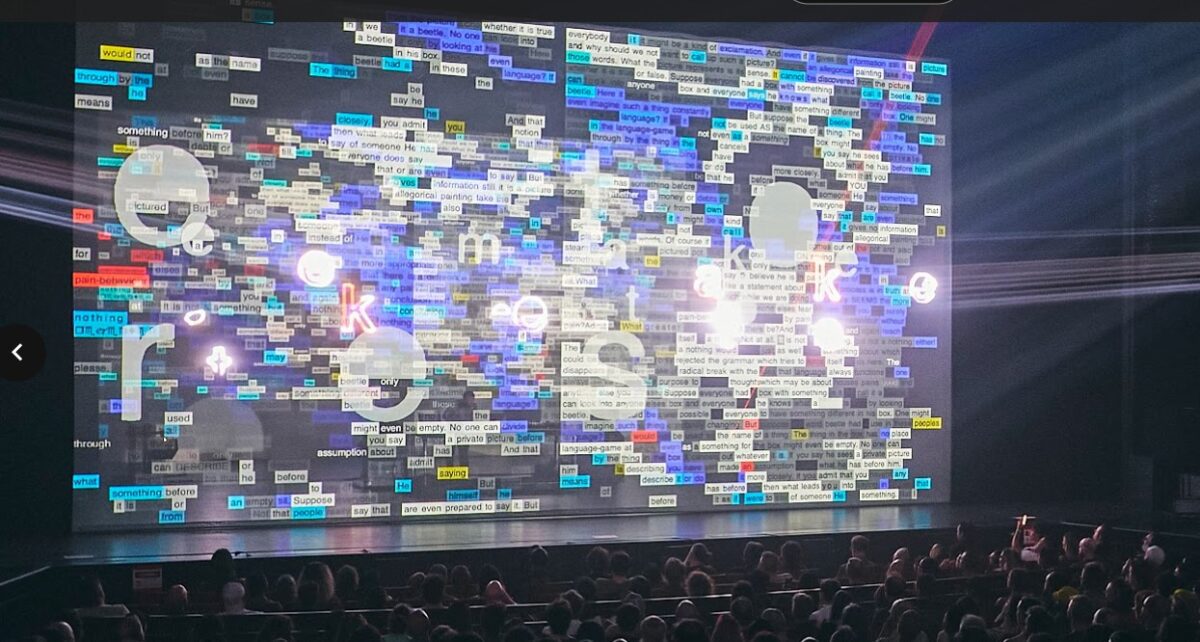
Then a pivotal moment: the appearance of the text. Projections of raw sentences, emerging as the intensity increased. This use of words, rare in Cooper’s performances, became the defining element of the set. The faster the tempo, the more the characters scrolled, until it created a paradoxical impression: that of finding ourselves face to face with the racing of our own thoughts, in a digital mirror of our saturated daily lives. The visual then took over the music, and the music, in turn, let itself be guided by this mental rhythm. It was at this moment that the effect was fully revealed. When the text stopped being projected, another shift occurred in the room: as if freed from a weight, the audience began to dance. The last fifteen minutes of the show took a more physical, more embodied turn, proof that the experience had worked, that the text had captured attention to the point of suspending the body, and its withdrawal had opened the space to the liberation of movement.
This choice echoed Cooper’s new project, On Being, which was released in February 2025. The album, born from hundreds of anonymous confessions collected online, directly questions what it means to “be” today. The responses, ranging from the most intimate pain to the purest declaration of love, served as the raw material for a work that translates the contemporary human experience into sound and image. These fragments of thought materialized in the visual space, making tangible the weight of collective speech.
In two hours, Cooper offered much more than a concert. He orchestrated a form of expanded listening, where spectators became witnesses to a shared inner landscape. In the effervescent context of MUTEK, where the temptation is to rush from one room to another, this introspective interlude suggested a valuable counterpoint. A slow breath in a festival that is often experienced at high speed. This reminds us that immersion is not only about technology and visual performance, but also about shared vulnerability. Behind the lasers and semi-transparent screens, it is our humanity that is revealed as fragile, dense, and multiple.
Tokyo and Berlin-based producer Machìna took the first edition of MUTEK’s Metropolis series by storm with a live modular techno performance that was as bare-bones as it was dumbfounding. For this North American premiere of Action, she stripped techno down to its core, improvising with nothing more than a drum machine and her voice woven into the framework of the eponymous album – a truly mesmerizing experience from start to finish.
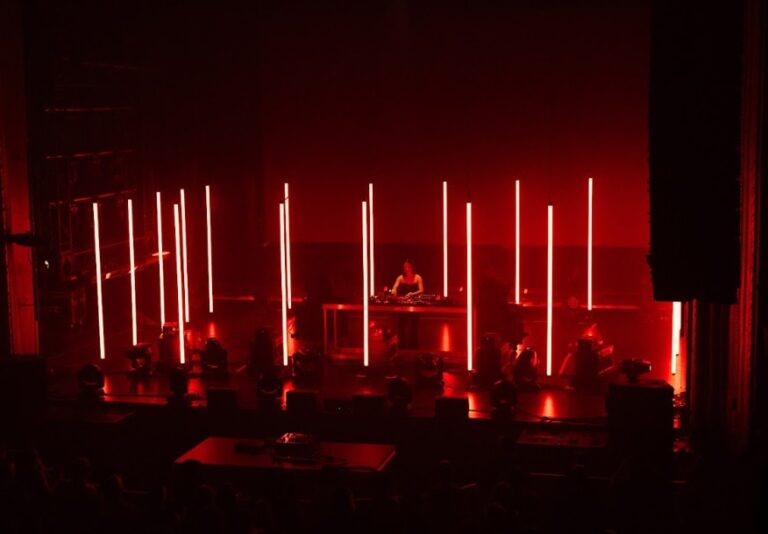
Clad in a sleek black latex dress and bathed in flashes of red light, Machìna put the venue’s monster sound system to work with classic rave sonics and an infectious minimal beat. It was a full sensory experience as the subwoofers made the floor shake and dancers responded accordingly – moving in unison and responding to shifts in tempo. Her live modular improv unfurled themselves in measured intensity – sharp snares, intricate cymbal patterns, funky distortion – electrifying both floors of the concert hall.
As the set progressed, the Korean-born artist steered progressively towards something darker and ominous. A single spotlight from above cut through the hazy stage, as vertical bars of red light enclosed her in a cage-like structure. At times, the beams seemed to drip from the vaulted ceiling like blood, a detail that strikingly evoked the infamous “Blood Rave” scene from the movie Blade. The crowd, immersed in the visuals, danced in near-ritualistic rhythm as pounding drum kicks reverberated through the space.
At moments, Machìna trimmed down the melodies to their rawest elements – the roar of the drum kicks, bouncy hi-hats & textured sounds – heightened anticipation before releasing the floor back into an all-out frenzy of rhythms and light. The alternating tension and release, combined to a formidable light installation, made the set a fully sensory experience: bass reverberated to the back of the Metropolis, lasers cut through the sea of bodies in motion, and every shift in sound eliciting a reaction from the crowd.
By the time she closed, Machìna had set the bar impossibly high for the rest of the night : fans clapped and begged for more, aThis sharp, refreshing techno set firmly established the artist as a true master, fluidly blending simple beats and layered percussion. One of the best performances of Mutek so far.
By the time she closed, Machìna had set the bar impossibly high for the rest of the night to festivalgoer’s delight. Fans clapped and begged for more, a true testament to her talent. This sharp, refreshing set that fluidly blended stripped-down beats with layered percussion was by far one of the best performances of MUTEK so far.
MUTEK | Roaming, The Art of Bringing People Together According to Gayance
by Marc-Antoine Bernier
On Friday evening, Nocturne 3, Espace SAT was transformed into a veritable party thanks to Gayance, aka Aïsha Vertus. With Roaming, the Montreal artist delivered a dazzling collective performance, inviting the audience to share a taste for dance, change, and solidarity.
Surrounded by a close-knit group, Gayance has woven a story in several chapters, where each piece becomes an emotion to be experienced together. Alongside her are Funky Watt on musical direction and bass, Evan Shay on saxophone, Peggy Hogan on keyboards, and Judith Little-D on percussion and vocals. Three distinguished guests—Janet King, Yassin “Narcy” Asalman, and Magi Merlin—also joined in to punctuate the show with unique moments, giving the evening the feel of a collective story told in several chapters.
One of the most memorable moments was the appearance of Narcy, a pioneer of Arabic hip-hop. With a Palestinian flag projected behind him, he had the audience repeat the words “Don’t lose focus. Breathe,” reminding them that “It’s not about one, it’s about us.” ” Set to a jazz-tinged drum & bass beat, this rallying cry carried unexpected political and emotional depth, mourning and solidarity.
Between house, drum & bass, Caribbean grooves, and jazzy accents, Roaming took the form of a musical and emotional journey, eclectic and deeply human. An evening where the artists’ contagious energy transformed into a true call for togetherness.
Photo : Frédérique Ménard-Aubin
Publicité panam
Subscribe to our newsletter
Gérez votre confidentialité
Nous utilisons des technologies telles que les cookies pour stocker et/ou accéder aux informations des appareils. Nous le faisons pour améliorer l’expérience de navigation et pour afficher des publicités (non-) personnalisées. Consentir à ces technologies nous permettra de traiter des données telles que le comportement de navigation ou les ID uniques sur ce site. Le fait de ne pas consentir ou de retirer son consentement peut avoir un effet négatif sur certaines fonctionnalités et fonctions.
Functional
Always active
The technical storage or access is strictly necessary for the legitimate purpose of enabling the use of a specific service explicitly requested by the subscriber or user, or for the sole purpose of carrying out the transmission of a communication over an electronic communications network.
Preferences
The technical storage or access is necessary for the legitimate purpose of storing preferences that are not requested by the subscriber or user.
Statistics
The technical storage or access that is used exclusively for statistical purposes.The technical storage or access that is used exclusively for anonymous statistical purposes. Without a subpoena, voluntary compliance on the part of your Internet Service Provider, or additional records from a third party, information stored or retrieved for this purpose alone cannot usually be used to identify you.
Marketing
The technical storage or access is required to create user profiles to send advertising, or to track the user on a website or across several websites for similar marketing purposes.