Techno and politics: a look at the Kyiv counterculture
by Elsa Fortant
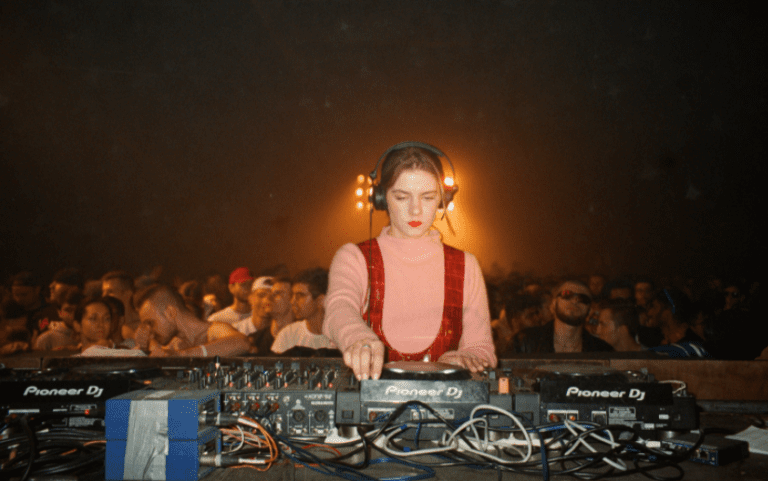
No matter what you say, dance floors – whether institutional or underground, legal or illegal – are eminently political, especially when it comes to electronic music. An aspect that Melvin Laur, artist and co-founder of the collective project Vertige Records, highlights in a thesis entitled “Ethnographic analysis of the Kyiv rave community: the post-revolutionary context”. His research work, carried out as part of a master’s degree in management sciences at HEC Montréal, presents the rave culture of the Ukrainian capital through the discourse of the actors who carry it out, mainly members of collectives organizing parties and artists, taking as a starting point the party as a political act.
Without going over the whole history of the rave movement throughout the world or even in Ukraine, it is important to know that after 2014, rave culture in Kyiv experienced, with a ten-year delay, a lightning development, to the point of becoming a popular destination for “techno-tourists. Why 2014? It was the year of the Euromaidan revolution, in response to the refusal of Viktor Yanukovych, the pro-Russian president at the time, to sign the agreement for Ukraine’s entry into the European Union. The movement was launched by the students who saw their future slipping away before their eyes. They protested peacefully by occupying the Maïdan square, in the heart of the capital. Then, the forces of order arrived. The repression was violent, with 125 deaths. The clashes lasted 93 days and ended on February 22, 2014 with the resumption of control of the country by the army, the exile of Yanukovych and new presidential elections. For those who are curious, the documentary Winter on Fire, produced by Netflix and available for free on YouTube[1], traces the history of this struggle of the Ukrainian people for freedom.
For Melvin Laur, this revolution catalyzed the Kyivian rave culture: “This culture was born from repression and political demands. It lasted and became professionalized until it became something really cultural, he explains. In fact, before the Maidan revolution, from the early 2000s until 2014, there was a huge drum and bass scene, really important. The genre predominated alongside commercial music and Ukrainian, Russian-speaking or international pop. Then there was this revolution and techno became very popular in Kyiv, taking precedence over the rest. Nevertheless, the early years of the techno scene in the post-revolutionary context are still marked by police raids and repression.
At the forefront of the movement were collectives such as the pioneering Rhythm Büro, Cxema, VESELKA and Laboratorium. Kyiv seemed to nurture a certain interest in raw and violent techno, “saturated to death boxes”, while offering a more conventional offer to please European tourists. There’s quite a heterogeneous scene there and that’s what was interesting to watch,” Melvin continues. Closer, a club located in a former Soviet factory, is very tech-house oriented, while places like O’tel – formerly Metaculture, but no longer existing – were really much more gabber and fast music, 160+bpm. In between, you had Kyrilliska with more industrial techno. And more to the west, on the Donbass side, it was the Shum collective that was the talk of the town, with a partnership with Boiler Room some time ago. The ephemeral parties organized by the collectives are also a way for young people to reappropriate their territory, by taking over disused buildings, former textile factories and vestiges left by the USSR.
Since the invasion of Ukraine by Russia, several Ukrainian techno artists, directly affected, have turned their social networks into platforms to relay information on the situation, like the DJ Daria Kolosova. Etapp Kyle participated in the “Support Ukraine Fundraiser Compilation[2]“. Stanislas Tolkachev has launched a label, Rudiment[3], whose profits – music and merchandise – will be donated to Ukrainian humanitarian organizations. Nastia, the most internationally known Ukrainian DJ, continues to tour (which has earned her criticism from some of her collaborators on the NECHTO label). She is taking on an ambassadorial role through the creation of a “Stand with Ukraine” fund and by organizing an auction, in collaboration with the brand Sennheiser[4]. Finally, an open letter[5] calling for the banning of Russian artists was signed by more than sixty actors of the Ukrainian electronic scene.
“It is really touching and impressive to see the different forms of resistance that are being put in place, there is the one on the ground but also this other part of the resistance, much more artistic and cultural, and that we perhaps often tend to forget and rightly so in these difficult times and which can be very dark. Creation is an escape and a way to resist”, concludes Melvin. To donate, check out this list of verified Ukrainian foundations.
VR Concerts: A future for Quebec’s music industry?
by Stephan Boissonneault
“In the midst of every crisis, lies great opportunity.”
Whether many in the music industry know it or not, they have been reflecting on this ethos by Albert Einstein constantly. Promoters, venue owners, and other industry folks alike had to remain optimistic after Quebec ended its first lockdown, and unleashed a deluge of concerts and live events. Things were good and the worst seemed like it was over. Then Omicron made its way to Canada … and I don’t have to reiterate what happened next.
Two festivals that were caught in the middle of Quebec’s second lockdown are the past Taverne Tour in Montreal and the upcomingLe Phoque OFFalt music festival in Quebec City. The teams behind both festivals could have cancelled their February festivals and no one would have faulted them; cancelling or rescheduling live shows has been a two-year reality for promoters. I think Lucy Dacus has been rescheduled three times? And really, who knows what’s going to happen? All we can do is live with optimistic hope.
Hopping into the Matrix
Still, Mothland decided to persevere in early February, switching their Taverne Tour into a virtual reality “Matrix” experience with sprite avatars and a digitally-recreated world of Montreal. It kind of felt a bit like Habbo Hotel meets a Gameboy version of Pokémon Yellow or something of that nostalgic videogame ilk.
Taverne Tour festival was free, with shows pre-recorded, and an amalgamation of festival attendees, some who had their video on continuously, and others who remained black screens. There was a digital merch table of the artist playing and you also had the option to watch the shows on Youtube alone. If you missed Taverne Tour, not to worry. The generous team at Mothland is leaving the concerts on the Taverne Tour website here for some time.
There were customizable attire options for your avatar and private chat spaces so you could watch the shows with your friends or alone in peace. The streams were, for the most part, without any latency issues or lag and the sound quality was quite superb. People were pretty respectful (you never know in this world of online trolls) and everyone danced in unison by pressing “z.”
It was a chance for many, like myself, to discover artists that I had been itching to see “live,” like experimental rock wizards, Atsuko Chiba, psych-rock darling, Alias, the freak psych-folk legend, Gus Engelhorn, or new to me, synth-pop crooner, Andy Jon.
Did it replace the live music experience? Of course not, but that was not the point. It was an enjoyable VR concert alternative and much more community-focused than watching a concert stream at home.
Metaverse Music
Next on the list is Le Phoque OFF on Feb 21 – Feb 25, boasting more than 50 artists of different genres like Les Lunatiques, Érika Zarya, Charlotte Brousseau, Zouz, La Fièvre and Émilie Landry.
“We had the festival ready to go with some big names playing, but with the Quebec government restrictions, there was no feasible way. So we looked to our friends at NOWHERE to create a Metaverse festival experience.”
Festival co-founder and managing director of Le Phoque OFF, Patrick Labbé, says this to 15 or so media personnel during a mid-afternoon media visit, within the metaverse. What does that look like? The digital room is tinted in blues, purples, and pinks and the main wall says “WELCOME TO THE NOWHERE LOUNGE,” “NOWHERE” being the 3D metaverse platform that has worked with Nine Inch Nails, SXSW, Red Bull Music, etc.
Everyone is on a webcam attached to a floating hexagon moves by using their keyboard. You can also jump with the space bar to get a birds-eye view of the digital landscape.
There are three virtual stages, or “scenes,” each with its own colour tone and background.
The main Sirius XM room has glass platforms you descend to get to the stage and in the distance, there are floating mountains and a star system. Another room, DOZE, looks like a synthwave album cover while the quiet room is mostly dark and opaque.
I bounce in and out of these scenes with ease as we all watch a pre-recorded show of Quebec City’s, l i l a. Who knew that soft indie rock in the metaverse would really fit?
“The problem is many people hear about a show in the metaverse and have no idea what it will be like,” says Labbé. “We have to get people in this headspace that this really is the future.”
Labbé knows virtual shows will never replace live music, but he does envision them becoming more commonplace, especially if the pandemic continues.
“We’re not even done with this year and we’re already thinking about having a hybrid model for festivals down the line,” says Labbé. “Think, you could watch a show with friends in different timezones while being at a festival. The possibilities are endless.”
Virtual concerts are here to stay and while they will never replace live music, during this time of confusion, they could be an alternative to echo the live experience.
The full week pass of Le Phoque OFF is 28$ or you have the option of choosing a 10$, one day pass, modest prices considering many stream shows are usually in the 20 dollar range. So if you have nothing to do during that week—as I’m sure you won’t because Quebec isn’t fully “opening” until March—give Le Phoque OFF a try.
When Music Hurts: Learning and Spreading Resilience
by Elsa Fortant
At Pan M 360, we’re looking at the health of music and its practitioners through our “When Music Hurts” article series. In this article, our contributor Elsa Fortant looks at distress and resilience in the music business.
GA survey conducted by the Quebec Musicians’ Guild (GMMQ) in 2020 revealed that 57% of musicians were considering changing jobs[1]. After a second complete shutdown, the curtain falls… and for some, never rises again, as we were reminded during Suicide Prevention Week, held from January 30 to February 5. Through the storm and despair, can we identify resilience factors? That’s one of the questions Morgane Bertacco, a doctoral student in neuropsychology at Université de Montréal, is asking. For more than a year, as part of the research program “Musique en temps de pandémie au Québec”[2], she has been conducting a survey of Quebec musicians. It is hoped that this unique project will allow the cultural community and the government to better understand the effects of the pandemic on the mental health of artists.
The music business is fragile, and that’s nothing new. However, the COVID-19 crisis and its management–in other words, the total shutdown of musical activities on two occasions–have exacerbated already precarious working conditions: endangerment of the on-demand or task-based economy model (freelancing, self-employment), job uncertainty, and normalization of unpaid work. One thinks, for example, of the videos of confined musicians that flourished at the beginning of the pandemic and for which the artists were not necessarily paid.
To date, no data exists on the mental health of Canadian musicians. Morgane Bertacco is determined to fill this gap. The young researcher, who was studying performance anxiety, has completely changed her thesis topic to focus on the mental health of musicians in the face of the pandemic. “When I submitted my dissertation proposal in December 2020, the only literature we had on COVID-19 was the early studies that looked at mental health in the general population. We knew that anxiety was starting to seriously rise, depression was starting to seriously rise,” she explains.
As early as 2021, the surveys conducted by the GMMQ and the report with the evocative title “Pour que les arts demeurent vivant[3]“, prepared by the Fédération nationale des communications et de la culture (FNCC) and published in March of the same year, offered us a first glimpse of the gravity of the situation. If it was a question of taking the pulse of the cultural milieu, it was found to be weak: high presence of depressive symptoms, psychological distress among artists, suicidal thoughts among 11% of artists compared to 7% in the Quebec population…
The research conducted by Morgane Bertacco focuses on musicians over the age of 18 residing in Quebec during the pandemic, both students and practicing professionals who meet the GMMQ definition. It is an online questionnaire that covers the themes of depression, anxiety, stress, resilience and well-being. The 160 responses obtained so far will be supplemented by individual interviews. The interest being to be able to compare the results of the study, the team selected those of a British study conducted in 2016 among professional musicians. In that study, it was reported that 71% of musicians have experienced anxiety and panic attacks and 39% had depressive disorders.
“Since it’s an online survey, we’re not allowed to use the tools we would use in a clinic, so we took screening questionnaires that are available to everyone,” says the doctoral student. “We have the PHQ-9 (Patient Health Questionnaire) to screen for the possibility of a depressive disorder and the GAD-7 (Generalized Anxiety Disorder) to screen for a generalized anxiety disorder.”
The goal of this research is also to identify resiliency factors, i.e., the elements that have enabled musicians to cope and bounce back. Until the data analysis is complete, there is a freely available resource published by the Mental Health Commission of Canada, “A Guide to Building Resilience through Self-Care[4]“. A report entitled “Innovation and Resilience in Arts, Culture and Heritage Canada”[5], funded by the Government of Canada, has just been released. It draws on 29 examples of artists and organizations that have innovated to find resilience during the pandemic. This tells us that we are entering solution mode. We also welcome the creation of a Psychosocial Support Fund administered by the Artists’ Foundation, allowing for the financial support of psychological health care up to $850 per person.
“I want to be able to come up with a real solid assessment, with recommendations that I hope to be able to take up with the government to say, if it ever comes back, this is what the musicians went through and this is what they would have liked to have seen put in place,” the student concludes. “I hope to be able to find the resiliency factors that helped the musicians who got through the pandemic the most, so that I can offer a program to the musicians themselves, that they can say to themselves that others were successful because of it.” Let’s not lose hope.
Morgane Bertacco has decided to reopen the survey to get a snapshot of the situation one year later. To participate, just click on this link in French and in English.
If you or someone you know needs help, call1 866 APPELLE (277-3553), 24 hours a day, 7 days a week.
[2] Program conducted by the Observatoire interdisciplinaire de création et de recherche en musique (OICRM), in collaboration with the Université du Québec à Montréal (UQAM), the International Laboratory for Brain, Music and Sound Research (BRAMS), the Laboratoire de recherche sur la musique, les émotions et la cognition (MUSEC) and HEC Montréal.
2021 was a great year for video production, despite the circumstances. Directors showed inventiveness and audacity in pursuit of an original clip, despite the constraints. As for the artists, it was an additional opportunity for them to remain in the public eye; one could even say that the video has become a more than essential tool since the beginning of the pandemic. PAN M 360 has selected 21 videos that have made their mark this year, whether for aesthetic or ethical reasons, or because they are simply enjoyable to watch.
The Pan M 360 Team
Lil Nas X Montero
At first glance, “Montero” isn’t subtle; it is a vulgar, provocative and polarizing video. Yet these are also its strengths]. It’s a journey into the queer rapper’s imaginary world. The singer walks through a fantasy realm, kisses an alien and… performs an erotic dance for Satan himself. This crude approach is an asset for Lil Nas X. He uses his vulgarity as a criticism of a sometimes too proper society and cradles this criticism in a colourful visual universe. With a certain sense of the second degree, “Montero” is a highly entertaining clip. (Louis Garneau-Pilon)
Bon enfant Porcelaine
Here’s a clip where, apart from a few explosions here and there, the spectacular is in the details: open your eyes, music fans, and put this on your 396-inch TV! The rock-pop-disco assembly Bon Enfant takes us back to church, the one in the parish of Saint-Pierre-Apôtre in the borough of Ville-Marie. Director/editor David Bourbonnais and cinematographer Nathan B. Foisy take advantage of the stained-glass windows, pulpit and other architectural elements and ornaments. The celebrant Daphné Brissette and her flock Guillaume Chiasson, Étienne Côté, Mélissa Fortin and Alex Burger dance, relax and stroke the Casavant organ under the neo-Gothic arches, dressed in white as if for an unconsummated wedding. Then we find ourselves in the forest with a horse, Alex Burger pulls something that looks like a calf’s heart from an urn. It’s Catholic, it’s pagan, it’s the best. (Luc Marchessault)
Bomba Estéreo Agua
Colombia’s monarchs of la nueva cumbia put out several gorgeous videos for their 2021 album Deja, indulging in their lush local wilderness. The best is the panoramic envisioning of “Agua”, a standout track on the record as well. Alone in the jungle, singer Liliane Saumet imbibes a mystic cocktail, and awakens to a communion with the sacred spirits, in the form of a riotous floral costume party. (Rupert Bottenberg)
Nimco Happy Isii Nafti
A song that was released a few years ago in Somalia and generally played at weddings, but which became an international success in 2021. Nimco Elmi Ali sings an ode to love in four languages: Somali, English, Arabic and Swahili. “Isii Nafti” was shared online by Black American personalities such as Cardi B and Trevor Noah, who used their fame, implicitly, to shed light on this little-known artist across the Atlantic. This viral buzz was a nice way to honour a Somali woman and a whole part of African culture, long—and still—ignored by the Western mass media. (Salima Bouaraour)
Marie-Gold C’est qui le boss?
“Who’s the boss?” asks Marie-Gold, the troop leader. “Marie!” the six scouts who accompany her answer in chorus. In this video, the MC offers us her vision of the power trip, with her own symbols of success. No drugs are sold, but rather biscuits prepared with gusto by grandmother scouts, and alcohol is replaced by glasses of milk. But rest assured, the story always ends the same way: the money goes into the boss’s pocket. Marie-Gold takes advantage of the contribution to become the owner of what seems to be a key to the city, presumably Baveuse City? Story to follow in February 2022. (Elsa Fortant)
Little Simz ft. Obongjayar Point & Kill
To like a video, you have to like the song. So here’s not only a superb track from the latest album by Nigerian-born British artist Little Simz, Sometimes I Might Be Introvert (which easily made it into our Top 100 of the year), but also to a remarkable video. In the five minutes or so of “Point & Kill”, director and photographer Ebeneza Blanche (Elle, Harper’s Bazaar, Nike…) takes us to Lagos with Little Simz and Obongjayar, another British artist of Nigerian origin. By incorporating often still or slowed-down images, close to a very colourful photography, the clip moves from lightness to a much more political territory, but still in a very artistic way. “Point & Kill” is a visual and sonic experience that celebrates Nigerian culture with style, a polished work of impeccable aesthetics. (Patrick Baillargeon)
Bruce Liu Finale, 18e Concours Chopin, Varsovie
One year after its postponement due to the pandemic, the 18th edition of the Fryderyk Chopin International Competition was held in Warsaw from October 2 to 23, 2021, following preliminary rounds in July. For those who were unable to attend or follow the competition, the recording of the final performance by Bruce Liu, the first Canadian to win the first prize, is a must-see video. Bruce Liu is critically acclaimed for his highly personal playing. This excerpt shows the agile fingering, intelligent lines and stage presence of the man who promises to be the next darling of the piano world. (Alexandre Villemaire)
BADBADNOTGOOD Timid, Intimidating
There’s a flavour of nostalgic yearning in this track from innovative Toronto jazz unit BADBADNOTGOOD, and it’s matched most accurately by director Winston Hacking’s fascinating technique. He integrates found images physically into natural backdrops, toying with congruence and contrast, while hinting at a sense of the tangible that’s fading in the digital era, a feeling further evoked by the weathered 8mm-film filter. (Rupert Bottenberg)
Morly Eliogy
Released in the summer of 2021, ‘Til I Start Speaking is the first full-length album by the young American singer Kate Morley. Her subtly arranged ballads, influenced by folk, soul, jazz and electro, are well served by a heartfelt performance. Written after a break-up, “Eliogy” bears the marks of pain, both the pain you feel and the pain you make the person you are leaving feel. The video that accompanies this song is remarkable. To illustrate her point, Morly unrolls a ribbon inside her mouth. One by one, the words come out, leaving their marks on the singer’s cracked lips. (Steve Naud)
Salvatore Ganacci Fight Dirty
After a number of impressive videos in a deadpan surrealist mode, Swedish DJ Salvatore Ganacci switches gears and enlists the animation studios Goono and Truba to fabricate an explosive, hilarious homage to Japanese anime and video games. A feisty girl and her fearsome friend, an enormous disembodied hand, confront their foes. The fracas that ensues is a dizzying montage of colourful mayhem. (Rupert Bottenberg)
Snapped Ankles The Evidence
British band Snapped Ankles released a new album in July, their third, aptly titled Forest Of Your Problems. If you’re not familiar with them, legend has it that Snapped Ankles are wild men of the woods, living in the branches and looking like a pile of leaves or bushes, who have come down from their trees to play danceable komische post-punk with a mix of synthesizers, guitars and foraged instrumentation. Daisy Dickinson’s psychedelic video shows the entire Snapped Ankles crew—The Business Imp, The Cornucopian, The Nemophile and The Protester—singing and dancing in the forests of Sussex in several vignettes. (Patrick Baillargeon)
L’Impératrice Hématome
The results have come back and the diagnosis for “Hématome”, from French electro sophisticates L’Impératrice, is takotsubo cardiomyopathy, also called broken-heart syndrome. Deftly directed by Roxane Lumeret and Jocelyn Charles for Studio Remembers, the video for the track is a medically fixated animated fairy tale that captures heartbreak in a suitably strange and bewildering way. (Rupert Bottenberg)
Hot Garbage Sometimes I Go Down
It’s all about the colours in this music video. With the four recurring panels, each with its own specific vibe, it kind of looks like Wes Anderson made a ’70s exploitation film. In two panels we have private detectives on the phone speaking with the people in the other panels. In another, a man is gorging himself with a splendour of dishes, also on the phone. In another, a woman is reading tarot cards while on a vintage phone. As the heavy fuzz of Hot Garbage consumes the frames, the people begin disappearing after an entity takes over each panel. The video is low-budget, tells a fragmented story, and keeps your attention. (Stephan Boissoneault)
Kyary Pamyu Pamyu Dodonpa (lyric video)
The lyric video is generally a cheap and easy placeholder for a song’s forthcoming “official” video, and/or cheap and easy click-bait to fuel a hike up the charts, but sometimes they’re works of art in and of themselves. The animated collages for The Stones’ Their Satanic Majesties Request, for instance, those were great—and so is this hectic optical overload for “Dodonpa”, a manic jam even by the standards of the saccharine sorceress of J-pop. (Rupert Bottenberg)
Lingua Ignota Pennsylvania Furnace
In a long, still shot of flourishing nature, Kristin Hayter, alias Lingua Ignota, appears and disappears, sometimes prostrate, sometimes inquisitive, searching for the path to repair. But this path means rupture, if not death. “And all that I’ve learned is everything burns,” she sings with spite, as red smoke envelops deserted places, pastures and houses. Her purification rituals thus become confessions of surrender. The first poignant extract from the album Sinner Get Ready, the clip was entirely directed, conceived and edited by Hayter. (Geneviève Gendreau)
Sarah Aristidou Æther
Shot in a sort of grey-blue monochrome, the desolate landscapes of the video accompanying the release of soprano Sarah Aristidou’s excellent album Æther are in keeping with Edgard Varèse’s Un grand sommeil noir, a piece not often performed but possessing a rare dramatic and suggestive intensity. We see in it what inhabits us most powerfully: a dreamlike landscape? A waking mystery? The ravages of climate change? Exoplanetary scenery? Superb. (Frédéric Cardin)
URUBU Recorded/VR01
Welcome to the parallel universe of Vertige Records! Behind the camera is Adrien Taret, the promising young director-editor who crafts the videos for the collective (URUBU, MELVIN, and MOLZK). The team takes great pleasure in reappropriating the aesthetic codes of the 1990s—Blade posters stuck on the wall, wraparound shades, gaming references and flashy colours. We follow the day of Vinz, a technoboxing enthusiast, whose assistant films his every move, up to a basement battle against his nemesis… (Elsa Fortant)
Hayden Pedigo Letting Go
For a little over a week, director Rocco Rivetti and cinematographer Gilles O’Kane shot the clip Letting Go in Lubbock, Texas. Artist Shonray Nichols added the final hand-drawn animation for the final scene. Here is what Rivetti told us about the video: « I wrote a simple narrative script where the character from the album artwork, a man in corpse paint standing in front of a Big Rig restaurant, burns his worldly possessions, and returns to heaven as an angel. I drew inspiration from William Blake’s Paradise Lost, as well as the profound pagan spirituality of early Norwegian black metal bands. Ideas like a restoration of faith, transmutation through fire, and a possible reversal of the fall from grace were really resonating with me at the time, and seemed to fit the emotional timbre of the music well. The main goal was to take a character that could be viewed as flippant or silly, and to instead treat them with the same respect and humanistic spirituality that the songs on Hayden’s record share ». (Isabelle Marceau)
A Place to Bury Strangers End Of the Night
After multiple lineup changes in 2018 through 2020, fans had no idea what was to become of A Place To Bury Strangers, but leader Oliver Ackermann came back with a new husband-and-wife band and a video in late 2021. The music video is really just a live session of the “End Of The Night” single, but with some super-imposed, drugged-out video wizardry. It begins with Oliver playing a quick synth line until the bassist smashes the instrument into pieces. Soon after, floating bodies and heads fly across the screen as more and more sonic distortion cloaks the environment. It’s dirty and very punk rock. (Stephan Boissoneault)
Kee Avil See My Shadow
Musically, “See My Shadow” may evoke Diamanda Galás and Laurie Anderson having lunch with Lydia Lunch, or Xarah Dion and Lana Del Rabies jamming to the theme from American Horror Story. Visually, one wonders if the heroine has covered her face with papier-mâché, latex, clay, or human flesh. This video for Kee Avil (Vicky Mettler in real life) makes us think of a trio of horror films: Eyes Without a Face, The Texas Chainsaw Massacre and Goodnight Mommy. “See My Shadow” is a foretaste of the album Crease, which Kee Avil will release on March 11, 2022. (Luc Marchessault)
Shortparis Говорит Москва (Govorit Moskva)
The second single from the new album Yablonnyj Sad, “Govorit Moskva”, which can be translated as “Moscow speaking”, is a solid musical and visual indictment. Released on May 1st to celebrate spring and International Workers Day, this skilfully orchestrated and performed video features a parade and military training course, a demonstration and a procession. As always, the choreography is inventive, this time made of a succession of sequence shots, making us part of this jagged parade. A true disruptive force, Shortparis rests on an inextinguishable resolution that Nikolay Komyagin exemplifies, with a voice and a presence from which nothing can escape. (Geneviève Gendreau)
The 20 Best Album Covers of 2021!
by Rédaction PAN M 360
One of the pleasures of owning vinyl albums is being able to study the cover from every angle while listening to the music. Sometimes the cover is so captivating that you forget about the music; sometimes the content is far less interesting than the container (how many times have we been fooled!). The best, of course, is when both the music and the artwork are excellent… unforgettably so. Among the hundreds of albums with amazing covers that passed through our hands in 2021, here are 20 that caught our attention.
The Pan M 360 Team
Weezer OK Human Atlantic/WEA
Swedish visual artist Mattias Adolfsson‘s hyper-charged drawing evokes what could be the inside of a computer (in keeping with the wink of the album‘s title) or an ultra-messy space studio, a sort of joyful mess in which one can lose oneself for hours, carefully examining every small detail. River Cuomo, leader of the American pop-rock band and a great fan of comics, is said to have fallen under the spell of the Swedish artist’s drawings during a visit to a comic book shop. (Patrick Baillargeon)
Noé Talbot Remercier les accidents Slam Disques
To illustrate the cover of Remercier les accidents, pop-folk-rock-punk songwriter Noé Talbot has chosen a willow tree with a bole submerged in the waters of Lake Wanaka, in southern New Zealand. This resilient tree must be featured in thousands of photographs; the one Noé chose was taken by Belgian photographer Loïc Naessens. It’s hard to find a more perfect match between the plant, the aquatic, the mineral and the celestial. “I won’t promise you much except the present”, sings Noé on “Pour l’instant”, the tenth track on the album. That’s what this willow tree is telling us: only the present counts. (Luc Marchessault)
Altin Gün Âlem Independent
Based in Amsterdam, leading contemporary Turkish psych-rockers Altin Gün are no strangers to inviting yet freaky hallucinatory imagery on their record covers–see also their other 2021 album,Yol.The indie release Âlem, a Bandcamp exclusive, boasts a mysterious image by architecturally-inspired U.K. designer Alexander Khabbazi, and merits mention as well as a special fundraising project, with proceeds going to the worthy environmental initiative EarthToday. (Rupert Bottenberg)
IDLES Crawler Partisan
You know that sensation of hazy simplicity when you have to look at something more than once to decipher its meaning? That’s what this album cover is. Simplistic, yet confusing. We have a double-story flat with open windows against a dark background. On the right, a lonely astronaut or vintage motorcycle driver (it’s unclear) is in mid-jump in trainers. It’s like a scene from a play or a page in an IKEA catalog. You can also try to derive a thematic link to the songs, but really, it’s just a cool piece of abstract photography that sticks with you. (Stephan Boissoneault)
Máquina Delírio Mefistovalsas Independent
To our knowledge, no deals with the devil were made by this duo from the wonderfully named town of Florianópolis, Brazil, regarding their album of trippy psych-rock tangents, Mefistovalsas. A deal was however struck with artist Pedro Correa, who delivered all his favourite elements—eyeballs, outer space, jungle cats and geometric forms. This would work great as a blacklight poster, wouldn’t it? (Rupert Bottenberg)
Attacca Quartet Of All Joys Sony Classical
After the vibrant and psychedelic iconography of their last album, Real Life, with its electro sounds, the Attacca Quartet’s second album of 2021 is presented in a more sober and refined visual style that echoes its minimalist repertoire. The palette evokes the emergence of shadow into light, while the illustration of the bird, by Anja Hoppe, evokes the aerial side of the repertoire, but also the newfound freedom of being able to create and play together after months of confinement. (Alexandre Villemaire)
Squid Bright Green Field Warp
This cover, like the tracks on Bright Green Field, is rich in content. The lush green field, the garbage bins forming a figure, the bright blue sky—all elements that jump out at you. It is both a disarming image in its simplicity of composition and engaging in its complexity of elements. Also worth mentioning is the superb mix of blue and bright green with a sad grey, giving the impression of a rotten candy from the inside. An album doesn’t have to have only excellent audio content, the packaging can also be superb! (Louis Garneau-Pilon)
Super Break Orchestra The Breaks EP Trigger
Tokyo ten-piece Super Break Orchestra bash out the kind of brass-heavy funk that’s engineered to accompany clashing breakdancers. Who better to create the artwork for their debut EP than Dragon76, who mixes American street-art style and hip-hop graffiti traditions with the anime, video games, and folk art of his native Japan—oh, and a pronounced samurai sensibility (no wonder he’s winning art battles in his adopted home, NYC). (Rupert Bottenberg)
Marianne Faithfull & Warren Ellis She Walks in Beauty BMG
Last year we were shocked to learn that the great and beautiful Marianne Faithfull had contracted covid. Despite her advanced age and frail health, she survived the virus and this spring released She Walks in Beauty, an album in which, against a spellbinding soundscape created by Warren Ellis, she recites the poetry of the English Romantics—Byron, Hood, Keats, Shelley, Wordsworth, Tennyson. The booklet accompanying the physical edition of the disc is magnificent. Paintings by the British artist Colin Self are added to the text of each of the poems. The contemplation of these impressionistic images completes the listener’s experience by immersing him or her in a poetic universe of great splendour. (Steve Naud)
Vistas What Were You Hoping To Find? Retrospect
While viewed as a thumbnail, the cover of the second album by effervescent Scottish pop-rockers Vistas seems a simple, pleasing geometric pattern. Zoom in and there’s an awful lot going on in the artwork by Colorado designer Rosston Meyer, founder of Poposition Press, a master of the modern pop-up book who brings that instant-3D technique to the gatesleeve jacket of LP edition of the record. (Rupert Bottenberg)
Dream Theater A View From The Top Of The World InsideOut
It was only after I identified the author of the illustration that I understood why it had caught my attention. In addition to creating Dream Theater’s covers since Octavarium (2005), Canadian artist Hugh Syme’s surrealist style can be seen on hundreds of albums since 1975 (Rush, Bon Jovi, Iron Maiden) and even advertisements (Sensodyne toothpaste!). To illustrate the title of the progressive metal band’s 15th album, Syme chose Kjeragbolten, a boulder on Norway’s Kjerag Mountain, as the top of the world. (Christine Fortier)
Ken Sasaki Keep Playing 2 Independent
A “retro wave sound that is not merely nostalgic” is how Tokyoite Ken Sasaki defines his congenial pop, sweet and light with a flavouring of upscale funk, chiptunes, and Japan’s own “city pop” of the ’80s. It’s well matched by the cover art by Shinsuke Koshio, founder of the SUNDAYVISION design studio, which looks like it sounds great—and maybe tastes great, but that could just be a voracious holiday appetite speaking. (Rupert Bottenberg)
Jerusalem In My Heart Qalaq Constellation
The women can’t hide their dismay behind medical masks. There was the explosion in the port of Beirut in the summer of 2020, an enormous cataclysm. Lebanon was already plunged into a deep crisis of corruption, economic misery was getting in the way and the hope of reconstruction took a hard blow. Led by Lebanese-Canadian Radwan Ghazi Moumneh, the multi-disciplinary vehicle Jerusalem in my Heart takes the hit in this excellent, collaborative, international show of solidarity with a deep Lebanese anxiety (Qalaq) as the creative backdrop. The photo report selected for the album cover could not have been better chosen to express the state of affairs and the music that it inspires. (Alain Brunet)
Chad Vangaalen The World’s Most Stressed Out Gardener Flemish Eye
Calgary’s Chad Vangaalen is long since a familiar name in Canadian indie music—he’s been at it for a couple of decades now with his idiosyncratic folk-rock—as well as illustration and animation (recall his incredible 2020 video for Sun Ra Arkestra’s “Seductive Fantasy”). The spaghetti-faced weirdo on this album, one of several Vangaalen releases this year, is a good example of his psychedelic cartoon style, equally silly and sinister. (Rupert Bottenberg)
Gazelle Twin & NYX Deep England NYX Collective
Gazelle Twin has had one success after another. Her talent is also evident in her ability to surround herself with equally brilliant artists. This magnificent album is the logical follow-up to the London concerts where she performed with the female electronic drone choir NYX, in reworked versions of some of the songs on her 2018 album Pastoral. The work of Italian illustrator Elisa Seitzinger, with its exploded and casual medieval bestiary, couldn’t be more fitting for Deep England. The cover design is by Jonathan Barnbrook, who also designed David Bowie’s last album, Blackstar. (Geneviève Gendreau)
Population II À la ô Terre Castle Face
This is the cover of my year 2021 because it’s everything I love about Montreal: the beautiful, unexpected encounters, the ones where you let yourself be guided by the energy of the city, its people, its talents and its music. This cover is the one you absolutely want to own after having shed tears of happiness at having had the chance to discover a musical gem. This cover is the one you want to keep as a souvenir, like a Polaroid you would take to immortalize forever an unforgettable journey—such as the one I made while listening to Population II under the Van Horne viaduct, one day in November 2021. (Salima Bouaraour)
Infiltro Disforia Independent
They may be from the exact middle of the planet, but Ecuadorian noise-rockers Infiltro take their abrasive racket to extremes. The cover of their latest record, Disforiais blessed by the charming presence of a pill-popping punk-rock rat, an archetypal image that looks like iot could have come from the dripping pen of underground comic legend S. Clay Wilson, or ’90s grunge graphic maestro Savage Pencil—but it’s in fact by cartoonist and illustrator Paco “Afromonkey” Puente, founder of the Azno Cómics anthology. (Rupert Bottenberg)
Hayden Pedigo Letting Go Mexican Summer
Describing himself as a “non-emergent” artist from Amarillo, Texas, Jonathan Phillips used a photo given to him by Hayden Pedigo as inspiration for the album cover. He says it was one of many sarcastic photos of Pedigo dressed in streetwear. Phillips turned it into an oil painting on a foot-square wooden panel, and from this work the album cover was created, provoking by its colours and the strangeness of the character. (Isabelle Marceau)
Tendinite Neither/Nor Araki / Poutrage
A trio from Reims, France, Tendinite deliver lo-fi garage punk, crude yet effective, as demonstrated by their latest album, Neither/Nor. The multi-armed mutant of the striking cover artwork is by Val l’Enclume, a graphic artist whose absurdist, apocalyptic style has earned them an association with the longstanding, Marseille-based silkscreen art gang Dernier Cri. (Rupert Bottenberg)
Ghost Rhythms Spectral Music Cuneiform
The second album on Cuneiform for the ten musicians of the French band Ghost Rhythms, led by drummer Xavier Gélard and pianist Camille Petit. A strange cover, by Jonathan Martin, which isn’t particularly related to the theme of the record (distancing and its remedy, telepathy), but it has an accidental, or involuntary, character that has a certain charm. The music is a kind of jazzy progressive rock that has affinities with Soft Machine or Miriodor. To be discovered. (Réjean Beaucage)
PAN M 360’S TOP 100 OF 2021! (PART 3 – JUNE TO AUGUST)
by Rédaction PAN M 360
PAN M 360’s rundown of the hundred best music releases of 2021, in five parts over five days, continues with further titles, these ones released between June and August.
The Pan M 360 Team
Billie Eilish Happier Than Ever Interscope
The colourful pop sensation and Gen Z icon, who shifts from the whispery to the airy, once again wrote this album with her brother Finneas in his basement. With two Grammys in 2021, including one for “No Time to Die” (the theme song to the latest James Bond film), and a plethora of prestigious awards on both sides of the big pond in 2020, Eilish is establishing herself as one of the must-see artists of this new decade. Major. (Claude André)
Dobet Gnahoré Couleur Cumbancha
Couleur is an ode to women, a praising of the French-speaking world, a love letter to motherhood, a celebration of African music… But above all, an excellent album! Dobet Gnahoré offers us a tour de force that contains a little something for everyone. Those who love Afro-pop will find something to their liking in the bewitching rhythms of the African diva. Those who want to broaden their horizons will discover a whole new and exciting musical world. Those who want to dance will be able to dance until the wee hours of the morning! (Louis Garneau-Pilon)
Etana Pamoja Freemind Music
The singer Etana released the self-produced album Gemini in 2020. Already back this year with Pamoja, which means “together” in Swahili, the Jamaican has surrounded herself with a number of artists on the album, mostly from the African continent. The album also features Vybz Kartel, Damian “Junior Gong” Marley and Europeans Alborosie and Patrice. In terms of rhythms, she has drawn on Afrobeat, dancehall and, of course, the roots-reggae to which she has accustomed us since her debut. Rich in influences, masterfully produced and interpreted by one of the major singers of the current scene, Pamoja marks a great coup in 2021. (Richard Lafrance)
René Lussier Complètement marteau ReR Megacorp / Circum Disc
More than an extraordinary guitarist or a crazy composer, René Lussier is a sound researcher. Except for the double bass quartet (4 times Hugo Blouin) that can be heard in Le clou (1999), it’s Lussier who plays everything, including “a whole lot of homemade percussion made of rubbing, mouth noises, cake spatulas, barbecue spits and Styrofoam on a wet window,” not to mention, of course, the daxophone and the guitars. A good vintage! (Réjean Beaucage)
Ofer Pelz, Meitar Ensemble Trinité New Focus
After studying in Jerusalem and Paris, Ofer Pelz obtained a doctorate in composition at the University of Montreal. He uses different working methods, such as exploring the concept of “unstable repetition”, reverse engineering and ways of composing that are inspired by mathematics or derived from electroacoustics (logarithmic spiral, accumulation of loops, etc.). The Meitar ensemble is based in Tel Aviv, but this record nevertheless offers several opportunities to hear, albeit on tape, “the sound of Montreal”. (Réjean Beaucage)
King Gizzard and the Lizard Wizard Butterfly 3000 KGLW
It’s sometimes hard to find inspiration for a first album. Finding inspiration for the 18th is probably just as difficult. However, the prolific septet King Gizzard and the Lizard Wizard succeeded in doing just that. They abandon somewhat the intensity of prog-rock in favour of dream-pop-style synth loops. The result is amazing. The lyrics have also evolved from the whimsical stories of the past to the ambiguous world of dreams. Butterfly 3000 is perhaps an unexpected diversions for the Australian prog sensation. But as a band that specialises in unexpected detours, this one is well worth the effort. (Louis Garneau-Pilon)
Greentea Peng Man Made AMF/EMI
After two EPs and numerous singles, the Brit Greentea Peng arrives with Man Made, a surprisingly cohesive first album. Daughter of an Arab actor father and an African mother, Aria Wells (her real name) and her band The Seng Seng Family offer 18 tracks of lascivious neo-soul, largely coloured with psychedelia, R&B, dub, funk, acid jazz, bhangra, trip-hop and hip-hop influences that support lyrics with strong sociopolitical contours, even if they are sometimes a bit naive. If her style reminds one slightly of Lily Allen or Erykah Badu, the comparisons stop there, the Londoner’s doing a definite thing of her own. (Patrick Baillargeon)
Haepaary Born by Gorgeousness Flipped Coin
After the grand success of Leenalchi, another South Korean act modernizing deep and formalized local traditions is the Seoul-based duo Haepaary (a wider view aligns them with the similarly mystical Kuunatic from Japan, and Prairie WWWW from Taiwan). The pair practice a sort of subversive, ritualistic electro-Confucianism, revisiting royal temple music of the Joseon dynasty, and the two women counter patriarchy as well, exploring the traditionally masculine vocal genre called namchang gagok. The results are mesmerizing, even deeply haunting. (Rupert Bottenberg)
Hélène Barbier Regulus Michel / Celluloid Lunch
With Regulus, Hélène Barbier has modestly established herself as the queen of lo-fi avant-pop. On this second solo album, which she made quite alone at home (pandemic and all), the French singer and multi-instrumentalist, exiled in Montreal for the last ten years, creates an intimate universe, populated with small, deceptively approximate songs, between soft no-wave and minimalist post-punk, an engaging and original music with a crazy charm. Regulus is the work of an ingenious and inventive creator who is not afraid of taking risks. (Patrick Baillargeon)
Hildegard Hildegard Chivi / Section 1 (RoW)
Here we have a clear case of synergy—Ouri and Helena Deland are inspired by the nun Hildegarde von Bingen, a rare woman of letters in the Middle Ages, composer, artist, and high mystic. The Montrealers are elevated beyond their individual achievements in electro and indie-folk-pop, which are highly commendable by the way. The song forms are deconstructed to perfection, the vocal melodies and texts are at the service of works constructed like electronic or instrumental pieces, the arrangements, treatments and transmutations of the sources (voices, instruments, keyboards, strings, sounds) show an uncommon finesse. (Alain Brunet)
Sleater-Kinney Path of Wellness Mom + Pop Music
Path of Wellnessis the tenth work by this band, which recently switched from a trio to a duo after the departure of the hard-hitting drummer Janet Weiss. Guitarists and singers Corin Tucker and Carrie Brownstein produced the new album themselves. The rhythmic aesthetic of Janet Weiss is continued here by three drummers who take turns playing efficiently. There’s nothing unusual about Path of Wellness, not much that doesn’t fit S-K’s modus operandi. Apart from the keyboards that grace several pieces. But with these women from Olympia, Washington, even the ordinary is Olympian. (Luc Marchessault)
Amenra De Doorn Relapse
The Flemish band, which has been active since 1999, presents a delectable album this year. In full control of their means, they catapult the listener into a space where gravity reigns. Despite the extreme heaviness that characterises their aesthetics, the pieces breathe—the atmospheres are carefully set up, and Colin H. Van Eeckhout’s primal scream gives the full measure of the suffering. It’s sometimes joined by the singing of Caro Tanghe (Oathbreaker), instilling bits of hope. We understand that this pain is not a simple complaint, but a catharsis, as serious as the thorn, the title of the album. (Geneviève Gendreau)
Anika Change Sacred Bones
After a debut album in 2010 and an EP in 2013, Anika didn’t release anything under her own name (preferring to join other artists, notably the Mexican band Exploded View), until Change, released during the summer. With her cool beauty, Nico-esque phrasing and mechanical art-pop songs, Annika Henderson has had no trouble (re)winning over an audience with more avant-garde tastes. Co-produced by her and Exploded View’s Martin Thulin, Change sees the German-British singer create her own songs, whereas almost all the tracks on her first effort were covers. Change also takes Anika off the neo-dub path and a little closer to krautrock and post-rock, while still remaining bold, experimental and very elegant. (Patrick Baillargeon)
U-Roy Solid Gold Trojan Jamaica
Solid Gold was released a few months after U-Roy’s death and features several impressive new collaborations with both heavyweights and newcomers. The album reconfirms the relevance of Daddy U-Roy with his covers of Jamaican classics, including the surprising “Man Next Door” with Santigold, and “Stop That Train” with Rygin King. Big Youth offers a convincing re-reading of “Every Knee Shall Bow” and Richie Spice, a “Wear You to The Ball” that would have satisfied even Duke Reid… Ziggy Marley offers an energised version of “Trenchtown Rock” and Shaggy accompanies the doyen DJ in an assureds old-school style on “Rule The Nation”. (Ricahrd Lafrance)
Arjun Vagale Time Top Quartz Rec
Arjun Vagale has remained silent for a few years in order to devote himself to the creation of his label and his project Asymetrik. These are two completely separate stylistic entities. Vagale has created five tracks of hypnotic dub techno. As you listen, you slip peacefully into the charming darkness of “Scatter Dos”, after having stomped hard on “Time Cop”. “Sustain Sequence”, ephemeral and bewitching, leaves you on a tart note, energetically asking for more. (Salima Bouaraour)
Rodrigo Amarante Drama Polyvinyl
Cruelly overlooked in the northern hemisphere, Rodrigo Amarante is well known in his native Brazil, where he was a member of Los Hermanos, an indie rock band famous enough to fill stadiums. Having made his home in the United States, he now records solo albums that are gems of inventiveness and finesse. His latest, Drama, subtly blends folk, rock, samba and bossa nova. With his smooth, comforting voice, he sings in English and Portuguese about the big questions of life, without ever taking himself too seriously. (Steve Naud)
Giri Antichthon Axis
With Antichthon, Giri explores the theme of the cosmos and space travel. Antichthon is the planet that could be home to mankind as it leaves Earth. The scientific team of the Discovery Behind The Sun mission travels on board the Cyrillia. On the way, they come across a sister ship with a team from Antichthon on board, heading for what appears to be their future home: Earth. Dream or reality? In the manner of a science fiction story, the tension is built up both on the micro scale of a room and the macro scale of the album. It is clear that Giri is an excellent storyteller. (Elsa Fortant)
Emma Jean Thackray Yellow Movementt
Released on the label that Emma-Jean Thackray created, Yellow offers a rich, organic, studio-recorded sound. Perhaps it could be categorized as “light music” thanks to particularly catchy tracks like “Say Something”? One thing is certain, Yellow is more accessible than Um Yang, her previous EP (2020), which played in the free-jazz court. The fourteen compositions call upon names like J Dilla or Fela Kuti. An Afrobeat lover, the bandleader borrows her kick-hi-hat-snare rhythmic patterns from house, which gives her work an unstoppable groove. (Elsa Fortant)
Lingua Ignota Sinner Get Ready Sargent House
The hard dialectic of Sinner Get Readyis fairly comparable to that seen in her previous recordings: entanglement, clashing, collision, tearing, suturing, symbiosis. Her recent allegations of assault by Alexis Marshall of the band Daughters, with whom she had an affair, add density to the states evoked in this excellent album. Lingua Ignota (“unknown language”) marries the sacred music and folklore of Europe and America, Appalachian song, choral singing, that beautiful contralto voice. With this bonus: the silkier, softer portion of her expression has never reached such heights. (Alain Brunet)
Susumu Hirasawa Beacon Teslakite
An icon of adventurous techno-pop in 1980s Japan, Susumu Hirasawa is best known for his unforgettable later work scoring films by the late anime master Satoshi Kon. Blending anthemic earnestness and a streak of ironic, deadpan humour, Hirasawa’s sensibility has remained firmly intact over the decades. On his 14th solo album, his familiar melodic stylings, operatic grandeur and flights of falsetto are ever present, as is his strange yet alluring juxtaposition of martial force, playful absurdity, guileless emoting and disconcertingly unfamiliar electronic sounds. The most vital factor is the sense of sympathy and optimism Hirasawa never fails to project, forever the light cutting through darkness that the album’s title suggests. (Rupert Bottenberg)
PAN M 360’S TOP 100 OF 2021! (PART 4 – AUGUST TO OCTOBER)
by Rédaction PAN M 360
PAN M 360’s rundown of the hundred best music releases of 2021, in five parts over five days, continues with more great records, released between August and October.
The Pan M 360 Team
The Limiñanas / Laurent Garnier De Peliculas Because
French couple Lionel and Marie Limiñana pastiche a certain dark, transatlantic psych vibe, summoning the shadows that lingered after the Summer of Love with dope-stunned drones and dissolute poetry. De Películasfinds them partnered with Laurent Garnier, a veteran of 1980s Manchester and a titan of the French Touch scene. Thus are the pneumatic, propulsive grooves assured. Built for comfort, not for speed, they carry The Limiñanas’ luminous organ grind and raspy raconteur routines with grace. Bonus: Edi Pistolas of legendary Latin dance-punks Pánico, whose snakebite delivery adds hot sauce to the grand, swaggering “Que Calor !”. (Rupert Bottenberg)
Hubert Lenoir Pictura de Ipse : musique directe Simone Records
The ballad “SECRET” sets the tone for Pictura de Ipse : musique directe—Hubert switches to the confidential, the guitars have taken over, keyboards, synths and programming reign, funk-like atmospheres dominate. This album, which Hubert produced himself, is in many ways a tribute to Prince, as spectacularly illustrated by “FOURQUARTS”. To summarize, Lenoir dumped neo-glam, went to Flying Lotus, Mac Miller, Thundercat, Frank Ocean and his highness Prince, and then came up with the most daring and successful Quebec album of 2021. (Luc Marchessault)
André Duchesne Travaux publics : ballades urbaines, vol. 1 et 2 Autoproduction
It’s probably harder to make music as a band these days, so the co-founder of Conventum put together a virtual ensemble (guitars, bass, programming [sax and drums]). Then he had fun doing it all himself: recording, editing, mixing, etc. The results are amazing, and amazing to hear. The sounds are astonishing, and there are colours of the protean musique actuelle of the ’70s and ’80s, when Conventum resembled Henry Cow (or vice versa), but with a dose of DIY that makes the music sway. (Réjean Beaucage)
Deutsch Nepal Dystopian Partycollection III Entartete Musikk
Deutsch Nepal’s releases are rare. The current album is the third part of the Dystopian Partycollection series, the first two of which date from 2008 and 2016. This time it’s a compilation of tracks, covers and alternative versions composed between 2012 and 2021, and on which some collaborators intervene. Unpretentious, then. The whole is less uniform than his albums, but the magic still works. Happy inclusions are the vocal imprecations of Peter Andersson, the surprising presence of the Italian guitarist Alessio Betterelli (“How Low…”) and the icy rhythms of Geoffrey Delacroix, alias Dernière Volonté (“Amanda Lear”). (Geneviève Gendreau)
Tasha Tell Me What You Miss the Most Father/Daughter Records
On Tell Me What You Miss the Most, her second album, Tasha sings that she would stay in bed all day if she could. Her slow, fluffy drums and lightly saturated guitar summon both sweetness and melancholy. Her flute, strings, celestial voice, a slight echo and evocative titles (“Burton Island”, “Lake Superior”) form a warm envelope. Simplicity stirs feelings when expressed well. It’s a necessary break that she offers here, between the sky and the earth, the tumult of grey days and the noise of the city, for a more beautiful winter. (Anne-Sophie Rasolo)
Hayden Pedigo Letting Go Mexican Summer
A prolific musician at only 27, it’s safe to assume that Texan Hayden Pedigo’s fame and influence will continue to grow. Letting Go features blue skies, an abandoned ranch and high Texas plains that stretch as far as the eye can see. Alternating between a six-string and a twelve-string, the acoustic guitar is played in the primitive American style, and Pedigo handles the rhythms perfectly, as a storyteller would. The pieces evoke vivid, fundamental emotions, making Letting Go a gripping listen. (Isabelle Marceau)
Little Simz Sometimes I Might Be Introvert Age 101 – AWAL
If you’re looking for the definition of an artist, fulfilled, radiant, putting her beauty and intelligence at the service of the concept of the powerful woman, capable of giving off both strength and sweetness in one go and of laying down her committed lyrics with genius, you’ll find it in Little Simz. My dear colleague and friend Alain Brunet has already reviewed this album and I follow him all the way. I put this queen on my list because she exudes incredible maturity and undeniable talent. Her exceptional personality comes through in her voice, regardless of the styles of her albums. For me, the image and symbols they convey honour all women in this world. (Salima Bouaraour)
Michael Spyres, Orchestre philharmonique de Strasbourg, Marko Letonja Baritenor Erato
Is it possible for the same singer to perform both baritone and tenor roles? Michael Spyres is the exception to this separation of voices. Originally a baritone, Spyres has spent many years perfecting his voice to expand his vocal range. The result is astonishing; one is amazed at the ease with which he takes on the vocal garb of different characters and alternates between bel cantiste high notes and sonorous Verdian lows. Accompanied by Marko Letonja and the Strasbourg Philharmonic Orchestra, nothing sounds forced and the grain of the voice remains stable and percussive in the performance. (Alexandre Villemaire)
Suuns The Witness Secret City Records
The Witness explores new avenues for Suuns, with the inclusion of acoustic, wind and string instruments, superb, almost jazz arrangements punctuating the hybridizations between avant-rock, electronic and experimental aesthetics, to which Suuns have accustomed us since 2010. The Witness poetically addresses various angles of our globalized voyeurism, planetary facts and gestures simultaneously observed on a daily basis by millions of humans. There is an added value in a congruent portion of the arrangements and execution on this album, which is certainly one of the best vintages from this extraordinary band, still one of the most important on the Montreal scene. (Alain Brunet)
Low Hey What Sub Pop
In 2018, the band Low confused many with the release of Double Negative, an album on which they exploded their song structures with distortion and electronic assaults. Overwhelmed by the radical approach, bassist Steve Garrington left the band, which was reduced to the pairing of Alan Sparhawk and Mimi Parker. The duo’s comforting vocal harmonies now make their way through a cloud of discordant noise and show us that amidst the chaos, the lights of humanism still manage to shine. (Steve Naud)
Nicolas Bernier et Simon Trottier Les éternités vibrantes Indépendant
This is music that is atmospheric, to say the least. In the eleven-minute final movement, which gives the record its title, one can almost hear the voice—or the solo instrument—rising above what would then be a magnificent backdrop. It’s quite a power to let us hear what isn’t there, and that’s what develops over the course of this programme, which is based on a certain form of voluntary simplicity. (Réjean Beaucage)
LLNN Unmaker Pelagic Records
The Danish band’s third record is, according to the accompanying release, a thunderous sonic tale of how technology, in combination with certain power structures, transforms humanity and affects human values. This description makes sense of the darkness that emanates from Unmaker’s post-metal sludge swirls. A meditative record that you can listen to over and over again. Matt McCachy, singer of the Montreal band Cryptopsy, guests on the song “Desecrator”. (Christine Fortier)
Emily D’Angelo; das freie orchester Berlin & Jarkko Riihimäki enargeia Deutsche Grammophon
Mezzo-soprano Emily D’Angelo’s daring debut album pushes the envelope with an eclectic programme that mixes medieval works with electro-indie rock and pieces by 21st-century female composers. The “augmented” works of Hildegard von Bingen rub shoulders with the low, soaring pieces of Hildur Guðnadóttir, the percussive and lyrical tunes of Missy Mazoli and the poignant excerpts from Sarah Kirkland Snider’s Penelope cycle, of which the memorable “The Lotus Eaters” is a highlight, with its effective and engaging rock passage of electric guitar and drums, to which D’Angelo’s clear, low tone is surprisingly grafted. A shocking album from a young lyrical artist who turns the canon associated with classical singers on its head. And that’s just as well! (Alexandre Villemaire)
Malik Djoudi Troie Lisbonne Lux
Here’s Troie (Troy), whose title refers to the famous horse, except that instead of hiding a commando of Greek warriors, it reserves for the music lover a dozen beautiful electro-soul tracks c/o Malik Djoudi. Their common denominator lies in the sweetness they exude, to varying degrees, without it ever being too much. It must be said that Djoudi sings high, always right, with a voice that acts like a non-steroidal anti-inflammatory ointment. Duets with the rapper Lala &ce, sacred monster Isabelle Adjani and Philippe Katerine, who personifies the title character of the twisted nursery rhyme “Eric”. So we smile briefly before “Petit héros”, the melancholic finale to an otherwise invigorating album. (Luc Marchessault)
Fuck Toute Coké Computer Slam Disques
It starts with “Gelé su’l feu”, a tribal riff with Arabic tendencies, big drums that hammer out a nasty beat, a guttural voice that would scare an ear doctor, and it goes on for 36 and a half minutes, until the last note of “Persona”. We are dealing with skilful practitioners in whom harmonic rigour takes precedence, with musicians who alternate genres and tempos without a hitch. On this second full-length opus, Fuck Toute edify the listener with their musical and lyrical cohesion. The band that is now at the confluence of punk, metal and Quebecois noise is called Fuck Toute, let’s face it. (Luc Marchessault)
Circuit des Yeux -io Matador
Haley Fohr, better known by the name of her main project Circuit des Yeux, is a singer-songwriter with a four-octave vocal range. From her lo-fi beginnings of accompanying herself on twelve-string guitar and releasing dark experimental albums, her compositions have become more melodic and dramatic. The album -io presents powerful pieces with orchestral support that can match her voice. It’s her most accomplished album. (Isabelle Marceau)
Marissa Nadler The Path of the Clouds Sacred Bones
Dark dream-folk ballads make up this ninth album, conceived during the pandemic and produced by Nadler. During quarantine, she watched reruns of episodes of Unsolved Mysteries intensively; the sordid and fantastic stories served as inspiration for the lyrics. This forced isolation also prompted her to learn to play the piano, which she used in an exploratory way on the album. She was able to count on the following (remote) collaborators: harpist Mary Lattimore, guitarist Emma Ruth Rundle, keyboardist Jesse Chandler (Mercury Rev) and Simon Raymonde, ex-bassist of the Cocteau Twins. (Isabelle Marceau)
Andrew Wan, Charles Richard-Hamelin Beethoven : Sonates pour violon et piano nº 4, 9 & 10 Analekta
Violinist Andrew Wan and pianist Charles Richard-Hamelin conclude, in imperial fashion, their series of Beethoven’s complete violin and piano sonatas, begun in 2018. United in a synergistic expression of playing, the striking duo delivers a coherent interpretation of the multiple dynamics and nuances of Beethoven’s sonatas. From the fine, richly textured piano writing of the fourth sonata, through the virtuosic musical competition of the ninth, to the lyrical and biting harmonic textures of the tenth, the two performers deliver a deft and sensitive performance of great musicality. (Alexandre Villemaire)
Vanishing Twin Ookii Gekkou Fire
At the helm of Vanishing Twin is the farsighted multi-instrumentalist Cathy Lucas, and it’s to her credit as captain of the ship that something so multifarious should also be satisfyingly cohesive. Stereolab are the most obvious reference point, but other delicious ingredients that constitute the band’s excellent second album include low-gravity tropical space disco, elegant Ellingtonian exotica, celestial harmonies and unusually refined lyric-writing. That every second phrase concludes with a question mark is in keeping with the insatiable curiosity that clearly propels the auditory adventures of Vanishing Twin. (Rupert Bottenberg)
Juçara Marçal Delta Estácio Blues Mais Um
One third of the Afrocentric and highly experimental samba-punk unit Metá Metá, São Paulo singer and songwriter Juçara Marçal steps out with a solo album that’s perhaps a bit more accessible, but no less inventive and inspired–and though it never mentions the execrable Bolsonaro by name, it carries a compelling if unspoken political energy. Francophone listeners will appreciate the rough, raw reinterpretation of “La femme à Barbe” by the great Brigitte Fontaine, France’s feminine equivalent of Serge Gainsbourg. (Rupert Bottenberg)
PAN M 360’S TOP 100 OF 2021! (PART 5 – OCTOBER TO DECEMBER)
by Rédaction PAN M 360
PAN M 360’s rundown of the hundred best music releases of 2021, in five parts over five days, wraps up with a final 20 top releases, from the last months of the year.
The Pan M 360 Team
La Zarra Traîtrise Universal
Warning, instant crush. Right away, the album opens with “Fille de joie”, a piece that sets the scene for the character that is La Zarra. The juxtaposition of a contralto and tragic voice with a melancholic message and a music that evokes big movie productions with its strings and jerky beats. The character imposes herself. From the outset, it is a question of choosing to believe or not. Let’s go for the first option. Bang! (Claude André)
Converge / Chelsea Wolfe Bloodmoon I Epitaph
Chelsea Wolfe joins Converge again, the purpose being to shed some ambient light on the band’s approach, renowned for the complexity and high mathcore virtuosity of its proposals. However, here, the focus is on playing and singing at medium or slow tempos, things necessarily become more melodic, the ambiences softer than bitter. We are here in an ideal context, where the depth of a concept, the animality, the sensuality, the heaviness, the doom metal saturation, the dripping guitars, the post-rock and post-prog influences, the virtuosity of the execution all meet. (Alain Brunet)
Clinic Fantasy Island Domino
The band that wore surgical masks before it was fashionable delivered what may well be the most positive, and perhaps most pop and electronic record in their catalogue last October. In a nutshell, Clinic have gone disco funky, expanding their sonic palette with the addition of several new gadgets and wacky instruments. This ninth effort from the Liverpool outfit, now a duo, blends influences as disparate as The Human League, Fun Boy Three, Kid Creole and The Coconuts, cosmic Italian disco, the Memphis Jug Band and old blues into a cohesive, groovy and always menacing whole. (Patrick Baillargeon)
Dooms Children Dooms Children Dine Alone
From Alexisonfire and Gallows fame, Wade MacNeil has created a psychedelic rock grimoire, channeling all of his insecurities, passions, and hallucinogenic experiences into one album. He’s a guy who knows exactly what he wants musically, and on his debut, he went for ’60s psych-rock meets contemporary jam-band. The album is peppered with memorable riffs, haunting sounds, and velvety vocals. (Stephan Boissonneault)
Xenia Rubinos Una Rosa Anti-
Expressing herself in Spanish and English, this brilliant mixed American generates a protein-rich blend of genres, at the crossroads of synth-pop, synthwave, avant-pop, soul/R&B, hip hop, jazz, rumba and bolero, the whole coated with an experimental touch reflected over no 14 songs and pieces. Una Rosa, the second studio opus released on Anti-, offers a furiously fragmented repertoire, whose coherence and vast musical culture can be appreciated over the course of several listenings. The compositional approach, the atypical arrangements and the emotionally charged voice make Xenia Rubinos an exceptional artist. (Alain Brunet)
Jerusalem In My Heart Qalaq Constellation
Who other than Lebanese-Canadian artist Radwan Ghazi Moumneh carries out these extreme mixtures of traditional/classical music from the Levant with dark ambient proposals on the borders of bruitism? The mastermind of this singular multidisciplinary approach has developed a unique language, distinct from all Middle Eastern and Western proposals, with many collaborations to support it in this case. Metaphorically, Qalaq can be seen as an emotional documentary of the violent upheavals in Beirut and the aesthetic challenges that its artists are now facing. This is the expression of deep anxiety… what the word qalaq means. (Alain Brunet)
Omar Sosa & Seckou Keita Suba Bendigedig / Otá Records
Four years after their magnificent Transparent Waters, the Cuban pianist and the Senegalese griot are back with Suba. The excellent Venezuelan percussionist Gustavo Ovelles, a nuanced and discreet decorator, accompanies them on this album. There is such a connivance, such a quality of listening in this magical trio that you can even hear the silences between them, the restraint, the tenderness, the humanity… Suba, the title of the work, is indeed an “ode to the dawn” in Keita’s native language. Let us also mention the presence of another distinguished guest, the Brazilian cellist Jaques Morelenbaum. Highly recommended. (Ralph Boncy)
Aquaserge The Possibility of a New Work for Aquaserge Crammed Discs
For this new work, the nine musicians of the protean Toulouse collective Aquaserge pay homage to four contemporary composers: Edgard Varèse (1883-1965), Giacinto Scelsi (1905-1988), György Ligeti (1923-2006) and Morton Feldman (1926-1987). This is a big programme, which includes five tribute pieces composed by Aquaserge, a song written by Varèse on verses by Verlaine, and a piece by Morton Feldman on a text by Rainer-Maria Rilke (in two versions). It’s calm, it’s frenetic, it’s melodious, it’s dishevelled, it’s semi-classical, it’s new-prog, it’s post-jazz, it’s avant-rock, it’s furious, it’s pacifying, it’s strong, it’s rough, it’s round, it’s good. Very, very good, in fact. (Luc Marchessault)
Christina Pluhar / L’Arpeggiata Alla Napoletana Erato
Truculent music with accents of commedia dell’arte, folklore and the glibness of the narrow streets of 17th- and 18th-century Naples. Delicate lyricism, crisp onomatopoeia, lively rhythms, communicative good humour. A tribute album to the first hit parade in history! (Frédéric Cardin)
Joy Crookes Skin Sony
As Joy Crookes’ album unfolds, the cover showing her in golden skin armour takes on a special meaning. Beyond the power she embodies through her words and the understated power of her voice, Crookes, at her young age, commands a certain amount of admiration. Skin is an album full of emotion and colour, with lyrics largely written by her and a cast of instrumentalists (saxophone, tuba, bass, drums) that give body to the work. This album goes beyond the current trend of London’s sweet pop singers. (Anne-Sophie Rasolo)
Michael Klein Trip Image Odd Even
Trip Image can be visualized more than it can be listened to, like a colourful condensed glitch. An ardently decipherable composition. Klein, a classically trained pianist born in Frankfurt, became familiar with the German techno scene in the 1990s. The synthetic texture fizzes against a background of hallucinogenic modularity, bound by a cacophonous depth. Trip Image has an epileptic as well as an orgasmic flavour. “Taste”, “Whisper”, “Touch” and “Smell”: your senses will be in total loss. (Salima Bouaraour)
Attacca Quartet Of All Joys Sony Classical
The members of the Attacca Quartet, a 2019 Grammy-winning ensemble, offer on this album a unique repertoire in its assemblage, historically on opposite sides of the spectrum, but linked by a thematic unity. With great dexterity and musicality, the performers bring together the clean lines of Glass and Pärt’s minimalist works with the harmonic richness of 16th- and 17th-century composers such as Dowland, Bennett and Gibbons. In an aesthetic that is at once meditative and full of vitality, the ensemble cements its artistic approach, which is a redefinition of the string quartet and its repertoire. (Alexandre Villemaire)
Bernard Lavilliers Sous un soleil énorme Universal
Fans of the “metaphor dealer” will be delighted and appeased by Sous un soleil énorme, his 22nd album, which will make us dance, travel, trip, dream, think and burst into tears in eleven songs, right from the first track, “Le cœur du monde”. Perhaps his best since the immense Carnet de bord in 2004. Between the intimate and the worldly, Lavilliers sways, but not always, to catchy and enveloping Argentine rhythms, where resounding brass adds touches of redemptive lyricism. (Claude André)
IDLES Crawler Partisan
IDLES have been on a hot streak, releasing an album almost every year since their 2017 debut with Brutalism. 2020’s Ultra Mono was a hard one to follow up, but IDLES came back with some of the best atmospheric post-punk in a long time. Crawler is not a typical IDLES album—it’s a slow and heavy burn that makes use of discordant guitar, thundering bass and drums, and Joe Talbot’s violent pacifistic lyrics—but it feels completely cohesive right from the first track, when Talbot asks, “Are You Ready for the Storm?” (Stephan Boissonneault)
Léonie Pernet Le Cirque de Consolation InFiné
In just two albums (the other is Crave, released in 2018), a soundtrack for a series presented on Arte (H24 – 24 heures dans la vie d’une femme) and three or four EPs (some of which contain remixes of her songs by Acid Arab, Malik Djoudi and Arthur Simonini), Léonie Pernet has succeeded in circumscribing her sound identity. Her electro often tends towards the acoustic, the earth is never far away, nor the firmament. No laughing matter, “The void has pursued me since childhood”, she sings in “La mort de Pierre”. The old new-wave torch from 45 years ago still glows. Everything on this dangerously bewitching album was composed and written by Pernet, with a little help from Jean-Sylvain Le Gouic for a few pieces. (Luc Marchessault)
Bruce Liu 18th International Frederic Chopin Competition: Bruce Liu Deutsche Grammophon
If you haven’t had the opportunity to follow and hear the performances of Bruce Liu, the first Canadian to win the first prize at the 18th edition of the Fryderyk Chopin International Piano Competition, then this album is for you. On this album, surely the first of many, we hear Liu perform the bulk of the competition repertoire in his dynamic and lively style. Without falling into the excess of sentimentality and interiority that can often be found in Chopin, the young Montreal pianist appropriates the musical material in a very personal rendering, imbued with virtuoso lyricism and great gaiety. (Alexandre Villemaire)
CMD Social Factory Reset Fixed Rhythms
Strength, finesse and atmospheric ambience: these are the words that could potentially define this latest release from Corina MacDonald, aka CMD. Nevertheless, it would be extremely reductive if we were to stick to these three terms alone. Social Factory Reset is an EP of remarkable richness and quality: the fruit of a long term effort. CMD has created an album that can be listened to fluidly and naturally, with sounds that have been (re)worked, triturated and intertwined, giving the whole a composition of great harmony and tranquillity. A subtle mix between dub, acid, techno, house, even post-new wave and electro. Corina is a seasoned member of the Montreal scene as a producer, DJ, host of a radio show (Modular Systems on CKUT 90.3FM), and has performed many times at the MUTEK festival. I wish her continued success in 2022. (Salima Bouaraour)
The Witching Tale The Witching Tale Bellissima Records
This is the first album from a band formed by composer and producer Katharine Blake (Mediæval Bæbes, Miranda Sex Garden) and multi-instrumentalist Michael J. York (Teleplasmiste, The Utopia Strong, Coil). Six additional musicians have been called upon to enrich, if need be, this delightful opus all in counterpoints and dissonances. Rich is the description that comes to mind when considering the list of 28 instruments used, in addition to the vocals and the field recordings. The music never seems saturated: finely written and performed, the impression is one of lightness and grace. These are real gems that always skilfully combine elevation and experimentation. (Geneviève Gendreau)
Ascii.Disko Todos los conciertos, todas las noches, todo vacío Young and Cold Records
Everything suggested that the veteran Hamburg native had given up his musical career. Did his 2008 track “Phoenix” foreshadow the return we had been waiting for? Whatever the case, Ascii.Disko has risen from the ashes, and is obviously still smoldering. He returns with aplomb to his characteristic sounds, sometimes minimalist, sometimes extremely heavy. Now based in Spain, he offers an album of great appeal, whether it be more introspective and minimalist tracks (“Stillstand”, “Unter Wellen”) or real danceable fireworks (“Selbstaufgabe”, “Todas las noches”, “So Anders”) that have nothing to envy the classics of his repertoire. (Geneviève Gendreau)
Arca Kick ii, iii, iiii, iiiii XL
Arca has undertaken to multiply her compositions through Kick, which began publicly in June 2020 and to which we are now entitled to the second, third, fourth and fifth parts of the same cycle. Not only does this transgender artist succeed in implanting noise and cutting-edge electroacoustics in a pop culture context, but she also infuses her Latin American roots into an already colossal oeuvre. Divided into distinct chapters where reggaeton, electronic cumbia, post-rock and grunge are intertwined, the vast Kick project tells us more about Arca’s genius. (Alain Brunet)
Robbie Shakespeare O.D., September 27, 1953 – December 8, 2021
by Richard Lafrance
With his longtime friend Sly Dunbar on drums, bassist Robbie Shakespeare formed The Riddim Twins, known as the ultimate reggae rhythm section of the last 50 years. His death from kidney problems at the age of 68 last Wednesday in Miami, where he had been living for several years, highlights the pivotal periods that have defined contemporary Jamaican music since the 1970s, of which he was one of the primary architects.
As a teenager, after trying his hand at guitar and then drums, he developed a fascination with the electric bass sound of Aston “Family Man” Barrett, then a member of The Hippy Boys, who often hung out in his backyard, adjacent to a ganja distribution center popular with East Kingston musicians. Barrett agreed to teach him his technique, and Shakespeare began accompanying the Barrett brothers, “Fams” and his drummer brother, Carly, in the studio as often as possible, He would set up and take down the drums while observing Barrett’s bass playing. Later in the evening, Fams would teach him more precisely the basslines that had been deployed during the daily session. Around 1972, when Family Man left the Hippy Boys to join the Upsetters, Shakespeare replaced him and also became involved with The Revolutionaries, the house band at the legendary Channel One studio, where he was one of the main architects in developing the Rockers sound. The following year, at the Tit For Tat reggae club, he met drummer Lowell “Sly” Dunbar, got on stage with him for a few songs, and sealed a collaboration that would last for over five decades.
In demand by all the major producers of the time—including Bunny Striker Lee, who had them accompany his favorite artists such as Cornell Campbell, Johnny Clarke, Linval Thompson, and Barry Brown under the name The Aggrovators—The Riddim Twins spent a few months as free agents before forming their own label and production company Taxi Gang in 1979. Their first production, Gregory Issacs’ “Soon Forward”, was a huge success and brought them the stars of the moment, including Dennis Brown, Sugar Minott, Augustus Pablo, and Barrington Levy. This immediate popularity led the duo to accompany the most prominent Jamaican artists of the time, as well as international artists who came to Jamaica or to Compass Point Studios in the Bahamas—where Chris Blackwell, owner of Island Records, appointed them as the house band (Compass Point Allstars). These included Mick Jagger, Bob Dylan, Yoko Ono, Jackson Browne, Carly Simon, Joe Cocker, Cindy Lauper, Grace Jones, Sting, Britney Spears, and of course Serge Gainsbourg.
At the dawn of the ’80s, after the death of Bob Marley, Sly & Robbie developed a sound and image inspired by rock culture that would propel the vocal trio Black Uhuru to worldwide fame and earn them a Grammy in 1985 with the classic album Anthem. They collected two wins and 11 nominations, as well as a tour supporting The Rolling Stones. Taxi Gang clocked in many hours on the road as well. In 1986, along with Yellowman, Ini Kamoze, and Half Pint, the Riddim Twins toured the world and did so again with Michael Rose, Johnny Osbourne, and Bitty McLean in the 2000s.
In the early ’90s, the duo introduced “Murder She Wrote” by Chaka Demus and Pliers, and Pliers’ cover of “Bam Bam”, borrowed Toots & The Maytals’ winning song from the very first Jamaican Song Festival in 1966, which has been sampled extensively to this day. Still very active, the duo released their most recent experimental album, Red Hills Road, on the French label Tabou this very year.
It is estimated that Sly & Robbie have played or produced nearly 200,000 songs in their career! Last year, Rolling Stone magazine named Robbie Shakespeare the 17th best bass player of all time. Jamaican Prime Minister Andrew Holness tweeted yesterday morning: “He will be remembered for his outstanding contribution to the Jamaican Music Industry”.
The far-northern festival hosts some of the most compelling bands of the year.
Last weekend, eight hours north of Montreal, the city of Rouyn-Noranda was host to the 19th year of the Festival de Musique Émergente (FME). For four days, music fans were able to experience the rising talent Quebec and Ontario have to offer. While old-guard groups like post-art rockers The Besnard Lakes and futuristic prog-metal heroes Voivod were present, FME was primarily held together by artists you may have never heard of. So, PAN M 360 have taken it upon ourselves to shed light on a few must-see artists.
Hippie Hourrah
Fans of bands like The Growlers or Allah Las will have a good time with Hippie Hourrah—the new halcyon psychedelic rock project from Cédric Marinelli (Les Marinellis), Miles Dupire-Gagnon (Elephant Stone, Anemone) and Gabriel Lambert (Elephant Stone, Anemone, The Besnard Lakes). Hippie Hourrah put the listener and their audience in a hazy trance. The lead guitar, featuring an assortment of loops and delay, is a marvel, but the band is so much more than shiny guitar wankery. There’s a bass sitar for all that droney goodness and French vocal work that’s light, but complex. Hippie Hourrah is the perfect accompaniment to a morning run or a yoga session… or psychedelics, if that’s your bag. They have a show in Sherbrooke, QC this coming November.
Marie Davidson & L’Œil Nu
Experimental electro-pop artist Marie Davidson made her debut in 2012 with her self-titled album, but her latest project, formed out of a trio of old musician friends who have all cut their teeth in the Montreal DIY scene, is something to behold. It’s an ethereal return to her unique brand of electro-pop, but this time it has bigger fangs. The new album Renegade Breakdown can pair easily with any horror or thriller film, and Davidson’s smokey voice is mesmerizing. The sounds of the new project has the feel of classic-rock greats like Heart or Fleetwood Mac, but also that of a dingy German disco club. It’s an album you play loud, late at night, after a few drinks. Marie Davidson & L’Œil Nu have a show a month from now at La Tulipe, before their European tour.
Ouri
Multi-instrumentalist, DJ, and electronic producer Ouri’s set at FME was a tranquil beat of reprieve from some of the more thunderous and raucous performances. Her skill at a variety of instruments, including bass synth, bass guitar, and lap steel, and her sweet-as-honey RnB vocal tricks, make for an interesting and breathtaking experience. Her backing band, made up of a maestro keyboard player and steadfast modular-synth DJ, also deserve some spotlight. Near the end of her set, Quebecois vocalist Antony Carl harmonized with Ouri on the month-old single “Felicity”, to bring the performance to an angelic close.
Yoo Doo Right
Montreal has a sizable list of prolific post/krautrock favourites. Of course Godspeed You! Black Emperor and Fly Pan Am come to mind, but Yoo Doo Right, who released their debut LP Don’t Think You Can Escape Your Purposein May, is quickly carving a name out for themselves. If A Place to Bury Strangers is New York’s loudest band, then Yoo Doo Right is a contender for Montreal’s. Their set is booming and literally reverberated through the streets of Rouyn-Noranda during the secret show on the corner of a city block. Their mostly instrumental post-rock is hypnotic, 10-minute interludes that use repetition to put the listener under a planetary spell. Gargantuan riffs, thunderous bass, and war-march drumming—this is a sound that leaves you dizzied, thinking about the complexities of life, the cosmos, and wanting more of both.
Ducks Ltd.
Ducks Ltd. exist somewhere between the jangle-pop stylings of The Smiths and a more contemporary band like Beach Fossils. Though lead singer Tom McGreevy’s vocals have the same intensity as a bloody barroom brawl, the overall sound is calming and chic. Together with his band and songwriting partner, Evan Lewis, Ducks Ltd. rapid strum bright and melodic chords as McGreevy sings about the frailties of humanity—stopping for the odd indie-rock lead hook. It’s a sound that makes you want to jump and move around, but also contemplate what is wrong with everyone else. There’s bits of nihilism, cynicism, and pessimistic rock attitude on their Get Bleak debut EP. They also have the full debut LP, Modern Fiction, due in October.
The OBGMs
Short for the “Oooh Baby Gimme Mores,” The OBGMs are a Toronto punk-rock trio with a sound bathed in sweat and fury. Similar to punk legends like Bad Brains and The Jam, The OBGMs sing songs of betrayal, resentment, and disheartening scenarios. They’re a band that must be experienced live. Although, under current restrictions, it does feel odd not being able to mosh to their melodic punk. The frontman Densil McFarlane also commands the stage with his head banging and random DIY attitude—like laying off the stage on his back and running through an entire brisk-paced song. The group was also shortlisted for the Polaris Music Prize for their 2020 album The Ends.
Visibly Choked
The pandemic allowed many bands to be born out of rejection or passion—one of which is experimental hardcore punk group Visibly Choked from Montreal. They certainly had one of the smallest billings in the festival, but they left every audience member in a state of narcosis after their violent set. As her face contorts and switches from bouts of boiling anger to provocative grins, lead singer Gabby Domingue looks like she’s possessed on stage. The music is radical, treading a line between experimental math-rock and extreme blastbeat punk. Gabby’s vocals come from a place of furious trauma and she makes sure everyone in the audience is aware. Visibly Choked’s set seemed short, but it was honestly hard to comprehend time as they unleashed a cacophonous onslaught for the senses. They have a single out in four days, “Mother Tongue”, and an upcoming self-titled EP this November, but be sure to witness them live.
Saro Derbedrossian: from Montreal, at the top of a small hip-hop empire
by Félix Desjardins
HotNewHipHop is one of the most influential platforms on the hip hop planet. Who knows that its founder and CEO is a Montrealer? Who knows that the HNHH neighbourhood is located in the Saint-Laurent borough of Montreal ?
Saro Derbedrossian is from an Armenian family living in Lebanon, and moved to Montreal. He enrolled in the MBA program at the John Molson School of Business at Concordia University. A few years later, he went into business with a friend, the first project being to create an online forum dedicated to hip-hop. PAN M 360 spoke with who heads one of the most influential platforms dedicated to Hip Hop culture in the world: HotNewHipHop (HNHH).
“In the early 2000s, all the people of my generation were fascinated by the web,” Derbedrossian begins. “I married that interest with my love of music, that’s how it started.”
Admitting that he wasn’t a hip-hop fan at first, he finally let himself be conquered after many years in the business. Although this kind of business is born out of passion, the businessman assures that he has always been serious in his approach, believing in the enormous potential of his site.
“It’s never been a hobby,” he says. “I’m not a publisher, an editor or a journalist. My angle was to see how the industry works and turn a music curating model into an assumed, full-flesh publishing model. To do that, you have to understand how the digital world works.”
Originally, HNHH was just a page offering daily hip hop selections. Now, the site welcomes more than 12 million unique visitors each month and expands its content to include the entire culture surrounding the scene.
“In the beginning, hip-hop was a more marginal genre. Now hip hop culture is popular culture,” he explains. “So today we find content ranging from sports to Hollywood gossip to haute couture, interests that reach their ‘young audience’.”
Even if he remains humble, Derbedrossian is convinced that HNHH helped some international artists reach fame by sharing their songs, or by offering them a platform. Among the list of artists who owe him a great deal: The Weeknd, Tyga, Chris Brown, Wiz Khalifa, Iggy Azalea, Tory Lanez and Post Malone, to name a few.
“We didn’t put their names on the map, but we certainly helped their careers in a spectacular way,” he says.
At his side, HNHH Content Director Rose Lilah of Montreal adds.
“So many labels come to us to break their artist. We’re often the first to post, the first to support, even if we don’t necessarily get the credit. Post Malone’s manager talked to us directly about how we helped him.”
HNHH’s target audience is divided between the older, more purist fans and the younger, who worship the Lil Babys, Roddy Richs and Lil Uzi Verts of this world. There is a significant divide between these two groups with distinct mentalities.
“We often hear traditionalists say that hip-hop is dead,” says Derbedrossian. “As a business owner in this industry, I don’t want to hear that! I’ve begun to be antipathetic to people who claim it, rather than looking at it from an evolutionary perspective. All genres evolve.”
In fact, Lilah believes that the supply has never been greater on the hip-hop scene than it is today. At the same time, she explains that it’s easy to put the spotlight on women rappers, who are in the thick of things these days.
“When we started, there weren’t that many female MCs,” she explains. “Today, it’s easy to encourage them, we have so many choices.”
With the advent of social networks, especially TikTok, Derbedrossian finds it’s easier than ever to reach the top… but harder than ever to stay there.
“Today it’s easier to become an artist, to have a good song, because there are ways to reach consumers more easily and quickly,” he explains. “You don’t need anyone to post a song on Spotify, and with the help of the algorithms, you can make a name for yourself. We see a lot of one-hit wonders.”
Derbedrossian knows this evolving scene at his fingertips. In fact, he believes that a site like his has a much finer understanding of it than the giants of the industry.
“I think they leave out the real roots of the genre. We’re more in touch with the artists, with the art itself. I don’t think the people who select Grammy nominees are as immersed in hip-hop culture and understand it as well as our team does.”
Prior to the pandemic, which forced the company to make temporary layoffs, HNHH had about 20 employees between its Montreal headquarters and its New York office. In addition, Derbedrossian and his team had signed a lease for an office in Los Angeles, where they planned to produce more video content.
Even if the most important hip-hop scenes are in New York, Los Angeles, Atlanta or Toronto, Derbedrossian never considered moving HNHH headquarters out of the borough of Saint-Laurent.
“I had the opportunity to move permanently to the United States, but I love Montreal, I love the vibe. I also think about the people [who live here] who helped me get where I am, and we have a strong team.”
While waiting for the health crisis to end, Saro Derbedrossian and his team stay the course and offer dozens of articles a day to their readers.
“I’m glad we’re doing something right. I am proud of the success we are experiencing. After the pandemic, we hope to offer much more to our audience.”
Reggae legend Bunny Wailer died this morning at the Medical Associates Hospital in Kingston, Jamaica, at the age of 73. He had been in and out of hospital since having a stroke in July 2020. Born Neville O’Riley Livingston, Bunny was the last surviving founding member of The Wailers. The trio would disintegrate in 1973 as Bob Marley became a global icon before his death from cancer in 1981, and Peter Tosh would become a martyr after he was murdered in his home during a robbery in 1987. When I interviewed Bunny at length in 2010, HOUR mag slugged the cover story “The Forgotten Wailer” (to preview Bunny’s show at the Montreal International Reggae Festival).
But sometimes Bunny could be his own worst enemy…
For that cover story, the world’s foremost Marley and Wailers historian, my friend Roger Steffens, told me, “Leroy Jodie Pierson and I spent the decade of the 90s working tirelessly on Bunny Wailer’s autobiography, Old Fire Sticks. We began with 64 hours of interviews over a three-week period, locked in a Kingston hotel room with him and various colleagues from different periods of the Wailers’ history. There are more than 1,800 pages of transcripts, detailing almost day-by-day Bunny’s life, from the time he was 8, with Bob Marley. Virtually all the questions fans have about the Wailers’ history are answered in Bunny’s often bitter memoir. He never formally told Leroy and me that he had abandoned the project, reportedly under pressure from the Marley clan, and we had to learn this sad news from his bandleader back in 2001. I consider his failure to share his side of the story a crime against history.”
Festival International de Jazz de Montréal co-founder André Ménard was also burnt by Bunny who got a $10K advance for a 1998 festival concert no-show. So when the Montreal Reggae Festival booked Bunny in 2010, André told me, “We’re not taking any action against Wailer because we don’t want to give him an excuse not to come a second time. Bunny Wailer posed to me as a man of integrity and principle. I still think he is a great artist. But a man of integrity? Fuck it! I’m still waiting for his personal invitation to see him at the Reggae Festival. That will be the most expensive concert ticket I’ve ever paid for.”
In the end, Wailer was a no-show for that concert too.
Over the course of his legendary yet tumultuous career, Wailer won three Grammys and received Jamaica’s Order Of Merit in 2017. He is forever a reggae icon. While Bunny felt overshadowed by Bob and Peter, may the three childhood friends find some peace at long last