Alain Brunet Will Receive the Tribute Award at The 2026 Opus Awards Gala
by Frédéric Cardin
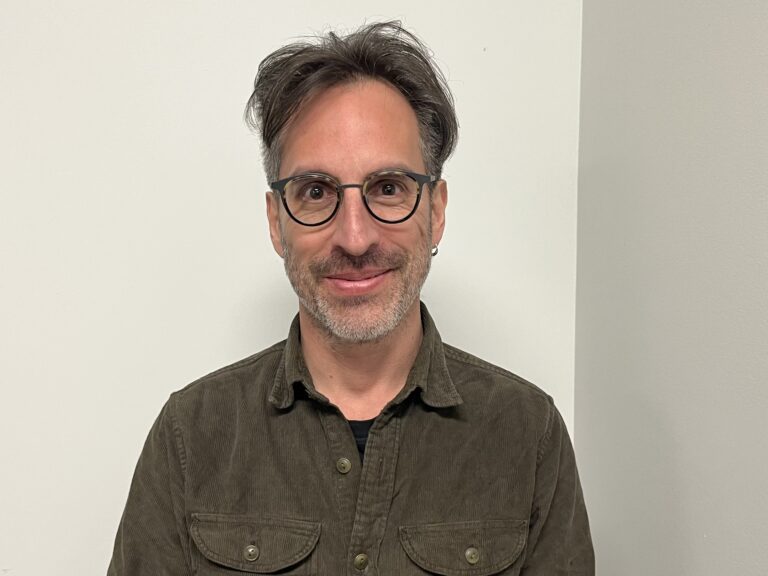
More than 50 years of fervent music love and passionate journalism will be celebrated at the 29th edition of the Opus Awards Gala on Sunday, February 8, 2026. I am referring to the career of Alain Brunet, a journalist who is unique in Quebec, Canada, and even internationally in that he has covered the entire spectrum of popular music as well as so-called serious music throughout his career. Try to find others who have done so with such aplomb and, above all, such sincerity!
Our friend Brunet, who will receive the Tribute Award at the Opus Gala, has shared his knowledge of listening and mediating musical art almost everywhere: from CIBL in his early days to La Presse, where he worked for 35 years, from 1984 to 2019 (and where most of us knew him), to Radio-Canada from 1984 to 2013, not to mention Télé-Québec and TVA. When I was young, I associated Alain with “popular” music, everything from rock to rap, metal, punk, soul, country, indie, and certain “edgy” genres such as contemporary jazz, prog rock, Indian classical music, electro, etc. But not classical music.
The thing is, at La Presse, someone else was exclusively in charge of that, with no desire to share except for interviews with classical artists, which Alain wrote more and more of starting in the 2000s, as well as in his blog (2007-2016), where he also produced album reviews and concert reports. It was only later that I discovered Alain Brunet’s love for the vast repertoire of millennial classical music from Europe, which finally made me realize the unparalleled magnitude of this man’s love of music.
Faced with a certain resignation on the part of traditional media when it comes to music curation, and their retreat into an almost exclusively mainstream and consensual zone, representing something like 2 or 3% of what exists in music, Alain founded Multimédias M 360 and its online platform PAN M 360 (us!!!) in 2019. Pan M 360 is a bilingual collaborative referencing vehicle whose purpose is the discovery, appreciation, analysis, and dissemination of creative music, across all genres and cultures, without any hierarchy of styles. A challenge that left many skeptical, but which is increasingly proving to be a success and even an indispensable offering.
Alain Brunet won’t shout it from the rooftops, nor will he stage his own media triumph to celebrate himself. That’s why we’re taking up the torch here to give him the recognition he fully deserves, because the result of his dedication has been and continues to be to inspire others, many others, to cross the boundaries between styles and thus open minds and hearts to the richness of Music, from Bach to Stockhausen, via John Coltrane and Sun Ra, John Zorn, King Crimson, Nusrat Fateh Ali Khan, Hermeto Pascoal, Anouar Brahem, Aphex Twin, Alain Bashung, Stéphane Lafleur, and thousands upon thousands of others.
If you feel wonder at the infinite possibilities of emotions and listening pleasures that musical curiosity can produce, you are on the same wavelength as Alain, and all of us at PAN M 360.
On Sunday, February 8, 2026, at Bourgie Hall of the Montreal Museum of Fine Arts, we will thank the person who makes all this a little more possible every day, thanks to his hard work and unwavering dedication to this cause, which remains as vital and sincere as ever even after nearly half a century of loyal service.
Vibration Festival | A French-Mexican musicologist is passionate about the links between music and politics
by Michel Labrecque
From October 16th to 18th, the Faculty of Music at the University of Montreal held a conference entitled Music, Diplomacy, Propaganda. Curious by nature and a journalist by profession, our collaborator Michel Labrecque attended. He met Luis Velasco-Pufleau, a musicologist and experimental musician who runs a blog on the links between music and politics and conducts extensive research on this topic.
Luis Velasco-Pufleau grew up in Guadalajara, Mexico, received a doctorate in musicology from the Sorbonne University in Paris, and taught at McGill University. He lives in Fribourg, Switzerland, and is an associate professor at the University of Montreal.
This citizen of the world is also a musician in the experimental rock band Mad Song. A musicologist who makes music is not so rare. Several of them were present at this conference organized by the University of Montreal.
Luis Velasco-Pufleau is interested in all forms of music and its connection to politics. For example, he dissected the album Le Trésor de la Langue (1989) by Quebec guitarist René Lussier, which transformed Quebecois sound archives into music, to share it with the world and understand his political approach.
He explored the use of music during wars and the role of music during the recent pandemic. He questions how the government produced a star-studded song called “Love Will Prevail” (the English title of a Mandarin song) to glorify and demonize the role of the Chinese people in the country where the pandemic began. It was a song approved by the communist government’s politburo. A song of solidarity and encouragement, but one that lacks any criticism.
One of his recent interests is the war in Ukraine. “It’s a very sensitive subject,” he says. Many Ukrainian orchestras have toured Europe and elsewhere to raise awareness about the Russian invasion. “But suddenly, orchestras that used to play a lot of Russian works stopped playing them, even though it’s part of their history over the last century. It’s an understandable reaction; it was imperial music, but there are paradoxes: Dmitri Sostakovich, a composer who had a lot of trouble with the Soviet regime and who wrote a symphony dedicated to the fight against the Nazis, is being banned.”
Luis Velasco-Pufleau never makes judgments. He analyzes the facts, compares them, and analyzes them. “I try never to generalize or condemn anything; I observe music in specific political contexts.”
Another bizarre example: Islamist extremists like ISIS in Syria and the Taliban in Afghanistan ban music when they take power. “But at the same time, in their propaganda videos, they use songs that resemble music; it’s very contradictory. They ban all music except that of the ISIS war.”
Luis Velasco-Pufleau has written several texts on the so-called “humanitarian” pop of the 80s, such as the Live Aid festival or the songs We Are The World or Do They Know It’s Christmas?, which brought together dozens of American and British rock stars, which helped raise tens of millions of dollars to fight famine in Ethiopia in 1984.
“It was a somewhat naive discourse of solidarity that said, we can’t change the world, but we can help. However, it didn’t address the root causes of the problem, which was a civil war in a particular context.” So, this solidarity certainly saved lives, but in a depoliticized context. It was also the beginning of the music video and international continuous news networks.
On the other hand, these humanitarian musical interventions are much more complicated when Westerners are more familiar with the political context, notes Luis. “For Gaza and Ukraine, it’s impossible to do it in such a depoliticized way, because it’s much more politically charged in our countries.”
With the rise of populism all over the world, our French-Swiss-Mexican and somewhat Montreal friend is unlikely to run out of places for research and observation.
“I think that musicology and the humanities can help us better understand the situation in the world. What does music tell us about a conflict or a political situation?”
« La musique est un outil formidable pour comprendre les identités, comment les gens pensent, forment une société avec ses conflits », conclut notre musicien musicologue. Nous sommes plutôt d’accord.
Vibrations Festival | An Expert Explores American Musical Diplomacy
by Michel Labrecque
From October 16th to 18th, the Faculty of Music at the Université de Montréal held a conference entitled Music, Diplomacy, Propaganda. Curious by nature and a journalist by profession, our collaborator Michel Labrecque attended. Here, he presents a discussion with Danielle Fosler-Lussier, a musicologist specializing in American musical propaganda during the Cold War.
Chatting with Danielle Fosler-Lussier for thirty minutes just makes you want to dig deeper. This musicologist is a bottomless well of knowledge on the links between music, diplomacy, and propaganda in the United States.
In 1970, in the midst of the Vietnam War and the Cold War, the US State Department sent the rock band Blood Sweat & Tears to tour behind the Iron Curtain. The band played in Poland, Romania, and Yugoslavia (now disbanded in Croatia, Slovenia, etc.).
It was a strange bet: the members of the group were rather anti-war and very critical of the Republican government of Richard Nixon. Nixon hated this kind of group, but the idea was to demonstrate that the United States was a much freer country than its communist adversaries.
Young people in communist countries were thrilled by these concerts. In Romania, the police intervened, and it ended in imprisonment.
“Blood Sweat and Tears suffered greatly from this tour,” Danielle Fosler-Lussier tells us. “American progressives criticized them for collaborating with the government.” In return, the American right didn’t like them either.
The United States used a lot of diplomacy and musical propaganda during the Cold War, between 1945 and 1991. This involves many paradoxes. Jazz musicians like Louis Armstrong and Duke Ellington were sent to several African and European countries to promote American values, while they themselves were victims of rampant segregation in their own countries.
Fosler-Lussier explains that jazz musicians formed a large contingent, but there were also folk and classical musicians. Sometimes, these musicians were very critical of the United States. “At the same time, many musicians understood the totalitarian reality of certain countries and came back more pro-American,” the musicologist learned while writing her book Music in America’s Cold War Diplomacy (University of California Press, 2015).
“The US began these propaganda operations during World War II. It started in Latin America, where Nazi Germany and Fascist Italy were conducting very intense propaganda,” says Fosler-Lussier.
After the war, musical propaganda intensified against the USSR and its satellite countries, particularly through radio stations like Voice of America, which the Trump administration has just dismantled. Did this propaganda diplomacy have a real impact? “If you ask diplomats, they say yes. Through a musical performance, music brings people together and can start a conversation on other topics,” explains Danielle Fosler-Lussier.
Starting in the 1970s, these initiatives slowed down. But since music is one of the United States’ great cultural forces, this propaganda diplomacy continued beyond government efforts. There were exchange programs, particularly in rap and hip-hop, under the Barack Obama and Joe Biden administrations.
Anthony Blinken, Secretary of State under Joe Biden, is a special case: a rock guitarist himself, he inaugurated the Global Music Diplomacy Initiative in 2023 by singing a song by Maddy Waters. In 2024, he also played Rockin’ in the Free World, by Canadian Neil Young, in a Kyiv bar during the Ukrainian war. An idea that got people talking, but did not meet with unanimous approval.
What emerges from Danielle Fosler-Lussier’s work is a nuanced portrait. Certainly, the United States was making these musical efforts to promote its interests and worldview, but this “propaganda” was diverse and contained critical elements, something that would not have been possible on the Nazi or Soviet side. Or today, one might extrapolate, on the Russian or Chinese side.
For the musicologist, making a difference in propaganda and diplomacy is not easy. “During this conference, we are trying to do this work, but it is really not easy. For some, the word “propaganda” is evil, for others, it means moving ideas, it is more positive.”
And what remains of these musical efforts today, under the Trump administration? Danielle Fosler-Lussier remains cautious, since speaking out as an academic has become much more complicated than it used to be. “As far as I know, nothing is happening, the Voice of America radio station no longer exists, and the US State Department seems to have moved away from the idea of cultural exchange with the rest of the world.”
Danielle Fosler-Lussier has also written a book on Béla Bartok and the Cold War and Music on the Move, about how music crosses borders through the ages, available free from the University of Michigan Press.
75th Anniversary of the Faculty of Music | Music, Diplomacy, Propaganda
by Michel Labrecque
Spending three days talking about music, propaganda, and diplomacy? For the social, political, and cultural journalist I was for forty years at Radio-Canada, it seemed intriguing.
I spent the entire day of October 17th at the Faculty of Music listening to lectures and interviewing participants.
To be honest, it was sometimes a little too ethereal or niche for my taste, as academic researchers can sometimes do, but I learned a lot of things and not just about music. Did you know that at the end of the 17th century, Spain occupied between a third and a half of Italy? That France and the Austro-Hungarian Empire were fighting over the other half? I don’t. Do you remember that in 1935, Fascist Italy invaded Ethiopia, causing 275,000 Ethiopian deaths and 15,000 Italian deaths? That the United States, under Republican John Eisenhower, distributed musical instruments to less fortunate countries?
That the BBC, the British public broadcaster, made extensive use of music intended for the Allies abroad to convey its messages of solidarity during the Second World War.
In all these events, music played a role, diplomatic or propagandistic. In the 17th century, operas were created or altered to convince Italian nobility to change their allegiance. In British news bulletins broadcast in cinemas during the 1930s, music played a very important role; white “civilized” music was often contrasted with the “savage” music of colonized countries.
All these researchers, from a dozen countries, offered us targeted examples to understand the role of music in diplomacy or propaganda. And above all, it’s difficult to distinguish between these two terms. Where does diplomacy end and propaganda begin, or vice versa?
We also mentioned more recent examples, which I would have liked to have discussed in more detail: the Olympic ceremonies, among others. You will no doubt agree with me if I say that the one for the Paris Olympics in 2024, through its music, gave an impression of French audacity and innovation. Was it diplomacy or propaganda? Or just audacity?
“Politics, diplomacy, and the arts are much more closely linked than we think,” Frédéric Ramel, a researcher in international politics at Sciences Po Paris, told me. This political scientist has chosen to focus on what he calls “the sensitive,” which includes emotions and the arts. “We tend to consider it less important than military or political strategy; I’m not so sure,” he adds.
An example? Qatar, the Arab emirate known for hosting the World Cup and for sheltering some leaders of the Palestinian Hamas movement, “has put forward a woman, Dana Al Fardan, a singer and composer at the crossroads of classical and pop music, as the cultural ambassador of this small country. Putting a woman forward is very important for the image of this conservative country abroad,” notes Frédéric Ramel.
For him, this is an example of musical propaganda. At the diplomatic level, many countries, including Canada, have musical artists tour abroad. “France does this constantly, especially in the United States; music has power and potency,” concludes Frédéric Ramel.
The French political scientist adds that it’s not just states or the political world that can use music for diplomatic purposes. In Italy, in some cities, migrants and citizens are brought together in the form of musical workshops. This dialogue soothes morals and facilitates coexistence.
Publicité panam
Music Immigration | A much-needed platform
by Sandra Gasana
This Monday, October 6th, the launch of the brand new Music Immigration platform took place at the Conseil des arts de Montréal. This is the result of several months of work, surveys, questionnaires, and action research conducted by Caroline Marcoux-Gendron, associate professor in the Department of Music at UQAM and postdoctoral researcher in the Department of Management at HEC Montréal. She was supported by Hortense Dubus, research assistant and doctoral student (UdeM), Brazilian artist Mônica Freire (UQAM), Marie-Jeanne Blain (UdeM/UConcordia/IRMS), and Myriam Zmit (UdeM).
Among the partners in this ambitious project are the Quebec Music Council, SPACQ-AE, the Social Centre for Immigrant Assistance (CSAI), the Carrefour Jeunesse Emploi de Portneuf and, of course, the Montreal Arts Council.
After the obvious observation that it was difficult for immigrant musicians to find their way around when they arrived in Quebec, this platform aims to centralize all useful information in one place and according to 8 categories. Among these, we find the creation and production of music, distribution, financing an artistic work or knowing your rights as an immigrant musician. For each of the 8 tabs, an exhaustive list of resources is offered with complete fact sheets.
There is also a dictionary including all the vocabulary used in the Quebec artistic community which can be very useful for newly arrived musicians.
Another section of this platform is dedicated to events aimed at musicians, professionals in the cultural and immigration sectors and employment assistance, as well as researchers interested in issues related to the professionalization of immigrant musicians. Conference cycles, workshops, commented performances, in short, the platform has just been launched and the coming months are already full of activities.
Finally, all the documentation is accessible in the tab bearing the same name, and it includes in particular the report on the professionalization paths of immigrant musicians in Quebec, which is at the origin of this initiative.
This platform should be replicated in all provinces of Canada and, why not, internationally as well. It responds to a pressing need experienced by many musicians who are not only faced with uprooting upon arriving in a new country but also face barriers when it comes to making a living from their profession. A platform like Musique Immigration clearly meets this need.
Yves Jarvis and Mustafa Honoured at The 20th Polaris Music Prize
by Marc-Antoine Bernier
According to the Polaris community, Yves Jarvis is the creator of the Canadian album of the year, All Cylinders, and Mustafa is the singer-songwriter of “Gaza Is Calling,” the Canadian song of the year. The 2025 Polaris Gala was held Tuesday night at Massey Hall in Toronto, marking the 20th edition of this award, which annually recognizes the best Canadian music based exclusively on artistic merit and expert evaluation. Presented by the CBC, the evening ran from 8 p.m. to 11 p.m. and alternated between award presentations and various performances.
Mixed performances
Montrealer Marie Davidson opened the evening with “Sexy Clown,” from her album City of Clowns, which was nominated on the short list. Alone behind her mixing desk, she delivered a raw and theatrical performance, as only she knows how. Gatineau-born musician Yves Jarvis followed with a psychedelic and evolving set, shifting from rock bursts to more soulful and contemplative moments, already showcasing the breadth of his soundscape even before the winners were announced.
The program then took the audience on a journey through a mosaic of genres. The duo Bibi Club offered indie pop tinged with post-punk, with “Le feu” and “Shloshlo,” supported by looped visuals and the clear voice of Adèle Trottier Rivard.
Toronto’s Saya Grey kicked off her set with “Hell (Of A Man),” delivering intimate folk music accompanied by her band, first on acoustic guitar, then setting aside the instrument to take up more space on stage with “Lie Down.”
There was a change of tone with OBGMS, whose punk-rock energy was mixed with gospel passages. Dressed in white, accompanied by projections of the Earth in flames, they took us on a journey of collective and visceral rage.
On the Montreal side, Ribbon Skirt imposed a nervous and tense indigenous rock sound, carried by the song “Off Rez,” and the post-punk aesthetic of its lead singer. The band’s musicians never stopped moving on stage, as if immobility would freeze the soul in cement.
Toronto singer Nemahsis then softened the atmosphere with her melancholic alternative pop, particularly on “You Wore It Better,” carried by an ethereal voice and minimalist arrangements.
Then, Population II plunged the room into a psychedelic trance with “La Trippance,” a progressive rock track extended for the occasion, supported by strobe lights, frenzied riffs, and even a heartfelt “Vive le Québec libre.”
To conclude, Lou-Adriane Cassidy, illuminated by a red moon projected behind her, gave a spellbinding and electrifying performance with “Dis-moi, dis-moi, dis-moi” and “Journal d’un loup-garou,” bringing the evening to a close on an intense note.
New and former winners
This year, the gala introduced a Song of the Year Award, with a $10,000 prize from SOCAN. The award went to Mustafa for “Gaza is Calling.” The Toronto singer, the only artist absent from the evening, was unable to collect his award in person.
In closing, the Album of the Year Award was presented by Haviah Mighty to Yves Jarvis for his fifth album All Cylinders, released last winter. Formerly known as Un Blonde, the Montreal-based artist walked away with a $30,000 prize. He succeeds Jeremy Dutcher, the winner in 2024.
Two other awards highlighted Canada’s musical heritage. The Polaris Heritage Prize, which recognizes albums released before the award was created in 2006, was presented live for the first time: the jury selected Jane Siberry‘s The Speckless Sky (1985), while the public chose Grab That Gun (2004) by The Organ.
Finally, the organizers took advantage of this anniversary edition to announce the launch of a new submission portal accessible on their website. This tool will now allow artists from across the country to submit their albums directly to the Polaris jury, simplifying access to the selection process.
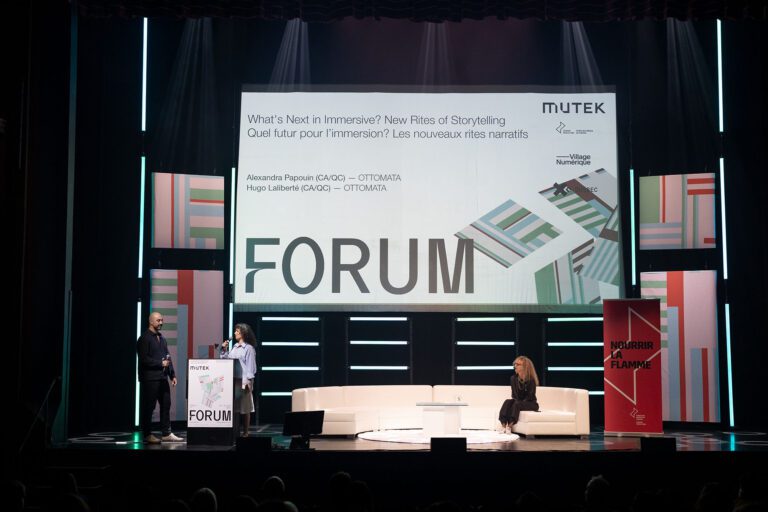
MUTEK Forum 2025 – Talk Show: What’s Next in Immersive? New Rites of Storytelling
by Elsa Fortant
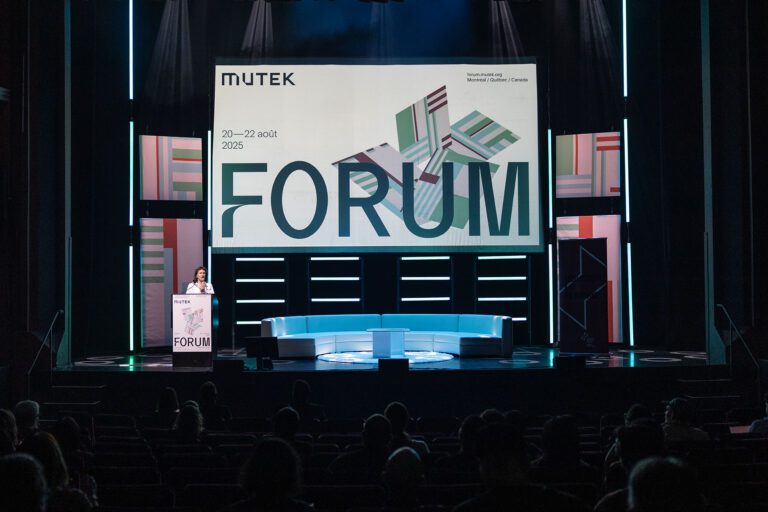
For its 11th edition, the MUTEK Forum will take place from August 20 to 22 at the Monument-National with a program centered on the theme of “Radical Rituals.” In a rapidly changing world, rituals are becoming essential anchors for individuals and communities. MUTEK invites us to think of radical ritual as a tool of resistance in the face of a particularly unstable sociopolitical context.
The introduction of a new talk-show format reflects the Forum’s willingness to experiment. Hosted by Myriam Achard of the PHI Centre, this program, consisting of five 10-minute segments, examines the future of immersion from the perspective of immersive arts and the new narrative rituals they enable.
Segment 1 – Ana Brzezińska: A Brief History of Immersive Art
Ana Brzezińska, a curator specializing in immersive art, offered a historical perspective that provided a solid foundation for the audience’s reflections. What is immersive art? For her, « It’s virtually anywhere you go. It’s many things, digital or phygital. It’s opening people’s imaginations and democratizing an artistic discourse that has historically been hermetic and intimidating. »
The transition from storytelling to storyliving enables unique forms of engagement and a constant capacity for surprise. This evolution is part of a rich genealogy, from Sensorama to the amusement parks of Coney Island in 1943, to contemporary immersive installations.
Immersion thus becomes a design methodology rather than a simple medium, responding to post-pandemic needs for accessibility, collective experiences, and openness. As Brzezińska points out, immersion must “place people at the heart of the experience, which is more important than the experience itself.” Segment 2 – Marc Barto: Museums as open laboratories
Marc Barto, senior digital producer at the Victoria and Albert Museum (V&A), presented a vision of museums transformed into open laboratories, where visitors move from a passive role to active engagement. With 2.8 million objects, only 2% of which are on display, museum institutions such as the V&A need to rethink their approach to transform passive visitors into engaged visitors.
Works such as Tidalo, a digital violin for two players by Hazar Emre Tez, and Craig Against the Machine, a semi-automated electric guitar by Craig Scott, illustrate this new approach, where technology enables shared experiences and emotions with the artist and other participants.
Bianca Shonee Arroyo-Kreimes’ project The Pond constitutes a critical reflection on our contemporary relationship with nature through an immersive multimedia installation. The artist subverts the codes of natural history museum dioramas by creating an artificial ecosystem populated with hybrid creatures, using various technologies (augmented reality, projections, holograms) to question the boundaries between natural and artificial. The work explores how new generations progressively accommodate technological substitute environments in the face of natural world degradation. Within the MUTEK framework, she presents Field of Reeds, an augmented reality experience that transforms everyday urban spaces into lush speculative ecosystems, inviting participants to rediscover a lost relationship with nature by virtually superimposing vibrant jungles onto the modern urban landscape in an alternative future where non-human life has disappeared.
Segment 4 – Ottomata: Pushing the boundaries of interaction
Alexandra Papouin and Hugo Laliberté from Ottomata shared their unique approach to immersion through interaction. Since 2017 and their installation Splinter, they have been seeking to move beyond the buzzword “immersive” to bring more sensitivity to the concept.
Their signature lies in the “zero moment” that instant when a person understands the interaction in a natural, almost inevitable way, without instructions. Their latest installation, TETRA, which you can discover at the Village numérique until August 28, transforms touch into a sensory and collective experience, exploring the invisible forces that surround us and transforming sound and visuals in real time.
Segment 5 – Centre PHI : Inventing a new immersive dramaturgy
Phoebe Greenberg and Julie Tremblay from the PHI Centre concluded with BLUR immersive, a project exploring cloning, resurrection, and genetic editing. Their approach is to combine several disciplines and art forms while maintaining a coherent narrative, creating a new topology of experiences.
The project overlays multiple realities: live performance, animation, AR/VR. The same actor can be presented in a synthetic world, then as an animated character via motion capture, and finally in augmented reality. This revolutionary approach also requires a reinvention of distribution, with theaters paradoxically showing more interest than traditional museums or art centers.
This first day of the MUTEK 2025 Forum outlines the contours of a changing digital creativity. Radical rituals are no longer just anchors in the face of instability, but are becoming tools for actively transforming paradigms.
Between digital ecology, immersive storytelling, and creative resistance, this edition promises to question our relationship with technology and art in a world in perpetual motion. The Forum thus continues its mission: to be a space for exchange where the possible futures of digital creation are shaped.
Mutek Forum – Pauline Bourdon: Towards Sustainable Festivals, One Event at a Time
by Elsa Fortant
As part of Mutek Forum 2025, PAN M 360 met with Pauline Bourdon, who helps festivals in their socio-ecological transition. Founder of Soliphilia and with 17 years of experience in the British festival industry, she works notably with TEAM Love Productions on events like Glastonbury Festival. Specializing in team support and implementing sustainable strategies, she also works as a trainer in several English universities to raise awareness among future professionals about today’s and tomorrow’s challenges. A meeting with an expert who sees festivals as experimentation laboratories for a more sustainable society.
PAN M 360: What journey led you to help festivals in their socio-ecological transition?
Pauline Bourdon: I have quite a unique path. I started in artistic logistics for festivals 17 years ago, then moved to England 11 years ago to work on events like Glastonbury. Gradually, I realized I was losing that authentic relationship with art due to an industry that had become very commercial. There was a moment when I realized there was a disconnect between my personal ethics and the career I was pursuing. In 2019, I created Soliphilia to combine artistic logistics and sustainable development, bringing my expertise in cultural policy and artistic logistics with the goal of systemic change in the festival industry.
PAN M 360: How would you define your day-to-day work?
Pauline Bourdon: My work is very diverse. First, there’s a lot of data collection and analysis to quantify practices, whether negative or positive. This is essential to measure impact and justify changes. Then there’s an entire educational component: creating tools for teams and ensuring their training. I favor long-term systemic change rather than one-off solutions. The idea is to help each person understand their role in this ecological transition and the creative solutions they can implement in their area of expertise. Concretely, this means spending time with teams, listening to their challenges, providing resources, staying informed about best practices elsewhere, and developing strategies adapted to each context.
PAN M 360: What was your presentation about at MUTEK Forum?
Pauline Bourdon: I presented the concept of using imagination as a tool for climate action, through two concrete projects we’ve developed. The first is called “Town Anywhere”: it’s a 6-hour immersive game that projects participants into the future, in 2035, to help them imagine and prepare for upcoming changes. The second project involves using mycelium – mushroom roots – to replace polystyrene in stage design with a compostable material created from agricultural waste. For me, festivals are true idea laboratories: they constitute a temporary small city with all the necessary infrastructure. If a solution works for 45,000 people at a festival, it can potentially be replicated on a societal scale. This is my vision of cultural events as experimentation spaces between imagination, systemic change, and just transitions.
PAN M 360: Where do festivals stand today regarding reflection and implementation of eco-responsible strategies?
Pauline Bourdon: Progress varies enormously by territory, notably due to audience behaviors that are linked to local cultures. The UK has positioned itself as a global leader in sustainable event management, with a very strong network of actors and tools that are now being replicated elsewhere in the world. However, there’s constant tension between commercial imperatives – particularly private sponsors – and teams’ environmental ethics. The reality is that festivals are complex ecosystems with socio-political and economic links that make solutions much more complicated than simply “replacing plastic cups with reusable ones.” An intersectional approach is crucial to avoid reproducing the extraction errors we observe in other sectors of the ecological transition.
PAN M 360: We’re seeing a growing number of partial or complete festival cancellations that must deal with increasingly difficult weather conditions. How do you perceive this evolution?
Pauline Bourdon: It’s a major challenge that perfectly illustrates current climate issues. England, for example, was historically prepared to handle rain, but today we must face heat waves on terrain that isn’t adapted to these new conditions. Weather predictions become crucial – we’ve experienced situations where 30% chance of rain turned into torrential downpours for three hours. Organizations like the Met Office now work with the industry to develop more precise predictions and adaptation tools. I think we also need to create professional unions because, unlike cinema, the festival industry isn’t unionized. This would allow for collective adaptation and better protection of workers facing increasingly unpredictable climate changes.
PAN M 360: With the pandemic, several technologies like livestreams or the metaverse have enabled certain cultural accessibility, but they also have an ecological impact. Between taking a plane to go to a festival in Europe and participating in a virtual festival, how should we position ourselves?
Pauline Bourdon: It’s a complex question because we still lack reliable data on the real impact of digital technology. The main problem is that consumption behaviors change completely depending on context. For example, a toilet flush at home consumes much more water than dry toilets at a festival. At home, during a virtual event, people will cook, leave lights on longer, invite friends – all factors that modify the environmental equation. At festivals, we have a controlled space where we can precisely measure consumption. Paradoxically, a four-day festival where you don’t shower can have a lower environmental impact than classic all-inclusive vacations. A specificity of festivals is that they make our environmental impact visible, unlike other cultural industries like cinema where production waste remains invisible to the public.
PAN M 360: As festival-goers, what simple actions can we adopt?
Pauline Bourdon: First, we must understand that organizing teams often reach plateaus – for example in recycling rates – and going further requires active public participation. A few simple actions can make a difference: coming with an open and curious mind, bringing your own water bottle, exploring vegetarianism even temporarily to show there’s demand, favoring carpooling and never traveling alone in a car. But above all, I think we need to develop more empathy toward teams who work enormously, often with considerable personal sacrifices. Rather than systematically criticizing on social media as soon as something doesn’t go perfectly, it would be constructive to understand the complexity of organizing an event and encourage the efforts being made.
PAN M 360: And what about artists in all this? Tell us about “green riders” or “eco riders.”
Pauline Bourdon: Artists operate in a very difficult economic context, where monetization has shifted toward live concerts. The rider – this contractual document where artists express their technical, logistical, and personal needs – is seen by all industry players: managers, promoters, concert venues. It’s therefore a very powerful tool that can be used to convey ecological and social values. A green rider can include requests like non-gendered toilets, no plastic, accessibility measures, or even requirements for gender parity in programming. At TEAM Love, we observe that green riders double each year. It’s the power of numbers that allows these practices to be normalized and gradually become standard in the industry. The goal is for these ecological and social concerns to become natural in contractual negotiations.
Mutek Forum 2025 – Resisting Artwashing: Building Artist-Led Futures in Music and Culture
by Elsa Fortant
On this final day of the Mutek Forum, PAN M 360 presents a report on the panel organized by FEMINAE NOX dedicated to the issue of artwashing in the electronic cultural industry. Around the table, we found Stacey “Hotwaxx” Hale, godmother of house music, Salome Asega, artist and director of NEW INC at the New Museum, and Rachel Weldon, founder of Debaser & Pique. Moderated by Mira Silvers, founder of Feminae Nox, the discussion explored the question of corporate funding and resistance strategies against the ultra-commercialization of underground and grassroots cultures by these same corporations.
Definition and Stakes of Artwashing
The discussion opened with the definition of artwashing. According to Rachel Weldon, it is the practice by which corporations or institutions fund artists, festivals, or cultural organizations in order to divert attention from their harmful practices or improve their public image. This instrumentalization exploits the social and cultural capital of creators, particularly in a gentrification context where artists unwittingly become agents of urban transformation, as Salome Asega adds.
The panelists emphasized the deeply problematic dimension of this dynamic. The economic precarity of artists becomes a lever of manipulation that corporations do not hesitate to use. This financial dependence harms free experimentation and creativity, transforming creators into communication tools serving corporate interests, in the same way as a public relations campaign.
The issues of dependence on private funding can be more significant in certain territories than others. We obviously think of our American neighbors. As Salome Asega reminds us, the absence of generalized public funding has long forced artistic organizations to negotiate with private funding. This reality requires them to clearly define their mission and the lines they refuse to cross to maintain their integrity.
The speakers distinguished two types of corporate funding: marketing-oriented and research and development-focused. R&D funding allows for more authentic partnerships with real added value for artists and projects, unlike marketing funding which further instrumentalizes creators as communication strategies.
How to Resist Artwashing?
In two words: support and get involved in grassroots initiatives and divest from corporations.
Concretely: resistance to artwashing involves clear institutional commitments and public stances. The panelists notably mentioned joining PACBI (Palestinian Academic and Cultural Boycott of Israel), a movement that encourages cultural institutions to boycott Israeli products and refuse partnerships with organizations complicit in the occupation. This collective approach allows organizations to move beyond individual actions to adopt a coherent and visible political stance.
Resistance also involves refusing systematic capitalist expansion. Rather than seeking growth at all costs, organizations can identify and cultivate an engaged audience. For her part, Stacey “Hotwaxx” Hale favors authentic interactions with participants at her events and maintains direct and human communication based on word-of-mouth and personal conversations (by phone, not text, #millennial #GenZ).
Artwashing recently made headlines with the acquisition of Boiler Room (BR) by Superstruct Entertainment in January 2025, with Superstruct being owned by financial giant KKR (Kohlberg Kravis Roberts & Co.). KKR invests in companies linked to the Israeli military, settlements, and the weapons industry and now uses Boiler Room’s cultural credibility to whitewash its image. The global artistic community reacted by boycotting Boiler Room events and forcing their cancellation. An example that shows that numbers make strength, that passion in the right place can move mountains, and that it is still possible to turn the tide on our scale.
MUTEK Forum Day 2: Towards a Quantum Musical Aesthetic
by Elsa Fortant
Day 2 of the MUTEK Forum continued exploring the intersection between technology and artistic practice, with a particularly fascinating session on the emergence of a quantum musical aesthetic. Presented by the École de technologie supérieure (ÉTS) and moderated by Pía Baltazar, Director of Arts-Sciences Development at the Society for Arts and Technology, this panel brought together France Jobin, a pioneering artist in the field, Sebastián Duque Mesa, physicist and artist, and Olivier Landon-Cardinal, professor-instructor at ÉTS.
The session opened with a provocative question from moderator Pía Baltazar: “Is there a quantum musical aesthetic? We are at the tip of our ignorance. What does it mean to think musically in quantum terms?” This inquiry laid the foundation for an exploratory three-part discussion.
Context: Scientific Knowledge and Music as Collective Memory
The discussion began by establishing the fundamental relationship between musical genres and their sociopolitical contexts. France emphasized how every musical genre is anchored in specific sociopolitical circumstances, citing blues, techno, and computer-assisted music as perfect examples of this phenomenon.
Sebastián Duque Mesa raised a fundamental question about the very nature of quantum music: “Does a quantum computer produce quantum music, or is it just an instrument?” In other words, do we use quantum technology as a tool or do we genuinely seek to incorporate quantum principles into compositional thinking?
Olivier Landon-Cardinal offered an interesting perspective on art’s role in making complex scientific concepts accessible. He argued that art can convey intuition about quantum science and information without requiring mathematical equations. As he noted: “In quantum mechanics, we build intuitions based on our knowledge and you can be sure they will be deconstructed by new experiments.” Art, he suggested, can help transmit quantum intuitions by transcending traditional academic boundaries, reaching a broader audience.
Practice: Quantum Concepts in Compositional Strategies
The discussion traced a lineage of pioneers who laid the groundwork for quantum musical thinking. Iannis Xenakis, the mathematician-architect-musician, was highlighted for his exploration of probabilistic composition in works like Metastasis (1955). Curtis Roads, Xenakis’s student, revolutionized electronic music with granular synthesis, which “builds acoustic events from thousands of sound grains,” as described in The Computer Music Tutorial (2023).
Sebastián noted how Curtis Roads found a way to use music as a proxy for exploring quantum concepts, inspired by Dennis Gabor’s theoretical framework from the 1940s. This approach treats sound particles that “you can’t hear” as compositional building blocks, exploring concepts like superposition and collision in works such as Half Life Part 1: Sonal Atoms (1999).
Olivier Landon-Cardinal emphasized the historical significance of wave-particle duality in both physics and music, noting how the development of computers finally provided the tools to practically explore these concepts. The recognition of quantum entanglement, first described by Schrödinger 100 years ago in his 1925 equation, represents what he called “the characteristic trait of quantum mechanics.”
Perception and Experience: Quantum Listening and the Observer Effect
The most intriguing aspect of the discussion focused on how quantum principles might transform the listening experience itself. France described her project Infinite Possibilities (Particle 1) (2024) and Infinite Probabilities (Particle 2) (2024), conceived as two albums that can be experienced separately or together. In this framework, they function as quantum systems and the listener becomes the observer whose choices determine the musical reality.
France Jodoin’s work Entanglement (2023) draws inspiration from quantum field theory’s concept of “vacuum fluctuation,” where particle pairs appear and disappear simultaneously. This piece explores how quantum concepts can generate new forms of musical experience that exist in superposition until the moment of observation.
In her installation work, particularly in environments like SAT’s dome with 95 speakers, France Jobin attempts to create different experiences for each listener within the same physical space. This echoes Olivier Landon-Cardinal’s observation that “when you interact with a quantum system, things are not real before measurement. In the case of France’s performance, we are in the same room listening to the same thing but we have a different perception of the event. Acquiring information allows us to build our own reality.”
The session concluded with France Jobin’s invitation to Forum participants to “feel the quantum” at Métropolis 1, where she will present Lueurs Quantiques with Markus Heckmann. To do this, she invites us to experiment with different perspectives by moving between the dance floor, mezzanine, and the rest of the venue to create our own reality.
MUTEK Forum 2025 : Radical Rituals
by Elsa Fortant
For its 11th edition, the MUTEK Forum will take place from August 20 to 22 at the Monument-National with a program centered around the theme of “Radical Rituals.” In a rapidly changing world, rituals are becoming essential anchors for individuals and communities. MUTEK invites us to think of radical ritual as a tool of resistance in the face of a particularly unstable sociopolitical context.
This year, the three days of conferences and activities are structured around three themes (one per day): storytelling and narration with the Canada Media Fund, technology with the École de technologie supérieure (ÉTS), and ethical practices for the future. Sarah McKenzie, Executive Director of the Forum, opened this edition by emphasizing the importance of partnerships, particularly with the Indigenous Screen Office (ISO) for the second consecutive year.
MUTEK AI Ecology Lab: When Sustainability Meets Creativity
One of the highlights of this year’s edition is the MUTEK AI Ecology Lab, whose results were presented today. This year, six projects were hosted in residence at the Society for Arts and Technology (SAT), each with the goal of thinking, reflecting, questioning, and proposing sustainable AI solutions. The projects are presented in the form of an exhibition that demonstrates a critical and creative approach to emerging technologies.
Among the projects presented, Lionel Ringenbach’s Wattsup stands out as a tool for measuring AI energy consumption, responding to growing concerns about the carbon footprint of these technologies. CITYChat, developed by Femke Kocken, Ivonna Bossert, Connor Cook and Sura Hanna, offers a roadmap for transforming data into a sustainable, private, and self-hosted chatbot—meaning one with a lower ecological impact.
These initiatives are part of a broader effort to critically reflect on the environmental and social impact of technologies, a recurring theme in the DNA of the MUTEK Forum.
Fire, Fungi, and Family Fun: The ShazamFest XX Experience
by Jake Friesen & Lyle Hendriks
If you’ve ever done magic mushrooms, then you already know what the first hour of the trip looks like. For the uninitiated, it is not uncommon to experience a nauseating foxtrot through the very worst of your anxieties. At the same time, your body negotiates whether or not you’ll lose the ice cream you just ate for dinner. This is the most challenging part of the shroom experience, as you doubt yourself and every decision that brought you here.
Slowly but surely, you find your bearings, your boyfriend, and your bravest face. You walk down a wooded path, and you are greeted by a kindly clown on bag-check duty. He bends to peer in your bag, only for his foamy red clown nose to tumble to the ground. A tearing sound rings out through the trees as he attempts to retrieve his nose. He has ripped his pants, and in that moment, you are divinely rewarded by the universe for sticking it out during the come-up.
This is ShazamFest. A place where your ability to commune with your discomfort will be rewarded with world-class musical performances and a community unlike any other.
Taxi Girls /Main Stage
Taxi Girls Strike First
ShazamFest’s approach to programming is unorthodox, to say the least. My first indication of this was when Montreal punk outfit Taxi Girls took the stage at 8:30, before the sun dipped below the mountainside and before the evening’s shows really kicked off.
This is a group that would be most at home in a ‘venue’ like Montreal’s Van Horne Underpass or some place equally dirty and illegal—somewhere Vera Bozickovic’s scratchy, hostile vocals can crash off hard concrete and thrashing bodies. Instead, here they are, giving it their all on a warm summer evening as kids practice their cartwheels and young parents bob their heads. It’s a striking juxtaposition, and it’s certainly not the slot I’d give to such a raucous, high-energy group. And yet somehow, it just works. The femme four-piece is relentless, oscillating between hard rock and hardcore, steadily whipping the growing crowd before them into a nucleus of movement and moshing.
Meeting Captain Shazam
When I first laid eyes on ShazamFest founder Ziv Przytyk, it was seeing his face on the back of a ShazamBuck, a fun twist on the usual drink tickets offered to media. The man himself is no less irreverent and whimsical, more than happy to regale us with story after story of all that’s gone on in 20 years of ShazamFest. Geared in a naval officer’s hat, Captain Ziv teaches us a little about the history of the festival, how he and his brother Sasha came home to the Eastern Townships after some time abroad, returning with a simple and singular mission: To throw a damn good party.
ShazamFest founder Ziv Przytyk
What was, presumably, a thrown-together rager in the woods 20 years ago has truly blossomed today. Admiral Ziv surveys his lands as he speaks, pointing out the rustic stages and structures that circle the mainstage area, telling us about the stage catching fire one year, about catching cops gawking at burlesque the next. Despite being a personal friend to seemingly all 2,000 attendees, he’s a warm, gracious host as he welcomes us into his world.
Martin the Stretcher / Main Stage
The Celestial Bodies of Sci-Fi Burlesque
Ziv and his partner, Elisabeth Besozzi (who has been beside Ziv with ShazamFest for some time) clad in dazzling DIY UFO costumes, took to the stage to introduce us to the universe of Sci-Fi burlesque. In dizzying ShazamFest fashion, the performance swings like a pendulum—wildly between glamorous and grotesque. Rhapsody Blue brought showgirl drama, while Martin the Stretcher and Daddy Red provided the evening’s body horror. I was pleasantly surprised by the experimental balloon-based burlesque act brought to us by Râx Kaléidos. Equal parts elegant and freakish, their foreboding performance was brought to life by their ability to convey narrative to a medium not typically revered for its use of plot.
Bob Log III / Main Stage
Bob Log III Sets Shazam on Fire (Again)
When you drive out to an ambiguous rural acreage for a festival you’ve never heard of, the dream is, of course, to find new artists you love. Fortunately for me, ShazamFest XX rang in the milestone in the best possible way: Bringing back one of their most legendary musical acts for a swampy swansong for the ages.
Log’s reputation precedes him. We were informed that the last time he headlined ShazamFest 13 , they managed to convince The Blood Brothers, a pyrotechnics company from Quebec who frequently works in Hollywood, to help—which apparently resulted in some $20,000 worth of explosives being set off during the show. This was made even more spectacular when the mainstage looked like it caught fire, a story that witnesses all seem to remember quite fondly. While the IEDs were absent at this year’s Bob Log III show, the Tucson-based slide guitar savant had no trouble making this performance just as explosive.
Bob Log III takes the stage in a human cannonball suit, à la Evil Knievel, The Stig, or maybe one half of a redneck Daft Punk. His face is obscured by a motorcycle helmet, which has a shitty mic fixed inside to let him sing. The resulting effect, not to mention his downright unknowable guitar tone, makes it sound like music coming out of a birthday card from some hot, humid hell. Playing a kick drum with his feet and truly unique blues-punk slide guitar with his hands, Log puts on one of the craziest barnburners of a show I’ve ever seen one man play.
Whether it was making toast on stage and tossing it at the audience, bringing up members of the crowd to bounce on his lap while he plays, or simply the way he leaps to his feet, fist overhead and screaming obscenities after every song, there’s something about this Arizona-based, internationally-known freakshow that just feels so right. Humdinging slide guitar and four-on-the-floor kick drum. Lyrics requesting a boob in his Scotch. Downright hostility, taunting us as he threatens to play his last song. The man is a foul-mouthed virtuoso, ‘humbly’ concealing his raw skill and showmanship under unforgettable gimmicks and a raw, played-up machismo.
Kelowna Rose / Amphitheatre Stage
The Chronicles of a Very Sweaty Tent
Saturday morning came in swinging with a heatwave sun punishing me for the sins of the night before. Drenched in sweat, I slithered out of my tent and made my new home in the river that runs along the edge of ShazamFest.
During my extended stay in the river, I was exposed to the overwhelming bass of BricaBrac Sound System. While it was perhaps 800 dB too loud, I was once again rewarded for my discomfort, as I was able to observe the ShazamFest community at its finest. Families of every configuration imaginable are all participating in the simple pleasure of chilling in the creek. As a twenty-something city dweller, it is exceedingly rare that I am at the same event as a four-year-old or sixty-five-year-old, let alone us all having a good time together. ShazamFest might just be on the cutting edge of what it means to create a truly intergenerational event where everyone’s got an eye out for each other, and the kids are there to keep the adults in check.
Just as BricaBrac Sound System faded into the heat of the day, a familiar tune floated down the river. The 2013 indie classic, “Riptide,” was performed by a Shazam youngster in the kids’ talent show. ShazamFest boasts an impressive slate of programming for children, from puppet-building workshops to circus skills and live entertainment for kids.
ShazamFest is ultimately made more raucous because of, not despite, its family values, and in this day and age, I think that’s something worth celebrating (hopefully, for 20 more years).
After a long, hard day drinking beer in the river and basking in the sun, I walked my sorry ass up to my tent for a nap. The oppressive heat of the tent sent me to a nearby patch of grass to catch some Zs, during which time, I was lulled in and out of sleep by the voice of a literal angel from heaven, Kelowna Rose. With powerfully dreamy vocals and a comedic flair in her lyricism, she made for a peaceful refuge from the chaos of the ShazamFest mainstage. That nap saved my life, but Kelowna Rose saved my soul.
Kroco / Mainstage
Kroco: Disco Resurrection
Sitting atop a grassy hill overlooking the mainstage, I reacquaint myself with the waking world. From my perch, I see festivalgoers slide by like Jell-O across a red-hot dashboard. The well-loved ShazamFest structures stand proud in this quaint pseudo-town square. Suddenly, Kroco takes the stage.
These silver-clad disco-punks waste no time commanding me to dance like a flame commands a moth. Their undeniable sound quickly draws an impressively active crowd to their display of frenetic joy. Despite being a fountain of energy, Kroco as a group embodies precision and synchronicity. Each member is doing their part to craft a glittering disco canvas for lead singer, Rafik, to make their mark upon. Rafik the Kid is impossible to look away from, constantly in motion with their 70s’ swagger, while never failing to deliver addictive falsetto.
Days later, as I write this, the chorus of “Neptune (I want it)” bounces around in my little brain. Kroco does exactly what they set out to do: create irresistibly dancey disco with uncompromising punk convictions.
Just as the audience begins to find its groove, a mysterious duo joins the crowd.
Brahima Key and Philippe St-Denis (Giant puppets)
Two giant puppets, to be precise. Manned by their creators, Brahima Key and Philippe St-Denis, these two magnificent human puppets danced alongside the regular-sized human audience. Sometimes, stopping to wave at awestruck children, or coming together to dance in each other’s gangly puppet arms, the appearance of these puppets added an otherworldly beauty to an already spectacular Kroco set. As a puppet enthusiast myself, I was delighted to see the warm reception of these carefully crafted giants by the audience at large. I will be keeping an eye out for the next collaboration between master of giant puppetry Key and metal sculptor St-Denis.
The Ballad of Incomprehensible Programming Choices: Tribal Roses
The peak of my mushroom experience, unfortunately, coincided with The Tribal Roses, a predominantly white-presenting dance troop that delivered a lengthy mess of cultural appropriation to hits such as the Harry Potter theme (electronic remix) and Woodkid’s “Iron” (of Assassin’s Creed fame). In gaudy makeup and confusing dress, they toddled the stage with the disorganized pageantry of a baby’s first dance recital. Even in my altered state, I found nothing redeeming about this performance.
Éliane Bonin / Main Stage
Losing the Plot, Finding the Beauty: Les Sorcières Brulent Toutes
Les Sorcières Brulent Toutes was a gruelling march through the world of circus and freakshow entertainment. Despite my souring disposition as the performance dragged on, MC Lilith (AKA Éliane Bonin of the circus troupe Productions Carmagnole) administered desperately needed adrenaline to the fading audience through their radical retelling of Adam and Eve through an impassioned gender-fuck lens.
The final notable act of the troupe came in the form of fearless, ballerina-esque contortionist Eris D’Eir, twisting and balancing bare-chested on a bed of broken glass. This performance felt like a small eternity, where I found myself fondly remembering a time when ShazamFest used to have music…
Salin / Main Stage
Salin Puts on the Ritz
After a truly bizarre, long-winded, stint of circus, burlesque, and pseudo-Indigenous, whitewashed firewalking ‘ceremonies,’ the crowd is antsy for another show. The infectious vitality of Kroco is a distant memory, Bob Log III a half-forgotten tale amongst the consistently confusing flow of ShazamFest’s program and schedule. The acid is wearing off, the sunstroke setting in. The band is late. Could all be lost?
Fortunately, our fears are quickly slid aside as Montreal-based jazz fusion artist Salin finally takes the stage. Like a pageant queen, she arrives dressed in a stunning gown with her hair in a huge beehive atop her head. From the moment she sits down behind her drum kit at centre-stage, she doesn’t stop beaming for a moment, and neither do we.
Salin is one of the most graceful, yet powerful drummers I’ve ever seen. Incredible volume control, a crisp, hair-raising snare, coaxing tones never thought possible from a seemingly simple percussion instrument. Somehow, she (almost) never steals the show, despite being more than capable of doing so. Instead, we watch as she and her five bandmates elegantly, equitably share the stage for each song. Every player is firmly rooted in their niche, pitching in their sonic contributions without ever crossing the line into indulgence, a trap so many modern jazz outfits seem to fall for.
The band trades their solos, handing the torch to one another with grace and elegance, all under the watchful, smiling eye of Salin. Her drumsticks are conductor batons akimbo, a sweeping fill to the left elicits a stunning flute moment, then to the right to command a plucky Strat solo. It’s not until the end that Salin truly takes a moment of her own, a thunderous yet ever-restrained crescendo of ghost notes and subdivisions. A symphony on the skins, while her band watches in awe, just as we are.
Into the Night with Francbâtards
It’s getting late, the shows are behind schedule, and my brain is feebly existing in a mushy, transitory state between psychedelic elation and dog-tired. Over on the mini stage next to the bar, a small army is setting up on the tiny platform. I quietly pledge to myself: One song, then it’s back to the tent for bed.
Naturally, I should have known it wouldn’t have worked out this way. I should have known my perseverance would pay off, too, as it has time and time again in the parallel reality of ShazamFest. How could I have known that this 9-piece group would turn out to play an absolutely electric set of ska, afro-beat, reggae, and more? Because it’s ShazamFest, and evidently, they do not fuck around when it comes to closers.
One song from Francbâtards, and suddenly the waning crowd has returned in full force, swarming the comically packed stage as they fire off blistering French rap, ridiculous full-band compositions, and an energy I can only describe as manic. If we were thinking about calling it a night before, Francbâtards reminds us that things are only getting started, easily taking us to sunrise as we shout back lyrics, kneel on the ground, and writhe and twist amongst each other. Raucous, rowdy, and a damn good time, Francbâtards was the perfect act to conclude my first ShazamFest.
Nature, Connection, and Love – ShazamFest Specialties
It was a bittersweet feeling to pack up my tent and remaining warm beers on Sunday morning. Eager to sit in front of an air conditioner and think cold thoughts, but at the same time, sad to say goodbye to these stunning grounds and the magical commune that had popped up within them.
Before we hit the road, we were invited to stop by the main farmhouse on the property, a breathtaking, Secret Garden-esque locale where Ziv lives along with his parents, Jerzy Przytyk and Natasha Bird. Chickens run free, Chica the Dachshund dozes in the grass under the breakfast table, and a warm breeze blows through the nearby apple orchard. Hearing Jerzy speak on 20 years of ShazamFest, I start to understand how something like this is possible.
ShazamFest Festival goers
To call Jerzy and Natasha’s warmth and kindness ‘hospitality’ would be underselling it. They have an open attitude to life itself that pervades every aspect of the festival and beyond, lessons which were obviously instilled in fest founder Ziv from the beginning. Jerzy thinks of the farm as something of a public place, a beautiful refuge from the pressures of life, the futility of work, and the agony of toiling under technofeudalism (all of which clearly pass as light breakfast conversation amongst new friends around here). “There’s space for a few friends inside,” they say, “and a couple thousand in the yard.”
Jerzy left communist Poland a lifetime ago to start a new chapter in Quebec, though he clearly imported more than just the CCCP t-shirt he’s sporting. We talk about the alternatives to “life” as we know it. That near-unimaginable possibility of spending your time on earth growing your own garlic and throwing your own parties instead of working yourself into a casket. They invite us, strangers they’ve known for less than a day and some 50 years their junior, to come back for a camp-out whenever we like, and you get the sense they really mean it. Not out of some kind of obligation or politeness, but out of a deep love for anyone who chose to be here this weekend.
Being welcomed into the home of this family helped us to understand what truly powers the magic of ShazamFest. It’s not the incredible music, the death-defying stunts, the raucous rappers, or the sensual circus that makes this gathering special, but the spirit at its core.
What other festival feeds you fresh, farm-grown food at around $2 a plate? What other festivals see world-class jazz musicians following up circus body horror and amateur, but impassioned fire shows? What other festival shrugs off the curated, sanitized programming of modern-day events in favour of true freaks and weirdos, schedule flow be damned? It’s ShazamFest. A place where people make it happen simply because they love it, and the rest is up to you.
As we say our slow goodbyes in the warming summer morning, I’m reminded of a shroom-fueled explanation of this place I overheard between a vet and a new initiate: “It’s nature. It’s people connecting with each other. It’s love. It’s ShazamFest, man. You’re gonna fucking love it.”