Fête de la musique de Tremblant 2024 | Piazzolla told in words and music
by Frédéric Cardin
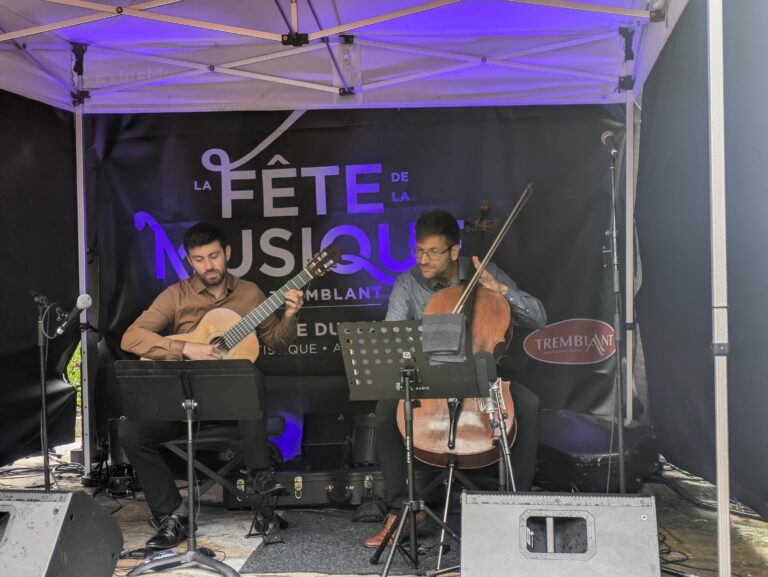
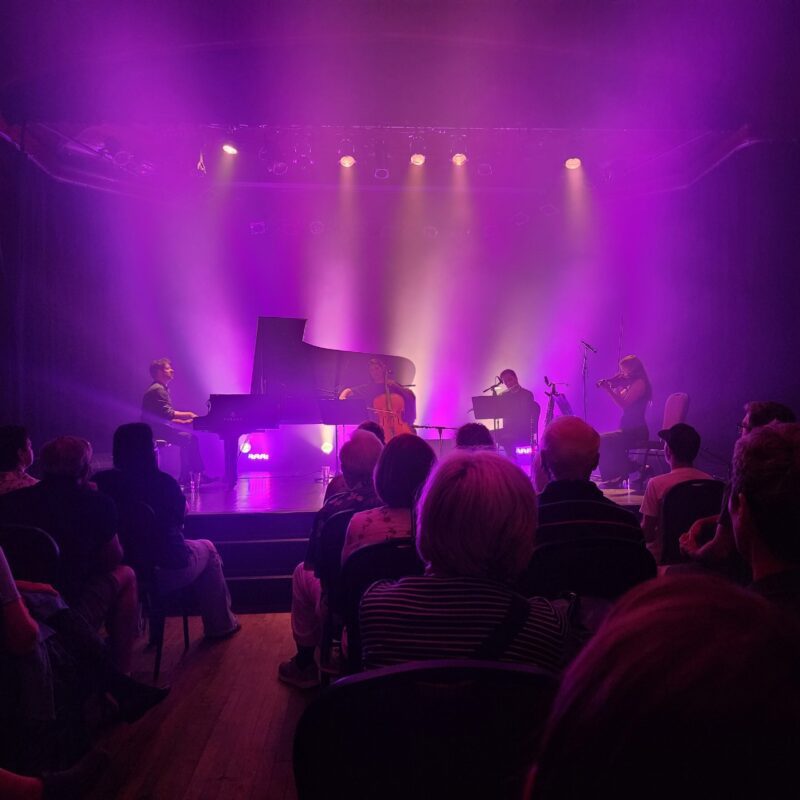
At once didactic, playful and musically solid, cellist Dominique Beauséjour-Ostiguy and guitarist Christ Habib’s show Hommage à Piazzolla succeeds in making a history lesson on the life and career of the great composer/bandoneonist light and entertaining. Over the course of an hour, the two young artists use music to take us from the composer’s very beginnings (influenced by traditional tango, then jazz and finally very serious classical music) to his maturity, that of Tango Nuevo. Even if the two musicians’ presentations lack a little professionalism, the information offered and their relative conciseness have the advantage of adding a dose of meat around the bone for the many laymen, without making it academic. That said, the most remarkable thing there is the quality of the duo’s playing, particularly that of Beauséjour-Ostiguy. His technical ease, coupled with an intensely felt musicality, make him one of today’s finest young classical talents. Hats off, too, to Christ Habib, who expresses himself with a beautiful tactile delicacy.
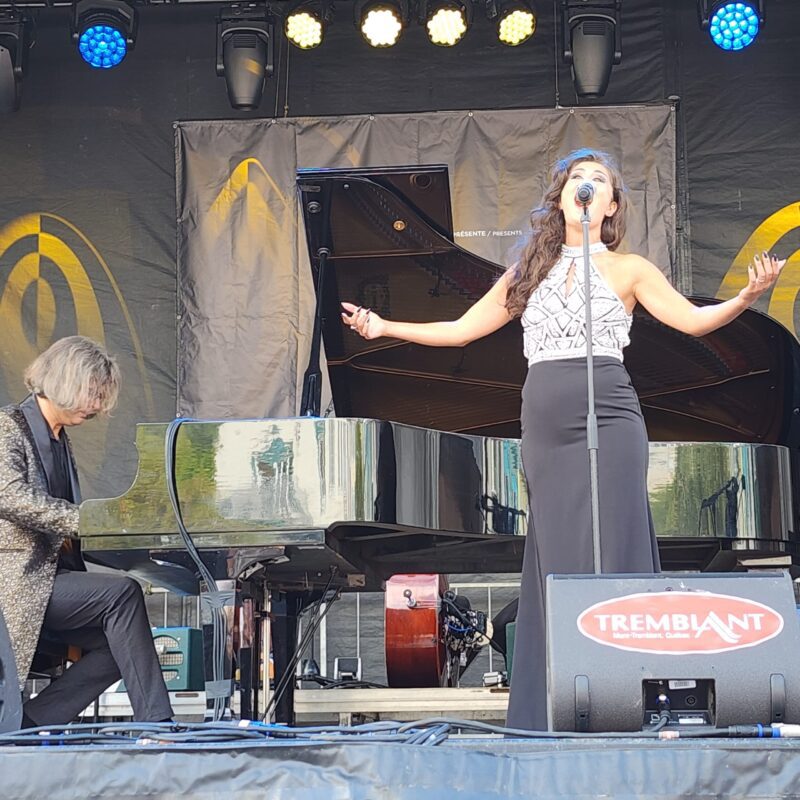
Fête de la musique de Tremblant 2024 | Marianne Trudel and Karen Young: Excellence comes in two
by Frédéric Cardin
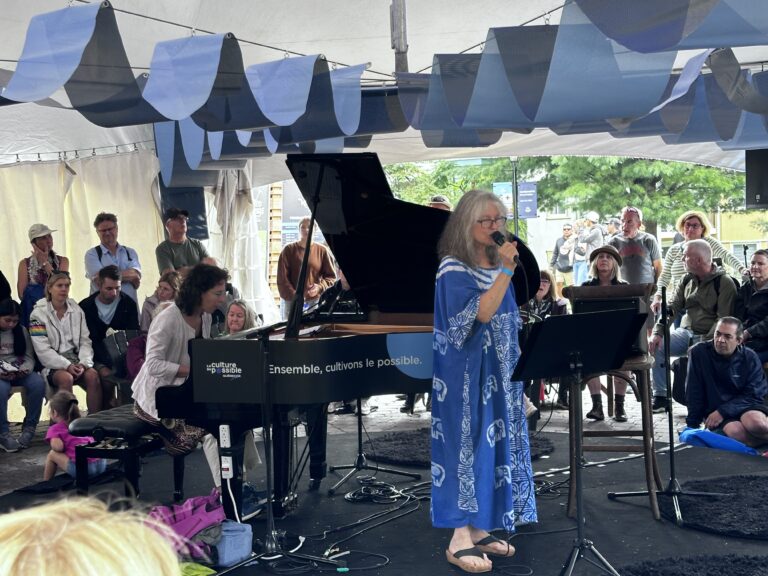
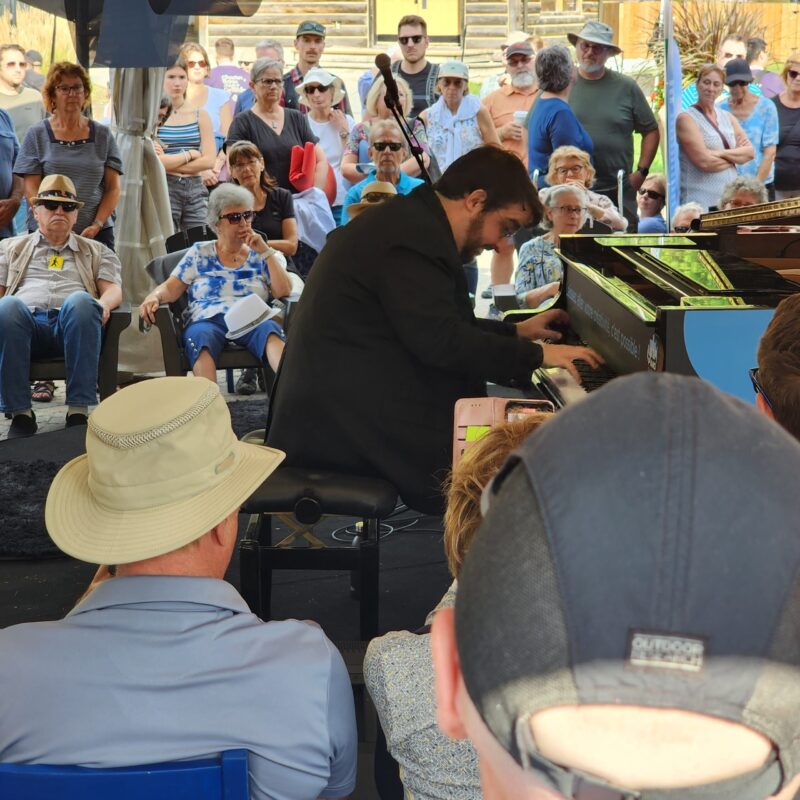
Disaster averted. Five minutes before Marianne Trudel and Karen Young were due to perform on the main stage of the Fête de la Musique de Tremblant, a deluge broke out. You could see the large audience fleeing on all fours. The two artists were quickly moved to the small public piano tent. The brave souls who made it there were rewarded with two things: comfortable shelter and an hour of top-class singing and jazz piano. The theme of several of the songs chosen by the two artists was… water. You can’t make that up. Karen Young, with a professional career spanning some fifty years (I don’t want to reveal her age, let’s be delicate. Anyway, you’ll find the info on Wikipedia….), is still one of the most exceptional voices to have emerged from Canada. Through a repertoire of finely transformed tunes by Monk, Strayhorn, Gilles Vigneault, Joni Mitchell, Abbey Lincoln, Richard Desjardins and others, she has captivated audiences with her expressive, ethereal singing. Marianne Trudel, a masterful pianist, also stood out thanks to her performances, which were perfectly symbiotic with her partner’s refined spirit. A lesson in high art performed in imperfect circumstances.
Fête de la musique de Tremblant 2024 | Hispanic and flamenco all round with Les Rugissants
by Frédéric Cardin
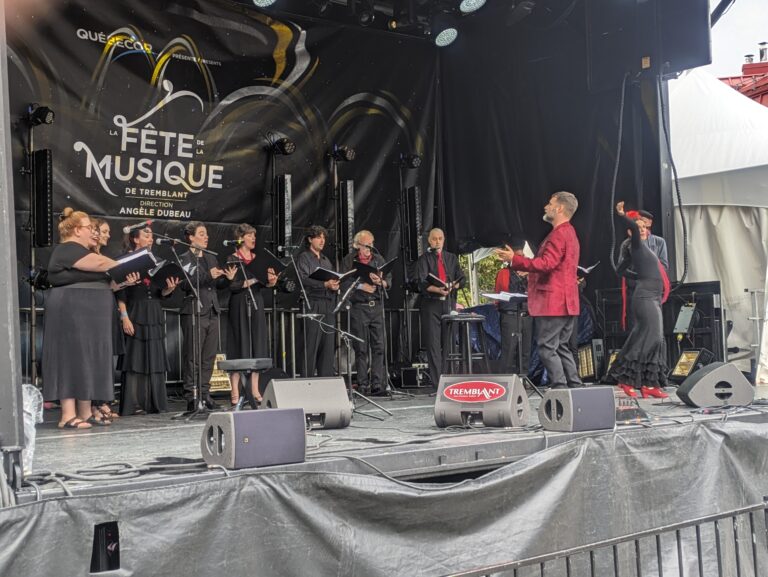
The vocal ensemble Les Rugissants, directed by Xavier Brossard-Ménard, put on a fine hour of rich choral singing this Saturday afternoon at Tremblant 2024’s Fête de la Musique. A dozen top-class singers, accompanied by a guitarist and a flamenco dancer, all led by Brossard-Ménard’s energetic, communicative direction, transported the audience in Tremblant’s main square into a Hispanic vocal universe far removed from facile clichés. Whether using Spanish or foreign composers, but inhabited by the magic of this country, the artists did not hesitate to offer works of a level of ‘seriousness’ and harmonic demands somewhat more advanced than in the other classical shows on the bill. This approach is to be applauded. That said, you’d have to be in very bad faith to balk. The programme put together by Brossard-Ménard was well chosen in terms of its expression of colours easily identifiable with the Iberian peninsula, despite some tonally modern passages. It was a performance of the highest quality, underpinned by a refinement that testifies to fine artistic integrity.
Fête de la musique de Tremblant 2024 | The warmth and elegance of the great Paulo Ramos
by Frédéric Cardin
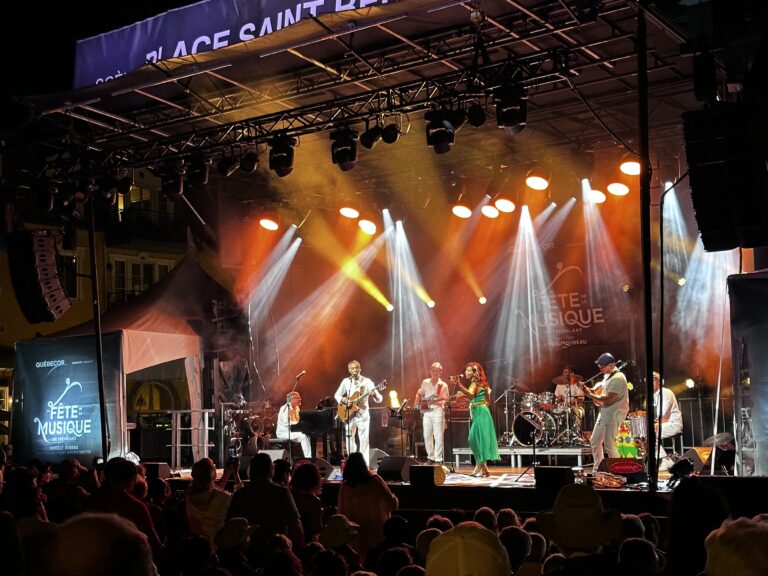
Paulo Ramos is synonymous with elegance, class, quiet strength, warm gentleness… and impeccable Brazilian music, of course. The artistic director of the Fête de la Musique de Tremblant, Angèle Dubeau, gave the veteran guitarist and singer the task of bringing the warmth and sunshine of his native country to the first of the two major shows in the 2024 edition. Mission accomplished. It must be said that it wasn’t difficult for this godfather of Brazilian music made in Quebec. The man has a lot of experience, and a lot of friends. After launching out on his own, but accompanied by his faithful quintet made up of Sacha Daoud, Daniel Bellegarde, Dan Gigon, John Sadowy and Rodrigo Simoes, Paulo invited a number of regulars to his concerts, including the excellent Bia. She offered up a few songs, including a beautifully modified and ‘pimped’ Chega de Saudade, as well as daring a few capoeira steps! The Quebec-Brazilian beauty is still in fine form! Guitarist and singer Rommel Ribeiro, Winnipeg-born singer Annick Brémaud and two dancers added the right layer of style to make this Brazilian evening an undeniable public success.
Fête de la musique de Tremblant 2024 | Beautiful flights of latino a capella singing
by Frédéric Cardin
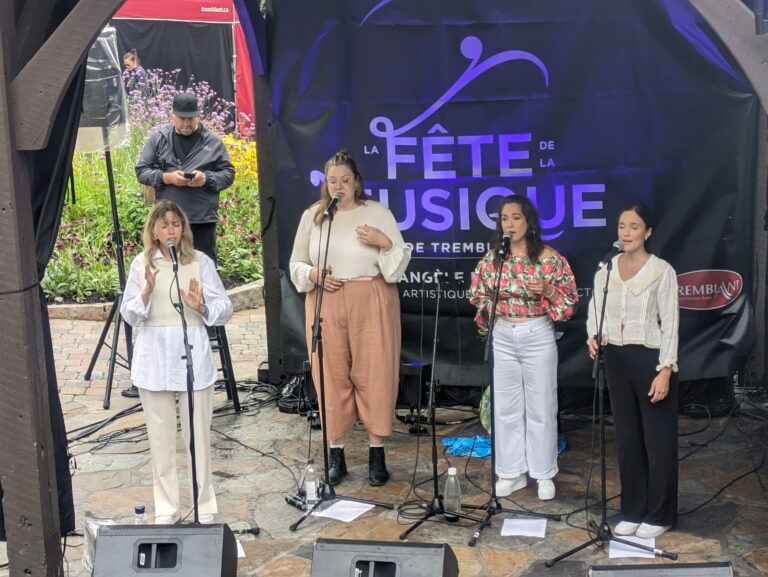
Mikhaëlle Salazar is ‘Chilicoise’, as she says herself. The young woman of Chilean and Quebecois origin founded the Mikha.elles vocal quartet in 2020. Of course, the pandemic has meant that the group’s influence has only just begun. But the group is showing great potential to spread the word. What we heard on the Deslauriers stage at Tremblant’s Fête de la Musique on Saturday afternoon made a pleasant impression. The a capella quartet, made up of Mikhaëlle Salazar and her friends Marie-Neiges Harvey, Carmelle Gauvin and Judith Little-Daudelin, lead the listener through a repertoire of songs, original compositions and Latin folklore, set to harmonies bordering on jazz and supported by an onomatopoeic rhythm reminiscent of men’s barbershop ensembles. It’s elegant yet relaxed, an image reinforced by Mikhaëlle Salazar’s simple, engaging presence. The young ladies were among the first to launch the activities of this Fête de la Musique 2024, so they had to perform in the light rain, which only dried up a little later. The audience was nevertheless present and remained attentive, a sign that the quality was there.
Fête de la musique de Tremblant 2024 | Ensemble Caprice: fun and festive
by Frédéric Cardin
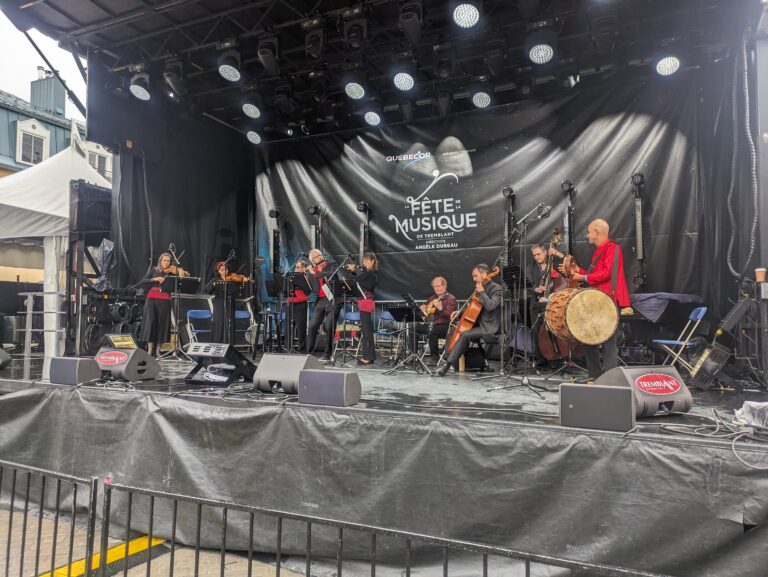
The morning drizzle had just ended when Ensemble Caprice began playing on the Québecor stage at the Fête de la Musique de Tremblant. The sun wasn’t out, far from it, but it was already more pleasant, especially as the Montreal ensemble had brought some light with them. Twice, in fact. First there was the presence of director Mathias Maute, who provided some amusing entertainment. I knew Maute was a nice guy, but I didn’t remember him being so funny with the audience. Perhaps I hadn’t been paying close enough attention… The conductor’s comments had the particular advantage of supporting a sparkling programme devoted to Vivaldi and the ‘nomads’ of Baroque Europe. Vivaldian concertos that were as twirling as one could wish sat happily alongside anonymous works by little-known composers with a strong folkloric flavour from various corners of the continent, particularly from Eastern Europe. I’d like to highlight the sound quality provided by the festival’s sound technicians. Classical music suffers from outdoor performance and amplification is often not up to scratch. What I heard yesterday was of a quality you’d have heard from the Montreal Symphony or the Orchestre Métropolitain with Yannick Nézet-Séguin, for example. Very good point for the organisation.
Fête de la musique de Tremblant 2024 | Sophie Faucher and Callas in symbiosis
by Frédéric Cardin
The Fête de la musique kicked off last night with an off-site presentation (in the village church of Mont-Tremblant) of the play Callas : une voix pour être aimée (Callas : A Voiced to be Loved) starring Sophie Faucher as the divina at the end of her life, Marc Hervieux as Giuseppe di Stefano, tenor and companion on her final years, and Dominic Boulianne as pianist and coach Robert Sutherland.
I won’t go into the details of this play, which tells the story of the singer’s last (plausible, but fictitious) moments before she was found dead in her Paris flat. For that, I invite you to listen to the interview I conducted with Sophie Faucher and Marc Hervieux (in French).
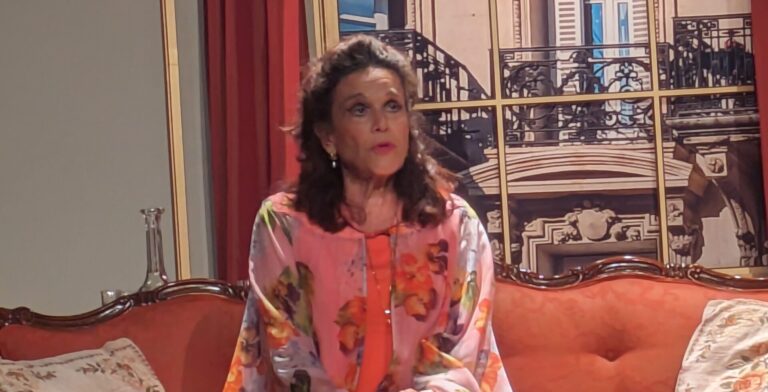
I have to admit that I hadn’t yet had the chance to see this play, written by Sophie Faucher and Anne Bryan, and which premiered in autumn 2023. What I saw and felt yesterday was above all a Sophie Faucher inhabited by her role. Here we are, with a gracious lady who is no more than a shadow of her former artistic self. And yet she still has greatness. We’d like to tell her so. We’d like to get up on stage and retort when she says that her voice was everything, that her voice made her. To tell her that no, it was she who made this voice, who gave it its unique character. It was her passion and extreme artistic integrity that built an instrument that has become iconic. That’s how much we believe in it. Marc Hervieux (tenor Giuseppe Di Stefano) is sunny, the polar opposite of the depressed star. But he has his dark side. He loves Callas with all his heart, but he too clings to the past. To the time when she still had her powers, and with whom he could reign on the stage. This forthcoming tour of Japan, which he has come to rehearse at his friend’s house, is a lifeline to which he is clinging after a family tragedy (he has lost his daughter). So he is only partly attentive to Maria’s despair. As for the pianist, he doesn’t really know what to say, other than generic platitudes most of the time.
It’s a shame, then, that Maria Callas’ last moments (if they ever took place like that) were weighed down by the inability of two men to understand the pain of a woman torn apart. The inability to commune with her tragedy, and to pierce her dark shell of regret, absence (maternal love) and resignation (she will sing no more). In fact, Callas’ final moments in this play are the story of a failure. A failure of communication. Perhaps it was possible to break through the defences behind which the exhausted diva had repressed herself, this certainty that she was no longer of any use without singing? She says: ‘The best way to serve music from now on is to keep quiet’. But serving music could have been a matter of passing on the knowledge she had acquired, of giving inspiration to another generation, and so on. Who knows, perhaps with the right words, the right arguments, Maria could have survived ‘Callas’ for a while longer. She could have avoided the trap of having to die out like one of her much-loved characters, Traviata, Mimi, Tosca, Aida.
All these things run through our minds during the hour and a half of the show. And it’s the proof that Sophie Faucher’s acting is so strong, because we dream of intervening, of finding the right arguments, where these two gentlemen fail.
Hervieux is also good and fair in the role of Di Stefano. We can forgive him a few stammerings, but he is genuine in his outpouring of tenderness and love for his friend. The same feelings that drive him to become harsh and even cruel when she doesn’t (or no longer) live up to the idol he still holds her up in his mind. The advantage he has is that he can sing, too. Which he does very well indeed, and with generosity.
Dominic Boulianne plays pianist Robert Sutherland, caught off-guard by this rehearsal that goes nowhere.
The staging, by Marc Hervieux, is very classical, in the form of a three-person huis clos in the realistic setting of a Paris flat with hints of faded luxury. The movements and set-up are designed to help us understand the emotions of the protagonists.
If you understand French (there is no English translation yet) and especially love opera, I encourage you to dive into this play with all your heart. You will be moved.
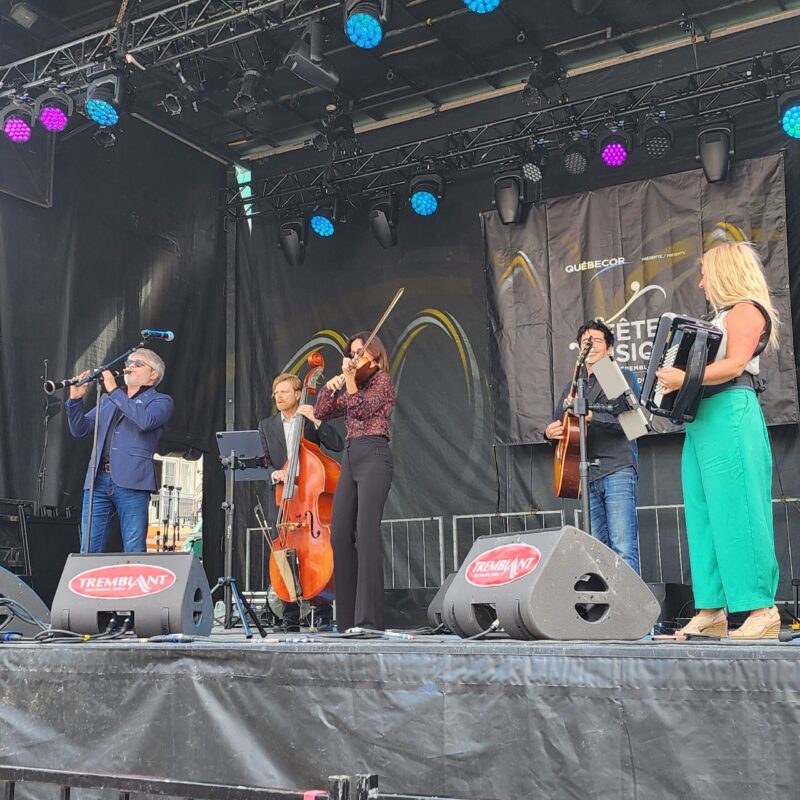
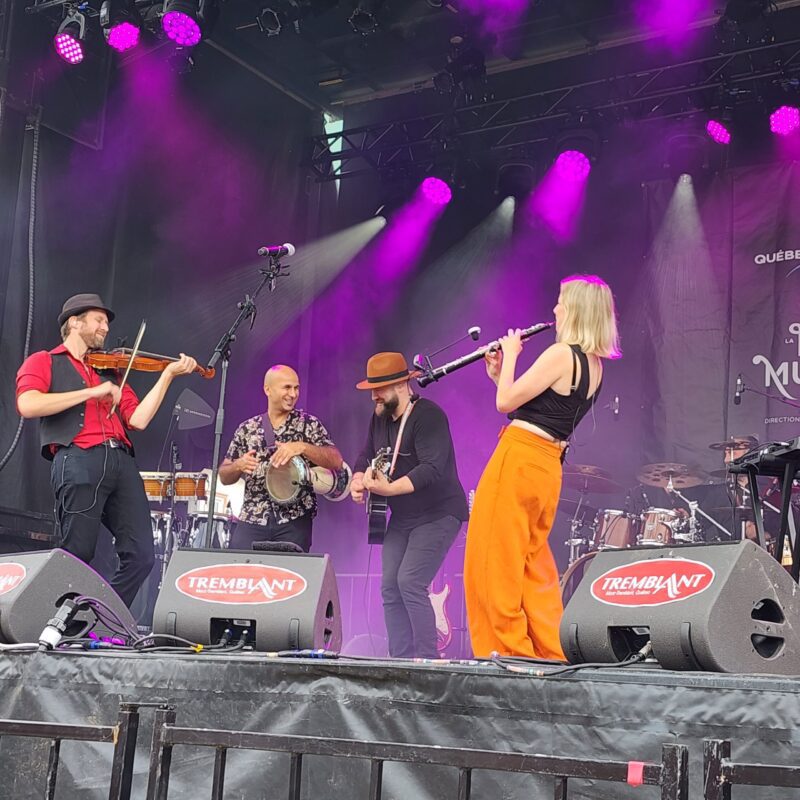
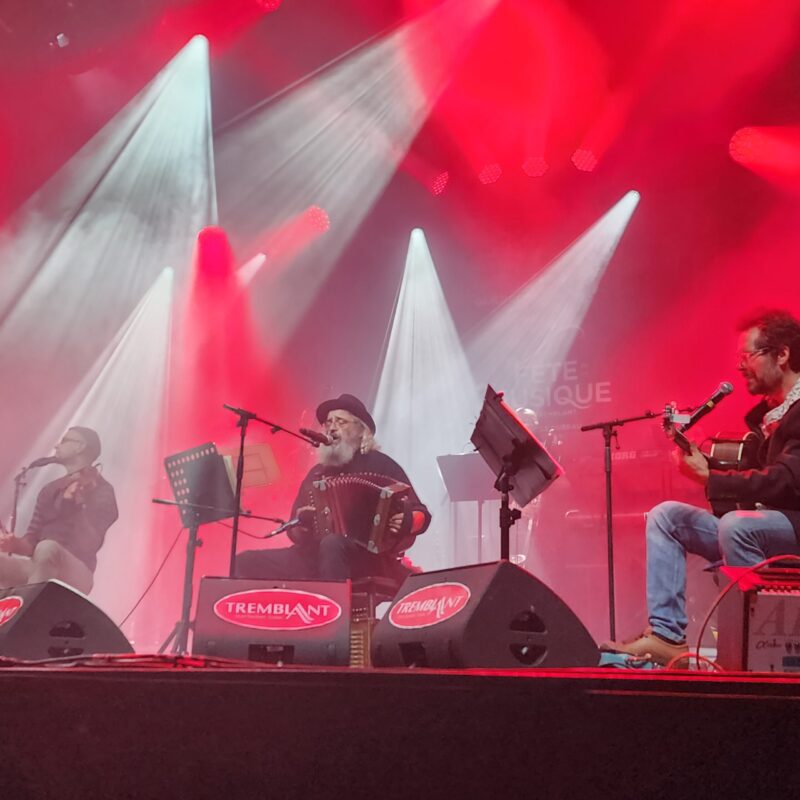
Throughout the Labor Day weekend, Mont-Tremblant’s pedestrian village was filled to capacity, and the near-perfect weather certainly contributed to the winning conditions for its main event, the Fête de la Musique, presented for the 23rd time since the first, 28 years earlier. Angèle Dubeau’s artistic direction stayed the course: consensus-based choices of quality classical and pop music, and a unifying eclecticism, from Western pop to Balkan or Afro-Latin accents. Here are some of the highlights, compiled by PAN M 360.
Jean-Michel Blais, neoclassicism and deep humanity
In this charming little church in Mont-Tremblant, a once sacred place transformed into a concert hall without losing its original aroma, Jean-Michel Blais presented a reduced version of his music for chamber orchestra on Friday. Aubades is certainly appreciated by neoclassical audiences.
Seduced by strictly acoustic composition for an ensemble requiring polyphonic rigor and thus an acceptable mastery of classical language, the musician puts aside his production skills and concentrates on his piano playing, instrumental composition and his more recently acquired skills as an arranger. We won’t repeat here the debate on neoclassicism’s triumph among twentysomethings, thirtysomethings and beyond… This approach has obvious limits but, whatever one thinks of it, remains a zone of elevation for music-lovers fed up with pop and its Indian variations.
Super-friendly, intelligent and unpretentious despite his remarkable success, Jean-Michel Blais doesn’t reinvent the wheel, but nevertheless puts his melodic skills to the service of chamber music. Melodies and tonal harmonies, tight counterpoint, four-part instrumentation: piano, cello, violin, woodwinds. The scores are not overly complex, and the music may seem predictable to anyone familiar with Romantic and modern music (late 19th/early 20th century), or with a number of French film scores, but it nevertheless demands rigorous execution from the performers involved. All in all, a very pleasant moment with a human being who fully deserves the success he is currently enjoying.
Kleztory… anything but kleztheoretical
The group is made up of Elvira Misbakhova (violin), Airat Ichmouratov (clarinet, bass clarinet, duclar), Mark Peetsma (double bass), Raphaël D’Amours (guitar), Mélanie Bergeron (accordion). Elvira, also a violinist with I Musici de Montréal and violist with the Orchestre Métropolitain, and Airat, a post-romantic composer increasingly played by our orchestras, founded the group shortly after arriving in Quebec in the 90s. Kleztory remains an important project for these classical musicians, as they seek out specialized performers, particularly in Balkan music, more specifically that which dominated before the forced migrations and exactions caused by Nazism in the ’30s. Over the years, Kleztory has managed to get closer to the spirit of klezmer and other compatible music such as jazz. Elvira, the virtuoso of this group, is more supple and sensual than ever, with a host of excellent musicians. In addition to klezmer, the Jewish music of Kleztory and its modal explorations with quarter tones, you’ll be able to experience it once again, on September 21 at Salle Bourgie, with a bonus pianist, David Ryshpan. Anything but… kleztheoretical!
Charles Richard-Hamelin, cultural mediation at Tremblant
Given his already immense stature and stature, pianist Charles Richard-Hamelin might well not lend himself to this type of cultural mediation, refusing to take part in the crowds at a small festival. But no! The virtuoso, certainly one of our country’s most accomplished pianists, at least in the Canadian top 5, remains humble and accessible. Set up in a small tent, surrounded by curious music lovers who had come to meet him, the pianist lent himself to the game four times, no less. One of these hour-long performances consisted of providing details of his famous second-place finish at the Chopin Competition, arguably the most prestigious piano competition on Earth, 2nd place won in 2016 among 450 excellent performers, “a bit like the piano Olympics”. He played a little-played piece by Chopin, the Allegro de concert, Op. 46, during which you could hear the murmurs of the crowd, dogs barking and babies whimpering in strollers. We were also treated to 6 waltzes by Chopin, most of them very well known. Between pieces, Richard-Hamelin gave us many details of his preparation for the competition he won in 2015.At the end of the program, his fans will ask him to give details of his preparation, parental authority and the need for daily rehearsals throughout his childhood and beyond. All in all, these generous encounters help to cement the relationship between great performers and their audiences.
Ayrad, Maghreb music with rock attitude
A multicultural, multi-genre group with a predominantly North African flavour, Ayrad is led by Moroccan-born guitarist and composer Hamza Abouabdelmajid, assisted by Annick Beauvais (amplified oboe, bass, vocals), Anit Ghosh (violin, backing vocals), Kattam Laraki-Côté (percussion, backing vocals), Sylvain Plante (drums, percussion) and Gabriel Brochu-Lajoie (bass, keyboard). For a decade now, we’ve been familiar with this North African approach with a rock attitude, incorporating raï, chaâbi, gnawa, Tuareg desert blues, but also funk, Afro-Latin and even Indian bhangra. The Ayrad machine is honed to perfection, and we’re dealing here with serious professionals who’ve been at it for years.
Yves Lambert, new creative cycle at 67
It was written in the sky, our national Yves Lambert would cap the triumphant 90 minutes of his show with a sequence of “La cuisinière” and “Dans nos vieilles maisons”, hits from La Bottine souriante which he left two decades earlier but of which he was the emblematic figure. This audacious and diverse program included a heartfelt tribute to Philippe Bruneau, covers of traditional songs including one by Jean-Paul Guimond and a pair of classics by Oscar Thiffault, as well as original songs and two Bottine Souriante medleys. Since breaking away from la Bottine, Lambert has gone through a number of creative cycles, the most recent of which is now a quartet (vocals, diatonic accordion, violin, guitar, podorythmy), and the forthcoming album relaunches his orchestral ambitions. In this context, Gabriel Schwartz’s arrangements complete the ensemble with four additional instrumentalists (flutes, sopranino sax, bassoon, clarinets, keyboards) and require a delicate sound system to ensure that these beautiful arrangements are perceptible, especially in the most rhythmic sequences of the program’s repertoire. And since this new cycle has only just begun, adjustments are necessary, and we can already foresee that Yves Lambert will soon be fine-tuning all this. Whatever happens, the absolute majority of his fans will be delighted by the proposal, and will see nothing but joy in it.
Serhiy Salov, un hommage à l’Ukraine
Dimanche midi, le premier concert au programme était donné par le pianiste ukrainien Serhiy Salov, établi à Montréal depuis exactement 10 ans. S’étant produit à maintes reprises sur les scènes montréalaises, le Québécois d’adoption avait reçu la commande d’un hommage à son pays natal dont on sait la souffrance quotidienne. Ainsi, il a joué des compositeurs ukrainiens, romantiques ou modernes, dont Mykola Lysenko, un contemporain de Liszt, ou encore Igor Naoumovitch Chamo et Miroslav Skoryk, ayant tous deux vécu au 20e siècle. Le pianiste jouera également la 12e étude de Chopin op 10, dont le pays d’origine jouxte l’Ukraine. Le compositeur avait écrit cette étude tempétueuse après avoir appris la reconquête de Varsovie ar les troupes russes pendant l’insurrection polonaise de novembre 1830 contre les abus de la tutelle russe. Parallèle évident avec l’actuelle tentative russe de dominer l’Ukraine, il va sans dire, et tout à fait compatible au style intense de Salov, pour employer un euphémisme. « Dessert ou digestif », au programme, une chanteuse azérie (qui fut réfugiée vu la guerre) s’est jointe au pianiste. Accompagnée de son hôte, la soprano Irane Ibragimli chantera ce requiem de guerre de Miroslav Skoryk, une pièce de circonstance dans le contexte de la guerre qui fait rage en Ukraine… et dont Serhiy Salov est un fier partisan.
The Lost Fingers
We’ve known The Lost Fingers since the decade of 2000, the latest incarnation dating back to 2014: Valérie Amyot, vocals, François “La Mitraille” Rioux, lead guitar, Byron Mikaloff guitar, Alex Morissette, bass. Originally inspired by gypsy jazz, The Lost Fingers have built a repertoire based on both guitar virtuosity and a hybrid repertoire between gypsy jazz and pop culture, including lively rereadings of hits such as Pump It Up. Clearly, the concept is still finding takers, as the crowd responded very well..
Lengaïa Salsa Brava, que calor!
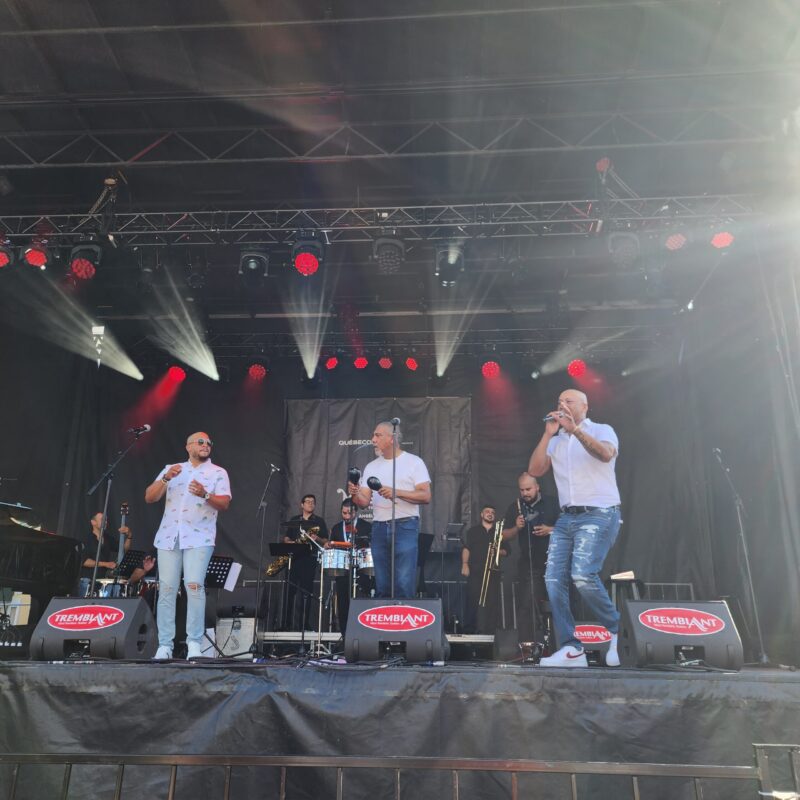
Lengaïa Salsa Brava is a Latin combo founded in Montreal in 2012 by Guyanese trombonist Giany-Frantz Huyghues-Despointes. Like Montreal, Lengaïa is multicultural: its members come from 7 different countries: French Guiana, Cuba, Colombia, Peru, Quebec, Spain and Venezuela. Needless to say, its members communicate in the three languages they use on a daily basis: French, English and Spanish. In keeping with the instrumentation of the best Latin orchestras in the 3 Americas, this ensemble is made up of three trombones and a baritone saxophone, a section of three percussionists, a double bassist, a pianist and three singers. The real deal! In 2023, Lengaïa released a 3rd studio album, Estética de un Rumbero, from which the Tremblant audience was treated to some invigorating excerpts. Salsa, rumba, guaguanco, cha-cha-cha, bachata, Latin jazz and other Afro-Latin rhythms power this well-oiled machine. Make no mistake, Lengaïa is not a token Latin band, the by-product of a nostalgic diaspora. Indeed, there’s every reason to be amazed by the quality of execution of these excellent musicians, perfectly united and inspiring the dancers on Place Saint-Bernard, where the main stage is located in the heart of the pedestrian village.
Diane Juster’s resurrection with Angèle Dubeau & La Pietà
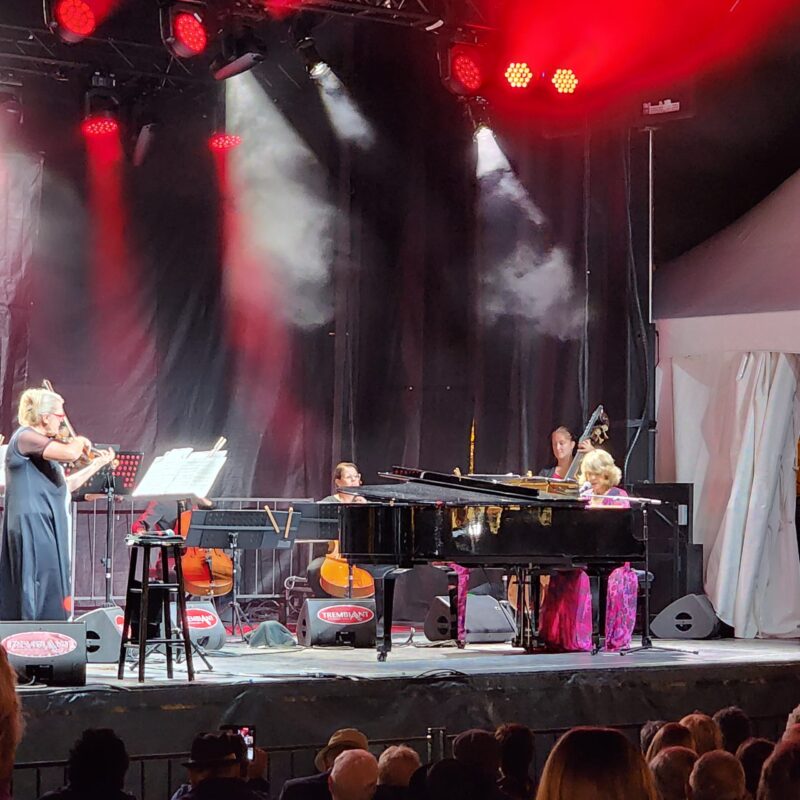
Every Fête de la musique culminates in Angèle Dubeau and La Pietà adding a special guest to their Sunday program. On November 27, she will be at the Maison symphonique with a special program, all Philip Glass and Ludovico Einaudi, from which she played a few excerpts to a packed house: on the Glass side, “Opening” and the first movement of his Symphony No. 3 for strings, on the Einaudi side, “Experience” and “Choros”. This was followed by Saint-Saëns’ “Danse macabre”, performed in spite of a somewhat laborious sound system and the dampness that also affected the instruments – it has to be said that expertise in outdoor sound systems for string ensembles is rare, as these classical ensembles generally play indoors, without contact microphones. Next up was 9-year-old prodigy Iza Kamnitzer, performing the Hommage à l’Ukraine. After performances of Enescu’s “Rhapsodie roumaine” and two Einaudi titles, a “grande dame de la chanson”, to use Angèle Dubeau’s expression, appeared. Diane Juster, whom very few people have seen on stage for many years, agreed to come and perform her classics, all songs of passionate love: “À ma manière”, “J’ai besoin de parler”, “Ce matin” and the essential “Je ne suis qu’une chanson” that became a huge hit by Ginette Reno . At the very least, an instructive dive into the 70s…
Charles Richard-Hamelin à la Fête de la musique de Tremblant
by Rédaction PAN M 360
Lauréat de la médaille d’argent et du prix Krystian Zimerman lors du Concours International de Piano Frédéric-Chopin à Varsovie en 2015, le pianiste Charles Richard-Hamelin se démarque aujourd’hui comme l’un des plus importants de sa génération. Il s’est aussi fait remarquer à l’échelle internationale en 2014 en recevant le deuxième prix au Concours Musical International de Montréal ainsi que le troisième prix au Seoul International Music Competition. Charles Richard-Hamelin a été récipiendaire de l’Ordre des Arts et des Lettres du Québec et du prestigieux Career Development Award offert par le Women’s Musical Club of Toronto.
Silver medalist and laureate of the Krystian Zimerman Prize at the 2015 International Chopin Piano Competition in Warsaw, Canadian pianist Charles Richard-Hamelin is standing out today as one of the most important musicians of his generation. In 2014, he also won the second prize at the Montreal International Musical Competition and the third prize at the Seoul International Music Competition in South Korea. Charles is the recipient of the Order of Arts and Letters of Quebec and the prestigious Career Development Award offered by the Women’s Musical Club of Toronto.
GRATUIT!
Ce contenu provient deCharles-Richard Hamelin et est adapté par PAN M 360.
Membre fondateur en 1976, avec André Marchand et Mario Forest, du groupe culte du Québec La Bottine Souriante, Yves Lambert en sera la figure emblématique jusqu’à 2003. Au sein du groupe, Yves Lambert produira 11 albums totalisant plus 800 000 copies vendues ayant accumulé, 3 disques Platine et 4 disques d’Or. Dès les années 80, le groupe devient ambassadeur culturel de premier ordre et les tournées ne tardent pas à se multiplier tant en Europe qu’en Amérique du nord. Leur présence sur la scène internationale suscitera l’intérêt de plusieurs acteurs internationaux tel qu’ÉMI avec qui le groupe a signé pour le marché international. Yves Lambert partagera avec La Bottine, spectacles, tournées internationales, émissions télé et radio ainsi que 6 Félix, 3 JUNO’s, BBC Awards et bien d’autres distinctions. Après 26 ans, en tant que chanteur et leader de La Bottine Souriante, Yves Lambert c’est hissé au titre d’icône de la musique traditionnelle québécoise.
Angèle Dubeau nous parle de son passage à la Fête de la musique de Tremblant :
“Le concert de samedi lui est consacré avec toute sa québécitude. Il sera entouré de huit ou neuf musiciens. Quand on connaît Yves, on sait qu’il est un rassembleur. Je suis sûre que le pied va être gigueur sur la place! L’an dernier, j’ai invité Yves, le lui ai dit : « Je te sais rassembleur, je veux que tu crées vraiment une grande fête au village, je veux que tu fasses danser, que tu fasses taper des mains, que ce soit vraiment une ambiance de fête. Je ne suis absolument pas inquiète, ça se fera. Yves devait donc présenter ce spectacle l’année dernière et… nous avions dû l’annuler à cause d’un orage avec éclair, tonnerre… bref trop dangereux pour l’électricité sur scène. Les spectateurs étaient tellement déçus, les artistes aussi. J’étais alors montée sur scène:« Je vous le promets, ils seront de retour l’année prochaine. » Alors voilà, ils sont de retour.
“Pour la petite histoire, on avait quand même vécu un moment magique. Dans l’attente de savoir si l’orage allait passer, on était tous à l’arrière-scène, sans électricité. Autour de nous, on voyait des flaques d’eau. Et alors un musicien d’Yves a commencé à taper du pied… tap, tap, tap…, aussi avec les mains, un petit rythme de gigue avec les pieds dans l’eau. Puis ça s’est mis à chanter tout doux pendant à peu près 15 minutes. C’était magique! Mais nous n’avons pu continuer à cause de l’orage persistant. Alors j’ai bien hâte d’entendre Yves Lambert pour de vrai sur scène, cette fois.”
GRATUIT!
Ce contenu provient de la fête de la musique de Tremblant et est adapté par PAN M 360.
Ayrad réunit les talents de musiciens issus d’horizons différents : le chanteur, guitariste et auteur-compositeur d’origine marocaine Hamza Abouabdelmajid, Annick Beauvais (hautbois, voix), Anit Ghosh (violon), Sylvain Plante (batterie, percussions) et Gabriel Brochu-Lajoie (basse, claviers), Marton Maderspach (percussions).
Le groupe n’hésite jamais à transgresser les frontières musicales. Ayrad propose une musique transculturelle, combinant des rythmes andalous et berbères, des grooves reggae et chaabi marocains, et des souches pop et rock. Un mélange unique qui attire les auditeurs aventureux et passionne les amateurs de musique du monde. Galvanisé par la voix exceptionnelle de Hamza, ce groupe de musiciens expérimentés est capable de pousser ses chansons à leur paroxysme, en leur insufflant une énergie contagieuse, quasi-magique, qui ne laisse aucun public indifférent.
GRATUIT!
Ce contenu provient de Ayrad et est adapté par PAN M 360.
Jean-Michel Blais à la Fête de la Musique de Tremblant
by Rédaction PAN M 360
Le pianiste et compositeur montréalais Jean-Michel Blais conjugue la sensibilité mélodique pop de Yann Tiersen et de Chilly Gonzales à la stupéfiante maîtrise technique de compositeurs minimalistes comme Philip Glass et Erik Satie. Pour faire suite aux sublimes Il et Dans ma main, Blais a dévoilé un nouvel album intitulé Aubades le 4 février 2022 sur les étiquettes MKX/Decca et Arts&Crafts.
Angèle Dubeau nous parle de son invitation à la Fête de la musique de Tremblant:
“Je suis très contente que Jean-Michel vienne enfin à la Fête de la musique. Ça fait longtemps que je le voulais et les horaires ne fonctionnaient jamais. Et là, c’est bon! Je le connais depuis quelques années, j’ai enregistré l’une de ses pièces avec La Pietà, Nostos. À l’époque, je lui avais donné rendez-vous pour un café dans Vieux-Montréal, je lui avais dit alors : « Cette pièce se porte très bien à un ensemble à cordes. Il s’en était étonné : « Tu peux jouer ça au violon ? Tu peux faire ça ? » Oui, oui, oui, oui! écoute, me laisses-tu t’impressionner avec quelque chose ? » J’avais répondu :« Écoute, je prendrais Nostos, je ferais une cadence au début avec le violon, puis après on fera le build-up. »
“Je lui avais fait part de mon idée, il était ravi. Il était venu à la première répétition parce qu’il était bien curieux de constater le résultat. Et il avait fait : « Wow ça sonne bien avec les cordes! » J’avais dit « Oui, puis tu devrais en faire davantage pour les cordes ou les orchestres de chambre ». Je suis tellement contente qu’il l’ait fait dans son dernier album, Aubades. Je ne veux pas dire que c’est grâce à moi, mettons que j’ai semé quelque chose. Il viendra donc avec un quatuor à cordes pour y présenter des extraits d’Aubades. C’est le coup d’envoi du vendredi soir. »
GRATUIT!
Ce contenu provient partiellement de Bonsound et est adapté par PAN M 360.