A bold transformation of Tchaikovsky’s Swan Lake envisioned by choreographer Ivan Cavallari, The Lake, in this truncated yet enhanced identification of new symbols, was premiered last night in the Wilfrid-Pelletier Hall at the Place des Arts in Montreal.
A Swan Lake stripped of its princes, princesses, talking animals, and wicked sorcerers to find itself in the world of luxury and olfactory fashion, namely a perfume brand promotion agency. I will not go over all the details regarding the vision of the artistic director of Les Grands Ballets Canadiens de Montréal; you can, on this subject, consult the report of a meeting held with Mr. Cavallari himself last week, right here:
The Lake at Grands Ballets : Replacing Tchaïkovski… by Tchaïkovski
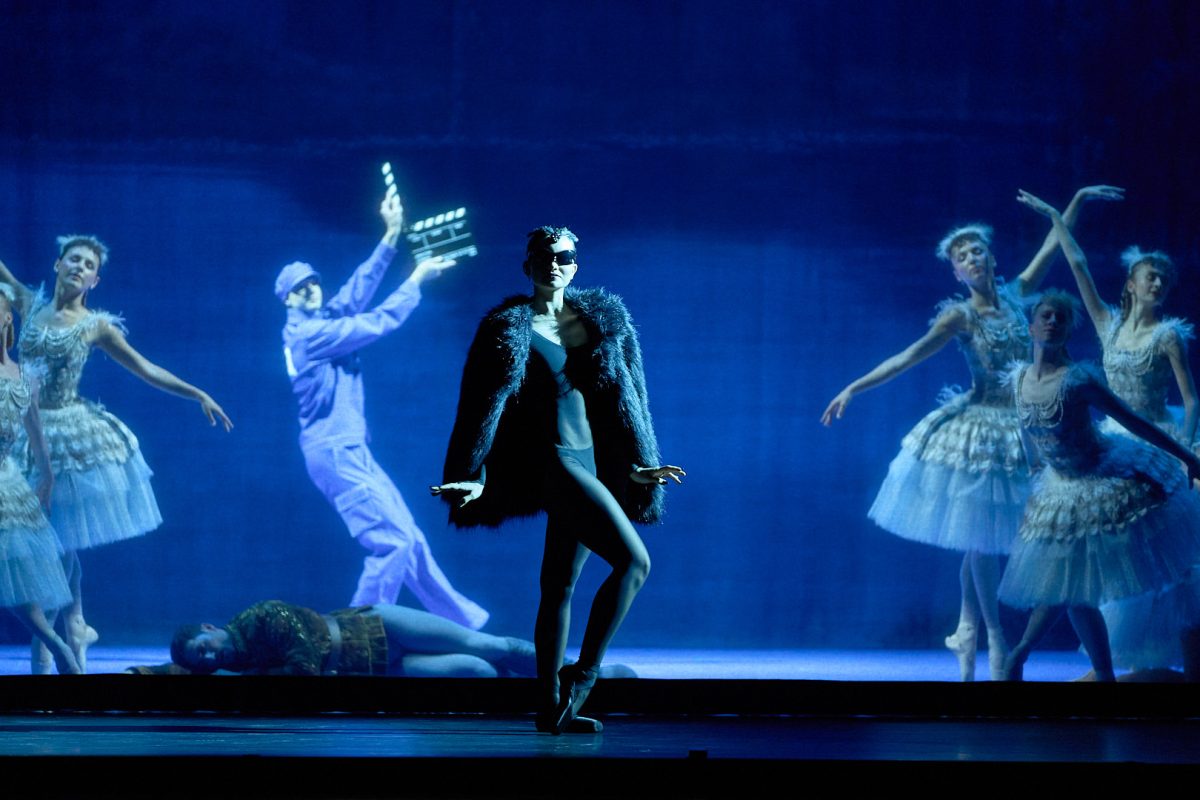
The curtain opens on a typical scene of choreographic enchantment. But the magic is interrupted in an effective transition to a film studio. The sets fade, the technical lighting structure descends from the ceiling, the cameras come into view, and the technicians bustle about. Odile, the muse of the Cygne Noir (Black Swan) perfume, takes center stage, the undisputed star of the brand. Siegfried is clearly her lover, but he is unceremoniously tossed around by the imposing personality of the frail yet temperamental star. A first pas de deux does not change the impression: it is Odile who leads the game. Here, Cavallari has completely stripped the stage bare to give the duo all the space. Deep blue curtains as the backdrop, and that’s it. The Lake, in a simple colour, stripped of its magical stereotype soul to make room for the personalities of the protagonists.
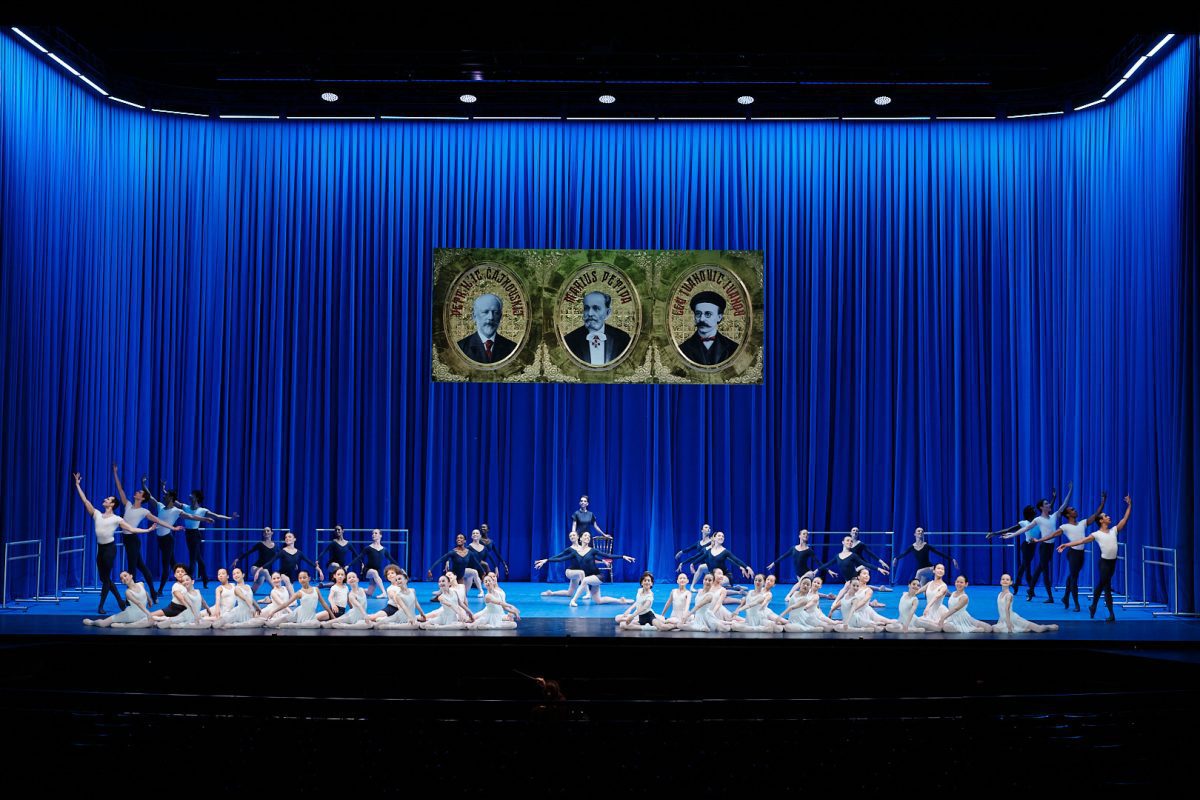
Transition to a dance school. Under the watchful eyes of the three original creators of the ballet, Tchaikovsky (music), Petipa, and Ivanov (choreography), the children perform before allowing Odette, the remarkably talented one from the school, to enter. She stands out from Odile with a clear naivety and a character without arrogance. You can see it quite well in the movements, the gestures, the costume, too. A simple, light dress, in contrast with Odile’s sporty, athletic, and high-performance clothes under a transparent veil.
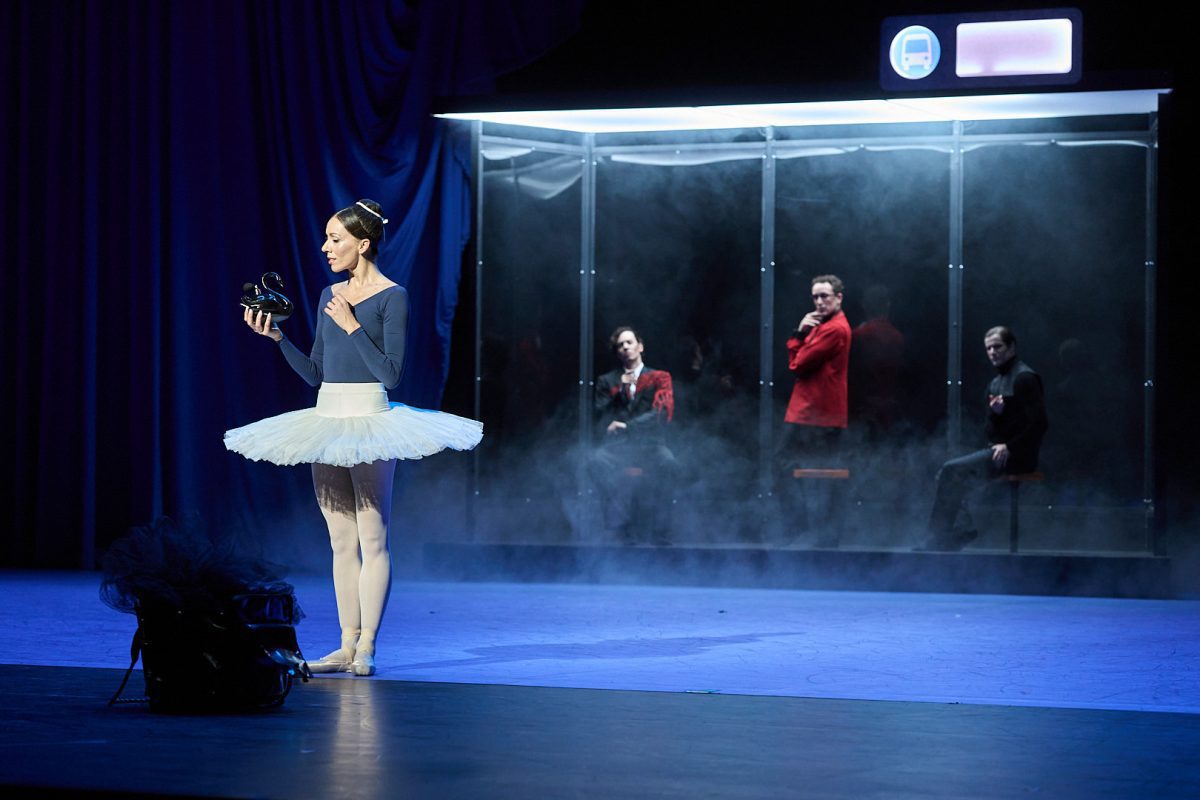
Odette leaves the school, Siegfried the stage. The scene of their meeting is ingenious and beautifully aesthetic. The two wait in a bus shelter that gradually moves from the left to the right. In the bus shelter, an ad for the famous perfume Cygne Noir. Odette is fascinated, Siegfried introduces himself, he is part of the ad too. Odette leaves with a card from Siegfried. She will go to participate in the auditions for the brand’s next product.
During these auditions, Odette fascinates everyone with her grace and talent, particularly the three creators, now materialised as capricious designers in red and black, and “realistic” avatars of the original villain Rothbart. It is during this episode that Siegfried, attracted to Odette, dances with her. Odile catches them and lets her anger explode. She leaves a bag with her perfume inside. Odette is enchanted by the scent and gets caught in the trap set by the three designers who offer her a contract on the spot. What am I saying, an arrangement is imposed on her.
There is something very significant in this scene where three men in positions of power take it upon themselves to instrumentalise a young woman as one would a particularly effective tool to achieve productivity goals. She finds herself dressed in a stylish bikini-like costume that Lady Gaga might wear in Ibiza. Odette is clearly dehumanised, and left a bit bewildered by the speed at which things have happened, even wondering what exactly she has just signed. A pact with the (three) devils, it seems. Or see it also as Tradition takes hold.
Music, between synthesis and radical cutting
This is where Cavallari introduces the excerpt from Tchaikovsky’s Pathetique Symphony, replacing the original folk dances, which are now rather unnecessary in this context. The transition to this music, from the original Swan Lake, is quite smooth. Obviously, it’s the same composer, and the same style. It remains that it could have clashed. But no, Cavallari’s choice is just as symbolic: the Symphony itself, but especially the 4th movement, which ends in silence and not in a grand finale. Odette, the authentic one, has just died.
Let’s take this opportunity to talk about the music. If you wanted to immerse yourself in Tchaikovsky’s complete and sumptuously enveloping soundtrack, you’ll have to pass. First of all, know that the original ballet lasts more than two and a half hours. Cavallari’s Lake makes it a good hour shorter. By replacing, moreover, part of the score with excerpts from the Symphony No. 6 “Pathétique” by the same composer, the music you already know is even more severely truncated.
Finally, famous landmarks, such as the Swan Theme, usually heard in the second act, are this time presented at the very beginning of the evening. As if the choreographer had wanted to get rid of this cumbersome melodic emblem as quickly as possible, probably because it was too powerfully associated with the “Once upon a time,” aspect of the work. In the logic of the Lake, the idea is valid. That said, due to habits, we still look for this sound reference later in the work, even though it doesn’t come.
On the performance side, the Orchestre des Grands Ballets played correctly, with some very beautiful ensemble passages, while others, like the first measures, were mechanical and lacked fluidity. I don’t usually take too much time to mention technical or intonation errors. This kind of thing happens. But I must highlight the serious intonation problem of the violin solo associated with the pas de deux of Siegfried and Odile, then Odette. A notoriously difficult score, it is true. But here, it was out of tune to the point of making teeth grind. And not just once. In a sustained and repeated manner. It’s a shame. If I had been with visitors, I would have been embarrassed.
Odette’s Revolt
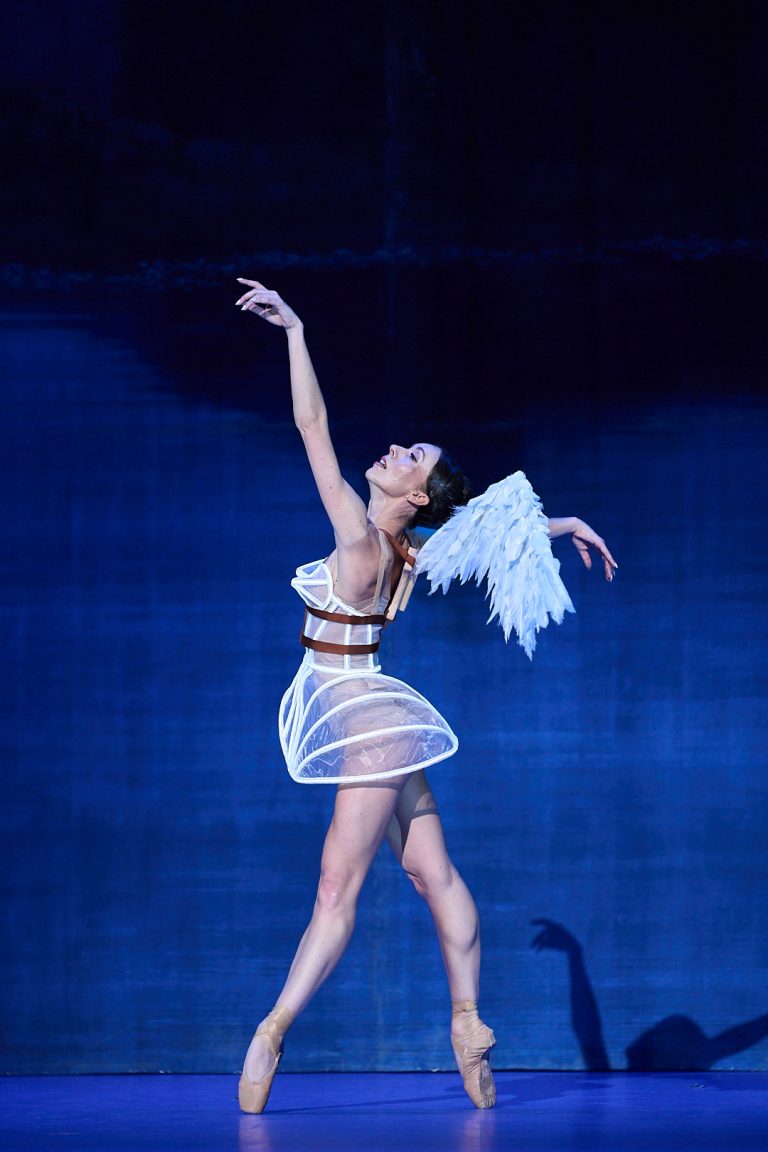
Let’s return to the action on stage. The frenzy of success becomes Odette’s daily life. But it is a success that does not belong to her. The next scene, the first after the intermission, is of great symbolic violence: the three designers manipulate Odette, and her body, as they please. On vertical screens at the back of the stage, we see a body (that of Odette), marked with numerous indications, all of which are alterations to be made. The three “villains” violently undress Odette, who was dancing in a very simple dress, the one she wore to school. The aggression here is entirely masculine, heavy with messages. They impose a futuristic tutu/corset (illuminated!) on her, adorned with a pointed bustier like the one Jean-Paul Gaultier made for Madonna.
Odette plays along, but eventually gets tired of it. She revolts, causing the appearance of four white swans, echoes of her identity submerged by a role that is not hers. The battle rages with the three designers, who refuse to lose their power over the young woman. Through all this, Siegfried looks quite pathetic. He tries to protect Odette, but is easily pushed aside. It is Odette, alone, who now leads the game, who tears her ties with this world that almost swallowed her.
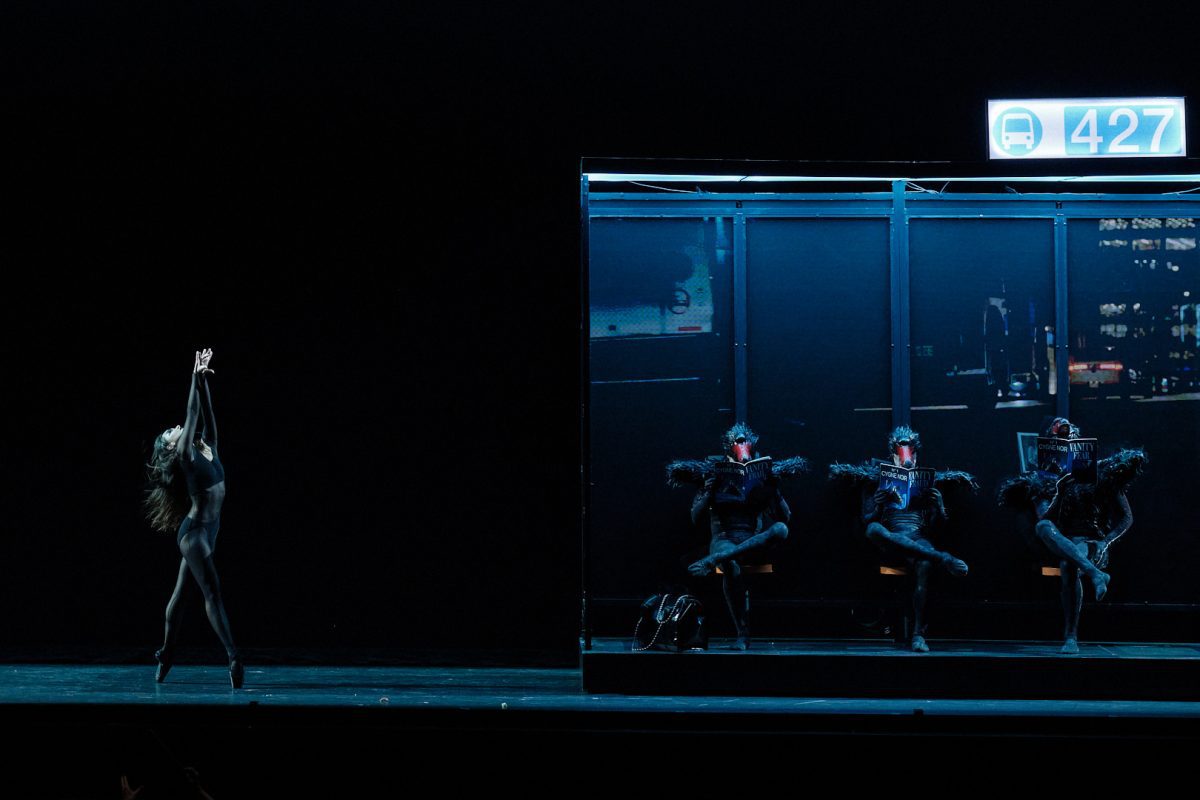
Notable irony: after their failure, the three designers find themselves at the bus stop seen earlier and encounter Odile, who also seems to be questioning herself. A symbol seems to carry this reflection: her hair is down, left free to float and wave in the movements.
Correct intuition, because in the next scene, the last of the show, Odette has also let her hair down. It ends in a scene of calm, where Odette embraces Siegfried, with other couples behind, in the shadows. It’s not a fairy tale ending; the young woman does not find ultimate comfort in the lover’s arms. Here, I rather had the impression that it is Siegfried who is being comforted. Odette is doing him a favour by loving him, despite his insignificance.
A little bit of magic, nevertheless
Overall, Ivan Cavallari offers an interesting and effectively modernised reinterpretation of the classic tale. The message is certainly quite obvious, even somewhat unsubtle. But it still seems necessary to repeat it, considering the retrograde turmoil that is currently unfolding in the world.
When we go to see Swan Lake, and despite the outdated social discourse that accompanies it, we love to be amazed. We love to enter the tale and the fairyland. The big trap of this update was to turn it into a socio-political thing, a vehicle for an engaged message, with serious statements completely evacuating the sense of magic and enchantment.
Cavallari opted for a middle ground, hence the label of Magical Realism that he himself affixed to his creation. So that in the end, this modernised Swan Lake is not completely devoid of wonder. The magic still seeps through the symbols, through the allegories, through Odette’s waking dream. That said, some scenes stripped to the extreme, like the first pas de deux in front of a vast blue curtain, would still have benefited from a more evocative environment, whether classical or modern. There was a sense of emotional dryness.
On the choreography side, Cavallari’s choice to remain strictly faithful to the gestures, metrics, and codes of classicism could also have been reshaped, in addition to the music and the scenic concept, to signify even more strongly the dichotomy between dream and reality, between Realism and Magic, between authenticity and corporate oppression. The world of fashion could have been illustrated with modern, contemporary gestures.
I remain pleasantly struck by a few memorable scenes: the bus stop, the large display of the Cygne Noir, vulgar and almost Trump-like in its golden attire, the three designers who, fleetingly in a scene that passes very quickly (you have to observe carefully), take on the appearance of the three first creators, Tchaikovsky, Petipa, and Ivanov, the final scene of the embrace, etc. I think that this vision offered by Ivan Cavallari provides part of the answer to the modernisation of classics dusted off by the social dissonances they convey in this 21st century, where new generations need to connect differently to masterpieces. Some will say that it was done by succumbing to the attention deficit of a generation accustomed to rapid scrolling. Perhaps one could have extended the study of Odette and Odile’s characters, taken the time to delve deeper, and made their transitions more organic, more credible. It does indeed happen a bit too quickly.
But the portrayal of the character Odette as the truly central element of the work, leaving the “charming prince” Siegfried far behind in the shadows, now that feels good.
The presentation of The Lake continues until June 7th.