période romantique / Pop

Fête de la Musique 2025 | Marc Hervieux’s Big Italian Party

by Frédéric Cardin

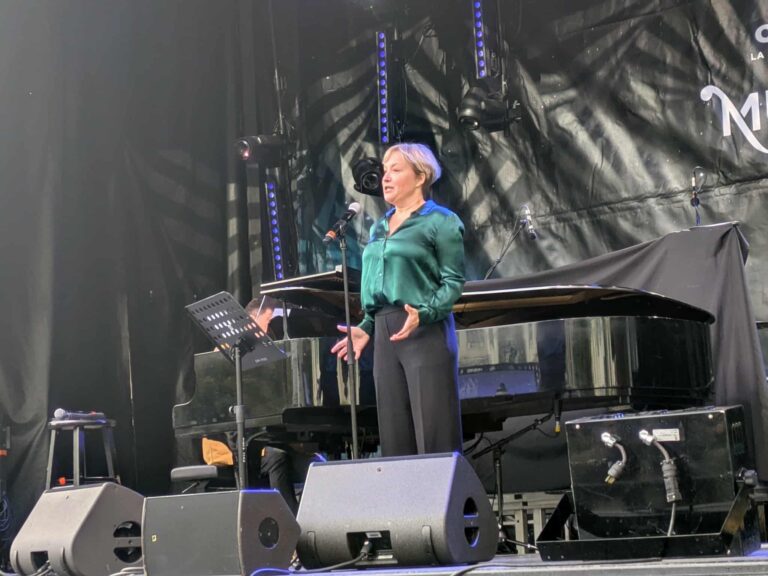
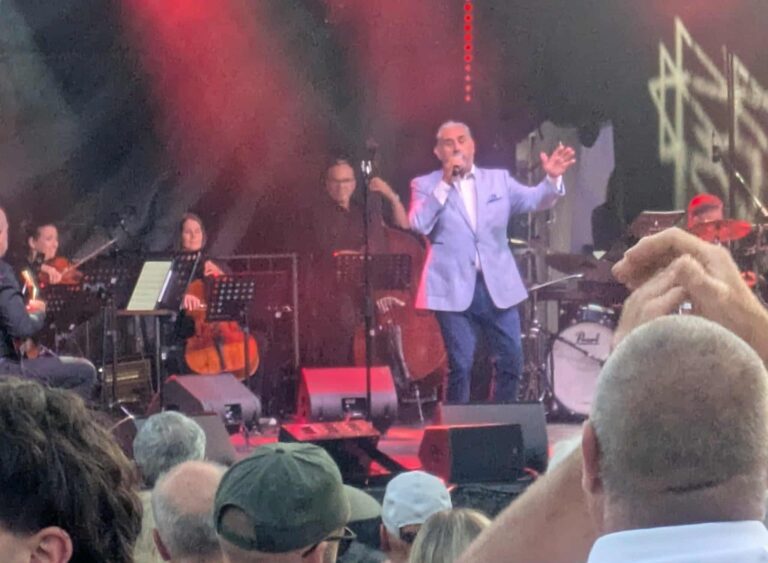
Angèle Dubeau often repeats: she listens to the public. You can also listen to her tell the anecdote about this Marc Hervieux concert, given on the Québécor stage, this Sunday evening in Tremblant. People had not had enough of the tenor last year, when he came to present the play A Voice to be Loved: Maria Callas, with Sophie Faucher. It is true that he sings very little in that production. And Angèle, always on site and ready to receive the spectators’ comments, clearly heard the many people who told her: “it was very beautiful, but we were hoping to hear Marc sing more often!”. That was last year. This year, Marc returned, with the mandate to satisfy the festival-goers. Satisfy as in “having a feast,” and a real feast it was! A copious buffet at a big Italian party, with Neapolitan songs (and Italian and Sicilian, to be precise) in abundance, sung by a master of ceremonies in formidable form. From the moment he stepped on stage, Hervieux galvanized the crowd, like a Sinatra in the good old days of Live at the Sands. And then the timeless titles followed one another, Volare, Torna a Surriento, Arrivederci Roma, Parla Piu Piano, Core’n’grato, etc., colorful and delivered with the mastery of a connoisseur. Hervieux is totally in his element here. For each piece, a presentation, simple and embellished with strokes of humor that hit the mark. An hour and a half like that, and the audience would have taken double, I think. You may know me: I like copious and complex music, even demanding and even experimental. As a result, you will probably think that it was a rather “light” set for my usual sonic palate. I would answer that no one, not even a strange music-loving insect like me, can turn up their nose at it and that, moreover, you would have to be monumentally bad-faith-ish not to recognize the absolute perfection of this kind of entertainment. When it’s done with so much sincerity, authenticity, and generosity, one can only bow before such flawless success.
période romantique

Fête de la Musique 2025 | Andrew Wan and Charles Richard-Hamelin: Brahms, Franck, and sunshine

by Frédéric Cardin

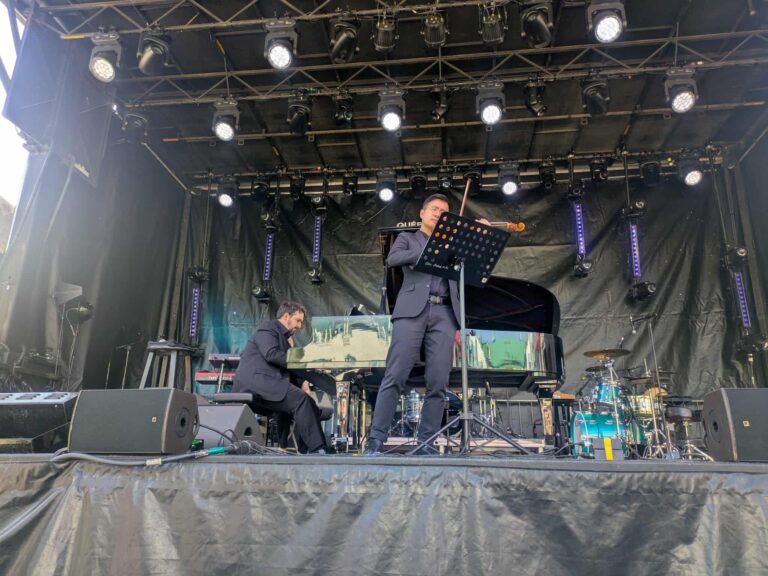
The duo consisting of pianist Charles Richard-Hamelin and violinist Andrew Wan (also concertmaster of the OSM) needs no introduction. A decade of artistic complicity has brought these two individual and natural talents together in a chamber music diptych of the highest order. The recordings of Beethoven and Schumann sonatas they have made are demonstrations of very high-level musicality. Wan, and perfectly supported by Richard-Hamelin, shows a very focused concentration on the discourse and narration of the works. The young man tells a story while playing, which is already good, but in addition he has something interesting to say. On the big Québécor stage in Tremblant, the Fête de la Musique gave us the first of Brahms’ sonatas, which the two musicians have been working on for some time now and which will be part of the duo’s next album, dedicated to the German composer. We have already heard the two friends in this repertoire, at the Classica Festival earlier this year. The impression had been good, and it was again this Sunday afternoon. The Sonata, in the smiling key of G major despite its very intimate character, was deployed without exaggerated effects, Wan focusing on the interiority of the discourse and on the poised pace of expressiveness. We could have taken a little more in terms of emotions, without the risk of making a fuss, but we were nevertheless very pleased in terms of instrumental beauty and esthetic satisfaction. As a concert supplement, not another Brahms, but rather the great Sonata in A major by César Franck. We too often tend to darken this work, because it is Franck, because despite the fact that he was Belgian, we associate him with Germanism and a lush and dense Romanticism. Yet, the major key implies light and open feeling, even a certain blossoming. Wan and Richard-Hamelin understood this necessity well, despite a restraint that took a bit long to dissipate in the first movement. But the audience was rewarded with a final Allegretto poco mosso full of candor and naturalness, a perfect accompaniment to a generously sunny early afternoon at the foot of Tremblant Mountain.

Chanson francophone / chanson keb franco

Fête de la Musique 2025 | Coeur de pirate Offers a Few Previews in Tremblant

by Frédéric Cardin

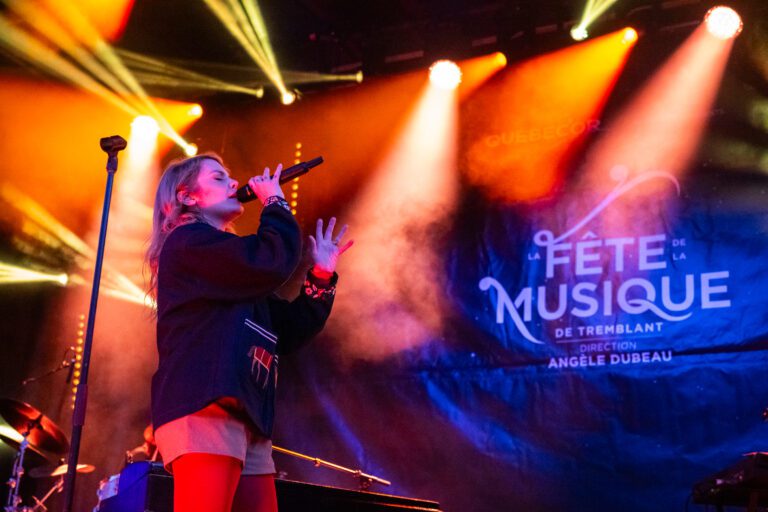
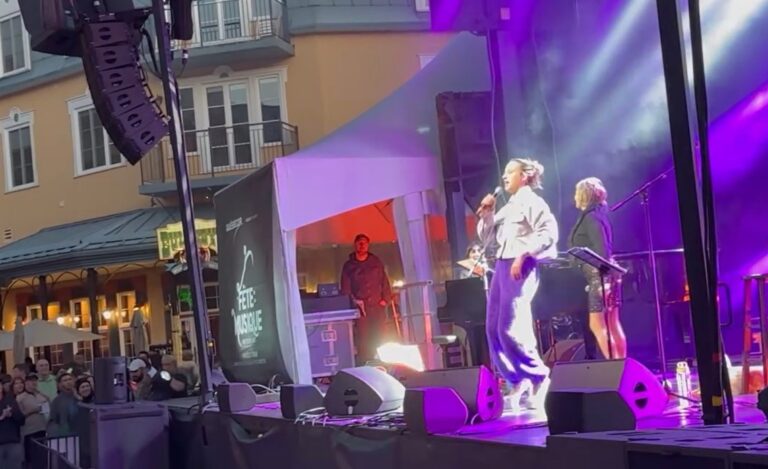
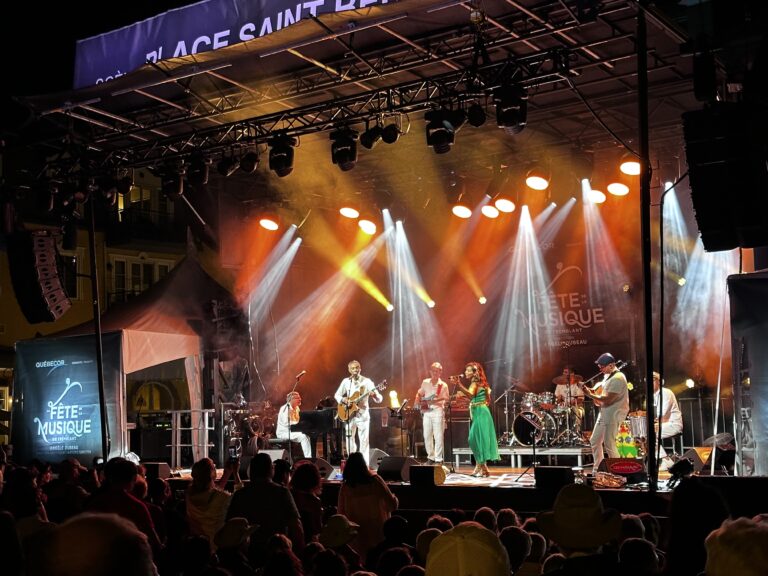
In a basic, almost spartan format (drums, bass, vocals, and a little piano, of course) but extremely effective, Béatrice Martin, alias Coeur de Pirate, performed for the first time at the Fête de la Musique. Apparently, Angèle Dubeau had been working on getting her to come for quite some time. It finally happened for this 25th edition and, judging by the reaction of the audience, it was a huge success. Of course, there were the songs that everyone was waiting for and singing along to even before the artist arrived: C’était salement romantique, Place de la République, and Somnambule, performed in their classic form, with solo piano and vocals, right in the middle of the program. Like a gentle, melancholic pause. But there were also more upbeat hits such as Golden Baby, Prémonition, Oublie moi, and Crier tout bas.

And then, through a fairly fast-paced set, performed at full speed but without giving the impression of being rushed, the Pirate with a lyrical heart offered up a few new songs that those present at the foot of Tremblant Mountain had the privilege of hearing live for the first time: the recent Cavale, which served as a perfect and exciting appetizer at the very beginning of the show, the dramatic and powerful Les enfants des temps derniers, and the ballad Château de sable, written for her daughter Romy. If what we heard in these songs is any indication of what the next album, due out in a month, will be like, it is sure to be a popular success, as it is on par with the singer’s best productions, with melodies that stick in your memory.

Publicité panam
Musiques du Monde

Fête de la Musique 2025 | The musical Esperanto of the Kuné ensemble

by Frédéric Cardin

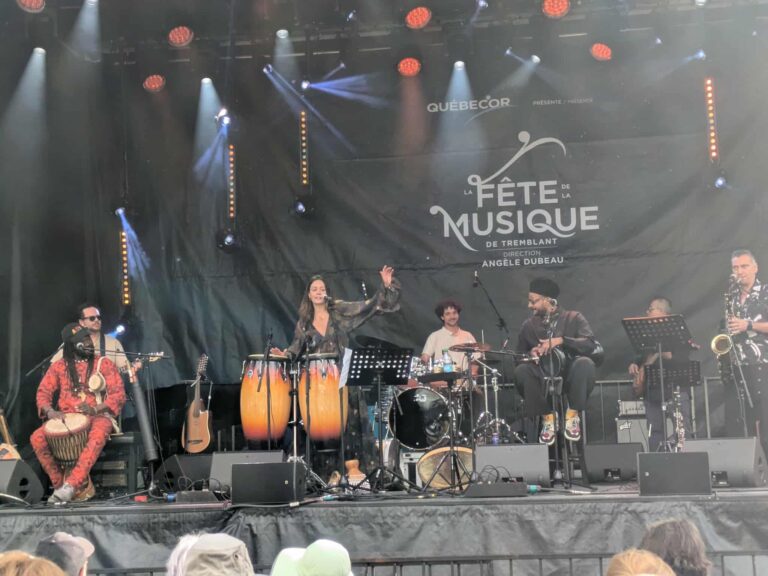
The Toronto-based collective Kuné (which means “together” in Esperanto) brings together a fairly broad ecumenical group of influences and musical traditions in the same assemblage. West Africa, Greece, Iraq, Brazil, Turkey, Peru, Mexico, etc. are all represented by the musicians who form its beating heart. The mayonnaise is deliciously taken, obviously, because the pieces follow one another with a speed that leaves no spectator hungry. Catchy rhythms, which draw as much from the traditions of Brazil and West Asia as from Mandingo Africa, traditional Europe and the Latin world; simple but catchy melodies, seductive voices, perfectly interwoven intercultural arrangements and instrumentations, in short, Kuné is a kind of small global orchestra emblematic of contemporary Canada. One wonders why these artists have not come to Quebec before (unless I am mistaken). In any case, we should look into it, because they know how to raise the energy level on a stage.

Classical

Fête de la Musique 2025 | The feathers of Luc Beauséjour and the character of Julie Boulianne

by Frédéric Cardin

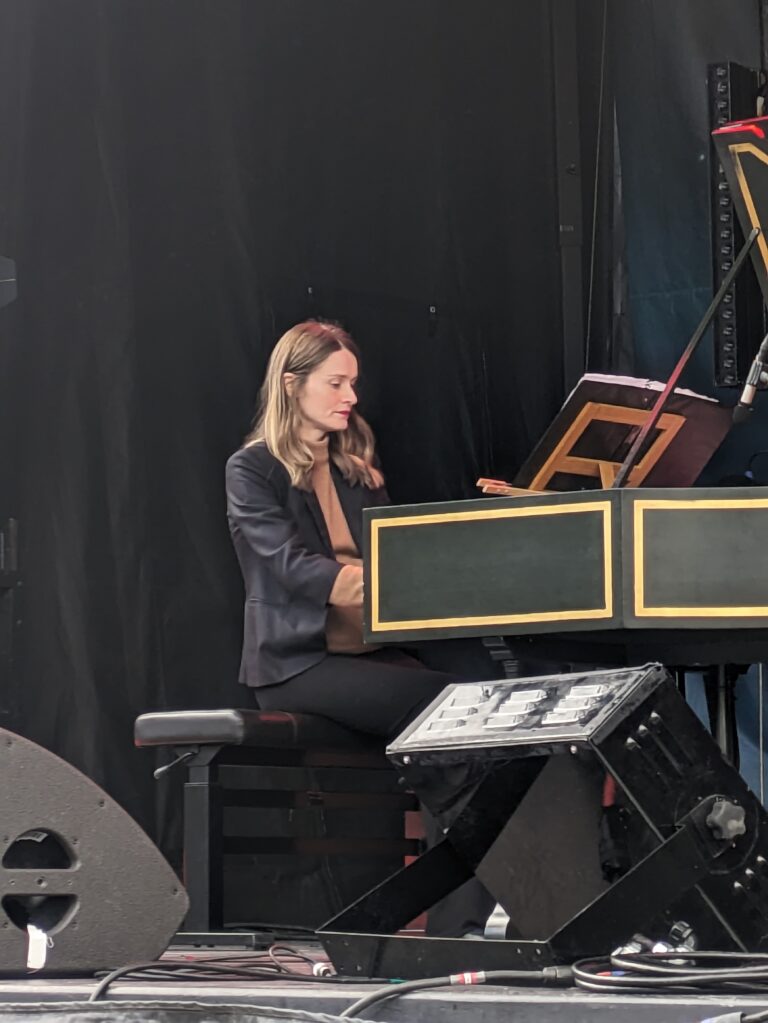
Not easy for classical artists to perform at the Tremblant Music Festival. The temperature has its moods, and it doesn’t care if it suits the performers and their instruments. It was chilly on this Saturday afternoon at the foot of the mountain, which can’t be ideal for a singer. Plus, it rained, it was sunny, and it rained again. But well, Julie knows how to do it and has performed with character the different arias on the program presented on the big Québécor stage. A lot of Mozart (The Marriage of Figaro, Don Giovanni...) and French Melodies (Hahn, Pauline Viardot…), a repertoire that she naturally inhabits and that the Quebec mezzo beautifully sketched, with a touch of facial expression, enough to follow the characters’ states of mind. Luc Beauséjour assisted with all the necessary elegance on piano. At the end of the recital, which was still attended by quite a few people despite the uncertain weather, Angèle Dubeau gave the pianist a bag full of bird feathers. He revealed to us that he uses them to make plectrums for his harpsichord (which is used to pluck the strings of the instrument), a material that was used in the past. Just to see the reaction of the audience who “discovered” a manufacturing secret hidden behind the music, the Fête de la Musique was worth organizing.

Classical

Fête de la musique de Tremblant 2024 | The Stars of the Conservatoire shine in the cold

by Frédéric Cardin

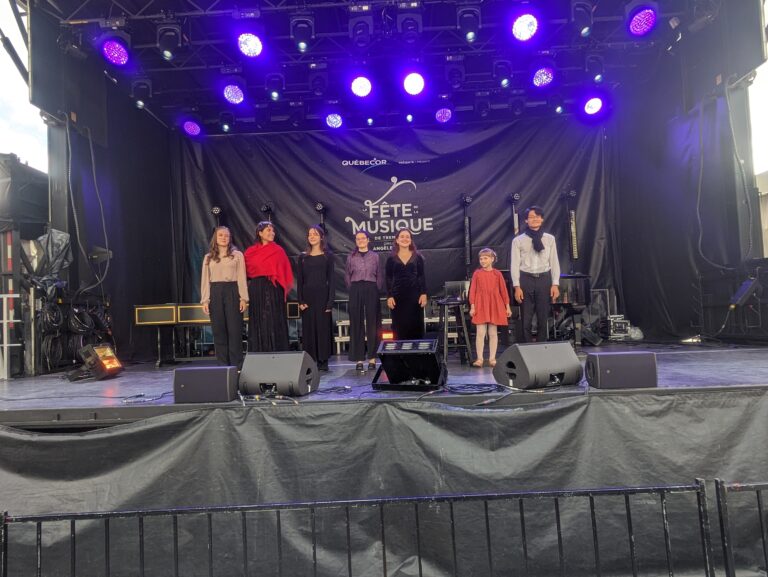
The artistic director (and founder) of the Fête de la Musique de Tremblant, Angèle Dubeau, is true to her values: she strongly supports the practice of music by young people. Angèle Dubeau, who hosted the Radio-Canada programme Faites vos gammes (Practice your exercises) from 1994 to 1998, once again gave a few students from the Conservatoire de Montréal an hour and a half of exposure on the event’s main stage (the Quebecor stage). In front of a large and admiring audience, we heard Chloé Dumoulin (solo piano and accompanist to the other instrumentalists), Iza Kamnitzer (violin), Kaïla Stephanos (flute), Juliette Bégin (trumpet), Natasha Henry (soprano), Flavie Lacoste (oboe) and Zhan Hong Xiao (solo piano) perform in succession in the cold of Tremblant (12 degrees). A few spontaneous favourites: the youngest of the group, violinist Iza Kamnitzer, who at 9 years old (and barely more than three apples) played some solid flights of Kreisler and some fine subtleties by Dvorak; soprano Natasha Henry, who seemed to me to be the most polished of the group in terms of finish and technical clarity (very fine French diction in an aria from Massenet’s Manon! ) and Zhan Hong Xiao, a pupil of Richard Raymond who is preparing to take part in the Chopin Competition in 2025. He certainly has the talent and maturity to perhaps come back with a prize, as Charles Richard-Hamelin did in 2015.

Baroque

Fête de la musique de Tremblant 2024 | Mélisande McNabney and the women of Versailles

by Frédéric Cardin

The last day of the Fête de la Musique de Tremblant (in fact, half a day), Monday 2 September 2024 saw the festival’s Quebecor stage give pride of place to one of the most delicate instruments there is: the harpsichord. A delicacy put to the test by the weather: it was chilly! A mere 8 degrees in the morning, and barely 12 by midday, by the time of the concert. In the end, the instrument held up very well. Perhaps that’s because the harpsichordist, Mélisande McNabney, knows it so well and can reassure it with her precise touch. Mélisande gave a top-class performance, despite the circumstances (you can guess that frozen fingers have to move more slowly), accentuated by beautiful introductions that told us some of the stories of women musicians at the Court of Versailles. An hour of serious but extremely enjoyable harpsichord playing (Mélisande’s smiling animation was a great help), which has certainly done much to democratise this instrument among a large audience. So hats off to the organisers of the Fête de la Musique, who dared to ignore prejudices (difficult instrument to approach, arid repertoire, etc.) by offering a public platform to this often ill-considered member of the keyboard family.

Bossa Nova / Classical / Jazz / Opera / Pop

Fête de la musique de Tremblant 2024 | Music from mother to daughter

by Frédéric Cardin

The second and final major show of the Fête de la Musique de Tremblant 2024 featured the artistic sisterhood of Natalie Choquette (mother), Florence K and Éléonore Lagacé (daughters). This infrequent meeting (at least in public) gave rise to some unexpected and sometimes even surprising stylistic crossovers. I had never heard of Éléonore Lagacé’s mezzo lyricism. She demonstrated a very appropriate operatic sense in Carmen and in the duet of the flowers in Lakmé, with Maman. Sometimes solo, sometimes in duet or trio, we moved from jazz to Latin, pop and then classical before returning to one or the other in collisions that emphasised the complicity between the ladies, rather than the technical perfection that occasionally escaped. The large audience took no offence, for it was rather the relationship between the three artists that they had come to savour. In this sense, and with a good dose of hamming it up, mother and daughter lived up to expectations with some touching moments.

Caribbean / Funk / Hip Hop / Reggae / Twoubadou

Fête de la musique de Tremblant 2024 | Waahli, Music and Stage master

by Frédéric Cardin

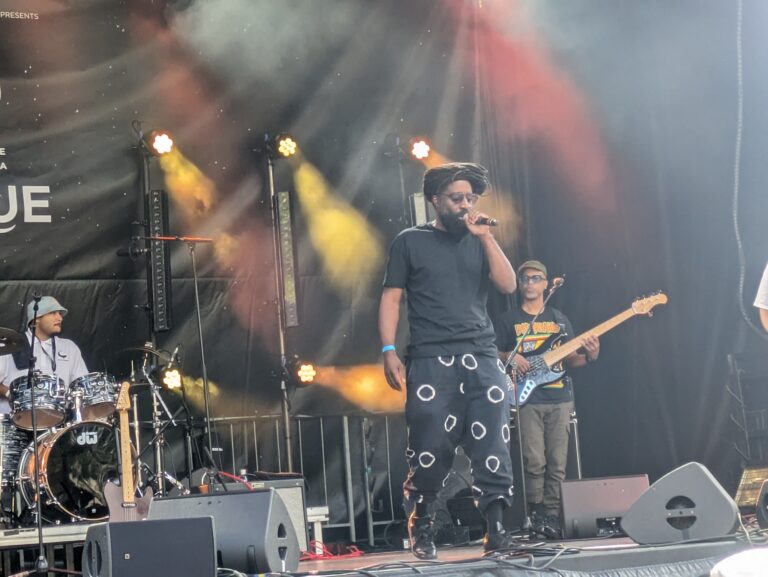
Although Waahli’s show on the main stage of La Fête de la Musique de Tremblant was billed as Hip Hop, Waahli’s true musical essence is Haitian groove-soul tinged with Hip Hop (among other things). Such is the nature of the rich, wide-ranging palette of sounds produced by this Montrealer of Haitian origin. In this fiery but smiling groove, we find Funk, Reggae, Konpa and, yes, Hip Hop, with an extra dash of classic Twoubadou and bits of Jazz. To this stylistic richness, Waahli adds a dose of stage presence that imposes with respect and authenticity, as well as an attitude well away from the clichés of violent, macho Hip Hop. Waahli appeals to everyone, and Tremblant’s ‘hilltop’ square was well inhabited  with youngsters dancing to the hard beats and grey-heads swinging their arms at the singer’s cues. Tremblant was the last stop on a Quebec tour, so the current version of Sundance, Men sou yo, Mal du pays, Teke fren and many others were played for the last time. Angèle Dubeau repeats that this is a festival for ‘all kinds of music’. The proof is in the programming.

Choral Music

Fête de la musique de Tremblant 2024 | Hispanic and flamenco all round with Les Rugissants

by Frédéric Cardin

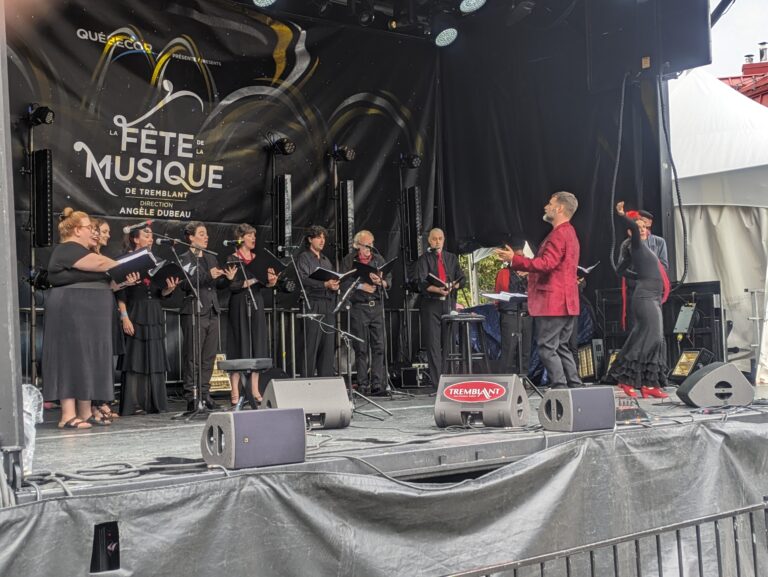
The vocal ensemble Les Rugissants, directed by Xavier Brossard-Ménard, put on a fine hour of rich choral singing this Saturday afternoon at Tremblant 2024’s Fête de la Musique. A dozen top-class singers, accompanied by a guitarist and a flamenco dancer, all led by Brossard-Ménard’s energetic, communicative direction, transported the audience in Tremblant’s main square into a Hispanic vocal universe far removed from facile clichés. Whether using Spanish or foreign composers, but inhabited by the magic of this country, the artists did not hesitate to offer works of a level of ‘seriousness’ and harmonic demands somewhat more advanced than in the other classical shows on the bill. This approach is to be applauded. That said, you’d have to be in very bad faith to balk. The programme put together by Brossard-Ménard was well chosen in terms of its expression of colours easily identifiable with the Iberian peninsula, despite some tonally modern passages. It was a performance of the highest quality, underpinned by a refinement that testifies to fine artistic integrity.

Bossa Nova / Brazilian / Samba

Fête de la musique de Tremblant 2024 | The warmth and elegance of the great Paulo Ramos

by Frédéric Cardin

Paulo Ramos is synonymous with elegance, class, quiet strength, warm gentleness… and impeccable Brazilian music, of course. The artistic director of the Fête de la Musique de Tremblant, Angèle Dubeau, gave the veteran guitarist and singer the task of bringing the warmth and sunshine of his native country to the first of the two major shows in the 2024 edition. Mission accomplished. It must be said that it wasn’t difficult for this godfather of Brazilian music made in Quebec. The man has a lot of experience, and a lot of friends. After launching out on his own, but accompanied by his faithful quintet made up of Sacha Daoud, Daniel Bellegarde, Dan Gigon, John Sadowy and Rodrigo Simoes, Paulo invited a number of regulars to his concerts, including the excellent Bia. She offered up a few songs, including a beautifully modified and ‘pimped’ Chega de Saudade, as well as daring a few capoeira steps! The Quebec-Brazilian beauty is still in fine form! Guitarist and singer Rommel Ribeiro, Winnipeg-born singer Annick Brémaud and two dancers added the right layer of style to make this Brazilian evening an undeniable public success.

Baroque

Fête de la musique de Tremblant 2024 | Ensemble Caprice: fun and festive

by Frédéric Cardin

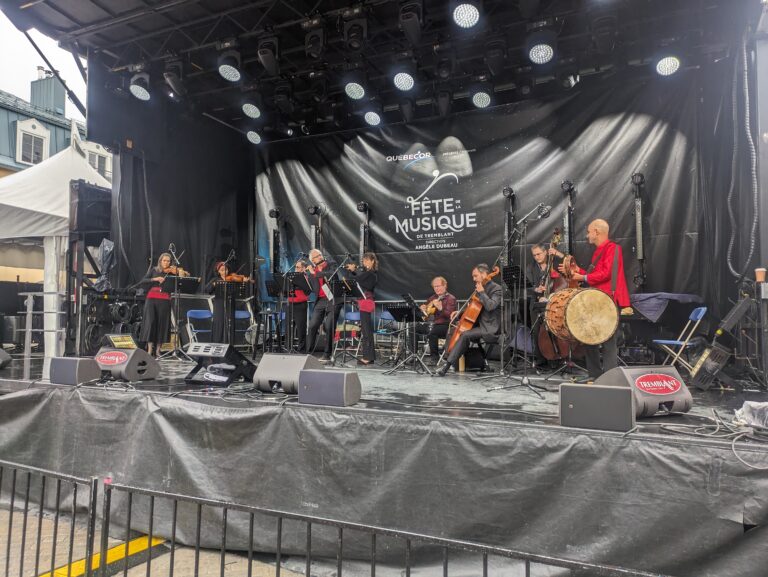
The morning drizzle had just ended when Ensemble Caprice began playing on the Québecor stage at the Fête de la Musique de Tremblant. The sun wasn’t out, far from it, but it was already more pleasant, especially as the Montreal ensemble had brought some light with them. Twice, in fact. First there was the presence of director Mathias Maute, who provided some amusing entertainment. I knew Maute was a nice guy, but I didn’t remember him being so funny with the audience. Perhaps I hadn’t been paying close enough attention… The conductor’s comments had the particular advantage of supporting a sparkling programme devoted to Vivaldi and the ‘nomads’ of Baroque Europe. Vivaldian concertos that were as twirling as one could wish sat happily alongside anonymous works by little-known composers with a strong folkloric flavour from various corners of the continent, particularly from Eastern Europe. I’d like to highlight the sound quality provided by the festival’s sound technicians. Classical music suffers from outdoor performance and amplification is often not up to scratch. What I heard yesterday was of a quality you’d have heard from the Montreal Symphony or the Orchestre Métropolitain with Yannick Nézet-Séguin, for example. Very good point for the organisation.

Subscribe to our newsletter

Inscription
Infolettre

"*" indicates required fields

Type of Suscribers