Baroque / Indian Classical

Caprice at the 9th Floor: a pleasant meeting between Baroque and Carnatic music

by Frédéric Cardin

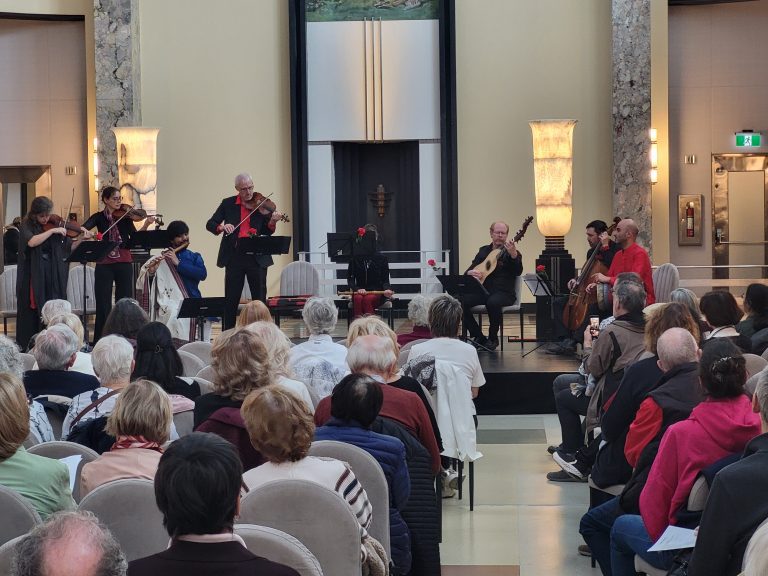
The Caprice ensemble offered an unusual meeting between Carnatic music (from South India, represented by the excellent flautist J.A. Jayant) and Baroque (European) during a rather pleasant concert on the 9th floor of the Eaton Centre in Montreal. If the concerts are usually scheduled at 5 p.m., it was at noon that it was held, exceptionally. I don’t know if it was the time itself, but the attendance result was positive, for a proposal that was quite niche after all. Successful initiative, therefore, in terms of attendance, and, I am happy to say, also in purely artistic terms. It was not a total fusion between the two aesthetics, far from it. Let’s rather call it a meeting and a dialogue, in which each protagonist often expressed themselves in their own musical language.

It is the transitions between the pieces, Indian and Baroque, as well as the judicious choice of the program, that managed to create a beautiful impression of symbiosis for the entirety of the hour and a few of the concert.

The concert was launched with an improvisation on the bansuri flute, carried by the subtle arabesques of Jayant, a flautist renowned for his timbral quality and technical ease. An exoticism (from a Western point of view), which led to a striking contrast, when the Caprice ensemble began a kind of variation in prelude to the launch of the hit of baroque hits: the famous Pachelbel’s Canon. Fortunately, there was no routine in Caprice’s performance. A colourful reading of ornamental details and a lively rhythmic dynamic made it quite refreshing. Jayant returned with a classical Indian piece (Jagadodharana by Purandara Dasa, a composer who worked during the European Renaissance), supported by the traditional drone associated with this music, but here provided by the Montreal orchestra. Caprice continued with Bach’s Air on the G String, and the rest of the hour unfolded somewhat like that, but with transitions between the two traditions making quite a bit of sense all the time, whether on a rhythmic, harmonic, or simply atmospheric level.

I also highlight the very beautiful contribution of the bass William Kraushaar, who gave us some very beautiful moments of vocal grace in Purcell (Wondrous Machine and The Cold Song), Handel (O ruddier than the cherry), and especially Monteverdi (Si dolce è’l tormento), one of the most beautiful song melodies, across all styles and eras. His deep timbre, with a dark and captivating purple hue, gave me some chills. Only in The Cold Song did I perceive moments where the artist omitted certain repetitions (symbolising the shivering cold) or phrase endings. It is indeed a piece that is difficult to sustain mechanically. But it’s really not much to complain about, in the end. In any case, he recovered very well in the next piece, and finale, signed by Handel. A whirlwind piece of intense love, executed with precise and captivating technique for the listening ears.

The director of Caprice, Matthias Maute, said that this concert served as a territory to explore and build a music of the future, where the world’s traditions would speak to each other on equal terms, while inspiring stimulating innovations.

READ THE INTERVIEW I CONDUCTED WITH HIM ABOUT THIS CONCERT

In this sense, the essay proposed by Caprice and his guest is quite successful, and makes one want to have more in the future.
Baroque / East African traditional music

Concert at the 9th Floor : the African essence of the chaconne

by Frédéric Cardin

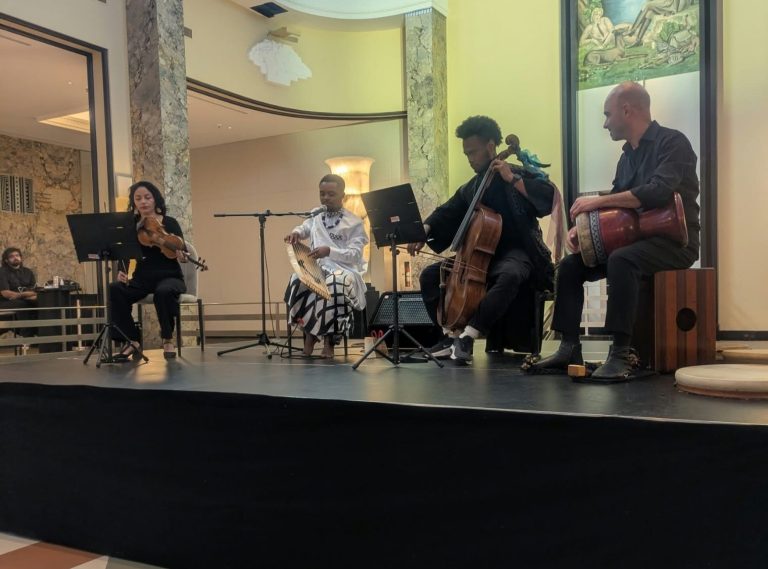
Yesterday was the first concert in the VoixMonde series, led by percussionist Ziya Tabassian. A series that will take us later this season to China, Latin America and the Jewish world of klezmer (with the Montrealer Socalled). Yesterday at 5 PM in the Art Deco panorama on the 9th floor of the Eaton Centre in Montreal, it was the African essence of Rwanda taking the stage, with singer and musician Deo Munyakazi, performer of the inanga, a traditional instrument at the heart of the traditions of this small country in the Great Lakes region of Africa.

The uniqueness of the VoixMonde series, and also its mission, is to enable a dialogue between non-European scholarly traditions and Western classical music. Thus, for the needs of this dialogue, violinist Karin Cuellar and baroque cellist Kyran Assing joined Munyakazi, as well as Ziya Tabassian himself on percussion.

In a one-hour program, we heard beautifully unfolded melodies by Munyakazi’s assured voice, which is elegantly accompanied by his plucked-string instrument, whose body somewhat resembles a concave surfboard. The sound that rises from this instrument is very soft, very velvety, but sometimes has to fight a losing battle against the greater power of his Western companions, despite the amplification. In the last piece, Ngwino urare, Munyakazi came out of his general reserve, standing up and urging the audience to sing along with him. This reserve was perhaps imposed by the venue itself, as I have seen and heard this musician elsewhere, and he knows how to get the audience up with considerable energy.

The intersection between Rwandan tradition and classical music was made through two chaconnes by relatively obscure composers of the European Baroque: Antonio Bertali (1605-1669) and Nicola Matteis (1650-1713). The reason for this historically plausible dialogue lies in the origins of this form, initially danced in the Spanish colonies. These were already a space of syncretism between Spanish, indigenous, and especially African cultures, stemming from the slave trade. Obviously, all of this was largely distilled into the final European result, but the nod served as sufficient justification to allow Deo Munyakazi (and Ziya Tabassian on percussion) to integrate into the musical play of the two baroque specialists (Cuellar and Assing). I would have liked Munyakazi’s inanga to play a bigger role, though. He was very discreet (and only present in Matteis’ chaconne). A polite crossover, then, but nevertheless some beautiful musical moments, especially with regard to the violinist Karin Cuellar, a very good interpreter of early music. In the continuo, Assing, who is equally good, did not have much space to shine. But that is the nature of much of the music from that era for the cello.

Finally, we were treated to a pleasant and respectful meeting, a chic interculturalism that was sometimes touching, and high-quality melodies (like the one in the video above). A program perfectly calibrated for the imposing aura of the 9th floor. 

période romantique

Brahms and Beethoven in 9th Heaven

by Frédéric Cardin

Two trios with clarinet were offered on the 9th floor of the Montreal Eaton Centre yesterday, at afterhours time. The very beautiful series of HausMusique concerts, organised by cellist Cameron Crozman and pianist Meagan Milatz, in the rich Art Deco environment of the 9th floor of the Eaton Centre, has been unfolding for almost two years now. The concerts last an hour and the programs are always inviting, supported by quality performers.

Yesterday, the hall was almost capacity-filled for the performance of a youthful clarinet trio by Beethoven and another, a masterpiece of maturity, by Brahms. Crozman and Milatz were joined by the Canadian clarinettist James Campbell, a world-renowned figure and a sensitive and seasoned performer.

We were charmed by the well-articulated sparkle of Beethoven, still imbued with Haydnian classicism, but revealing through almost spontaneous episodes expressive tendencies that herald the composer’s more dramatic maturity. A lot of liveliness from the three performers, with a very good sense of dynamics and expressive contrasts. We thoroughly enjoyed Meagan Milatz’s crystalline technique on the piano, even though in one or two cascades of notes, the artist may have pushed the urgency of the tempo a bit, to the detriment of the expected clarity. Nevertheless, the intensity of the collective performance, sprinkled with touches of humour inherent to the composer’s intent, offered beautiful moments of musical pleasure.

LISTEN TO THE INTERVIEW WITH CAMERON CROZMAN ABOUT THESE TRIOS AND THE HAUSMUSIQUE SERIES

Next came the ‘’pièce-de-résitance’’, the Clarinet Trio Op. 114, the first milestone in the so-called “Autumnal Brahms” period, the time of the last masterpieces initiated by his meeting with the clarinettist Richard Mühlfeld. Here, no effervescent bubbling. We are completely elsewhere. The long languorous lines, imbued with seasonal melancholy, certainly, but also with a soft and tender light, make us think, as James Campbell comments, of a chilly November that we protect ourselves from by drawing the curtains and snuggling by the fire with a comforting drink.

Very beautiful dialogues between the cello and the clarinet, Crozman and Campbell engaging in generous exchanges while respecting the spirit of the music. A great natural rapport is evident between these performers.

An inspiring moment of music, in the magic of a unique and enchanting place.

The next concert in the HausMusique series, and the last of the 25-26 season, will take place on June 2nd. On the program: Ravel and Debussy. Crozman and Milatz will be joined this time by the OSM’s solo violinist, Andrew Wan.

DETAILS AND TICKETS

We will talk to you again about HausMusique during the unveiling of the 26-27 season program. Stay tuned.

Subscribe to our newsletter

Inscription
Infolettre

"*" indicates required fields

Type of Suscribers