atelier / Chaâbi

Festival du monde Arabe : Atelier d’initiation au chant chaâbi marocain au Centre des musiciens du monde

by Rédaction PAN M 360

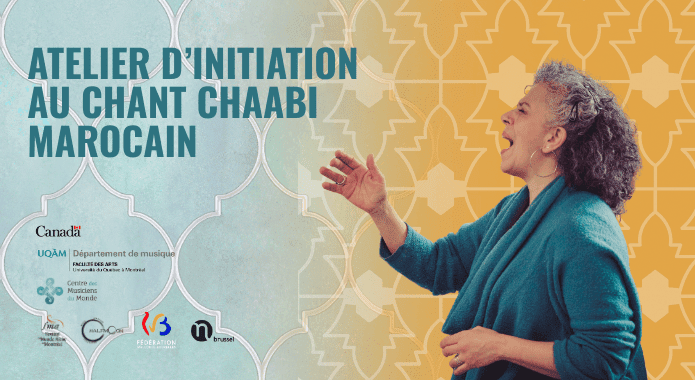
Envie de chanter, de voyager, de découvrir une musique populaire vibrante et festive ? Cet atelier est fait pour vous !
Depuis plusieurs années, la chanteuse Laïla Amezian propose des ateliers ouverts à tous, sans prérequis, pour s’initier au chant chaabi marocain. Le chaâbi, c’est la voix du peuple : une musique transmise de générations en générations, ancrée dans le quotidien, rythmée, chaleureuse, porteuse de joie mais aussi de récits profonds et parfois engagés.
L’atelier ne se limite pas à une simple pratique vocale, c’est une véritable plongée sensorielle dans l’univers musical du chaabi à travers la voix et le rythme. Vous serez en effet invités à ressentir la musique de l’intérieur, à découvrir des textes aux accents poétiques, et les histoires qu’ils racontent, les émotions qu’ils transmettent.
Ce moment collectif est aussi une occasion de s’immerger dans une culture vivante, d’en comprendre les codes, les symboles, et la richesse souvent méconnue. Une attention particulière est portée à la diversité des styles chaabi de la partie nord du pays, et au rôle essentiel des femmes dans cette tradition musicale.
Aucune expérience musicale n’est requise : seulement l’envie de découvrir, de partager et de laisser sa voix résonner avec celle du groupe. À la fin de l’atelier, vous repartirez avec en tête quelques extraits de chansons et leurs traductions en français, ainsi qu’avec des repères rythmiques simples et des éléments pour prolonger l’expérience chez vous ou avec d’autres.
Un atelier chaleureux et accessible, à vivre comme un moment de plaisir, d’échange et d’ouverture.

Want to sing, travel, and discover a vibrant, festive popular music? This workshop is for you!
For several years, singer Laïla Amezian has been offering open workshops, with no prerequisites, to introduce participants to Moroccan chaabi singing. Chaâbi is the people’s voice: a music passed down through generations, rooted in daily life, rhythmic, warm, joyful, yet also carrying profound and sometimes engaged stories.
This workshop goes far beyond simple vocal practice: it’s a true sensory immersion into the musical universe of chaabi through voice and rhythm. You’ll be invited to feel the music from within, to explore texts rich with poetry, the stories they tell, and the emotions they convey.
It’s also a collective experience, an opportunity to dive into a living culture, to understand its codes, its symbols, and its often-overlooked richness. Special attention will be given to the diversity of chaabi styles from the northern regions of Morocco and to the essential role women play in this musical tradition.
No prior musical experience is required, only the desire to discover, to share, and to let your voice resonate with the group. By the end of the workshop, you’ll take away fragments of songs and their French translations, along with simple rhythmic patterns and tools to continue the experience on your own or with others.
A warm and welcoming workshop, to be lived as a moment of pleasure, exchange, and openness.

POUR ACHETER VOTRE BILLET, C’EST ICI!

Ce contenu provient du Festival du monde Arabe et est adapté par PAN M 360
classique / Jewish Traditional / Singer-Songwriter

The Yiddish soul of Montreal at Centre des musiciens du monde

by Frédéric Cardin

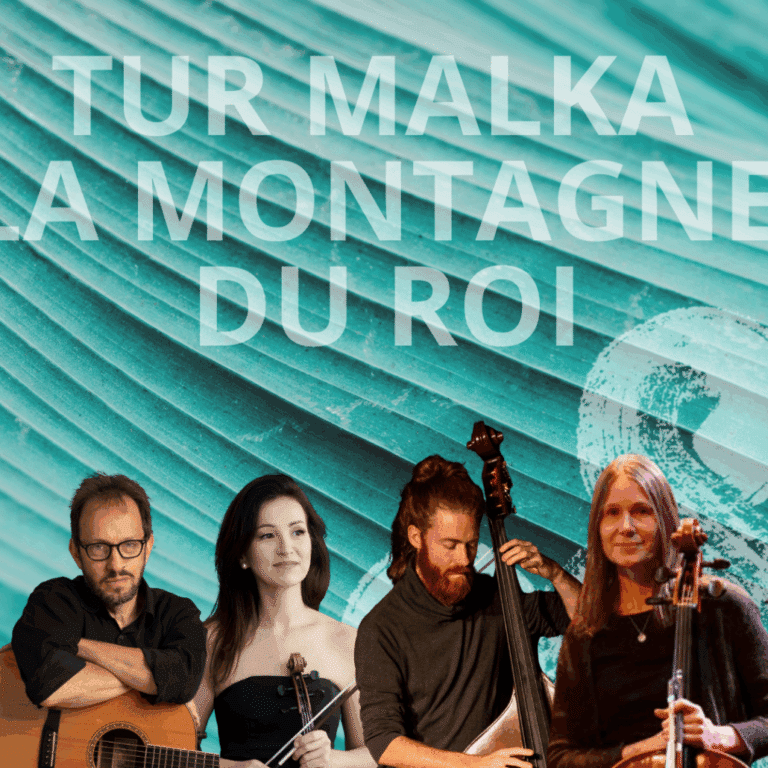
The Centre des musiciens du monde launched its new season of Intimate Concerts last night. An extended season, with more concerts and discoveries in store. If last night’s concert is any indication, it will be a rich year. Melodically, some of the most beautiful songs I’ve heard in years were performed at the Tur Malka (King’s Mountain) – New Yiddish Songs from Canada concert. Several of them were brand new, never performed on stage before. If there are indeed a few details to fine-tune and a stage performance to coordinate, the touching beauty of the material offered by the ensemble is a guarantee of assured success in the hearts of those who will listen to them.

The quartet is made up of Henri Oppenheim on piano, guitar, percussion, compositions and arrangements, Mael Oudin on double bass and arrangements, Elvira Misbakhova on viola and Sheila Hannigan on cello. Oppenheim is the originator of the project, a Frenchman of Jewish origin who has lived in Montreal for almost 30 years. The songs in Yiddish, the language of the Jews of Eastern Europe, draw on the ultra-poignant, even emotionally powerful, melodic style of the Eastern European tradition, which was heavily decimated by Nazi Germany, but fortunately still alive in Montreal, one of the world’s main bastions of this culture. Oppenheim draws his texts from Yiddish poetry, including that of several Montreal artists such as Chava Rosenfarb or Jacob-Isaac Segal.

The arrangements, full of tenderness and melancholy, are carried out with great care by the outstanding performers Sheila Hannigan, a regular in all kinds of music, and Elvira Misbakhova, an excellent violist with the Metropolitan Orchestra, in addition to having played very often in klezmer ensembles in the metropolis. Mael Oudin on the double bass is more discreet, but his presence is nonetheless essential. Oppenheim leads the transitions in a sober manner, and with a discreet touch of humour.

Ultimately, it was an extremely touching moment of human communion, steeped in the cultural richness of Jewish Montreal, without which the soul of the metropolis would not be what it is today.

DETAILS AND TICKETS FOR THE INTIMATE CONCERTS SERIES

Next concerts of the series:

  • December 17, 2025 – Didem Basar, kanun – Under the Moon of Topkapi
  • January 23, 2026 – Ori Shalva, choir – Echoes of Sakartvelo, Georgian polyphonies
  • February 11, 2026 – Guillaume Martineau, piano and Gabriel Paquin-Buki, clarinet – A Night in the Garden of Eden
  • March 18, 2026 – Sadaf Amiri, santour – The sparkle of inner strings
  • April 15, 2026 – Persian-Inca Duo – Federico Tarazona (charango) and Showan Tavakol (kamancheh) – The Valley of Dreams

Balkan music / Choral Music

Enchanting choral Croatia at the Centre des musiciens du monde

by Frédéric Cardin

I’ve been a regular at the Centre des musiciens du monde’s (CMM) Intimate Concerts series since the very first one last January. They’ve all been excellent, each time featuring top-quality artists who’ve settled in Montreal for its cultural vitality and, in the process, enriched it in an exceptional way, thanks to the traditional and refined sounds from Rwanda, Syria, Mongolia, Iran, Peru and so on. While I’m fairly familiar with all the artists featured (and to be featured) in the series so far, one exception was on stage last night: the vocal ensemble Sava, whose existence I didn’t even know about until quite recently. I was so taken with them that I had to tell you about it.

Sava is an all-female vocal quartet devoted to traditional Balkan polyphonic songs. For this concert, Sava covered some of the repertoire specifically from Croatia, with secular and religious songs. This performance, behind the altar of the Church of Saint-Enfant Jésus (in a very intimate setting), totally bowled me over. This was due not only to the surprise effect, but also to the exceptional vocal quality of the four performers, Antonia Branković, Dina Cindrić, Sara Rousseau and Sarah Albu (the latter also one of the most exciting recent voices in contemporary and avant-garde music in the city). In the perfect acoustics of the venue, the seductive rubbing of thirds, fourths and fifths of the four voices produced a soothing vibratory effect on the audience gathered, and on your humble reviewer, who was transported back in time and space, to an ancient and perfectly authentic Dalmatia.

I don’t know how often the ladies perform in concert, but they’d better go at it! And if you’re ever interested, you should know that the ensemble is a product of all kinds of music courses available at the CMM!

MUSIC SCHOOL OF THE CENTRE DES MUSICIENS DU MONDE

classique persan

Centre des musiciens du monde: Persian delight with Kayhan Kalhor

by Frédéric Cardin

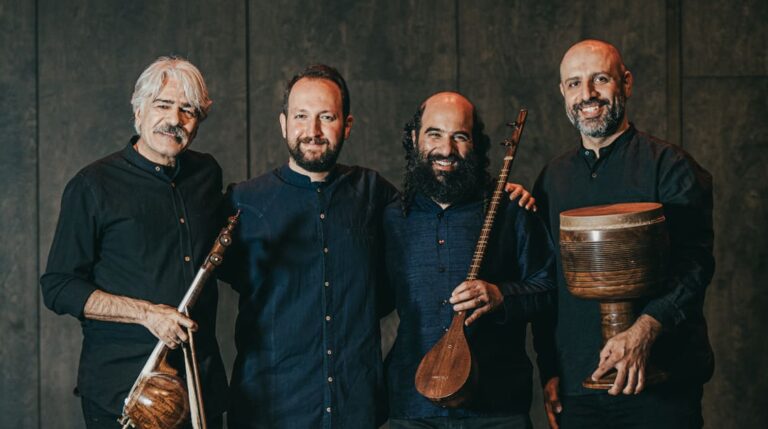
Last night at the Centre des musiciens du monde in Montreal, we heard almost 90 uninterrupted minutes of sublime music performed by one of the world’s greatest musicians, Kayhan Kalhor, master of the kamancheh. I’m not just talking about his status in Persian classical music, for which he is certainly THE musician of his time, and perhaps of all times, but about his genius as a musical artist in all genres. Kalhor is a virtuoso and performer in a class of his own.

Yesterday, he was on stage to give the final concert of an extensive tour for the Chants d’espoir (Songs of Hope) programme. He was joined by Montrealers Kiya Tabassian on setar and Hamin Honari on tombak, as well as his compatriot Hadi Hosseini on vocals. 

Paris concert (without Hadi Hosseini) : 

An artistic tour de force in which instrumental improvisation sits naturally alongside classical Persian poetry (that of Saadi, who lived in the 13th century) rendered with brio by Hosseini, one of the most assertive and accomplished voices in classical Persian singing today. Long, skilfully ornamented melodies intermingled with the comments of the instrumentalists, linking contemplative, introspective episodes with others that were more energetic and lively. The tunes, which flowed into one another without pause, were partly drawn from the scholarly repertoire, but mostly from the spontaneity of the musicians on stage, all of whom are remarkable improvisers. It was a sold-out concert, attended in large part by members of the Iranian community, but not exclusively. A very attentive and respectful audience, from which I didn’t hear a single unexpected phone ring! Symphony audiences should learn a few lessons from this…

Concert on December 16 in Montreal : 

Montreal can be proud of this kind of event, because it’s partly thanks to this city that it exists. Kiya Tabassian, of the Constantinople ensemble, is a former student of Kalhor, who himself lived close to the metropolis for a time (he has a Canadian passport as well as an Iranian one), and Hamin Honari moved from Vancouver here to Montreal to take advantage of the artistic opportunities offered here. And in the midst of it all, the Centre des musiciens du monde, which continues to impress with the quality of its projects and the growing influence it exerts on the non-Western scholarly music scene, is actively helping to build Montreal’s reputation as one of the best cities for world music in the West, perhaps the best in America. 

FROM JANUARY AT THE CENTRE DES MUSICIENS DU MONDE: A NEW SERIES OF INTIMATE CONCERTS, ONE WEDNESDAY A MONTH. DETAILS TO COME ON THE ORGANISATION’S WEBSITE

Subscribe to our newsletter