Baroque / Opera

Festival de Lanaudière | The Coronation of Poppea, the triumph of Octavia and the mastery of Alarcon

by Frédéric Cardin

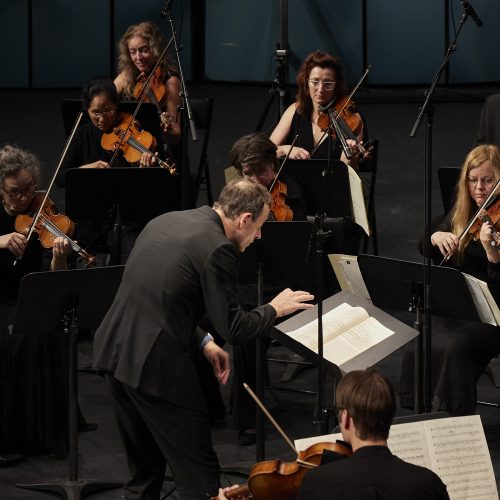
On the strength of a masterful Orfeo in 2023, the Cappella Mediterranea conducted by Leonardo Garcia Alarcon made an eagerly awaited return to Lanaudière with Monteverdi’s “other” opera, The Coronation of Poppea. A different work, conceived at the very end of the composer’s life (whereas Orfeo was written some thirty years earlier) and subject to commercial dictates unheard of for opera at the time. On this subject, READ the interview I conducted with Mr. Alarcon in preparation for this concert.

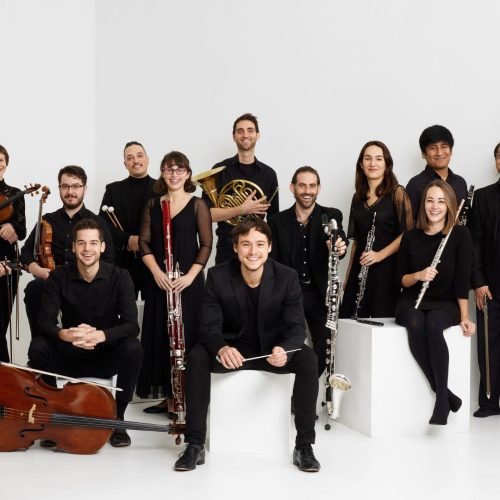
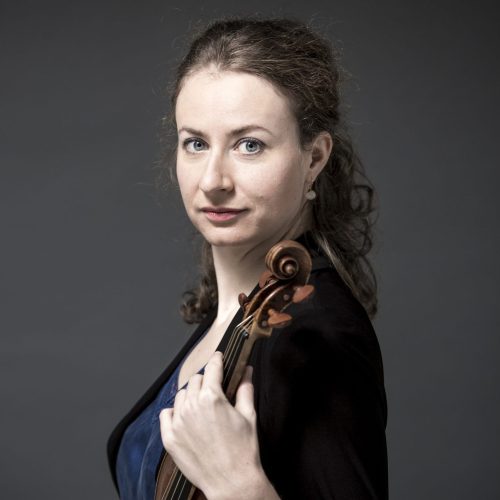
Alarcon was surrounded by his faithful colleagues on instruments and vocals, many of whom were there in 2023. The same calibre, then, with the addition of Lanaudière’s Pascale Giguère, called in at the last minute to replace a sick violinist. Hats off to Ms. Giguère, and we’re justifiably proud of her, for the musician’s playing was fully up to the standard of the ensemble.

In a more sparing gauge than for Orfeo (see again the interview mentioned above), the Cappella demonstrated its perfect match with the score, as much in the suggestion of emotions as in the precision of the melodic and accompanying lines. And, once again, the splendour of the singers was on display. Countertenor Niccolo Balducci in the role of Nero was imperial, but without grandiloquence. Sophie Juncker, who was said to be indisposed by a virus, held her part very well, even if there were occasional lapses in the strength of her projection. Nothing to make us sulk, that said. The secondary roles were all of a very high standard: the solemn Edward Grint (Seneca), the amorous and even naive Lucia Martin Carton (Drusilla), the slightly pitiful and even loser Christopher Lowrey (Othon, splendidly ridiculous in his Hawaiian t-shirt) and the truculent Samuel Boden in a panoply of small roles (a nurse, Arnalta, Damigella, etc.), which he performed with humour and casualness, despite the use of a tablet on which he consulted his score. One can only imagine the increased impact his performance would have if he knew how to do without it!

But beyond all that, I was particularly charmed by soprano, Mariana Flores in the role of Octavia, a noble and somewhat haughty empress, humiliated by the rejection of her emperor husband and driven to plot like a villain to save her marriage and, above all, her title and reputation.

In an exquisite tight-fitting dress, she was as desirable as a queen should be in legend. But her Olympian presence gave her the appropriate emotional distance, betraying a character that Nero described as ‘frigid.’ An accusation often tinged with misogyny, but which here refers to the typical attitude of a matron from a prestigious and aristocratic lineage, whose scorned dignity can only be expressed by a certain contempt for the world. Yesterday, Mariana Flores had the most accomplished voice, the most qualitatively holistic, powerfully expressive in her anger, poignant despite her reserve in her ideal high-pitched murmurs. A voice without tonal flaw or timbral approximation. For your humble servant, the queen of the evening, despite her final downfall in the libretto.

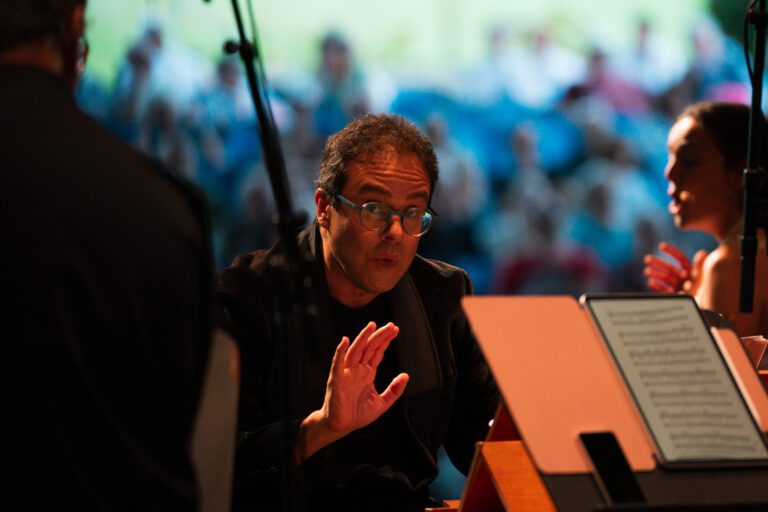
On the whole, too, the acting is impressive, embodied and clearly the result of long and expert work. You believe it from start to finish. Leonardo Garcia Alarcon demonstrated the full depth of his mastery of Monteverdian language and style. Another triumph for the musical director. We wonder what miracle he will bring us next time, but we can only look forward to it.

That said, audiences will have to be worthy of receiving this artistic quality, by coming in greater numbers. Otherwise, at some point, people will tire of offering exceptional programmes to sparse audiences. 
Choral Music / Classical / Modern Classical / période romantique

Festival de Lanaudière | Magistral Opening

by Alexandre Villemaire

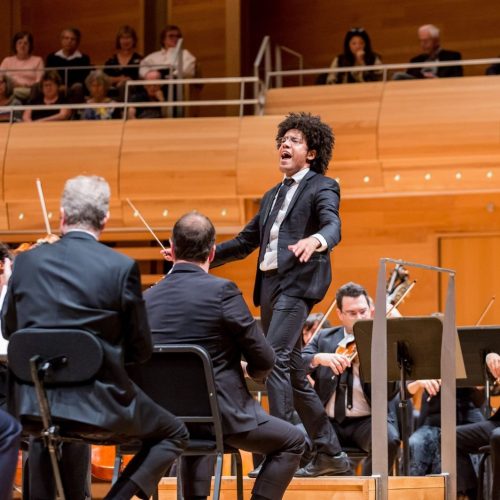
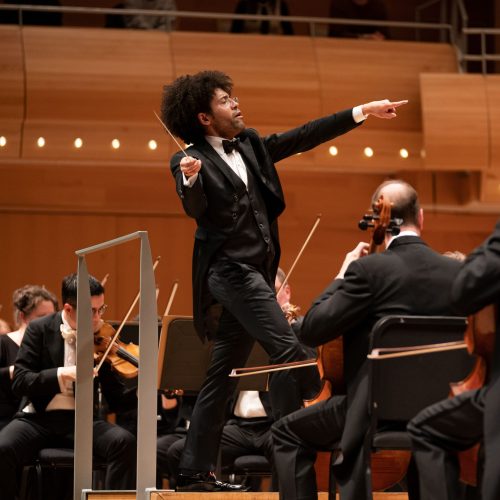
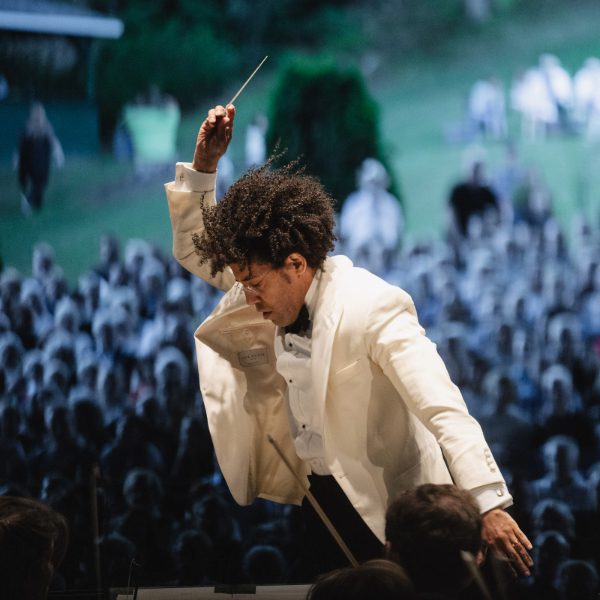
The 47th edition of the Festival de Lanaudière opened with a bang, as sonorous as the first note of the masterpiece of this July 4 concert inaugurating a month of music in the Lanaudière region. Led by Rafael Payare, the Orchestre symphonique de Montréal and the OSM Chorus delivered a masterful performance of Carl Orff’s landmark secular cantata Carmina Burana. This was the first time in thirteen seasons that the work had been performed at the festival. An excellent opportunity for listeners and music lovers to discover or rediscover the work.

The first part featured two works with contrasting pictorial characters. The opening work was “Icarus” by composer Lena Auerbach. Eminently descriptive, the work of course refers to the figure from Greek mythology who, wanting to get too close to the sun, burnt his wings and ended up drowning. It’s an example of human nature’s desire to push back its limits through boasting and greed. The work oscillates between different moods, sometimes tense, sometimes lyrical. The first section establishes a dialogue between strings and woodwinds in this affect. A second section takes on more dramatic accents with the intervention of the brass, followed by a passage of great lyricism in the strings that flows into a harmonic anxiety that culminates in an evocation almost of a funeral march with the intervention of tubular bells. A third, calmer section is introduced by the harp in dialogue with the pizzicati of the violins, before a counter-melody interpreted by first violinist Andrew Wan progresses in an evanescent suraiguity that eventually melts into the ethereal sound of musical glasses. All in all, a well-cut composition with fine orchestration and imaginative orchestral effects.

After this ethereal piece, Rachmaninov’s “Rhapsody on a Theme” by Paganini moves into a wild register. Taking up the already virtuoso work of Italian violinist and composer Niccolo Paganini, Rachmaninov’s equally complex treatment was led by German pianist Kirill Gerstein. He demonstrated great pianistic agility in expressing the various passages, supported by a precise Rafael Payare. The only discomfort we felt was that the orchestra, even in its instrumental support role, was a little too sonically recessed.

Masterpiece. From the first stroke of the timpani and the first note of the chorus singing “O Fortuna”, we are taken on a solid musical journey. The words are clear, the pronunciation and articulation precise, and the various dynamics Payare brings to bear are roundly executed. The OSM conductor opted for a sequence of each of the twenty-five movements in attaca for his interpretation, keeping the attention and the audience and giving the work a clear narrative direction to its medieval poems tackling themes such as the constant nature of fortune and wealth, joy and the pleasures of alcohol and the flesh. Among the finest moments is the ninth movement, “Reie”, which features a superb, intimate passage between the voices. The entire In Taberna sequence, literally “at the tavern”, was aptly staged by countertenor Lawrence Zazzo and baritone Russell Braun. The unique tenor aria “Olim lacus colueram” (Once I dwelt on a lake), literally a swan’s lament describing the various stages leading to its being eaten, was both comic and disturbing, but unambiguously clear. Equally unambiguous was the duet between soprano Sarah Dufresne and Russell Braun “Tempus est iocundum”, (Time is joyous) where the inflections of the vocal line and the acceleration leave no doubt as to the nature of the text, which describes a scene of committed love. Both Dufresne and Braun delivered a heartfelt, vocally arresting interpretation of their respective arias.

With a masterful start to its fourth season, we can only wish the Festival de Lanaudière good luck for the rest of its programming.

Publicité panam
classique

Festival de Lanaudière: Mahler et le chant de la nuit

by Rédaction PAN M 360

Gustav Mahler et sa Septième, c’est un cosmos entier qui tient dans le creux de la main, celui du monde viennois et d’une certaine idée de la culture : de l’apothéose du classicisme à la modernité énigmatique du premier vingtième siècle, jamais poussée aussi loin, peut-être, que dans ce mastodonte symphonique créé dans une Europe marchant inconsciemment vers l’abîme. L’Orchestre symphonique de Montréal et Rafael Payare, dont l’interprétation de la Cinquième Symphonie, à l’été 2022, est restée gravée dans toutes les mémoires, restituent la puissance évocatrice de ce chef-d’œuvre, dans le cadre idéal de l’Amphithéâtre.

Gustav Mahler and his Seventh Symphony hold an entire cosmos in the palm of your hand, that of the Viennese world and a certain idea of culture: from the apotheosis of classicism to the enigmatic modernity of the first twentieth century, never pushed so far, perhaps, as in this symphonic behemoth created in a Europe marching unconsciously towards the abyss. The Orchestre symphonique de Montréal and Rafael Payare, whose performance of the Fifth Symphony in the summer of 2022 remains etched in everyone’s memory, restore the evocative power of this masterpiece in the ideal setting of the Amphitheatre.

POUR ACHETER VOTRE BILLET, C’EST ICI!

Ce contenu provient du Festival de Lanaudière et est adapté par PAN M 360.

classique

Festival de Lanaudière: La Cinquième de Beethoven par les Grands Ballets

by Rédaction PAN M 360

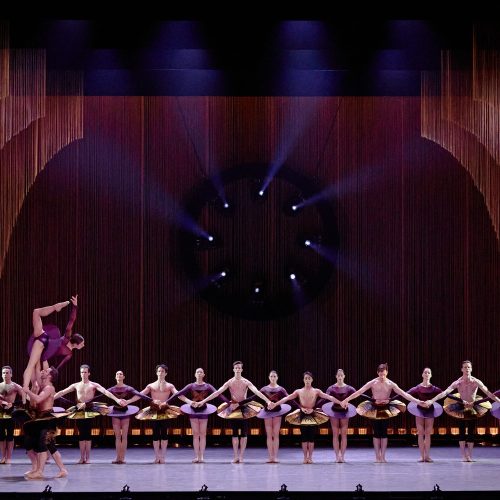
De nouveau cet été, Les Grands Ballets Canadiens foulent les planches de l’Amphithéâtre et retrouvent le public lanaudois pour une soirée d’émotion à fleur de peau et de prouesses chorégraphiques, entre la Cinquième de Beethoven – évoquant la liberté, la force tragique du destin, la transformation perpétuelle du monde – et un pot-pourri d’extraits parmi les plus célèbres du répertoire de ballet.

Once again this summer, Les Grands Ballets Canadiens take to the stage at the Amphitheatre and welcome back the Lanaudière public for an evening of raw emotion and choreographic prowess, between Beethoven’s Fifth – evoking freedom, the tragic force of destiny, the perpetual transformation of the world – and a medley of some of the most famous excerpts from the ballet repertoire.

POUR ACHETER VOTRE BILLET, C’EST ICI!

Ce contenu provient du Festival de Lanaudière et est adapté par PAN M 360.

classique

Festival de Lanaudière: Prométhée et la Septième de Beethoven

by Rédaction PAN M 360

Dans le cadre idéal de l’Amphithéâtre, Jonathan Cohen et Les Violons du Roy convient Beethoven – sa majestueuse Septième, son message humaniste, son désir irrépressible de liberté et de fraternité universelle – puis son interprétation du mythe de Prométhée, toujours brûlant d’actualité, tant il nous ramène aux fondements mêmes de l’éthique…sans oublier un détour chez Mozart, maître incontesté de la mélodie et de la gymnastique instrumentale la plus confondante.

In the ideal setting of the Amphitheatre, Jonathan Cohen and Les Violons du Roy welcome Beethoven – his majestic Seventh, his humanist message, his irrepressible desire for freedom and universal brotherhood – followed by his interpretation of the myth of Prometheus, which is still so topical today, as it takes us back to the very foundations of ethics… not forgetting a detour to Mozart, undisputed master of melody and the most confounding instrumental gymnastics.

POUR ACHETER VOTRE BILLET, C’EST ICI!

Ce contenu provient du Festival de Lanaudière et est adapté par PAN M 360.

classique

Festival de Lanaudière: Tchaïkovski et Rimski – Korsakov par Payare et l’OSM

by Rédaction PAN M 360

Deux compositeurs de génie, monstres sacrés de leur art, contemporains, compatriotes, que pourtant presque tout sépare sur le plan esthétique. Tchaïkovski et Rimski – l’exaltation sentimentale du premier, profondément attaché aux traditions musicales européennes, puis le geste orientalisant et la fascination de l’Ailleurs du second, réunis dans un concert qui de chacun fait entendre l’œuvre possiblement la plus connue, la plus emblématique. Rafael Payare et l’OSM sont au rendez-vous, ainsi que le fabuleux pianiste Yoav Levanon, dans ses débuts avec orchestre au Canada.

Two composers of genius, sacred monsters of their art, contemporaries, compatriots, yet almost everything separated them aesthetically. Tchaikovsky and Rimsky – the sentimental exaltation of the former, deeply attached to European musical traditions, and the orientalizing gesture and fascination with Elsewhere of the latter, brought together in a concert that features perhaps the best-known, most emblematic work of each. Rafael Payare and the OSM are on hand, as is the fabulous pianist Yoav Levanon, making his Canadian orchestral debut.

POUR ACHETER VOTRE BILLET, C’EST ICI!

Ce contenu provient du Festival de Lanaudière et est adapté par PAN M 360.

classique

Festival de Lanaudière: Nicolas Ellis et Farah Alibay en orbite!

by Rédaction PAN M 360

C’est le genre de rencontre inusitée dont Lanaudière s’enorgueillit, celle d’un jeune chef d’orchestre québécois dont la carrière explose, déjà habitué du Festival, et d’une scientifique de haut vol, associée à la NASA, qui gravite dans les plus hautes sphères de l’aérospatiale. Nicolas Ellis et son Orchestre de l’Agora nous font voyager dans la stratosphère, avec les Planètes de Holst et la suite orchestrale Orion de Claude Vivier, expertement secondés par l’ingénieure Farah Alibay.

It’s the kind of unusual encounter that Lanaudière is proud of, that of a young Quebec conductor whose career is exploding, already a Festival regular, and a high-flying scientist, associated with NASA, who gravitates in the highest spheres of aerospace. Nicolas Ellis and his Orchestre de l’Agora take us on a journey into the stratosphere, with Holst’s Planets and Claude Vivier’s orchestral suite Orion, expertly assisted by engineer Farah Alibay.


POUR ACHETER VOTRE BILLET, C’EST ICI!

Ce contenu provient du Festival de Lanaudière et est adapté par PAN M 360.

Baroque

Festival de Lanaudière: Intégrale des concertos brandebourgeois de Bach II

by Rédaction PAN M 360

La réputation de l’Orchestre baroque de Fribourg, prince parmi les orchestres d’Europe, dépasse les frontières : auréolée de multiples prix pour une discographie parmi les plus vastes de notre époque, la célèbre phalange allemande nous offre un panorama en forme de kaléidoscope de l’univers de Bach – en exclusivité nord-américaine – au travers de ses célébrissimes Concertos brandebourgeois, en passant par la musique de son tout aussi célèbre contemporain, Antonio Vivaldi. Une rencontre imaginaire entre deux géants, le temps de deux concerts qui marquent le retour de l’orchestre au Québec, après 10 ans d’absence.

The reputation of the Freiburg Baroque Orchestra, a prince among Europe’s orchestras, extends far beyond the borders of the country: the renowned German phalanx, winner of numerous awards for one of the most extensive discographies of our time, offers us a kaleidoscopic panorama of the world of Bach – exclusively in North America – through his celebrated Brandenburg Concertos, to the music of his equally famous contemporary, Antonio Vivaldi. An imaginary encounter between two giants, in two concerts that mark the orchestra’s return to Quebec after a 10-year absence.

POUR ACHETER VOTRE BILLET, C’EST ICI!

Ce contenu provient du Festival de Lanaudière et est adapté par PAN M 360.

Pop

Les grandes dames de la chanson à l’amphithéâtre Fernand-Lindsay

by Rédaction PAN M 360

Ce tout nouveau spectacle mis sur pied par les Productions Stéphane Laforest inc. rend hommage aux grandes dames de la chanson sous le grand Amphithéâtre Fernand-Linsday à Joliette!

L’orchestre La Sinfonia de Lanaudière et ses 30 musiciens, dirigé par le Maestro Stéphane Laforest, sera accompagné des magnifiques voix de Kim RichardsonMarie-Denise PelletierGeneviève Leclerc et Stéphanie Bédard dans les grandes chansons de Barbra Streisand, Ella Fitzgerald, Céline Dion, Ginette Reno, Withney Houston, Édith Piaf et bien d’autres.

This new show pays tribute to the great ladies of music! The 30 musicians La Sinfonia de Lanaudière orchestra, conducted by Maestro Stéphane Laforest, will be accompanied by the magnificent voices of Kim Richardson, Marie-Denise Pelletier, Geneviève Leclerc and Stéphanie Bédard in the great songs of Barbra Streisand, Ella Fitzgerald, Céline Dion, Ginette Reno, Withney Houston, Édith Piaf and many others.

POUR ACHETER VOTRE BILLET, C’EST ICI!

Ce contenu provient de la Place des Arts et est adapté par PAN M 360.

classique

Festival de Lanaudière : Karen Cargill chante Wagner

by Rédaction PAN M 360

Entre Schumann et Wagner court la trame de toute la tradition romantique allemande, ses exaltations, sa noblesse tout introspective et sa ferveur tourmentée. Nouvelle rencontre sur les cimes avec Rafael Payare et l’OSM, cette fois accompagnés de la merveilleuse mezzo-soprano Karen Cargill, de retour au Festival pour la première fois depuis ses débuts remarqués, à l’été 2019.

The fabric of the entire German Romantic tradition is woven between the polar apexes of Schumann and Wagner: exaltation, noble introspection, and tormented fervour. Experience another meeting at the top with Rafael Payare and the OSM, joined this time by the superb mezzo-soprano Karen Cargill who makes her first return to the Festival since her remarkable debut in the summer of 2019.

POUR ACHETER VOTRE BILLET, C’EST ICI!

Ce contenu provient du Festival de Lanaudière et est adapté par PAN M 360.

classique

Festival de Lanaudière : Rafael Payare dirige L’Oiseau de feu

by Rédaction PAN M 360

Après Daphnis et Chloé l’été dernier, Rafael Payare et l’OSM poursuivent chez Stravinsky leur exploration du répertoire des Ballets russes, et nous transportent vers un monde féerique et légendaire avec la version intégrale de L’Oiseau de feu. La virtuosité éclatante de cette partition aux mille couleurs trouve son pendant dans le Concerto pour harpe de Glière, défendu de main de maître par Xavier de Maistre dans ses débuts à Lanaudière.

Last summer they performed Daphnis and Chloe. This year, Rafael Payare and the OSM continue their exploration of the Ballets Russes repertoire with a work by Stravinsky that will transport the audience to a fairytale world: the complete version of The Firebird. The dazzling virtuosity of this multicoloured masterpiece is matched by Glière’s Harp Concerto, masterfully performed by Xavier de Maistre in his Lanaudière debut.

POUR ACHETER VOTRE BILLET, C’EST ICI!

Ce contenu provient du Festival de Lanaudière et est adapté par PAN M 360.

classique

Festival de Lanaudière : Hamelin et l’Everest Rachmaninov

by Rédaction PAN M 360

Si Marc-André Hamelin n’est pas étranger aux répertoires réputés injouables, ou encore aux marathons quasiment surhumains – que l’on pense seulement aux intégrales Brahms et Beethoven des dernières saisons ! – il se mesure cette fois-ci à une sorte d’Everest : le Troisième Concerto de Rachmaninov, dont la difficulté diabolique, le caractère délirant et l’ardeur véhémente exigent du pianiste toutes les prouesses. Un rendez-vous indispensable avec des partenaires de choix, l’Orchestre Métropolitain et Yannick Nézet-Séguin.

Marc-André Hamelin is no stranger to repertoires deemed unplayable, and to virtually superhuman marathons—think only of the complete Brahms and Beethoven concerts of the last few seasons! —This time around, he tackles what might be called an “Everest” of the piano repertoire: Rachmaninoff’s Third Concerto, devilishly difficult, delirious in character and ardently vehement, demanding the highest level of proficiency. An unmissable performance with elite collaborators, the Orchestre Métropolitain and Yannick Nézet-Séguin.

POUR ACHETER VOTRE BILLET, C’EST ICI!

Ce contenu provient du Festival de Lanaudière et est adapté par PAN M 360.

Subscribe to our newsletter

Inscription
Infolettre

"*" indicates required fields

Type of Suscribers