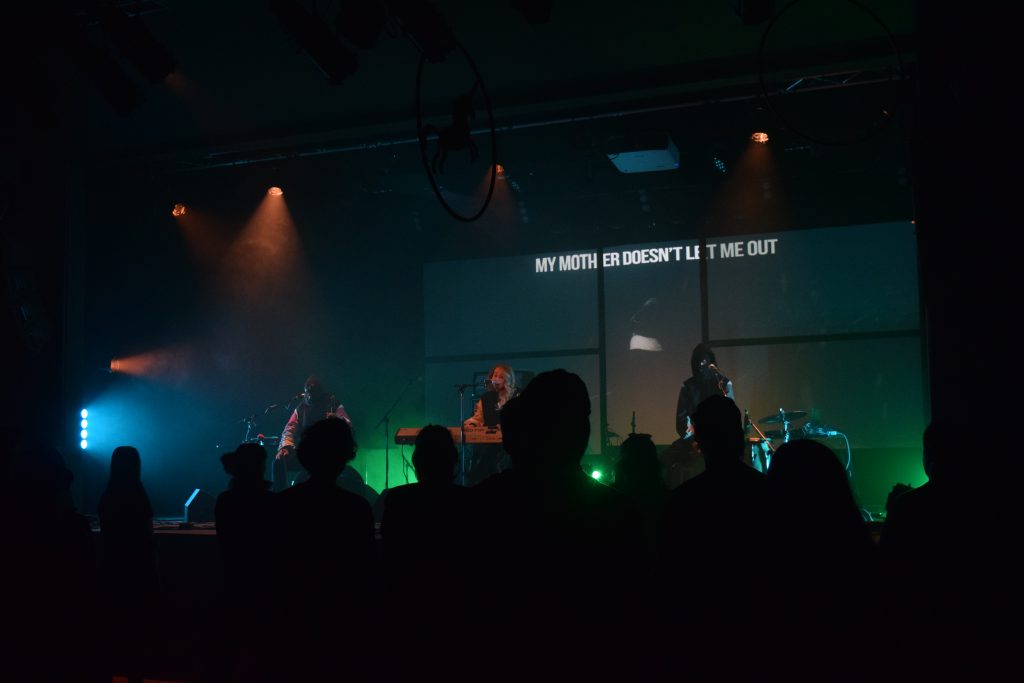
After a first degree in art history obtained in France, Jessica Ekomane decided to take advantage of a university exchange program to discover Berlin and undertake a course in sound studies. Still living in the German capital, she has found her place and her mode of expression: experimental music. After having experimented with sound installation, it was during her first concert in a Berlin bar that her interest in the form was confirmed. Invited to Montreal by AKOUSMA, the composer will present Manifold, a piece commissioned by INA-GRM, written for the acousmonium (orchestra of speakers).

PAN M 360: Please introduce us to “Manifold”, the piece you will perform at Akousma

Jessica Ekomane: I always have a hard time talking about this piece because I feel like it brings together a lot of things I’ve been working on over the last few years, including developing melodies, polyphony and rhythm, all at the same time. I also use a lot of “tuning”, tuning that is not the European piano tuning, well equal temperament as we know it. I use a “heptatonic” tuning that comes from Malawi. It is a family of tuning that is found in different countries and also in the diasporas. I try to go in this direction, to break a little bit of this very reduced choice of notes with which we have been making music for a very long time. Moreover, as I use Max/MSP (editor’s note: musical software of sound synthesis), I am really in the field of the frequencies. It’s not notes so it doesn’t really make sense to limit myself to those few frequencies.

PAN M 360: You played a DJ set for the 31st anniversary of the legendary club Trésor in Berlin,

Jessica Ekomane: So when I do DJ sets, I don’t play music to make people dance, it’s more experimental stuff. It’s true that it changes me from what I usually do, it’s a much lighter side and it also allows me to share the music I like, to listen with others. We listen together. I like to make mixes because it’s an opportunity to put forward artists who are less known. I don’t intend to make a career out of it, I rarely do it because I really want to keep this fresh side, not too professionalized.

PAN M 360: What are the elements that had an impact on you you when you discovered the Berlin experimental music scene? 

Jessica Ekomane: What’s interesting about this city and what I discovered when I moved here is the openness, compared to, for example, some French institutions that seem very closed and elitist. In Berlin, there are spaces to start with where people are just interested and rather encouraging, even if they give criticism or feedback. Except for the fact that it was a lot of white men, it was always experimental music. If people see that you’re doing something, they’re willing to give you an opportunity. That’s how I got my first gig at Madame Claude’s bar, which hosts both known and unknown experimental music artists.

PAN M 360: How do you perceive the place of women in the experimental scene in Berlin?

Jessica Ekomane: It has improved a lot in the last few years. I’m also in dialogue with women from the previous generation who tell me that they used to be alone and they really see the evolution, not only on the level of musicians, on the level of sound engineers for example. It’s possible to have women or non-binary people as sound engineers. Of course there is a lot of progress to be made, but when I leave Berlin or come back from other places, I realize how far ahead it is. Maybe it’s also because I’ve created a bubble for myself, an environment where I don’t have to deal with it as much, because it’s a lot to bear sometimes. I hope that progress will continue because historically speaking, we are at a time when there are many questions about identities that can also create friction or a reverse effect with people who want to go against that.

PAN M 360: Are there any female composers, singers, who inspire you by their background or their music?

Jessica Ekomane: I really like Éliane Radigue, I really like Mariana Maché. Recently, I’m starting to listen to Mary Lou Williams more too, she’s an Afro-American composer and pianist who comes  from jazz, she did some great vocal compositions, Nina Simone too. I also listen to a lot of music that is not necessarily gendered, for example the music of the pygmies who are between the Congo and Cameroon. That’s where I learned the most about how to think about polyphony.

JESSICA EKOMANE SE PRODUIT CE JEUDI 13 OCTOBRE À L’USINE C, 21H, DANS LE CADRE DU FESTIVAL AKOUSMA. POUR INFOS ET BILLETS , C’EST ICI

Andrew Boudreau is an active member of the creative jazz scene in North America. An adept pianist and composer, Andrew will be presenting music from his 2022 album, NEON, as part of the L’OFF Festival de Jazz. His performance at L’OFF is something of a homecoming for the artist who once studied at McGill’s own Schulich School of Music. We spoke to him about his music, his upcoming performance, and his thoughts on the creative scene. 

PAN M 360: Andrew, thanks so much for being with us. I suppose the first thing I’ll ask you is how the hell do you manage to play a 13/8 ostinato while keeping 4/4 in your right hand.

Andrew Boudreau: Haha that’s a good question. I’m not sure I know the answer. If I find out I’ll let you know.

PAN M 360: Thanks for indulging me. So what is your relationship with Montreal? I understand you studied music here.

Andrew Boudreau: I’m originally from Nova Scotia. I moved to Montreal to do my bachelor’s degree in music at McGill. I stayed in the city for three to four years after my studies. 

PAN M 360: So you must be familiar with the L’OFF Festival de Jazz?

Andrew Boudreau: Oh yeah. I think the first time I played might have been in 2013, a long time ago, but always as part of other people’s projects. I think one of the cool things about this festival is that the big mission is to celebrate the scene here. I think that involves some kind of collaboration with those outside of the scene with musicians that are from here and that is a really beautiful thing to witness. It’s one of the reasons that October is a great month to be in Montreal. 

PAN M 360: Well let me ask you, what exactly is the nature of your quartet and your album NEON?

Andrew Boudreau: It’s a quartet with three of my friends, Neta Raanan on Saxophone, Simón Willson on Bass, and Eviatar Slivnik on Drums. We all met in Boston where I went to do my master’s and now we all live in New York City. They are heading up to meet me here, and for some of them, it will be their first time in Canada, which is really exciting. As far as the nature of the music goes, I definitely wrote these compositions with these three people in mind. There are some parts of it that are really specific in terms of composition and notation, but also parts that are quite open-ended. I think that is because of their strengths as musicians playing stuff you write and stuff you don’t write. 

PAN M 360: What sources of inspiration are you drawing from here?

Andrew Boudreau: For the music on the album, I started working on it, in a way a long time ago, but also during 2020 and 2021 which were obviously quite intense for a lot of people … I suppose that left a bit of a mark on the music. Some of the music is connected to geography. One of the compositions on the album is titled “Mile-Ex.” I used to live in the Mile-Ex and when I did, no one would know what you were talking about, and now it’s pretty trendy, now that I’m gone ha. I’ve been inspired by a lot of visual artists. One of my favourite artists is Nova Scotian, Maud Lewis. She lived in a tiny house on the coast and no one really paid attention until she passed away, unfortunately. Musically speaking, I’m pretty omnivorous, I’m always looking to hear new stuff. Some of what I listen to has piano, bass, drums, and saxophone, and some of it doesn’t at all. It changes by the day.  

PAN M 360: How would you best describe your presentation at L’OFF this year?

Andrew Boudreau: I would describe it as a collection of individual compositions. It’s not that there is one frame of reference, writing only about one writer, painter, or event. For me, it’s more about piecing together a collage or a narrative through a bunch of pieces or compositions. What we’ll be playing is some assembly of this music that I’ve written. I like to rearrange them in different ways, so they can be somewhat different each time, even if we have recorded these nine pieces a certain way. What we’ll be doing is creating an arc through some arrangement of those pieces, finding new ways to sequence them and present them. 

PAN M 360: Modern jazz can be a bit daunting for some, is there anything you would want people to be aware of going into your show or not really. 

Andrew Boudreau: I don’t know what I’d tell them to listen for in advance … I would say that for me, it’s less about word painting. It’s almost to me that all the titles are subtitles or something. I think theme and variation apply to all the music here, otherwise, I suppose it’s more about creating a mood or an atmosphere and seeing how that can evolve, devolve, and change. But I suppose rather than giving instructions, I would just be curious to hear what people have to say. 

ANDREW BOUDREAU IS PERFORMING THIS THURSDAY OCTOBER 13TH, 10PM AT DIÈZE ONZE

Andrés Vial is a well established pianist, multi-instrumentalist and composer based in Montréal. A staple of the creative scene here,  Andrés is a regular performer at the L’OFF Festival de Jazz. This year finds him returning with what will no doubt be two remarkable shows, one with his own quintet and one as part of a special collaboration with drummer Joe Chambers. 

PAN M 360 : Andrés, many thanks for taking the time. It seems you have quite an exciting L’OFF this year. It must be nice to return to the festival circuit. Would you say there is something special about L’OFF this year in light of all that has happened since 2019 or not really?

ANDRÉS VIAL :  Thanks for asking me! The last few editions of l’OFF Festival were hybrid and/or virtual, so I think this year is special for everyone involved. It definitely is for me, because I haven’t played the festival since October 2019, and this year I get to perform with my mentor, Joe Chambers.

PAN M 360 : The music you are presenting with your quintet this year explores folkloric and rhythmic idioms from West Africa and South America. Is this a new direction for you or something that has always been a part of your musical voice?

ANDRÉS VIAL :  It’s not entirely a new direction for me. I’ve been fortunate to have the opportunity to collaborate with renowned musicians from West Africa, the Caribbean, and Latin America for decades now – people like Bassekou Kouyate from Mali, Malika Tirolien from Guadeloupe, and  Janet Valdés and Obsesión from Cuba. And my family is from Argentina and Chile, so I heard a lot of South American music growing up. Since about 2015, I’ve been consistently incorporating elements of South American folklore into my original compositions, as well as adding pieces by South American composers to my jazz piano (solo and trio) repertoire. 

The original music I’m presenting at l’OFF Fest this year was definitely written and arranged with specific musicians in mind, who come from West and Central Africa, South America, the Caribbean, the US and Canada: Mamadou Koita, Elli Miller Maboungou, Vovo Saramanda, Michael Davidson, Tommy Crane, Ira Coleman, Martin Heslop, Caoilainn Power and  Joe Chambers.

PAN M 360 :  Do you find that the ‘jazz’ idiom is easily assimilated with music from other cultures?

ANDRÉS VIAL :  Jazz is essentially hybrid music to begin with. Like many other New World musical traditions originating in the African diaspora, jazz has always incorporated elements of African, European, and Indigenous music. Of course, depending on the era, geographic location, and specific circumstances, the extent of these different influences can vary greatly.  

PAN M 360 :  Did you come to any new epiphanies or discoveries in working on this project, perhaps about the unity of all sound and things?

ANDRÉS VIAL : Definitely. I felt a unified sense of purpose being expressed by the group immediately. They’re all such sensitive musicians that I could really hear how much everyone was listening and adapting to each other and the flow of the music. I think it always comes down to how musicians relate to each other, personally and musically. Because we’re all operating within the greater sphere of Black music, it’s been pretty easy to get on the ‘same page’ quickly. There are alot of commonalities in terms of how we approach ensemble playing, improvisation, polyrhythms, etc., but there are also some noticeable differences that have required us all to adapt to best serve the music. Each of us has been pulled out of our comfort zone at times, and each of us has also been able to share aspects of our own culture and musical knowledge with the others. It’s really been a gift.

PAN M 360 : I would love to know more about your work with Joe Chambers. How did it come to be and what exactly is the nature of your ensemble ? 

ANDRÉS VIAL : I saw Joe perform at Upstairs and give a masterclass at McGill around 1999 or 2000. It was such a heavy experience that I decided to audition for the New School in NYC, so I could study with him. ( I was playing a lot of drums at the time.) I played vibraphone in his Jazz Percussion Ensemble there for a year, which was great, and we played a lot of the compositions that Joe contributed to Max Roach’s M’BOOM percussion ensemble, of which he was a core member.

Fast forward about 20 years to 2022. This past May, I was preparing to record an album of my own original percussion ensemble music, and I emailed him to ask if he’d like to play on it. He said yes! He came up to Montreal for 3 days and we cut the record – it was an amazing experience. About a month later, he called me and asked if I’d like to work with him on his new Blue Note album! I ended up playing piano on 3 tracks, contributing two of my originals (Dance Kobina and City of Saints), and co-producing.

Our co-led ensemble features musicians who appear on both of our upcoming records. For our OFF Jazz Fest show we’ll be playing mostly originals, as well as a few standards.

PAN M 360 : How has it been working with someone directly connected to the jazz lineage? 

ANDRÉS VIAL :  It’s been a dream come true, on so many levels. I’ve learned so much from playing with him. He is absolutely one of the finest ensemble players of all time. His level of groove and swing, his dynamic range, his touch, his telepathic ability to connect with everyone in the band…and he’s such a great composer. Joe turned 80 this year –  what a profound contribution he has made to this music over the last 7 decades! It has felt surreal at times, especially for me and the other jazz cats in the band. Personally, there is nothing more rewarding than having a mentor say they dig your piano playing and your compositions, and they want you to join their band. It’s truly been an honor to work with him.

PAN M 360 :  Can we expect an album release any time soon? Anything exciting on the horizon we ought to be on the lookout for? 

ANDRÉS VIAL : Joe’s album Dance Kobina will be out on Blue Note Records on February 3rd. My album Spirit Takes Form, featuring Joe and many of the aforementioned musicians, will likely be out by Fall 2023.

PAN M 360 : Thanks again for your time, wishing you all the best Andrés. 

ANDRÉS VIAL :  Thank you, Varun!

The Andrés Vial Quintet plays this Thursday, the 13th of October, at 12PM at The Montreal Museum of Fine Arts


The Joe Chambers/Andrés Vial ensemble plays on the 15th of October, at 8PM at Théâtre Plaza.

Conceived by American saxophonist Steve Lehman and composer Frédéric Maurin, artistic director of the Orchestre National de Jazz, in close collaboration with the Institut de recherche et coordination acoustique/musique (IRCAM) in Paris, the “Ex Machina” project “explores new musical directions” by developing a game of real-time interactions between the soloists and a form of artificial intelligence in the context of a large jazz ensemble. 

Resulting from a collaboration with the Musical Representations team of Ircam directed by Gérard Assayag, the Ex Machina project integrates devices created from the DYCI2 environment by Jérôme Nikapour in the composition process and in the soloists’ improvisations in real time. Thus, the computer and its software become in turn “a generator of electronic orchestrations for the composers and an improvisation partner for the musicians”.

A most singular project, its presentation at Off Jazz, this Friday at the Théâtre Plaza, deserves our full attention. This justifies this conversation with its conceptors !

PAN M 360: What “machine” are we talking about here?

STEVE LEHMAN : In this context, the “machine” refers to the DYCI2 Software but also all of the other tools we often use as part of our compositional process: ableton live, max/msp, spear, open music, etc.

PAN M 360: What is the DYC12 environment?

STEVE LEHMAN : DYCI2 (not DYC12) is a computer-driven musical environment capable of responding intelligently to live and pre-recorded audio signals from acoustic instruments and other sources.

PAN M 360: Then, is artificial intelligence involved ?

STEVE LEHMAN : Yes, DYCI2, is meant to demonstrate a kind of (artificially) intelligent musical behavior.

FRÉDÉRIC MAURIN : But it seems to me that the term AI is sometimes overused, at least in the kind of music we make, because it’s still a system that needs human ideas to work.

PAN M 360: How were the triggers designed to generate this dialogue?

STEVE LEHMAN: Triggers are used in this context more for work with pre-recorded audio and synthesizers. The real-time interaction doesn’t involve triggers.

FRÉDÉRIC MAURIN: In this context, triggers are used more for working with pre-recorded audio and synthesizers. Real-time interaction doesn’t involve triggers, other than sending a signal to the DYCI2 system that says “now listen to this instrument”. 

PAN M 360: What was the commitment  of IRCAM, generally dedicated to contemporary electroacoustic music, in this creative process?

STEVE LEHMAN : Fred and I worked in close collaboration with researcher, Jerome Nikapour, to explore and in some cases expand the capacity of DYCI2 and its integration into our written and improvised music for acoustic instruments.

PAN M 360: How did this collaboration with IRCAM come about?

FRÉDÉRIC MAURIN: On my side, I had been in contact with IRCAM for some time and I had taken several of their courses.

STEVE LEHMAN : When Fred became director of the ONJ, he opened up a dialogue with IRCAM which led to this collaboration and co-commission of the piece “Ex Machina.” Personally, I have also been involved in various projects with IRCAM and a guest researcher and artist-in-residence since 2011.

PAN M 360: What is the part of the collective performance beyond its interaction with DYCI2 ?

STEVE LEHMAN : There is a great deal of notated music for the ensemble. And the formal design of the music is structured in great detail as well.

PAN M 360: How much of this is improvisation?  Individual performances? 

STEVE LEHMAN : Yes. Individual solos and then individual solos that happen in the context/structure of a given composition.

FRÉDÉRIC MAURIN: There are both individual solos and a duet that form a kind of “cadenza” and individual solos that occur within the context/structure of a given composition with sometimes the whole orchestra playing.

PAN M 360 : Why “39”? Why “Ex Machina”? 

STEVE LEHMAN : For “39”, you’ll have to ask Fred. For ‘“Ex Machina”, it’s away to evoke the idea that certain aspects of the music come “from the machine” And maybe also a subtle reference to Gérard Grisey’s “Tempus ex Machina.”

FRÉDÉRIC MAURIN: For “39”, it’s very simple: it was the provisional working title of this piece because it was the 39th piece I was writing for a large ensemble and then in the middle of a rehearsal, a musician from the orchestra said to me “keep this title, because at the moment many people are at 39°C because of the illness”. So I kept it. 

PAN M 360: You can see some excerpts of the performance of this work by the NYO on YouTube… Will an album be recorded?

STEVE LEHMAN : Yes, we will record in late-January with a release anticipated in Fall 2023.

PAN M 369: Can you explain how your paths (Steve and Frédéric) crossed and what your common interests were in carrying out this project?

STEVE LEHMAN : Fred and I met in Paris after a concert I presented there with my octet in 2016. We quickly discovered that we had a great deal of musical interests in common, including a deep interest in the French Spectral school of composition (Tristan Murail, Gérard Grisey) and it’s potential integration into improvised music. 

PAN M 360: Do you know of any other projects of that kind, i.e., an interaction between contemporary jazz and electronic devices favoring an interaction, or even a work put together in real time?

STEVE LEHMAN : Not so many. But I think George Lewis and his development of the Voyager software for real-time interaction is an important precedent that one should note.

PAN M 360: How was this approach received by audiences?

STEVE LEHMAN : Extremely enthusiastic! We have received standing ovations at all of our first 5 concerts in Paris, Amsterdam, NYC, Washington DC, and Brown University. It’s a good feeling. I think audiences see and hear that the entire ensemble is 100% invested in the music. And I think there is a sense that this project involves a good deal of risk and exploration. And it seems that listeners connect and appreciate that a great deal.

PAN M 360: What will be the instrumentation in Montreal? Is this the line-up?

Steve Lehman – Compositions, alto saxophone

Frédéric Maurin – Compositions, direction

Fanny Ménégoz – Flute, alto flute, piccolo

Catherine Delaunay – Clarinet, basset horn

Steve Lehman – Alto saxophone

Julien Soro – Tenor and soprano saxophones, clarinet

Fabien Debellefontaine – Baritone saxophone, clarinet, flute

Jonathan Finlayson – Trumpet

Fabien Norbert – Trumpet

Daniel Zimmermann – Trombone

Christiane Bopp – Trombone

Fanny Meteier – Tuba

Chris Dingman – Vibraphone

Stéphan Caracci – Marimba, vibraphone, glockenspiel

Enzo Carniel – Piano

Sarah Murcia – Double bass

Rafaël Koerner – Drums 

STEVE LEHMAN: Yes, that’s right. You should also include Dionysios Papanikolaou – Live Electronics.

PAN M 360: How do you situate this approach in a context where “serious” jazz has every interest in renewing itself?

STEVE LEHMAN: I’m not sure I understand the question. But as a student of both Jackie McLean and Tristan Murail, I can say that this projects feel very personal to this group but also 100% consistent with the never-ending evolution of the traditions of both jazz and spectral music.

FRÉDÉRIC MAURIN: I believe that jazz is precisely a music that is always reinventing itself since its beginnings. It has never stopped and it continues today ! The problem today comes rather from a part of the critics and from certain places or festivals that believe that this music should be the one that was played 70, 60 or 50 years ago. But it is the history of jazz to evolve. In 1947, some critics and programmers said that bebop was not jazz. History repeats itself.

PAN M 360: Sorry, the wording of this question may be reductive and confusing.  The intention was rather to underline that your approach is extremely relevant in a context that is more difficult and less favorable to jazz than it was, which has little to do with its real creativity. 

FRÉDÉRIC MAURIN: No problem. Indeed, we agree that times are not very conducive to risk-taking despite the incredible vivacity of artists. 

PHOTO CREDIT : SYLVAIN GRIPOIX

EX MACHINA DE L’ONJ, IS PERFORMED THIS FRIDAY, 8 PM , AT THÉÂTRE PLAZA AND PRESENTED BY L’OFF FESTIVAL DE JAZZ DE MONTRÉAL – INFOS + TICKERS HERE !

In contact with electronic music (Drum N Bass, Jungle, House) since her teenage years, Denise Rabe has followed a creative path marked by stages and encounters that have, as a DJ and producer, gradually led her to find her place in the techno world. Since then, the German has played in the most famous clubs in her country and has collaborated with figures of atmospheric industrial and abstract techno like producer Rrose and Shxcxchcxsh. The uniqueness of Denise Rabe’s work is illustrated through the subtle blurring of the boundaries between experimental and pure dancefloor-oriented techno, as evidenced by her latest EP Blame Me—featuring remixes of The Advent, TWR72, and Cri Du Coeur

DJ set hör

PAN M 360: Can you introduce yourself through two/three events or encounters during your career that shaped you into the artist you are today?

Denise Rabe: The most important encounters were when I was 16. My friend Exzeme taught me turntablism. I loved it and bought my first Technics turntable. My first little experience on stage scared me so much that I never wanted to do it again in public. 10 years later (2011) when I moved to Berlin [which has another whole universe in it, why and so on, but we wanna keep it short] I changed my mind and wanted to go for it and recorded my first Soundcloud set. Here I met the boys from Legotek and played shows in About Blank, Sisyphos, GoldenGate, Tresor … 2014 I met Emmanuel from ARTS through a Tresor gig, we hung out afterward and I showed him my first productions, he liked it and this is how my first EP with the incredible Rrose Remix was born. 

PAN M 360: What can you tell me about the creative process and inspiration for the Blame Me EP?

Denise Rabe: This is always the hardest question for me to answer. It starts with a recording and then takes me to a place I had no idea I would end up. But I remember I wanted to work with some ACID sounds. It turned out sounding definitely not like the usual ACID tracks, not even close I would say. But that’s completely normal for my process I start with an inspiration and in the end, even I can’t hear the connection anymore. But I like that it’s so surprising and that’s important for me in a creative process. Find your way and sound. If I wanna do something specific I end up frustrated most of the time. I need to go with the flow. 

PAN M 360: About the art of remix in general, is this something you like to do? What’s your approach to this specific exercise? 

Denise Rabe: It depends, if the sounds are interesting it is easier to work with and it’s more inspiring. It is definitely more challenging when the track has a hi-hat, a clap, a kick, and one or two sounds only.  The last one is tougher for sure but also a good challenge and practice to work on your skills. Making a good track with not so many elements is not so easy.  But yes most of the time I enjoy doing it. 

PAN M 360: When I listen to your music, I feel there is an interesting balance between dancefloor-oriented and more contemplative/experimental musical elements, does one side influence the other, and if so, how? 

Denise Rabe: I am always in the middle of you must do some dance floor stuff and the other half is more on the artsy side of things. I want it to be danceable cause every (Techno) producer wants to hear their tracks played by others. I try to find the balance between artsy and what works for the people in the clubs. Music should come naturally because it is something very personal and I would say my music is and mostly I have the best flow on breakbeats, it comes more naturally. No idea why. So I would say the experimental one is influencing the dance floor music. 

PAN M 360: How do you organize your working time between production and DJing? How do you manage your pace that I suppose goes crazy quick in Berlin?

Denise Rabe: Usually I do my DJ stuff the week before the gig but then I can’t do anything else. Depends also on how many gigs I have and how much time is in between, if I play more regularly—the prep for the shows is quicker. When there is a bigger gap it needs more time again, to recall the music and my organization of it. It helps to do podcasts so you have some stuff to go through as well. The digital is a blessing and a curse at the same time. You don’t have to carry all the records anymore but the amount of music to choose from is too much. That is what overwhelms me sometimes. And I do sit in the studio when it feels right. Not every day is a day to be creative. I recently figured I am not a machine, and I have to respect that. The more pressure I put on myself—the less music comes out. “No pressure” is my new mantra. 

Photo by Katja Ruge

PAN M 360: How did the collaboration with Arkham Audio happen? Do you have ties with the Belgian techno scene?

Denise Rabe: I met Jerome (Cri Du Coeur) through my good friend Sammy one of the CYRK guys who is from Belgium and manages the label.

PAN M 360: You are also managing your own label, Rabe. From your experience, what are the biggest challenges in distributing music nowadays?

Denise Rabe: Definitely in Germany, Deutsche Post became the biggest enemy for Bandcamp sales. They changed the size and price of the packaging worldwide. On the other hand Triple Vision is doing the job of distributing. Of course, the environmental aspect, the time it takes and the costs make you think twice to press and what to press. That’s also why I started the digital-only series now Rabexxx. 

PAN M 360: Will you be featuring other artists’ work on Rabe in the future? 

Denise Rabe: For now I am focusing on the digital side of the label to work with other artists in collaborations. The first one was with Ricardo Garduno. I am definitely open to opening up the Label in the future, but not yet. We will see I want that it happens naturally. 

You could walk outside your door right now, pick up a small pebble, and toss it across the street, and the chances you hit the dwelling of a Montreal musician are pretty high. Many of them make Lo-Fi music; music that sounds a bit “dusty” due to production restrictions—or in the case of the duo project Tinkertoy Fog Machine from Kai Thorpe and Tyrin Kelly—on purpose.

Living up to their name, Thorpe and Kelly are meticulous ‘tinkerers,’ using DIY recording techniques until their music sounds like a beat-up and forgotten cassette that has been manipulated and warbled from playing it too many times. It’s psychedelia that kind of sounds different with every play. Just check out their 2021 release Fingers Crossed.

The two bandmates are definitely on the same wavelength as longtime friends, roommates, and members of the local dance-punk group, Crasher, and backing musicians for Boyhood, an alt-rock group from Ontario.

This past summer, Thorpe, and Kelly have been refining the Tinkertoy live show and are planning on going back into the studio with hopes to record more material, meshing with their DIY aesthetics.

We chatted with both Thorpe and Kelly before their performance at Pop Montreal on Oct 1.

PAN M 360: How did Tinkertoy Fog Machine get its start?

Kai Thorpe: We’ve been playing music together since we were like 15. We met in high school so this is kind of just like a continuation of like all these projects that like kind of ended up changing their names over the years so yeah. I guess we’ve been Tinkertoy since 2017. That’s when we moved here from Ottawa.

PAN M 360: And is the music created through jamming or made on a computer program? I can never tell with Lo-Fi stuff like this.

Kai Thorpe: This is like computer song music, but not completely. I feel like that’s kind of discrediting it in a way in my books because I don’t personally find that very glamorous, but the songs were definitely not thought up on the spot. I think maybe we like we jam at the beginning of it to get the first idea, but then it’s all totally layered in Ableton. But then for recording, we have like an eight-track reel to reel that we end up re-recording into.

Tyrin Kelly: Yeah I think the initial ideas come from Ableton demos and loops but then we try to recreate it with more live-off-the-floor energy. Our roots are analog things. We like analog.

PAN M 360: Ah you use reel-to-reel. The recordings sound very vintage too, like finding a dusty cassette under a bed. Not dated, but Lo-Fi and washed out for a purpose.

Tyrin Kelly: We actually spent like a month just like re-amping … like this was kind of our like experimental recording stage, but we’re trying to like teach ourselves like, how to record ourselves. So we’d like to be re-amped like every single instrument 10 times without thinking about getting it done in any way. So we would send vocals and like drums through guitar amps. And then if it sounds bad we discard it, or if it sounds kind of good, we’ll save it. So we can kind of just do that over everything. Just to give a kind of a more like, like you said, ‘dusty vintagey’ vibe.

Kai Thorpe: I feel like it paid off in the end (laughs).

PAN M 360: It kind of reminds me of really, really old Tame Impala demos. Before, he was huge. So do you have a lot of l older vintage equipment? I guess you have the reel-to-reel but any other analog kind of stuff that you play around with?

Kai Thorpe: We have like outboard gear like preamps and some mics. I built some of the preamps and compressors too. Also for like our instruments, I think I have the same guitar the Tame Impala guy has. It’s a Hagstrom 1970 I think? I got it for like 600 bucks from a guy in Longueuil, like an old rocker guy. Now they cost so much.

PAN M 360: Do you guys handle the lyrics together as well?

Kai Thorpe: I’d say everything is like a 50/50 split. Like everything is shared between Tyrin and I. It’s definitely a joint effort.

Tyrin Kelly: And I just wanted to say that the two singles we have out right now, we spent a lot of time on them and maybe overthought them a bit too much? But it was a good process of kind of reinventing our sound so it’s cool to hear that it sounds a bit unique because it was a lot of tinkering around with it.

PAN M 360: Well I’d say the name Tinkertoy Fog Machine makes sense then if you’re constantly tinkering with your sound. And you guys have a silkscreen printing project together as well? Is it linked to Tinkertoy or do you do it on the side?

Kai Thorpe: Aesthetically it is, but this is mainly Tyrin’s project [Trap Door Printing] but it’s all one thing if that makes sense?

Tyrin Kelly: Yeah I feel especially with screen printing specifically, there’s so much correlation between it and like, DIY music. So yeah, I guess we did we printed the cover art. A lot of show posters on street poles voters. And, like just references to the early Montreal scene … there were a lot of like silkscreen posters. I just like the idea of like keeping that alive.

Crasher EP cover via Trap Door Printing

PAN M 360: So would you say you’re going to take the Fall and Winter to keep playing live and then look at recording some new material? Another two singles or a full-length LP?

Kai Thorpe: The next step is a record. We want to do a full length, but it’s kind of daunting, you know? Making a cohesive body of work. I feel like it’s kind of daunting, but I think that’s the next step.

Tyrin Kelly: And if we recorded with someone else, it would be with someone we’re close with and still that sort of DIY mentality. We like to have creative control and we know what we like. The reason why you do DIY is that every step of it is creative. Like you do the mixing stage and it’s creative. Mastering is creative. All of it is creative.

PAN M 360: For sure. What’s the live show at POP Montreal going to be like?

Kai Thorpe: When people see us now they always say ‘Wow I was expecting something totally different.’ It’s more of a psych rock vibe with lots of tweaks that need to be sorted out. We have a four-piece live band. So we have like a keyboard player and a guitarist, and then I play bass and sing and Tyrin plays drums.

Tyrin Kelly: I feel like we play Fingers Crossed and then everything else is pretty much unreleased. Like work to try them out live recording them, I guess. And yeah, I guess we spent the summer just trying to be better by playing live a lot. That’s kind of been our main focus for now.

Tinkertoy Fog Machine plays w/ Sun Entire, Max d Tremblay, and Cobra & Vulture at l’Escogriffe Bar on Oct 1 @ 9pm. TICKETS HERE

Haruna Kimishima is known in Japan as Haru Nemuri. Without claiming to know much about the current Japanese musical spectrum, it is easy to acknowledge the talent of this artist who will probably make a big splash at Pop Montreal this Saturday.

Typhoon of punk poetry and rap, hardcore aesthetics with virtuoso components, the music of this brilliant artist also involves J-Pop, noise or electro referents.

We owe him 3 albums and an EP since 2018: “Harutosyura” (2018), “Kick in the World” (EP, 2018), “Lovetheism” (2020), “Shounka Ryougen” (2022). Already, we can talk about consistency and depth across the board.

PAN M 360 just jumped on the bandwagon, we really insisted on making the following conversation with Haru Nemuri possible.

PAN M 360: How do you see the progression of your craft  since the beginning?

HARU NEMURI: I’ve been making music by wanting to become stronger, more beautiful, and more dignified.

PAN M 360 : What would have been the main steps ?

HARU NEMURI: I think that progress is made by never stopping to question both society and myself.

PAN M 360 : Are you self-taught or also have you been trained in music?

HARU NEMURI: I am self-taught.


PAN M 360 : How did you build this language of sounds?


HARU NEMURI: I don’t know, to be honest (laugh). I actively use things that feel sacred, things that have a destructive feel, and things that have a compelling atmosphere.

PAN M 360 : Of course, different crucial influences are observed :  hardcore punk, avant rock, rap, avant pop, noize, synthpop, post-minimalism, nujazz, to name a few. What would be your own description of styles and influences from Japan, Occident and other parts of the world ?

HARU NEMURI: When it comes to Japanese music, I first fell in love with bands that are categorized as “ROCKIN’ON-kei (style)”. As for western music I like alternative and hardcore bands and in Russian punk and hip-hop.

PAN M 360 : There seems to be no separation between experimental culture and popular forms in your approach. How do you see it yourself?

HARU NEMURI: To me I think it’s interesting to have both coexisting and I’m consciously creating that state.

PAN M 360 : So you are « closer to the ideal », better in composition and playing. How do you work in your studio?

HARU NEMURI: I can’t really see the destination of where the ideal is as of yet, but I think so. Basically, I make all the songs at home and then in the studio I’m often taking time recording and spending time mixing.

PAN M 350 : For you, what are the main differences between « LOVETHEISM » album and « SHUNKA RYOUGEN »?

HARU NEMURI: I think “SHUNKA RYOUGEN” has a blank space where there are more existences of others.

.

PAN M 360 : The musicianship seems to be excellent! Can you tell us how you have built your band?

HARU NEMURI: Depending on the situation, the case, and the piece of music, I decide each time who I want to have them join the performance. I decide who to play with based on if they are not discriminatory and cool.

PAN M 360 :Who is playing what in the studio? 

HARU NEMURI: Depending on the song, guitar, bass, and drums are often performed by musicians who specialize in each.

PAN M 360 : How is it translated on stage? What is the gear? Who is playing with you? What is the visual aspect of your show? What is the performing aspect? Are there a lot of electronics involved?

HARU NEMURI: I often hear my own sound through a monitor. From the computer through an interface the sound is outputted from two guitar amps, one bass amp, and speakers. The mic is passed through a vocal effector. My manager is operating the computer and controlling the sound to come out.

PAN M 360: Most of your international fans do not understand the Japanese language. They feel the poetic intentions and they love the music. Is it okay with you?


HARU NEMURI: Of course. It gives a lot of meaning to my choice of using music as an expression.

PAN M 360 : Do you see your craft as songwriting or music composition including words and  melodies through a musical proposal?

HARU NEMURI: I think it would be the second one. (music composition including words and melodies through a musical proposal).

PAN M 360 : You can play in many kinds of festivals. What are your favorite events ? Where do you mainly perform in Asia and in the rest of the world ?


HARU NEMURI: Every event I’ve attended so far has been great. I don’t actually have a specific venue that I always perform at but in Asia it would be in Tokyo and Taiwan. For the rest of the world, I go to Europe and America. I’d love to go anywhere.

PAN M 360: So this is it! Thank you for your answers and have a safe flight to Montreal!

HARU NEMURI: Thank you so much!

AT POP MONTRÉAL, HARU NEMURI IS PERFORMING AT ENTREPÔT 77, ON SATURDAY, 10 PM. FOR MORE INFOS CLICK HERE.

Clearly, Niineta is one of the most significant recordings from contemporary Aboriginal culture. The slow, dramatically heavy rhythms and organic linearity of this cohesive ten-piece journey represent a milestone of the sonic landscape portrayed by artists from North America’s first peoples.

Vocalist and producer Joe Rainey has taken a major step forward: his native values of meditation and contemplative connection with the universe are matched by an uncommon electronic language. Ambient, dub, industrial, techno and post-minimalist music all merge into a another kind of pow wow.

The traditional song of this Ojibwe artist is thus inscribed in a new context, at the same time concerned with the oral tradition and a dizzying leap into the present and the future. The digital world becomes a perfect complement to the expression of this artist who is concerned with updating the musical legacy of his ancestors. 

Since Joe Rainey is on the same program as Tortoise this Saturday, in the context of Pop Montreal, PAN M 360  reaches the artist at his home in the Green Bay area, Wisconsin. 

We’ll be talking mainly about the excellent Niineta, co-produced with his colleague Andrew Broder, electronic musician and producer from Minneapolis. Let’s remember that the album was released last May under the 37d03d label.

PAN M 360: So you’re based in an urban area, right?

JOE RAINEY: I’m an Ojibwe from the Red Lake Reservation in Minnesota. However, I was born and raised in Minneapolis. I’ve never lived on the Red Lake Reservation for any length of time, but I’ve visited there a lot. So I am an urban native.

PAN M 360: This is indeed evident in your deep interest in electronic music and other experimental forms. At the same time, it’s impossible to say that you are not close to your roots.  Wow!

JOE RAINEY: People might reduce my work to pow wow music singing with electro beats but… it’s actually something I’m very proud of. The musical fusion that took place with my friend Andrew Broder is original compositions on my part. They were done by listening to what Andrew Broder sent me as he went along. So I sat down in the same place I’m talking to you from, and created each song you hear, molded into the beatmaking that Andrew suggested. 

PAN M 360: The result is very special, no doubt.

JOE RAINEY: Thank you! But at first, you know, I didn’t intend to make it public. What you heard was going to be a personal project. But towards the end of that process, I started thinking about who I was as a contemporary Aboriginal artist. And if I had something to say, it would be exactly that. So I wanted to go towards that, with everything that was behind me, everything that I knew about my musical culture and that had come before me.

PAN M 360: You mean your personal life and culture are the foundation of your music.

JOE RAINEY: Yeah, I didn’t do that on my own, it’s just the idea I had in my head that you hear. So I wanted to express that idea somehow and I had a friend who helped me.  

PAN M 360: There are now some indigenous artists involved in new forms of music, instrumental or electronic, but we don’t really know of any other ambient music like that! Also, music with refined harmonization as you suggest is rare.

JOE RAINEY: Well, some church music in the indigenous culture has harmonies, so it’s not that new. However, I was not inspired by this music…I can also point to some pow wow songs as being harmonies. And when Broder said to me “Hey, do you know you have any?”, I said “No, I didn’t know”. And some of my takes ended up harmonizing naturally, with the help of my colleague.

PAN M 360:How would you describe what came to mind in doing this important work?

JOE RAINEY: Collaborating over the last five or six years with different artists that have been sampled, it kind of created a space in my mind for that creativity to flourish. During that creative time, I was also listening to indigenous experiments in electronic music, A Tribe Called Red for example. So I think that all of that just kind of clumped together in my mind. And then it all came out in my 40s, just with the ability to have that time to really internalize. Everything I did on this album was done during the quarantine, in this room, with these instruments and computers.

PAN M 360: Before the pandemic, what were you doing? We didn’t say it was totally different, or that you were electronic producers who sang.

JOE RAINEY: I’ve been a pow wow singer for quite some time. I’m also an archivist. I harvest, I compose, I record, I sing. Plus, I have a day job because I have a family to support. But I’ve been lucky enough to meet people through music, it’s really opened up my musical side which has always been there my whole life. So this album is the culmination of all these years of work, research and meetings, I may have created my own thing.

PAN M 360: What kind of archivist are you?

JOE RAINEY: I use archives from all periods from the 1940s on.  I know someone who has them all, so I can work with that material.

PAN M 360: Like Jeremy Dutcher in Canada?

JOE RAINEY: You know, I’ve had a few conversations where he’s been introduced to me. The album that he did, it’s very beautiful, very well done. But until recently, I didn’t know that. And it’s right up my alley.

PAN M 360: How do you play this music live?

JOE RAINEY: Andrew Broder and I perform as a duo. We’ve known each other for a number of years, we’ve done things together before this album. And he left the door open for me to ask him for help. So I asked him to help and he was involved in the whole process. He’s the other half, he’s more responsible for the production, and I’m responsible for the vocal side.

PAN M 360: Are you also involved in the production?

JOE RAINEY: Oh yeah! A lot of the samples you hear are my samples, so I co-produced it, exchanging information and music throughout the quarantine and it was never a difficult process, never a difficult process to work with Broder, just because it was so natural.  Broder sent me a long series of beats and sounds. I had to think about what I wanted to sing and what I wanted to convey. It was like each of us defining the other’s phrase.

PAN M 360: Is there an audiovisual proposition to your concert?

JOE RAINEY: Not exactly. We try to let everyone experience the music, determine the meaning. Just through sound, we wanted people to go through a lot of emotions, whether it’s happy, sad, scared, soft or loud.  We just wanted people to be completely immersed, to really feel what they hear, more than what they see.  

PAN M 360: Would you agree that your work can also be trance-like or meditative?

JOE RAINEY: That’s the way I’ve thought about it too. 

JOE RAINEY IS PERFORMING AT RIALTO THEATRE ON SATURDAY, 8:30 PM, OPENING FOR TORTOISE

Since the beginning of his very young career, he has accumulated more than 35 million listens online, the apathy song being his most listened to song on the listening platforms.

But who is this guy, famous to some and unknown to others?

Born in Ottawa, Maxime Trippenbach, aka Maxime., recently moved to Montreal. At the age of 13, he was charmed by Deadmau5’s music during a car ride with his father.  “When I got home, I discovered that the Canadian DJ was using FL studio software. I immediately downloaded the software and learned how to use it,” he says.

The 24-year-old singer-songwriter and producer navigates between indie pop, bedroom pop, and indietronica. Last August, Maxime. launched Rubber Checks, a five-track EP. Through this project, he addresses the loneliness of a young artist. “I wrote most of my EP shortly after I moved to Montreal,” he says.

Maxime. wants to “create something different that draws listeners in from the first moments of his songs.”

At his POP Montreal show at the Diving Bell Social Club on Wednesday, Maxime. plans to play his most popular songs as well as a few unreleased tracks. “In concert, I like to modify my songs and offer a different version than the one available on online listening platforms. Otherwise, what’s the point of coming to my shows,” he says with a laugh.

On stage, he is accompanied by James Clayton on guitar and Lucas Kuhl on drums, two long-time friends.

Pan M 360 spoke with him to find out more about his music, his creative process, and his presence at Pop Montreal.

PAN M 360: How and why did you start making music?

MAXIME.: I started making music when I was 13 years old. When I was young, I took guitar lessons. My father always had compilations on CD in the player of the family car. One day he played a Deadmau5 song and I thought it was really good. When I got home, I discovered that the Canadian DJ was using FL studio software. Immediately, I downloaded the software and learned how to use it. When I was about 20 years old, I decided to leave electronic music behind, pick up my guitar and start singing. That’s when the musical universe of Maxime. started.

PAN M 360: What are your musical influences?

MAXIME.: I grew up listening to a lot of electronic music, from Cage the Elephant to Radiohead. Today, I listen to mostly alternative and indie music. When I create, I incorporate elements of EDM, because I still produce on the same software since my childhood. All my drums are electronic, I modify my voice a lot and use a lot of synthesizers.

PAN M 360: What is your creative vision?

MAXIME.: I want to create something different that attracts the listeners from the first moments of my songs. Also, I want my music to be a real earworm. Melodies are very important to me and I like when my music is close to pop. Also, I like to make unpredictable songs.

PAN M 360: You recently released your EP Rubber Checks. Tell us about the creation of this project?

MAXIME.: I wrote most of my EP shortly after I moved to Montreal. I didn’t know many people and I didn’t go out much. I stayed in my room a lot and wrote songs. I write about my life and my moods at that time. My lyrics are vague to let my listeners interpret them in their own way.

PAN M 360: You are performing on Wednesday at the POP Montreal festival. What does this experience mean to you?

MAXIME.: I didn’t expect to be accepted to be part of the festival, I just started doing shows. In fact, my performance at Pop Montreal will be my fourth ever. On stage, I am accompanied by Clay (guitar) and Lucas (drums). They are two of my friends and we have a lot of fun playing together. What I like about Pop Montreal is that the different events are not all in the same place. There are a lot of artists to discover. Also, I love Montreal so it’s a good excuse to be there!

PAN M 360: How did your first shows go?

MAXIME.: So far, I’m having a lot of fun. However, I’m starting to understand how difficult it is from a technical point of view to do a show without pitfalls. I recently did a show in Montreal and the power went out halfway through my last song. I wasn’t sure what to do, it was a very strange ending. I hope everything will be fine on Wednesday.

PAN M 360: What should we expect from you on Wednesday night?

MAXIME.: I’m going to play my most popular songs and some new ones. When I play live, I like to change my songs and offer a different version than the one available on online listening platforms. Otherwise, what’s the point of coming to my shows?

MAXIME. PERFORMS THIS WEDNESDAY, 9 PM IN A PROGRAM PRESENTED AT THE DIVING BELL SOCIAL CLUB, AS PART OF POP MONTREAL. INFO AND TICKETS HERE!

Originally from Morocco, YouYou was born in Montreal. After listening to Vince Staples’ Summertime ’06 album in 2015, he got into music. In his most recent creations, the producer draws heavily from Afro house and Carioca funk. YouYou describes his music as “diverse and enchanting. When he creates, his main goal “is for people to be able to forget about everyday life for a few minutes and be transported into his world.”

Early in his career, YouYou was part of the Montreal beatmaking collective Jeune et Ambitieux. In fact, the group opened for rapper YBN Nahmir at Club Soda in 2018. During the pandemic, it began releasing its own songs. In early October, YouYou plans to release an Afro house-tinged EP. His latest track, Soweto, is part of that project. “This is the result of many hours of hard work. I couldn’t be more proud of the result,” he says.

On a daily basis, the young artist listens to many artists of different musical styles such as Citizen Deep, Kaytranada, Hubert Lenoir and Lydia Képinski. “I like many different musical styles and I think that allows me not to lock myself into a musical style when I create,” he says.

On Wednesday night, YouYou will be on stage at Casa del Popolo as part of the POP Montreal festival, which is just beginning: “I feel like this is one more step towards my ultimate goal. I want to popularize Afro house in Montreal and be an important figure in Montreal DJing,” he says, smiling.

Pan M 360 chats with YouYou about his musical career and his participation in the Pop Montreal festival.

PAN M 360: When did you start and why?

YOUYOU: I started making music in 2015 after listening to Vince Staples’ Summertime ’06 album. I loved it, especially the percussion. At the time, I was a boy who was easily bored and didn’t do much. In the beginning, I was part of a collective called Jeune et Ambitieux (J&A) with two good friends. We did several shows and we opened for YBN Nahmir at Club Soda. My experience with J&A taught me a lot. So I’ve been in the music business for a while. During the pandemic, I started to release more solo tracks.

PAN M 360: What are your musical inspirations?

YOUYOU: I am very inspired by world music. Lately I’ve been listening to a lot of carioca funk. It’s a very rhythmic and catchy musical genre. Also, I really like afro house. I’m going to release an EP at the beginning of October and it sounds very much like afro house. Then I really like to work with samples from North Africa. On a daily basis, I listen a lot to the music of the South African producer Citizen Deep. He is one of the biggest figures in afro house right now. I also listen to Kaytranada, High Klassified, Hubert Lenoir and Lydia Képinski. I like a lot of different styles of music and I think that allows me to not lock myself into one musical style when I create.

PAN M 360: What is your goal when you create?

YOUYOU: When I create, I imagine the reaction of my listeners. When someone listens to my sounds, I want them to focus on what they are feeling. I want people who are going through a rough patch to be able to channel themselves and find themselves in my songs. On other songs, I want my listeners to get caught up in the beat and dance. My main goal is for people to be able to forget about everyday life for a few minutes and to be transported into my world.

PAN M 360: Would you like to have artists to put their voices on your next productions?

YOUYOU: Certainly, I would love to collaborate with artists in the future. I have tried in the past, but it was a bit complicated. Artists like Kaytranada and High Klassified started out as solo beatmakers and were eventually able to invite artists onto their music. I’d like to get to that point too. Most of the songs I’m creating right now are made for someone to sing on. As soon as I get an opportunity like that, I will take it.

PAN M 360: Do you think the Montreal DJing scene will continue to grow in the next few years?

YOUYOU: I believe that the Montreal DJing scene is capable of going even further. It may be hard to believe, but no one thought that one day a Montreal DJ would win two Grammys (Kaytranada). When I see artists from here doing such things, I tell myself that anything is possible. Of course, we have to work very hard and we need the music industry to support electronic music. This summer, CRi made history with his set at the International Jazz Festival. We’re on the right track and I’d like to be part of that growth.

PAN M 360: You released your track “Soweto” in early September. How did this track come about?

YOUYOU: At the beginning of the pandemic, I started listening to a lot of Afro house and I dove into that world. I was impressed by the African chants, the percussion and the electronic influence. I started creating Soweto in March 2022. The more I discovered the world of Afro house, the more I wanted to add elements to my song. So, the creation of Soweto was spread out over several months. I am very happy with the result.

PAN M 360: You are participating in the POP Montreal festival. What does this occasion represent for you?

YOUYOU: This festival means a lot to me. I’ve been interested in this event for several years and I want to participate. This year was the first time I suggested I apply. When I received the confirmation of my selection, I was in Morocco with my family. I was extremely happy to be able to be part of POP. I feel like this is one step closer to my ultimate goal. I want to popularize Afro house in Montreal and be an important figure in this movement.

PAN M 360: What kind of show will you be playing on Wednesday night?

YOUYOU: I’m going to play some songs that I’ve been working on for a very long time. Some of them are already online, others are new. In fact, I’ll be previewing my next EP. The show is the result of a lot of hard work over the last few years. This will be the first time I will be able to show the public the extent of my art. People will be able to feel different emotions and hear different musical styles. You have no idea how much I’m looking forward to it!

AS PART OF POP MONTREAL, YOUYOU PLAYS THIS WEDNESDAY, 8:30 PM, IN A PROGRAM PRESENTED AT THE CASA DEL POPOLO. FOR INFO AND TICKETS, IT’S HERE.

One artist from Alberta, Sister Ray, might be finally getting the recognition they deserve. The debut album, Communion, was released this past May on Royal Mountain Records and is still a shining stalwart example of the intricacies and simplicity you can achieve in the indie/ alternative folk genre.

Behind Sister Ray is the songwriter, Ella Coyes, a musician who cut their teeth in Edmonton and beyond by touring with a mostly improvised set of solo guitar music. The lyrics of Coyes are deadpan but visceral, pulling back layer after layer of personal history and reconciling with the past.

We had a great chat with Coyes about songwriting and finding a funny side to otherwise, existential, powerfully dark, and personal lyrics, before their set at this year’s POP Montreal on Sept 30.

PAN M 360: Hey Ella. It’s pouring here in Montreal. How’s Toronto?

Ella Coyes: Hey, we have an overcast day here and I’ve been enjoying it a lot.

PAN M 360: Yeah you’re from Edmonton too. So am I. You don’t really get Fall there at all.

Ella Coyes: Oh my God, when I first moved here it was in the pandemic. I moved in 2020, which was funny, but Fall came and I was like, ‘I’m fine. This was a great choice. I have a long fall.’ And I love it so much.

PAN M 360: What prompted the move? I’m guessing music?

Ella Coyes: Well, I was supposed to move in March of 2020. To make a record and play music. Like I got a Canada Council Grant. And I was ‘OK ‘I’ll move. I’ll make this record.’ And then it just got delayed for a little bit.

PAN M 360: You used to play improvised guitar sets back in Edmonton and toured them a bit. Is that kind of like how some of the songs on Communion were written? Just like you playing them differently and improvising them over the years?

Ella Coyes: Yeah, it was the beginning of a few of them. It’s like, two-thirds of “Crucified” was written that way. And then, a few other tracks, kind of started at those shows. I’ve had a couple of them for quite a few years, a couple of them I wrote between, March and September of 2020. I think just out of not having, you know, really anything else to do? I was writing so much. So they come from a pretty long, long period of time.

PAN M 360: Would you say you learn more about yourself from writing these songs about your past?

Ella Coyes: I think something that I’ve really felt from playing the shows again, and touring a bit is I have learned from them over such a long period of time. I think I’ve got it sometimes. And then now that I’ve been on the road a bit more, I am realizing maybe even how little I knew about them when I wrote them, which is really exciting for me. The song “Justice” has really changed drastically for me from the time I wrote it.

PAN M 360: Lyrically?

Ella Coyes: I think lyrically … I love making music, but so much of it for me is about the lyrics. Because it’s an opportunity to communicate in a way where there’s phrasing involved. It’s like we’re talking in a different way. And for me, it really sits in a different place. And I think I’m asking myself different questions now when, when I play that song. I think some of my favourite songs are the ones that kind of give me an avenue, to be honest with myself. And sometimes when I write them, I’m not quite ready to be as honest with myself as I am once I’ve been able to kind of look at it for a while and observe it and experience it with different people and in different places.

PAN M 360: And Communion is a very vulnerable record and it seems like much of the lyrical content is derived from your personal experiences. Having said that, have you ever thought ‘maybe I’m being too personal?’ Or on the flip side, not personal enough?

Ella Coyes: Yeah, I think about that all the time. Sometimes, I really will listen to myself play the songs, like when I’m practicing at home. And I really think about what they’re about. And I’m like, ‘Jesus, I could have dialed it back a little bit.’ But not actually I don’t think that’s the true path. But yeah it’s very personal. And I hadn’t put out a record before, so it was I was kind of stunned at this point. When it came out I was like, ‘Oh my God. I did say that.’ I put that on a record’ (laughs).

PAN M 360: Did you grow up religious at all? Because there’s a bit of religious imagery within the album. Especially in “Crucified” to Communion you know, just those words. How did those kinds of things make their way into the lyrics?

Ella Coyes: So I definitely grew up Catholic. And like, more specifically, I grew up Metis-Catholic which is like the intersection for me that I find always very interesting. There just seems to be a lot of conflicts there for me a lot of the time; about being both of those things, but then really going together. When I was a kid, I loved being Catholic. I felt really close to God when I was a kid and when I was a teenager, it was a huge part of my life. And kind of later in my teens, I went pretty late in my teens until I started to not have had that in my life as much anymore, and at this point, kind of not at all, but I think it was just like I was going through some feelings of loss with it.

And those words, in particular, I find those words to be really full in my mouth. I really liked those words a lot. In a lot of songs, I’ll start with one word that I really like and grow them into a small phrase that … I don’t know any other way to say it, but that just fills up my whole mouth. And a lot of those words really feel really whole and complete to me when I am saying them but especially when I’m singing.

PAN M 360: The language and just the cadences you sing in are very conversational. As if you’re speaking to the listener like they’re a long-lost friend over the phone. There’s that one line in “I Wanna Be Your Man” that always sticks with me. The apostle line.

Ella Coyes: Yeah where I talk about tonsils? [Full Line is: I wanna be your man/ Be a very good apostle / Reach in deep inside for your tonsils / Maybe there then I would find only you]

PAN M 360: Yeah the first time I heard it I was like ‘Woah. This is very vivid and I have no idea what to make of it.

Ella Coyes: That’s so funny that you say that because when I went to SXSW by this year, and I played that song, someone laughed very loudly in the audience, which is really funny because that’s not really something that happens. I’m playing solo guitar music, so I wouldn’t say there’s a lot of laughing.

For me, my favourite shows are the ones where I feel like someone is kind of talking to me and having a conversation with me. And that’s what I like about music; is that it’s obvious we’re not having a conversation. But when I feel like someone is kind of just chatting with me, I really like that a lot. But yeah, the lyrics are like the thing I spend the most time on when I’m writing and I really enjoy them and kind of the like, the intricacies of them.

PAN M 360: They’re also very deadpan, the lyrics, but also very mystical and light-hearted which is refreshing because you’re singing about some pretty heavy topics.

Ella Coyes: Yeah if it’s too serious, it doesn’t feel right. And I don’t think that is the best way for me to communicate to be super on the nose serious all the time, even though I’m talking about quote-on-quote “serious shit.” Because I feel like I need room to breathe a little bit being in it and not just have like a feeling of I don’t know constant dread or something like that. It just doesn’t sit right. I like the lyrics to have little moments. Like when that person laughed. I was like, ‘That’s right. That’s how I feel about it.’ Also, I am laughing a little bit when I sing some of those lines. On the inside.

Sister Ray Plays Pop Montreal at Casa Del Popolo on Sept 30. Tickets HERE

Nunami nipiit” (Echoes of the Earth) for voice, throat singing, choir and orchestra, orchestrated by François Vallières assisted by Jean-Sébastien Williams.

This is the very first work in the very first program of the season of the Orchestre Métropolitain conducted by Yannick Nézet-Séguin.

This Sunday afternoon at the Maison symphonique, the three-part symphonic version of Maurice Ravel’s ballet “Daphnis et Chloé” will be preceded by a dialogue between the orchestra and Inuit culture, embodied here by singer and percussionist Sylvia Cloutier as well as Elisapie, to whom the proposal was first made.

That’s why she lends herself to PAN M’s questions, a few days before fully experiencing these orchestral auroras with the OM and its audience.


PAN M 360: How did this project come about?

ELISAPIE: It’s crazy! The desire of the Metropolitan Orchestra is there, to go and meet the diversity, the communities. I felt it during the first edition of the Grand Solstice in 2021, for the National Aboriginal Day on June 21. I was perhaps stubborn about wanting to have the Orchestre Métropolitain with us for a TV show that was not in Montreal. Finally we managed to get the OM to collaborate with Jeremy Dutcher, to create a meeting. I demanded that Yannick (Nézet-Séguin) be there, I bit like a symbolic meeting between conductors to make peace. In my opinion, the conductor had to come because it was to him that we asked for the invitation to our celebration. Then a small group from OM, about ten musicians, came to Jeremy Dutcher’s side, and it was a magical moment. Beyond that, Yannick had a problem with the customs because he had changed his date of entry into the country and the formalities of the COVID held him back. He was on the verge of tears when he had to face the facts, he felt so bad! So we had to present him in a video conference so that he could talk. He was very generous and his band was magical.

PAN M 360: Did the invitation to a concert of the OM follow or was it already planned?

ELISAPIE: There was already an interest of the OM to invite me, Yannick wanted to collaborate with me and also with other native artists, he deplored that we did not have enough space in the public space and he agreed on the necessity of a real work of exchanges. It wasn’t clear at the time, but around the holidays, I received the invitation. I was working on my new album at the time, I didn’t think I could do it and … I finally decided that everything could be done and that we would work on this invitation from OM in the spring. Great conversation starter!

PAN M 360: Is this sequence presented next Sunday with OM the result of a commissioned work?

ELISAPIE: I didn’t have a commission… I was just told that OM would like to open (this Sunday) their season in the period coinciding with the National Day of Truth and Reconciliation (September 30th). It was a real wish and they suggested a 20-minute carte blanche. I could do what I wanted and they would entrust me to François Vallières for the orchestra arrangements.

PAN M 360: So how did you arrange these 20 minutes?

ELISAPIE: Obviously, I didn’t want to improvise this sequence, I wanted to create a mood to make people in the room shiver. So I opted for a mix of original music and songs from my culture of origin, starting with throat singing, drums from home, evocation of sounds from home… I wanted the audience to go on an adventure. And there is also my work, my proposals, my voice. So OM encouraged me to include two songs from my repertoire, this time in Inuktitut, without imposing anything – Qanniuguma, which is about the lightness and the crazy freedom of snowflakes, and Una another one more personal, more emotional, dedicated to my biological mother.

So this sequence will include songs from my repertoire linked with other sounds and symphonic arrangements to create a mood with François’ arrangements.

PAN M 360: So the idea of an adventure is important.

ELISAPIE: Yes, people have to feel in vast territories where there are not many humans, where the sounds are different, where people from the South are destabilized and moved by the real North and not by the North that we visit in an organized trip. The inspiration is to invite people from the South to the North. And it’s not just a little snow that falls gently. It can also be steep, tough, and you have to have faith in life (laughs).

PAN M 360: More specifically, did you connect your two songs with new orchestral bridges?

ELISAPIE: Yeah, kind of. I don’t want to go into too much detail but the songs are part of the soundscape. Let’s imagine ourselves in the Great North, there is the extreme softness, the intimacy between humans, but also the hard side of life there. All of this is addressed and what lies beyond the songs brings us back to the purity of the people of the North, of who we are. We are also people who are prone to hypnotic behavior or trances. The ayaya for example, are very slow songs or tales that tell a story that puts us in a particular mood.

PAN M 360: Will you have other colleagues at your side?

ELISAPIE: Sylvia Cloutier will be there, on percussions and throat singing. She is originally from Kuujjuaq, Nunavik. We will also be able to count on a choir that lends itself very well to certain sequences of our creation. I don’t want people to understand the words in Inuktitut, but to feel the emotions and intentions. I think we have an amazing window!

PAN M 360: What will the orchestra be doing, roughly speaking, according to the arrangements of François Vallières and his colleague Jean-Sébastien Williams?

ELISAPIE: I asked to support the rhythm of the drums, all the evocations of nature, also the chaos.

PAN M 360: Will there be pre-recorded sounds? Sounds of nature for example?

ELISAPIE: No, everything is live. We are the nature! (laughs)

PAN M 360: And you will be at the center of it all?

ELISAPIE: Not really in my perception. I don’t like to say at the center, I see myself more as an accompanist who comes with my songs, my voice and my emotions. I am not in the center but with the herd.

PROGRAMME

ELISAPIE : “Nunami nipiit” (Echoes of the Earth) for voice, throat singing, choir and orchestra (orch. and arrangements F. Vallières, coarrangements and co-writing J.-S. Williams)

RAVEL : “Daphnis et Chloé”, ballet in three parts

ARTISTS

conductor: Yannick Nézet-Séguin

ORCHESTRE MÉTROPOLITAIN

SINGER : Elisapie

SINGER AND PERCUSSIONIST: Sylvia Cloutier

CHORUS: Chœur Métropolitain

CHORUS LEADER: François A. Ouimet

CHORUS LEADER: Pierre Tourville

CHORUS: Senior Choir of the Vincent-d’Indy School of Music

FOR INFO AND TICKETS FOR THIS CONCERT OF THE OM, IT’S HERE

Subscribe to our newsletter