Rachel Therrien, a Quebec-born trumpeter, flugelhornist, and composer, is a constant presence at this year’s Montreal International Jazz Festival. She is overseeing the “Jazz Composers” series, which takes place every evening at Cabaret L’Entracte. Our contributor Michel Labrecque spoke with her about it.
PANM360: Rachel Therrien, you’ve revived the “Jazz Composers” series at the FIJM—is this something that’s really close to your heart?
Rachel Therrien: This series was launched in 2013 at the now-defunct Bleury Bar à Vinyle, which was right nearby. It ran for eight years. The concept behind the series is to form bands with musicians who have never played together before—groups of five musicians each night. It’s quite an experience!
PANM360: So it’s completely improvised?
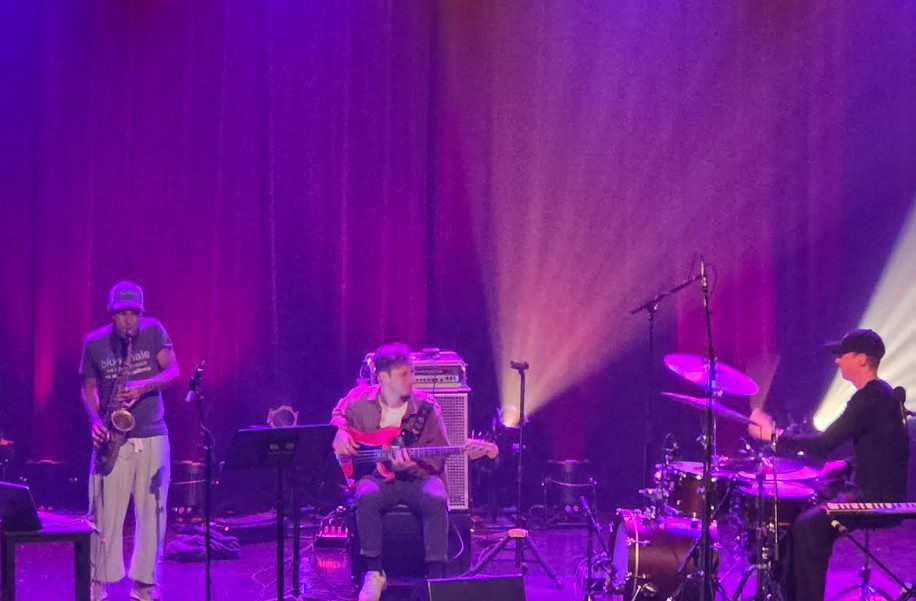
Rachel Therrien: Not exactly. Each musician brings two compositions. They have three hours to choose and rehearse. It takes place at the new jazz club called L’Entracte (1112 Ste-Catherine West), from June 28 to July 3 at 10 p.m.
PANM360: We’ll be hearing from musicians both local and from elsewhere. Did you help choose them?
Rachel Therrien: With the help of a good friend, Simone Leblanc, who is a saxophonist herself. The idea is to bring together musicians from different backgrounds—as well as different generations, English-speakers, and French-speakers—and see what happens. In previous editions, these unlikely concerts have built bridges and fostered collaborations among musicians.
PANM360: Which of these thirty musicians will we hear? Six concerts times five musicians equals thirty, right?
Rachel Therrien: The first two concerts have already taken place. On the 30th, we’ll hear from Quebec singer Marie-Jeanne Paquet; two trombonists from New York, Matt De Leon and Trevor Turla; Jean-Philippe Grégoire on guitar; drummer Aaron Dolman, who works with both rock and jazz artists; and bassist Dave Watts.
PANM360: Just this lineup looks enticing. And it’s going to continue for four more nights. Without naming them all, tell us about some of the highlights. Rachel Therrien: For example, we have Karina Colis and Dan Martinez, two musicians of Mexican descent based in New York, who are members of the cumbia band Chicha Libre, among other groups. We’ll also have Christine Jensen and Bill Mahar, two veterans of the Montreal music scene—and such brilliant artists.
PANM360: What about you—are you going to play on July 1?
Rachel Therrien:Absolutely, and I’m really looking forward to it. I can’t stress enough how much I encourage people to come see the concerts in this series. Because these are one-of-a-kind concerts that will never be repeated. With musicians from truly diverse backgrounds and different origins. You’re going to hear something special.
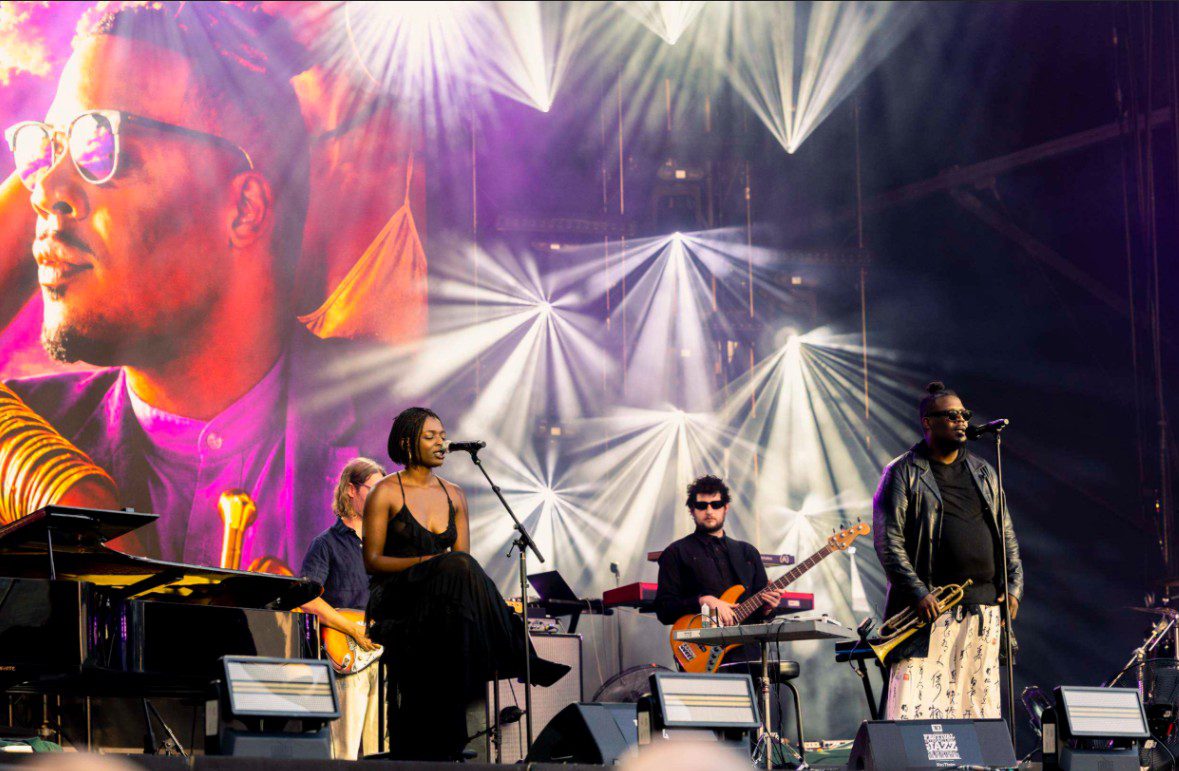
Performing last Monday June 29 on the main outdoor stage of the Montreal Jazzfest, Grammy-winning trumpeter and vocalist Keyon Harrold is touring his genre-bending record Foreverland with a stellar core band: Nir Felder on guitar, Shedrick Mitchell on keys, Brad Adam Miller on bass and Charles Haynes on drums, plus the remarkable participation of a female singer, Ogi (born Ogi Ifediora), Nigerian-American R&B and soul beautiful contralto.
She was joining the jazz band at some points of its performance, and that was the real thing! Where jazz meets actual african american actual R&B and hip hop. Of course, Keyon Harrold is one of the most renowned trumpet soloists in the jazz-pop world, highly acclaimed by a large audience but also respected by purists. Which means a high cred. We of PAN M 360, by the way, have been lucky to interview him a few hours before his MTL set.
This set could have been entitled « Miles and me » by its leader, read this interview to understand how Keyon Harrold is paying tribute to Miles Davis, born 100 years ago.
PAN M 360 : We know you for a while now. The big break for you was more or less a decade ago, and now we jazz lovers follow your career carefully. And you’re back in MTL after you came a few times at this festival. We know as well that you’re involved in many pop or hip-hop or R&B soul recordings for superstars. So many stars! That being said, you’re not in between pop and jazz. You do your own stuff. So how would you describe the last distance of your own path?
Keyon Harrold : I would describe the last couple years as me coming from the back of the stage to the front of the stage. Again, I’ve worked with so many incredible artists and so many different projects, from Raphael Sadiq to Jay-Z, Beyonce, Maxwell, Common, Mary J. Blige, etc.
It’s always amazing and great to do collaborations and be a part of certain things, but it’s also great to basically make my music the focus and to make my art the vehicle for expression. So to have my own messaging is a special thing. I don’t really take it lightly that I respect that process of what it took to get to it.
So the last few years have been basically me saying yes to myself more so than anything. And there’s an issue with being good at many things. It’s because it’s easy to put yourself on the back burner.
So for the last few years, it’s been an orchestrated approach to basically push myself forward, do my own music, do my own shows and prioritize my own objectives and my own music.
PAN M 360 : let’s talk about your own music, the way it’s built right now. So what are you going to offer this summer?
Keyon Harrold : I mean, for this show specifically, we’re celebrating the centennial of Miles Davis. As a trumpet player, I’ve kind of been tapped as the heir of the, you know, I work with the Miles Davis estate, Vince Wilburn, shout out to Vince Wilburn and Aaron Davis, Miles’ son. So we do a lot of work.
So this year we’ve been doing a lot of stuff with the Miles Davis electric band and I’ve been doing tributes, celebrating the centennial of Miles Davis. So I’m infusing some Miles Davis, showing the love that I have and appreciation for who I am as an artist that I’ve taken from Miles Davis. And I’m using that into some of my own music and I’m going to weave it in a very special way. I’m talking, you know, music from Bitches Brew and other things. And we’re just going to, you know, interweave it. And I kind of call it, you know, kind of Miles and me as to the presentation that I’m going to present today.
It’s my music, but also with hints of, you know, the classic Miles Davis stuff, just giving a nod to him. I mean, we did a show at Carnegie Hall, which was, you know, similar to that. So again, I can’t forget about myself when I’m, you know, presenting music, but at the same time, you know, shouting out, you know, the great Miles Davis.
PAN M 360 : So we understand that there are a few tribute concerts on tour; Marcus Miller is doing one, Butcher Brown & Nicholas Payton are doing another tribute to name the ones coming at the MTL Jazzfest.
Keyon Harrold : Yeah, there are others like John Beasley, so he’s doing a presentation called, I think, Limitless Miles. That’s with Sean Jones and Marcus Strickland and a few other guys. So we see that there are a few.
PAN M 360 : Because you’re a great trumpet player, let me ask you what you draw from Miles’ styles? You’re a trumpet player. What do you draw from his style? I know you don’t sound like Miles, you have your own thing. So you take the inspiration and make it your own
Keyon Harrold : You know, you know, again, I’ve, you know, worked on the Miles Davis film with Don Cheadle, basically, you know, which won a Grammy and nominated for a bunch of different things. So Miles, again, was an integral part of who I am as a musician, as an artist, as a trumpet player specifically. That’s important to me.
What I’ve taken was, you know, different concepts, different ways to arrange bands and put people together and trust the process. Basically not doing too much and putting yourself in circles where the musicians can actually add to the music. You know, I don’t want to overwrite different things.I want the artists to be artists.
So the program is an interweaving presentation of my music with Miles Davis inflections on it. You know, I’ll play stuff from Birth of the Cool. I’ll play stuff from Bitches Brew. I’ll play stuff from, you know, some of the classic quintet stuff. The canon of Miles Davis. And again, it won’t be something that dominates my program because it’s my music from my album Foreverland.
PAN M 360 : Like Miles did in a way, because he was a huge artistic director. More than anything. Yes, he’s like more than a player, more than a composer. I think he was the ultimate artistic director.
Keyon Harrold : So, you know, again, it’s just like the point guard or like to, you know, some like a, I don’t want to say a puppet master, but a person who can really foresee these different people together. Like my band, you know, today, Nir Felder, Cedric Mitchell, Charles Haynes, and Dan Mitchell. I know, you know, what they can add to the music that I bring to them.
I know that, okay, I’m going to give them this and they’re going to make it, you know, go this way. They’re going to stretch it this way. They’re going to make it groove this way. They’re going to, you know, stretch the harmonies this way.
PAN M 360 : So you build on their personality.
Keyon Harrold : Absolutely. So, you know, if it was a different group of people, I would do different music. You know, I don’t try to force, you know, force a circle into a square. I allow the people to be themselves and I just float over the top of that. Yeah.
PAN M 360 : Since more than one century, jazz has been a hybrid, played everywhere in the world. It became an international language from African American roots as a starting point. So how do you see yourself in that?
Keyon Harrold : Man, in the canon of really dope music, you know, from the African diasporic traditions, I feel like I fit in it really, really, really, really well. So there’s no doubt about that.
You know, again, culturally and just understanding, you know, the idea of the groove, understanding the idea of, you know, the soul that must be a part of each song, that must be a part of each show. You know, the truth that I must bring to it comes from, you know, it’s built on a struggle. But at the same time, that struggle turns into a certain level of joy.
So I don’t take that for granted that I’m using, you know, my gifts, using my stories, using my energy to basically uplift the community, uplift anywhere I go in the world. It’s not, you know, I don’t take it for granted that I get a chance to, you know, basically uplift people. And it’s a beautiful thing.
Photos by Frédérique Ménard-Aubin
Publicité panam
Ascenseur pour l’échafaud is a legendary soundtrack. Miles Davis improvised it in a few hours, during the night of December 4 to 5, 1957. Its muted, nocturnal atmosphere has become an iconic signature of a certain style of urban film music, and has been copied many times since. In 2026, the Montreal International Jazz Festival will celebrate the centenary of the birth of the famous trumpeter. One of the programmers’ ideas was to ask Montreal trumpeter Rémi Cormier to recreate the famous score live with the film projection. But, as Rémi Cormier says, Miles would probably never have wanted his music to be foolishly replayed note for note. The Quebecer therefore proposes HIS version of this unforgettable music. What will it consist of? Find out by listening to the interview I conducted with the musician.
Originally from Guadeloupe, Marvin Caleb is part of a new generation of artists redefining Afro-Caribbean sounds. As a singer-songwriter and producer, he has been shaping a musical world since childhood where zouk, Afrobeat, R&B, and hip-hop blend together naturally. Inspired by artists ranging from Bob Marley to Admiral T, he developed a passion for music creation at a very young age through beatboxing and production. Following Love, Engage in 2023 and Smiley Days in 2024, he released Siwo Boy in 2025—a deeply personal project that celebrates his roots, his perseverance, and the journey he’s taken despite his doubts. A nominee for the 2026–2027 Radio-Canada New Artists Awards, Marvin Caleb continues his rise with a distinct artistic identity.
To mark his appearance at the Montreal International Jazz Festival, we’re sitting down with him to talk about his career, his influences, and the music that bridges cultures.
Publicité panam
Publicité panam
Publicité panam
Rachel Therrien, a Quebec-born trumpeter and composer, is a constant presence at the Montreal International Jazz Festival. Today, June 29, she will be performing at the Upstairs Jazz Bar & Grill with the Canadian all-female jazz supergroup The Ostara Project. Our contributor Michel Labrecque spoke with her about it.
PANM360: Rachel, can you tell us about The Ostara Project, an all-female jazz group that isn’t very well known here?
Rachel Therrien: It’s a pan-Canadian group that was founded in 2022 by Jodi Proznick, a double bassist from Vancouver, and Amanda Tosoff, a pianist from Toronto. We’ve released three albums, the most recent of which is titled *Roots*. It’s an ensemble made up of “band leaders”—women who lead ensembles and have their own solo careers. The lineup includes Quebec drummer Valérie Lacombe and saxophonist Claire Devlin, who is originally from Ottawa but lives in Montreal. And for this tour, we have Kim Zombik on vocals. The lineup changes frequently.
PANM360: Could we compare the Ostara Project to the American all-female supergroup Artemis, whose members have included Cécile McLorin Salvant and saxophonist Melissa Aldana, among others?
Rachel Therrien: It’s exactly the same concept. Beyond the music we make together, the Ostara Project—like Artemis—is a platform that showcases the work of each of us, as well as that of other female artists who collaborate with us.
PANM36: What does it mean to create music among women?
Rachel Therrien: We’re experiencing what men have been experiencing for ages in their all-male bands, and it feels great (laughs). My first experience with an all-female band was the Diva Jazz Orchestra, an all-female American big band that’s been around for 35 years. But this time, it’s a smaller ensemble with an extremely high musical standard. We all know how to organize a tour. That helps us connect with each other as women. Recently, we played with Edmonton trombonist Audrey Ochoa, who is fantastic.
PANM360: Do the two concerts tonight, June 29, at the Upstairs Jazz Bar & Grill mark the end of Ostara’s current tour?
Rachel Therrien: Since June 19, we’ve been touring all over Canada. After the Ottawa Jazz Festival, the tour wraps up in Montreal.
PANM360: Rachel Therrien, this concert is just one of your performances at the Montreal International Jazz Festival. We’ll continue our conversation tomorrow.
Rachel Therrien: Great, I still have a lot more to tell.
Crédit photo: Frédérique Ménard-Aubin
Publicité panam
Adrian Quesada, a guitarist and producer based in Austin—the most musical city in Texas—isn’t very well known in our part of the world. Back home, he’s recognized as a musician who reinvented Texas Latin music, also known as Tejas, from the time when that territory belonged to Mexico.
“I’m binational—I have Mexican parents, but I grew up on the American side of the border. I’m bicultural and even multicultural, and that largely defines my sound,” Adrian Quesada tells me during our chat.
On June 27, Quesada performed an instrumental concert with his Trio Asesino, a new group created by the guitarist that has just released an album. The virtually unknown quartet found itself playing to an impressive crowd…who had come to see Angine de Poitrine two and a half hours later!
This is Adrian Quesada’s second appearance at the FIJM. The first time was with the legendary Austin band Grupo Fantasma, which formed in the early 2000s and occasionally performed with Prince.
“It’s a band that revitalized Latin music in the United States,” says Quesada. “There were ten of us, influenced by cumbia, salsa, African music, and rock. There was a lot of improvisation, a bit like in jazz. For me, those were very formative years.”
Grupo Fantasma still exists, but Adrian Quesada left the band more than a decade ago. He won the 2011 Grammy for Best Latin Rock Album. Back on the TD stage, Quesada and his trio of “killers” captivate the crowd with long instrumental pieces, during which the Black organist in a cowboy hat lets loose with some wild solos. The result is a cinematic sound that lifts you up, with influences from Latin, jazz, and rock. It’s not the microtonal rock of Angine de Poitrine, but the audience is tapping their feet.
Another musical project by Adrian Quesada is called Black Pumas. It’s a soul-oriented duo that sings in English, featuring vocalist Eric Burton (not to be confused with the British singer Eric Burdon).
“I’ve always wanted to make soul music; I’d written a few instrumental pieces, and someone introduced me to Eric Burton, who brought his songs, and that led to two albums,” Quesada said in an interview. The band’s success surprised Quesada. After two albums, released in 2021 and 2023, the band went on hiatus.
Adrian Quesada is involved in a variety of different projects. One such project, Boléros Psicodélicos, was formed and released two albums, in 2022 and 2025.
“At first, I wanted to pay tribute to Mexican bands from the ’60s and ’70s, who started blending Latin influences with rock and California surf music. Then I added my own compositions and brought in singers from both the United States and Latin America,” the guitarist explains in an interview. He adds that this project was conceived during the COVID-19 pandemic. I love these two albums.
“Psychedelic”—or “Psicodélico” in Spanish—is a term that often comes up when describing the Texan’s music. It serves as a sort of common thread, but this psychedelic sound is constantly updated with more contemporary influences.
Speaking about his recent project, which he presented to us on stage on Saturday, he told us: “I wanted to create a more intimate project featuring instrumental, cinematic music. I was listening to jazz trios and wanted to recreate that atmosphere a bit.”
The TD Stage, which was set to host Angine De Poitrine, may not have been the ideal venue for fostering a focused listening experience. Nevertheless, in the media area, this group sparked curiosity. We’ll have to wait and see what comes next.
Adrian Quesada hasn’t finished surprising us: his next album will be the result of a residency at London’s Abbey Road Studios. “It will be largely devoted to hip-hop, one of my passions since I was a teenager,” he admits. Why not?
I haven’t told you everything. Explore Adrian Quesada’s world, and you’ll find other gems. I had one more question before saying goodbye: What’s happening with Austin’s music scene? This city, historically known for its musical diversity, is experiencing rapid growth thanks to the many high-tech companies that are profoundly transforming the region.
“The music scene is still very much alive; the problem, of course, is the astronomical rise in rent. But people, including newcomers, continue to support music. And the music community looks out for one another.”
That’s good to hear. Good luck moving forward under the presidency of this man who doesn’t even deserve to be named.
Photo Benoît Rousseau
Publicité panam
In recent years, California jazz has been closely associated with this community led by tenor saxophonist Kamasi Washington—a community in which several artists work at the intersection of 1960s acoustic jazz, hip-hop, and electronic music. One naturally thinks of Thundercat and Terrace Martin, among others, many of whom had collaborated on Kendrick Lamar’s recordings a decade earlier. However, there are other creative communities in Los Angeles, starting with the extended family centered around drummer, singer, rapper, composer, and big band leader Louis Cole. Colombian keyboardist Isis Paola Giraldo, who lived in Montreal for many years, is part of the big band, in addition to leading her own project, Chiquita Magic, with the superb drummer Justin Brown. They performed this weekend at Le Balcon and were joined by Louis Cole and David Binney late Thursday night into Friday.
Earlier, the Louis Cole Big Band had delighted thousands of festivalgoers at the event. Two singers dressed in medieval armor (no, this isn’t an ad for Bélair Direct) roamed the stage while the drummer, on the right side, pulled off one percussive feat after another, all while singing and conducting this large ensemble of excellent musicians. We’d seen him two years ago at Studio TD; Louis Cole has struck the perfect balance between entertainment, humor, and complex creativity—that is, electro- and hip-hop-inspired grooves (breakbeats, house, jungle, drum ’n’ bass, footwork, etc.) lie at the heart of the rhythmic framework of an orchestral composition entirely centered on these new grooves, which dictate the wind instruments’ parts and their harmonic support.
The following day, Friday at the Gesù, veteran saxophonist David Binney and his Action Trio allowed us to discover another facet of Louis Cole’s work. With the support of the excellent Serbian bassist Pera Krstajic, David Binney once again finds a way to refresh his sound; he remains a virtuoso on the alto saxophone, always in tune with the freshest and most contemporary jazz of the moment.
And since David Binney and I have known each other for 35 years, it was relatively easy to gain access to the green room for this conversation. Anyone who truly loves jazz will enjoy the story of this extended family!
David Binney : Good to see you!
PAN M 360 : Good to see you! Well, you know, I had this idea to have a chat with you and Louis (Cole) and Pera (Krstajic), so if that’s fine with you we can chat.
David Binney : All three of us , it’s a band, you know.
PAN M 360 : So how are you?
David Binney : Okay. Okay. All right, let me just get Louis.
PAN M 360 : Did you fly from L.A. to here?
Pera Krstajic : Yeah, we did, but we got here two days ago to play the Louis’s big band show yesterday.
PAN M 360 : Yeah, I saw this gig. Great! I also saw the gig two years ago also at the studio. Were you there?
Pera Krstajic : No, this was my first time playing.
PAN M 360 : Is it your first time in Montreal?
Pera Krstajic : Yeah. That was great so far.
PAN M 360 : Yeah, that was a great gig yesterday.
Pera Krstajic : Thanks, yeah. We had a lot of fun. It’s a good city. Very vibrant, yeah. I didn’t realize that this is such a big festival.
PAN M 360 : Well, it’s huge. Well, it’s probably the biggest on this continent.
Pera Krstajic : Right, yeah. Pretty crazy.
PAN M 360 : All right. So, I know David since like maybe 30 years, something like that.
David Binney : 1990, I think. Yeah, something like that.
PAN M 360 : So, 35 years. Well, we don’t chat every year, but once in a while we catch up. And it’s time to catch up because I like all this new bunch of people coming from Los Angeles; your Action Trio, Louis big band which includes you guys and also Chiquita Magic, Isis Giraldo.. Well, what happens with you, with Louis. And I also, as I said, I know Isis Giraldo because she lived in Montréal and was involved at the Café Résonance where she played a lot.
David Binney : Yeah, we played with Isis late night until 3 in the morning, that was an epic night!
PAN M 360 : And you Louis, how did you meet Isis Giraldo ?
Louis Cole : She was at my friend’s wedding. I have a band with Genevieve Artadi called Knower, and our mutual friend, Hans Berhnard, who also studied in Montreal, played bass. And so isis liked what we did at the wedding.
PAN M 360 : Well, I found out that she was playing in your big band 2 years ago when you came at Studio TD. So, Thursday I saw this band for a second time. I also listened to your project with Jules Buckley and Metropol Orkest. So he was very loyal to your sound.
Louis Cole : Well, I mean, he let me do all the arranging and all the orchestration and stuff. So he was cool in that way. So I think it was easier. So, I mean, which was one of the reasons I wanted to work with him, because he was like, yes, you can do all this stuff.
PAN M 360 : After your writing, he was conducting.
Louis Cole : Yeah, which is, I didn’t really know what level of importance that had or what exactly the details of that job were. But after seeing it, he really knows how to structure a rehearsal and pull, like, a good sound out of the orchestra. And basically take, you know, like, I tell him kind of the best way I can what I want, and he does a good job of, like, getting that performance out of the Metropol Orkest.
PAN M 360 : And did you experience with other big ensembles like that?
Louis Cole : We had one orchestra gig in London once, which was, like, people that he knew personally. His own orchestra, I think, that he put together, which was amazing. Yeah, they sounded great.
PAN M 360 : And what happened in the last chapter of your evolution, of your ensemble, your artistic direction, the way you want it to be?
Louis Cole : Like, what I just released most recently?
PAN M 360 : Yeah.
Louis Cole: Well, I mean, that was, like, the orchestra thing. So, I don’t know. I mean, it would be cool to do that again, but I’m trying to figure out what the next thing is. I’m just writing every day.
PAN M 360 : That’s always like that
Louis Cole :Yeah.
PAN M 360 : And sometimes something emerges, and that’s it.
Louis Cole : Right.: Yeah, I mean, I know that if I just give it some more time, it will start to take more of a shape. But for now, I’m just kind of writing and seeing where the inspiration builds to.
PAN M 360 : What is very interesting is ithat it’s always entertainment at the same time. So, you have a creative quest, and also you love to generate some fun.
Louis Cole : Yeah, I mean, I guess I try to stay true to what I would want to channel through the music. And we’re always, like, screwing around all the time. So, I mean, it’s pretty genuine, I think.
PAN M 360 : Yeah, it happens naturally. Also it’s a big tribe, so it has to be organized in a way.
Pera Krstajic : Yeah, but everybody’s a professional in this process. We know our job. Nobody’s raging , so, we don’t have to be, like, a bigot or anything. Everyone’s a friend, basically.
PAN M 360 : And so, what would be the next project in the next six months or one year?
Louis Cole : I mean, I’m just going to keep writing every day.
PAN M 360 : Is it a sort of permanent workshop?
Louis Cole : Yeah, I mean, I won’t call up the band members until I know for sure what the music is. You know, until I write the music and arrange it. At least as long as I’ve done music, it’s always been like that.
PAN M 360 : Well, this is the way to build a real building.
Louis Cole : Yeah, I think so, too. Yeah.
ABOUT ACTION TRIO
PAN M 360 : Now, let’s talk about Action Trio. So, maybe I’d like you to remind of your relationships with all of you.
Louis Cole : I mean, I was together in a relationship with Genevieve Artad. And Dave Binney was hitting on her at the jazz club. Genevieve stayed in touch and sent our music to Dave. And I’d heard of Dave, too.
David Binney : Let me tell, because there’s a couple more details. So, there’s Genevieve. We’re both in… it’s packed. What was that gig, by the way? I don’t remember what the music was, but it was packed. Genevieve’s there, and I say something to her. And you know Genevieve is, she’s just hysterically funny right away. We start laughing. And then I kept asking her if she wanted a beer. I literally asked her like five times. And she finally said yes. And then I was like, wow, okay, great. I’m drinking a beer with her, and then you come over.
And she goes, oh, this is my boyfriend. And you just remember it like it was yesterday. You just like, kind of a, hey, how are you doing? And then you just took off. I was like, okay. But she sent the music that they were doing. And I listened to it, and I was like, wow, this is great. And then he emailed me the next day. I was like, dude, I’m so sorry. I didn’t know that was you. I’m a fan of your music. Wow. And then from that point on, we’ve been super close. It’s like a family. And we’ve done tons of music together. And it’s like a family.
And then I met Pera in Serbia, in Belgrade, Serbia. In Belgrade. And he was 18. And he was at a gig that I was playing with Vasil Hadzimanov. Vasil was in my band in the 90s in New York. But I didn’t know that he had gone back to Serbia, but I hadn’t talked to him in years. And he asked me to come over and do a tour. And I went and did a tour.
Pera Krstajic : There was like the acoustic part of the gig, which I played, and then the electric, which actually you guys kept touring with that band.
David Binney : And I had no idea that Vasil was famous in Serbia. His parents were famous, and he’s famous. And so we did this kind of cool tour. And I kind of fell in love with Belgrade and the whole thing. We started a trio there, kind of similar to this one. And Pera and I became friends and we started this Action Trio, I ended up marrying a girl from there. So I was going a lot in Serbia so we would hang out together and then Pera came to the States, down in LA and we started this trio since.
Photo credit Louis Cole Big band: Benoît Rousseau
Publicité panam
The Montreal International Jazz Festival continues this Sunday, June 28. As the festival’s lead jazz programmer under the artistic direction of Maurin Auxéméry, Modibo Keita shares his picks for DAY 4 of the 2026 FIJM! Every day of the festival, Modibo offers jazz lovers the perfect itinerary for PAN M 360!
WATCH THIS INTERVIEW CONDUCTED BY ALAIN BRUNET
Publicité panam
The Montreal International Jazz Festival continues this Friday, June 26. As the festival’s lead jazz programmer under the artistic direction of Maurin Auxéméry, Modibo Keita shares his picks for DAY 3 of the 2026 FIJM! Every day of the festival, Modibo will be back with the best itinerary on PAN M 360!
WATCH THIS INTERVIEW CONDUCTED BY ALAIN BRUNET
Publicité panam
For me, Cammac is not a music camp, it’s a music center. The artistic director of Cammac, Guylaine Lemaire, thus clearly and unequivocally summarises the expanded role played by the center that has long been called “the Cammac music camp.” Of course, the primary vocation, which is to offer amateur musicians the opportunity to spend a week of artistic immersion under the guidance of teachers from the professional field, remains. But the portion dedicated to the weekly concert series (Musical Sundays) for participants and occasional visitors who come solely for the concerts. I spoke about the 2026 concert series, which will take place from June 28 to August 16, with Guylaine Lemaire.
PanM360: Hello Guylaine. Cammac is an institution with a long history…
Guylaine Lemaire: Indeed. In 2028, we will celebrate our 75th anniversary.
PanM360: Even though the summer concert series isn’t that old, it remains a cherished event.
Guylaine Lemaire: Yes, the audience is increasing, with many people who are not necessarily participants in the intensive camp weeks. It’s very good, because it allows the organization to shine. Moreover, not everyone has the opportunity to invest in learning an instrument and spend a week at camp to improve with a professional teacher. There is also room for those who simply want to come listen to a beautiful concert of about an hour on Sunday morning, and spend the rest of the day in a beautiful place if they wish.
PanM360: And enjoy a brunch while they’re at it!
Guylaine Lemaire: Yes, the concert with brunch package is very popular. The concert is at 11 AM, the brunch follows. For those who want to, of course. You can choose to attend only the concert and then go have a picnic on the site afterwards. It’s very flexible.
PanM360: Let’s talk about the 2026 series, which runs from June 28 to August 16. As usual, are there generally artists who are also at the camp to teach?
Guylaine Lemaire: Yes, for the most part. This also informs my programming. Since we have several different themes for the eight weeks of camp (chamber music, vocal music, early music, jazz, etc.), the programming also reflects this guideline. Our first concert, on June 28, features Denis Plante on the bandoneon and Stéphane Tétreault on the cello in their show Stradivatango. It’s the beginning of our intensive cello week. Imagine, the day after the concert, the participants will be able to enjoy Stéphane’s presence for the day!
The following week, Francis Colpron will lead the early music workshops. There will therefore be a concert by him with Les Boréades on July 5, The Passion of Reason.
PanM360: I saw a concert on July 11th with Annette Bauer (on flutes) and Ran Wang, who plays the Chinese guzheng. Silk Road Journals: Echoes from East to West
Guylaine Lemaire: Annette gives flute workshops. I saw that she had this project with Ran, which allows me to broaden the horizons of the series This is also part of CAMMAC’s DNA. The concert on July 19 will be exceptional: the Cobalt Quartet will come to play Schubert and Ravel to conclude the chamber music week they will have led. An important moment of the summer, if I may say so.
I would also like to highlight the following concert (July 26), that of the harpist Annabelle Renzo with the cellist Julian Armour. It will be the concert that concludes the Wellness Week. It’s called Echoes of Peace: Cello and Harp. A very beautiful concept brought to life by Annabelle, who offers year-round musical events related to the idea of well-being, both physical and mental (such as music/yoga concerts, for example, or forest walks). The theme of this year’s concert is hypnosis. Not the kind of hypnosis that’s silly like in illusionist shows, of course. Rather of a meditative and beneficial kind.
PanM360: It will end with three very different concerts…
Guylaine Lemaire: Just like Cammac’s activities! On August 2, the guitarist Michel Beauchamp, a teacher highly appreciated by the participants, will present a program focused on Latin America. Then, on the 9th, it will be jazz’s turn to shine with pianist Guillaume Martineau, who will be joined by Gabriel Paquin-Buki on clarinet. They will explore jazz, of course, but also klezmer rhythms and melodies, in addition to many other things. The title is inviting: A Night in the Garden of Eden
PanM360: Guillaume Martineau is a former Cammac participant, right?
Guylaine Lemaire: Yes. And I am happy to say that it was here that he discovered jazz! He was only doing classical music at the beginning. Then, after workshops with bassist Éric Lagacé, he fell in love with this music. From now on, he plays both classical and jazz.
The Musical Sundays series will conclude on August 16 with a female vocal quartet, consisting of Kerry-Anne Kutz (who will be one of the vocal teachers at the camp), Julie Leblanc, Monique Fauteux, and Catherine Léveillé. They will present a program of popular songs arranged by Simon Leclerc.
PanM360: Thank you for this interview. Have a great summer!
Like other local jazz artists—such as Hugo Blouin, Cédric Dind-Lavoie, and Sébastien Sauvageau (L’Oumigmag)—the Solarium Quartet blends traditional Quebec, French, and Celtic music with contemporary jazz. Louis Plouffe on saxophones, Karl-André Rozankovic on piano and keyboards, Vincent Dessureault on double bass and bass, and Léo Minville on drums and guitar are dedicated to blending our Francophone cultural heritage in the Americas with a universal language: jazz. Karl-André and Léo explain their approach and the trend, as well as the story of their journey and their recent live recording.
Solarium will perform at the FIJM 2026 on July 4 at 5 p.m. and 7 p.m. at Pub Molson
Watch this interview below, conducted by Alain Brunet
Publicité panam
On Wednesday June 24, I had the chance to have a conversation with Wendy Eisenberg in anticipation of their performance with Bill Orcutt as part of Suoni Per Il Popolo on Thursday June 25. Eisenberg shared their feelings going into this concert and what it’s like to go from their songwriting work to improvisation. They shared how their latest self-titled album helps them connect to their past self. This conversion illuminated the connections between musical practices rather than defining what separates them.
PAN M 360: So could you tell me about this concert that you’re coming to do? Because you’re doing it as a duo. And what shape is that going to take?
Wendy Eisenberg : So yeah, it’s just me and Bill improvising, presumably just on guitars, which is kind of a dream. This is probably one of the stranger duo concerts. things that I’ve ever done because Bill’s been a band leader you know for me for like a couple years now, like three years so we’ve never played like a proper duo in our entire time playing together but we’ve played next to each other internationally so I’m kind of nervous in a really rare way. Especially, because you know, I’ve been really so focused on song stuff for such a long time. This past year has been filled with, like, my songs, so returning to being an improviser is.
It’s not daunting because, like, that’s what I love to do, but it’s daunting because it’s like I’m playing with somebody who is/was kind of my boss and also playing in an idiom like duo guitar, which I haven’t really done with him. And he’s also got such a unique style. So I’ve just been trying to think, like, what kind of sound should I bring? What am I going to do? But in general, yeah, it’s just going to be us improvising together. It’s a pretty normal thing to do. Nevertheless I got to treat this one even more special.
PAN M 360: Yeah, having like the dynamics shift in a way seems kind of like an interesting energy.
Wendy Eisenberg : Yeah, it’s funny. I’m just kind of freaked out in a really hopefully generative way. I gotta say, it’s really exciting and before I started playing with Bill I was a huge fan. so it’s really cool to go kind of toe to toe and figure out how we’re gonna sound together.
PAN M 360: Compared to playing your songs that you’ve been playing for the last year, as you said, how does the mindset going into performing or your relationship to performing shift compared to improvising?
Wendy Eisenberg : The stakes are really the same for me all the time. It’s like, how can I open up, like, my heart in the music no matter what so that, like, the audience can feel that I’m doing that? Because with songs and with improvisation, it’s like they’re both really only successful if you’re playing something that you really mean. And it’s funny because, like, on the song side of things, the material you can think of as already existing, like, I’m playing this thing that I wrote before. But every single time you do it, it will feel different because you’re just in a different place and you’re like a different person related to the piece that you made. And it’s just, it’s weird.
Like, it’s almost like you’re still totally improvising, but it’s on a much subtler, almost like psychological level where how do I convey what I meant and also what I now mean when I hear these lyrics.
And when I write songs, I’m trying to make it so that every time I play them, I mean it for the first time. And I, like, I know that a song is good when I, like, I can imagine myself playing it when I’m, like, I don’t know, 50 years older and I still can feel how I felt. But with improvisation, because there’s no set-up on material, the stakes are kind of higher because you’re like ‘I have to make whatever’s happening really beautiful and urgent’ but you don’t have that much time to think about that because you’re just solving the musical problem.
So in either case you’re just trying to like clarify your mind and be like ‘okay, I know I love music, I know I love the people I’m playing with, so how do I get as far out of the way as possible so whatever’s happening it’s all intention rather than like all premeditation’ […] roundabout way of saying like it actually feels really similar but the thing like the audience knows what to listen for more in songs […] it has fewer parameter but we have to mean it just as much.
PAN M 360 : You’re very prolific, obviously, and you have so many albums of songs out. How much are you returning to these older songs? Are you always pushing forward? I feel like being an improviser feels like you’re interested in new things often.
Wendy Eisenberg : Yeah, one of the things that inspires me about Bill’s improvisation is that he’s kind of an improviser that’s not always interested in novelty, like he’s interested in action and intensity and emotion more than sound that I can make out of this thing. Because like his sonic power is just, he knows it’s amazing so he’s just kind of like, it’s not like he’s recombining but it’s kind of closer to somebody like Cecil Taylor than somebody like, I don’t know, SOPHIE, where it’s like what’s the newest sound that I can refine out of this thing? Yeah. But, yeah, like, with him, it’s more like I’m carving this sound that I’ve carved before, but it’s never going to sound like I carved it before. He’s got that thing that a lot of great jazz improvisers kind of have, too, where it’s, like, every moment that he’s playing, it feels like he’s discovering something new. And it is on the timbre level, but he’s kind of, he’s a little bit different than that.
And the reason I’m kind of bringing that up is like, you know, because it’s pretty far from the question you asked, is that I always want to play my older songs. I think that a lot of them are really good, and the only obstacle to it is that, like, they just have really dense harmony, so if I’m playing them with a band, it’s harder But when I’m playing alone, like, I’ll just dig something out from a record from 10 years ago and do it. Because it’s just amazing to see, like, the kind of, like, sonic choices just recur. Like, I’m still kind of trying to write the same, like, eight songs that I started off writing when I was 12.
You know, it’s a really cool question. But I think the improvisers mentality is how do I just really mean it in that moment? And sometimes that means going for like a sound I’ve never heard.
And sometimes it means playing a much more familiar song, except from the first person who’s discovered it.
PAN M 360 : I feel like you hear that in Bill’s playing anyways, the kind of idea of like, it’s like once it happens, it’s the most obvious choice, but it still can be surprising in that way, like in the way that like narrative can be, for improvisers it’s like well you had to do that like it’s almost like there wasn’t any other option, anyway I don’t know where I was going with that…
Wendy Eisenberg : yeah no I’m so that is such a perfect read of that and also like that thing that you’re noticing where it’s like yeah that would be the obvious choice and I’m surprised to me that’s like how you define like a hook in a pop song. Like, it’s so obvious that it always existed, but then you’re like, wait, no, it didn’t. And then now it’s the only thing that’s in my mind.
PAN M 360 : Yeah, it’s like the first, the songs that, like, stick with you probably for 10 years or since you were 12 are things that just have to exist in a way.
Wendy Eisenberg: Yeah, yeah like just beyond human and then you catch them or something
.
PAN M 360 : Being possessed by the muses or something.
Wendy Eisenberg: I know, it’s so funny to talk about because it makes me sound like you’re wearing a beret, but it’s super true.
PAN M 360 : Also, you’re playing guitar, obviously, as you do. Wendy Eisenberg: I hope so.
PAN M 360 : obviously it’s the instrument you’ve played the most and has followed you for the longest time, but is there something beyond that makes it special in a way?
Wendy Eisenberg: Yeah. Oh, man, that’s such a cool question. Yeah, I mean it’s an amazing instrument for a thousand reasons, but what’s special about it to me beyond just it’s just how much it bears. The guitar is such a weirdly global instrument and every culture can mess with it in different ways.
Bill’s got the missing strings thing, which is so amazing. […] That’s not the only thing, but that’s an aspect of his thing. You know, like that’s one, it’s not even like a sonic lineage, it’s material, there’s not one way to play it. And then there’s people in Thailand who scoop out the frets and treat it almost like sitar vibes, but it sounds like the Delta Blues kind of style. And then there’s people obviously in the desert, various African deserts that have different playing styles from each other. And that’s another specific style. And what’s so cool is all of it just sounds exciting. Maybe this is settling me as a creature of the 20th century and not the 21st, but whenever I hear a guitar, I’m just excited. […] And, yeah, it just feels like an instrument that’s, like, mediated by technology in the same, like, it’s electric, in the same way that we are, which I’ve never really thought about, but I’m working, so I’m thinking.
PAN M 360 :Yeah, like, the fact that it’s so associated with voice, a guitarist singer is such a classic.
Wendy Eisenberg: Yeah I mean Leonard Cohen’s like different from Elizabeth Cotton but like they’re pretty close but they’re so far away. It’s amazing that they came kind of from the same century. I just think about Leonard Cohen all the time too, not just cause you’re in Montreal.
the guitar, it’s not subjugated under the voice but it’s a little pal for the voice, for so many people. So then when you’re in an environment like what Bill and I will be playing tomorrow It’s this thing of its own, and it’s actually somewhat closer to a bowed string instrument, like in a quartet, you know?
[…]
an instrument of accompaniment for the human struggle for so long. Yeah, yeah. It’s so beautiful.
PAN M 360 : This year your released wendy eisenberg by wendy eisenberg How do you decide now it’s the time for the self-titled kind of introspective album versus these countless other more collaborative projects
W : First of all, I do everything in my life, like, halfway unconsciously.[…]And for this self-titled record it wasn’t like, okay, now this is Wendy Eisenberg, so all of those other people who are billed as Wendy Eisenberg in all of these different collaborations was not the entirety of me also.
These are the songs that I’d written when I was younger and, like, didn’t have those, like, younger, like, 12. […] Like, it’s really, a working title for the record was Little Wendy. I was, as you can probably tell from the song, a sensitive, kind of dreamy kid. I really wanted to write songs to do it, to kind of learn every single thing about what makes a song good, from like jazz harmony, to all of this like massive study that I’ve done in my life, like has all been towards the service of like communicating what I wanted to have communicated as a child. […] And whenever I wrote these songs, I knew they were done because I felt like I was either singing to my younger self or as my younger self because like the life that she had wanted had finally arrived for me. So I don’t really know if I drew a line exactly, but I just wanted to do my little self a solid. It felt more humane to call her by our name. Even though Little Wendy is really cute.
PAN M 360 :That is really adorable. And I think, like, the, it’s kind of like the time-traveling album
Wendy Eisenberg : Oh, totally. Yeah. Thanks for knowing that. It’s so cool that you hear that. I’m so moved.
PAN M 360 :not, not a collaboration. It’s just one through time or something
Wendy Eisenberg : Time Machine! Time Machine collaboration. Yeah, I mean I think that when I wrote that I was like, maybe I need to get out of whatever I’m doing. A cool way to do that is probably time travel although I’ve only done it sonically.
What I will say is that the link is always, you can’t write a song without messing around on the guitar which is technically improvising.