At the crossroads of electronic music, live performance and the visual arts, Hakeem Lapointe – under the name Amselysen – is developing an artistic practice in which sound texture becomes matter for thought, feeling and transformation. In this case, exploring this fantasy, the quest for the ideal perfume of a serial killer, no less.
Inspired by attentive listening to the world, the project draws as much on the poetry of field recording as on the deconstructed aesthetics of artists such as Oneohtrix Point Never, to compose works in which the boundary between composition and environment is blurred. Artist and curator for this edition of EAF x SAT x Tropisme, Amselysen wears many hats, navigating between the stage and curation with a resolutely experimental approach. Each performance becomes a field of exploration: a living space where sounds captured, transformed and reinterpreted take shape in the moment.
In the run-up to this program, conceived as an immersive, sensory experience (Saturday, May 31 at the Society for Arts and Technology – SAT), Amselysen shared some thoughts on his artistic journey, conceptual influences, relationship to the stage, and vision of out-of-format music. For PAN M 360, Félicité Couëlle-Brunet interviewed Amselysen and produced the following video montage.
The Classica Festival offers an original encounter with the cello, performed four times and exclusively by women, on Wednesday June 4 at Boucherville’s Sainte Famille church. A cello quartet, led by cellists Chloé Dominguez, Justine Lefebvre, Noémie Raymond and Kateryna Bragina. Those who play this instrument love to get together. Proof of this are the numerous ensembles of 12 cellos (I’m thinking of the Berlin Philharmonic, among others) and their respective albums, which have often reached the top of the classical charts. Here, four of today’s finest Quebec performers will offer a program in tribute to the instrument, but also to such composers as Isabella Leonarda, Nadia Boulanger, Hildegarde de Bingen and even Charlotte Cardin! A few males (one imagines them benevolent) mingle with the list (Piazzolla, Debussy, Monteverdi…). I spoke to the radiant Chloé Dominguez about all this.
On May 29, violist Elvira Mishbakova and pianist Meagan Milatz will perform an Ad Lucem concert at St. Andrew’s Presbyterian Church in Saint-Lambert. A project about hope in these difficult times, and about music as a vector of healing in this chaotic world.
Russian-born Elvira Misbakhova, currently principal violist with the Orchestre Métropolitain, talks to PAN M 360’s Judith Hamel about the concert, her musical choices and the bond between her and her stage partner.
PAN M 360: In this concert, you’ll be playing a duo with pianist Meagan Milatz, with whom you’ve often shared the stage. What unites you musically? What makes this collaboration special for you?
Elvira Mishbakova: The joy we share when we play together is immense! I think that if the musicians don’t talk much during their rehearsals, that’s fine, because everything happens through musical conversation, looking at each other and listening to each other. We understand each other instantly, and our reflexes, reactions and comments are always in tune! When work is based on trust, open-mindedness and musical flexibility, everything goes well.
PAN M 360: In your program notes, you describe this concert as a reflection on hope in difficult times. Can you tell us more about this idea?
Elvira Mishbakova: I chose the repertoire that resonates a lot with hope and enlightenment. When people come to concerts, I think they want to leave with different impressions, emotions, appreciation, maybe even with some learning, but also they come to events, to concerts to relax, to detach themselves from their reality, to dive into a moment of reflection, maybe find peace, and calm… or simply they are guided by their curiosity and admiration for classical music and this magnificent Classica Festival! Our idea for this concert is to share these moments of reflection, the moments of peace and calm, the moments of hope, because music has that rare power! It heals us, it unites us, it consoles us and it lifts us into the future, even in difficult times.
PAN M 360: The program for this concert spans several centuries and very different styles, from the Russian Romanticism of Glinka to the contemporary music of Kelly-Marie Murphy. What links all these works together?
Elvira Mishbakova: Light in its various states. I tried to find the reflection of light in each work. Sometimes the light is pure, as in Pigovat’s Magnificat, sometimes it’s inward and dark, as in Britten’s Elegy for solo viola, or it’s a beacon in the darkness, as in Arvo’s Part Fratres, or simply, it’s a hope for forgiveness in Max Bruch’s Kol Nidrei. The light is different, but it’s always there for us! If the audience could imagine that, or search with us for their vision of light in each piece, it would make us very happy.
PAN M 360: Kelly-Marie Murphy’s Ad Lucem will receive its world premiere. How did this work come to you?
Elvira Mishbakova: In fact, it’s a Quebec first! When I had the idea of this Ad lucem project (with the recording of an album), I immediately thought of commissioning a work from a Canadian composer, and as I admire Kelly-Marie Murphy’s music enormously, I suggested that she write a piece for viola and piano to be called Ad lucem, and she accepted with great enthusiasm! Meagan and I can’t wait to present it at our concert at the Festival Classica.
PAN M 360: Can you tell us a little more about Ad Lucem? What will the audience be able to hear and feel?
Elvira Mishbakova: The repertoire is very varied, with pieces from the classical, romantic, post-romantic, modern and contemporary eras, so there’s something for everyone! The audience will hear the original works written for viola and piano, as well as arrangements made by other violists to broaden our repertoire. It has to be said that the viola, as a solo instrument, is increasingly taking center stage! I’m very happy to play this instrument, which is the closest to the human voice. Meagan and I are really looking forward to this concert. I hope people will enjoy this choice of repertoire, which is filled with strong, deep emotions.
Photo Credit : Sasha Onyschenko
Publicité panam
This is how he decided to name his most recent Afro-dancehall album, released in 2024, which he continues to defend to this day. Originally from Guadeloupe, this is not Aldo Guizmo’s first appearance at the Festival des Saveurs interculturelles de Saint-Michel. He was there last year, but this year he will be accompanied by the group SolidGround, with whom he has collaborated on several occasions. This Afro-Caribbean-inspired artist is also a cultural organizer, computer engineer and radio host. A track from his recent opus “Touchy” was a big hit, and the opportunities for this vocalist continue to multiply. He’ll be performing on several stages this summer, so don’t miss the chance to see him this Sunday. Our journalist Sandra Gasana interviewed him a few days before his eagerly-awaited performance, as he was coming out from a rehearsal studio.
Publicité panam
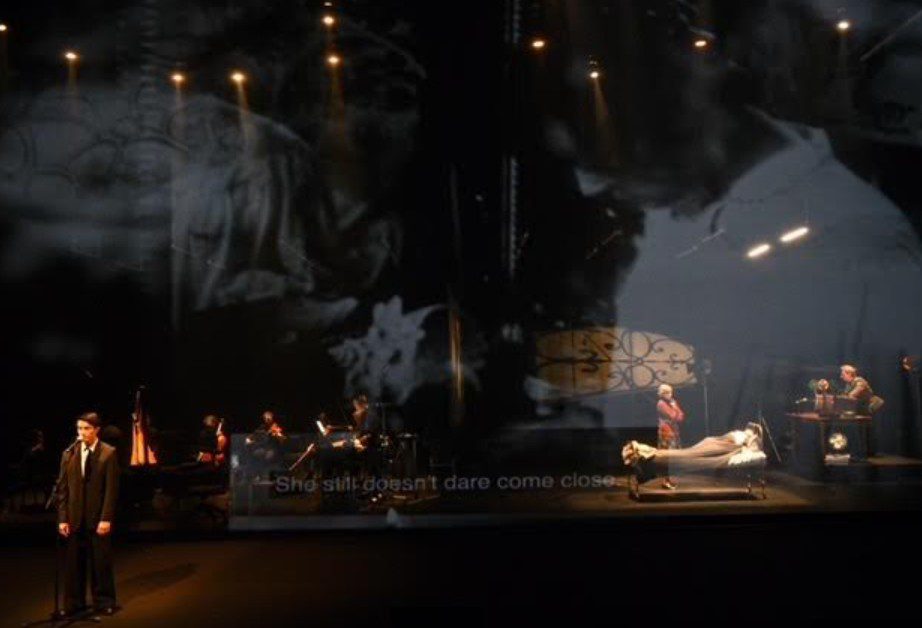
As part of the Festival TransAmériques (FTA) , the companies Carte Blanche and Chants Libres have teamed up with the Quatuor Bozzini to present the world premiere of a contemporary opera adaptation of the great movie Hiroshima, mon amour at Usine C. A creative lyrical tribute that revives our memories of the film, its events and our memories. Following the form of a film production, the show features Yamato Brault-Hori, Marie-Annick Béliveau and Ellen Wieser, who, on a stage clad in oversized projection tulles, deliver Marguerite Duras’s poetry of love and death, blurring codes and boundaries between media, as well as between past and present. Rosa Lind’s delicately dissonant score sets the eight musicians and their timeless love story to music. We had the chance to ask Christian Lapointe and Rosa Lind a few questions.
PAN M 360: How did you come up with the musical direction for the opera?
Rosa Lind : Text provides me with the musical inspiration. The emotion of the words, of the lines, guide me through the process. PAN M 360: Was it special for you to compose an opera for a film adaptation? Rosa Lind: I LOVE films! I had already delved into the adaption of « Wings of Desire » for a string quartet but an opera is so much fun because you can also work with human voice, which is totally appropriated for this very human story It felt natural for me to write in the direction of the story, mainly because I love the film so much. PAN M 360: Did the film’s original soundtrack influence the way you heard the story? Rosa Lind : Actually, when I work on something, I need to isolate myself completely, and so I do not listen to other composers in the process. When I watched the movie again for the opera, I watched it without sound to really be impregnated by the text and the magnificence of the images for my own definition and feelings can emerge. PAN M 360: Alongside the magnificent Bozzini quartet, what guided your choice of instruments?
Rosa Lind : I went with the harp because of it’s range (6 octaves), crystal clear on the highest notes and the depth of it’s bass. As a pianist, I often think as music pianistically. (laughs) I went with the clarinet because of the richness of the sound, like honey liquor. Finally, I opted for the flute because of it’s strong japanese connotation.
PAN M 360: Why did you decide to adapt Hiroshima mon amour into an opera set in 2025?
Christian Lapointe: I wanted to show the forgotten events, those recounted by the film and the film itself, in a context of unprecedented nuclearization of the world. PAN M 360: Where did you get the idea to add the character of Marguerite Duras and have her live alongside her own protagonists? Christian Lapointe: At the FTA in 2013, I presented a montage of Marguerite Duras’s texts “L’homme atlantique” and “La maladie de la mort” in which I had already begun to explore this. So I wanted to stage the writing itself, while at the same time winking at it.
PAN M 360: How did you come to choose the composer and the Bozzini quartet?
Christian Lapointe: Rosa is a good friend of mine and we wanted to do an opera together, so she suggested the film to me and it was an obvious choice. Secondly, the Bozzini Quartet is known all over the world, and we know that it can be “flown”, and they were already familiar with Rosa’s work too, so it gave us an opportunity to put all these fine people together.
PAN M 360: Why did you choose oversized projections to bring the images to life?
Christian Lapointe: I wanted to play on memory and forgetting, to play at remembering the film. The German soldier burning the film, the process of creating the film on stage, Marguerite Duras embodied – these are all representations of the film’s oblivion, which the giant projections serve to recall.
Sol-Étienne Labesse has been immersed in music since he was a teenager, before becoming drummer for the group Kulcha Connection, then Deya, before co-founding SolidGround, a reggae collective that accompanies several local and international artists. Rather like the reggae bands in Jamaica, who play for hours on end, sometimes accompanying twenty or so artists, SolidGround’s main aim is to promote reggae, not necessarily any one artist in particular. They advocate a spirit of sharing and exchange between artists. They will be at the Festival des Saveurs this Sunday, June 1, during the day devoted to the World Social Forum of Intersections, before continuing with a busy schedule this summer. They’ll be at the Festival de Reggae de Trois Rivières, but also at the Festival d’été de Québec, and in Montreal for a few dates. Sandra Gasana spoke to Sol-Étienne, live from the collective’s rehearsal studio.
Innovations en concert, inspiringly directed by Isak Goldschneider for some fifteen years (first with Cassandra Miller, then on his own since 2014), offers discerning and curious music lovers treasures of musical experience in each of its seasons. The 24-25 version concludes on 30 June with another find that promises moments of contemporary grace: the combination of a work by Ukrainian-Dutch post-minimalist composer Maxim Shalygin (Angel, for violin and cello, in its Quebec premiere) and another by Montrealer Olivier Alary, a vast fresco lasting some 40 minutes for 12 lap steel guitars. Yes, twelve lap steel guitars! It promises to be a fascinating evening at Saint-Denis Church here in Montreal. I spoke to Olivier and Isak about the works on the programme and other things.
Olivier Alary, tell us about your career path, which took you from architecture studies to music and then to Montreal.
It’s a fairly winding path, punctuated by forks in the road, but one that has developed organically. I first studied architecture, which enabled me to develop a sensitivity to structure, space and form – notions that, over time, found a natural echo in my approach to music.
It wasn’t long before I felt the need to turn my attention to sound. This led me to London, where I studied sound art at Middlesex University. It was a seminal period: I discovered a very free and experimental approach to sound, at the crossroads of music, installation and contemporary art.
In 2000, I released my first album under the pseudonym Ensemble on the Rephlex label, founded by Aphex Twin. This album attracted the attention of Björk, with whom I had the chance to collaborate on several projects, including her album Medúlla. That meeting was a turning point, giving me access to a wide range of creative contexts, from experimental music to avant-garde pop and multidisciplinary collaborations with Doug Aitken and Nick Knight.
After London, I spent some time in New York, before settling in Montreal, where I found a particularly favourable environment in which to develop my practice. It was here, after releasing a few albums on FatCat Records, that I really plunged into film music, a field in which I have worked for nearly fifteen years. I composed music for around sixty films, mainly documentaries and auteur dramas, working with filmmakers from a wide variety of backgrounds. This experience has enabled me to explore in depth the link between music and narrative, between sound and image.
After this long period of professional practice, I felt the need to return to the fundamentals of instrumental composition. With this in mind, I undertook a master’s degree in composition at the Université de Montréal, in order to better articulate my technical knowledge and explore new avenues of creation. It was within this framework that I developed my acoustic instrumental pieces, taking as my starting point the translation into written form of the techniques and processes I had been developing in the studio for over twenty years. This work enabled me to open up a dialogue between the electronic world I had cultivated and orchestral writing, by seeking to transpose production, editing and sound-processing gestures into a purely instrumental language. Vestiges is in line with this research.
And finally, I stayed. Montreal was an obvious place to anchor myself, both artistically and personally. The city has an exceptional pool of musicians, trained in four universities and a conservatoire, which fosters very high-level collaborations. Then I met my wife here, and we had two children. Today, even if my career path may seem a little fragmented, each stage has fed into the next, and the whole forms a coherent trajectory that continues to evolve.
What models (composers, musical styles) have shaped your musical personality?
My musical personality has been shaped by a wide range of influences, often by artists who like to push the boundaries, whether in music, film or the visual arts. In cinema, directors such as David Lynch, David Cronenberg and Andrei Tarkovsky have had a profound impact on me through their unique and often destabilising worlds. In the visual arts, I’m thinking in particular of figures like César, Jean Tinguely and Niki de Saint-Phalle, whose works question matter and movement, as well as Hans Bellmer and Gerhard Richter, who explore form and perception in radical ways.
Musically, I was strongly influenced by Krautrock groups like Can, Neu! and Kraftwerk. Their ability to blend hypnotic rhythms, electronic textures and improvisations fed my taste for sound experimentation. I also have great admiration for the psychedelic free jazz of Sun Ra and Pharoah Sanders, who offer incredible energy and freedom of expression.
Indie rock, particularly bands like Sonic Youth and My Bloody Valentine, showed me how noise, texture and layers of sound could become expressive elements in their own right.
In addition, electroacoustic music – particularly the work of Bernard Parmegiani and Luc Ferrari – has had a profound influence on my approach to composition, teaching me how to sculpt sound and create rich sonic spaces from subtle details.
I’ve also been inspired by twentieth-century contemporary music, with composers like György Ligeti, Gérard Grisey and Luciano Berio, who explore sound matter with great finesse. American minimalism, represented by Steve Reich, David Lang and Julia Wolfe, as well as the spiritual minimalism of Arvo Pärt and John Tavener, have also left their mark on my sensibilities through their ability to build powerful emotions through repetition and simplicity.
Finally, avant-garde pop songs by artists like Björk – with whom I’ve been lucky enough to collaborate – but also Velvet Underground, Robert Wyatt, Chico Buarque and Brigitte Fontaine, have always been a source of inspiration, combining musical innovation and poetry.
Beyond styles or names, what really drives me is this constant desire to go beyond conventions, to create bridges between different languages and mediums, and to seek music that can at once question, surprise and move.
Alary has collaborated with artists such as Björk, Nick Knight, Cat Power and Doug Aitken, and has released his music on labels such as Rephlex, Fatcat Records, 130701 and LINE. He has also scored over fifty films, several of which have won awards at prestigious festivals such as Cannes, Sundance and Venice.
How do you see the difference between composing for pop artists and artists associated with strict contemporary music?
I see composing for pop artists and for artists associated with strict contemporary music as two different but profoundly complementary approaches. I don’t see them as separate worlds, but rather as creative spaces that are in constant dialogue and mutually enriching.
Pop music, by its often more direct and accessible nature, offers a framework in which to play with shorter formats, clearer structures and an emotional immediacy that quickly touches the listener. It also allows us to explore more electronic sounds and textures which, although simpler on the surface, require great precision and sensitivity to maintain their impact.
Strict contemporary music, on the other hand, opens up a field of research in which we can experiment freely with more complex forms, advanced techniques and an abstraction that encourages us to question sound matter, time and perception. It’s a world in which rigour and depth coexist with innovation, enabling me to develop highly sophisticated instrumental pieces such as Vestiges, which took me over ten years to research.
What’s interesting is that these two worlds work like communicating vessels for me. The experience I’ve gained in contemporary music gives me the tools to enrich my pop compositions, by adding more subtlety, originality and density. And conversely, working on more immediate pop formats stimulates my creativity and pushes me to simplify, to be more direct, while retaining an expressive richness.
In my experience of film music, this ability to navigate between very different registers is essential. Depending on the genre of the film – be it suspense, horror or drama – it is often necessary to bridge the gap between accessible music that supports the narrative emotion and more experimental textures that create particular and original atmospheres. This has enabled me to develop a great deal of flexibility and an open-mindedness that feeds both my personal projects and my collaborations.
In short, rather than seeing pop and contemporary composition as two distinct disciplines, I see them as two poles of the same creative continuum. This oscillation between rigour and immediacy, between experimentation and emotion, allows me to constantly evolve my writing and hone my personal artistic voice, capable of crossing different styles and audiences.
Vestiges for 12 lap steel : why 12? Why lap steel? What attracts you to this instrument?
I chose to use twelve lap steel guitars in Vestiges because it’s an instrument that has fascinated me for the last fifteen years or so, particularly in the context of film music and my personal projects. What particularly appeals to me about lap steel is its unique sound texture, especially when played with tremolos and a slide placed directly on the strings. There’s something very vocal about the sound, almost like a human voice, which gives it a very special expressiveness.
Moreover, lap steel is often perceived as a limited instrument, with very strong connotations – particularly country or western – which can be reductive. My intention was precisely to break down these clichés, to explore its potential beyond these styles, to offer a totally different kind of music, further removed from these traditional genres.
I was also interested in the fact that the range of the lap steel is quite similar to that of a choir, from low to high pitches, which naturally led me to imagine similar voice patterns, with registers ranging from bass to soprano.
Why twelve guitars? Because a guitar has six strings, and the chosen choir has six voice registers. By doubling this – i.e. by doubling six – we get twelve instruments, which sounds much better and, above all, offers greater harmonic richness and depth of sound. This arrangement also allows us to play to the full the spatialisation of the sound, by distributing the guitars throughout the space to create a very interesting acoustic immersion.
Finally, I knew that working with this instrument in a long form would be a real challenge, but this very limitation stimulated me: I wanted to see if I could build a solid, coherent piece around this singular sound.
Vestiges is a unique work, the fruit of ten years of research
The message, or the main idea behind Vestiges?
The main idea behind Vestiges is linked to a reflection on the traces left by certain cultural, spiritual or social forms in transformation. I have the impression that we are living in a period of transition, where certain traditional landmarks – whether linked to religion, family structure or wider societal frameworks – are gradually changing or losing their central place in our lives.
With this piece, I wanted to evoke these transformations, imagining a kind of requiem for these ancient forms, and more specifically for the vocal and liturgical traditions stemming from various spiritualities. Vestiges is an attempt to summon these voices from the past, not to freeze them in a nostalgic posture, but to make them resonate in a different way – from a sensitive, almost mediumistic perspective. The twelve lap steel guitars become like relays, transmitters of sound memory, allowing these forms to reappear in a new light.
What adds an even more poignant dimension to the performance is the fact that it is being presented in the church of Saint-Denis – a site of magnificent architecture, steeped in history, but which is also beginning, in very real terms, to become an architectural relic. This context resonates perfectly with the theme of the work.
Musically, Vestiges is inspired by different forms of polyphonic vocal music, such as madrigals, choirs, Orthodox liturgical music and Gaelic psalmody.
Isak, tell me about Maxim Shalygin.
Maxim Shalygin is a Ukrainian-Dutch composer who has been living in the Netherlands since 2010. Like Olivier, he has a lot of experience of writing music for contexts outside the concert stage, such as film, dance or theatre – which perhaps explains, in my opinion, why their works share a certain atmosphere: a similar approach to space, sound and interiority.
What attracts you to his music? Why did you choose to play this piece (Angel) at this time?
The introspective nature of Shalygin’s music and its ability to evoke deep emotional landscapes resonate strongly with me. Angel, composed in 2020 during the global upheaval of the COVID-19 pandemic, reflects on humanity’s relationship with nature and the fragility of existence – it can be heard as a meditation on historical trauma. Performing this work today seems to me entirely appropriate, given what we are currently experiencing in the world.
How would you describe Angel’s sound? Can it be compared with other styles with which we are already familiar?
Angel offers listeners a delicate interplay between violin and cello: a meditative, ethereal soundscape. The work is inspired by Maurice Ravel’s Sonata for violin and cello, composed a century earlier in the wake of the First World War and the Spanish flu pandemic. As with Ravel, melody is at the heart of Shalygin’s expression, resulting in a work that I find both timeless and deeply human.
Any else to mention?
It’s interesting to underline the intersections of meaning between Angel and Vestiges d’Olivier, a 42-minute composition for twelve amplified lap steel guitars and electronic diffusion. There’s something very Shalyginian about the spectral vocality of Vestiges – this ghostly choir of echoes and reverberations floating between memory and oblivion. Each guitar, played with extensive and unconventional techniques, becomes a channel for fragments of sound, like echoes of forgotten voices: it’s perhaps reminiscent of another great Ukrainian masterpiece [Sergei Paradjanov’s Shadows of Forgotten Ancestors].
Vestiges draws on structural principles borrowed from madrigals, Orthodox liturgy, Gaelic psalms and chorales, to build a sound architecture rooted in the past while avoiding nostalgia. This emotional immediacy and attention to memory reminds me very much of Shalygin’s work; it is, for me, a fine example of convergent musical evolution.
I’m very grateful, in this project, for the opportunity to engage with works that challenge us musically and make us think about memory and the ephemeral nature of existence. As far as I’m concerned, music – and art in general – is a way of life.
Performers
Angel by Maxim Shalygin :
Adrianne Munden-Dixon, violin
Audreanne Filion, cello
Vestiges by Olivier Alary :
Jonathan Barriault; Nicolas Caloia; Steven Cowan; Simon Duchesne; Ben Grossman; Marc-André Labelle; Dominic Marion; Pierre-Yves Martel; Matt Murphy; Jean René; Pascal Richard; Julien Sandiford – lap steel guitars
Isak Goldschneider, musical director
This Sunday, Fred Everything will take the stage from start to finish, playing only tracks that he has been involved with. Far from being a simple DJ set, this is an occasion to witness the culmination of a lifetime’s work—which, with over 250 releases to his name and over 100 releases on his label Lazy Days, is quite a deep crate to pull from. Having produced, remixed, and collaborated on various genres ranging across all styles of electronic music, his improvisatory approach on the decks could take us in any direction.
Fred Everything’s lasting formula is something to be studied. Over the last three decades, his contributions to electronic music as a producer, DJ, and founder of Lazy Days Records have cemented his reputation as an artist who is not only diverse but also consistent. With a show at Mutek last summer, a Juno nomination for Electronic Album of the Year only a couple of months ago, and now a Piknic takeover, Fred Everything continues to bear the fruits of his authenticity.
Curious to know more about the mind behind this tour de force, Fred Everything kindly shared with us a piece of his story—or of history, considering his monumental body of work. Here, he talks about his preparation for Sunday’s set, his humble beginnings, his perennial approach, and his recent interest in mentorship.
PAN M 360 : You’ll be celebrating 30 years since your first release and 25 years of Lazy Days. This is a big moment—how are you feeling?
Fred Everything : Great! Going through all the music for my set, it’s definitely a bit of an introspective and emotional process. There are things that I think stood the test of time, and some things that I would do differently, but it’s all part of the journey that got me to where I am so I’m here to embrace it!
PAN M 360 : It’s quite a feat playing the whole night, but if I’m correct, this is something you’ve done regularly at Salon Daomé. What does an extended set allow you to do that you can’t normally achieve in a regular time slot?
Fred Everything : For my generation of DJs and the DJs that came before me, it’s a normal process. We got used to play from beginning to end in a venue. Welcoming people, setting up the mood, trying different things towards the night, and the best part, sending people home with something to remember.
PAN M 360 : You’ve spoken about long blends and creative mixing—do you come into a set like Piknic with a strict plan, or do you prefer to read the energy and improvise?
Fred Everything : I’ve never played a planned set ever. That goes beyond my beliefs as what a DJ does. We’re here to create a curated experience based on moments and moods. Having said that, I have a special set prepared for Sunday that includes only music I’ve been involved with. Whether it’s as an A&R for Lazy Days with different artists from the label, or my own productions, collaborations, remixes or even If it’s someone that remixed one of my songs. I do have an idea of the mood I want to set for the beginning, middle and end of my set but that also could change!
PAN M 360 : It seems electronic music has always been at the heart of your musical exploration. I read somewhere that even in the very beginning, you went out and got yourself a SH101 and TR909 to play at raves. Can you point out what drew you to this medium?
Fred Everything : I’ve been buying instruments since I was legally able to work during the summer in high school. I washed dishes to buy my first synthesizer. The 101 and 909 were purchased for my own production. They were very cheap at the time, maybe 300$ for both — I still have my original red 101 I bought 35 years ago. I was always fascinated by electronic sounds, even as a kid. Drum machines, synthesizers and vocoders would instantly get my attention when played on the radio. I think from a very young age, I always wanted to work with machines. I was also part of the first wave of raves in Quebec City, so I was able to play live with my instruments back then.
PAN M 360 : Fred Everything is known for, well, doing a little bit of everything. It’s especially impressive considering you’ve been at it professionally for over 30 years. But maybe that’s the secret… What would you say has sustained your creative curiosity over all these years?
Fred Everything : Music is like this force I have inside of me. Even when I get disillusioned, I somehow always find strength to continue. I chose it but it also chose me. One of the things that keeps me going is also to know that I still have things to express and still music to discover, old and new. It will never fully end.
PAN M 360 : Your latest release, Love, Care, Kindness and Hope, which was nominated for a JUNO award this year, came out on vinyl. You’ve always maintained a connection with physical formats. What role does vinyl still play in your creative and listening process today?
Fred Everything : As with everything I do, It also came out digitally, but It was important to have an object to hold, as a testament to this body of work. A lot of people still love vinyl. At home, I almost exclusively listen to records and I love to continue buying and playing records as much as I can. This is where I come from. I wish I could press everything I do on vinyl, but it’s a bit hard these days to make it feasible.
PAN M 360 : Aside from being a producer and DJ, I’ve noticed you’re also very active as a mentor, with a strong presence on platforms such as Puremix, Station Clip, IO Music Academy, and Echio.co. Without giving away all the sauce, what kind of advice or guidance do you find yourself giving younger artists?
Fred Everything : While I was never a good student growing up, I was always interested in sharing my knowledge. During the pandemic, I started doing it more online and I got requests for private mentoring, which I did on and off for the past few years. For the most part, I try to share a more philosophical approach to making music rather than repeating the endless technical tutorials that are already online. I’m doing a class on remixing next Wednesday, May 28th, here in Montreal at Station Clip.
PAN M 360 : You’ve spent time in cities like San Francisco and London but Montreal seems to have a lasting pull. What is it about Montreal that keeps you anchored here now?
Fred Everything : I lived in London shortly in 1999 and San Francisco for 8 years until 10 years ago. I love to travel but the best part is always to come home. I’ve had my ups and downs with this city in the past but we’ve totally made up now and I think that even with all its flaws, Montreal remains one of the best cities in the world!
PAN M 360 : Finally, Lazy Days turns 20 this year—first of all, congratulations. What are your hopes for the next chapter of the label? Are there new directions, artists, or formats you’re excited to explore?
Fred Everything : Thanks! There are a lot of things coming up that I’m excited about, like a new album I made with my old friend and music partner Atjazz. I’m also happy to keep releasing music from a lot of talented friends on the label and hopefully discover new talents on the way!
Presented by the Société de musique contemporaine du Québec, this Sunday, May 25 concert at Chapelle Notre-Dame-de-Bonsecours is a “vibrant tribute to Vancouver composer Jocelyn Morlock, who passed away prematurely in 2023, with a moving program built around her memory, featuring works by Samy Moussa, Rita Ueda and Tanya Tagaq. Simon Bertrand, composer and artistic director of the SMCQ, explains his choices.
“The late Jocelyn Morlock (1969-2023), a leading figure in Canadian concert music and winner of numerous awards, including a Juno Award for her piece My Name is Amanda Todd, dedicated to the memory of a young student who was the victim of harassment, was an outstanding composer, as evidenced by “a powerful catalog of works combining lightness and depth in a highly lyrical and personal musical language”.
PAN M 360: How do their works relate to those of the deceased?
Simon Bertrand: This concert was conceived as a kind of ritual in memory of Jocelyn Morlock. The works by Moussa and Ueda were commissioned by the SMCQ with the specific request of being “in memoriam” to Jocelyn Morlock, something made easy by the fact that both composers admired her work, as does Luis Ramirez. As for Tanya Tagaq’s powerful piece, it was all about dramatic effect, as the work is very disturbing. For it is a tribute to life, death, light and darkness.
PAN M 360: Why and how did Jocelyn Morlock make her mark?
Simon Bertrand: Through her music, which is both simple and complex, technically or emotionally, and through her humanist testimony, notably with her iconic piece My name is Amanda Todd, and her generous, empathetic approach to the music world.
PAN M 360: What are her most important works?
Simon Bertrand: In addition to “My name is Amanda Todd”, Exaudi is on the program for Sunday’s concert, and she considered it one of her best pieces.
PAN M 360: Why did you name this program Aurore solennelle?
Simon Bertrand: The theme of this season’s three portraits of female composers (Saariaho, Lizée, Morlock), on the sidelines of the MNM Festival, was the northern lights, in connection with what we experienced in 2024.
Morlock’s two works on the program are The uses of solitude, for flute, harp and viola, and the poignant Exaudi for solo cello and choir. The former is one of the composer’s very last works. It receives its Quebec premiere from Trio Kalysta (Lara Deutsch, flute; Marina Thibeault, viola; Emily Belvedere, harp). The second piece is performed by soloist Chloé Dominguez, principal cello of the Ensemble de la SMCQ and singers from the Voces Boreales ensemble, directed by Andrew Gray.
This concert will be dedicated to the cause of mental health among musicians.
PAN M 360: Why did you choose Exaudi and The Uses of Solitude for this program?
Simon Bertrand:Exaudi is a deeply moving work and a great success, both in terms of the vocal writing and the solo cello part. The Uses of Solitude is one of the last, if not the last, work she composed, and is a reflection on the loneliness engendered by the Covid-19 pandemic, which has caused much suffering in the musical and performing arts in general.
PAN M 360: Beyond the above description, what else can we say about the forms of each work by the composers invited to this tribute program?
Simon Bertrand: Samy has composed a work that is a very simple song for solo oboe that exudes melancholy and solitude. It almost becomes a character in the context of this concert, where there are more and more musicians on stage. Then the Kalysta trio plays two works, and gradually we move towards vocal music, with the oboe becoming English horn and the strings mingling with ritual in Ueda’s work, which is both moving and magical at the same time. The climax is Morlock’s Exaudi, followed by the return of the initial chant from Moussa’s solo oboe. It’s a kind of musical dramaturgy in tribute to Jocelyn.
This week at Festival Classica, violinist, conductor, and composer Guy Braunstein brings a bold reimagining of the Beatles’ final studio album to Quebec audiences with the North American premiere of hisAbbey Road Concerto. Scored for solo violin and orchestra, the piece reimagines material from the Beatles’ Abbey Road as a through-composed concerto—eschewing nostalgia in favor of transformation. Performed by the Orchestre symphonique de Trois-Rivières under Alain Trudel, the concerto offers a striking reinterpretation of beloved songs like “Come Together” and “Here Comes the Sun,” refracted through Braunstein’s distinctive symphonic language.
PAN M 360: Good morning, Maestro Braunstein. Is now a good time?
Guy Braunstein: It was—until you called me “Maestro.” Just call me Guy. My mother strongly recommends it.
PAN M 360: Well Guy, you must be very excited about the North American premiere of your Abbey Road Concerto. I know we all are.
Guy Braunstein: You bet.
PAN M 360: So how many times have you performed this concerto now so far?
Guy Braunstein: Around ten, maybe more. In several countries. I also recorded it for a CD, so yes—it’s got some miles on it.
PAN M 360: And how has the reception been?
Guy Braunstein: People go crazy. I’ve done a lot of transcriptions—Tchaikovsky, Dvořák, operatic stuff—but this is different. The audience reacts very differently compared to a standard violin concerto. It’s a whole other experience.
PAN M 360: You’ve said this isn’t just an arrangement, but a full-scale concerto. How did it all begin?
Guy Braunstein: Totally unplanned. About six years ago, my son—he was six at the time—got infected with Beatlemania. He discovered the Beatles and became obsessed. He’d keep asking me to play Beatles songs for him on the violin.
PAN M 360: So you started with a few sketches?
Guy Braunstein: Exactly. I made some short encore pieces, just for fun. But then the pandemic hit and suddenly I had a lot of time. I thought, “Why not make a proper arrangement of one Beatles tune—with piano accompaniment?” So I started listening to their late albums, and when I got to Abbey Road, I had a problem: I liked everything. I couldn’t choose.
PAN M 360: So what did you do?
Guy Braunstein: I said, “To hell with it—I’ll take the whole bloody thing.” And I started writing a full-blown concerto for solo violin and orchestra.
PAN M 360: Abbey Road already has a sort of symphonic architecture. Did that influence your decision to orchestrate it?
Guy Braunstein: Sure, it’s not just about loving the music. I love Led Zeppelin too, but I can’t do anything with their music on the violin. Abbey Road, though—I could hear how it could work orchestrally. It offered so much possibility.
PAN M 360: How did you approach arranging the album? What was your process?
Guy Braunstein: Normally I start with a full orchestral score and maybe make a piano reduction later. But this time, I began at the piano—just playing through the songs, exploring textures. Then I orchestrated. I had a plan, but I had to revise it constantly.
For instance, I added a bass trombone to mimic Paul McCartney’s powerful bass lines. Nothing else could replace that sound. The bass trombonist is going to be very busy tonight.
PAN M 360: The first half of the concert includes other arrangements of Beatles songs, right?
Guy Braunstein: That’s right yes. I haven’t heard that part yet.
PAN M 360: You’re not the first to orchestrate Beatles music—what sets your approach apart?
Guy Braunstein: I know I’m not the first. People have been arranging Beatles tunes since they were still active. But I’ve done this in a purely classical way. A few conductors have said it’s more classical than Rhapsody in Blue. It’s not a crossover piece—it’s a concerto.
And I’ll let you in on a secret: the violin part is brutally difficult. A couple of years ago, I played the Sibelius, Abbey Road, and Tchaikovsky concertos three weeks in a row. Sibelius and Tchaikovsky are tough, but Abbey Road was far more demanding.
PAN M 360: Did working so closely with the music change your relationship to it?
Guy Braunstein: I grew up in Tel Aviv in the ’70s. Everything got to Israel ten years late, so I basically grew up with the Beatles—listening to LPs, radio. It was already part of my musical DNA. But when you dig into something that deeply, you always rediscover it.
PAN M 360: I imagine you noticed details you’d never picked up before?
Guy Braunstein: Absolutely. After the first symphonic performance, I recorded it and went back to the studio. I made a lot of revisions. Technology can help you imagine things, but it doesn’t replace real people playing music. I’ve had the luxury of refining it after hearing it live, which is very much in line with how classical composers worked.
PAN M 360: I’ve been reading Geoff Emerick’s book—he talks about the Beatles’ studio experiments, like George Harrison’s discovery of the Moog synthesizer on Abbey Road. How it added such a rich, orchestral texture was a totally novel sound at the time.
Guy Braunstein: Yes—and that curiosity is what made them great. I saw some of Peter Jackson’s Get Back doc and also the Bernstein biopic with Bradley Cooper. Totally different musicians, but they had that same drive: curiosity ready to explode. That’s what separates good musicians from great ones. They’re always hungry. The Beatles could’ve stayed in their comfort zone, making hits like “I Want to Hold Your Hand,” but they pushed boundaries instead. They could’ve made a fortune repeating themselves, but they chose to evolve. That’s why they remain the most fascinating pop group ever.
PAN M 360: And that’s why your concerto feels so fresh—it gives people a new way to hear something they thought they already knew.
Guy Braunstein: Let’s hope the audience feels that way tonight.
PAN M 360: I imagine the orchestra enjoys the change of pace too?
Guy Braunstein: You’d think it’s a break from Stravinsky, but no—they’ll be sweating tonight. It’s hard work.
Hayti Lives, Vox Sambou’s sixth album, was launched a few weeks ago, but Vox Sambou was still out of the country. No problem, we finally got in touch with this hard-working artist, associated with the excellent composite group Nomadic Massive and also a solo singer-songwriter from Montreal, originally from Limbé, a municipality near Cap-Haïtien in the north of the island. A written conversation with a key figure in Montreal’s Afro-descendant culture.
PAN M 360: Hayti Lives is both a poetic and activist project. How can a critical or even militant stance become art in 2025?
Vox Sambou: As a musician, I always feel guided by the timeless words of the great musician Nina Simone: “An artist’s duty, as far as I’m concerned, is to reflect the times in which he lives. I think that applies to painters, sculptors, poets, musicians… For me, it’s a personal choice. But I’ve chosen to reflect my times and the situations I find myself in. To me, this is my duty.
PAN M 360: There’s so much to say about Hayti right now, which is struggling with an incredible social, economic and political curse. What are the themes of your new songs?
Vox Sambou: In my new songs for the Hayti Lives project, I tackle the themes of love, unity and resistance. It’s not a curse that strikes Haiti, but a persistent injustice. I’m writing these words to you from Limbé, northern Haiti, where I see hope in the faces of shopkeepers, teachers and young schoolchildren. Everyday reality is a lesson in resilience. Michel Vastel’s article, published in 2003, reveals a little-known truth: the Ottawa Initiative on Haiti shows the active role played by certain countries, including Canada and France, in the political destabilization of the country. France, above all, refuses to pay the ransom for independence, a debt imposed on Haiti for having dared to liberate itself. This is the real tragedy.
PAN M 360: Can you choose 3 to 5 songs and describe in more detail the choice of subject and the poetic approach?
Vox Sambou:
Eritaj :This song is a declaration of identity and memory. Through the words “Istwa nou, memwa nou se zam nou pou’n pa peri”, I want to insist on the fact that the Haitian heritage, its history, its culture, its resistance is a powerful weapon against erasure. It’s a subject rooted in a process of intergenerational transmission and reaffirmation of Haiti’s African roots. I used rhythms from the oral tradition.
Sergo: Sergo pays tribute to my mother and to all the Haitian women in the country’s history. These women are pillars of the economy, education and resistance, from independence in 1804 to the present day. The name Sergo is a symbol of dignity, courage and strength. With my musicians, I was able to work on petro percussion rhythms, Congolese influences and hip-hop. My dearest wish is to celebrate the living memory of these women through a constantly rising musical energy.
Kriminèl: This song was born of a sense of urgency about the continuing instability in Haiti. It denounces the violence imposed by the international community, but above all, it calls for collective awareness and citizen resistance. I’m calling on the population to wake up. My approach is based on the repetition and rhythmic intensity of Haitian percussion (particularly petro rhythms), amplified by Congolese, hip-hop and Afrobeat influences to create this song.
Voyaje: The inspiration for this song came in 2017 at the Helsinki World Music Festival, when I opened for Trinidad and Tobago music icon Calypso Rose. It’s a song that evokes the journey of identity, that of children of the African diaspora seeking to reconnect with their roots.
PAN M 360: As a French speaker who has spent time in Haiti, I have a partial understanding of Creole (the language of expression on this album, with some exceptions in French), but I’d like to know if you have any poetic models in Creole literature.
Vox Sambou: Ever since I was a child growing up in Limbé, Haiti, I’ve been immersed in Haitian literature. Those who have influenced me most are Oswald Durand and Frankétienne. The former, a 19th-century poet, gave the Haitian language its letters of nobility with texts like Choucoune, celebrating love and popular culture. Frankétienne, a prolific 20th-century writer and founder of spiralism, combines poetry, chaos and revolt to express the complexity of the Haitian soul. These two poets nourish my writing and my artistic commitment.
PAN M 360: How can you make Haitian Creole attractive to non-Creole speakers?
Vox Sambou: The Haitian language is already profoundly rich and attractive. For me, the best way to make it more accessible is through music, a universal language. Through my songs, I use the Haitian language to challenge our societies, raise awareness, uplift our humanity and share love.
PAN M 360: So that non-Creoles can learn more about Creolophony in song, can you tell us about your approach as a songwriter?
Vox Sambou: As an artist, I don’t impose a particular style or language on myself. For example, the chorus of the song Goumen (“to fight”) first came to me in Portuguese; I simply chose to translate it into Haitian, guided by inspiration, rhythm and message, while respecting the sounds and languages that are part of me.
PAN M 360: How do you distinguish between your solo work and your collective work, especially with Nomadic Massive? Where are the differences, the distinctions, the stylistic choices?
Vox Sambou: Nomadic Massive remains one of my great schools of life. From 2004 to 2017, I lived and shared extraordinary moments of learning, performing and artistic fraternity. This collective enabled me to develop a strong musical and political awareness. The Vox Sambou project, on the other hand, is more personal: it draws on traditional Haitian music, with a style less focused on hip-hop and more oriented towards the fusion of Afro-descendant rhythms. It’s a more intimate space, one of reflection and direct connection with my roots.
PAN M 360: Several musicians contributed to this album. Can you explain the recruitment process?
Vox Sambou: For this project, I began by working on the musical foundations with Canadian-Congolese drummer and percussionist Lionel Kizaba, before inviting the other members of my group. My approach is organic.
PAN M 360: Who are your core collaborators? In the studio? On stage?
Vox Sambou: I’ve been working with a loyal and talented team for over 15 years. In the studio and on stage, my core team remains almost the same. David Ryshpan (keyboards), Jean-Daniel Thibeault-Desbiens (drums), Diégal Léger (bass), Rommel Ribeiro (guitar), Rémi Cormier (trumpet), Malika Tirolien (vocals), Ronald Nazaire (percussion), Frank O Sullivan (guitar) and Lionel Kizaba (percussionist and drummer) are my close collaborators. With them, I’ve built up a musical and human complicity that nurtures the artistic coherence of all my projects.
PAN M 360: Who did the arrangements and production? What were you looking for?
Vox Sambou: I composed and worked out the basic structures of the tracks myself, leaving room for intuition and the soul of the rhythms. Subsequently, Rémi Cormier and Modibo Keita added their touch on certain brass sections, while Malika Tirolien signed some striking keyboard and guitar arrangements, notably on the song Kriminèl. My aim is to give the project a richness of sound that respects both my roots and my musical intentions.
PAN M 360: The musical subject of this album is said to be a meeting between the Caribbean islands (especially Haiti) and Central Africa (especially Congo): why is that?
Vox Sambou: I want to honor our cultural heritage. This album invites the children of the diaspora to reclaim their roots through the unifying power of art. I sincerely believe that art is the only bridge capable of reconnecting Africa’s scattered youth to their homeland, and thus offering them peace!
PAN M 360: The stylistic choices are eclectic: rara rhythms, voodoo, dancehall, afrobeat, soukouss, rap kreyol, afro-jazz, etc…. How would you describe yourself?
Vox Sambou: I make traditional Haitian music fused with jazz and hip-hop
PAN M 360: You’ve chosen an instrumental approach, so there’s very little electronics in your work? It’s simply a matter of taste? Can you describe your musical garden? What makes you tick the most?
Vox Sambou: I’ve always been drawn to an organic, instrumental approach. I’m drawn to drums, human voices, brass blasts and deep-rooted rhythms. My musical garden is the land of Haiti, nourished by echoes from Africa, the Caribbean and the streets of Montreal. It’s a place where tradition and innovation meet, where every sound carries a story, a cry, a living memory. Above all, I seek to create links, to make people vibrate.
PAN M 360: What are your next projects, solo or otherwise? Shows and others?
Vox Sambou: On May 17, we launched the Hayti Lives album in São Paulo, an important milestone in this new project. In June, we’ll continue with concerts in Rio de Janeiro, then head off for a series of dates in Europe. This summer, we’ll also be touring Western Canada. Whether in Canada or abroad, each performance is an opportunity to forge links, carry our messages and celebrate the richness of Afro-descendant cultures.
Conductor Francis Choinière wanted to celebrate the end of the Orchestre Philharmonique et Chœur des Mélomanes’ (OPCM) tenth season with the Holy Grail of any self-respecting conductor and orchestra: a Mahler symphony. In this case, the Second, entitled Resurrection, which will be performed at the Maison symphonique de Montréal on Saturday 24 May at 7.30pm.
I spoke to the conductor who, despite his growing experience, is still in the ‘young’ category. Will he ever grow old? Haha.
Mahler, Resurrection Symphony, conducted by Leonard Bernstein