In partnership with Oktoecho and the Najaa el Fen Festival, this show is part of the Performing Arts section of the Arab World Festival and aims to bring together young people from Quebec and Tunisia. Unfortunately, the young Tunisians were unable to come to Montreal as planned, but the organizers remain hopeful for next year. By combining traditional Tunisian songs with traditional Quebec songs, for example, some young people have created remarkable works that reflect their era. Keithy Antoine spoke with Katia Makdissi-Warren, who herself embodies this duality, being half Lebanese and half Quebecois.
Publicité panam
Ya Ghorbati means ‘My exile’ in Arabic, and that is the title of the evening of 8 November. Featured in the series Andalousie au féminin, Lila Borsali is preparing to arrive in Montreal with a team of nine people. A regular at the Festival du monde arabe, she always comes with a different and unique project. It is important to her that audiences have a context in which to immerse themselves when they come to see her show. Having been well-rehearsed in Algeria and elsewhere, the show is ready to meet Montreal audiences. Keithy Antoine spoke with Lila Borsali a few days before the show on November 8 at the Cinquième Salle.
Publicité panam
He is half Moroccan, half Quebecois and has been immersed in both cultures since a young age. Travelling to Morocco every summer during his childhood, Amine Benarqia developed a special bond with the country, which sparked his passion for Gnawa music, a style his father loved. The guembri has been his instrument of choice ever since, and he still plays it today. He will be using it to showcase all the facets of Gnawa music on 14 November at Espace Kawalees. He talks about it with Keithy Antoine in this interview for PAN M 360.
Publicité panam
Inspired by the Song of Songs, the world of Cantiques de l’amour is a musical adventure featuring the spellbinding Sufi singer Khaled Al-Hafez, bearer of Syrian memory, and the magical contralto Gabrielle Cloutier, whose voice shapes inner landscapes. They will be accompanied by the 36-member Ensemble Vox choir. They have prepared an eclectic repertoire that will address all stages of an individual’s life through music. Alain Vadeboncoeur is a regular at the Festival du monde arabe, now in his fifth year of participation. This year, he wanted to collaborate with Gabrielle Cloutier, and the two spoke with Keithy Antoine for PAN M 360.
Publicité panam
He’s being hailed as the one redefining the contours of Raï music. His melancholic voice lends itself perfectly to the themes of nostalgia and love often associated with this genre. At only 25, Chazil is already making waves. 2025 will be a landmark year for this young man from Constantine, in northeastern Algeria. He’s already put on a remarkable show in Paris, another in Jordan, and now he’s preparing to come to Montreal for the very first time for the Festival du Monde Arabe. He’ll be accompanied by Montreal-based musicians, and together they’ll introduce Montrealers to Raï 2.0. Sandra Gasana spoke with him live from Algiers for PAN M 360.
Publicité panam
Today we’re talking about Ziad Rahbani (1956-2025), a great musician, reformer, and visionary of oriental jazz. It’s also worth mentioning that he was the son of Fayrouz, the Levantine superdiva whom some consider the greatest Lebanese singer of all time. His late father, Assy Rahbani, was one of Fayrouz’s two main songwriters. Ziad Rahbani died on July 26th from kidney problems; he was 69 years old.
Music lovers with a passion for modern oriental music, classical Arabic music, and modern jazz may be familiar with the historical importance of Ziad Rahbani and his contribution to music. A complete artist, he was also a lyricist and playwright. His tragicomic plays were imbued with a profound opposition to religious or communal sectarianism, and his leftist leanings were also well-known in Lebanon.
His progressive stance, always marginal in Lebanon and the region, had led him to gradually withdraw from active cultural life, to the point of living in seclusion in his Hamra home in Beirut and rarely leaving his house. What Ziad dreamed of did not come to pass in his country; disappointment, demobilization, and isolation preceded his physical death.
A sad decline, a sad end, it’s truly regrettable. Ziad Rahbani remains no less important, and expatriate Lebanese and Beirut artists (for obvious reasons) have undertaken to pay tribute to him with a musical and theatrical performance of his work. Since everyone should discover the art of this great Lebanese artist and visionary, PAN M 360 presents this interview with Johnny El Hage, a man of the theater and a great admirer of Ziad Rahbani.
PAN M 360: This blend that Ziad offered was quite unique and, unfortunately, little known to Western audiences. This November 3rd is an opportunity for the Montreal public to experience it. Late, too late, but… better late than never. Johnny El Hage, you’ve created a show—tell us about it!
Johnny El Hage: It’s a journey into the world of Ziad Rahbani. We’ll focus on his music and theatre, as well as radio programs he produced between 1965 and 1990. And we’ll also reflect a bit on his political ideas as expressed in his work.
PAN M 360: Because he was very political, indeed. Very left-wing, he sharply criticized all the Lebanese governments in power under which he lived.
Johnny El Hage: He even supported Hezbollah at times, which he sometimes tended to see as a Lebanese resistance force rather than a terrorist organization. So, yes, he was a controversial figure. For a long time, he was an advocate for the resistance, and therefore anti-establishment. He was very left-wing. He was even close to the Communist Party.
What’s special about him is that he comes from a family whose political stance is diametrically opposed to this one. In his twenties, he left his family in East Beirut and moved to the west of the city during the civil war. His music and theater inevitably reflected his political vision. He longed for a shared life, a recognition of the other—the other Lebanese—whom we still don’t know, of a different religion, a different way of thinking, a different conviction.
PAN M 360: He therefore wanted the reconciliation of the Lebanese factions and also a unified response from Lebanon towards Israel and all forces deemed imperialist.
Johnny El Hage: Yes, he tried to dismantle national divisions. He tried to live with the Muslims of Beirut, he worked with them, he did everything in his power to make the Christians of Lebanon understand that their Muslim compatriots were much less different from them than they thought. And that these Muslims were fighting against the Israeli occupation of the country, and that they also wanted equality.
PAN M 360: Let’s try to quickly see his contribution to music. Ziad created songs but also a modern jazz including Cuban, Brazilian and, of course, Arabic music.
Johnny El Hage: He was a pioneer in integrating modern Arabic music and classical Arabic music into jazz. He even diverted the original work of his mother, Fayrouz, his father, Assy, and his uncle, Mansour. The Rahbani brothers and their interpreter, Fayrouz, were very romantic and traditional in their songs, their aim being to bring joy, hope, and dreams to the Lebanese people. And when Ziad wrote songs for his mother (after his father’s death), Fayrouz deviated from this approach. Now expressed in a language (or dialect) closer to the people, Fayrouz’s songs evoked the daily lives of ordinary people, what humans were truly experiencing in Beirut and Lebanon—poverty, political violence, and so on.
PAN M 360: And his theatre was also expressed in this way, one imagines.
Johnny El Hage: That political theater was brilliant. And during the civil war, he performed in both West and East Beirut. He played for Christians and for Muslims. It was also one of his very strong critiques of those in power. It was his struggle, and it’s still our struggle. His tragicomic theater provoked laughter and tears by reflecting our everyday realities. Even if our lives were shit, we could laugh about it after crying—or vice versa.
PAN M 360: Formally, how was his theatre structured?
Johnny El Hage: Ziad wrote scripts inspired by ordinary people from all corners of the city. These ordinary people were involved and expressed their concerns on stage through Ziad’s texts. His actors were therefore citizens who had other daily jobs besides art or theater—bartender, day laborer, reporter, etc.
PAN M 360: At some point, we were told, this theatre ceased to exist. Why?
Johnny El Hage: Yes, in the late 1990s, he stopped doing theater. He said he no longer knew what to say, that he had said everything he had to say because nothing had changed on the political scene in Lebanon. He gradually isolated himself while dedicating himself to music.
PAN M 360: How did you put together this show dedicated to Ziad?
Johnny El Hage: We’ve incorporated excerpts from his plays and radio programs. There’s narration drawn from his plays, monologues, and even his personal diary. We’ve also included his songs and music that reflect the political situation and the life we experienced there. Many of his songs, which we know by heart, were introduced to us through his plays. So, we’ve taken some of his songs that were composed and released in concerts, others from theatrical pieces, and we’ve blended them with some of his theatrical works—a few theatrical monologues—from four different plays created between 1975 and 1995. It’s a combination, in a way, of this colossal work encompassing music, theater, radio, and politics.
PAN M 360: Let’s also talk about his music. An excellent pianist and composer, Ziad mixed Arabic, modern, popular and classical music with modern and contemporary jazz, even fusing jazz with soul, funk, Cuban or Brazilian music.
Johnny El Hage: Ziad refused the label “Arab jazz.” He said no, it’s not Arab jazz, it’s jazz and other world music with Arab elements.
PAN M 360: Was it important for you to put on this show, to what extent?
Johnny El Hage: When Ziad died on July 26th, people started calling me and asking what I would do. Without any plan, without any preparation, people spontaneously showed up at our cultural space dedicated to Arabic expression. Not just regular customers, but also musicians and actors. And in four days, we put together a show with about ten artists.
We then realized together our love and admiration for his work. That’s why we proposed refining this spontaneous concept for presentation at the FMA, with actors, singers, and musicians—oud, keyboards, bass, percussion, violin, trumpet, guitar. A wonderful fusion of instruments, both Arabic and Western.
PAN M 360: In memory of Ziad, whose work survives him and will survive him.
Publicité panam
During a Wilding AI residency exploring the role of artificial intelligence tools in artistic practice, Pia Baltazar, Gadi Sassoon, and Daniela Huerta ultimately discovered that they would not be using them after all. But the conversation didn’t end there. These three artists share a keen awareness of our society’s descent into techno-feudalism.
As we discussed this topic with Pia Baltazar and her collaboration with these two exceptional artists, our conversation quickly expanded to broader philosophical reflections on art, technology, and power.
Pia Baltazar has been at the forefront of these issues for years, not only as an artist, but also as a researcher and lecturer. Having worked for many years on the S.A.T.’s innovation team, while also running her own multimedia studio, her words convey a passion and depth that spark curiosity.
PAN M 360: Seeing your name at Akousma, alongside Gadi Sassoon and Daniela Huerta, who, in my opinion, were the stars of MUTEK this year, I thought I should find out more about this project. Can you explain a little about the roles you share in this project?
Pia Balthazar: Yes, so, I’m going to backtrack a little bit. The three of us participated in a project called Wilding AI, which was a research-creation project. It was really an exploratory project, where the idea was to try to see how to question AI tools, not only theoretically, but also practically.
Then also, what were the issues involved in these questions, because working with AI is a much-discussed topic at the moment, and, in my opinion, sometimes in a somewhat superficial way. So we really said to ourselves, “Right, let’s go and see what this is all about.”
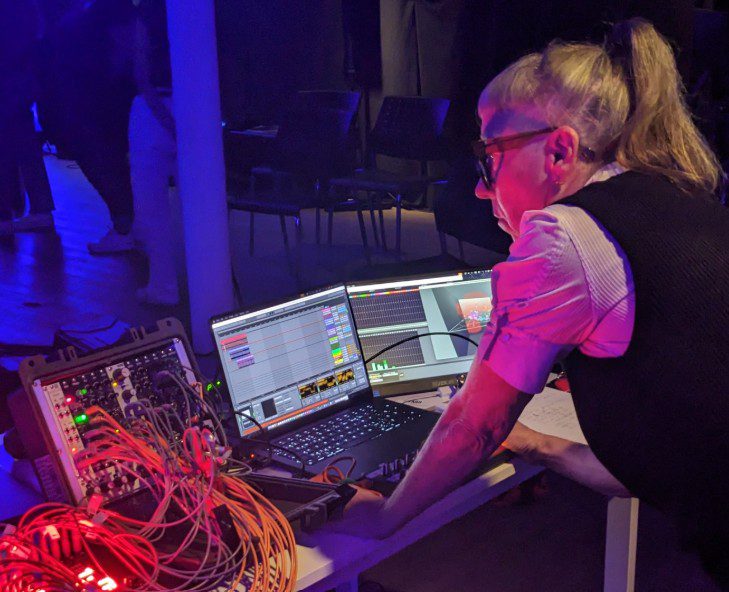
It wasn’t planned at all at the beginning, but we were in Amsterdam for a festival with several people, including Gadi Sassoon. One evening, we experimented a little. Gadi had a system that uses an AI agent called Claude. He had found a way to give Claude instructions to create tracks in Ableton with whatever we told him. So he would create an instrument, effects, notes, patterns, etc.
I gave the most absurd instructions I could think of. I don’t remember exactly what they were, but it was breakcore with a fuzz double bass and a flute playing kitsch melodies with inserts by Pierre Boulez. It was Muzo noise. We had a lot of fun. But in reality, the result produced by the AI wasn’t that interesting. What was really interesting, however, was seeing how Gadi and I interacted in this process.
A few weeks later, I went to see him in his studio in Milan. We had set out with the idea of taking this way of working with AI tools further, but in fact, we realized that it was much more fun to just go with electronics, voice, and improvisation, and use the studio as an instrument.
We did a first take like that, then we worked in Montreal in the spatialization studios at the University of Montreal. And then Daniela came along. We also added takes with vocals and analog synthesis. So, in a way, it was really the opposite of what you can do with AI. It was all live performance, using only things we generated ourselves with our movements.
It was also our response to the fact that often, with AI, it’s like, “Ah, I have an idea, I have an instruction, and presto, it’s going to generate my track. ” Here, we did exactly the opposite, which is to say we worked very intuitively with these instruments that are our bodies, our voices, and analog synthesizers that we adjust with their little knobs and all that. And that produces this music that is very… you’ll see what you think, but it’s very visceral.It was also our response to the fact that often, with AI, it’s like, “Ah, I have an idea, I have an instruction, and presto, it’s going to generate my track. ” Here, we did exactly the opposite, which is to say we worked very intuitively with these instruments that are our bodies, our voices, and analog synthesizers that we adjust with their little knobs and all that. And that produces this music that is very… you’ll see what you think, but it’s very visceral.
PAN M 360: I can’t wait to hear it. But if you’ve decided to leave generative AI out of your process, how does this concept manifest itself in the work?
Pia Baltazar: Our thinking ultimately went beyond the generative AI tools that everyone sees and uses, such as ChatGPT. The discussion was more about AI systems such as recommendation algorithms and how they make us totally addicted. That’s AI too, you know.
And finally, what we asked ourselves was: what is the connection between these AI tools and our nervous system? Ultimately, the way AI hybridizes with us is not necessarily like the classic image of a cyborg. For example, if you ask AI to show you a cyborg, it will show you a human body with some kind of prosthetics. But in reality, the way it works is that it completely changes our relationship with our nervous system, our relationship with time, our relationship with addictions, our relationship with how we react, our anxiety levels. All of these things ultimately interact in a very intimate way with our nervous system.
So we ended up making this really dark song. It’s really, really dark, this song. It’s kind of ambient, doom, something like that.
And in a way, it was also by working with Daniela Huerta, who is into very witchy stuff, that we realized that it was actually a kind of exorcism.
PAN M 360: I find it very interesting that you mention this link between technology and the nervous system. We don’t often talk about the addictions it creates, but I’m sure it resonates with a lot of people, myself included. Are these effects intrinsic qualities of AI algorithms and technologies, or do they point to a bigger problem?
Pia Baltazar: AI is just two words put together, but then it’s about practices and technological development choices made by certain people, in this case a handful of guys who live in Silicon Valley and all think pretty much the same way.
In other words, AI is not an autonomous entity, contrary to how it is often presented—that is a myth. It is true that AI, operating through a black box, is rather opaque in its functioning, but what is important is the criteria you give it.
So, you tell it, for example for Instagram, that the goal is to make the person as addicted as possible so that they stay hooked on the app. The algorithm will find ways to achieve this that we have no idea how it works internally. It’s a very heuristic approach, in fact, which is the opposite of what was thought of as artificial intelligence when five other guys got together at a conference in 1957 and talked about artificial intelligence.
It was completely different from what they thought. They thought it would be something very controlled. In fact, it’s not like that at all. The way it works is completely chaotic. It’s just trying to find ways to learn heuristically how best to achieve the result.
So, the only thing we can define in relation to how most AI algorithms work today is: what is the objective?
And in this case, the goal for the tech bros, Zuckerberg, Sam Altman, Elon Musk, and that whole bunch of crooks, is to see how they can maximize profits.
Except that, on top of that, these guys share what they call a kind of dogma, which they refer to as a “mindset.” And there are studies on this. It’s documented in relation to things that are said, that are written, seminars they attend.
And how do they see it? They see it as follows: the planet, the Earth’s ecosystem, is doomed anyway, and AI is the next step, the superior form of intelligence, so there’s no point in trying to save what’s there. What’s important is to achieve as much autonomy as possible for this superior intelligence.
So, if you like, there’s this kind of dogma, this ideology behind it. Their wet dream is that their brains will be updated and uploaded into AI, which will ultimately give them eternal life.
So, that’s the ideological system that underpins the entire way in which most of the AI that is manufactured today is based on this ideology.
PAN M 360: Unfortunately, this ideology extends beyond Silicon Valley, but that doesn’t make AI any less appealing as a subject for artistic research. Is it still possible to approach these technologies in a critical way?
Pia Baltazar: Technology is never neutral.
And to say, “Oh yes, technology is neutral, it depends on whether we use it well or not,” is completely illusory. The reality is that technology carries within itself the way it is made, in its very nature. So that’s the mainstream view of AI. Faced with this, there are ways to resist it, to create alternatives.
That’s what we did, particularly with this project I set up when I was working at the SAT, called ARIA, where basically the idea was to say: this idea of AI as a continuation of technology as it has been since technology came into existence.
Well, how could we create alternative models that would correspond to the values, practices, and imaginations of artists? So, we conducted a large consultation that was funded by the Ministry of Culture, and we realized that artists, depending on what you put behind the words “AI,” are not necessarily against it.
And if it’s something that respects them, that isn’t going to steal intellectual property, that isn’t going to have terrible consequences for the climate, that isn’t going to have all those biases, well, people are interested.
And that’s when other models are generated. They may be smaller models, models that you train yourself, models over which you have some form of control, and so on, in fact. So, what I mean by all this, and this long journey I’ve taken, is that AI is what we make of it.
To answer your basic question, AI is what we make of it, and AI is just a way of giving a name to what is the main paradigm of technological development.
PAN M 360: How do you see your role as an artist in all this?
Pia Balthazar: It’s a bit like David versus Goliath because we’re very small, we don’t have much money, and that’s just how it is.
But on the other hand, as artists, I believe we have a strength, which is that we are capable of telling stories. And the stories we tell are what will also determine how people imagine things, what myths they believe in, and what worldviews they develop based on those myths. So we have a responsibility in that regard.
In this case, on this particular part, we didn’t use any. We used it for experimentation purposes.
But otherwise, I believe that one of the best ways to do this is to divert, tweak, and turn the tools against themselves.
That’s what we all do as artists. We have tools that are designed to do a certain thing, and then we make them do something other than what they were designed for, and that’s where it gets interesting, you see? And that’s precisely why these technologies aren’t interesting in themselves. I remember Robert Bresson, who was a filmmaker in the 1960s in France, part of the New Wave. He said something like, “These prodigious machines that fell from the sky, use them to repeat, to reproduce the artificial.”
In a few decades, it won’t make any sense anymore, you see? And it’s kind of the same thing, in that today, where AI is dangerous is when, instead of using someone with a certain skill, a certain sensitivity to produce an artistic artifact, we entrust it to an AI that will do some kind of standardized thing. And what does that do? It reproduces what a human would have done in relation to that, but emptied of all substance.
In fact, it’s just like reproducing the external form of things. So what I think about this is that ultimately, no matter what tools we use, what matters is what our stance is, what our attitude is, and how, ultimately, we don’t just settle for what the instrument, the tool, the technology gives us, but how, through it, we manage to stretch and transform it to ultimately produce something that is a human emotion.
And so, for me, I’ve never been able to settle for the tools I found on the market. I’ve always had to tweak them, to make my own tools.
PAN M 360: I’m starting to understand your point better about how AI is really just the technology of the moment. If we take Super 8 as an example, we often say that it’s warm, analog, nostalgic, when compared to an oil painting, Super 8 must have seemed cold at the time.
Pia Baltazar: That reminds me of a story. It was about Karlheinz Stockhausen, a composer from the 1960s, after the war, who went to see a Zen master and had a big contradiction because he worked with analog synthesizers. So, which is precisely in line with what you’re saying today, that all musicians who do a bit of experimental music use analog synthesizers because they’re hot, they sound good. Well, at the time, he went to see this Zen master and said to him: “I have a real moral dilemma because I want to make natural music (that’s the term he used), but I use tools that are artificial,” and the Zen master said to him, “That’s not the issue. The issue isn’t what tools you use, but how you use those tools, whether naturally or artificially.” ” So, the term ‘natural’ is a bit outdated now, but I think it’s the same attitude that we need to adopt.
How do you use your tools? Do you use them to imitate what already exists, or do you use them for their own capabilities? And in that regard, AI tools can be interesting because they hallucinate. That’s what they do all the time, they hallucinate. Often, it’s right, but often, it’s wrong!
So, if we’re going to use AI, we might as well let it run wild. That’s how I see it.
PAN M 360: Recognizing the creative power of each of these artists, this collaboration is sure to leave some jaws on the floor. And that’s the whole point. A reminder that, in the age of AI and automation, nothing can replace the visceral quality of human expression. At Akousma, on this Halloween night, we will remember that certain presences haunt not machines, but minds.
Publicité panam
James O’Callaghan is undoubtedly one of the most prominent composers in his thirties in the Canadian music scene. His works are highly diverse, both in terms of the instruments used and their references, which range from electroacoustics to contemporary instrumental music, IDM, and post-punk! A creature of his time, James O’Callaghan is invited to Akousma this Friday to broadcast the work “Fear of the Dark”, which has little to do with the Iron Maiden song of the same title. Although… there may be a few slightly harsh sounds scattered throughout this electronic work on Halloween night! For the first time, PAN M 360 meets this prolific and highly talented Canadian composer, originally from British Columbia, who now divides his time between Berlin and Montreal.
James O’Callaghan is undoubtedly one of the most prominent composers in his thirties in the Canadian music scene. His works are highly diverse, both in terms of the instruments used and their references, which range from electroacoustics to contemporary instrumental music, IDM, and post-punk! A creature of his time, James O’Callaghan is invited to Akousma this Friday to broadcast the work Fear of the Dark, which has little to do with the Iron Maiden song of the same title. Although… there may be a few slightly harsh sounds scattered throughout this electronic work on Halloween night! For the first time, PAN M 360 meets this prolific and highly talented Canadian composer, originally from British Columbia, who now divides his time between Berlin and Montreal.
PAN M 360: You are involved in various forms of composition: electronic, instrumental, vocal, mixed, even forms close to rock. Quite a program!
James O’Callaghan: I am a curious person and have always wanted to try new things. I am motivated by exploration, like water that flows under a rock to find its way. I would not expect, for example, to be interested in writing for classical instruments. Yes, a little bit of everything.
PAN M 360: You received your musical education in British Columbia, studying electroacoustics at Simon Fraser University, after which you came to McGill for your master’s degree, which you completed in 2014. How did you diversify your approach?
James O’Callaghan : It was really thanks to the Simon Fraser program. I started out in electroacoustics, but the program also required us to write for instruments. If I could have specialized in electroacoustics, I would have, but the program wasn’t segmented. At first, I wasn’t really interested, but one of my first teachers at the time, Rodney Sharman, really encouraged me to learn the instrumental language, and I became very enthusiastic. And then this program involved a professional contemporary music ensemble reading and performing student works each semester.
It was really cool for a young composition student to work with professionals who were really open to my work. I really loved the collaborative process of writing instrumental music, which is very different from electroacoustics, where you’re alone in the studio and can change the sound directly without consulting anyone. Two very different ways of working. Then I even got to work with symphony orchestras in British Columbia. So I was really lucky to be in the right place at the right time, because I didn’t have any background in instrumental music before.
PAN M 360: We’ve been told that you commute between Berlin and Montreal.
James O’Callaghan: Yes, my girlfriend, the artist Sarah Albu, and I live here part-time, which is convenient because we have a lot of work here, but we both also have quite a few projects in Europe, so it makes sense to keep both homes for the time being.
PAN M 360: In this case, it is an electroacoustic work presented at Usine C this Friday.
James O’Callaghan: I am grateful to Akousma and its artistic director Louis Dufort for asking me to do something new in electronic music, not really dancefloor, not EDM or IDM, not the kind of thing you would play at Mutek late at night, for example (laughs).
PAN M 360: So you’ll be presenting “Fear of the Dark”, which is also the title of an Iron Maiden song, haha!
James O’Callaghan: Yes, I imagine I’m not the first to use that title.
PAN M 360: That said, it makes sense because you sometimes have a rock attitude. You’ve just released Purple Heck, an EP of post-punk songs where your rock crooner voice drips with desire!
James O’Callaghan: Yes, I released it in August, and I’ve already played a show in Berlin with this material. I hope to play a few shows in Canada. I played everything myself—baritone guitar, bass, keyboards, synths, electronics, vocals. A band would be the next step, this music lends itself well to that! If I can find the time, it’s something I’d like to do more often.
PAN M 360: But “Fear of the Dark” promises to be an electroacoustic work.
James O’Callaghan: Exactly. And I think that title is a good choice for my music presented at Akousma. Because Fear of the Dark can also come from Pierre Schaeffer (one of the fathers of electroacoustics), meaning the distancing of an environmental object from its source. There is a kind of anxiety surrounding this. It attracted me when I started studying this music at university. I wondered why it seemed so difficult to think about the source of sound. That’s really what prompted me to think about this piece, to think about the idea of the sound object, something that carries the anxiety of separating sounds from their source.
PAN M 360: Can we learn a little more about the structure of this piece? “Fear of the Dark”?
James O’Callaghan: What I knew when I found out I would be doing this play was that it would be performed on Halloween night. That certainly influenced the choice of title. My starting point was to try to think of all those clichéd sounds you hear in horror movies or haunted houses—screaming birds, whistling wind, threatening voices, creaking doors, suspicious footsteps echoing, etc. There are also sounds that I explored in my previous works that could lend themselves to the exercise. I also thought about the anxiety-inducing passages in Michael Jackson’s song “Thriller”.
PAN M 360: Yes, in which Vincent Price lends us his voice from beyond the grave!
James O’Callaghan: I love that song! There are little references to “Thriller” in the piece. In fact, there are two tributes in the piece. The other is to the electroacoustic piece Cricket Voice by composer Hildegard Westerkamp, who went into the desert and recorded the sounds of crickets, then transposed them to other octaves before revealing their source.
One of the theoretical motivations for this piece was an article by the late Andra McCartney, a sound artist and acoustic ecologist from Montreal, entitled “Alien Intimacies”. In this text, she recounted how she had taken Hildegard Westerkamp’s piece, “Cricket Voice”, and played it to a group of students, then asked them to describe what they had heard and how they felt while listening to it.
This piece, which is meditative in nature, with an environmental sound linked to acoustic ecology, elicited different perceptions than expected: most students drew comparisons with science fiction, horrible monsters, etc. She observed that electronic manipulation of sounds and listening to them in the dark could often cause anxiety. That is why I wanted to refer to this piece in particular by using the sounds of crickets.
PAN M 360: Will you be broadcasting this piece yourself on Akousma?
James O’Callaghan: Yes, I just finished an octophonic mix of the piece, which means it’s spread across eight main channels distributed across some fifty speakers installed at Usine C.
PAN M 360: OK! Now let’s talk about other aspects of your vast musical world, especially since your works are often performed on contemporary stages. “Limit”, one of your most recent works, was premiered by Paramirabo last September. So what are your main projects?
James O’Callaghan: Well, right after Akousma, I’ll be working on a new piece for Jean-François Laporte – Totem Contemporain. I’m going to write a piece for his invented instrument, the Table de Babel.
PAN M 360: According to its official description, the Table of Babel consists of two bowls, a pipe, eight insects, several vibrating membranes and divas, as well as a free latex electron. Each element has its own compressed air supply and is therefore controlled independently. So what do you do with this Table of Babel ?
James O’Callaghan: I staged it my way, emphasizing the fusion of genres. When Jean-François approached me, he was also interested in my interest in techno, so there will be a techno aspect to it all.
In two weeks, I will be traveling to Toronto to finalize the piece “Amor Fati”, which I have been working on for about six years with pianist Cheryl Duvall, who is also co-artistic director of the Thin Edge New Music Collective. She commissioned several composers to write long pieces, lasting an hour or more. My piece will premiere at the Canadian Music Centre on November 13 and will also be performed in semi-darkness with powerful speakers set up in another room. The pianist will have to play from an oral score that she will hear in her ears, so she will be performing without reading.
PAN M 360: Did you say blown up?!!
Photo tirée du compte Instagram de James O’Callaghan
Publicité panam
This is her first time in Montreal, and despite the recent rainy weather, Lamia Aït Amara will bring the warmth of her native Algeria to her performance at the National Theatre, as part of the Arab World Festival. For the occasion, she has come with her seven-piece orchestra, who will introduce us to Andalusian music. For Algerians, it will be a nostalgic evening, a journey back in time. For others, it will be a chance to discover one of the most beautiful voices in Algerian music, as well as the nouba, hawzi, and malhoun styles. Our journalist, Sandra Gasana, spoke with Lamia as she was preparing to head to rehearsal.
Publicité panam
In the atrium of the Conservatoire de Montreal, I had a conversation with the electronic musician and composer Francesco Giomi concerning the concert that would take place in an hour. This concert was a dedication to the late Luciano Berio on what would have been his 100th birthday.
PAN M 360: First, what brings us to this work with Tempo Reale (an electronic music research, production, and educational centre, based in Florence, Italy.)
Francesco Giomi : The concert is a monographic concert dedicated to the music of Luciano Berio, but the first is not by Luciano Berio; it is a sort of homage we realized by using some of the material taken from Luciano Berio’s musique. It is called In-naturale, it is a paraphrase of the title of Berio’s piece Naturale, which is a piece that includes a very famous Sicilian singer, together with viola and percussion. This is an example of Berio’s interest in ethnic music because he was very interested in music from traditional cultures.
So the concert includes four pieces, the first is this ‘In-natural hommage, which gives an idea of some of the creative work of Tempo Reale. By taking material from the archive and reorganizing this material. In Europe, we use this word: ‘reactivating’ the archive. We did this several times, it’s an interesting way to interpret an archive. Then there are three pieces by Luciano Berio: Thema, Chant Parallèle and Visage, threepieces around this idea of voice.
They give another idea of the activity of tempo reale concerning the idea of the performance or interpretation of fixed media music, Music on tape. Especially Thema and Visage are presented here for the first time in [North America] in a very new version realized in an Ambisonics environment. Ambisonics is a technique to create music in space. We spent time in Florence to develop these versions. […] We use artificial intelligence to separate things in the piece and then to move things in space. It is a piece created 10 days ago.
Thema and Visage are pieces strongly linked to Cathy Berberian, Luciano Berio’s first wife, but first of all she was a very important singer, a very important woman and a fantastic performer. He collaborated with her for several years. I think he realized with her some of his most important pieces of his repertoire.
PAN M 360: Would you say ambisonics goes beyond a re-spatialization process?
Francesco Giomi: Well ambisonics is a new technique.
PAN M 360: Is this developed by tempo reale?
Francesco Giomi: No, no ambisonic is a standard. […] Everyone can use it and we use it for this project but also for other pieces.
PAN M 360: Does your work, In-Naturale use this technology?
Francesco Giomi:It uses a more traditional technique of spatialization. [However] Chants Paralèlle, which is the third piece, uses a technique that is completely manual. So in one concert, there are three kinds of moving sounds.
PAN M 360 :Beyond his interest for voice, how do you find his interest in various traditional cultures is reflected in his work?
Francesco Giomi: This is only in In-Naturale there are fragments from different cultures, because we use not only fragments from Berio’s music but also fragments from Berio’s archive. Because during the 60s Berio went around to record things, so in his archive we find music from Yemen, music from Jewish people, music from Sicily – voices from Sicily. Berio’s music is very ‘accogliente’(welcoming). So, sound is considered material, and the composer can reorganize it, giving it form, giving it musical structure. This is the modernity of Berio’s music because now, in my opinion, there are many many of interesting aspects in the music from other cultures, in cultures different from the Western dominant culture. You can find interesting sources of sound in African music, in Asian music, and in particular regional music. If I think of] Italy, where traditional music is still alive, Sardinia, Sicily, and Sardinia. I imagine it happens in France, in Spain, in Greece, even in Mexico. Maybe less in the USA [laughs]
PAN M 360 :Do you think the use of voice in his work and the welcomingness of his music coexist?
Francesco Giomi: For Berio, voice is very important to Berio. He once described the voice as ‘the house of the music’ or perhaps ‘music home’. Voice is the first expression tool for everyone. He used voice all his life but I think his meeting with Cathy Berberian was the most important for his research. If you work with voice you can [welcomes] new types of voice, many types of vocal expression; Text, words, but also preverbal sounds, invented languages, so on and so on.
PAN M 360: Like in Visage, Berio described it as a pre-radio play.
Francesco Giomi : Exactly, brava, brava, in Visage you can [hear] invented languages or invented fairytales. So Cathy Berberian [is playing] a completely invented fairytale without any real words.
PAN M 360:I’ve heard Berio described as a surrealist composer. Do you think that is a fair description?
Francesco Giomi : I don’t know, perhaps in his younger period. Because, for example, during the 60s he collaborated with this radical poet Edoardo Sanguineti. So the collaboration between them was really surprising, fantastic. Laborindo II which is one of the most important pieces by Berio and A-ronne which is a piece for voices.
PAN M 360 :So those were both with Edoardo Sanguineti, this was a kind of composer-librettiste relationship.
Francesco Giomi: Keep in mind that Sanguineti is one of the most important poets in the [1900s] of Italy.
PAN M 360: And you think he brought a more radical edge or expansive perspective to Berio’s music.
Giomi : Well, Berio in some music was very radical, less in some, but in folk songs, rendering and sinfonia was very radical, and was very deep in investigating some boundaries of musique, some limits of musique. But anyway I’m not a musicologist, I’m not allowed to speak on the life and music of Berio, I am musician.
[…]
Part of my work is to preserve the legacy work concerning live electronics. […] Part of the work of Tempo Reale is to perform in the original way Berio’s music. To try to give the future the possibility of knowing how Berio’s music with live electronics should be performed. So we realized the scores of Berio’s work with electronics which would allow Berio’s work with electronics. [these are scores] that allow [anyone] to perform them without us, without me. This is important because a written score you can archive, you can transmit it to the future possibly more easily than electronics. So we try to translate our knowledge about Berio’s live electronics into written scores. So we [created] these four scores (Euphonime, Altra voce, Outis, and Cronaca del luogo). It’s important because I don’t care if someone else can perform Berio’s music. I can give her or him the possibility of performing a piece without me.
PAN M 360: So you’re making sure it can last into the future…
Francesco Giomi: Yeah sure, because also an orchestra piece can be performed by a conductor or another conductor. This is normal in music, its interpretation. This could be valid for live electronics. You can listen to the piece performed by me, or performed by another and say “a giomi is worse” thats normal.[laughs]
PAN M 360: So you’re allowing performance to be a part of electronic music. Were these created while Berio was alive?
Franscesco Giomi: Yeah Berio [created] before the written score before and then [created] with me or other people the live electronics part. Normally this happens for a particular performance or concert, then after the concert the score remains and we continue to perform the piece. These electronic parts were written during Berio’s life, from 1999 to 2003.
[…]
PAN M 360:So Chants Paralèlle is oneof theseelectronic piecesthat is performed?
Francesco Giomi:Chants Paralèlleis my [… checks italian translation…] batt horse or battle horse. It’s an expression that means it is a piece I regularly perform – I am very good at performing it.
Derived from the fact that, many centuries ago, if you went into battle, you chose the best horse. Anyway, this piece was a little hidden; he created this piece during his period at IRCAM in Paris, but he created it at GRM, another center for electronic music. I [heard] this piece for the first time in Paris in 1987 and I decided to study it. And I started to perform it and I have many many times. It is an interesting piece where Berio used a transformed voice with synthetic sounds. You can’t even recognize the presence of voice. It is also a piece with a tonal center.
PAN M 360 :Was this the first piece by Berio you worked on?
Francesco Giomi: Yes, well, I already knew all of his electronic work, but I performed them after our meeting in Paris in 1997. Especially great for me because my life changed completely.
PAN M 360 :I wanted to ask if this was one of the first presentations of In-Naturale ?
Francesco Giomi : No no, but it is the first time in the Americas. But you know Montreal for electronic musicians is a sort of [… checks italian translation…] Toy Land, it’s a quotation from Pinocchio. In the best way, of course, there are many academic structures for electronic music; it is very rich. Like here (Conservatoire de musique de Montréal), there is a fantastic venue for electronic music, UdeM, McGill; we are surrounded by electronic music structures. So I try to get my students to come here for exchanges because you breathe a very interesting air for electronic music. In Italy, we have a lot of interest in electronic music. There are thousands of people practicing, but the structures and the funds are lacking. We are lacking buildings, venues, speakers, studios and so on.
PAN M 360: But Tempo Reale is doing that work no?
Francesco Giomi:Yes, during the 90s there were several centers for electronic music in Italy but with the economic crisis of early 2000s many of them disappeared but Tempo Reale remained, and it is the biggest now, but still small in comparison to France or to Canada, well to Quebec.
Publicité panam
All it took was a phone call. That of bassist and composer Laurent Perreault Jolicoeur, who decided to contact kora master and Senegalese griot Zal Sissokho to propose this project in 2022. Three years later, they are about to release their album Racines (Roots), which will be launched at the Lion d’Or on November 11. In the meantime, the 10 tracks, which explore memory, identity, and modernity between West Africa and North America, will be available to listen to starting October 31. Our journalist Sandra Gasana spoke with the two musicians for PAN M 360 the day before the album’s release.
In her latest album, T.R.A.N.C.E., Julia E. Dyck highlights her experience as a hypnotherapist. The captivating rhythm of her voice creates vivid images in the mind. Her spellbinding voice, oscillating between command and reverie, floats above minimalist drones that subtly follow the emotions, traveling through love, fear, pain, and then returning to love. After listening to this album in the morning, I felt pleasantly awake and open to the world.
I had also heard Julia’s work with Audio Placebo Plaza and A Kind of Harmony, two projects that had given me a similar feeling of underlying calm. It seems that these projects share a similar sensitivity towards sound as a social actor and spiritual means of healing. I wondered where Julia fit into this evolving microcosm that is deep listening. Ahead of her performance at Akousma, I wanted to understand the roots of this unique practice, and Dyck generously answered, diving deep into the lessons that made her the artist she is today.
PAN M 360: Hello, Julia. Thank you for agreeing to do a phone interview with me this morning.I’ve spent a lot of time listening to your album T.R.A.N.C.E. One thing that really struck me, and it may seem obvious, is that your voice is truly mesmerizing.Have you always spoken in such a hypnotic way, or is it something you learned?
Julia E. Dyck: I love talking about this. Hypnotherapy training involves a lot of work and vocal exercises. However, long before that training, I was already very interested in my own voice. My very first experience was singing in a choir; as soon as I could walk, I sang in the church choir. I then moved on to musical theatre, then sang in a band, before returning to choir. I also worked for seven years at CKUT, where I did live radio. All of these experiences definitely made me very curious about the voice. I consider my voice, both in singing and speaking, to be my primary instrument.
That said, I really had to work on the hypnotic power of my voice. I was trained by a wonderful Montreal-based hypnotherapist, Andrea Young. One might think that the role of the hypnotist’s voice is to be relaxing. To a certain extent, this is true, but according to Andrea Young, the voice is a lantern that guides the conscious mind or keeps it occupied, while words, visualizations, metaphors, and symbols speak directly to the subconscious. It is therefore important to have a rhythmic voice and not be too relaxing, as people may fall asleep or not be as receptive to what you are saying.
PAN M 360: After all these years, would you say that your approach to sound is closer to that of a therapist or a musician?
Julia E. Dyck: Neither, and both at the same time. I would say that I trained in hypnosis and hypnotherapy from a truly artistic perspective. So I approached it as artistic research, even though it has now gone beyond what I initially planned to do with it. I am happy to be situated at the frontier between a more therapeutic practice and a more artistic or musical practice.
PAN M 360: What do you focus on when writing a text that makes it so vivid?
Julia E. Dyck: The album T.R.A.N.C.E. isn’t really a reading of the text. I have a few notes, then I improvise in a way. When I practice hypnosis, whether with a client one-on-one, in a group session, or for a recording, I too have to enter a trance state. Obviously, I couldn’t memorize and reproduce this 25-minute narrative. Often, it’s even longer than that. So I really rely on my subconscious, and the images that come to me follow a sensory thread of metaphors. It’s really the result of a very relaxed trance state that I find myself in, and the fact that I simply trust the voice, the words, and the story.
PAN M 360: That’s wonderful. I think the key word you just mentioned is trust—not only for yourself, so that you believe in the story and the words, but also for the listener, so that they can let themselves go into this trance state with you. Is there anything you or the listener can do to create that safe and open environment in which trance can occur?
Julia E. Dyck: What I love about doing something quite hypnotic in an artistic or performative setting is that people already approach these settings with an open mind and a certain curiosity. That’s all I can really ask for and hope for from any kind of audience. Often, people who might not be drawn to hypnotherapy or even meditation find themselves in a context and state of mind that allows them to be touched by something. At Akousma, I will be performing part of my latest album, Introduction to Somnambulism. So it’s not a hypnosis album in the same way as the album T.R.A.N.C.E., but it is clearly inspired by my training in hypnotherapy.
I don’t expect people to be completely hypnotized, especially since the set is quite short. However, I think they should come with an open mind, as they would for any other artistic event. Of course, my voice will be present and all the sounds I produce will be very precise and influenced by a translation of these hypnosis techniques. I will also be playing my set of giant chimes, which resonate throughout the room and should have an effect on the body. I find it fun to bring this giant, resonant instrument to a festival like Akousma, which is really focused on an electronic and acousmatic experience. However, I think the combination of these two elements should be quite effective and immersive.
PAN M 360: I’d like to talk about the podcast you did with Amanda Harvey, A Kind of Harmony. There’s a question I asked Amanda that I’d also like to ask you: What do you think is the most important lesson you’ve learned from your guests?
Julia E. Dyck: There are so many. In terms of something very specific that stood out to me and that I think about almost every day, it was a conversation we had with Beverly Glenn-Copeland. He was talking to us about his theory of the universal broadcasting system and his belief that everything he has created and everything great that has been created in this world, whether through art, science, or innovation, is somehow a co-creation between the creator and this larger consciousness of the universal broadcasting system.
So, the idea that the most incredible ideas and inspirations come to you as a transmission and that you can’t necessarily control them, that they are not necessarily the result of repetition, discipline, or research, but rather of an open mind, a willingness, and also a taking seriously of these transmissions. So it’s this idea that the artist can be more of a channel, a receiver for something that already exists in the ether. And that really changed my relationship with my own practice, because it’s something I’ve kind of experienced, but never been able to put into words. Hearing that from Glenn really made a lot of sense to me. I think I’ve become much more open to the universal broadcasting system and all these transmissions.
PAN M 360: That’s interesting, because this idea that transmission is at the heart of creation is much closer to the practice of listening, which is one of the main topics of the podcast. How has your listening changed since you became familiar with the universal broadcasting system?
Julia E. Dyck: We fill our ears, our perception, with so much media that it is rare to have the opportunity to receive or even notice a transmission that reaches us. But if we think about it in terms of listening to the environment and resonating with our surroundings, the Earth is constantly transmitting. If you are present and open to your immediate environment, you are more likely to receive these messages and signals, whether in an urban or natural setting. There is so much information around us at all times that it takes deliberate intention to tune in, be truly present, and really listen.
PAN M 360: We would like to thank Julia E. Dyck for introducing us to the hypnotic space that distinguishes art from therapy. We are now more ready than ever to listen. Come and experience this unique performance on the final evening of Akousma.