When you discover the unique journey of Dice B—rapper, producer, journalist, and youth worker—you understand why he was chosen as spokesperson for Black History Month 2026. This role comes with several responsibilities, such as speaking in schools, participating in panel discussions for Black History Month events, and giving interviews to media outlets like PAN M 360. This interview reveals a truly inspiring profile, highlighting all facets of the artist and the common thread running through it all. He also shared some exciting news, including a single he collaborated on with his younger brother, Sun Shan, titled “Le gardien de mon frère.” Our journalist, Sandra Gasana, had the opportunity to speak with the artist to learn more about his role as spokesperson and, above all, all his accomplishments to date.
Interviews
The Turkish pianist Fazil Say is one of the most remarkable artists of the last 30 years. His particular style, crouched over his keyboard, almost embracing it and murmuring more or less loudly while playing, may remind one of Glenn Gould. The artist, however, is more versatile than the Canadian. He does not shy away from the stage, on the contrary. He gives about a hundred concerts a year. Moreover, he composes a lot. He has already reached number 120 in his opus catalogue. Symphonies, concertos, and piano pieces, of course. In 2022, he recorded Bach’s Goldberg Variations, about twenty years after his previous album dedicated to the composer. Since then, he has been performing them in concert all over the world. On Tuesday, February 17, he will perform them at the Bourgie Hall in Montreal, as part of the “Exceptional Pianists” series (and believe me, in Say’s case, it’s true!). In addition, he will also play several of his piano works, including Black Earth and his Sonata Yeni Hayat (“A New Life”). I discussed Bach and his own music with Fazil Say before his visit to Montreal.
CONCERT DETAILS (No tickets are available, the concert is sold out)
PanM360: The recorded Goldberg Variations arrived in 2022, about twenty years after the previous recording dedicated to Bach. Why such a long hiatus?
Fazil Say: You know, I play between 90 and 100 concerts a year, in addition to writing a lot of music. Bach is important in my life, but you have to take the time to learn this music, especially major works like the Goldbergs. For the Goldbergs, it was the pandemic that gave me the opportunity. During the lockdown, I felt the urge to take the time that was suddenly offered to me to immerse myself in certain Great Works, such as the Goldbergs and Schubert’s last sonatas. For the Variations, I dedicated 3-4 months to the analysis, which was a great joy for me.
PanM360: In concert, do you do all the reprises?
Fazil Say: If we do them all, the piece can last almost 90 minutes. I decided to cut some repetitions and offer the entire thing in a timing of about 55-60 minutes. I don’t think this hurts the piece, and it allows me to offer a different second part of the concert.
PanM360: The Goldberg Variations are a masterpiece of musical architecture. They can be played with different narrative perspectives. Gould 1955 is almost atomistic, with each movement as a universe in itself. One can be completely holistic, with a pointed arch peak, like in a cross of ogives, at variation no. 16, a French Overture that can serve as a “second start” towards the second half. One can also conceive the whole as ten groups of three variations (a character piece, a virtuosic variation, and a canon) to which the initial Aria and its final reprise are added. In short, what is your narrative vision of this edifice?
Fazil Say: You are right to say that there are ten groups of three variations. You are also right to talk about the symbolic value of variation no. 16, right in the middle of the structure. For my part, I never play that way, with that idea in mind. I rather consider the long line, from beginning to end.
PanM360: Since 2022, how have the Variations evolved under your playing? What changes have you made to them, compared to the recording?
Fazil Say: After several dozen performances, I think the ideas are clearer, the whole is more mature. It’s normal. It’s a process that resembles life. I think my way of playing now is better than on the record.
PanM360: Do you want to play and, perhaps, record more Bach?
Fazil Say: I would like to record The Well-Tempered Clavier soon. But soon doesn’t mean tomorrow (laughs). Through all my concerts, commissioned works, chamber music, etc., I have to find the time. My next two years are already completely booked. And the Clavier is even more demanding than the Variations. So maybe in two years, a little more, I will be able to do the First Book. Then the Second, but I haven’t scheduled that yet…
PanM360: In the second part of the concert, on February 17, you will play your piano compositions, several of which are influenced by jazz. What place does this music have in your life?
Fazil Say: I have loved jazz all my life. Jazz and classical are not very different. I see jazz as a contemporary development of harmony and rhythmic play. A composer today must be interested in all kinds of music. Also the traditional music of one’s own country, or other countries, which I often incorporate into my compositions.
PanM360: Let’s talk about it. You will play, among other pieces, Black Earth, one of your first compositions and one of the most performed in the world. At one point, you mute the piano strings with one hand while playing with the other. It produces a sound that resembles a saz, a traditional Turkish instrument. How did you come up with this idea?
Fazil Say: By doing tests, experiments. I realised that it produced this sound, very interesting, very particular. That said, I didn’t invent anything. The prepared piano is a 20th-century innovation by John Cage. He would place pieces of wood, or metal, or plastic between certain strings to create strange percussive sounds. I don’t do that, but I draw inspiration from it.
PanM360: The program also includes the Sonata Yeni Hayat (New Life), Op. 99. What can you tell us about it? Why this title?
Fazil Say: I wrote it at the end of the lockdown during the pandemic period. I had in mind this terrible ordeal and all those deaths. I felt the urge to celebrate a new beginning. Hence the title. It’s a rather expressive piece, full of drama but also of hope.
I am also happy to be able to play some of my pieces in Canada. They are performed quite often elsewhere in the world, but, to my knowledge, not so much in your country. I hope people will enjoy them and want to hear more.
PanM360: What are you currently writing?
Fazil Say: Among others, a concerto for piano four hands. And other pieces for orchestra.
PanM360: There are no operas in your catalogue yet. Are you interested in writing one someday?
Fazil Say: I have been asked a few times to do it. The problem is finding a subject and especially a libretto that suits me. Moreover, I am someone more familiar with instrumental music. I should also learn how to write an opera, a challenge in itself, as it is an art with its own requirements, its codes, etc. Let’s just say it’s not on my agenda for the moment.
PanM360: But it’s not impossible…
Fazil Say: One should never say impossible.
PROGRAMME
J. S. BACH Goldberg Variations, BWV 988
Fazil SAY
Piano Sonata, Op. 99, “Yeni hayat” [New life]
Nazim, Op. 12, No. 1
Ses, Op. 40b
Kumru, Op. 12, No. 2
Black Earth, Op. 8
Claros: Temple of Prophecies, Op. 112
Summertime Variations, Op. 20
Paganini Jazz, Op. 5c
It took a meeting at a festival in Brasilia for Veeby and the collective of 11 Afro-Brazilian women, Funmilayo Afrobeat Orquestra, to decide to collaborate on their latest project: an EP entitled Muta Resistanz. Conceived during a ten-day residency in São Paulo in 2023, under the musical direction of Fredy Massamba, Veeby wrote all the lyrics and was the lead vocalist for the project. The whole thing was mixed and mastered in Brussels by Didier Touch, making it an international project involving Canada, Brazil, Congo, Cameroon, and Belgium. That said, this isn’t Veeby’s first project with female musicians. In fact, she had already collaborated with the women’s group Jigeen Ñi in Senegal a few years ago, with the same desire to highlight female musicians. In addition to this EP, Veeby is currently busy with Immersion 2026 with activities planned for February 14 and 15 at the McCord Museum, before flying to Gabon to participate in Black History Month. A woman of many talents! Our reporter Sandra Gasana spoke with her between two appointments to discuss her many projects.
Jazz multi-instrumentalist Julien Fillion captivates the imagination with his cinematic and immersive instrumental pieces. We spoke with him on the eve of his February 14 concert at Verre Bouteille, as part of the Taverne Tour.
Publicité panam
PAN M 360: First of all, I would like to congratulate you on your music, which I would describe as sophisticated, grandiose, and deeply inspiring.
Julien Fillion : Thank you, that’s very kind.
PAN M 360: You released an excellent EP entitled ego in 2024, followed in 2025 by an LP version, ego.alt. What was the mindset behind the ego EP, and how does it differ from that of the resulting album, ego.alt?
Julien Fillion : For me, ego.alt was really a second wind for ego. Once the EP was finished and with the idea of the film/live session project coming up, I felt like I hadn’t completely finished the work yet. Having to present this idea to a team forced me to push my thinking a little further, and quite naturally, new ideas for arrangements emerged. I had a lot of fun with Ghyslain Luc on the mix, taking the songs in a different direction.
En gros, c’est essentiellement la même musique, les mêmes arrangements, mais le fait de tout jouer en live change vraiment la donne. Il n’y a aucun montage, absolument aucun, ce qui rend le résultat beaucoup plus brut. Pour moi, c’est plus vivant, plus honnête et, au final, meilleur.
PAN M 360: You are a multi-instrumentalist: saxophone, keyboards, guitar, and electronic production are all strong points in your repertoire. What do these different instruments represent for you as a composer and musical director?
Julien Fillion : It all started with the guitar when I was a kid, and the saxophone came about by chance during an audition in high school. But my true love for the instrument really blossomed in college. I was that long-haired teenager who played rock music and electric guitar, haha.
Ultimately, all these instruments are different ways for me to express myself. I consider myself lucky to be able to play so many things, because it keeps me from getting bored and allows me to explore lots of different textures.
That said, I must admit that the saxophone remains MY instrument. It’s the one I’ve spent the most hours with, the one I’m most demanding with, and it’s also the one that requires the most courage from me. When I play the sax, I always feel like I’m letting others in on a part of my private life. It’s both the instrument I’ve mastered the most and the one that challenges me the most.
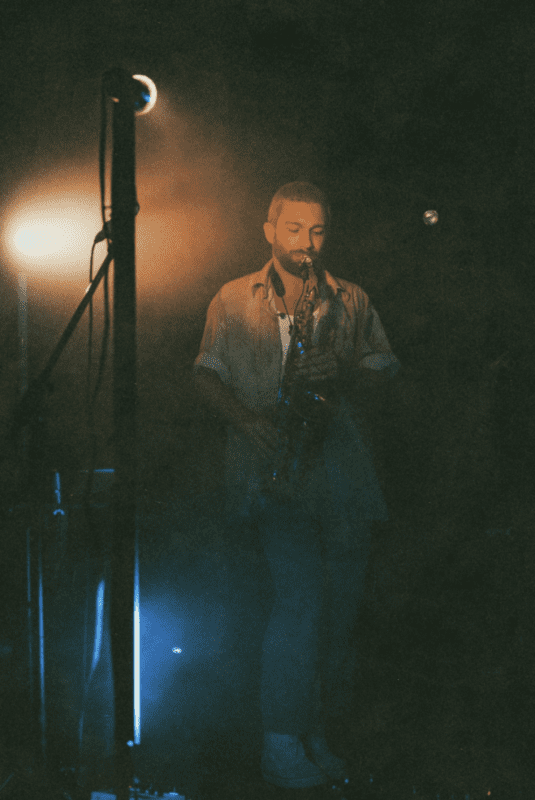
PAN M 360: Tell me a little about your collaborations with Bobby Bazini, Diane Tell, Adib Alkhalidey, and Les Louanges. How did these collaborations come about, and what form did they take artistically?
Julien Fillion : I consider myself really lucky to have crossed paths with these artists, because they truly nurtured and inspired the musician and artist that I have become. It’s hard to say exactly how these encounters came about… Music is a small world: you replace someone here, someone talks about you there, and poof, you find yourself on tour or in the studio.
“The only thing I can control is my work ethic. I’ve always prepared myself really well, because I strongly believe that you only get one chance in this business, and that first impressions are extremely important.”
PAN M 360: Your music has a strong cinematic dimension. It feels like you’re trying to draw us into vast, contemplative worlds, sometimes desert-like, sometimes cosmic (v(.)id, sahara, supernova). What are your sources of inspiration when you compose? Movies, video games, novels, visual arts… or something else entirely?
Julien Fillion : I’m really glad you see that, because that’s kind of my goal, haha. I’d love to give a super poetic answer, but in reality, I can’t really point to a specific source that inspires me every time. It’s more of a mix of my mood over the weeks of creation, production, rehearsals…
I feel like my brain ends up synthesizing everything around me and sending me ideas. For me, composing is really a craft: you shape it little by little, testing textures and atmospheres until it takes shape. And sometimes, these contemplative or desert-like worlds emerge on their own, as if the music had a life of its own.
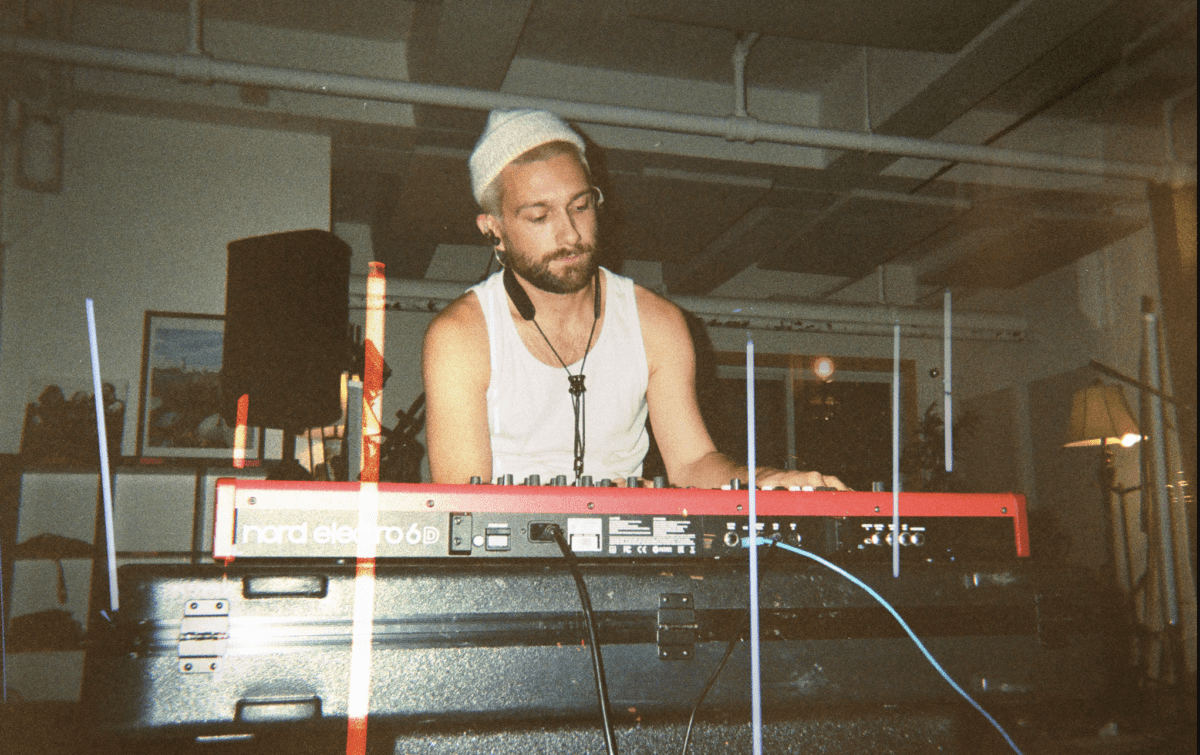
PAN M 360: Musically speaking, I hear echoes of Pink Floyd and Ennio Morricone, but also a wide variety of influences from all over the world. What are the musical influences behind your project (jazz, film music, etc.)?
Julien Fillion : I listen to everything, really, and I go through phases. I might spend two months listening only to Quebecois music, then switch to a Coltrane or Broïl phase. But my foundations—the music of my childhood—are Led Zeppelin, Pink Floyd, and Hendrix. I think that will always stay with me. It all mixes together in my head and ends up reappearing in my compositions, often in an intuitive way.
PAN M 360: Finally, what can we expect from your performance on February 14 at Verre Bouteille, as part of the Taverne Tour?
Julien Fillion : It’s going to be wild, that’s for sure! I can’t wait to play in Montreal, especially since we haven’t played here since the launch in October 2024. My friends and I have been playing together for about 10 years—the energy is incredible and we have so much fun on stage. The show will be intense, lively, sometimes gentle, sometimes completely wild… but always sincere. My goal is for the audience to feel how much we enjoy playing and leave with their heads full of music.
Julien Fillion will be performing on February 14 at Le Verre Bouteille as part of the Taverne Tour.
Publicité panam
Operating somewhere between sharp-edged rock, controlled chaos, and self-aware humor, Fake Friends have carved out a space that feels both immediate and slightly unhinged. The Montreal-based six-piece have built a reputation on songs that flirt with noise and tension while never fully letting go of melody, pairing abrasive moments with an instinctive sense of groove.
With Let’s Not Overthink This, their second full-length album arriving February 13, 2026, Fake Friends return with a record that feels bolder, louder, and more confident in its contradictions. It’s a project that reflects a band comfortable with friction between influences, personalities, and ideas, while continuing to evolve beyond their earlier releases.
As part of Taverne Tour, Fake Friends will be doing a free release show at Saint-Sacrament on the 13th of February. We caught up with Fake Friends to dig into the ideas, detours, and contradictions that shaped the record and the band around it.
From Brainstorm to Stage
PANM 360: You recently announced your second full-length album, Let’s Not Overthink This, coming out February 13, 2026. As a six-piece band, how do you approach writing and arranging? Does everyone contribute equally, or is there one member who leads the demo/riff process?
MICHEAL KAMPS: This album is basically Felix’s brainchild. He had a bunch of old demos on his computer, and we listened through them to pick the most inspiring ones. The lyrics are split between Felix and Matt. A lot of the arranging really comes together when we rehearse and play the songs live, which helps the tracks evolve naturally.
Noise, Basslines, and Everything In Between
PANM 360: Comparing this new album to your previous EPs and albums, and especially to your two singles (Sucker Born Every Minute and The Way She Goes), there seems to be a shift toward more noise and dissonance. You’ve incorporated more synthesizers, instrumental layering, and tracks that revolve around the bassline. As a band, who would you say are your main inspirations for this album?
MICHEAL KAMPS: People often compare us to The Hives and Shame. A friend who heard the album early even said we sounded like Spiritual Cramp. Honestly, it’s hard to pin down exactly where our sound comes from because there are so many influences within the band that we don’t all agree on. Luca tends to lean toward heavier music, Felix… doesn’t really like music at all (no joke). So inspiration kind of comes from a mix of everything and nothing.
PANM 360: Following up on that, is there a band or artist people often compare you to that you secretly disagree with?
MICHEAL KAMPS: In Halifax, some drunk guy almost peed on my shoe and said, “you guys are like the Canadian blink-182.” I absolutely hated that one.
PANM 360: Finally, are there influences on your sound that have nothing to do with music at all, such as movies, literature, art, or personal experiences, and how do they shape the mood or atmosphere of your songs?
MICHEAL KAMPS: Oh, the usual stuff — South Park, McDonald’s, the fine city of Cincinnati in the ’80s, spaghetti… Basically random pieces of our world end up leaking into the songs and giving them a certain weird vibe.
Publicité panam
Tracks, Guests, and Accidental Hits
PANM 360: Were there any collaborations or guest musicians on this album that fans should look forward to?
MICHEAL KAMPS: Absolutely. Our good pals Hannah Castelli (Cross Check) and Clarence Tremblay (Birds of Prrrey) contributed some amazing vocals on a few tracks. Akira Sato (Chop Sue Me) helped out with gang vocals and added some dialogue on one track. And, of course, sworn enemy and nemesis Timothy Aaron Bryan (Timo Bryan) of MULCH and DEATH AS IT SHOOK YOU tried to sabotage our recording… but somehow we ended up using his spoken word vocals for the benefit of the album.
PANM 360: If you had to describe the new album in one sentence to someone who’s never heard your music, what would you say?
MICHEAL KAMPS: 80s Cincinnati Spaghetti Chili Rock.
PANM 360: What’s the track you’re most proud of, and what makes it special compared to everything else you’ve done?
MICHEAL KAMPS: The last track, Good Friends, came together completely out of nowhere. Most of the album has kind of goofy, cheeky lyrics, but Good Friends is much more emotional and desperate. It wasn’t even supposed to be on the album, which makes it my personal favorite. It’s raw, unexpected, and heartfelt.
PANM 360: Compared to past releases marked by lineup changes and fragmented recording processes, how does this album reflect your growth as a band?
MICHEAL KAMPS: This one just feels solid. We were more focused, and everyone’s heart was in the same place. On our last release, we recorded in different studios with different engineers and went through so many lineup changes. Overall, this album feels more organic because it was all made with the same people from start to finish.
Greasy Sets, Big Stages, and Summer Plans
PANM 360: You’re doing a free launch show at Saint-Sacrement Bar in Montreal as part of the Taverne Tour. How are you adapting these songs for a live setting, and are there moments in your performance where you like to experiment or improvise?
MICHEAL KAMPS: You’ll have to come to the show to find out. The set is greasy, and we’re looking forward to performing in such a special space.
PANM 360: You’ve done some incredible shows in Canada, like your memorable performances with Me First and the Gimme Gimmes, and at Club Soda in Montreal. What can fans expect from your touring and live shows this year?
MICHEAL KAMPS: We’ll be out and about this summer. There’s a big Pouzza gig on the outdoor stage in spring, and we’ll definitely be hitting Ontario and the Maritimes. We’re also hoping to play some festivals outside Quebec that we’ve never done before. For the latest updates, just check our Instagram.
Closing statement
PANM 360: Looking back at this album and your journey as a band, what’s one piece of advice you’d give to other artists about evolving their sound while staying true to themselves?
MICHEAL KAMPS: Delete TikTok, delete Grindr and Tinder, throw your labubu in a volcano, listen to Miles Davis… and maybe try opium. Just kidding. The real thing? Have fun, don’t take yourself too seriously, and be nice to each other. That’s the most important part.
Publicité panam
Run Body Run. The idea behind its design relates to the feeling of paralysis linked to fear, particularly when you start to realize that you need to tell your body to move.
Next Friday at 8 p.m., Yolande Laroche will share the stage at O Patro Vys with Améry and Jane Inc. as part of the Taverne Tour. A multifaceted artist who has been active on the music scene for over ten years, she will be presenting new material that will soon be released in the form of an album.
I was lucky enough to hear a preview of this new project. True to form, the artist explores a direction that is difficult to trace back to her previous projects: the pop-rock band Pony Girl, her solo project Orchidae, or her instrumental ambient project mal/aimé, to name a few. The direction is completely different and the proposal is frank. Within a danceable electronic aesthetic, the serious tone of her voice exposes us to lyrics with confrontational, almost violent images.
For a demo, it’s at a very advanced stage of completion. The overall form is complete and the sounds are clearly defined. My curiosity is definitely piqued for what’s to come from the album Run Body Run.
Publicité panam
Diversity of approach
Pan M 360: You have the projects Orchidae, Pony Girl, mal/aimé, and Yolande Laroche, the eponymous project through which you released an EP in 2022.
Yolande: There is also another project called KayFayb, which features two members of FET.NAT, Lindsay Willman and Pierre-Luc Clément. It’s a performance project, a bit like violent jazz. We haven’t recorded anything, apart from a few short videos here and there on the internet.
Pan M 360: One topic I wanted to discuss with you concerns the diversity of your approach to music, which is particularly evident in your work as a multi-instrumentalist. You sing, play the clarinet, keyboard, and guitar too, right?
Yolande: I’ve also just started playing the alto saxophone a little bit; I bought one last year. I love trying new instruments, but it’s still new to me, both the saxophone and the guitar.
I see lots of people doing new things all the time, and I thought to myself, “Why should I stop doing that? I can do it too.” I’ve just started trying to convince myself that I can start new things.
Pan M 360: It can be difficult at times, especially if you already have a certain level of proficiency with other instruments, to be inexperienced for a while.
Yolande: The classical world demands perfection. It’s really difficult sometimes, but over the years, I’ve had to face the fact that I wanted to sing, but I wasn’t very good at it. I had to start from scratch, and even though it hurt, it had to be done.
Pan M 360: As with instruments, you seem to place importance on maintaining multiple projects and cultivating a plurality of artistic expression.
Yolande:Pony Girl was my first pop project after leaving the classical world. We made two albums and went on tour. After a big Canadian tour that was very intense emotionally, we took a break for about eight months without playing or recording. It made me feel really lost because I had put so much of my artistic identity into that band, and I started to question the fact that it was based on just one project.
After trying my hand at experimental instrumental music, I wanted to sing. So I started writing for voice and piano, and Orchidae was born from that. Kayfayb came from a desire to move toward experimental music. I connected with Pierre-Luc Clément and Lindsay Wallman. Together, we created a trio. What we do on stage is truly magical, but it may not be a project that will be recorded.
After that, I became interested in electronic music and ended up with Yolande Laroche, my most recent project. I think this is the project in which my artistic expression has developed the most.
I wanted to embody the different characters I’ve accumulated over the years. I really want to say something that’s important to me.
A new direction: temporal pluralities
Pan M 360: I found that with your eponymous project in particular, you are definitely moving in a more experimental and very direct direction. With mal/aimé, there is something more abstract, perhaps because the music is purely instrumental, without lyrics. For the EP Journal d’enfance, did you collaborate with Nick Schofield?
Yolande: Yes, and actually, Nick Schofield is my husband. We produced Orchidae together for an album I released last year. We’ve been together as a couple for five years. I have an office in our house and he has an office at the other end of our house. When I was working on the project, he would sometimes come into my office and we would discuss ideas, but I wanted to produce this album on my own and he gave me complete freedom to do so. He was still an excellent guide.
There’s always music playing in our house. He works on his stuff and invites me into his office to discuss his music. It’s a really beautiful connection between him and me. I can send you some demos if you’d like to listen! The lyrics are pretty intense… I can’t wait to share it with you.
Pan M 360: Absolutely! Is that the equipment you’ll be playing next week on the Taverne Tour?
Yolande: Yes, I’m going to play it. It’s the kind of thing I like to try. I’ve played this material a few times already. It was by playing that I was able to continue writing the lyrics. It really helped me to put myself inside the music so I could continue developing it.
Pan M 360: Something that particularly struck me about the EP Journal d’enfance was the inspiration you drew from your childhood diaries. What was it that appealed to you about digging so far back?
Yolande: For Journal d’enfance, I had the opportunity to do a creative residency at Studio Daïmon in Hull. Nick and I went on this residency in 2022 or 2023. We had three days and we just improvised together.
Before the residency, I went through my parents’ house to find the journals my mother had given me when I was young. At the time, she thought I was going through a lot of emotions and that it might be a good idea for me to put them down on paper. I decided to try to set the words I found interesting to music. I found the process really fun.
The first track on the EP is a recipe for a magic potion. The second is about the magic of the ocean, at a time when I was a little obsessed with The Little Mermaid. The third describes a strong feeling of rage, which I think was directed at my brother. I remember thinking as I was writing that I needed to end on a more cheerful note. So I wrote, “Let’s go to the wave pool.”
Those were very raw, very pure moments. I think that as adults, we tend to impose filters on ourselves that don’t exist when we’re children. Today, I try to keep up the habit of journaling by writing often. I also have a note in my phone where I write down lyrics or ideas all the time.
Publicité panam
Multi-channel composition and post-production
Pan M 360: At Daïmon Studio, you worked on compositions in ambisonic format. 7.1?
Yolande: Yes, exactly.
Pan M 360: How much did that affect the composition process?
Yolande: It was really fun. We got to decide how we wanted to do the spatial mix. In the first room, for example, the voices come from above your head, from the sides, from behind, and from in front. We got to play with the musical segments and make them spin around us. I found it really interesting.
Actually, I haven’t had much opportunity to present these pieces in ambisonic format. I did it once at Pique, a festival in Ottawa. The layout was a little different, with the speakers on stands arranged in a semicircle.
Pan M 360: And what was the layout like in the studio?
Yolande: It seems to me that there was a pair of speakers at the front and one in the center, two on the ceiling, and then one on each side at the back.
Pan M 360: You were also involved in the post-production stages of this project. Did you do the mixing and mastering directly in the studio?
Yolande: Yes, we had three days, and I wanted us to have a finished product when we left. It wasn’t something I wanted to take home with me. Nick and I set ourselves that challenge.
Pan M 360: Three days is the amount of time it usually takes you to compose three pieces, right?
Yolande: Not usually. It takes me a long time! I’m someone who thinks a lot, and I rarely stick with my first idea. I also need time for the lyrics, to sit with them.
Pan M 360: So you imposed a certain spontaneity on yourself during the residency.
Yolande: Yes, definitely. I think doing it that way added a certain element of magic for us.
Pan M 360: In your other projects, are you ever involved in post-production?
Yolande: Normally, you hire someone to do that. I don’t consider myself an expert at mixing. I like playing around with it, but there’s a lot I don’t know yet. I started using Ableton in 2019. For me, it’s still a new tool. I’m still discovering new features every time I use it.
Pan M 360: We are always learning!
Project in development
Yolande: The album I’m going to release under Yolande Laroche, the one I’m going to present at Taverne Tour, was composed exclusively in Ableton with my synthesizers, and the lyrics came later. It was definitely a new way of working for me.
Pan M 360: What will it be called?
Yolande: Run Body Run. The idea behind its design relates to the feeling of paralysis linked to fear, particularly when you start to realize that you need to tell your body to move. So I try to embody my fears and put those feelings into words and music.
In terms of aesthetics, I was inspired by a performance by Marie Davidson that I saw at Mutek last year. When I got home, I gave myself a month to make an album, with a view to presenting new pieces at an upcoming show. I started composing on Ableton every day, trying to create what I imagined to be my personal embodiment of the energy of Marie Davidson’s show.
Pan M 360: So once again, you’re going to be approaching a completely different musical style with this project. None of your projects have touched on purely electronic dance music yet, have they?
Yolande: That’s right. For the past few years, I’ve been going to more and more DJ sets, and I love going dancing. It’s so liberating to move your body to this kind of music.
Some of my other projects show a more vulnerable side of me, like Orchidae. I needed to embody that character in order to get through some sadder emotions and regain my confidence. I think now I’m ready to dance. I feel like moving a little.
Pan M 360: It’s going to be quite a varied evening next Friday. You’ll be sharing the stage with Améry and Jane Inc., is that right?
Yolande: Yes, that’s right. I opened for Jane Inc. with Pony Girl a few years ago, I think it was in Calgary. She’s really fantastic, I can’t wait to see her again! I don’t know Améry, but I’m looking forward to discovering her.
Pan M 360: Same here!
Publicité panam
Since the 1970s, when he was a member of the Montreal group Nébu, Jean Derome has remained one of the most prolific instrumentalists (saxophones and flutes), composers, and improvisers in Quebec’s creative music scene. Although never completely associated with contemporary or modern jazz, Jean Derome comes from that background and has always returned to it in his work, which can easily be described as multipolar, multireferential, and undoubtedly considerable. It therefore makes perfect sense that his work should be highlighted by the Orchestre national de jazz de Montréal (ONJ). The same goes for the title of this evening event on Thursday, February 12, at the Cinquième salle de la Place des Arts: The Audacity of Jean Derome, whose two long pieces on the program, orchestral suites entitled 5 Pensées and La Force et la Beauté, with the composer participating among the orchestra’s instrumentalists, are presented here by their creator.
PAN M 360: The NGO and Jean Derome have a somewhat natural relationship, since you have known its director, Jacques Lorain, since the 1970s.
Jean Derome : Since the days of the band Conventum.
PAN M 360: Jacques Lorain played in Conventum before becoming the bassist for the Orchestre Sympathique, that’s true!
Jean Derome : He played on Conventum’s second album. The bass lines he came up with on it were magnificent. I’ve known him since that time. I also knew him back when he wanted to start an association of jazz musicians. Then various circumstances led us down different paths, and I don’t know everything about his career… Just before the pandemic, there was talk of me singing classics of my choice by Duke Ellington and Billy Strayhorn.
PAN M 360: And that didn’t happen?
Jean Derome : I was writing a play called La force et la beauté (Strength and Beauty) at the time, and that’s the one we performed. It was only performed as a web concert. This play was performed in the first half, and the second half featured a series of songs.
PAN M 360: I remember that you were, if my memory serves me correctly, a big fan of saxophonist Johnny Hodges.
Jean Derome : Yes, I love Johnny Hodges.
PAN M 360: Who was the viola player in Duke Ellington’s big band?
Jean Derome : Yes. And Ellington, I studied that inside out and upside down.
PAN M 360: For this period of his professional life, spanning more than half a century, it is perhaps the greatest of them all.
Jean Derome : It’s an incredible production too. High quality, but also phenomenal in terms of the amount of work he put into it.
PAN M 360: But ultimately, people know very little about him.
Jean Derome : What struck me, even while putting this project together, was that I realized that songs I had been listening to for a long time were very, very little known. We know the series of hits: Satin Doll, Take the A Train (Strayhorn), etc.
So, well, it was an opportunity to start again. Then, basically, as time had passed, Jacques, instead of wanting to restart that show, suggested that I do a show featuring only my music.
So to complete the program, apart from the piece I had written for the ONJ, I proposed a piece composed for a Vancouver orchestra, the Hard Rubber Orchestra. The piece was premiered in 2001 and was performed once in Montreal as part of the Hard Rubber Orchestra’s Canadian tour. A piece like that, a large suite, is a lot of work. From my point of view, it’s precious. I won’t be writing many more like it. I feel a duty of loyalty to my pieces, to give them a chance to be heard. So I’m very, very happy that this piece is being performed again.
PAN M 360: And you won’t be conducting the ONJ this time?
Jean Derome : No, it will be Samuel Blais. For the 2020 concert, I was the conductor, and there was no conductor for the Ellington section. I had planned to play, but in the end I couldn’t play as much as I wanted to because I had to keep the group together, so I ended up conducting more than I had planned. So this time I’ll be part of the orchestra rather than in between. Now I’ll really be able to play, so I’m giving myself a little more space, I’ll be doing a few more solos than in the original version.
PAN M 360: Let’s now describe the program and the specific features of your pieces in the program. First, the one composed for the Hard Rubber Orchestra.
Jean Derome : It is called Five Thoughts for Hard Rubber, a piece in five movements. These movements do not have titles but different characters. The first is described as dark, dramatic, mysterious; the second is relaxed and spiritual; the third is processional, noble, and expressive; the fourth is energetic; the fifth is crazy, festive, almost frenetic, dedicated to the great Dutch drummer Han Bennink.
PAN M 360: From a formal point of view, is it really jazz?
Jean Derome : Yes, it’s jazz, but not that much… As you know, I have a very broad view of jazz.
PAN M 360: That’s your style. Except that sometimes you do things that are totally improvised, with instructions that have nothing to do with sheet music. So this time, you’re working in a more jazz-like mode, so to speak.
Jean Derome : It’s true, but the Hard Rubber Orchestra also did Latin music shows, so I kept some Latin elements in this piece dedicated to the memory of Ken Pickering, the late director of the Vancouver Jazz Festival, who was, I believe, the best artistic director of Canadian jazz festivals of his time.
PAN M 360: Let’s move on to the second part of the concert.
Jean Derome : The piece is entitled La force et la beauté (Strength and Beauty), commissioned by the ONJ.
PAN M 360: OK, and did the order come with any instructions?
Jean Derome : Nothing.
PAN M 360: It was carte blanche, in fact.
Jean Derome : Yes, yes, yes, the idea was to put together a concert combining Ellington’s songs. I went to see Kim Richardson’s show, where she sang Ellington with the ONJ, and it was very good. But it was funny because there were several pieces that I had chosen for the concert I did in 2020.
PAN M 360: So, in the end, the work you did was indirectly useful?
Jean Derome : Yes, exactly.
PAN M 360: Let’s go back to Thursday’s program. Can you tell us about the second piece from a compositional point of view?
Jean Derome : The subtitle of this piece is Clin d’œil amoureux au jazz, seven pieces that are actually dances. In this suite, I used a number of themes in different ways. That is to say, for example, the themes you hear in the first movement, Scat Funk Gospel, are presented in different ways. Later in the work, they return in other incarnations, other moods. The second and third parts are linked, one is called Intro Bossa, another is called Bossa dedicated to Hermeto Pascoal. Then there is a section called Intro Groove, which reprises motifs from Bossa, leading to the next section, Groove, which is almost a funk base, dedicated to Gil Evans. The last one is called Stride, which illustrates different adventures in a style reminiscent of film scores.
Seven pieces that are actually dances. In this suite, I used a number of themes in different ways. That is to say, for example, the themes you hear in the first movement, Scat Funk Gospel, are presented in different ways. Later in the work, they return in other incarnations, other moods. The second and third parts are linked together, one is called Intro Bossa, the other is called Bossa, dedicated to Hermeto Pascoal. Then you have a section called Intro Groove, which reprises motifs from Bossa, leading into the next section, Groove, which is almost a funk base, dedicated to Gil Evans. The last one is called Stride, which illustrates different adventures in a way that’s a bit like film music.
PAN M 360: Stride refers to a style of jazz from a century ago, doesn’t it?
Jean Derome : It starts like that, but gradually it modernizes, almost exploding. I take the stride more relaxed than James P. Johnson, Willie “The Lion” Smith, or Fats Waller. I take it more “medium,” and then it doubles in speed, with almost all the themes of the piece coming back and overlapping at the end. This layering is really complex because the themes don’t have the same number of bars. In any case, these are beautiful moments of music.
Publicité panam
Our journalist Florence Cantin had the pleasure of speaking with multidisciplinary artist Erika Hagen a few days before her performance at the Taverne Tour on February 12. They talked about her music: her shift to rock, the genesis of her project, her inspirations and aspirations… as well as their respective grandmothers. Here is a summary: a sincere discussion that revolves around the themes that fuel all of her artistic activities.
Publicité panam
The American saxophonist Steven Banks will be in Montreal this week to take part in two concerts with the Orchestre symphonique de Montréal. Starting on Wednesday and Thursday at the Maison Symphonique, where he will present the saxophone concerto by Grammy-winning composer Billy Childs Diaspora before a more intimate concert at the Bourgie Hall on Friday evening, where he will join a string quartet to perform pieces from Mozart but also his own composition Cries, Sighs and Dreams. Banks sat down with us to discuss everything from the pieces he will be performing this week to the importance of making classical music available to everyone.
PAN M 360: Thank you for taking the time to talk with me today. Next week, you’ll be in Montréal for two concerts. One of them will be with the Orchestre Symphonique, where you will perform Diaspora, a piece that Billy Childs wrote for you. What can you tell me about this piece?
Steven Banks: So, basically, it’s Billy Child telling the story of the African American diaspora, and to do so he uses three poems as what he calls guideposts in this piece, written by African American poets Niyura Waheed, Claude McKay, and Maya Angelou. The music goes through all sorts of character shifts and uses both soprano and alto saxophones.
There are battles in the piece, and there are moments that are beautiful cadenzas that I think are sort of maybe aside from the story in the way, that they are sort of like reflections on what’s happening, what’s been happening.
It’s essentially a story of resilience, and he uses anchors like the Black church in America to talk about how, despite all these things that happened, we were able to be resilient and look forward to a brighter future.
PAN M 360: So you’ve played this piece for now, like what, I think it’s your third year starting right now, playing this piece. What attracts you to this piece, and has your performance of it evolved over the years in any way?
Steven Banks: Yeah, definitely. I mean, I’m biased, but I think it’s the best saxophone concerto that there is, partially because it allows the saxophone to do so many things that it’s good at. You’re playing the soprano and alto saxophones, there’s lyrical playing, there’s intense playing, there’s, you know, there’s even a multiphonic in there at one point, and I just think he uses the instrument very well, and audiences really take to the piece.
In terms of what and how it’s changed over the years, I think, honestly, it changes every time I play it, is really what I’ve noticed, because I’ve played it with several conductors now, and each conductor has their own interpretation, each orchestra is completely different, each hall is different. I think that has been a good exercise for me in terms of flexibility and needing to be able to adapt to whatever the circumstances are with the piece and allow it to be organic in any situation.
PAN M 360: What would you say, would you like the audience to remember after hearing this piece? What goal as a soloist are you trying to achieve by touring with this piece across North America ?
Steven Banks: Yeah, there, well, I think I really want people to be aware of the story of the piece. I want them to look up the poets and learn more about their poetry. I want them to look up Billy Childs and learn about the vast repertoire of classical music that he’s written. I want them to hear the saxophone playing in a classical context. I also want them to see this piece as the future of classical music, because I think it has a way of defying genre boundaries. I mean, it is a classical piece that uses the orchestra, but it’s also not jazzy, but it has elements of jazz that allow the storytelling to move forward. I think that is something that might stay with people, and I also just hope that on a base level that they feel emotionally moved, and that it sticks with them for that reason as well.
PAN M 360: You started the Come As You Are initiative, which tries to bring classical music to underrepresented communities. Why was it important for you in your musical practice to include this kind of advocacy?
Steven Banks: Yeah, well, I think that’s been the central aspect of my career, and once I was able to have a platform with different orchestras and composers, it was like, how can I bring them into that? Because I think there are so many people, I think there’s so much potential with music that hasn’t been realized, because everyone doesn’t feel like it’s for them. And so whenever I go anywhere to play this piece or other pieces, I want people to feel as if they belong there and welcome there.
So really, the Come As You Are initiative is, it has a couple of different goals. One is to do these community concerts before a main concert, and the point of the community concert is almost like a lecture recital in which I walk through the piece and I’m playing and walking through the story as we go, reading the poems and all that kind of stuff. And I think it really helps people when they come to the concert feel like they actually know what’s going on and that they can be in on what’s happening.
PAN M 360: How has the industry changed in recent years to make those people feel welcome? And what do you think we need to do more to make sure that, like you said, those barriers slowly go away and more people can enjoy the music that we play in the halls?
Steven Banks: Yeah, I think there’s been a lot more music that’s been performed by all types of people, basically women and people from a lot of different backgrounds and that’s really great. For me, I think that the next step is just continuing to connect the music beyond the concert hall, but getting people to actually come to concerts is my thing. I believe that it is advantageous to perform in a school or community centre, but it is also crucial to bring the audience to the venue. A significant aspect of our work is the incredible sound of a concert hall and the ability to witness the orchestra in action.
PAN M 360: You will also be doing a second concert in Montréal, at the Bourgie Hall. The concert will be centred around strings and saxophone and include one of your own compositions. So how did composing come into your life as a performer?
Steven Banks: So I started writing in 2016 or 2017 during my master’s degree, and I was just going through a transitional time and trying to figure out where I am going next in life, and one of my friends was hearing me talk about it all the time, and he was like, you really should just write music about this. And I was like, I mean, I’m not a composer; I don’t even know where to start. And he was like, just do it.
And so I did. And I started by literally just going to a practice room and sitting down at a piano and turning on a voice recorder and improvised for a while. And then I listened back to it and started finding things that felt resonant to me or I felt could evolve into something. And so I just started writing it down by hand and that organically sort of turned into my first piece. I mean, it took me a really long time to write a very short piece, and now it’s really sort of integral to what I do.
PAN M 360: And how would you say that composition itself has changed you as a performer? How did it change your scope on creating new music and just performing in general?
Steven Banks: I think it makes me a better performer because I understand how I fit into the process of making music a little bit more. When you play and think like a composer, I believe you will perform better than if you think like a saxophonist. A lot of the things we think about as saxophonists are not relevant to how the audience perceives the music. And so I think it helped me release a lot of the things that I thought I should do or shouldn’t do and just really focus on the composer’s intentions.
And especially on a fundamental level, as a saxophonist, a lot of times we think about our parts as opposed to the score that has been written. And that’s the first thing that really changed. I almost never play the saxophone part anymore because the composer writes the whole piece. Even in a concerto, you’re just a part. It’s not like, oh, the saxophone is the thing and then everyone’s background. It’s all one thing. I think that really started to sink in when I started writing.
PAN M 360: You also initiated the (Our Time) commissioning project, which aims to promote the creation of new work for saxophone and establish it as an essential element of the 21st century musical landscape. What do you search for when commissioning pieces?
Streven Banks: One thing I would like to mention about the music I’m creating is that I really want to provide composers with opportunities to express themselves in their own way. I know that a lot of people, when they commission, they ask for specific things, as I really want this to be flashy, or I want this to be lyrical. And when I think about the great works of the past, Brahms Violin Concerto and Rachmaninoff or any important pieces, a lot of times those pieces weren’t commissioned really at all. The composer had something that they wanted to write, they wrote it and because it was genuine and unencumbered, they were able to create this great thing.
I really want us as saxophonists to have that music so that we don’t have to always do transcriptions and stuff like that, because I think we have a unique offering to music that other instruments just actually don’t have.
PAN M 360: So the second concert is called Strings and Saxophone. In this concert, you will be playing a quintet with an oboe, of course, with the soprano saxophone from Mozart. And you will also play your piece that is a string quartet with a saxophone. What captures your attention about mixing string instruments and the saxophone?
Steven Banks: I just love the sound. Like, I think that the string instruments have a lot of upper overtones in their sound, and that often allows the audience to perceive the saxophone as having a darker sort of richer and lusher sound, which I am attracted to.
I think that the saxophone, you know, generally speaking, doesn’t have enough repertoire in that vein. And so I’ve now written three quintets with a saxophone and a string quartet and I just love the possibilities that are there.
PAN M 360: Can you tell me a bit more about this piece of yours? Which is because the concert is like, very classical in some ways, you know, you have Mozart, you have Joseph Bologne, and then you have this more contemporary piece. So can you tell me a bit about this piece?
Steven Banks: Yeah so this piece, in many ways, I wanted to write something that would contrast with, you know, Mozart and more traditional programming. That was a thought that I was having. It’s not the reason I wrote it, but it is a thought. But specifically, the title comes from a quote from Hector Berlioz, where he says that the saxophone cries sighs and dreams, and it possesses a crescendo and can gradually diminish until the sound is an echo of an echo. And I love the idea of reaching the outer limits of something.
And I wrote this piece during the pandemic, when I felt like we were sort of reaching the outer limits of our psychological abilities and I feel like the piece is really like a journey to acceptance. And realizing that when you get to a point of acceptance, that you don’t go back to how you were at the beginning, but that you’re changed inherently in some way, and there are still some remnants of the things that have transpired over time.
I sort of have two streams of composition, I feel like I have some pieces that I write that are. They use a lot of extended techniques and are really out there and sort of crazy. And then I have some that are very, very classical sounding pieces that use cadences and all that kind of stuff. So this is kind of crazy. There are these harmonic glissandos happening in the strings that are supposed to create a feeling of confusion or something like the mind when it’s busy. Like, there’s a lot there and you can’t really focus on anything. But there’s, you hear all these things happening.
PAN M 360: So what would you like the audience to remember after the concert? Seeing all those ways of using the saxophone not only in a classical way, but more in a contemporary way.
Steven Banks: I guess I struggle with that because I want everyone to remember whatever they remember. I just want them to enjoy the music and some people come to music to get maybe a sense of relief and enjoyment and they will be drawn to Mozart because it’s beautiful and playful. But I also, I remember once when I performed Cries, Sighs, and Dreams, someone came up after me, came up to me afterwards and was crying and was like, I just needed to hear that, but I would also imagine that there are people who will be like, oh, that piece was kind of crazy and weird. So I want people to get whatever they get out of it and I hope they enjoy something.
PAN M 360: Well, thank you for your time. I cannot wait to see those concerts next week. And yeah, well, thank you so much for taking the time to speak with me today.
Steven Banks: Yeah, thank you. And I hope to get to meet you in person !
Artists
Rafael Payare, conductor
Steven Banks, saxophone
Nikola Hillebrand, soprano
Program
Jimmy López, Perú Negro (17 min)
Billy Childs, Diaspora, Concerto for Saxophone and Orchestra (23 min)
Intermission (20 min)
Gustav Mahler, Symphony No. 4 (54 min)
à
The upcoming visit of the renowned Estonian Philharmonic Chamber Choir to this continent includes a stop in Montreal on Sunday, February 15, at the Maison symphonique, hence this interview with Tõnu Kaljuste. The Estonian musician is both a choir director and conductor of international renown. Among his many honors are five Grammy Award nominations, including one for “Best Choral Performance” for Arvo Pärt’s album Adam’s Lament in 2014. In 2019, our interviewee won the International Classical Music Award for his recording of Arvo Pärt’s symphonies with the NFM Philharmonic Orchestra Wrocław. Considered one of the greatest specialists in Arvo Pärt’s music, if not the most eminent for his stage performances, Tõnu Kaljuste explains his artistic connection with the composer, now 90 years old, and how these works coexist on stage with those of the American Philip Glass, as well as Estonians Veljo Tormis and Evelin Seppar.
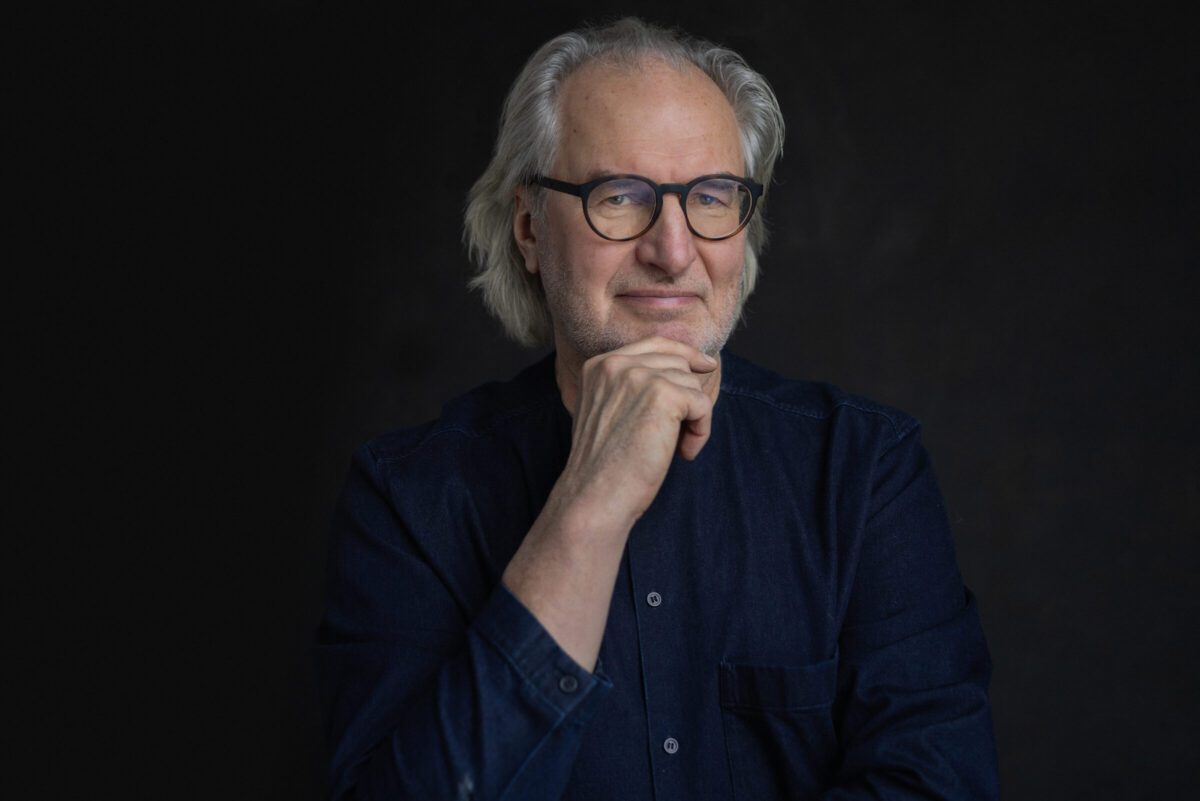
PAN M 360: You perform works by Arvo Pärt, as well as Luciano Berio, Eveline Shepard, Vejo Tormis, and Philip Glass. First, let’s talk about your relationship with Arvo Pärt, the most famous Estonian composer of our time. We know that he is always involved in concerts by orchestras that play his works. Is that correct?
Tõnu Kaljuste: It used to be, but not for the last two years. I visited him at his home recently, but he hasn’t been coming to concerts or production meetings.
PAN M 360: Does he still live in Estonia?
Tõnu Kaljuste: Yes, he lives in Estonia, near a center named after him in Laulasmaa.
PAN M 360: Can you summarize the history of your relationship with him?
Tõnu Kaljuste: It started in the late 1980s. He had heard Te Deum performed on Estonian public radio, and we met after he asked me to record the work on the ECM label. I had already recorded his music for ECM, and Te Deum was the second recording. That was it. In 1992-1993, we recorded Te Deum in Finland, in a church. After that, we went to Perth, Australia, for a festival featuring Arvo Pärt’s music. From then on, we began working together on a regular basis.
PAN M 360: A long-standing relationship based on trust and friendship!
Tõnu Kaljuste: Yes, but it is a professional friendship. We are not close friends; our connection is based on work. Our most intense relationship with his music coincided with the recording of his Fourth Symphony. You can find all the stylistic characteristics of his art in it, from the beginning to the end of the performance. I remember when we played this symphony in Stockholm, I realized that this work embodied not only the life of Arvo Pärt, but that of a generation of European composers from this great region who changed their style during the 1980s and 1990s, towards more consonant music, such as Penderecki, Gorecki, Kancheli, and others.
The Estonian Philharmonic Chamber Choir worked with the Estonian National Symphony Orchestra in Tallinn. In Canada, however, we are coming with the choir alone, even though several of Pärt’s works were conceived for both orchestras.
PAN M 360: How have you evolved as an interpreter of his work?
Tõnu Kaljuste: People don’t always change their interpretation deliberately, but life experiences can vary: the context of the performance and the performers themselves, for example, lead to changes in interpretation and bring new ideas, particularly regarding articulation. In the context of my Pärt Festival in September, we explore these new avenues of interpretation of his work.
PAN M 360: I invite you to comment on the complete program that will be performed in Montreal.
Tõnu Kaljuste: Yes. You could say that we will be performing Arvo Pärt’s best a cappella music. We will be performing various short cantatas and other large pieces. Of course, there are different styles of interpreting Arvo Pärt’s music.
The second half of the program is inspired by my own perception of the situation in the world, which is connected to pieces such as “Tormis” and “Pagan.” .” It was a historic moment in Europe when people came from Sweden to Finland to baptize the Finns, which generated conflicts between different ideologues on the subject of foreigners coming to change others in a country.
Tormis avait été enregistré précédemment par les King Singers mais lorsque j’ai entendu cette version j’ai demandé à Tormis d’en faire une version version chorale plutôt que pour trois chanteurs.
More closely connected to Berio’s folk inspirations, the second piece in the second part was also written for the King Singers. I made a version for choir and soloists. When I presented this version to Berio in Italy, he was very pleased with it. He initially believed that a choir could not perform this work, but my arrangements convinced him, given the result in terms of expressiveness, among other things.
There is also a connection between these works by Tormis and Berio in that they like to use the human voice not only in a classical way but also in a folk way, thus expressing different colors of the human voice through older musical forms, excluding vibrato or even including the evocation of crying or sounds produced by breathing.
As for Philip Glass’s excerpt Father Death Blues, taken from his chamber opera Hydrogen Jukebox, we recently performed it in Estonia. I think this performance was very successful because the work is closely connected to the current global atmosphere. I think the work was written during the Vietnam War… And since we are back to militarization and armed violence, this work is rooted in our current events. I think it’s good to conclude our program in this way.
PAN M 360: The coherence of this program is noteworthy. Arvo Pärt, arguably the most important living composer of sacred music in the world, is openly inspired by his mystical beliefs, whereas the other composers featured in the program are not, or to a lesser extent.
Tõnu Kaljuste: I see this program as a mirror of different ways of perceiving and experiencing reality. Philip Glass has his own vision of spirituality, and this diversity of thought must be expressed through his works, which are linked to different beliefs and philosophical visions. You know, in this opera by Glass, a character talks to different gods, telling them that none of them could stop the war, and that only humans could do so, if it were possible. Which is in itself a powerful message.
Glass’s words are not linked to any religion, whereas for Arvo Pärt, it is very different. This illustrates how human beings perceive the reality around them, through pain, anger, discourse, or prayer… I therefore see the first part of the program as a meditation based on different stories, while the second part is closer to social or political awareness in the current climate. Personally, I am connected to both visions of the program through my personal view of spirituality. Spirituality can be found in both worlds.Glass’s words are not linked to any religion, whereas for Arvo Pärt, it is very different. This illustrates how human beings perceive the reality around them, through pain, anger, discourse, or prayer… I therefore see the first part of the program as a meditation based on different stories, while the second part is closer to social or political awareness in the current climate. Personally, I am connected to both visions of the program through my personal view of spirituality. Spirituality can be found in both worlds.
Works
- Pärt, The Deer’s Cry
- Pärt, Nunc dimittis
- Pärt, Dopo la vittoria
- Pärt, Kontakion, Ikos, Prayer After the Canon
Intermission
- Luciano Berio, Cries of London
- Evelin Seppar, Iris
- Veljo Tormis, Piiskop ja pagan
- Glass, Father death Blues
- Artists
- Estonian Philharmonic Chamber Choir
- Artistic Director and Principal Conductor: Tõnu Kaljuste
Publicité panam
Released on January 31st, “18 ans et plus” (or 18 and over in English), is a cardinal point in Naïma Frank’s career and possibly in the greater definitions of r&b. As she herself says “Je réfléchis beaucoup à ce que je fait” (I think a lot about what I do), and where most artists would stop, she embraces risk. On “ainsi soit-t-il” she recounts the sheepish feeling of not knowing how such a combination of haitian rara percussions, UK garage beats and R&B vocal would be received. “Even if no one listens to it and people find it strange, I wanted to put a spotlight on my Haitian heritage.”
Now already one week since its release, Naïma Frank confirms the confidence you can hear in her voice throughout the album. Just as her lyrics are honest, she is surrendered, in full embrace of this vulnerability. “Advienne que pourra”.
In this short interview, Naïma Frank talks to our journalist Loic Minty about the long journey she took to reach this point of acceptance, and hints at some ideas she will be exploring for her show on the 19th of March.
Publicité panam
To coincide with the production of Orpheus in the Underworld, the opera workshop at the Faculty of Music of the University of Montreal invites us to delve into the satirical world of Jacques Offenbach. Robin Wheeler, co-director of the opera workshop, explores with us the reasons that led him to choose operetta, its pedagogical role, and the artistic decisions that resulted in the final product. Robin discusses the groundwork and challenges encountered during the season. This interview sheds light on the faculty’s mission with its students, highlighting the importance of the process and the crucial balance between voice and orchestra.
PAN M 360: Can you explain your role within the opera workshop?
Robin Wheeler: I am an associate professor at the Faculty of Music and co-director of the opera workshop, which I run with Richard Margeson, an internationally renowned tenor with a long career in opera. Each year, our role is to choose a work, assemble the artistic team—including the stage director—and provide musical guidance for the singers. My main focus is on musical preparation, this year in collaboration with accompanist Esther Gonthier, with whom I also share instrumental work.
PAN M 360: Why did you choose Orpheus in the Underworld this year?
Robin Wheeler: After a darker production last year with Hänsel and Gretel, we wanted to bring something lighter. In the current climate, it seemed important to offer the public a comedy. Offenbach was the obvious choice: there is no better composer when it comes to French operetta. Moreover, choosing a work with dialogue presents a valuable training challenge for the singers, who must learn to transition from speaking to singing, an essential aspect of their training.
PAN M 360: Did the choice of French also play a role?
Robin Wheeler: Absolutely. For most of our singers, French is their native language. Singing in their own language allows for immediate comprehension of the lyrics and more natural expression. It’s a real luxury for the performers, but also an asset for the audience.
PAN M 360: Do you think the work remains relevant today?
Robin Wheeler: Yes, without a doubt. Offenbach playfully subverts the myth of Orpheus and Eurydice: the characters don’t conform to traditional expectations, and the moral is embodied by the figure of Public Opinion. This satirical reinterpretation remains extremely relevant. The music, for its part, engages with tradition, notably through references to Gluck, while maintaining a great freshness.
PAN M 360: How was the artistic vision developed with the director?
Robin Wheeler: François Racine is a highly experienced opera director. He knows singers very well and treats them like true professionals. The staging remains relatively traditional in its aesthetic, but with subtle adjustments to the text to enhance its contemporary relevance and humor. His sense of comedy and his respect for the music make him an ideal collaborator for this project.
PAN M 360: What are the main musical challenges of this production?
Robin Wheeler: One of the major challenges is balancing the orchestra and the voices, especially since our hall doesn’t have a pit: the orchestra plays in front of the stage. Finding the right balance requires constant work. Furthermore, even though the music seems light, it demands great rhythmic precision. Offenbach gives the illusion of simplicity, but everything rests on extreme rigor.
PAN M 360: What learning opportunities does this production offer students?
Robin Wheeler: Beyond the performance itself, the entire process is what matters: the work since October, the very intensive technical week, the management of vocal stamina and energy. The students, from undergraduate to doctoral level, share the stage and form a true company. All the soloists also sing in the choirs, which strengthens the collective spirit and professional experience.
PAN M 360: What message do you wish to convey to the public?
Robin Wheeler: I would like the audience to remember above all the lightness of the work and the pleasure it provides. For two hours, opera allows us to forget the worries of everyday life. Seeing the youth, energy, and commitment of these young artists is something truly precious, both for the audience and for us, the teachers.
PAN M 360: More broadly, what do you think are the current challenges facing opera?
Robin Wheeler: Opera is a demanding and expensive art form, and funding issues are very real. Yet, I deeply believe in its importance, especially in difficult times. Art offers a space for escape, reflection, and beauty. If opera continues to exist, it is because there are still passionate artists and an audience ready to be moved.