Contemporary Jazz / Spoken Word

PAN M 360 at FIJM 2024 | Aja Monet, committed jazz, committed poetry, a breath of fresh air

by Alain Brunet

No other Montreal media has as many human resources on hand for expert coverage of the Festival International de Jazz de Montréal. Many of us are scouring the outdoor site and concert halls : Jacob Langlois-Pelletier, Frédéric Cardin, Stephan Boissonneault, Michel Labrecque, Varun Swarup, Vitta Morales and Alain Brunet offer their album reviews, concert reports and a few interviews. Happy reading and listening!

Live jazz supporting poetry was commonplace at the turn of the 60s. Beat generation poets were accompanied by jazzmen, as were African-American writers during the civil rights struggle and the more radical phases of Black American rebellion in many USA cities in the 60s and 70s. We also remember the Last Poets, whose syncopated declamations were (among other things) at the origin of rap as we know it today.

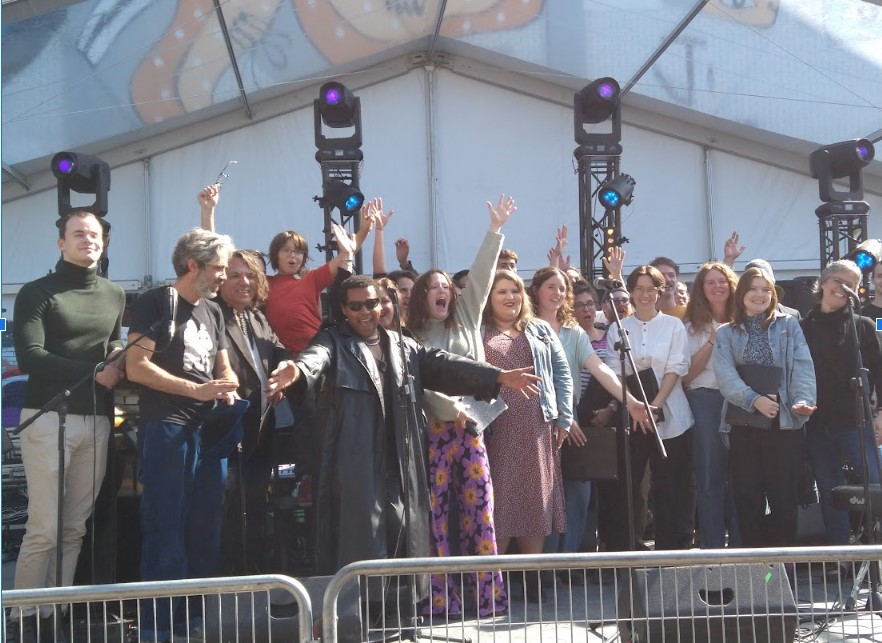
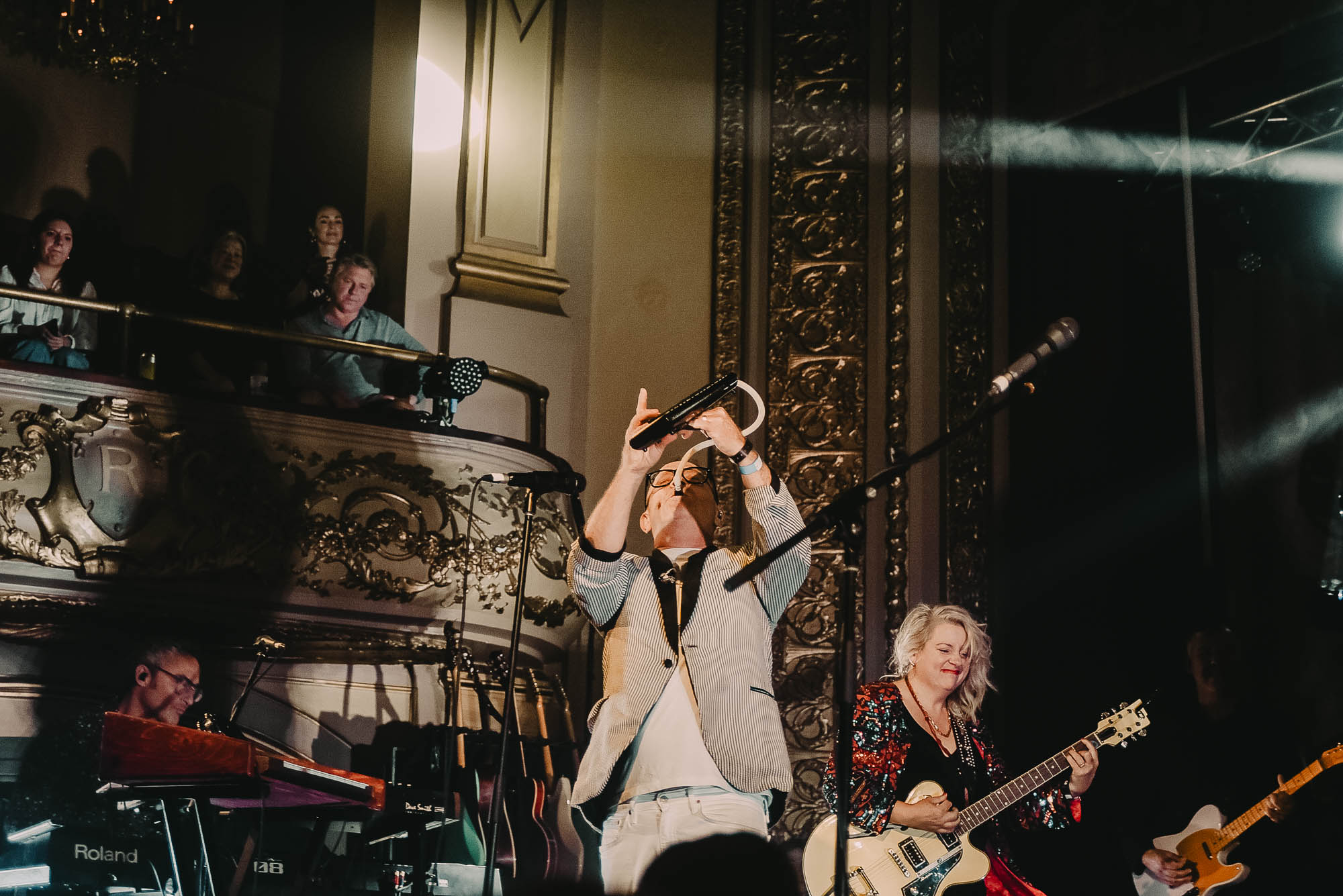
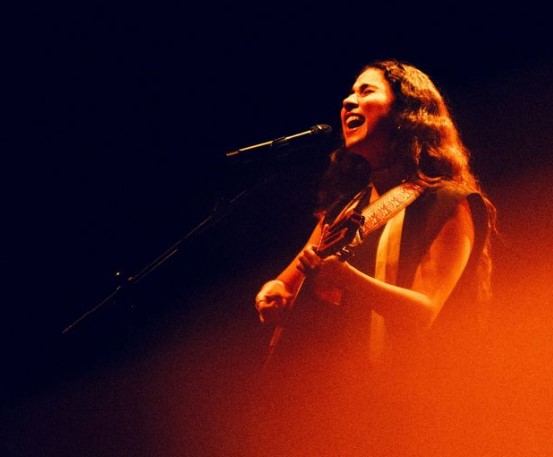
The marriage between poetry and jazz still exists, but its protagonists are a rarity today. And that’s exactly why Aja Monet, from Los Angeles, arrived at Studio TD on a Friday evening and blew in a breath of fresh air. Conscious poetry, creative and committed writing, both pamphleteering and sensitive, both private and political. In black American style, a contemporary jazz quartet accompanies this prolific thirty-something, who has published numerous novels and poetry collections and recorded the fine 2023 album When The Poems Do What They Do, the main subject of this concert / spoken words at FIJM on June 28.

From the point of view of literary form, the words are direct, the meaning is direct, and a few formal elements transform these pamphlets and reflections into art. But above all, it’s the timbre of the voice and the magnetism of this highly intelligent and beautiful woman. Her activism and social conscience run the gamut, from European colonialism to the detriment of America’s indigenous populations, to today’s African-American condition, via the ongoing tragedy in the Gaza Strip, pushing her to denounce everything from the homelessness crisis in Montreal. These are just some of the injustices she seeks to expose beneath the stones of our humanity at the dawn of one of the darkest periods in its recent history.

There’s no pretence here of evaluating Aja Monet’s literary work, just savouring this event where jazz and poetry are once again in symbiosis. A class act!

Afrobeat / thaï

PAN M 360 at FIJM 2024 | Salin implant her Afro-Isan-soul on festival-goers

by Alain Brunet


No other media in Montreal has as many human resources on hand to provide expert coverage of the Montreal International Jazz Festival. Jacob Langlois-Pelletier, Frédéric Cardin, Stephan Boissonneault, Michel Labrecque, Varun Swarup, Vitta Morales and Alain Brunet bring you their album reviews, concert reports and a few interviews. Happy reading and listening!

As Salin Cheewapansri was forced to observe on Friday evening on the Rio Tinto stage, she had learned her lessons well from the master Tony Allen, inventor of the afro-beat drumming style when he was a member of Afrika 70, the famous band of the famous leader Fela Anikulapo Kuti. Having died during the pandemic, the immense Nigerian drummer had the opportunity to demonstrate his science, an approach that has since been taken up by two generations of drummers, far beyond Nigeria where afrobeat was born.

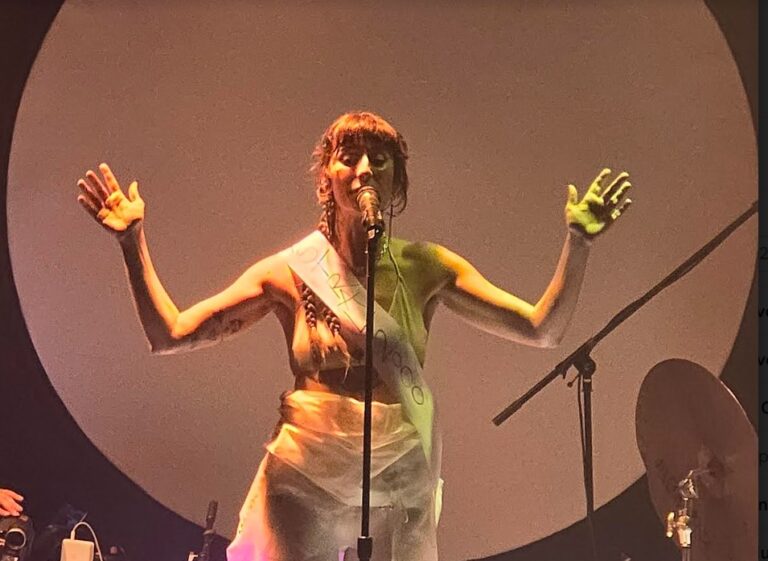
Fresh, smiling and sexy, Salin takes center stage and delivers the drum salvos. Of Thai origin, this excellent Montreal musician sports the beehive hairstyle once worn by Phil Spector’s Ronettes, like so many young American women in the mid-60s. Salin is at the center of a vast band: sax, trumpet, electric guitar, percussion, bass, keyboards, all Montreal pros happy to take part in this groovy hybridization.

She describes her personal style as Afro-Isan soul, a composite blend of traditional Siamese and Khmer music, seasoned with an Afrobeat groove, soul/R&B and jazz-funk-fusion. Salin is far from the first to weld these genres and sub-genres together, but she is certainly the first female drummer in the known universe to play at such a high level – perfectly mastered rhythmic patterns, straightforward tones, etc. – and she is also the first female drummer in the known universe to play that afrobeat groove at such a high level.

At the end of the program, Haitian musicians added new spices to this already spicy papaya salad.


Contemporary Jazz / Modern Jazz

PAN M 360 AT FIJM 2024 | Joey is simply doing his own thing

by Varun Swarup

With his trio of Kris Fine on bass and Jonathan Barber on drums, Joey Alexander graced those in attendance at the Théâtre Duceppe last Friday night with a warm and intimate set of original material. By all accounts the evening was a success, but considering the bar Alexander has set for himself, he may have disappointed some. Namely those expecting to be dazzled by a now twenty-something year old prodigy taking jazz to a new level, because Joey is simply doing his own thing.

In fact one wouldn’t even assume from hearing him that at the age of seven he was already as accomplished as a pianist could be. There is real modesty, restraint, and maturity in Joey’s playing, and he seems to have found his niche in writing a sort of accessible, soulful, hymnal repertoire. Without being too reductive here, the best way to describe Alexander’s playing might be to say it’s like hearing Bill Evans playing the soundtracks of Studio Ghibli. The depth of technique and emotion is there, if subtle, you can hear it in the lushness of his voicings and his ornamentations, but gone are the dissonances replaced by more open intervals and harmonies à la Studio Ghibli or Keith Jarrett on ECM.

The most fascinating part of the evening was getting to hear Joey Alexander play his mellotron, which is featured heavily on his latest album Continuance (read our colleague Vitta’s review here). It certainly marks a compelling new direction for Joey, but like Bill Evans himself, who flirted briefly with Fender Rhodes, it seems it will always be an auxiliary to the piano, never a worthy replacement. That said, any chance to see this subtle master at work is a good chance.

Photo credit: Joey Alexander Facebook page with Jazz Forum

Americana / Blues / Funk / Soul/R&B

PAN M 360 AT FIJM 2024 | Stephen Barry, 50 years of blues at the Gesù

by Alain Brunet

No other media in Montreal has as many human resources on hand to provide expert coverage of the Montreal International Jazz Festival. Jacob Langlois-Pelletier, Frédéric Cardin, Stephan Boissonneault, Michel Labrecque, Varun Swarup, Vitta Morales and Alain Brunet bring you their album reviews, concert reports and some interviews. Happy reading and listening!

At the helm of his blues band for 50 years, Stephen Barry has never had the voice of a great blues soloist, but… his relaxed vocals always come through, not unlike the tone of a JJ Cale. Stephen Barry has never been a great bass player, but he still manages to keep the tempo and produce his motifs without stumbling. At the helm of his blues band for 50 years, Stephen Barry has never had the voice of a great blues soloist, but… his laid back vocals always come through, not unlike the tone of a JJ Cale. Stephen Barry has never been a great bass player, but he still manages to keep the tempo and produce his motifs without stumbling. Able to make us forget his own limitations, Stephen Barry has always been an exciting artist.

And that’s still the case after half a century of blues, as evidenced by his commemorative album under the Only A Dream banner. Don’t look for a contradiction here, rather a contrast: thought and creative imagination regularly prevail in such forms, experience and subtlety can prevail over technique, and this is certainly the case with this leader and, let’s face it, blues thinker who knows how to dress for special occasions (skullcap, jacket and copper sneakers!) and who knows how to surround himself to serve his inspiration: Andrew Cowan, guitar, vocals and bright red jumpsuit, Jody Golick, tenor and soprano saxophones and cruisewear, Martin Boodman, diatonic harmonica and vocals, Gordie Adamson, drums and vocals. All experienced pros, loyal to Stephen Barry for ages, and what can we say about the choral contributions of Sylvie Choquette and Suzanne Lamontagne, invited to flesh out this appearance at FIJM 2024.

A nerdy artist fascinated by blues and other North American musical strains, Stephen Barry has always approached the blue note with respect, circumspection and, what’s more, a self-deprecating sense of humor. His music repels orthodoxy and purism, and his blues is peppered with brilliant stylistic appropriations, such as the cover of .

“Freedom Jazz Dance”, a superb Eddie Harris standard with a hell of a theme for the sax, this time served up in a boogaloo rhythm! Or Stephen Cassonade Faulkner’s country “Si j’avais un char”, the only song performed in French by our beloved Montrealer. Or Marvin Gaye’s funky soul “Inner City Blues (Make Me Wanna Holler)”.

The Stephen Barry Band had a very pleasant encounter with the audience that filled the Gesù to capacity on Thursday June 27, 2024, half a century since the start of this cruise.

crédit photo : Victor Diaz Lamich pour le FIJM

Jazz

PAN M 360 AT FIJM 2024 | June 28 at the Jazz Festival with Ambrose Akinmusire

by Michel Labrecque

Friday was my baptism of the 44th Montreal Jazz Festival. Getting back into it is always a blessing, especially when the weather is nice. In a brief moment, I was able to watch excerpts from performances by Sunny War, a young woman who reinvents the blues, outdoors, then by jazz poet Aja Monet, indoors. These two concerts were free, it was more than a treat.

In the meantime, I could see children bathing in the fountains of the Quartier des Spectacles and people of all origins waddling, chatting, smiling. The large outdoor stage was packed to listen to the jazz rock of Cory Wong. Not my cup of tea, but the crowd seemed to enjoy it. The eclecticism of the festival is very unifying. 

My favorite destination for this evening was Gésu, to hear trumpeter Ambrose Akinmusire perform solo. The 42-year-old prodigy trumpeter is alone on stage, almost completely in the shadows. Only his trumpet speaks, sometimes accompanied by the sound of voices. But what a trumpet my friends! A full sound, which inhabits the entire space. Where virtuosity alternates with long notes… and speaking silences. 

We are in the vein of his album Beauty is enough (2023), also performed solo. Ambrose Akinmusire explores every orifice of his instrument. He manages to make the trumpet sound in a thousand ways: sometimes it is a long blast of wind; sometimes the sound of his voice seems to harmonize with the brass. This trumpet belches, argues, rocks, cries, meows, calms, roars, sings. She explores all possible and impossible half-tones and quarter-tones. All these sliding notes that take us on a journey through our heads. With just a little reverb. I’m not always a big fan of the trumpet. But Ambrose’s is floating, poetic, learned, emotional, naked. The gentleman is also a great composer, as his other group albums have demonstrated. At the end of the concert, he finally spoke to us, explaining that this recital is, in part, an imaginary dialogue with other deceased trumpeters, notably Roy Hargrove and Wallace Rooney. For my part, as I listened, I imagined an infinite meditation, a therapy session, an atrocious war, people ranting in demonstrations and moments of absolute tenderness. My seatmates probably heard something completely different. We sometimes heard strange clicking noises during the performance. Was it a problem with the sound system or the effects the trumpeter wanted? The debate between spectators after the concert remained open. 

Today, Ambrose will perform again at Gésu in the company of veteran British double bassist David Holland. Many of us will be back.

Chamber Folk / Contemporary Jazz / Jazz

PAN M 360 AT FIJM 2024 | Killer show conducted by Julian Lage

by Vitta Morales


No other media outlet in Montreal has so many people on hand to provide expert coverage of the Festival International de Jazz de Montréal. Many of us are scouring the outdoor site and concert halls: Jacob Langlois-Pelletier, Frédéric Cardin, Stephan Boissonneault, Michel Labrecque, Varun Swarup, Vitta Morales and Alain Brunet bring you their album reviews, concert reports and some interviews. Happy reading and listening!

Julian Lage, Dave King, and Jorge Roeder put on a killer show last  Thursday night at Théâtre Duceppe. Notably, the trio displayed what interplay between instruments looks and sounds like when done at a very high level. The first fifteen minutes, in fact, King played almost entirely linearly as he shaped his drumming to Lage’s melodies and cadenza-like passages. At another point, Roeder and Lage dedicated a section of a song to playing impressive ionian inventions up and down their instruments in counterpoint. It’s sometimes hard to tell when moments like these are improvised or well rehearsed but either way it clearly shows the chemistry between musicians and can make for some memorable moments indeed. 

When the trio played decidedly more conventional, (with requisite walking bass and typical time feel on the drums), they didn’t shine any less. Their solos over chord changes with strict forms only forced them to focus their creativity melodically instead. When they grew tired of this, the entire band even played a section or two of dense free-jazz that they then juxtaposed with moments of shimmery ballads and chugging blues selections including “Northern Shuffle” from Lage’s latest album. 

By the time it was all done, Lage with the help of his musicians and twangy telecaster, had given the audience another night of eclectic and exciting music as is his custom.

photo credit by @victordiazlamich for FIJM

Cumbia / Rock

PAN M 360 AT FIJM 2024 | Lom live, a successful visit to MTL

by Vitta Morales


No other media outlet in Montreal has so many people on hand to provide expert coverage of the Festival International de Jazz de Montréal. Many of us are scouring the outdoor site and concert
halls: Jacob Langlois-Pelletier, Frédéric Cardin, Stephan Boissonneault, Michel Labrecque, Varun Swarup, Vitta Morales and Alain Brunet bring you their album reviews, concert reports and some
interviews. Happy reading and listening!

If you were within earshot of the Rio Tinto stage last  Thursday night between 8 and 11, you would have heard the very danceable stylings of LA LOM. Having reviewed their recorded music earlier in the week, I was curious to see how the live experience compared. The evening proved to be a lively one with audience members dancing, swaying, and even tenderly kissing during the more ballady selections. All for close to three hours total. I would probably classify this as a successful first visit to Montreal for the Los Angeles trio. 

Conducive to this success was certainly how well the drums were mixed and how well Nicholas Baker approximates an entire percussion section by himself. Baker makes clever use of a conga, cow bell, and a maraca in addition to the more conventional pieces of a drum set to create beats that are interesting, stylistic, and full sounding. Furthermore, his solos were very dynamic. 

On the subject of dynamic, this would describe the rest of the band as well with the mix being very hard hitting. (Once Jake Faulkner’s upright bass decided to work properly, that is). Sounding “big” is paramount when playing as a trio and perhaps even more important when so much of the set relies on dance music. Needless to say, I’m glad they nailed this aspect. 

In addition, the order of the songs were generally effective. For those who can’t or don’t dance, several cumbia songs of similar tempo and tonality could prove tedious, and so I’m glad some ballads and rock selections were interspersed strategically. It is LA LOM’s prerogative how much of each element they want to add, but they might do well to rely more on the rock aspect of their music. Zack Sokolow is a very capable guitarist and when he got moments to really shred, I got glimpses of a young Carlos Santana. (A feat even the current Santana wishes he could achieve more, I suspect). If not, it could be worthwhile to have Zack sing as they played a new ballad of theirs with the melody on guitar in the absence of the singer who provided her voice on the recording. 

I think strategies like this would only serve to shield them from the criticism that their music gets repetitive. I won’t deny this criticism but then again, I don’t go to nightclubs and complain that there aren’t enough songs in 5/4. LA LOM are a band for dancing and occasionally rocking out to, so listeners should expect the music to be in service of that. 

With all this said, after last night’s concert, I can confirm that LA LOM put on a mean show and I suspect we’ll be hearing more about them in the near future with their debut album coming out August 9th. Until then, catching them on the road and watching their stylized live videos will have to hold us over.

Instrumental Hip Hop / jazz groove / Punk / space rock

PAN M 360 at FIJM 2024 | Hiatus Kaiyote, or the musical complexity that rarely seduces crowds

by Alain Brunet

No other Montreal media has as many human resources on hand for expert coverage of the Festival International de Jazz de Montréal. A number of us are scouring the outdoor site and concert halls : Jacob Langlois-Pelletier, Frédéric Cardin, Stephan Boissonneault, Michel Labrecque, Varun Swarup, Vitta Morales and Alain Brunet offer their album reviews, concert reports and interviews. Happy reading and listening!

The Place des Festivals was bursting at the seams on St. Catherine Street for a band that had made little or no impact in Montreal until the opening night of FIJM 2024. For the connoisseurs in the small minority on site, Hiatus Kaiyote is a flagship band in terms of soul/R&B, hip-hop, jazz, space rock and punk attitude. For the majority on site? Not likely, but… it’s to the Australian band’s credit that they’ve made it to the front door of Montreal’s biggest festival, taking over the TD Stage for the biggest free concert of their opening night .

Exemplary, the crowd listened respectfully to this most impressive performance, which was unfortunately punctuated by two inopportune stops when some festival-goers fainted at the foot of the stage, while the singer called for the intervention of the security service… At least 10 of the 90 minutes scheduled for the performance were lost, and the rhythm of the show was affected, with two songs on the program being cut.

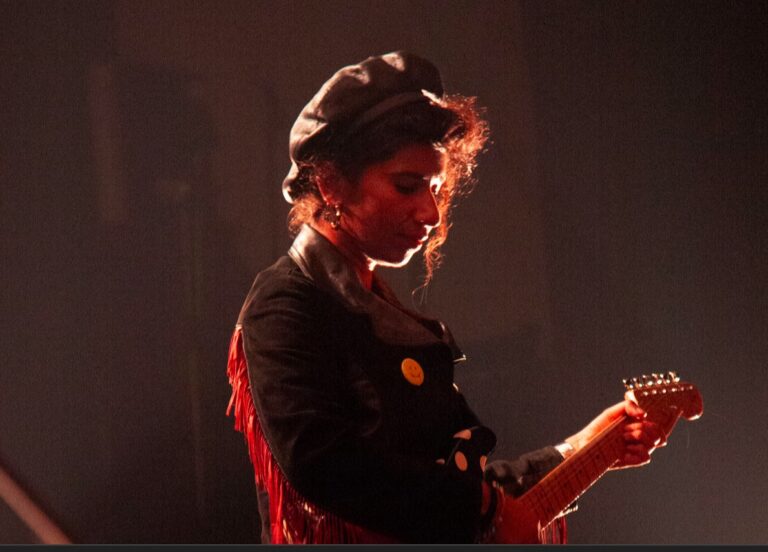
It wasn’t a perfect evening, but it was an opportunity to discover one of the most powerful bands on the groove planet, in the same way as Outkast. Childish Gambino (with band), Janelle Monae, Kendrick Lamar (with band) and Anderson Paak have all made their mark on Montreal fans in recent years. Singer/guitarist Nai Palm is a supernatural creature: her vocals, timbre and power are simply incomparable, and the soloist pilots a finely tuned machine that alternates between silky melody and intrumental complexity, aided and abetted by two backing singers whose male representative is also a fine saxophonist (soprano).

Hiatus Kaiyote was performing on the eve of the release of a new studio album, Love Heart Cheat Code, of which 4 tracks were performed on June 27: the opus’ title track, the very airy Dream Boat as intro, the equally spacey neo soul ‘Telescope’ on 9 and the very jazzy-soul-funk ‘Make Friends’ as early conclusion.

From the album ‘Mood Valiant’ (2021), we were treated to the lion’s share of the concert: the mid-tempo song ‘And ‘We Go Gentle’, the rhythmically charged ‘All The Words We Dont Say’, the up tempo ‘Chivalry Is Not Dead’, shot through with mind-blowing instrumental bridges as is the case with several pieces in the repertoire such as ‘Get Sun’, then the very jazzy ‘Rose Water’ and the jazzy ballad ‘Sip Into Something Soft’ or the slow, sure, dirty groove of ‘Red Room ‘(interrupted by an initial mishandled incident).  

From the album Tawk Tomahawk, the band covered the downtempo ballad ‘Nakamarra,. From the excellent opus ‘Choose Your Weapon’ (2015), Hiatus Kaiyote chose to chain ‘Molasses’, ‘By Fire’ and ‘Building A Ladder’, preceded by a pretty piano solo by Simon Marvin before hastily concluding.

All in all, a very fine performance from a strictly musical point of view, but one whose staging should have been refined in the context of a mass event.

crédit photo: @rousseaufoto pour le FIJM

Free Jazz

Suoni: regarding Luke Stewart + Tcheser Holmes + Aquiles Navarro + Keir Neuringer + Nicolas Caloia + skin tone + Geneviève Gauthier + Jason “Blackbird” Selman + Charlotte Layec + Dave Rempis + Tashi Dorji + Eric Hove

by Alain Brunet

An international festival can now have several dimensions, as cultural networks have multiplied exponentially in recent decades. The Suoni Per Il Popolo are part and parcel of this reality, and we could observe it this week at the Sala Rossa and Casa del Popolo, notably with this meeting between musicians from Philadelphia and Montreal, brought together on the same stage.

Monday evening began with some bad news: Moor Mother, the best-known artist in the Philly areopagus, had taken a flight that ended badly, as her plane had to turn back because of a passenger in crisis. Moor Mother was supposed to reschedule on Tuesday, but ended up canceling her engagement. It was therefore an opportunity to discover her African-American colleagues, united under the banner of the Irreversible Entanglements collective.

Luke Stewart (double bass), Tcheser Holmes (drums), Aquiles Navarro (trumpet, electronics),  Keir Neuringuer (alto + soprano saxophones, electronics), joined by Montrealers Geneviève Gauthier (alto sax),  Nicola Caloia (double bass), skin tone (mbira, electronics, sax), Jason ” Blackbird ” Selman (poetry and trumpet) and Kim Zombik (vocals).

The evening was built on a series of typically free jazz interventions of variable geometry. Solo sax by Aquiles Navarro, followed by double bass-voice-poetry (Caloia, Zombik, Selman), interspersed with mbira (a metal-striped instrument that some call the African piano), after which the MTL and Philly artists gradually mingled until the Irreversible Entanglements quartet brought the evening to a close, as they did the following day, Tuesday.

For those who see free-jazz as a redundant form implying limited technique on the part of its performers, it’s worth noting that high virtuosity is also part of the equation, as many excellent, more conservative jazz musicians also engage in free improvisation. The excellent saxophonist Geneviève Gauthier, for example, shines in many different contexts, including free and (especially) atonal improvisation

The Philadelphia quartet, for their part, don’t stick to conventional forms of free jazz, grafting on polyrhythmic grooves, typical of contemporary jazz or downright jazz-fusion, which differs considerably from the ” deconstructed swing ” approach of previous generations. The influx of electronic music via keyboards, computers and other cutting-edge technologies lends new colors to free improvisation. Certainly, the new generation of improvising musicians approaches free-jazz by enriching its discourse with components typical of the lutherie of 2024.

Another observation made the following Tuesday at the Sala Rossa, following the screening of a groove concert led by saxophonist Eric Hove and filmed in Parc Jean-Drapeau’s Biosphère, was that melody and tonality/modality are not excluded from the so-called free discourse, We observed and savored this during the duo formed by inspired singer Kim Zombic and double bassist Nicola Caloia, the best of the genre in Montreal since the (increasingly distant) days of the Michel Donato/Karen Young tandem. 

This hybrid approach was again in evidence on Thursday evening at Casa Del Popolo, as Montrealer Charlotte Layec’s bass clarinet juxtaposed her real-time playing with a series of filtered and recomposed recordings of mostly folk music. The same was true of the duo featuring Chicago saxophonist (alto and soprano) Dave Rempis and guitarist Tashi Dorji, originally from Bhutan and now based in Asheville, North Carolina. While the saxophonist’s playing, although very good, didn’t teach us much about free vocabulary as we imagine it, Dorji’s playing proved to be very singular for its explorations of saturation, its percussive approach and other textural research via a vast assortment of effects pedals.

It is to be hoped that this hybrid approach will find less confidential audiences and galvanize jazz lovers on a wider scale.

expérimental / contemporain

Suoni, June 17 | Reverberations, voices and multiple reflections

by Michel Labrecque

As the Montreal heatwave began, the Suoni Per Il Popolo festival offered us an intriguing concert at the Sala Rossa…with air conditioning.As the Montreal heatwave began, the Suoni Per Il Popolo festival offered us an intriguing concert at the Sala Rossa…with air conditioning.

This triple bill was surprisingly complementary: a young Kanien’keháka / Mohawk in search of a contemporary identity, a multidisciplinary artist on an ancestral quest, and a musician-poet trying to manage her multiple voices.

Kahero:ton opened this experimental ball, accompanied by guitarist Grim Beverage. We are immersed in an ocean of reverberation, with guitar, bass and synthesizer. We also hear numerous excerpts from interviews evoking past crises experienced by the Kanien’keháka / Mohawk communities of Quebec and Ontario. 

We sense that Kahero: ton is seeking a more experimental and contemporary voice to express its identities. It’s not all there yet, but it’s safe to assume that, before long, the artist, keyboardist and bassist will come up with a more refined creation. Stay tuned.

In the second half, Montreal musician, singer and multidisciplinary artist Sarah Rossy took to the stage alone, with a suitcase. It was the starting point for a journey in search of her ancestors. Sarah is of Lebanese origin on her mother’s side, and with this performance she metaphorically explores the arrival of certain communities here.

To accompany it, there’s a magnificent soundtrack, designed by Sarah, with voices, keyboards and multiple soundscapes embodying the journey. She also sings live, dances, mimes and speaks. Visual elements, also created by the lady, are added.

This show stands in stark contrast to Sarah Rossy’s recent releases, notably Seemingly Insatiable Waves and The Conclusion, which were closer to jazz and ethereal folk. Here, Sarah’s Arab influences are more in evidence. She has never concealed the great influence of the Lebanese legendary singer Fairuz.

It all adds up to a truly compelling show. Sarah Rossy’s voice is rich and versatile. The combination of sound and vision is complex and touching. Once again, the artist shows us the extent of her talent and artistic versatility;

Sarah was my favorite part of the concert.

To close the evening on a high note, Montreal-based Swede Erika Angell took to the stage to perform a large part of her debut solo album, The Obsession With Her Voice, released in March. 

Surrounded by an array of machines, sequencers, synths and effects pedals, Erica brought us into an infinite dialogue between her voice and her instruments. The machines multiply the sound of her voices, transformed by the machines. The sound of a bell reverberates endlessly. The symbiosis between woman and machine works;

Then along comes another woman, the fabulous drummer Millie Hong, well known on the Montreal alternative and jazz scene. A new three-way symbiosis is born. Millie Hong, who was a discreet presence on An Obsession With Her Voice, goes wild on stage, improvising around Erika’s voice and machine-generated harmonizations. At times, we verge on the delirious, then calm returns. 

In the background, if you’ll pardon the pun, are the visual works of artist Maxime Corbeil-Perron.

In short, it was a torrid and fascinating evening of music, demonstrating once again the great plurality of Montreal’s musical tenant.

Publicité panam
Arabic Classical / expérimental / contemporain

June 13 at Suoni Per Il Popolo: No Hay Banda with Sarah Davachi and Nadah El-Shazly + Sarah Pagé

by Laurent Bellemare

The Suoni Per Il Popolo festival may present three or four concerts each evening, but on a Thursday evening in June, a packed Sala Rossa was ready to welcome two hours of contemporary music. In the case of both proposals, they were premieres, and it was the excitement of discovering the new projects of these renowned artists that brought everyone together. Such enthusiasm for innovative music is to be welcomed, and confirms the relevance of the No Hay Banda series of events.

Sarah Davachi: No Hay Banda performs Three Unisons for Four Voices.

The shimmering sound of the vibraphone notes played with the bow had barely joined the spun sounds of the strings when the ensemble suddenly had to stop playing. The interruption was caused by the violinist feeling unwell, and she unfortunately had to withdraw from the concert to regain her strength. We had then heard no more than five minutes of minimalist music, moving very slowly and gently.

Following this false start, a few minutes passed without the crowd really knowing what was going on. Pianist Daniel Áñez was soon able to announce that the concert would resume with a substitute violinist, Clemens Merkel of the Quatuor Bozzini. A mere spectator, the musician offered to play Sarah Davachi’s work at a moment’s notice, much to everyone’s relief. The ensemble then got down to work and restarted their performance of the 70-minute piece. 

A little deciphering of the work’s title helps us understand how it works. On the one hand, the ensemble of six performers was divided into four instrumental groups: strings, winds, percussion and ondes Martenot (and electronics!). The voices interacted with each other by playing the same musical material (hence the idea of unison), but with individual freedom of execution. A sequence of notes had to be played in a given time, but the writing was not rigid as to how the performer would get there. In this way, the piece was structured by a chronometer, with precise timings determining its progression.

Perceptually, the work seemed to emerge from silence, then rise in density and intensity for half an hour or so, then calmly descend into nothingness. To appreciate such music, one had to be attentive to the micro-details – the subtle harmonic changes generated by the improvisational element. The effect was comparable to that of a massive drone whose harmonics had been skilfully orchestrated, in the manner of spectral music à la Gérard Grisey or Tristan Murail.

Unfortunately, the beloved Sala Rossa may not have been the best place to immerse oneself in this type of listening. Between floor creaks, chair squeaks and bar action, it wasn’t easy for the instrumentalists to monopolize the sound space. As a result, the audience’s selective listening was seriously challenged, which didn’t help to plunge fully into the musical proposition. A possible compromise would have been to amplify the instruments so that they enveloped the space more fully. All in all, Three Unisons for Four Voices was an invitation to plunge actively into the sound material, which the ensemble communicated with brio. We only regret the acoustic constraints that somewhat mitigated the immersive effect the work could have had. 

Nadah El-Shazli + Sarah Pagé

While not the artists’ first collaboration, the unusual duet between Egyptian singer Nadah El-Shazli and harpist Sarah Pagé is still a fresh offering. Pagé had indeed recorded harp on El Shazly’s 2017 album Ahwar, but the two artists’ collaborative concerts are more recent than that.

The performance contrasted sharply with the first part of the concert, to say the least. The songs were full of energy and moved along at breakneck speed. El-Shazli’s Arabic lyrics and traditionally-inspired vocals, modulated with live processing and complemented by sampling, combined in a tasty, novel rendering. The singer’s mastery of vocal ornamentation brought out the modal colors of her melodies. 

But what was most impressive was the variety of vocal techniques she employed. El-Shazly moved easily from a strong, full-bodied vocal projection to a more vulnerable voice with very little breath. What can we say about the few screams she let out towards the middle of the show? The singer also used the microphone creatively, to create dramatic effects. The further away the microphone was, the less processed El-Shazby’s voice became, allowing her to make skilful modulations of timbre and volume. She also ended one piece singing a capella, abandoning amplification for a goosebump-inducing moment.

Sarah Pagé was not to be outdone, well equipped with her amplified harp and an arsenal of effects pedals. In the course of her performance, the harpist traversed a wide range of playing modes, extended techniques and types of sound processing. Her performance was totally dynamic, moving fluidly from fast articulations to delay playing, bowed spun sounds and plucked chord ostinatos. Exemplary, Pagé once again confirmed the great versatility of his artistic practice.

All in all, the interplay between El-Shazly’s vocals and Pagé’s strings was a successful rendezvous. The performance seems to have been composed mainly of original music, although at least the last piece of the concert ‘Mahmiya’ was taken from El-Shazly’s solo album. In any case, we look forward to hearing a duo album from these two artists.

Photo by Pierre Langlois

Indie Pop

HABITAT SONORE :  the music that rocks Montreal… and the Phi Center !

by Salima Bouaraour

The music that rocks Montreal. Fifteen artists from the local scene. Fifteen songs with a very wide range. Synth pop, electro, R&B, indie rock, hip-hop. The list is available for listening from May 8 to August 11 at the Phi Center. A recommendation from PA N M 360 for your summer pleasure!

Artists – Gayance – Narcy – En Stéréo – KALLITECHNIS – The Bionic Harpist – Patrick Watson – Klô Pelgag – Daniel Bélanger – Bibi Club – Jean-Michel Blais – Waahli – Cosmic Cosmic – Malika Tirolien – Dominique Fils-Aimé – Karkwa – revisit the sound design of one of their works to allow audiences to fully immerse themselves in a three-dimensional universe offered by Dolby Atmos on a set of 16 multichannel loudspeakers. 

The listening experience lasts 51 minutes, while you sit or lie on comfortable cushions in the dark. Your hearing is thus called upon to its full potential, allowing you to fully appreciate the performance in depth;

The sensory euphoria offered by this listening experience has a high meditative potential, where each of the song’s sonorities occupies its own space, lulling you along as you take multiple detours through the infinite sweetness of Patrick Watson’s voice – Better in the Shade – , through the vocal warmth of Gayance – Lord Have Mercy – or through the magical harp of The Bionic Harpist. 

Canadian contemporary R&B star KALLITECHNIS will clearly stand out, with his upbeat track  WOUND UP, which won the 2022 Juno Award. Her album will be available to listen to from June 19 to 23 in the listening room: Mood Ring. 

PAN M 360 strongly invites you to experience this session specially dedicated to talented Montreal artists!

PLAYLIST: 

Jean-Michel Blais –  passepied  

The Bionic Harpist  In Stillness  

Dominique Fils-Aimé Cheers to New Beginnings  

Patrick Watson Better in the Shade 

Klô Pelgag Mélamine  

Daniel Bélanger J’entends tout ce qui joue 

Bibi Club  Le feu  

Karkwa Gravité 

Waahli Te revoir  

Malika Tirolien A Love That Will Last  

KALLITECHNIS WOUND UP  

Gayance Lord Have Mercy 

En Stéréo Clair Obscur  

Narcy Journey  

Cosmic Cosmic –  Jupiter 

POUR INFOS ET BILLETS

Subscribe to our newsletter

Inscription
Infolettre

"*" indicates required fields

Type of Suscribers